
Welcome to Aftermarket Report, a newsletter where we do a quick daily wrap-up of what happened in the markets, both in India and globally.
Markets Today
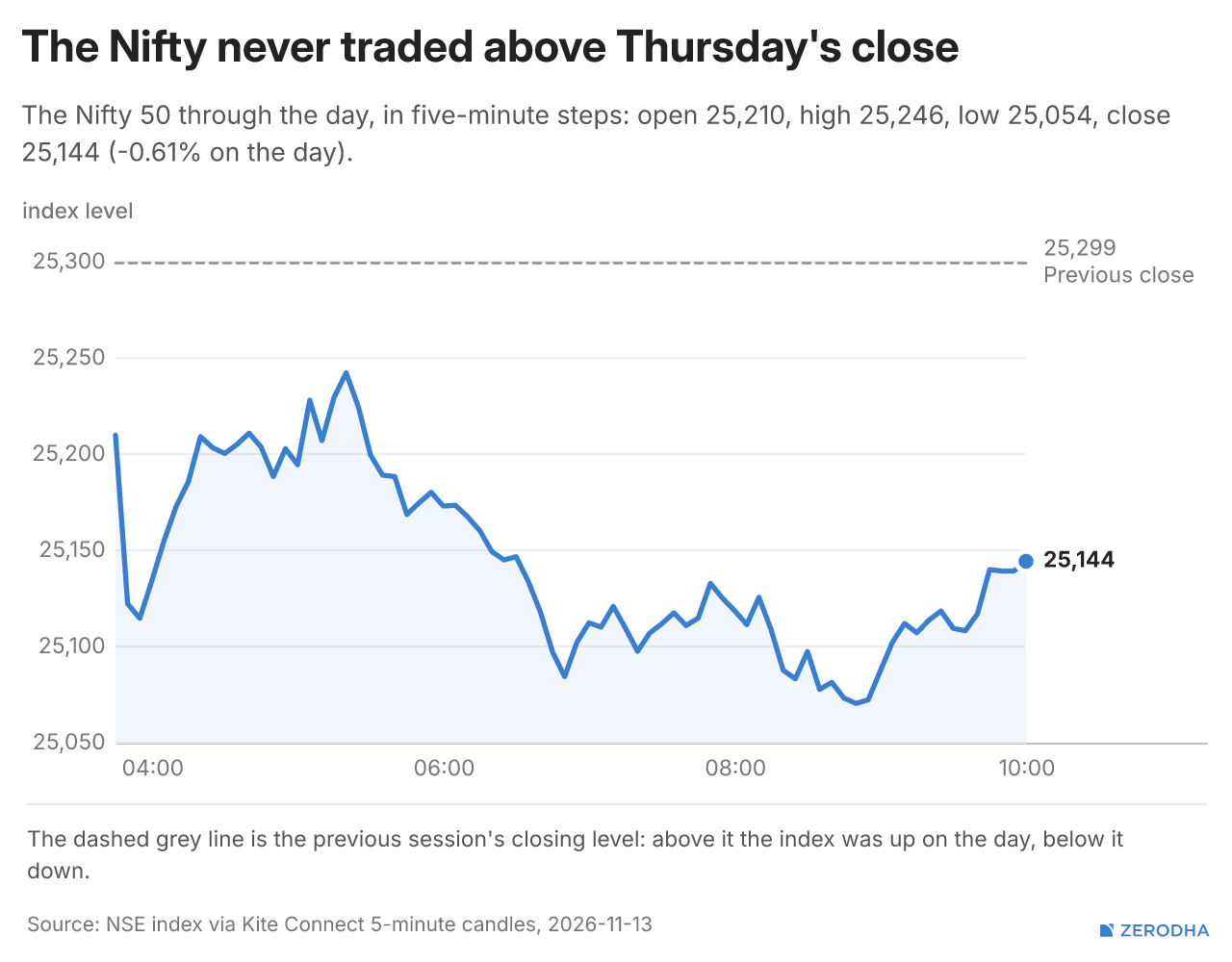
Nifty opened with an 89-point gap down at 25,210, tracking shaky global cues, a gradual rise in oil prices overnight, and the US Dollar Index hovering near 52-week highs. The index initially slipped towards 25,080 within the opening minutes before staging a sharp recovery towards 25,220 by 10 AM.
Buying momentum continued through the first hour, pushing Nifty to an intraday high near 25,245 around 10:45 AM. However, the recovery failed to sustain as selling pressure emerged at higher levels, dragging the index steadily below 25,200 by 11 AM. Weakness intensified through the rest of the morning, with Nifty slipping below 25,150 around noon.
The second half began on a weak note, with Nifty extending its decline towards 25,085 around 12:15 PM before attempting a modest recovery towards 25,135 by 1:15 PM. However, the bounce proved short-lived as renewed selling pressure dragged the index below 25,100, eventually touching an intraday low near 25,060 around 2:15 PM. Buying interest returned from the lows in the final hour, helping Nifty recover towards 25,120 before a late surge pushed it above 25,140. The index eventually closed at 25,144.30, around 66 points below its opening level, as the late recovery helped pare some of the day’s losses.
Fear & Greed Index
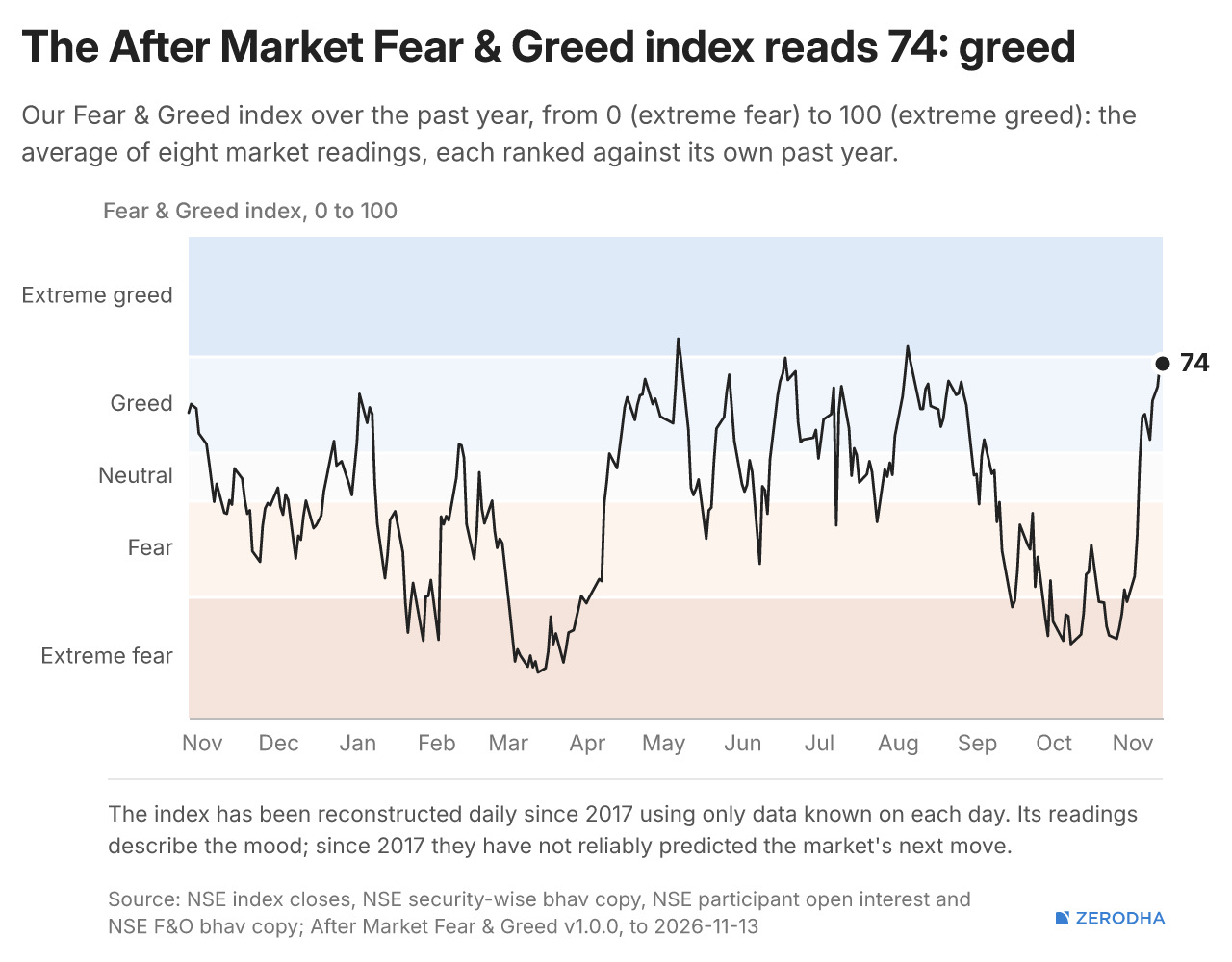
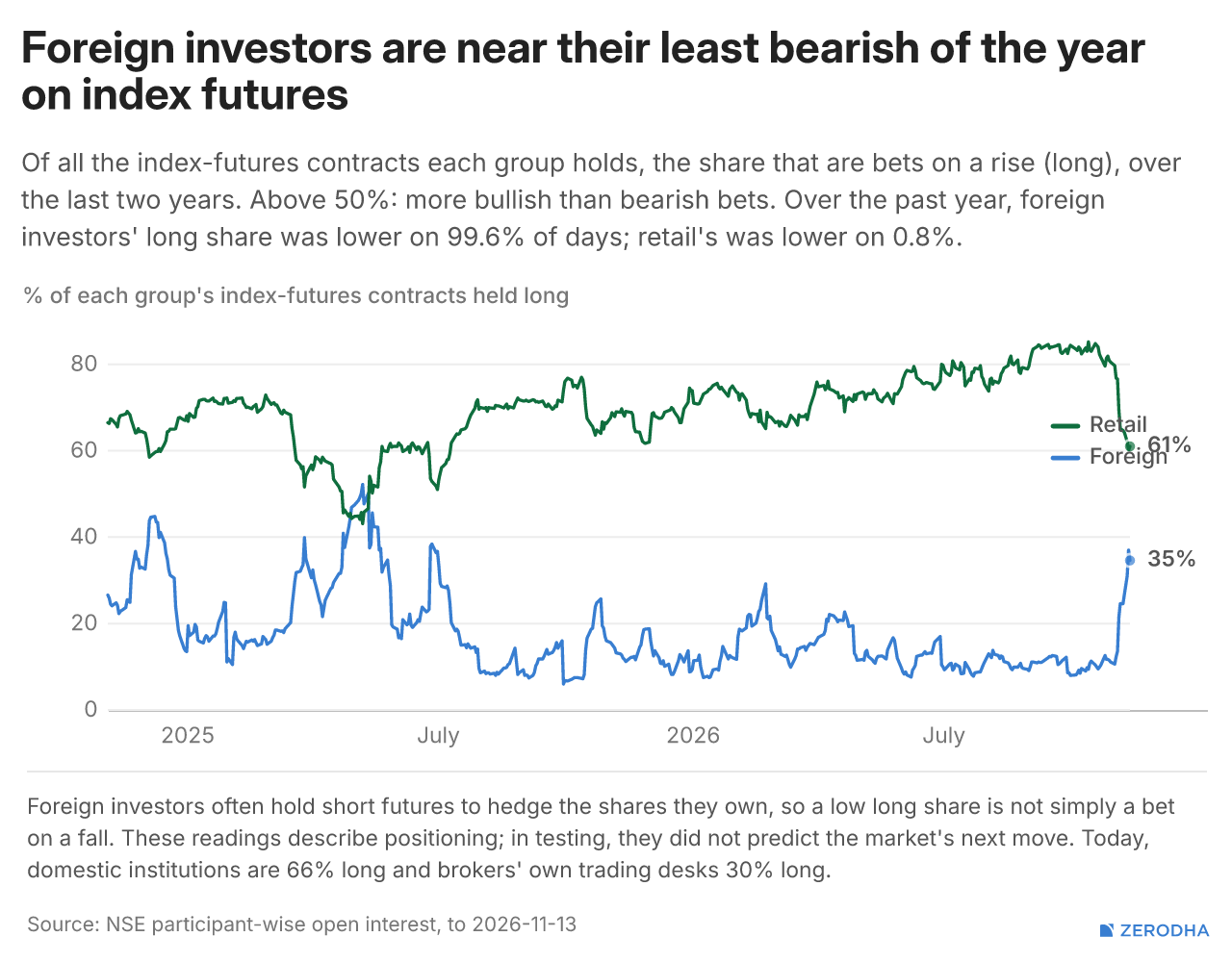
The Fear & Greed Index remained unchanged at 74, firmly in the greed zone, despite Friday’s market decline. Foreign investors’ relatively bullish futures positioning and cheaper downside puts supported sentiment, although weakening market breadth and defensive outperformance suggested some caution.
Market Breadth
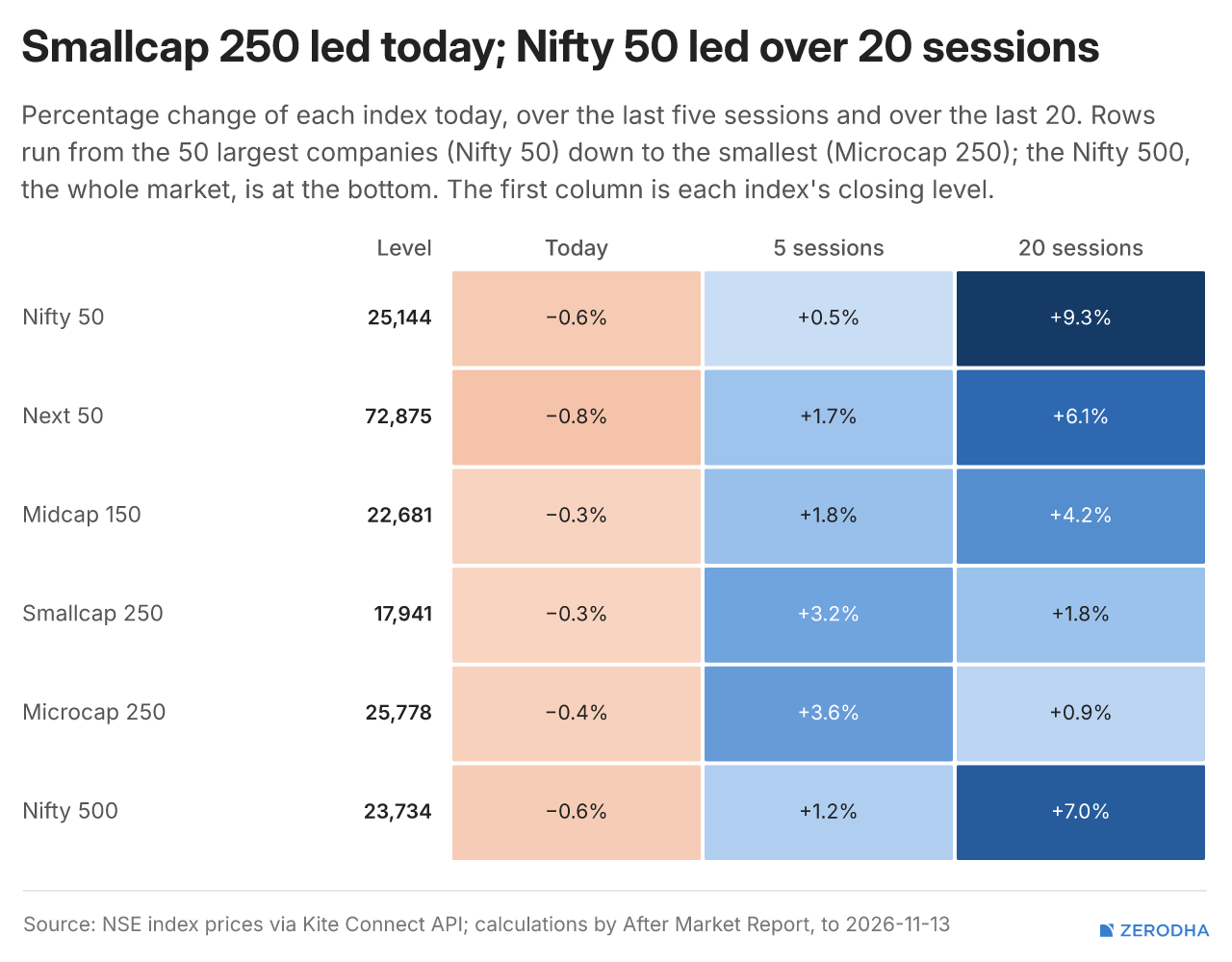
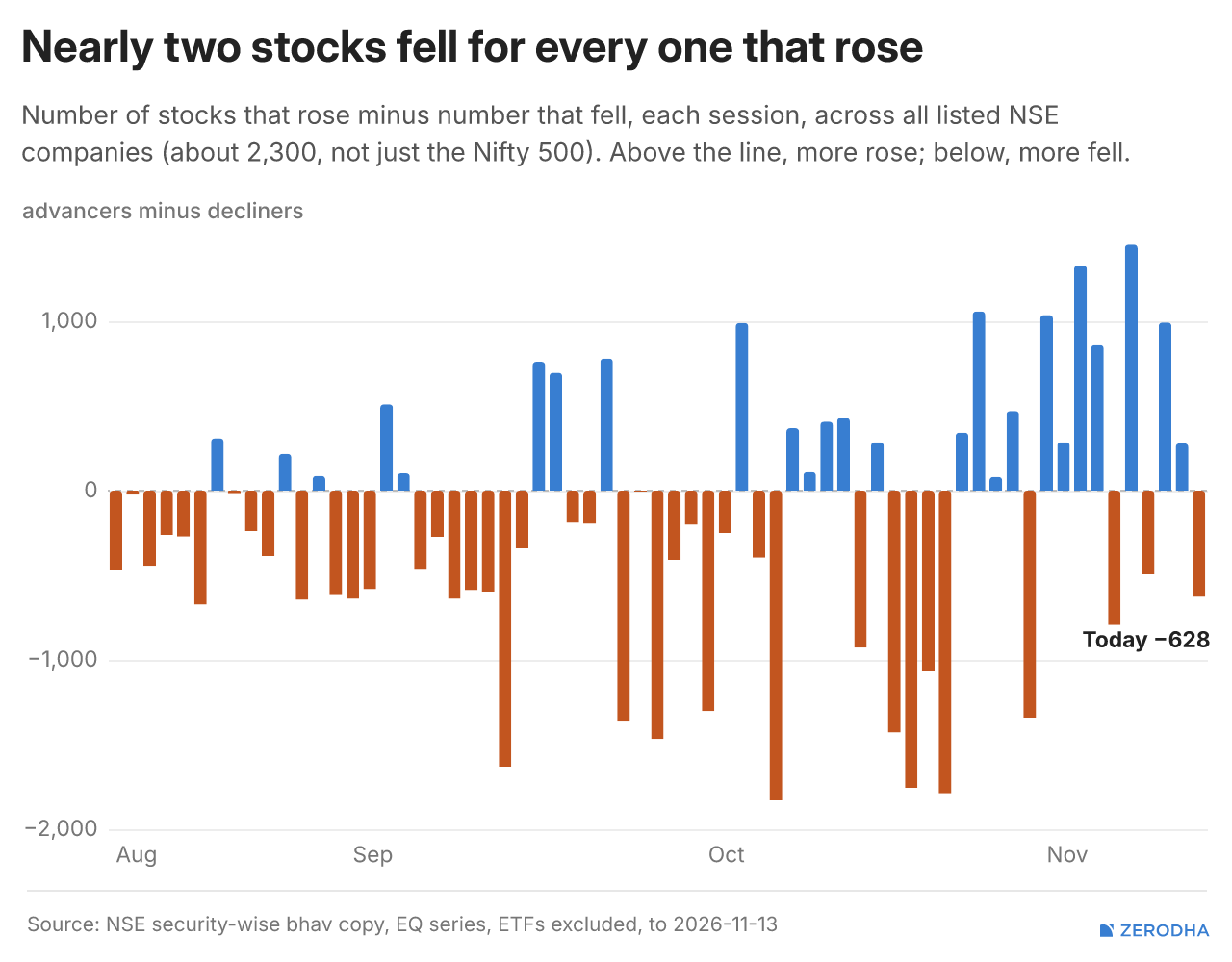
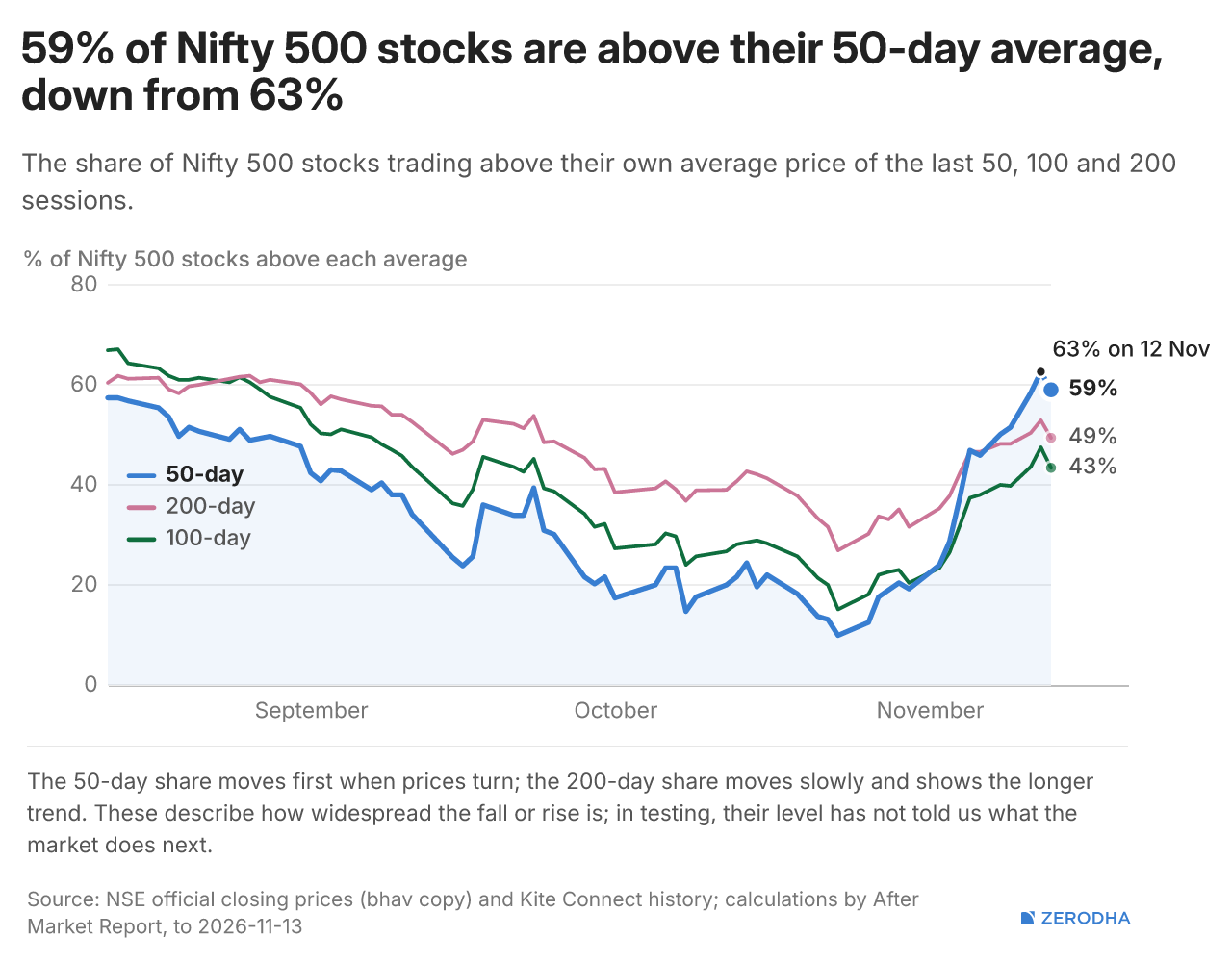
Selling was broad-based, with 1,498 declining stocks against 870 advancing, while the average Nifty 500 stock fell 0.49%. The share of Nifty 500 stocks above their 50-day moving average slipped 3.6 percentage points to 59%, although short-term participation remains stronger than the longer-term trend.
52 Week Highs & Lows
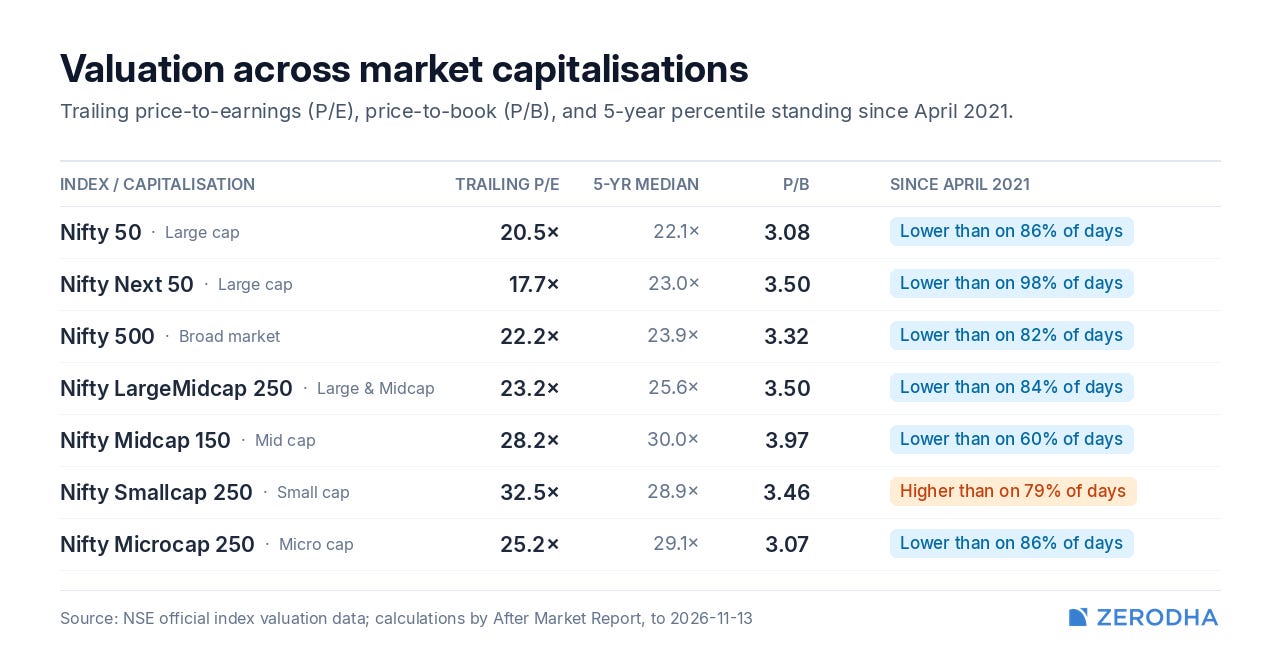
Valuation Check
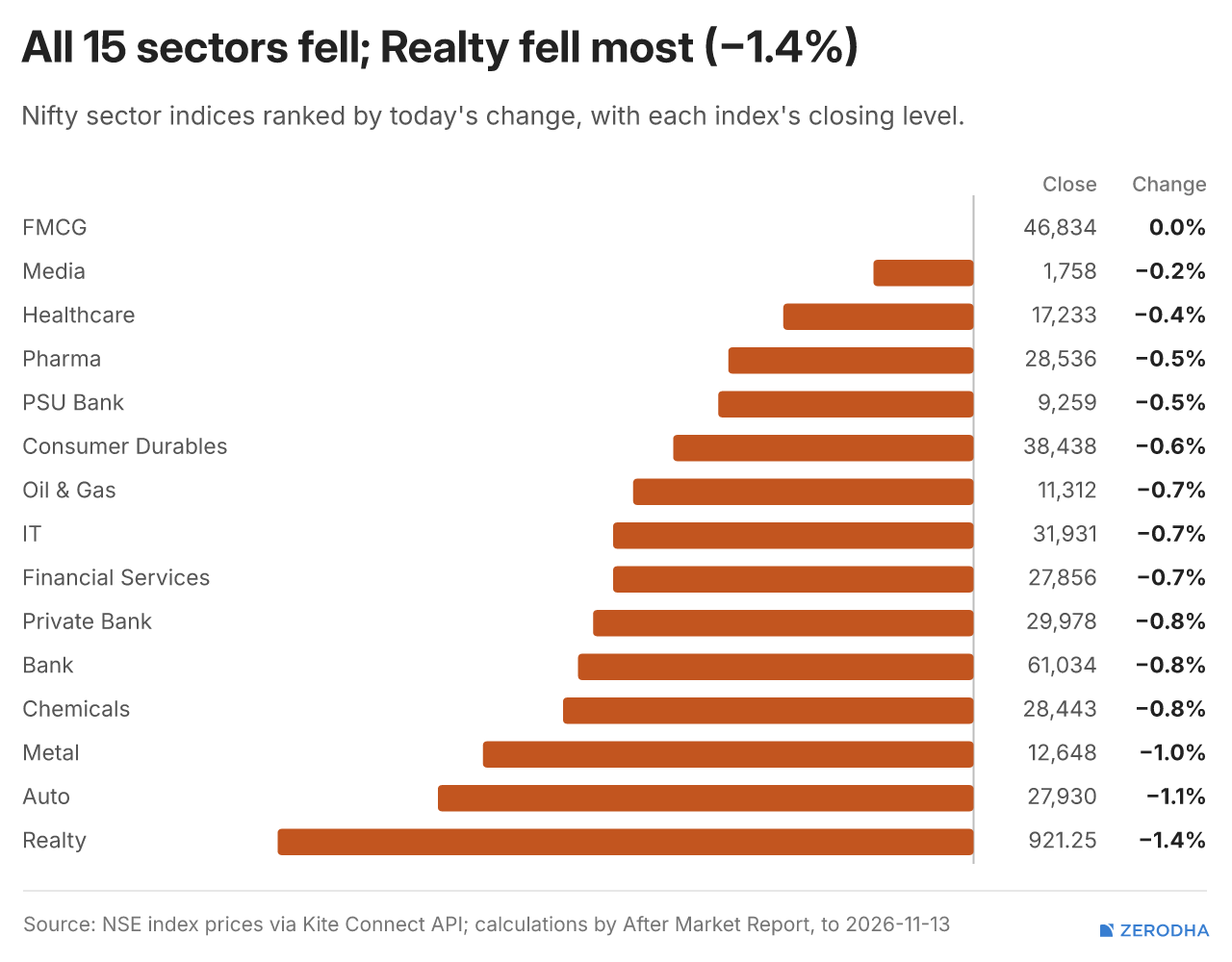
Sectoral Indices Performance
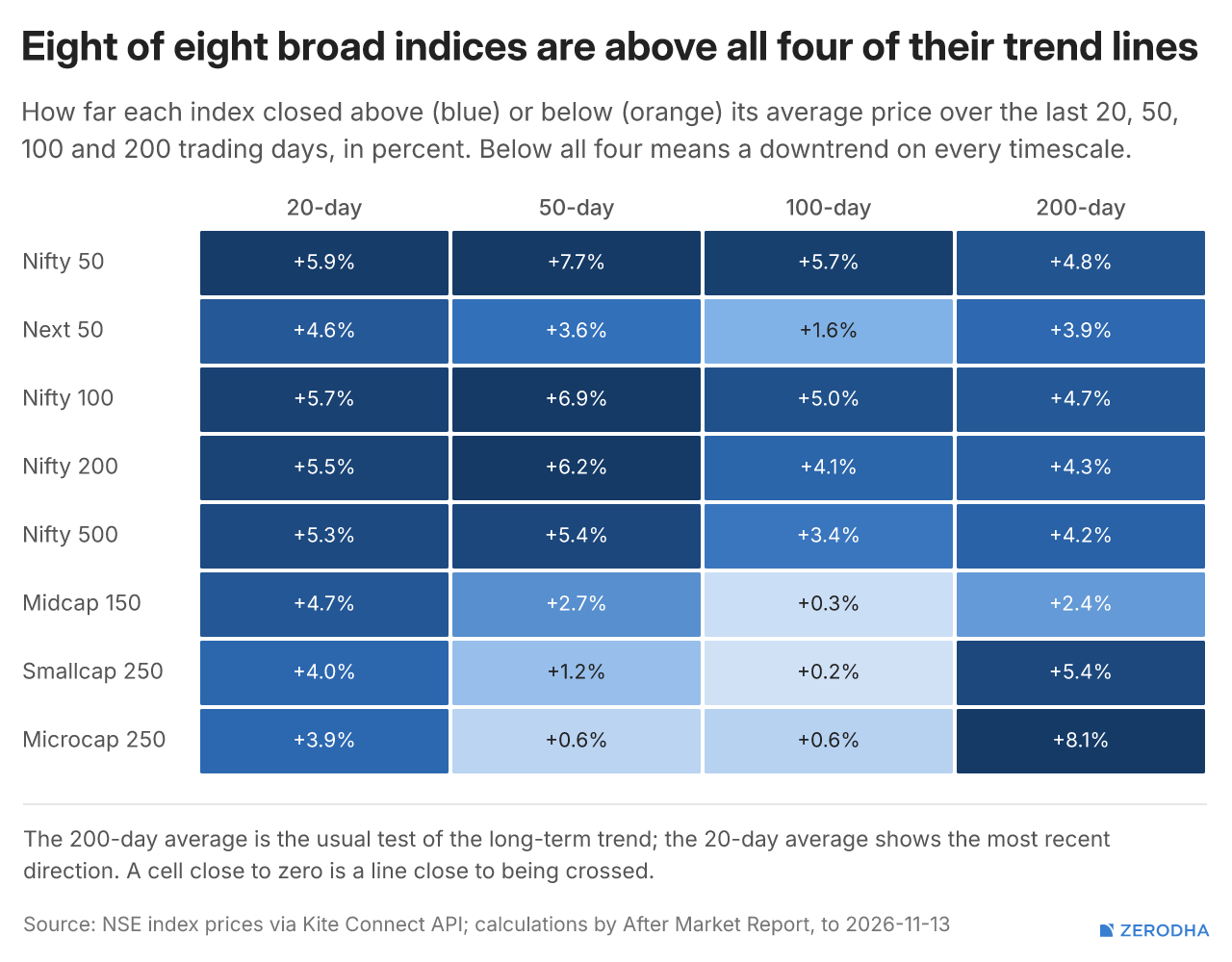
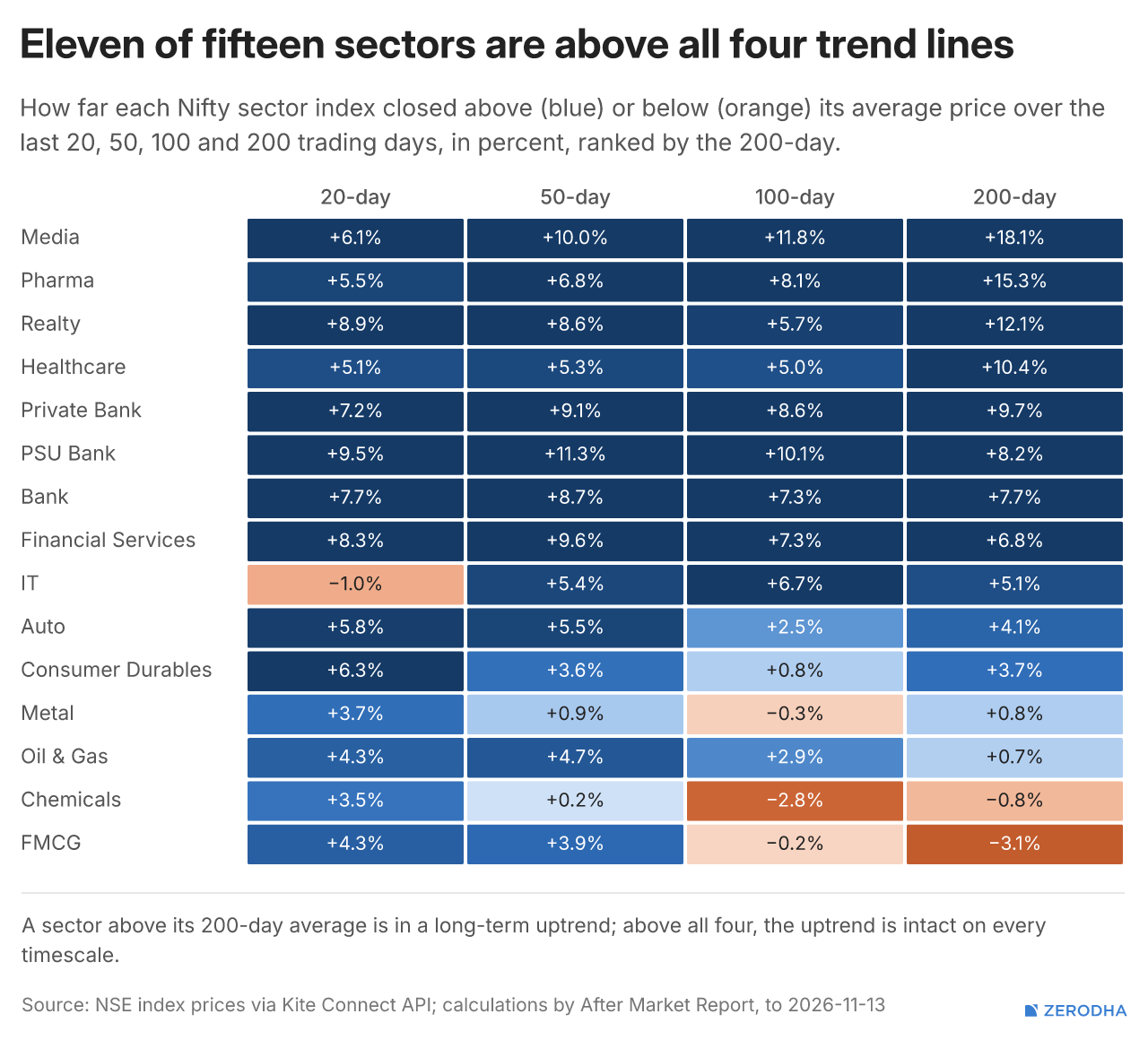
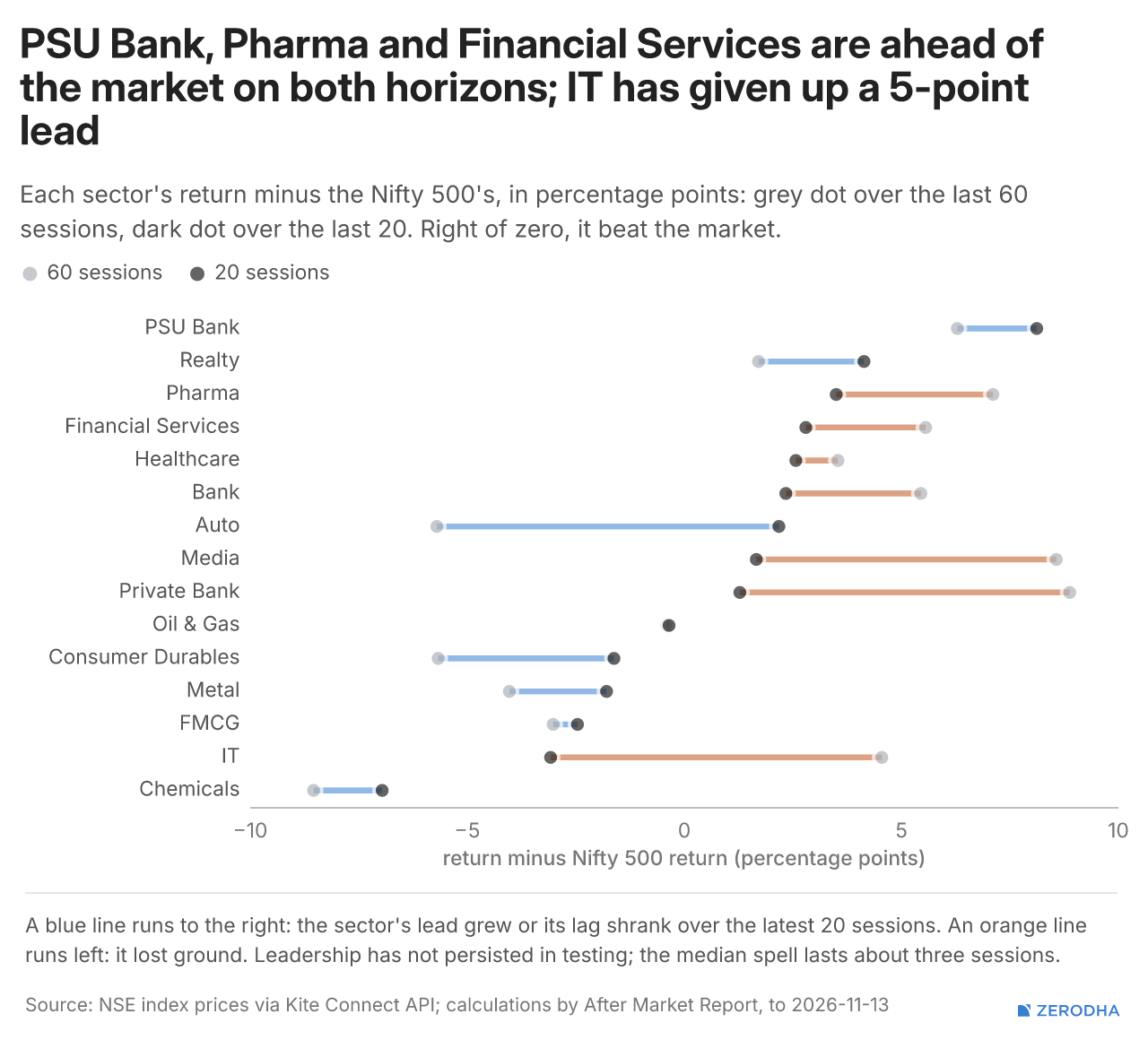
All 15 sectoral indices ended in the red, with FMCG showing the most resilience, declining just 0.01%, while Realty was the biggest laggard at -1.39%. PSU Banks, Pharma and Financial Services continue to lead over 20 and 60 sessions, with 13 of 15 sectors still trading above their 200-day moving averages.
Winners & Losers
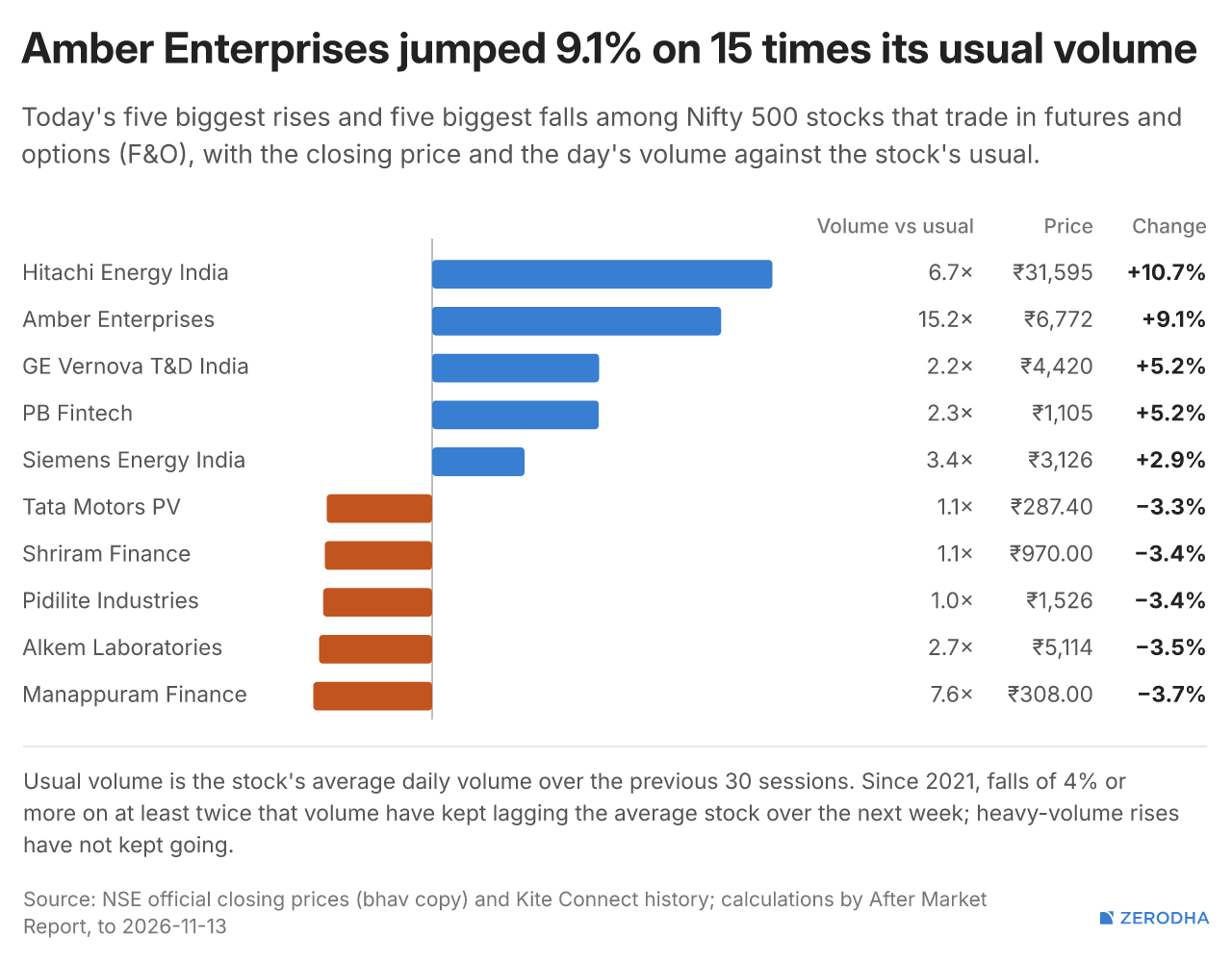
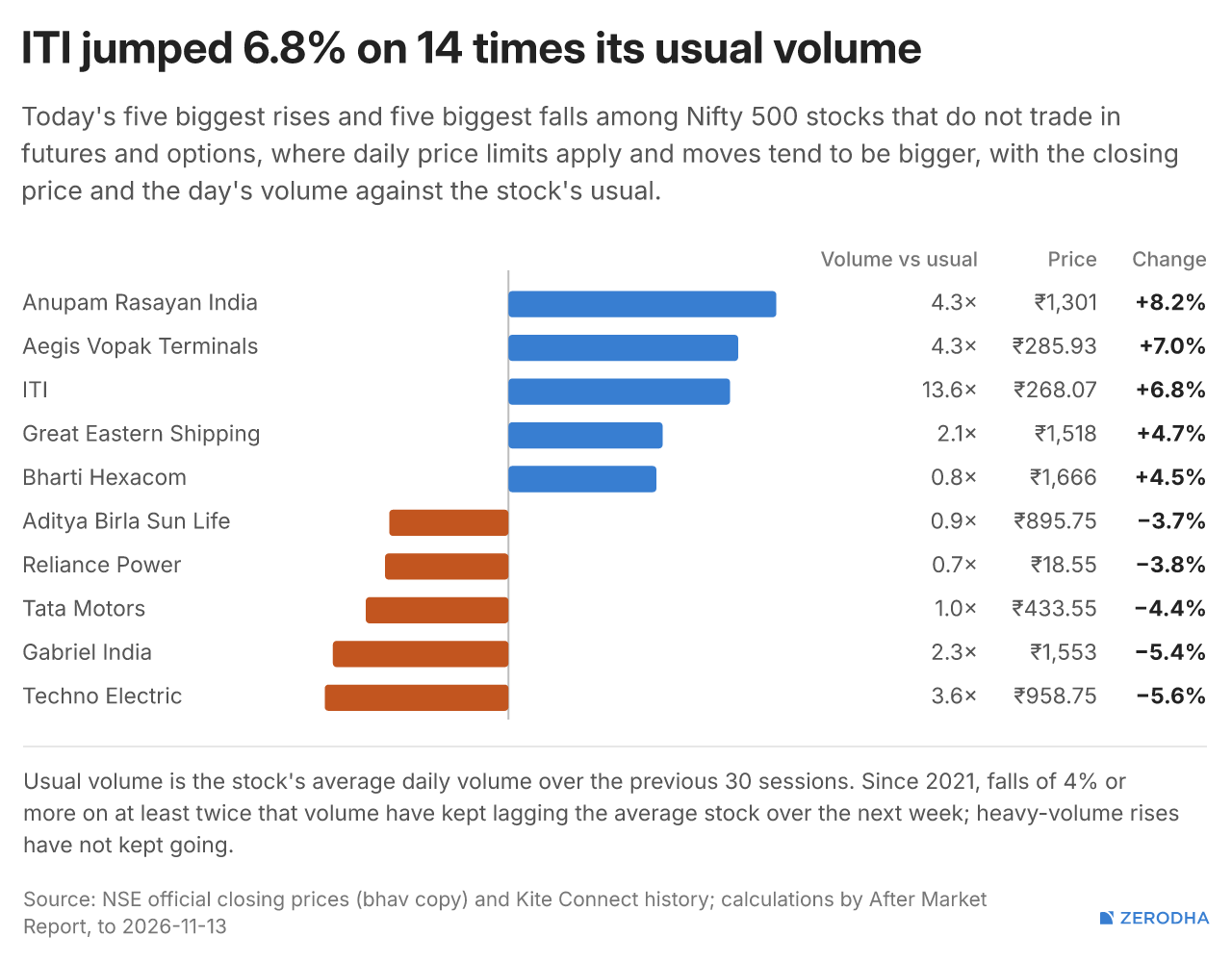
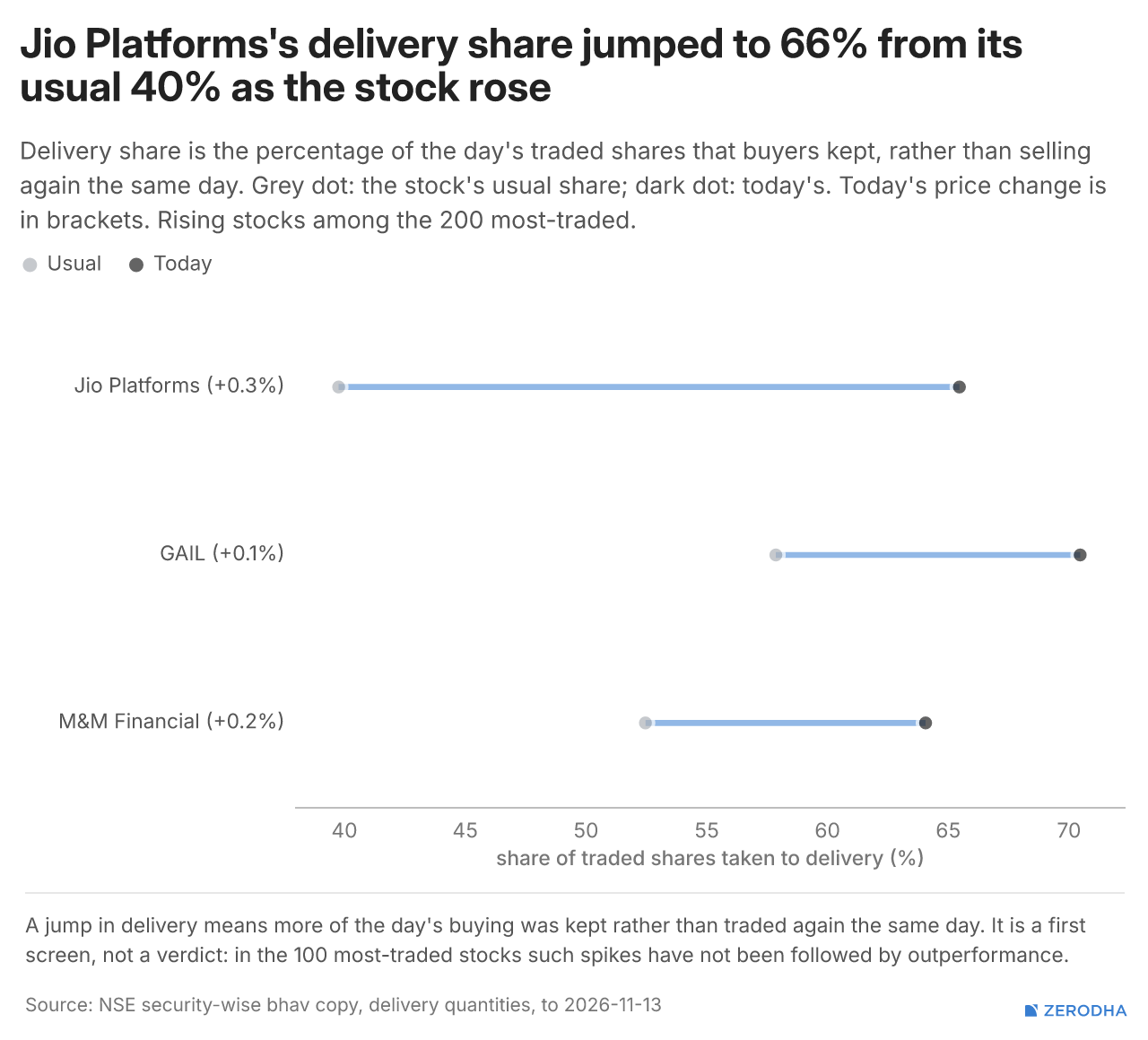
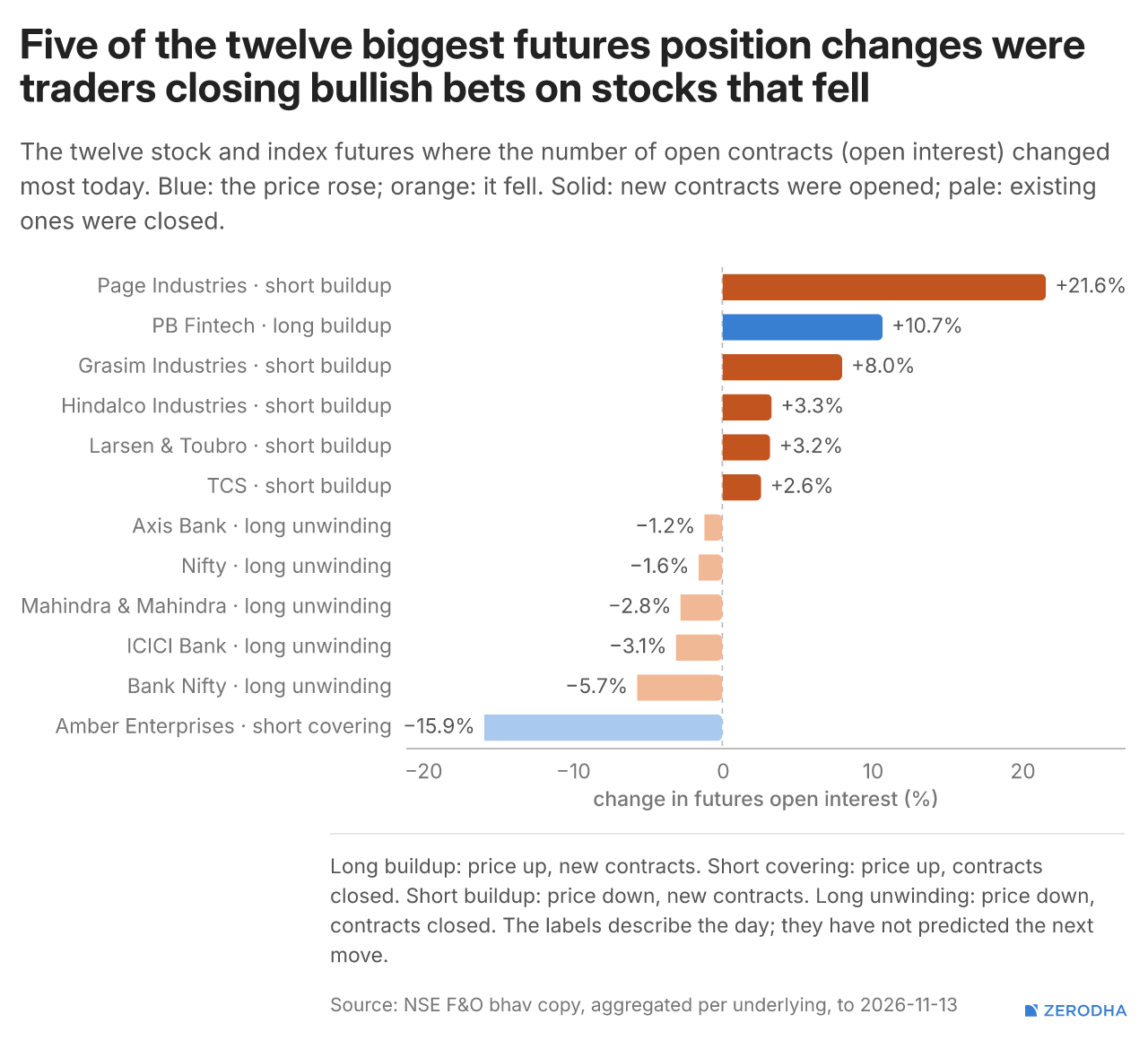
Hitachi Energy India surged 10.68% on 6.7× usual volume, while Amber Enterprises jumped 9.07% on 15× volume and ITI gained 6.80%. On the downside, Manappuram Finance declined 3.73%, while Jio Platforms recorded an unusual delivery spike, with 66% of traded shares taken to delivery against its usual 40%.
Delivery Data
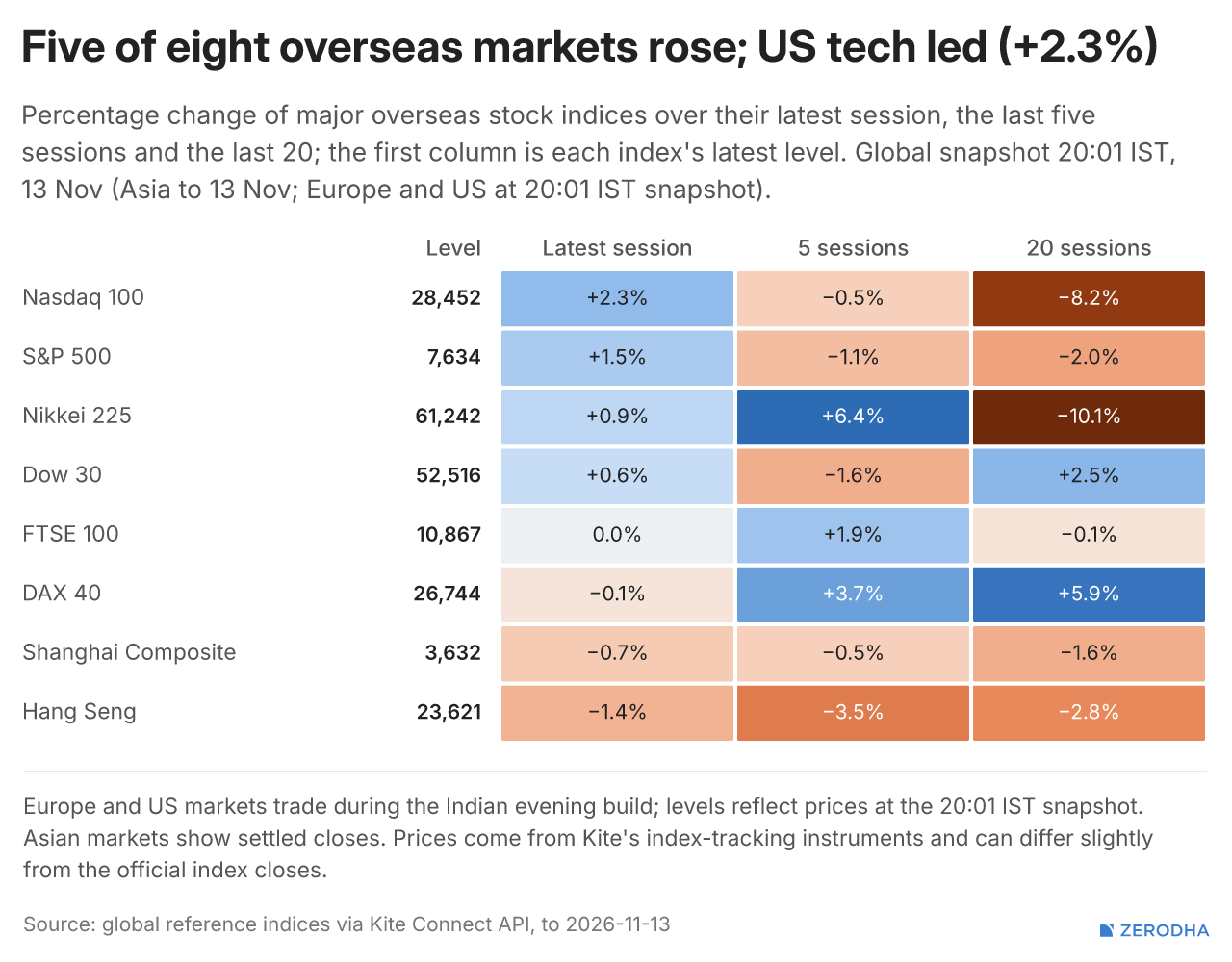
Global Markets
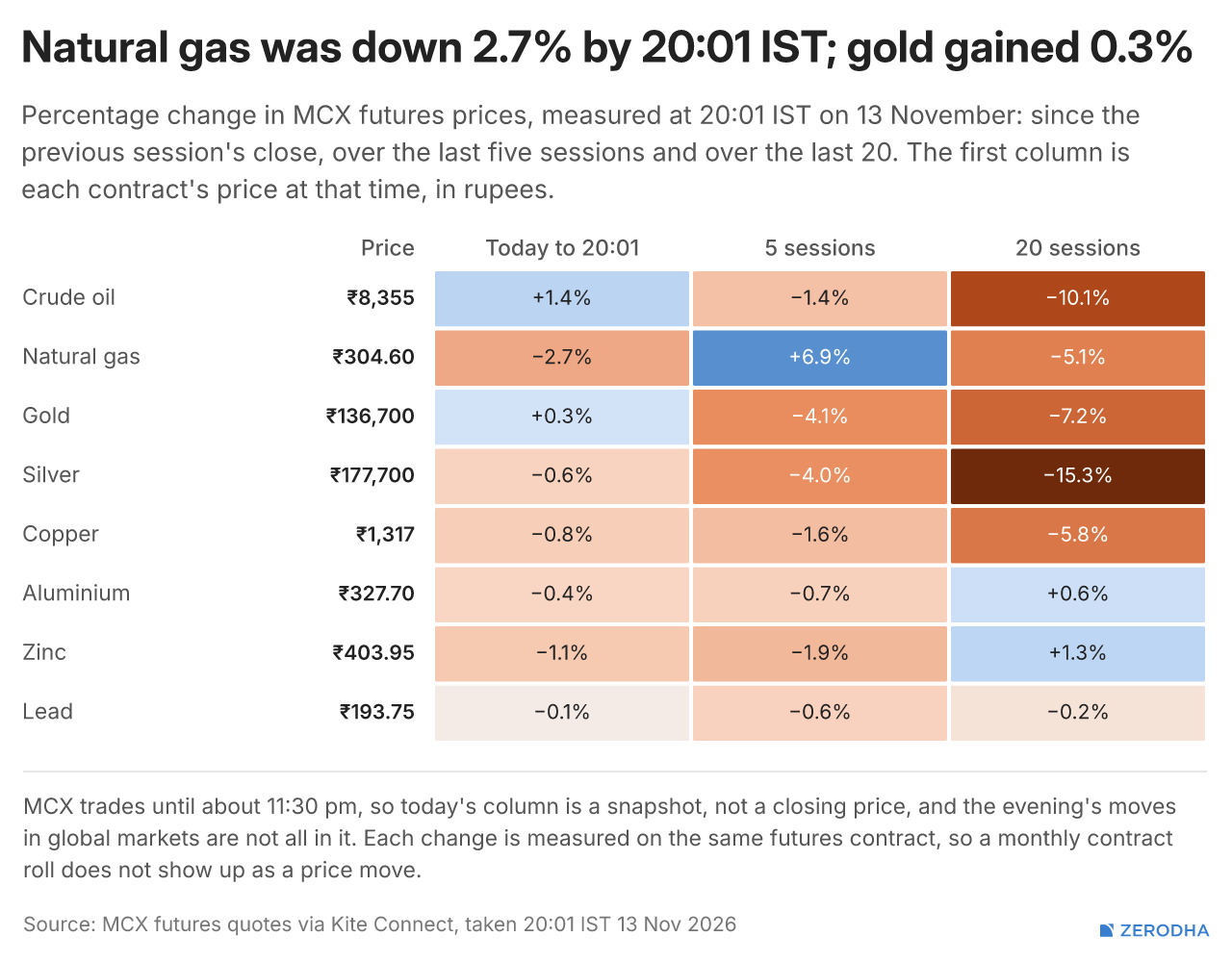
Commodities
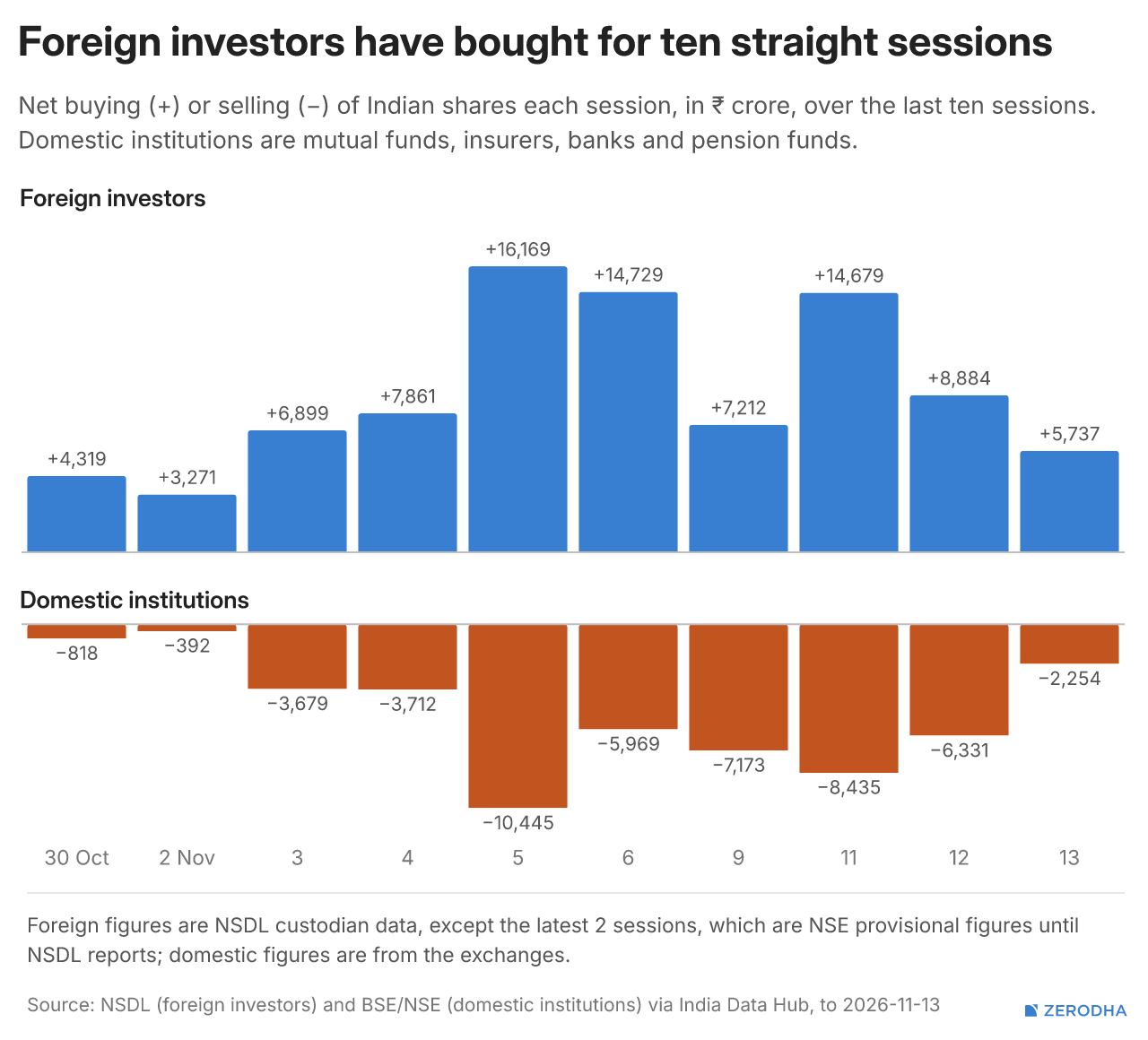
Institutional Flows & Participant Positioning
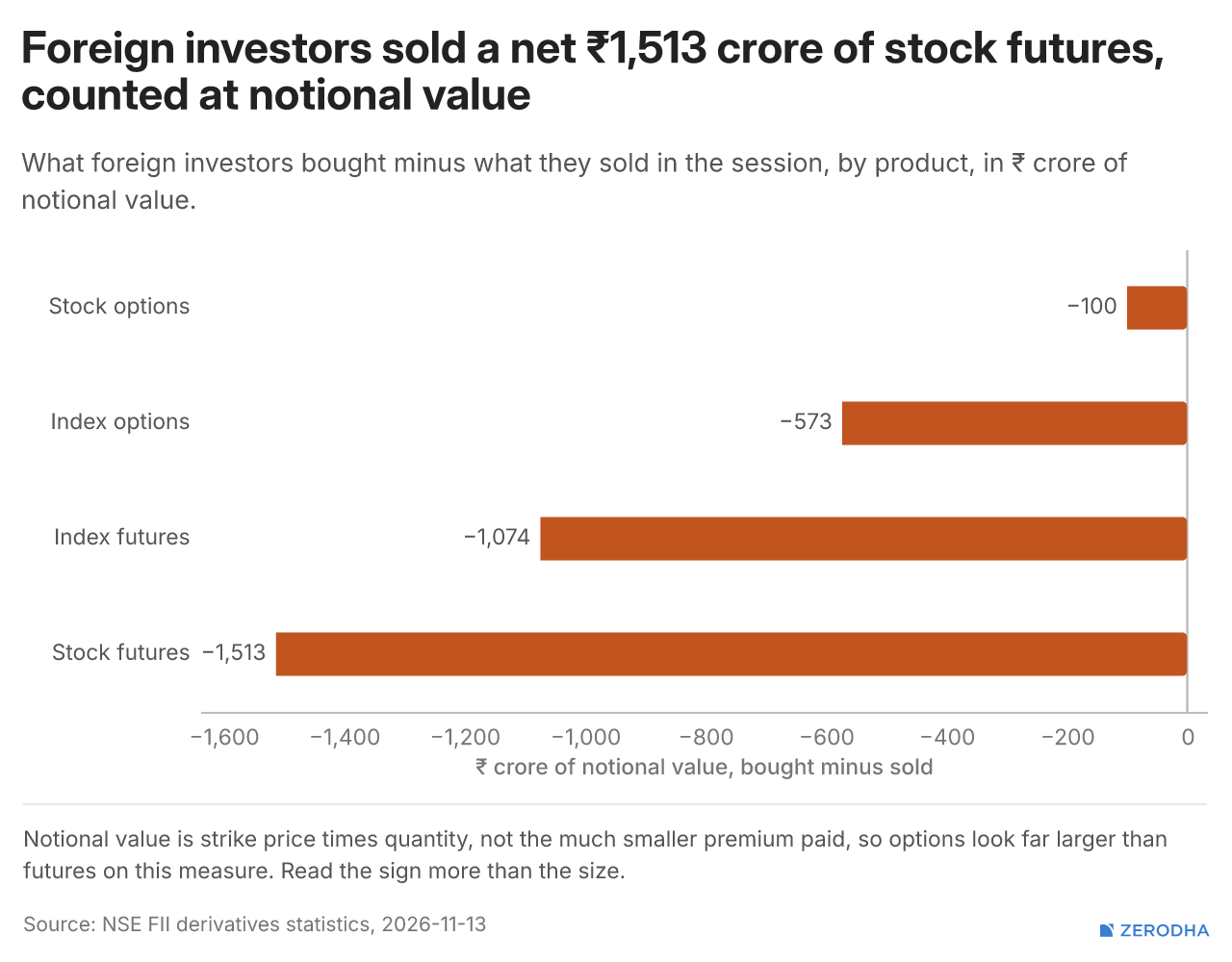
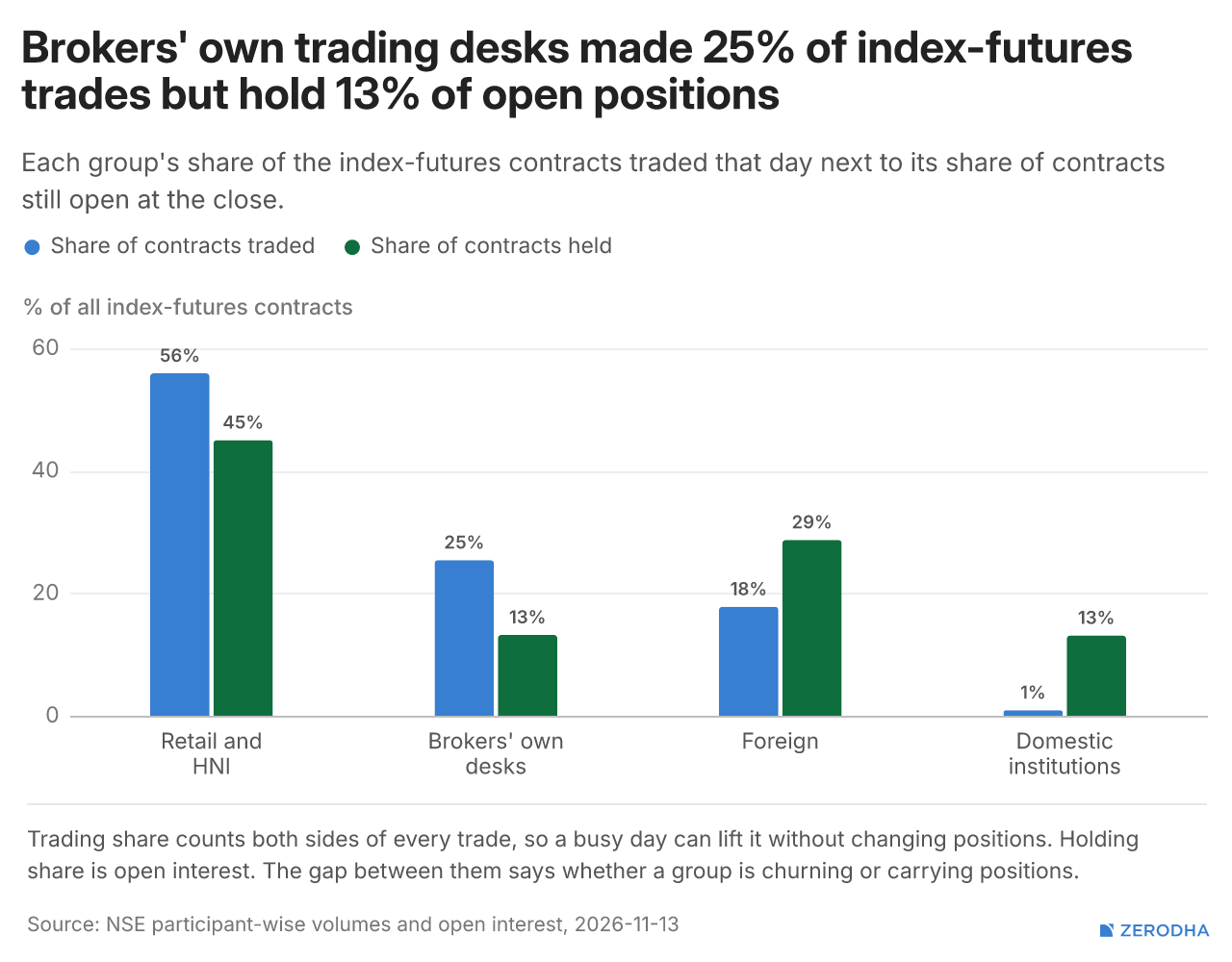
Implied volatility declined from 15.5% to 13%, making options cheaper overall, although demand for downside protection increased relative to calls. FIIs sold 6,201 index-futures contracts worth ₹1,074 crore, reducing their long positioning from 37% to 34.6%, while retail and HNI participants remained 61% long.
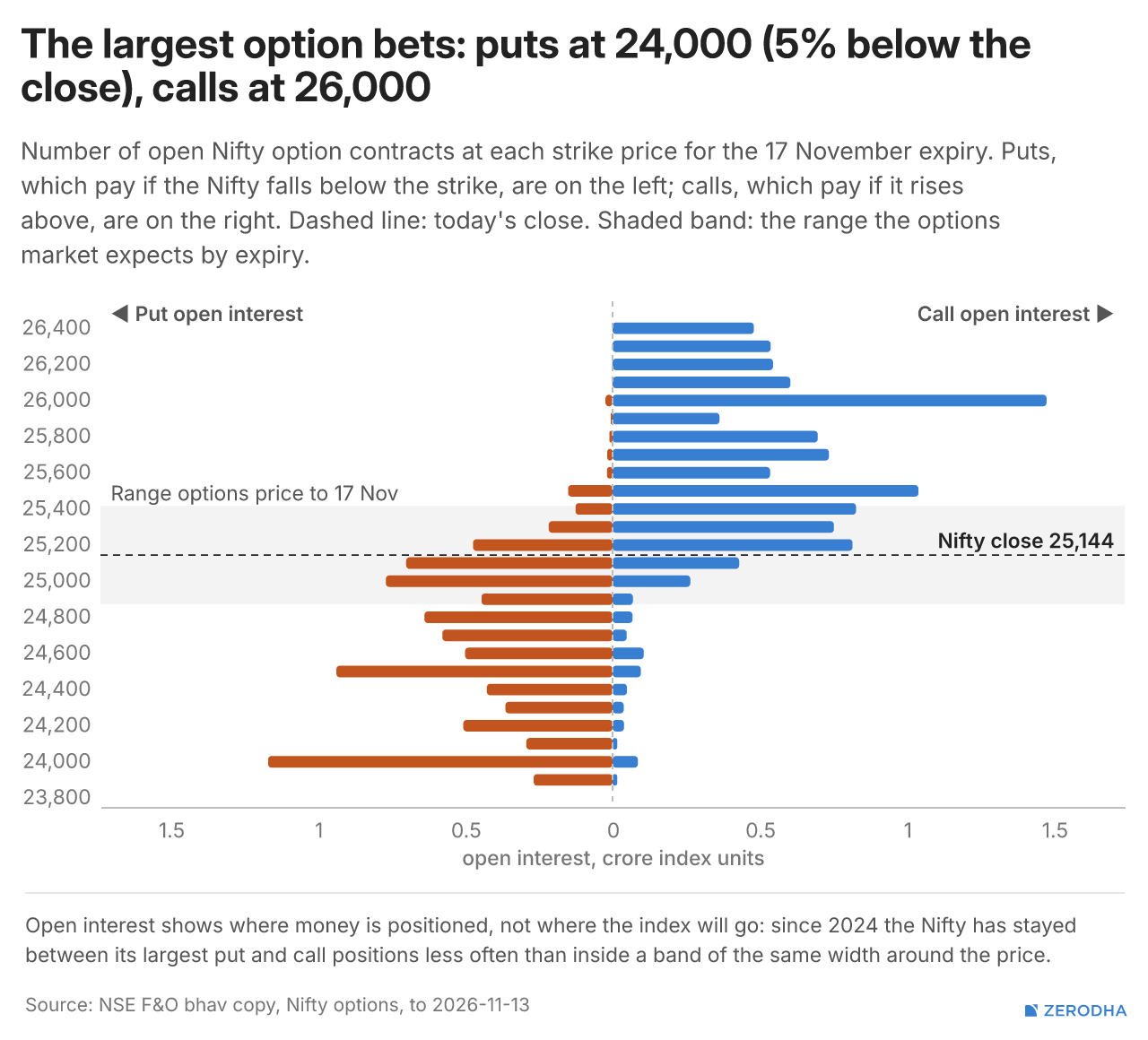
Options imply a 24,878–25,424 range into the November 17 expiry, with the heaviest put open interest at 24,000 and call open interest at 26,000. Nifty's 200-day moving average near 23,988 remains an important longer-term technical support level.
Thematic Indices
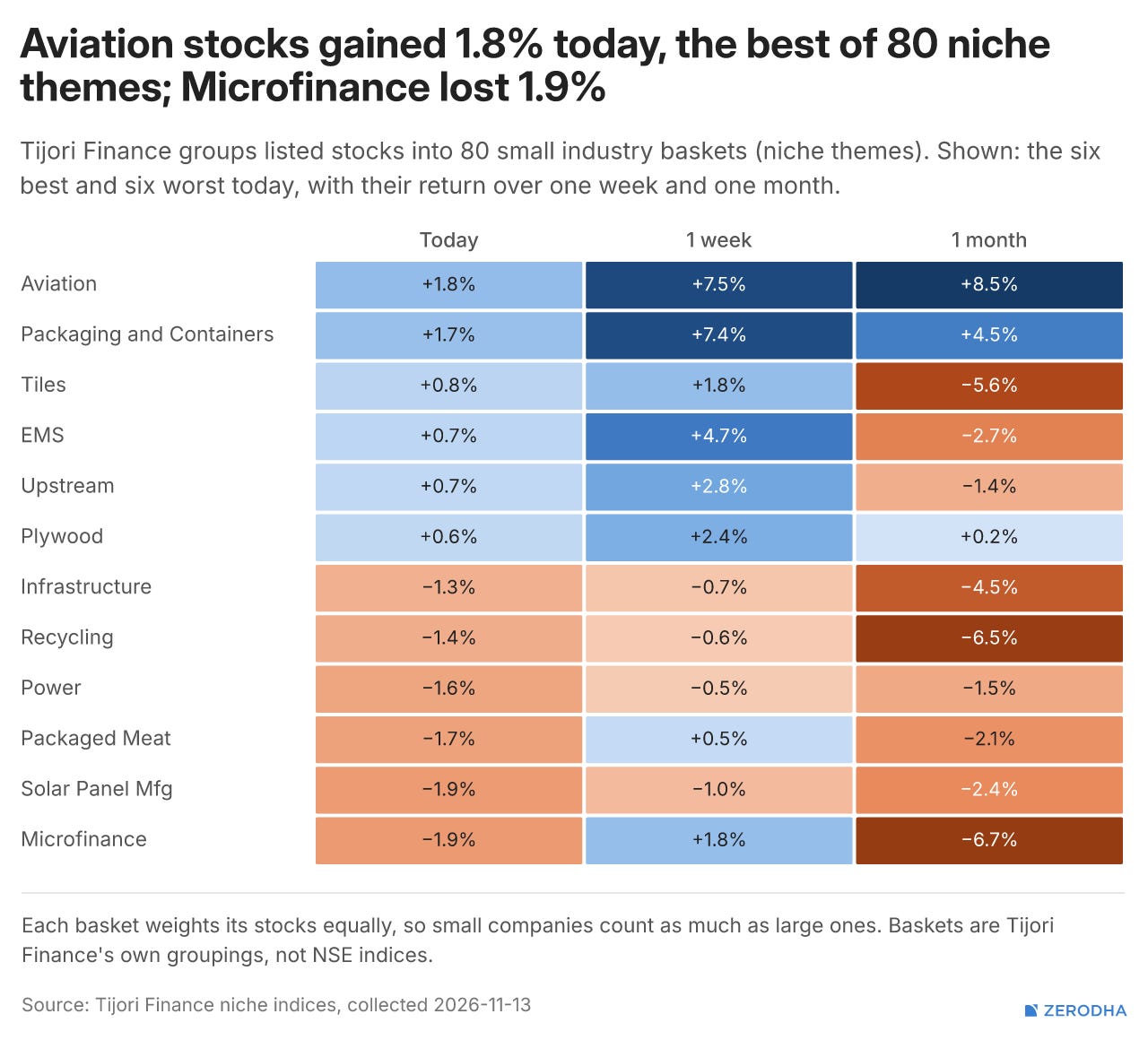
Tijori’s niche indices, where today’s move sorts pockets of the market beyond standard sector baskets. You can also track promoter buying and other interesting stuff, like Capex activity by the companies in the Tijori App’s idea dashboard
F&O Corner

Top Stories in India
India’s merchandise trade deficit widened to $39.88 billion in October from $30.21 billion in September, exceeding economists’ expectations of $32.25 billion. While merchandise exports reached a record monthly high of $49.47 billion, imports surged to $89.35 billion, driving the sharp increase in the trade gap. Dive deeper
Tata Motors Passenger Vehicles reported a consolidated net loss of ₹5,531 crore in Q2 FY27, compared with a profit of ₹76,170 crore a year earlier, primarily due to exceptional charges of ₹6,738 crore. Revenue rose 34% to ₹96,920 crore, while Jaguar Land Rover continued to face restructuring costs and the lingering impact of last year’s cyberattack. Dive deeper
Cash-strapped airline SpiceJet is reportedly considering raising ₹5,000 crore in fresh capital as it struggles with a shrinking market share, limited operational fleet and persistent financial challenges. The airline’s board will meet on November 18 to evaluate fundraising options, including equity shares, preference shares and debt securities. Dive deeper
Eicher Motors reported a 15% YoY increase in net profit to ₹1,573 crore in Q2 FY27, while revenue grew 20.3% to ₹7,422 crore. EBITDA increased 16.4% to ₹1,760 crore, slightly below estimates, while operating margins narrowed to 23.7% from 24.5% a year earlier. Dive deeper
The Reserve Bank of India approved the appointment of Pratap Singh as Managing Director and Chief Executive Officer of Fino Payments Bank. His three-year term will begin on November 27, 2026. Dive deeper
India’s gold imports declined 39.9% YoY to $24.78 billion during April–October 2026, compared with $41.24 billion in the corresponding period last year. The decline comes amid volatility in global gold markets, with prices recently correcting below $4,000 per ounce. Dive deeper
Top Stories Globally
A major Microsoft outage disrupted access to Outlook, Teams and Copilot across several countries, including the US and India, with services remaining affected for more than nine hours. Nearly 200,000 user reports were recorded on Downdetector, raising concerns about businesses’ dependence on a single technology provider. Dive deeper
Brent crude traded near $96 per barrel as hopes for a diplomatic resolution to the US-Iran conflict weakened. President Donald Trump said Washington no longer needed a deal with Tehran, while Iran reiterated that US sanctions and the naval blockade must be lifted before direct peace negotiations can begin. Dive deeper
US stock futures traded marginally higher on Friday, with the S&P 500, Nasdaq 100 and Dow contracts holding above the flatline. Investors awaited fresh inflation data while assessing risks surrounding AI stocks following Jensen Huang’s reported departure as Nvidia CEO. Dive deeper
The euro remained below $1.11, trading near its weakest level since March 2025 as expectations of further Federal Reserve interest rate hikes supported the US dollar. Political and fiscal uncertainty in France, concerns over Europe’s slowing economic growth and speculation surrounding the next ECB president added pressure. Dive deeper
Nvidia shares were headed for a sixth consecutive weekly decline, potentially marking their longest losing streak since 2012. The chipmaker has lost approximately 29% of its market value, or nearly $1.6 trillion, amid concerns over its leadership transition and the broader AI investment outlook, surrendering its position as the world’s most valuable company to Apple. Dive deeper
Management Chatter
In this section, we highlight interesting comments from management at major companies and from policymakers in the Indian and Global Economies.
Bharti Enterprises Chairman Sunil Bharti Mittal on froth in AI:
The artificial intelligence (AI) boom will eventually go through a correction, much like the dotcom bubble, but there is an opportunity for India to attract more investments as the froth settles.
"Superintelligence is here to stay; the strongest players will emerge once the current excitement around AI settles”
"Any AI froth settling down in the US is good for India," - Link
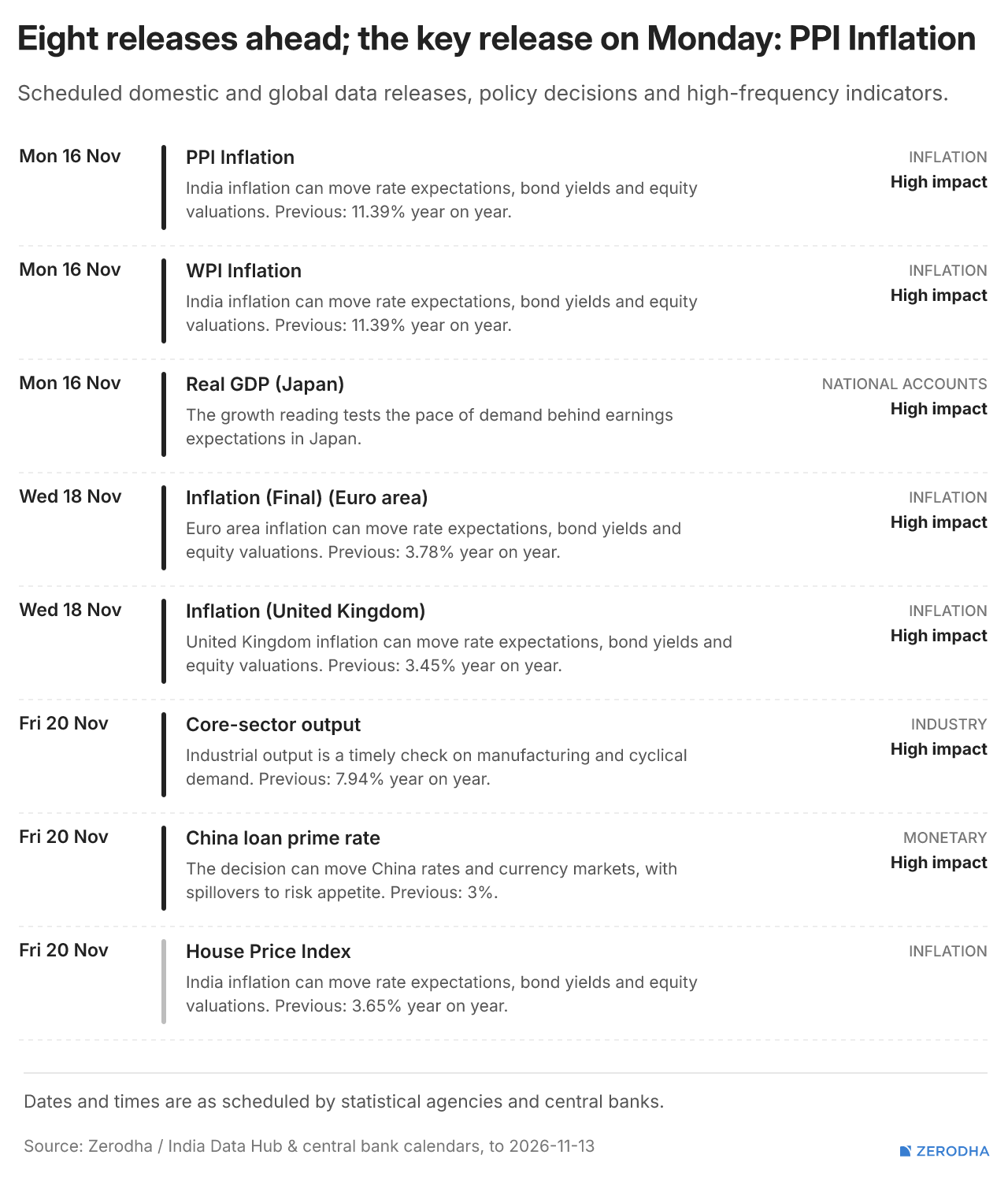
The week ahead & Corporate Actions
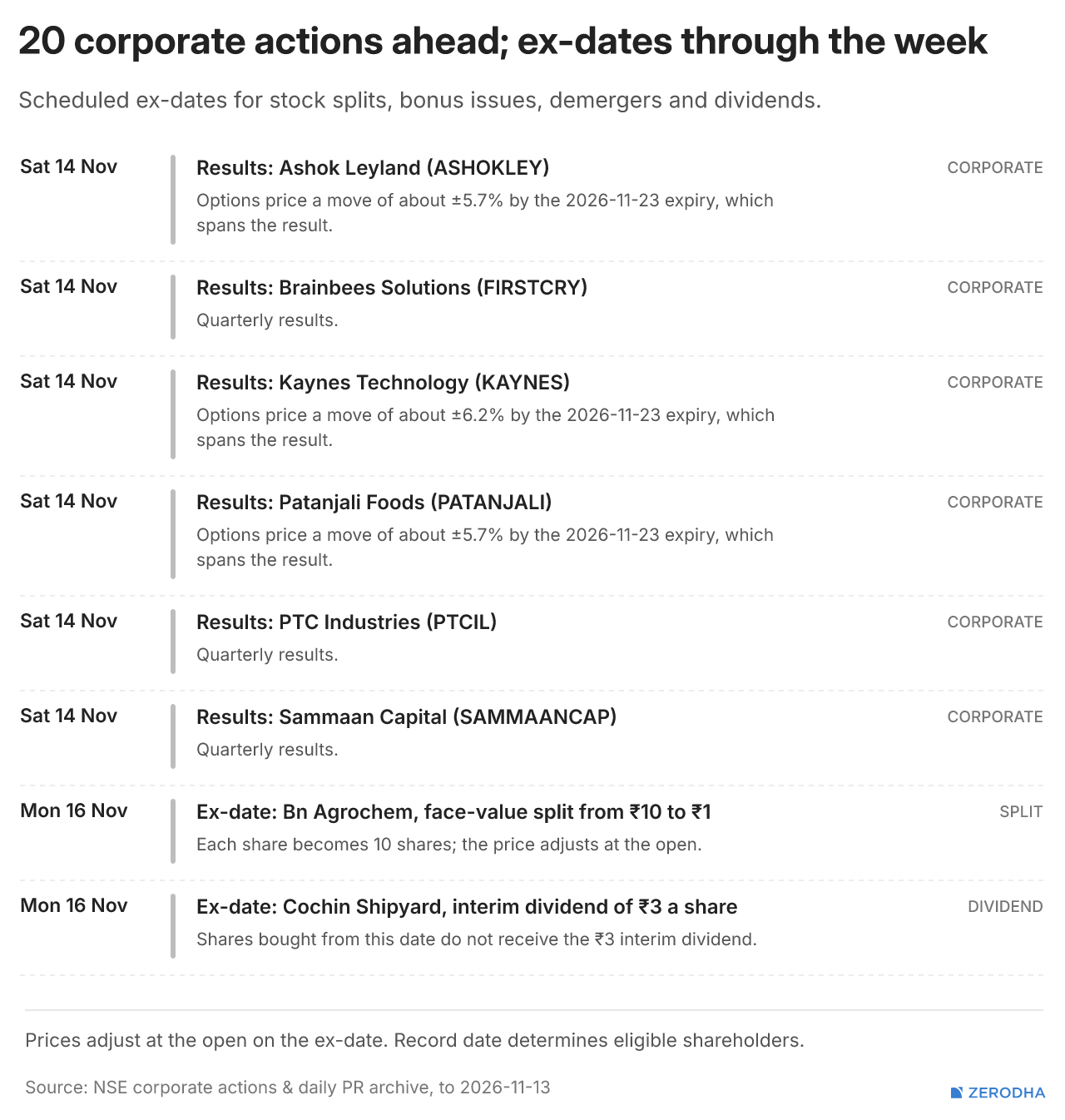
Corporate Actions
Published by Zerodha. Not investment advice. Data from NSE, BSE, and MCX.
In our latest special episode of In The Money by Zerodha, we test two strategies on Indian stocks: selling a naked straddle after results and selling an iron fly with defined risk.
Using data from 209 Indian F&O stocks between October 2021 and August 2026, we examine six exit timings, from the same day to five trading days later. We analyse average returns, win rates, median returns, and stock-by-stock performance to understand how holding periods affect results.
We then test an iron fly strategy, where protective options limit potential losses. We examine how protection costs affect returns and why positive median returns can coexist with negative average percentage returns.
That’s it from us for today. We’d love to hear your feedback in the comments, and feel free to share this with your friends to spread the word!