

Welcome to Aftermarket Report, a newsletter where we do a quick daily wrap-up of what happened in the markets, both in India and globally.
In our latest episode of In The Money by Zerodha video series, we move beyond price and focus on volatility as a core non-price market feature, breaking down what volatility really means, how it is measured, the differences between Historical, Implied, and Realised Volatility, how India VIX works, and why volatility itself often mean-reverts, while also exploring why short volatility strategies perform better in certain regimes, why fully rules-based systems are difficult to build, and how institutions use valuation and relative relationships to complete the full picture of mean reversion as a trading and investing framework.
Market Overview
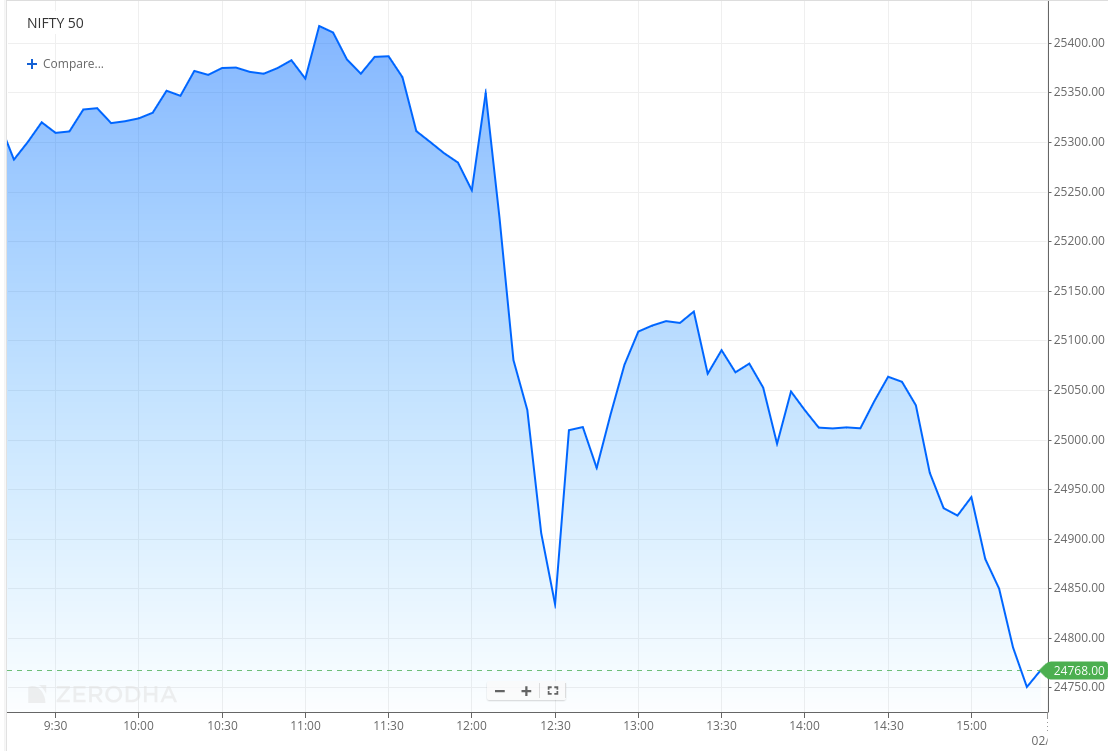
Nifty opened flat at 25,334 and traded with a mild positive bias in the opening hour, gradually moving higher and testing the 25,380–25,400 zone until around 11 AM, when the Union Budget speech began. Sentiment, however, turned sharply negative around noon after news of a sharp hike in STT on F&O trades. This triggered a sudden and aggressive sell-off, with Nifty plunging over 700 points in under 30 minutes and hitting panic lows near the 24,570 level.
Although the index attempted a recovery from these lows and rebounded toward the 25,050–25,100 zone by early afternoon, selling pressure resurfaced at higher levels. Nifty gradually drifted lower through the latter part of the session, as confidence remained weak. Persistent selling in the final hour dragged the index back toward the 24,770–24,800 zone.
Nifty eventually closed near the lower end of the day’s range at 24,825.45, ending sharply lower after an extremely volatile session dominated by abrupt sell-offs and fragile intraday sentiment following the sharp STT hike.
Looking ahead, markets are likely to remain sensitive to global risk appetite, ongoing Q3 earnings, upcoming RBI policy, and further developments around India–U.S. trade negotiations.
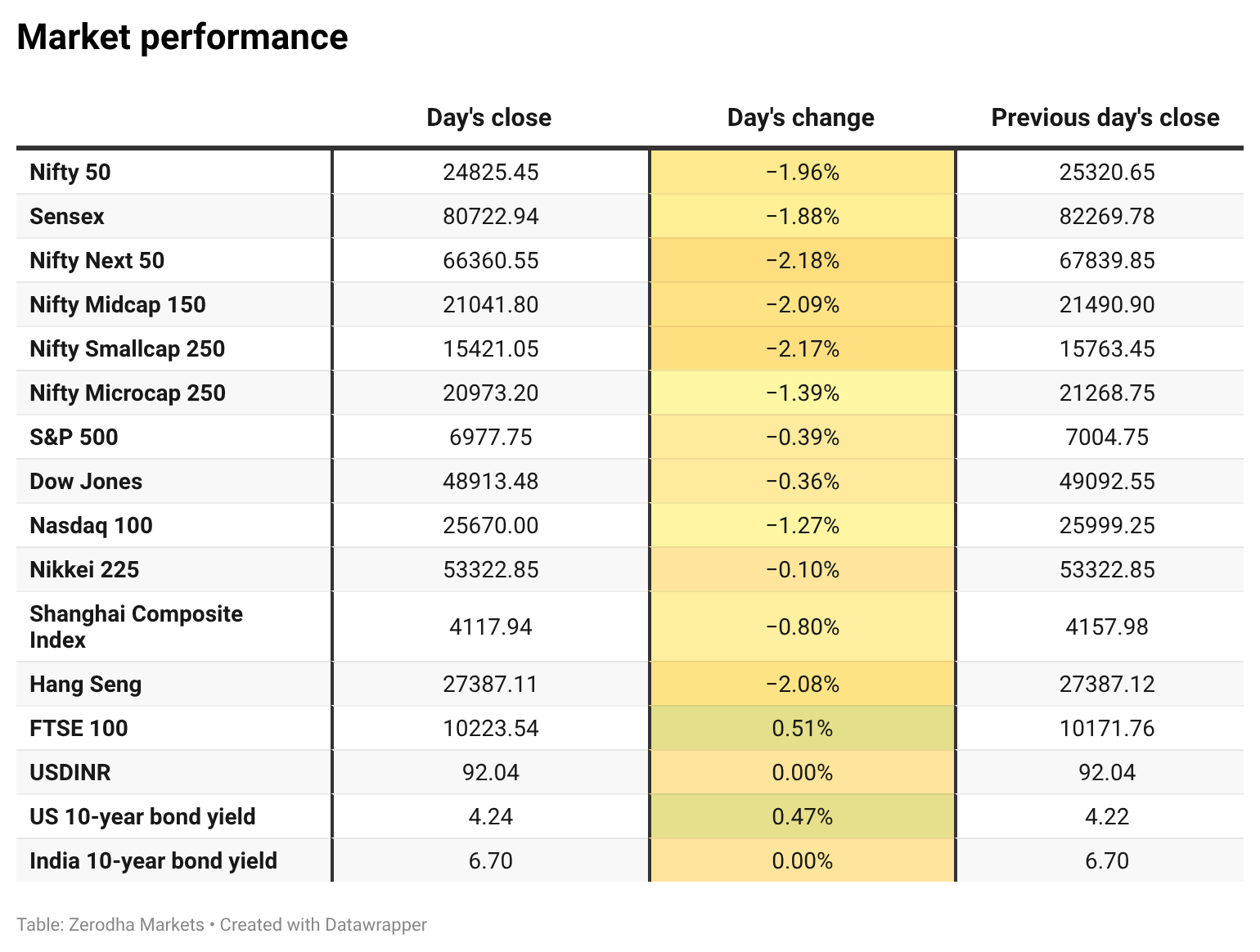
Broader Market Performance:
The broader market had a bearish session today. Of the 3,227 stocks that traded on the NSE, 1,054 advanced, 2,073 declined, and 100 remained unchanged.
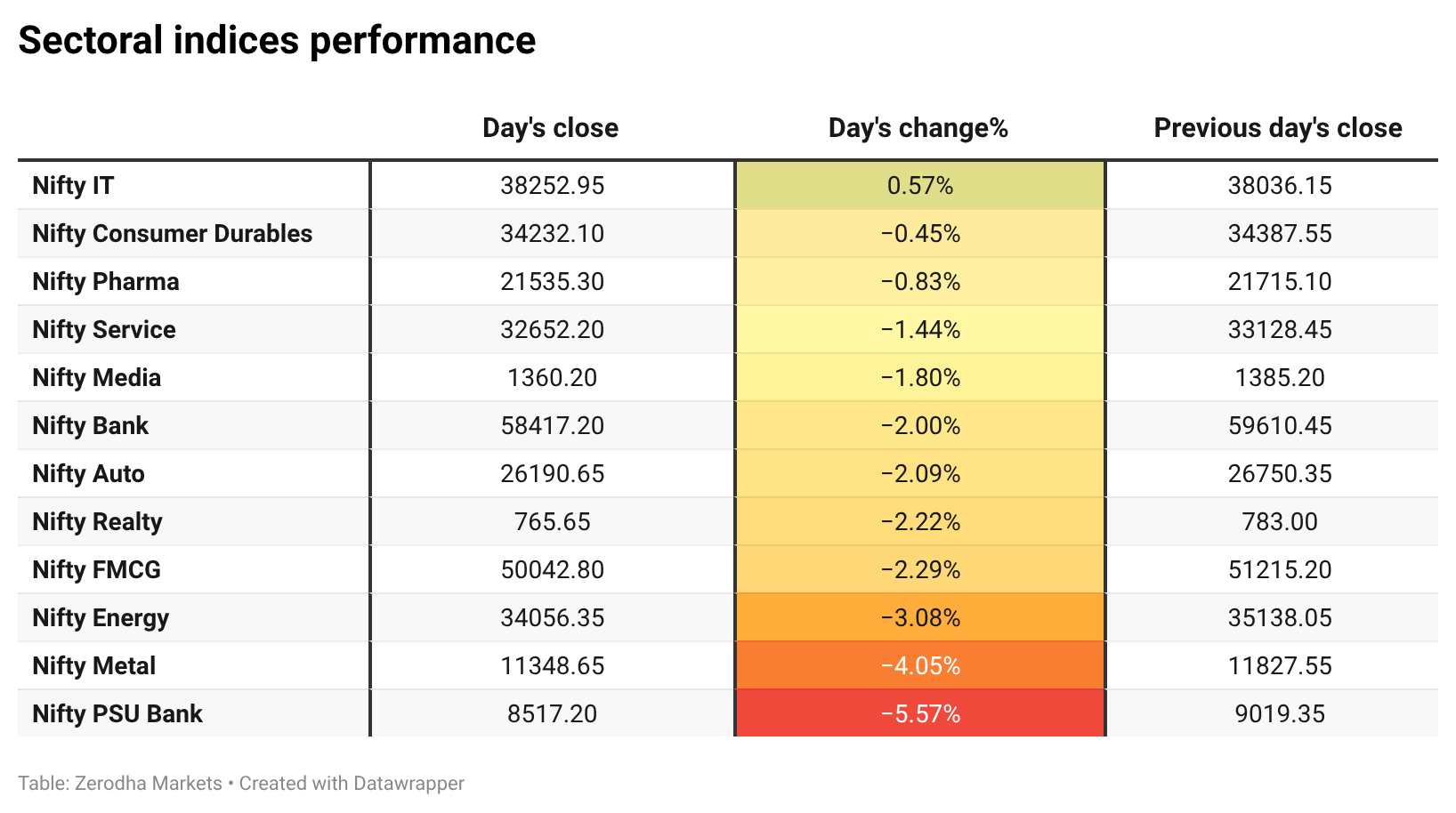
Sectoral Performance:
The top-gaining sector today was Nifty IT, up by 0.57%, while the biggest loser was Nifty PSU Bank, which plunged 5.57%. Of the 12 sectoral indices, only 1 closed in the green, while 11 ended the day in the red, indicating broad-based sectoral weakness.

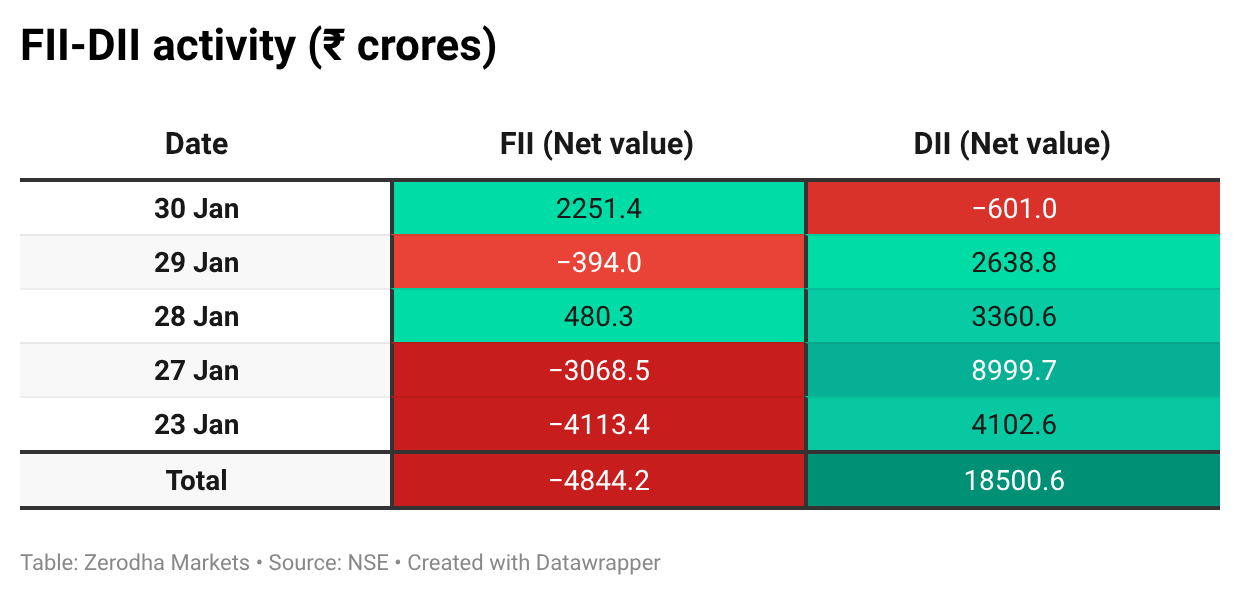
Here’s the trend of FII-DII activity from the last 5 days:
Change in OI for the day
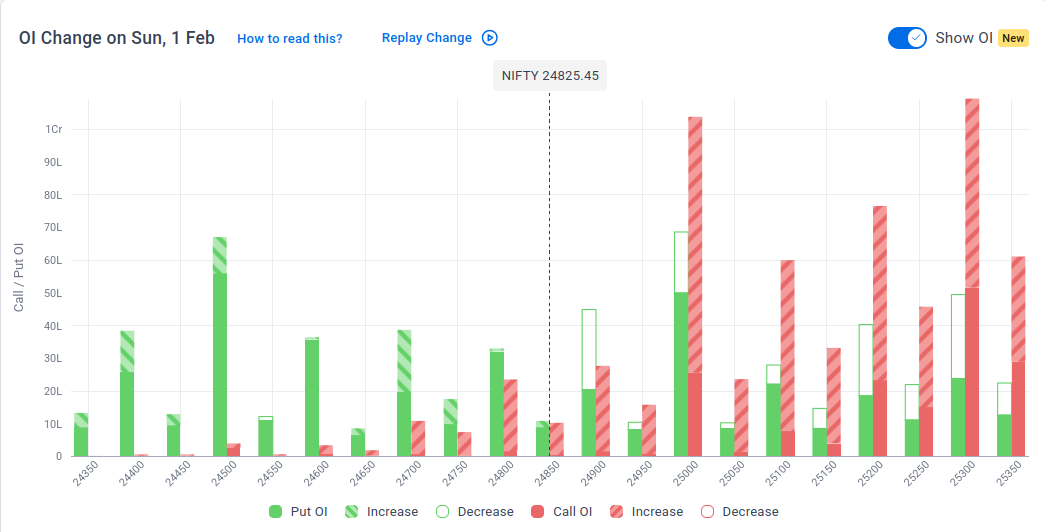
The following is the change in OI for Nifty contracts expiring on 3rd February:
The maximum Call Open Interest (OI) is observed at 25,500, followed by 25,000 & 25,300, indicating potential resistance at the 25,100 -25,200 levels.
The maximum Put Open Interest (OI) is observed at 24,500, followed by 25,000, suggesting support at 24,500-24,600.
Note: OI is subject to multiple interpretations; however, generally, an increase in Call OI indicates resistance in a falling market, while an increase in Put OI indicates support in a rising market.
Source: Sensibull
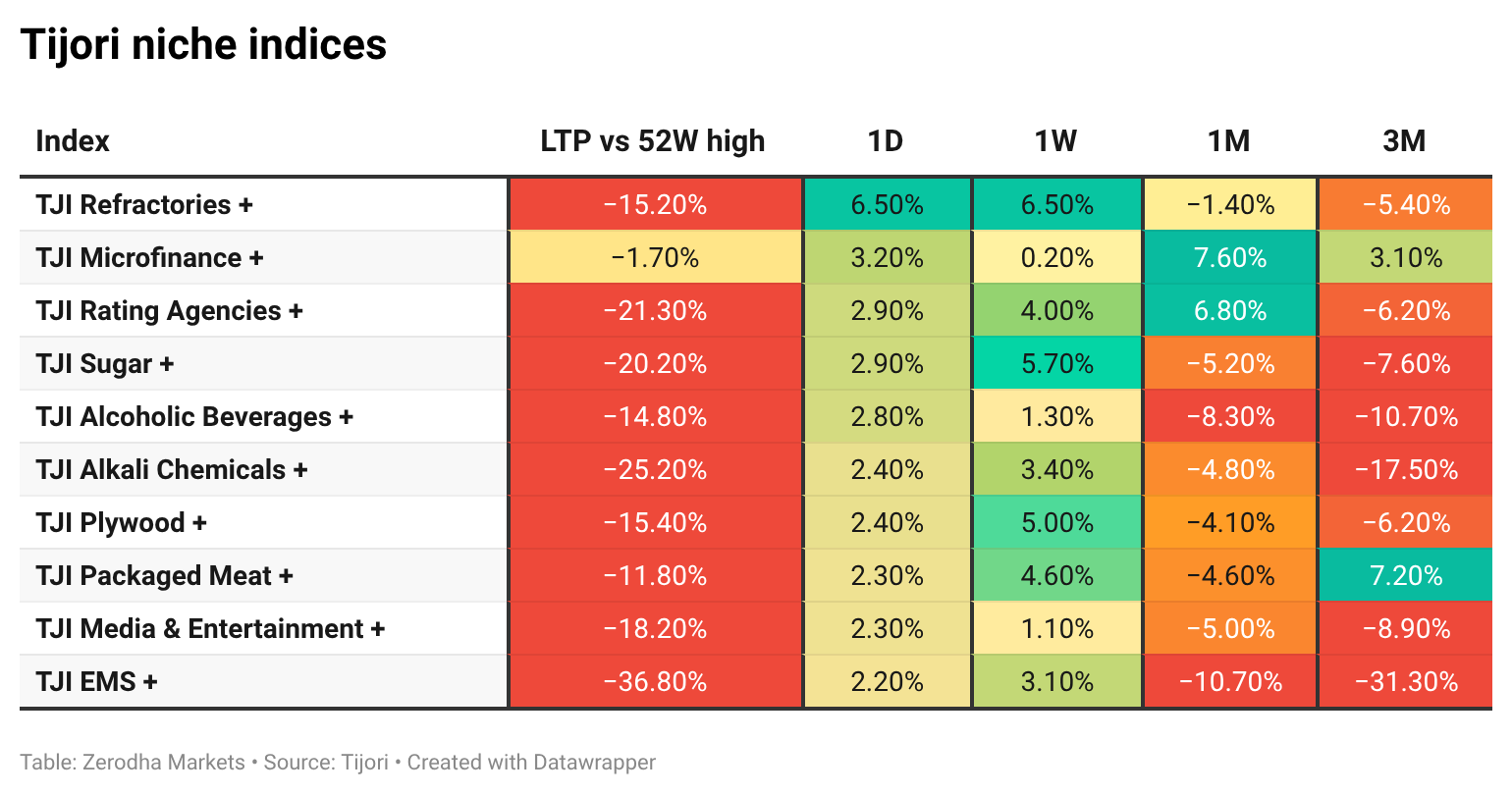
Tijori is an investment research platform that has constructed niche indices for various themes and sub-sectors. They help you understand the market performance of narrow slices of the market. You can also track the Promoter buying and other interesting stuff, like Capex activity by the companies in the Tijori App’s idea dashboard
What’s happening in India
The Government announced a sharp hike in Securities Transaction Tax, raising STT on futures by 150% to 0.05% and on options by 50% to 0.15%. The move marks a significant increase in trading costs for derivatives markets. Dive deeper
India has raised infrastructure spending by 11.4% to a record ₹12.2 trillion for FY27, underscoring its focus on growth and job creation. Dive deeper
The Union Budget announced a ₹10,000 crore SME Growth Fund to improve credit access and support modernisation of small businesses. Dive deeper
Union Budget 2026 has identified the IT sector as a key growth driver and proposed clubbing software, IT-enabled services, KPO, and contract R&D under a single “Information Technology Services” category. Finance Minister Nirmala Sitharaman said the move will apply a uniform safe harbour margin of 15.5%, with approvals granted through an automated, rule-based process without tax officer intervention. Dive deeper
In the Budget 2026 speech, Finance Minister Nirmala Sitharaman outlined support for AI, deep-tech and semiconductor development, including initiatives to strengthen the India Semiconductor Mission 2.0 with increased funding and ecosystem support. Dive deeper
India has cut tariffs on select capital goods and raw materials to support domestic manufacturing and ease costs for exporters impacted by US trade policies. Dive deeper
India’s defence outlay saw a sharp boost, with spending (excluding pensions) raised to ₹5.9 lakh crore from ₹4.9 lakh crore in FY26, a nearly 19% year-on-year increase. The hike underscores a renewed focus on military preparedness and continues a decade-long trend that has nearly doubled the defence budget, supporting modernisation and indigenisation. Dive deeper
The government introduced procedural tax reforms focused on simplifying compliance and reducing the burden on taxpayers, particularly small filers. Filing deadlines have been rationalized, with the due date for non-audit business/professional income cases and partners of non-audit firms extended from July 31 to August 31, while ITR-1 and ITR-2 filers retain the July 31 deadline. Dive deeper
What’s happening globally
Gold and silver saw a dramatic reversal, with gold plunging over 12% below $5,000 an ounce in its biggest intraday fall since the early 1980s. Silver crashed as much as 36%, marking a record intraday decline as the selloff rippled across the metals market. Dive deeper
President Donald Trump on Friday nominated Kevin Warsh to succeed Jerome Powell as Federal Reserve Chair, concluding a turbulent selection process marked by unprecedented controversy surrounding the central bank. The announcement ends months of speculation and uncertainty about the leadership transition at the Fed. Dive deeper
OPEC+ delegates say the group is on track to ratify its plan to keep oil production steady and maintain the early-2026 output pause when members meet in March, sticking with the supply freeze agreed in late 2025. Dive deeper
China’s manufacturing PMI slipped into contraction at 49.3 in January, signalling weakening factory momentum amid subdued demand. Dive deeper
Ford and Xiaomi have held discussions on a potential electric vehicle partnership, according to reports. The talks highlight growing collaboration between global automakers and Chinese tech firms in the EV space. Dive deeper
Oracle has secured an $88 million contract to provide cloud infrastructure services for the US Air Force’s Cloud One program. The deal expands Oracle’s footprint in government cloud computing. Dive deeper
Management chatter
In this section, we highlight interesting comments made by the management of major companies and policymakers from the Indian and Global Economies.
Ashishkumar Chauhan, CEO & MD, NSE on the impact of STT hike on investors and markets:
“I don’t think this STT hike will rattle long-term foreign investors; they are focused on the broader macro and structural story.”
“What it might do is curb speculative trading and very short-term structures, which is probably a good thing for market quality.”
“Long-term investors don’t make trades on a daily basis; they look at the structural growth story of the economy.” - Link
US President Donald Trump on purchasing oil from Venezuela:
“China is welcome to come in and would make a great deal on oil. We welcome China. We’ve already made a deal. India is coming in, and they’re going to be buying Venezuelan oil as opposed to buying it from Iran. So we’ve already made that deal, the concept of the deal,” - Link
Jensen Huang, CEO of Nvidia, about the OpenAI investment situation, based on the recent reporting:
“We are going to make a huge investment in OpenAI.”
“I believe in OpenAI, the work that they do is incredible, they are one of the most consequential companies of our time.” - Link
🧑🏻💻Have you checked out The Chatter?
Every week, we listen to the big Indian earnings calls—Reliance, HDFC Bank, and even smaller logistics firms—and copy the full transcripts. We then remove the fluff and keep only the sentences that could move a share price: a surprise price hike, a cut-back on factory spending, a warning about weak monsoon sales, or a hint from management on RBI liquidity. We add a quick, one-line explainer and a timestamp so you can trace the quote back to the call. The whole thing lands in your inbox as one sharp page of facts you can read in three minutes—no 40-page decks, no jargon, just the hard stuff that matters for your trades and your macro view.
Go check out The Chatter here.
So, we’re now on Reddit!
We love engaging with the perspectives of readers like you. So we asked ourselves - why not make a proper free-for-all forum where people can engage with us and each other? And what’s a better, nerdier place to do that than Reddit?
So, do join us on the subreddit, chat all things markets and finance, tell us what you like about our content, and where we can improve! Here’s the link — alternatively, you can search r/marketsbyzerodha on Reddit.
See you there!
Calendars
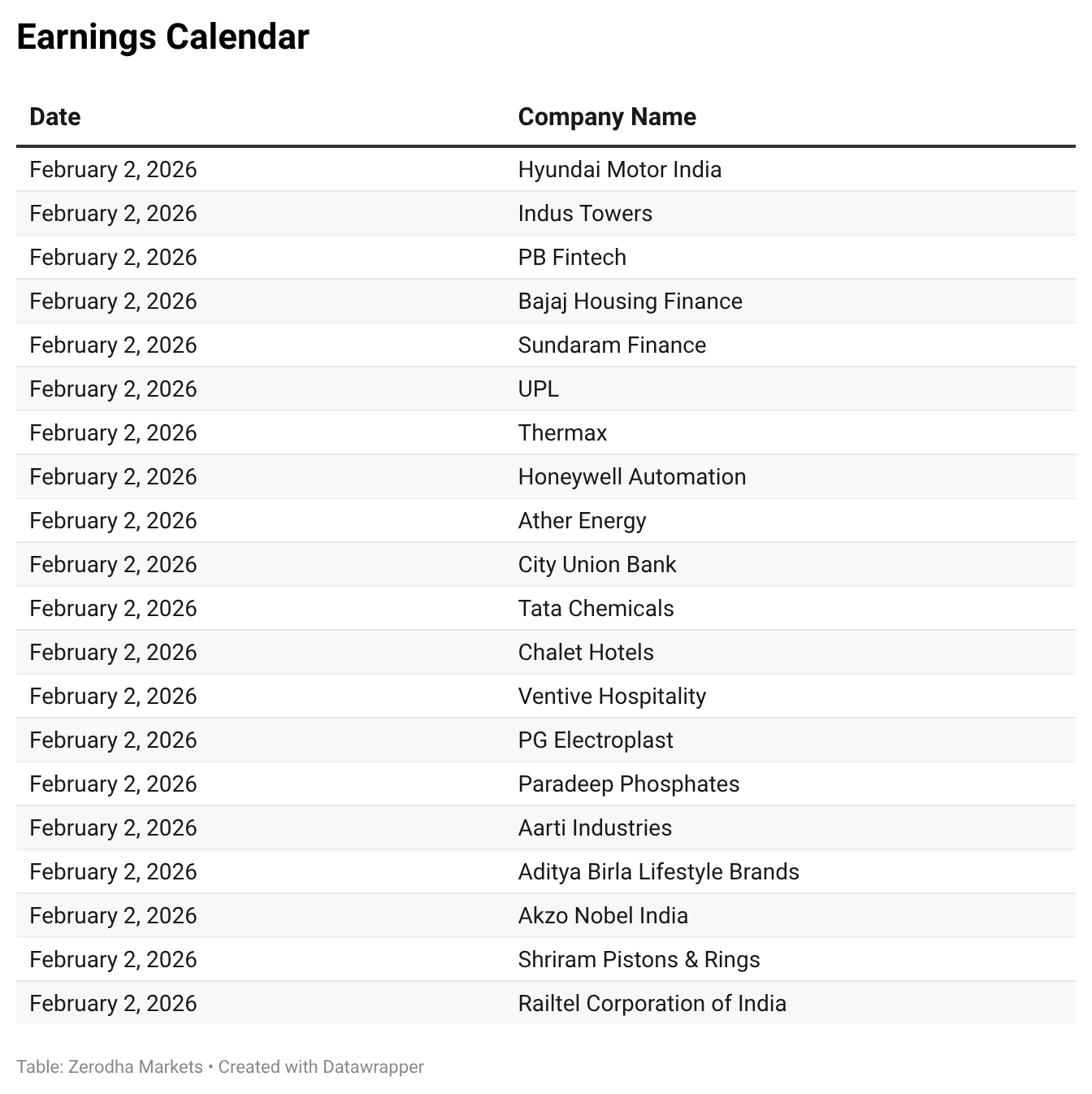
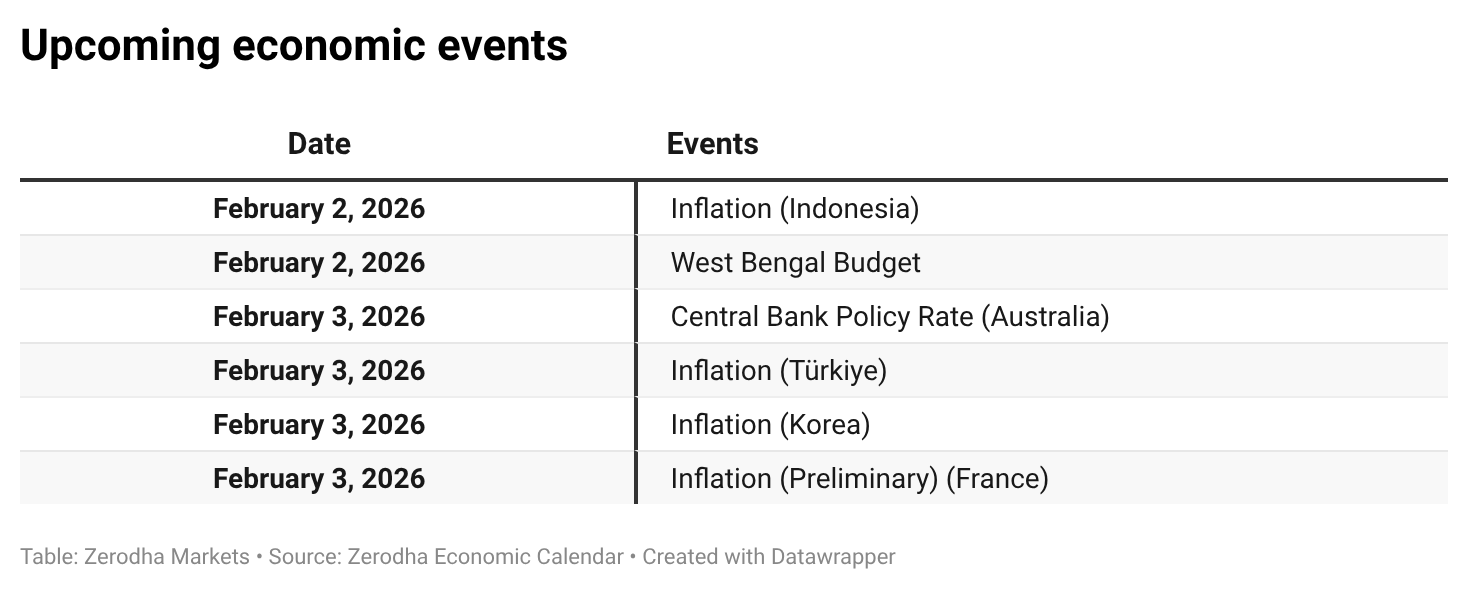
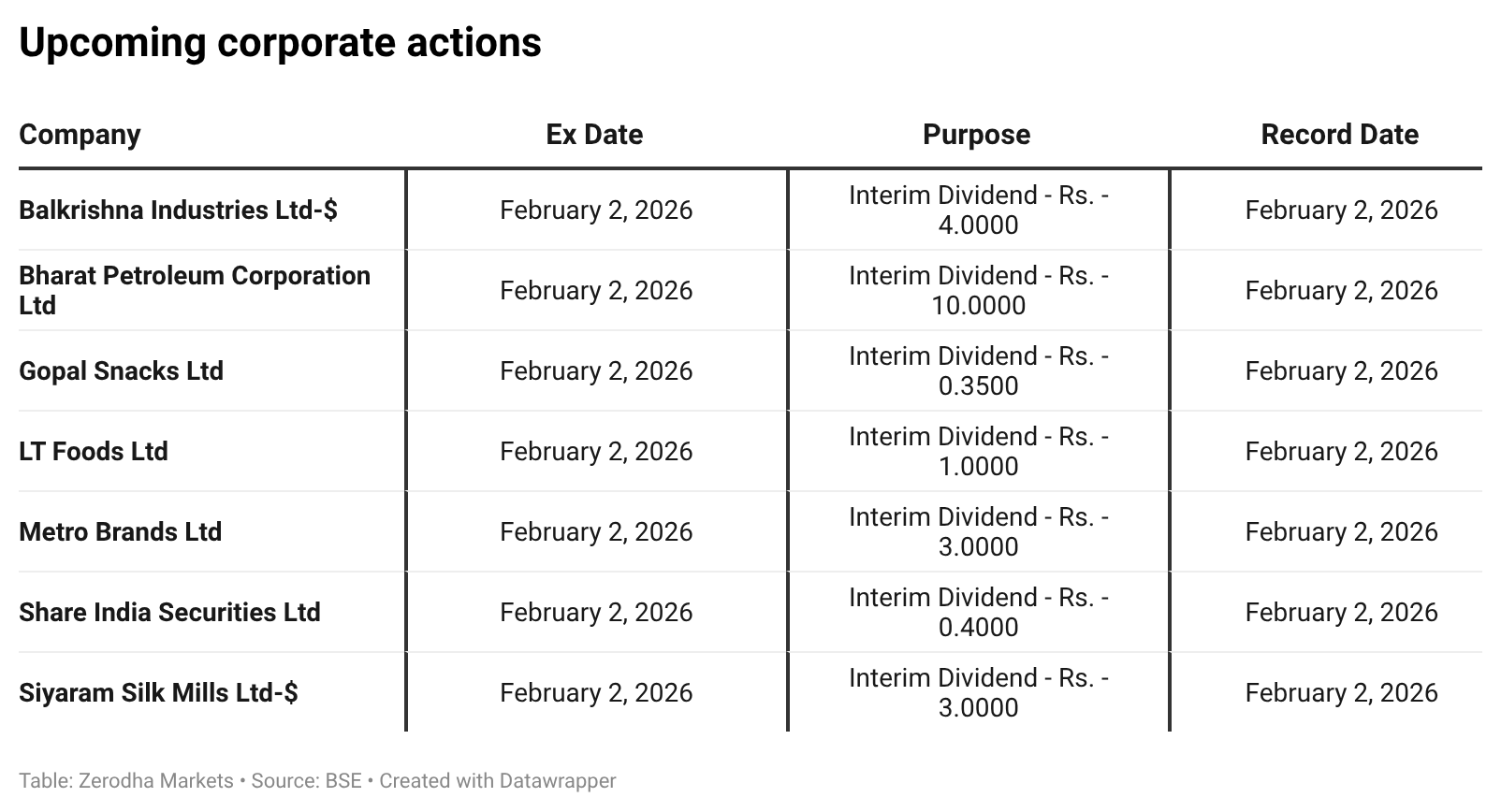
In the coming days, we have the following significant events, quarterly results, and corporate actions:
That’s it from us for today. We’d love to hear your feedback in the comments, and feel free to share this with your friends to spread the word!
Looks like FII is biggest winner In last 4 days, well domestic investor are only for bleeding from goverment as well as market.
Before going into your question, I think there is a problem in measuring how big is economy. Often it is measured by GDP of a country which is an old method. Eg- In Android phone we measure it's value by it's cost of manufacturing but if it's software fails then it has no value. Then you can imagine what we are measuring.
Now, problem of India is Unorganized Sector in various sectors which remains neglected from economy measurement. If we make them organised then our economy will become bigger and even biggest one in upcoming decades but it doesn't mean it will solve all of our problems.
Problems like unemployment can be as much high as current level even if India is biggest economy. But point is that increasing statistics is not our sole purpose but we have to solve our problem which can also lead to increase in size of economy.