
Welcome to Aftermarket Report, a newsletter where we do a quick daily wrap-up of what happened in the markets, both in India and globally.
Markets Today
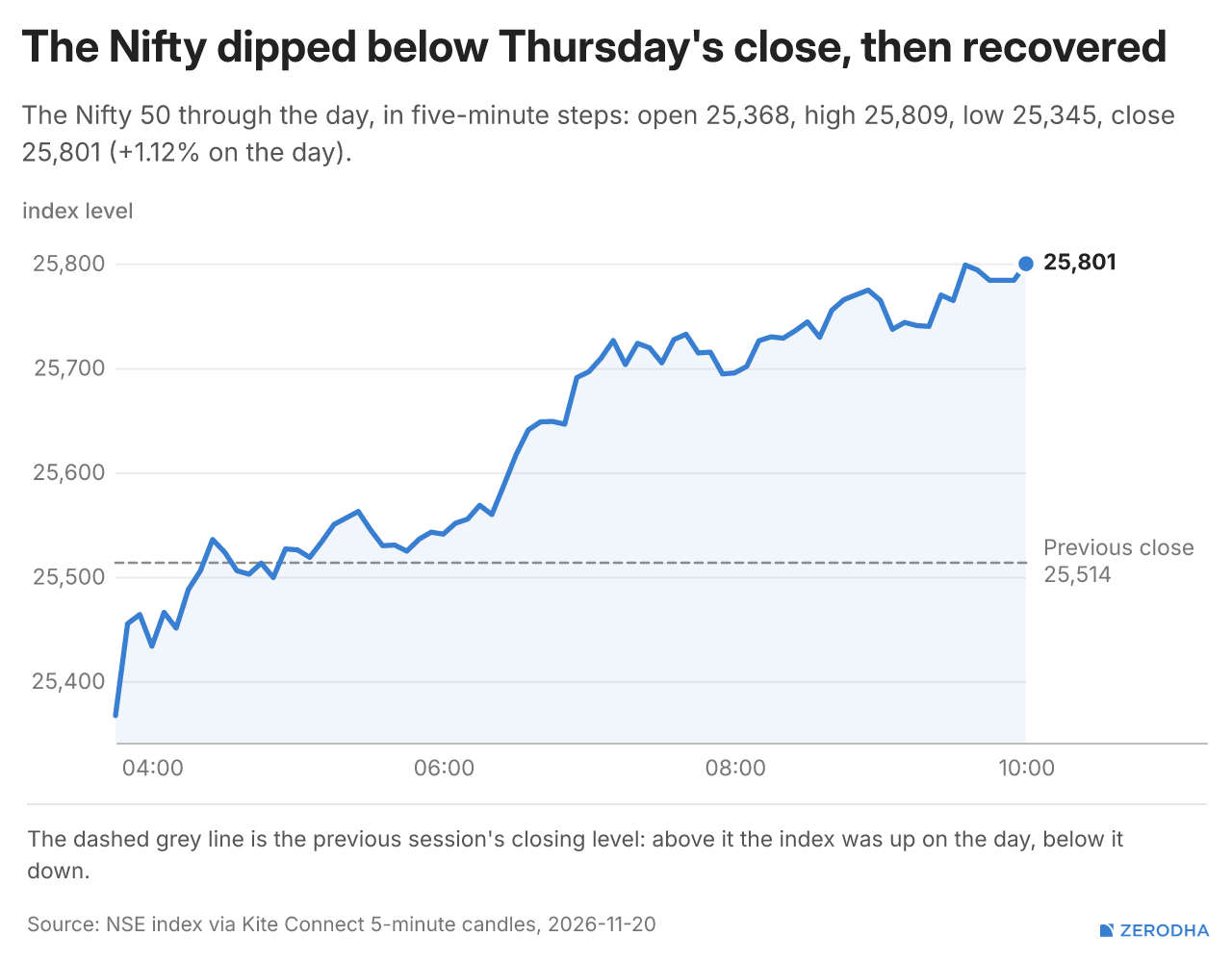
Nifty opened with a sharp 146-point gap-down at 25,368, tracking a steep overnight sell-off in US markets and deep losses across Asian equities. However, the index quickly recovered from its opening lows, climbing towards 25,500 within the first 30 minutes and extending its gains to 25,540 around 10 AM.
After a brief period of consolidation, buying interest returned, pushing the index towards 25,565 by 10:50 AM. Some profit booking at higher levels dragged it back towards 25,520, but the recovery resumed shortly after, with Nifty crossing 25,600 around noon. By the end of the first half, the index had extended its gains towards 25,700, completely reversing the opening weakness.
In the second half, positive momentum continued as Nifty consolidated between 25,700 and 25,750 before gradually moving higher towards 25,770 around 2:15 PM. A brief round of profit booking pulled it back towards 25,740, but renewed buying in the final hour pushed the index past 25,800. Nifty eventually closed near the day's high at 25,800.60, gaining over 430 points or nearly 1.7% from its opening level, marking a remarkable turnaround on the back of strong FII inflows despite the weak global backdrop.
Fear & Greed Index
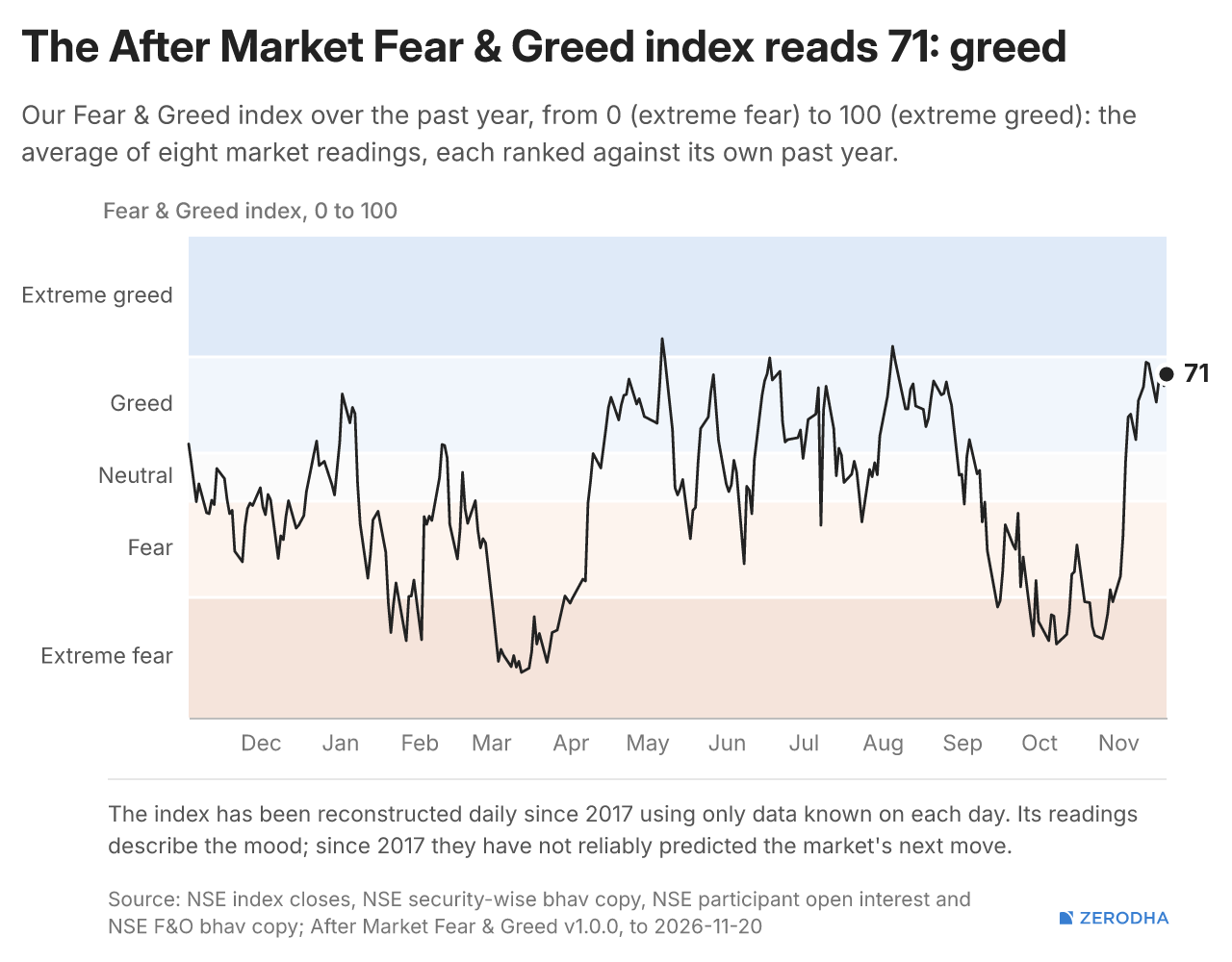
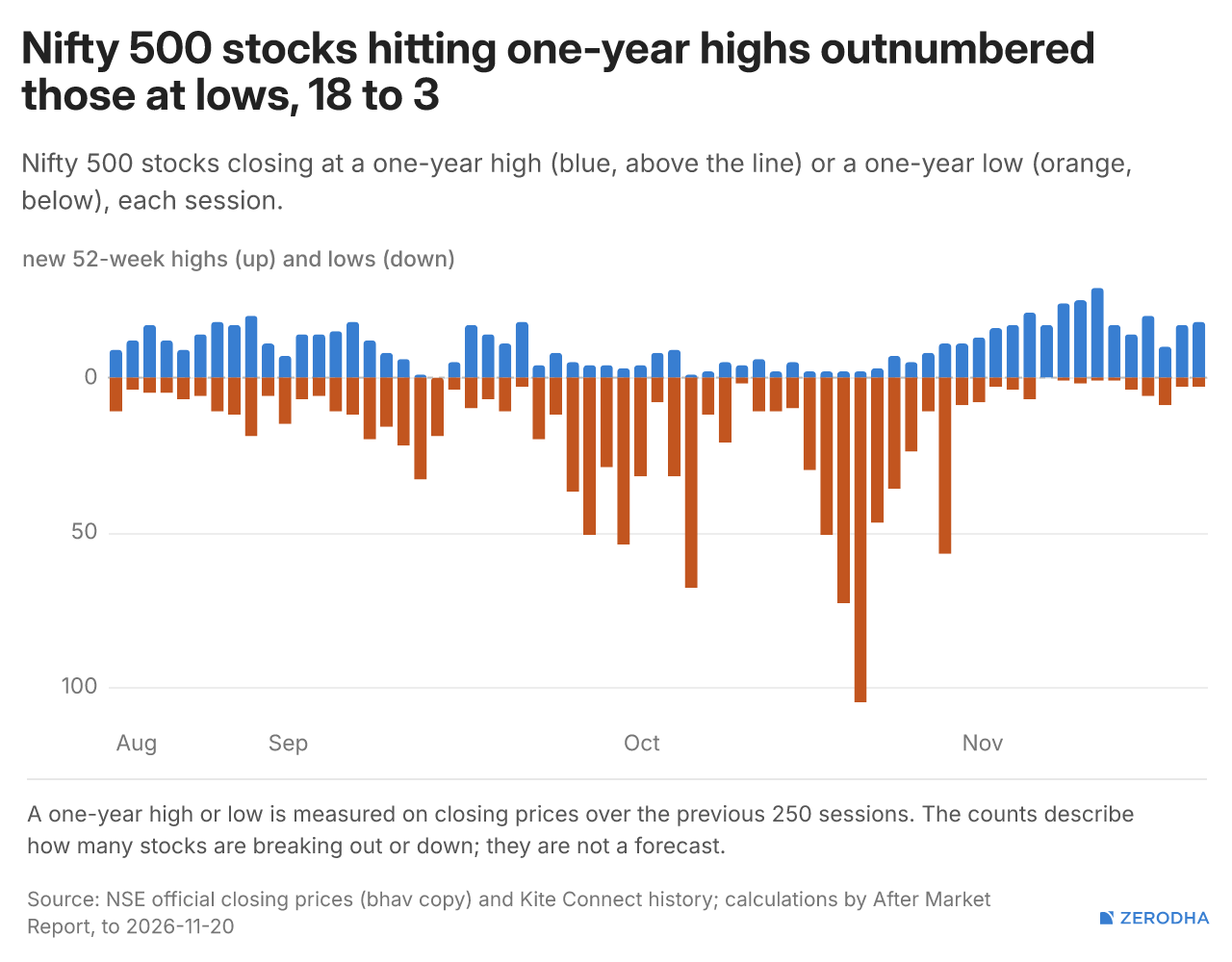
The Fear & Greed Index climbed from 69 to 71, remaining in the greed zone despite growing caution beneath the surface. Strong market momentum supported sentiment, although elevated volatility and an increase in stocks hitting 52-week lows suggested that investors remained cautious.
Market Breadth
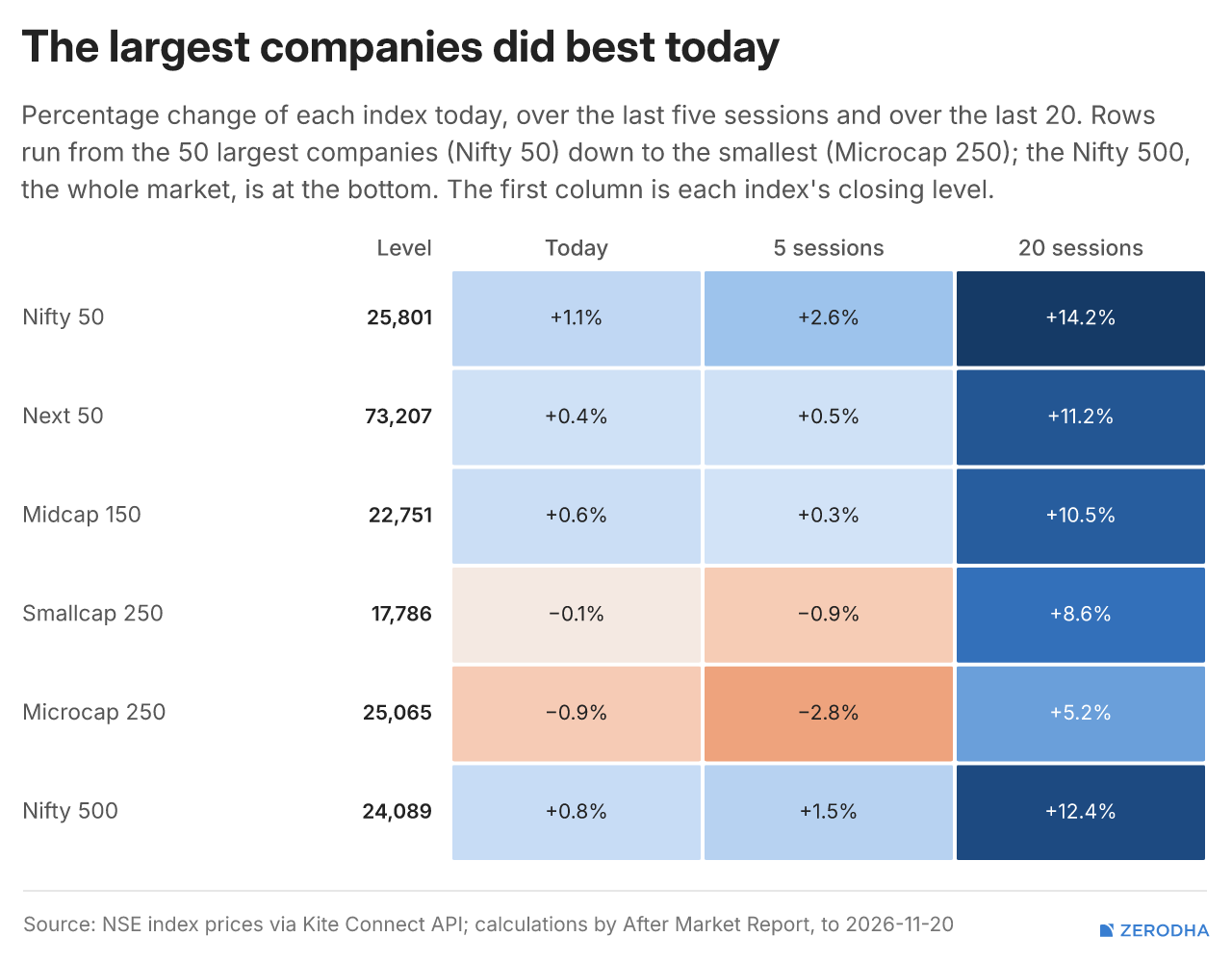
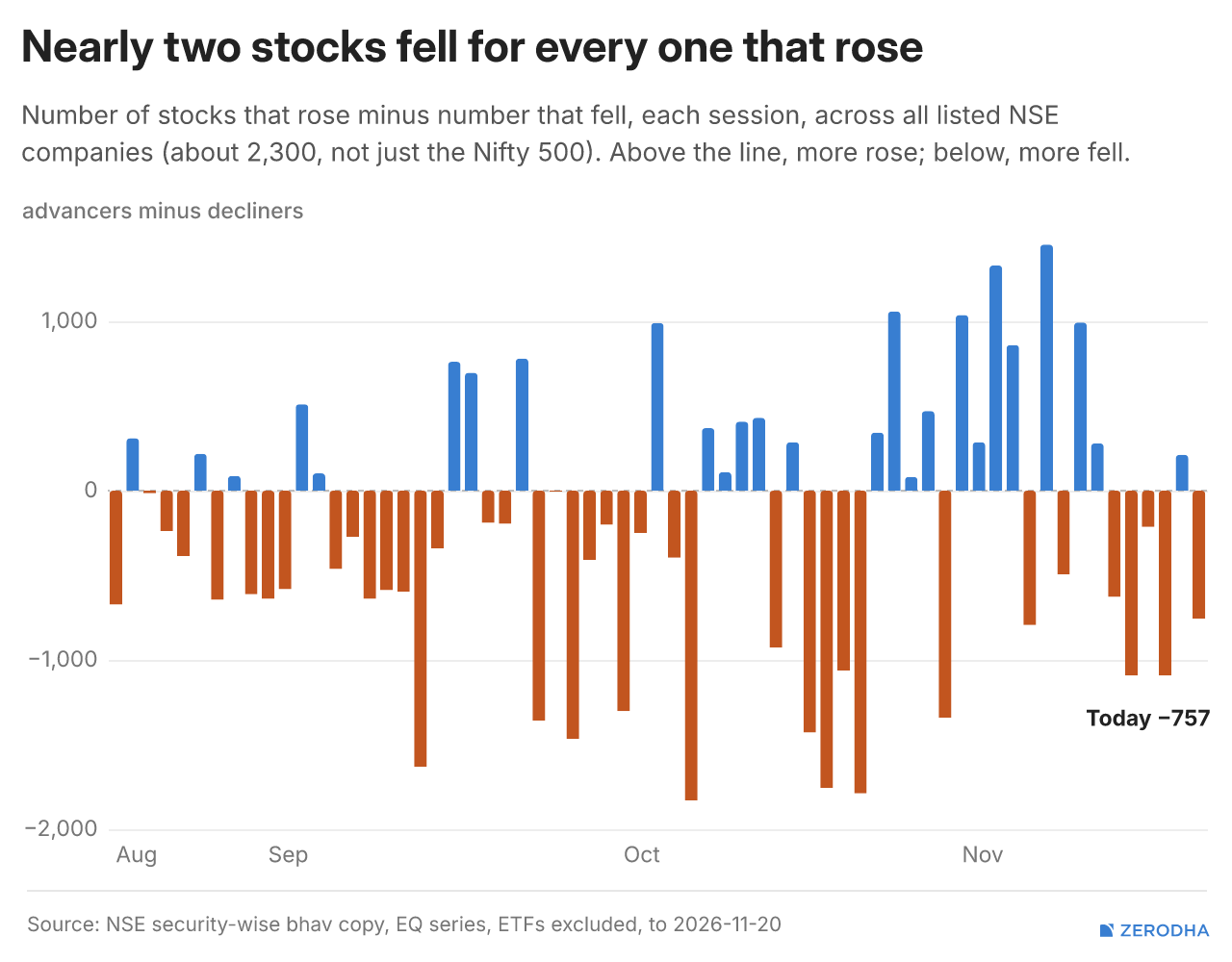
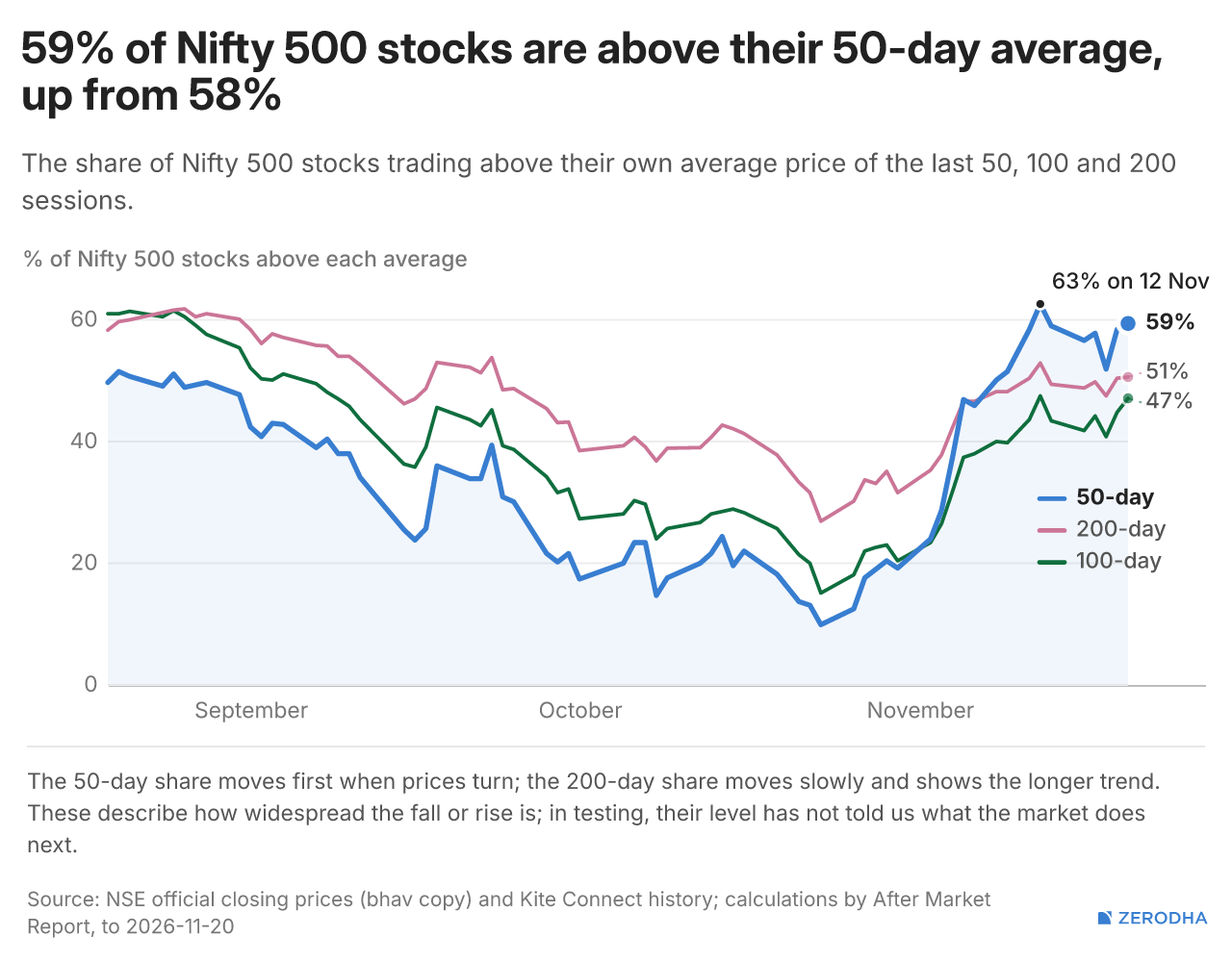
Market breadth remained sharply negative, with 1,568 declining stocks against just 811 advancing, despite Nifty’s strong gains. The average Nifty 500 stock gained only 0.16%, while the share of Nifty 500 stocks above their 50-day moving average improved marginally to 59.4%, highlighting the heavyweight-driven nature of the rally.
52 Week Highs & Lows
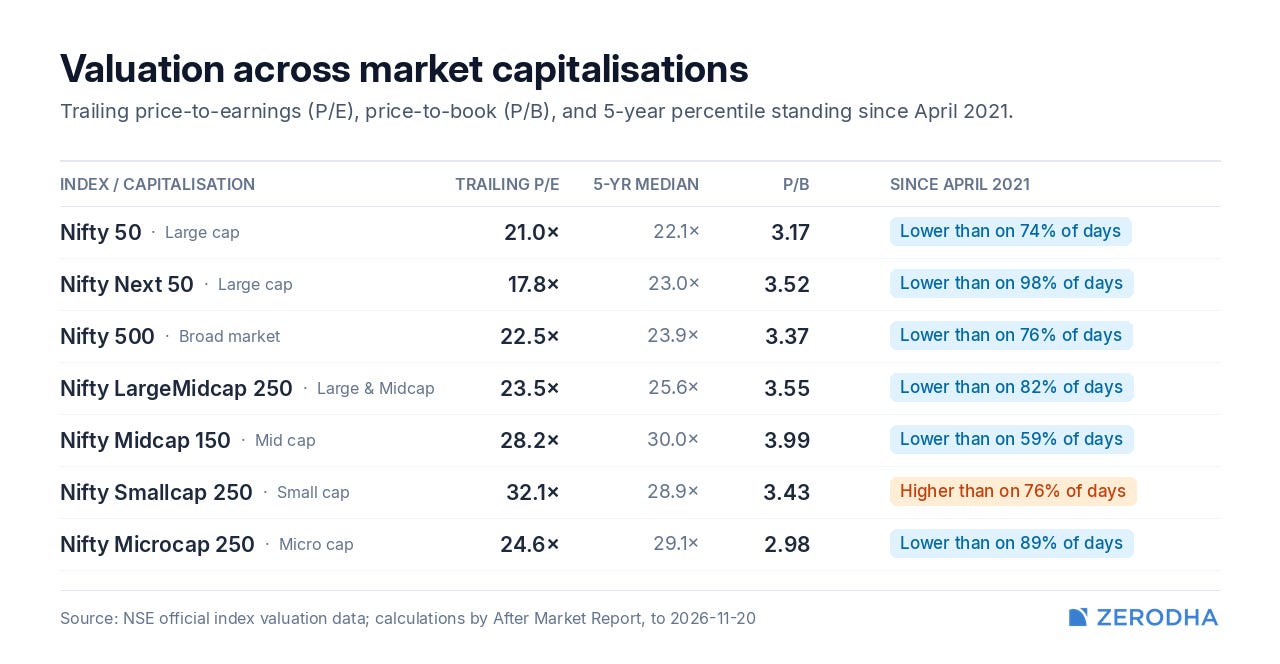
Valuation Check
Sectoral Indices Performance
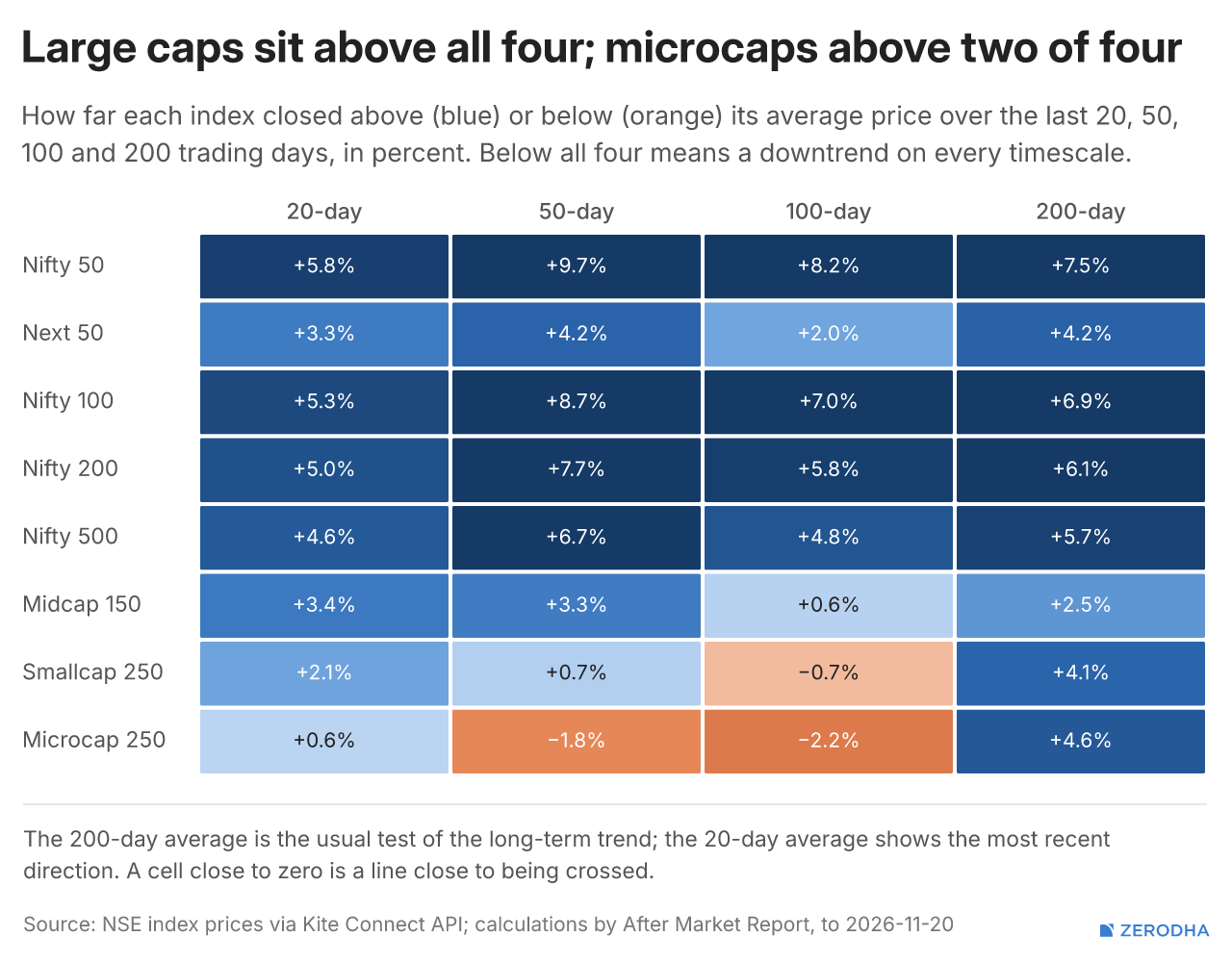
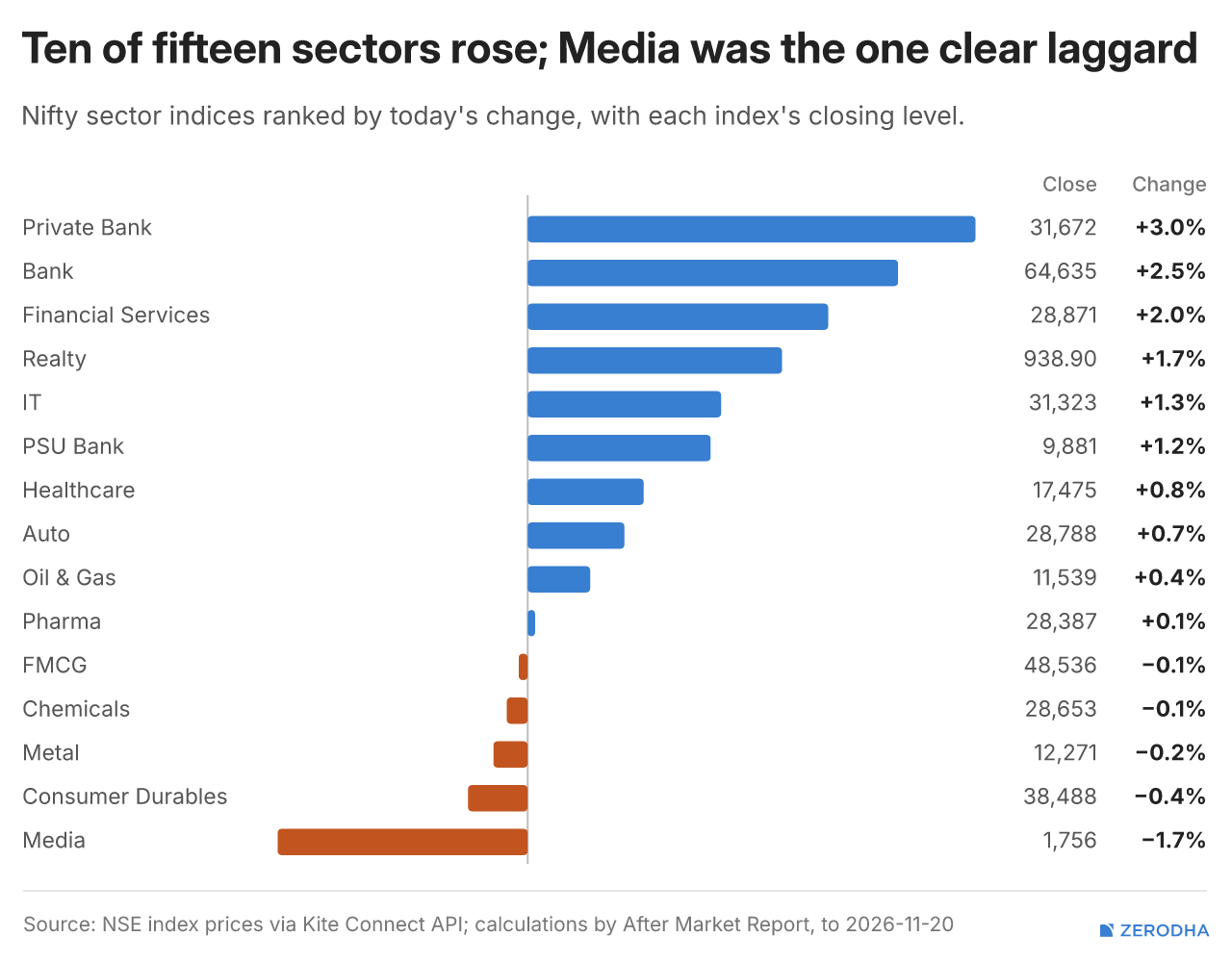
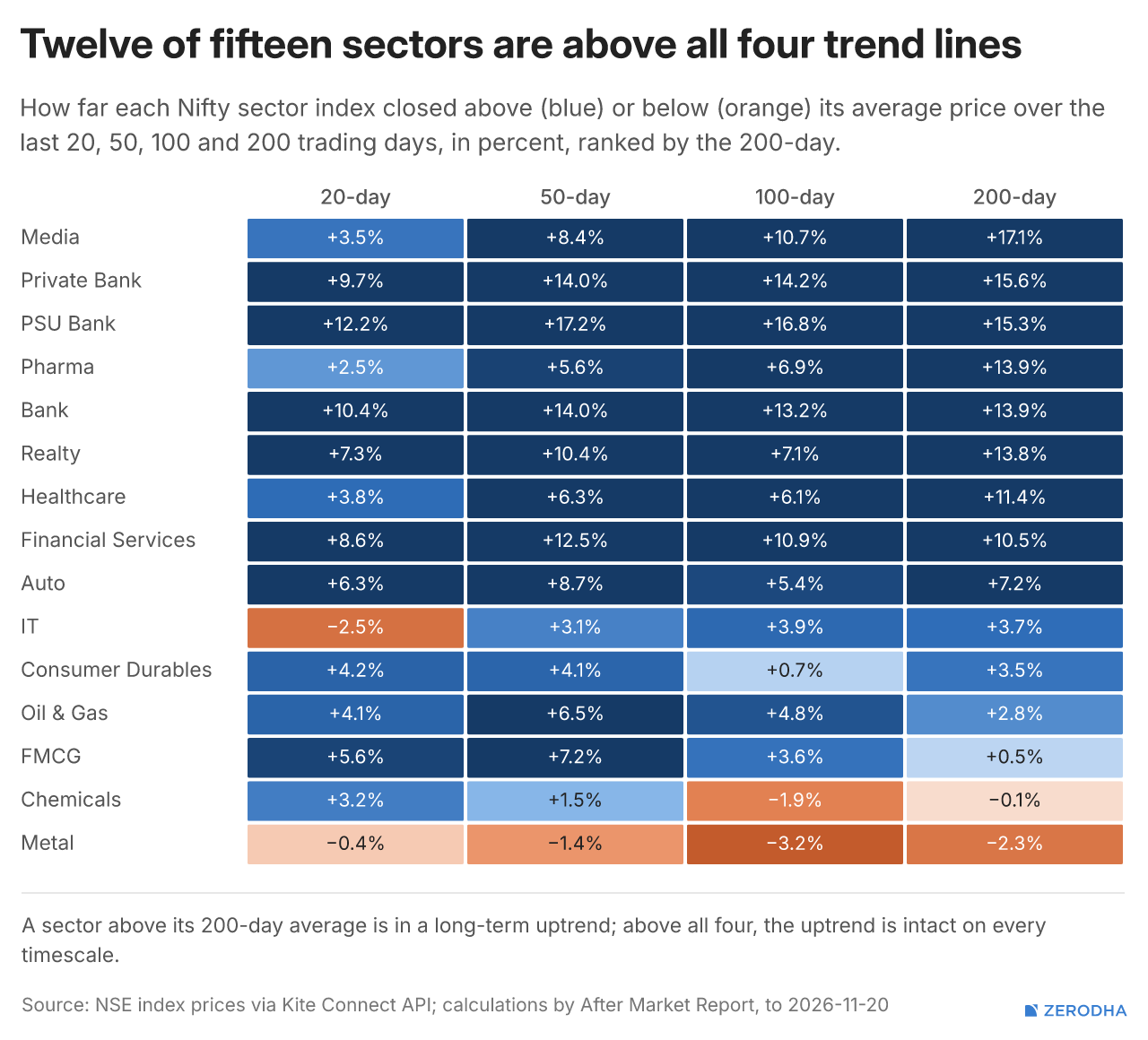
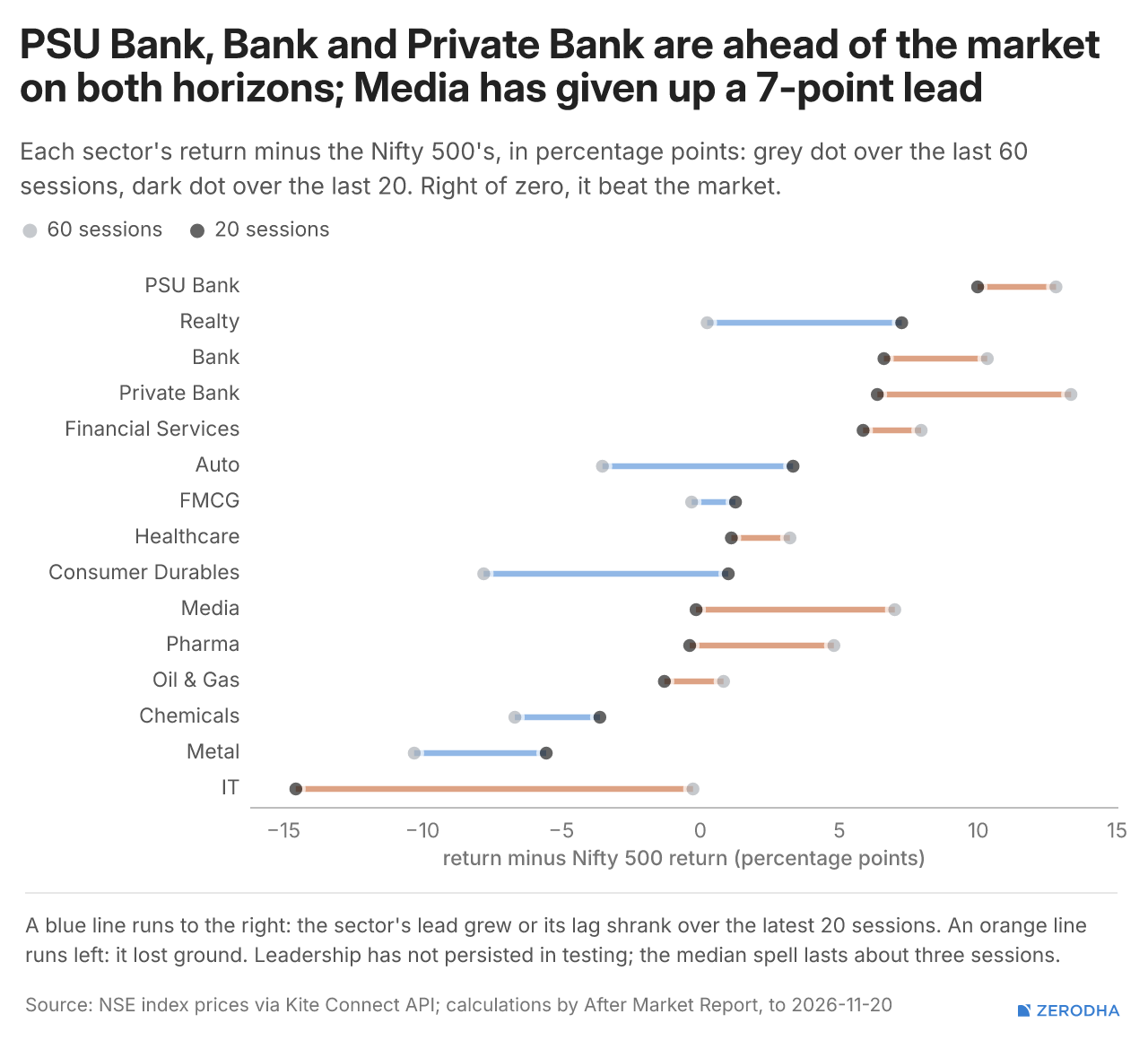
Private Banks led the rally, surging 3.01%, while Media declined 1.68%, with 10 of the 15 sectoral indices ending higher. PSU Banks, Banks and Private Banks continue to outperform over 20 and 60 sessions, with 13 of 15 sectors trading above their 200-day moving averages.
Winners & Losers
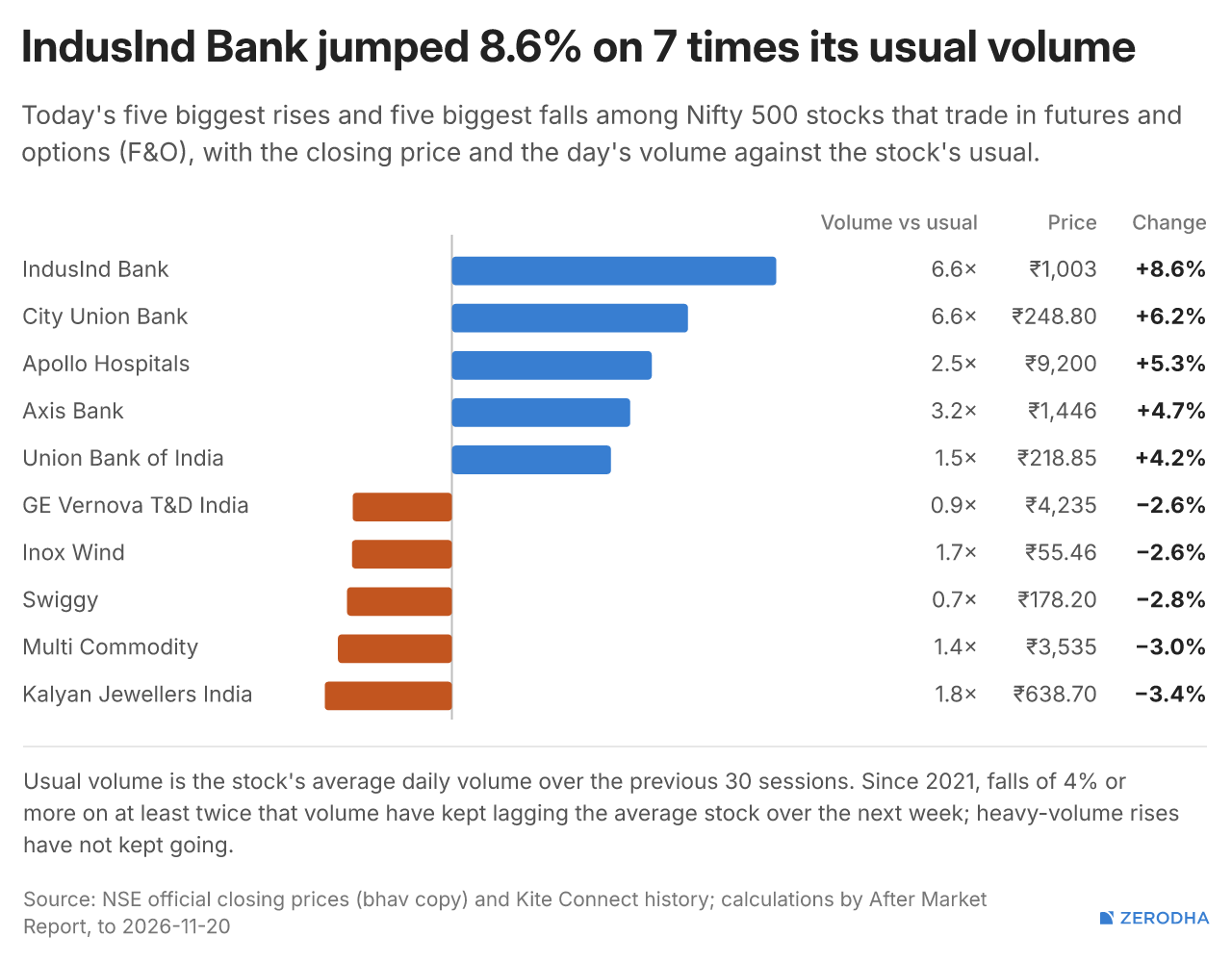
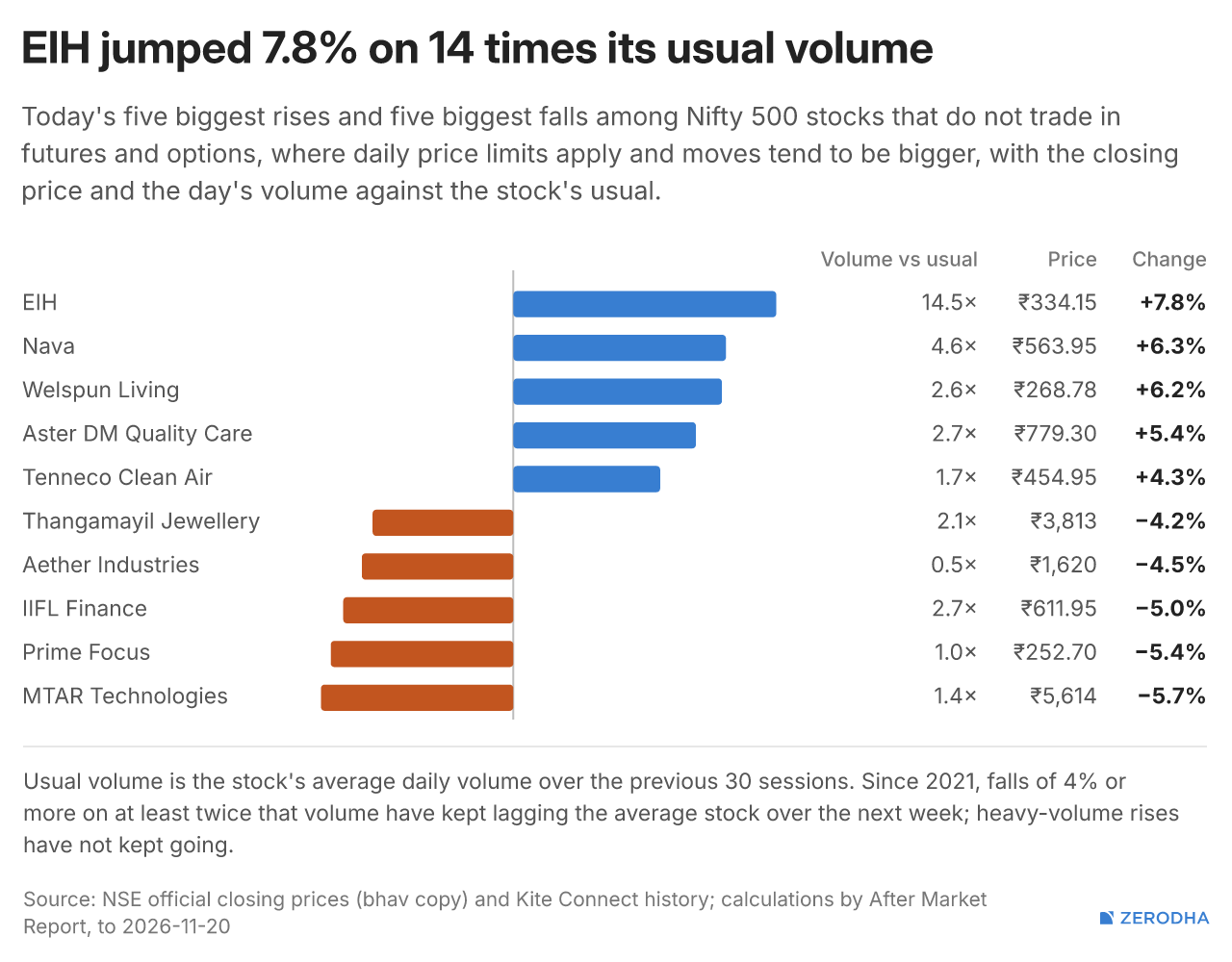
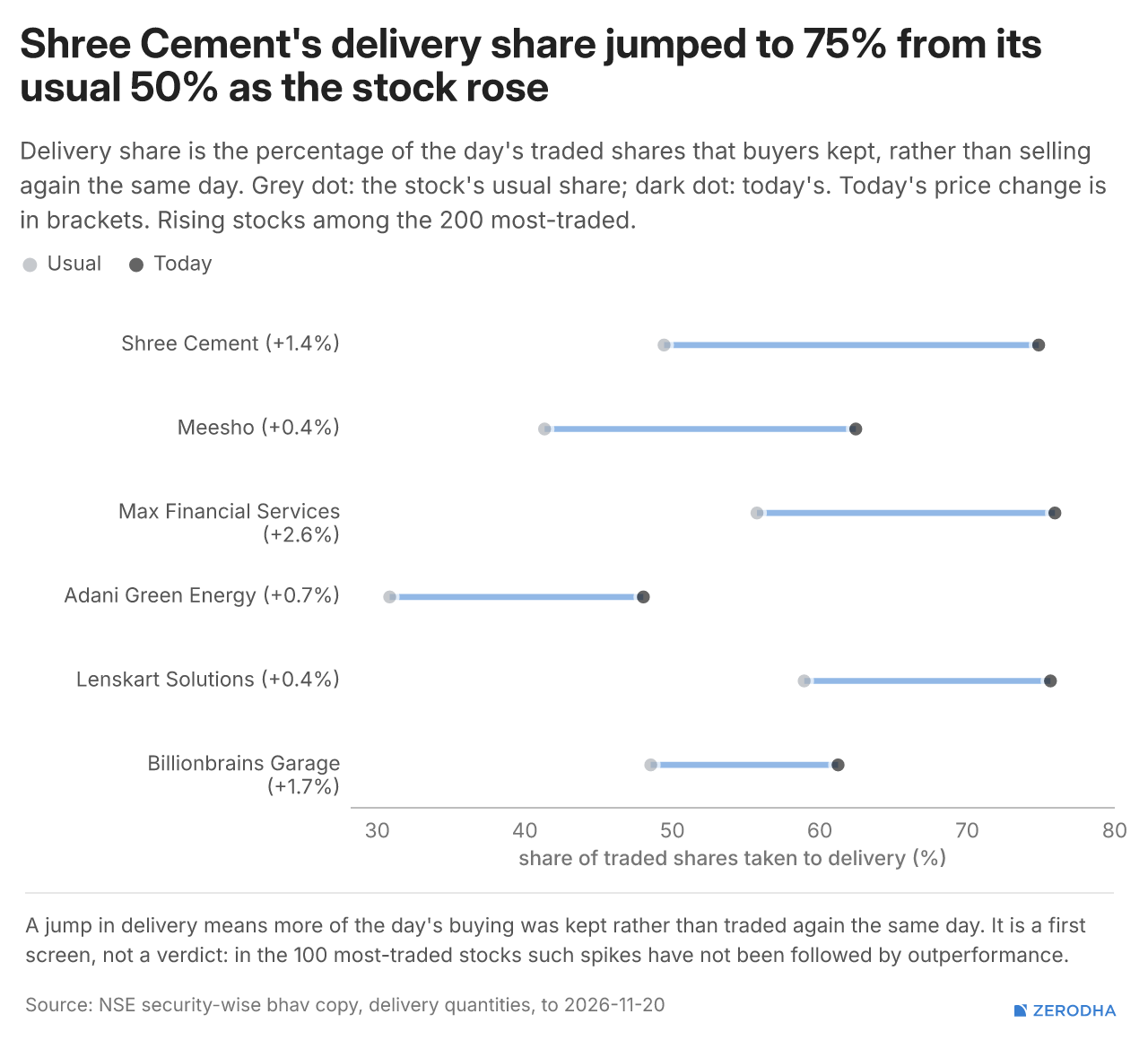
IndusInd Bank surged 8.59% on 6.6× usual volume, while EIH jumped 7.79% on nearly 14.5× volume and City Union Bank gained 6.25%. On the downside, Kalyan Jewellers declined 3.37%, while Shree Cement recorded an unusual delivery spike, with 75% of traded shares taken to delivery against its usual 50%.
Delivery Data
Global Markets
Commodities
Institutional Flows & Participant Positioning
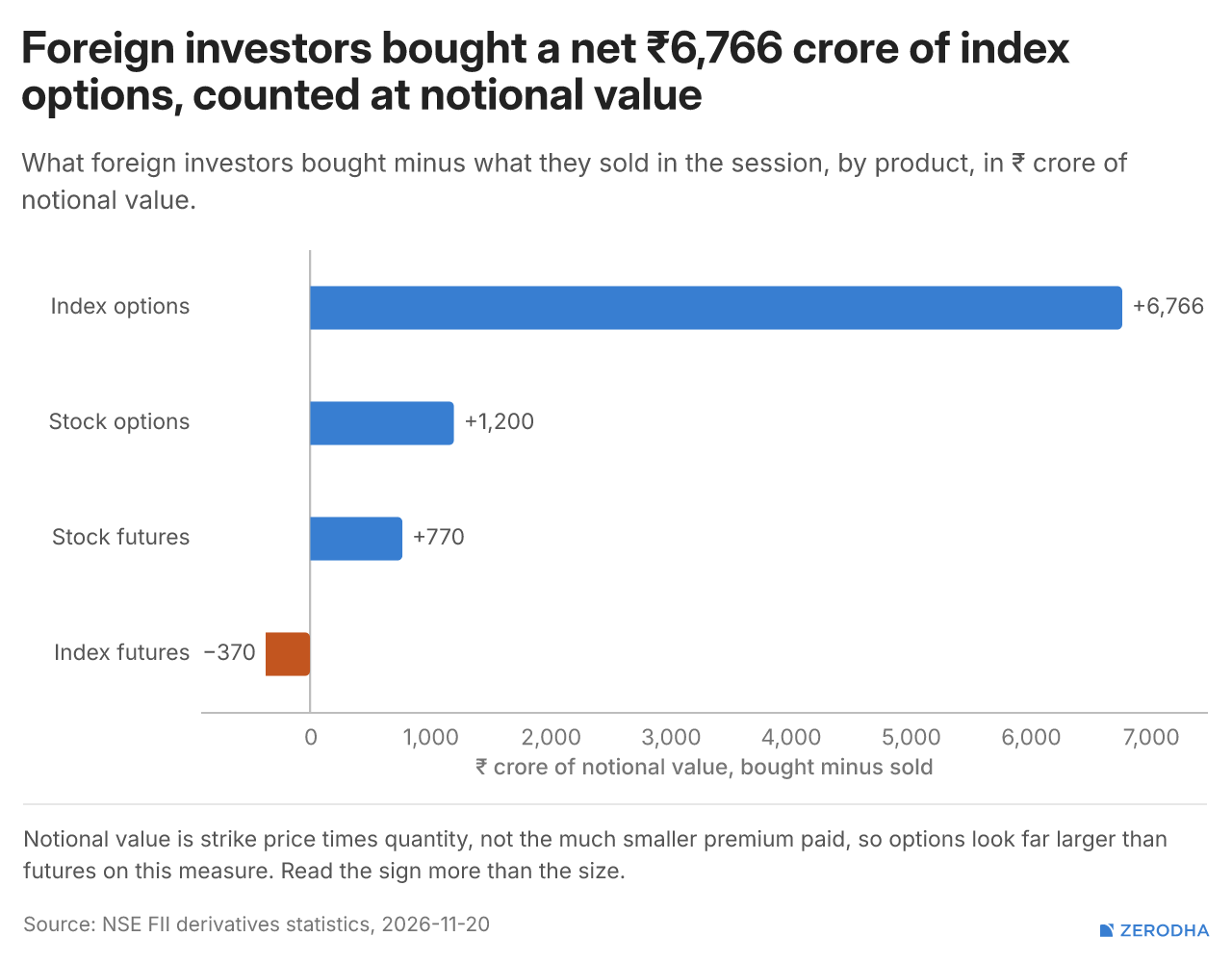
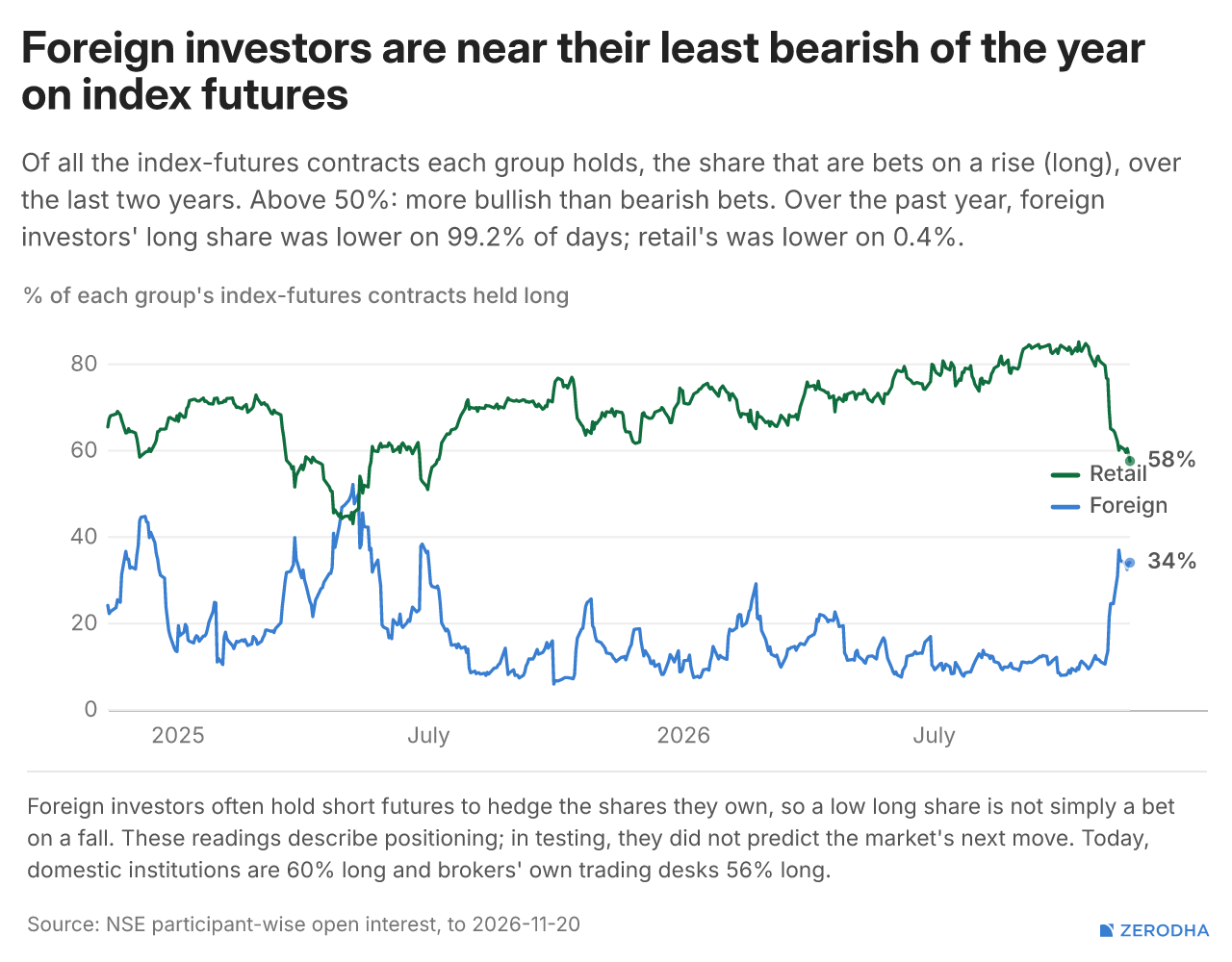
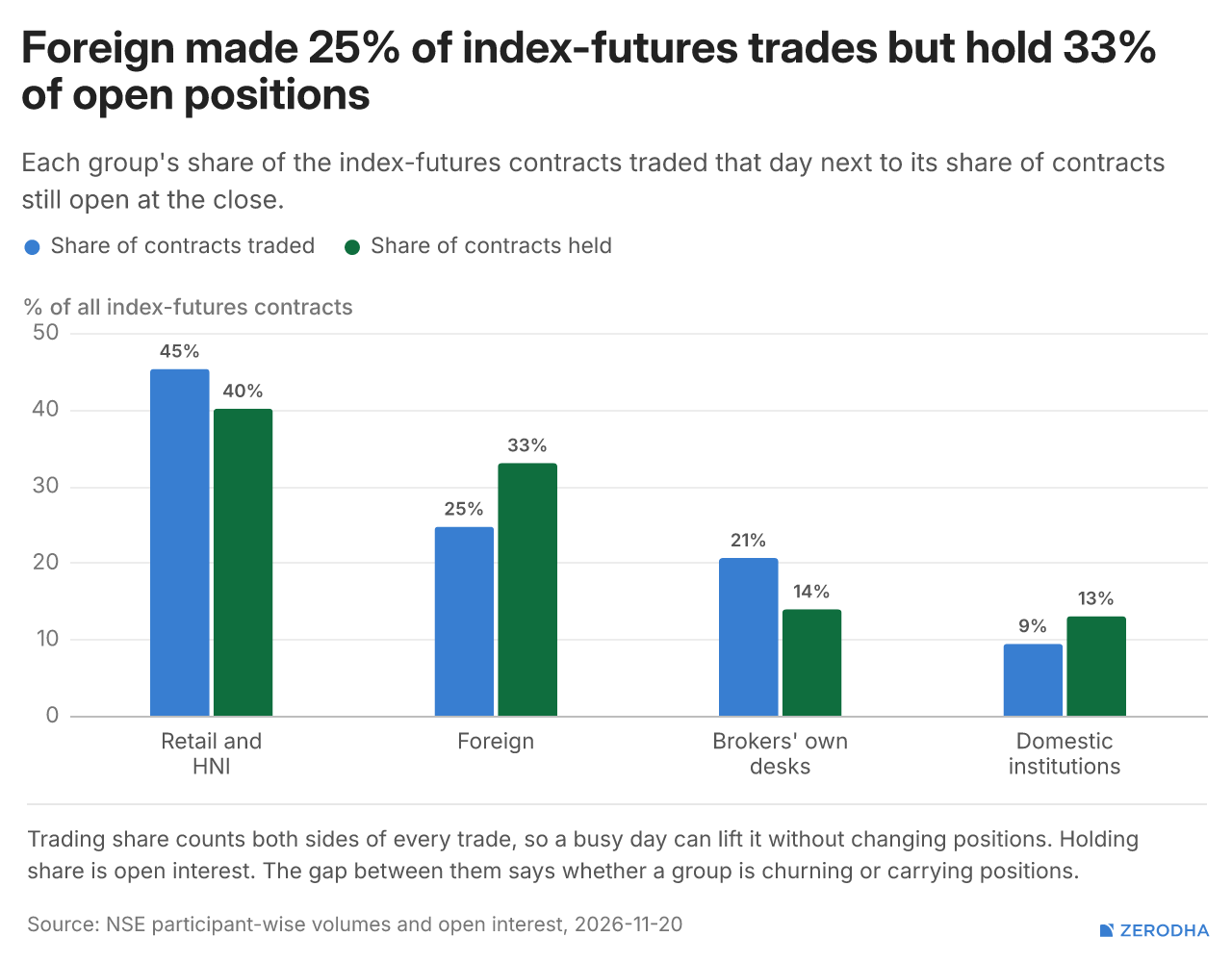
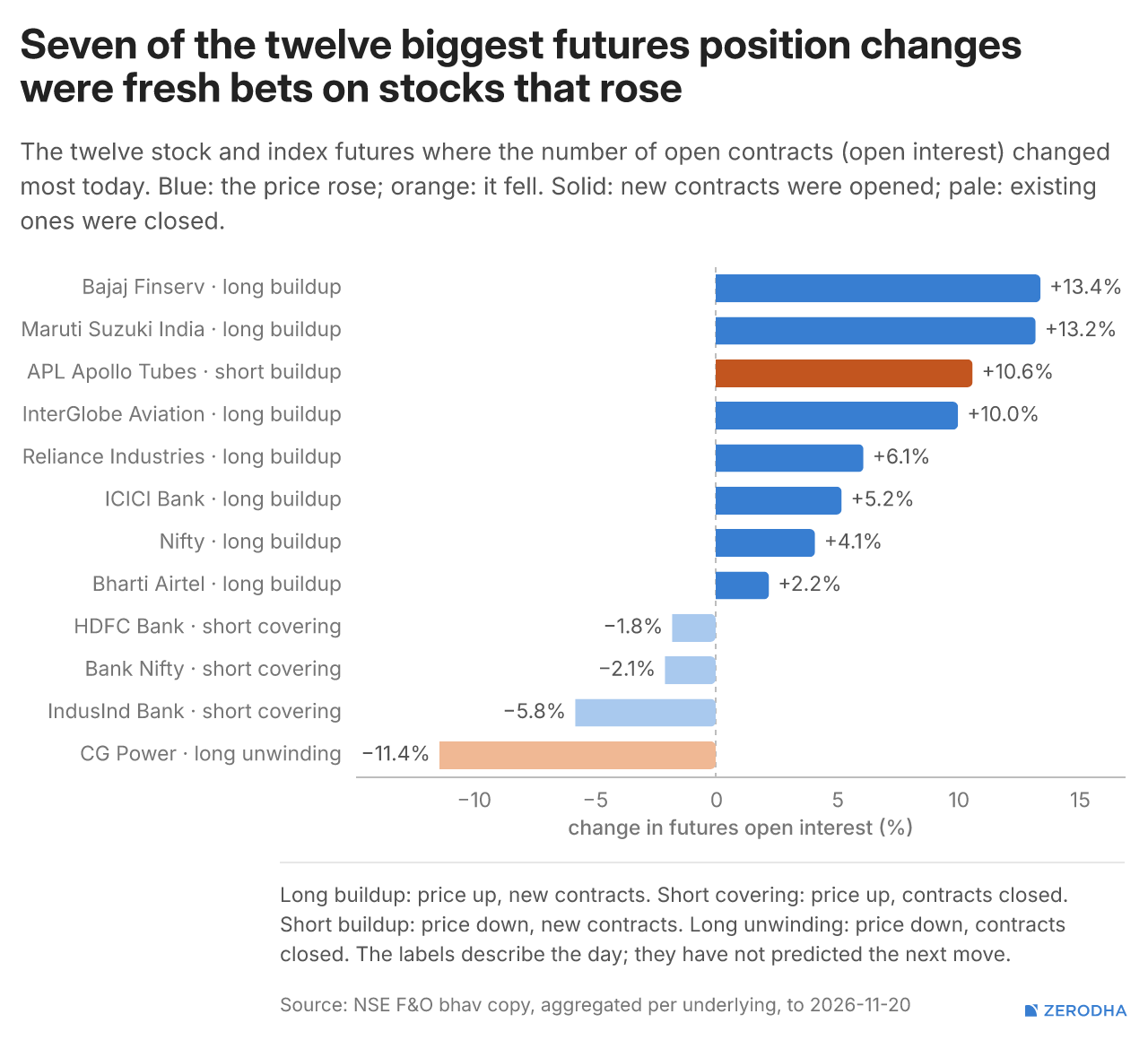
Put writing strengthened, with put open interest rising 12.8% against a 6.1% increase in calls, pushing the put-call ratio from 1.34 to 1.43. FIIs sold 2,207 index-futures contracts worth ₹370 crore, while their long positioning remained at 34.1%, and seven of the 12 largest stock-futures OI changes indicated fresh long buildup.
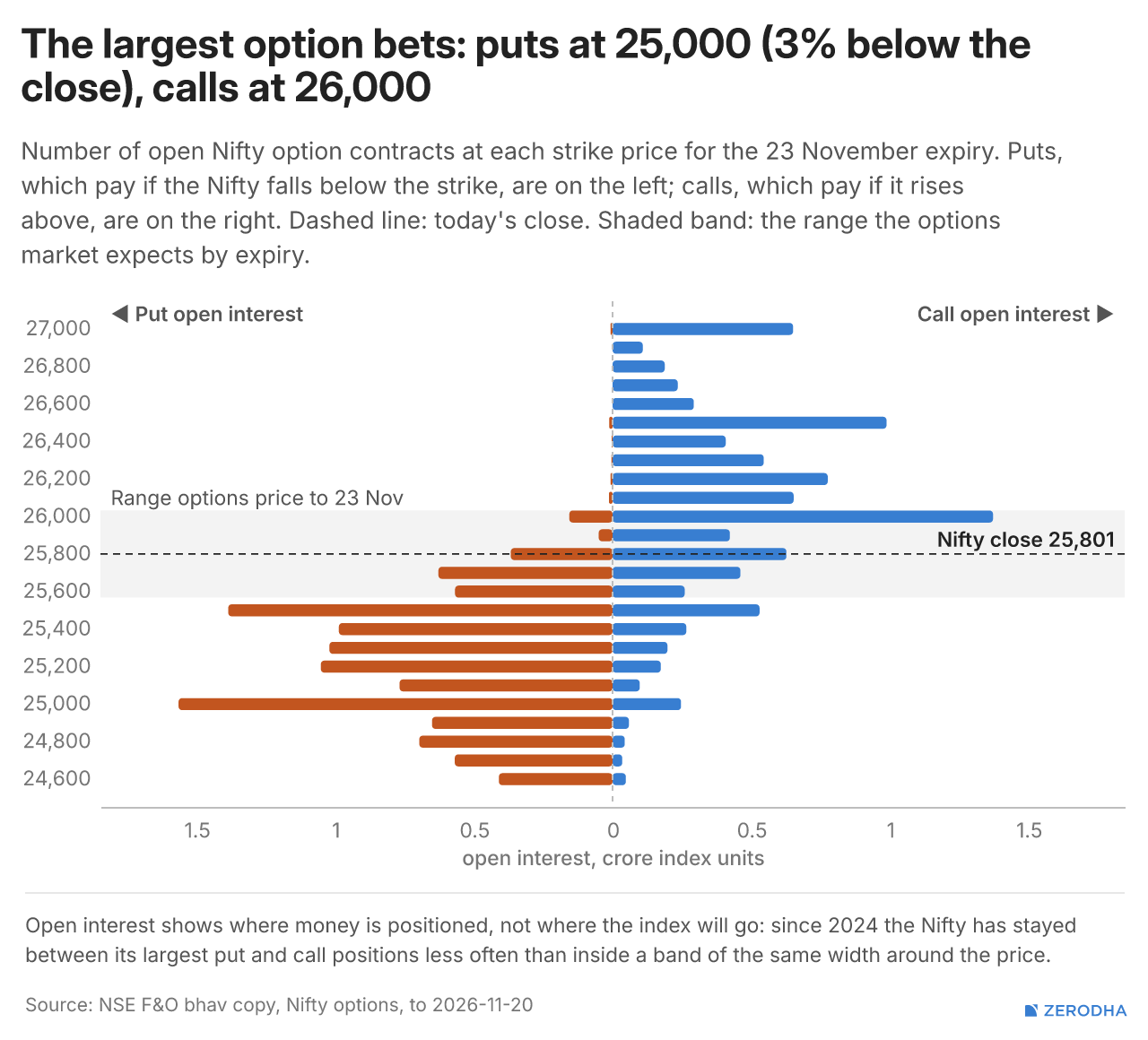
Options imply a 25,541–26,005 range into the November 23 expiry, with the heaviest put open interest at 24,500 and call open interest at 26,000. Nifty's 20-day moving average near 24,395 remains an important technical support level, with the index trading comfortably above it.
Thematic Indices
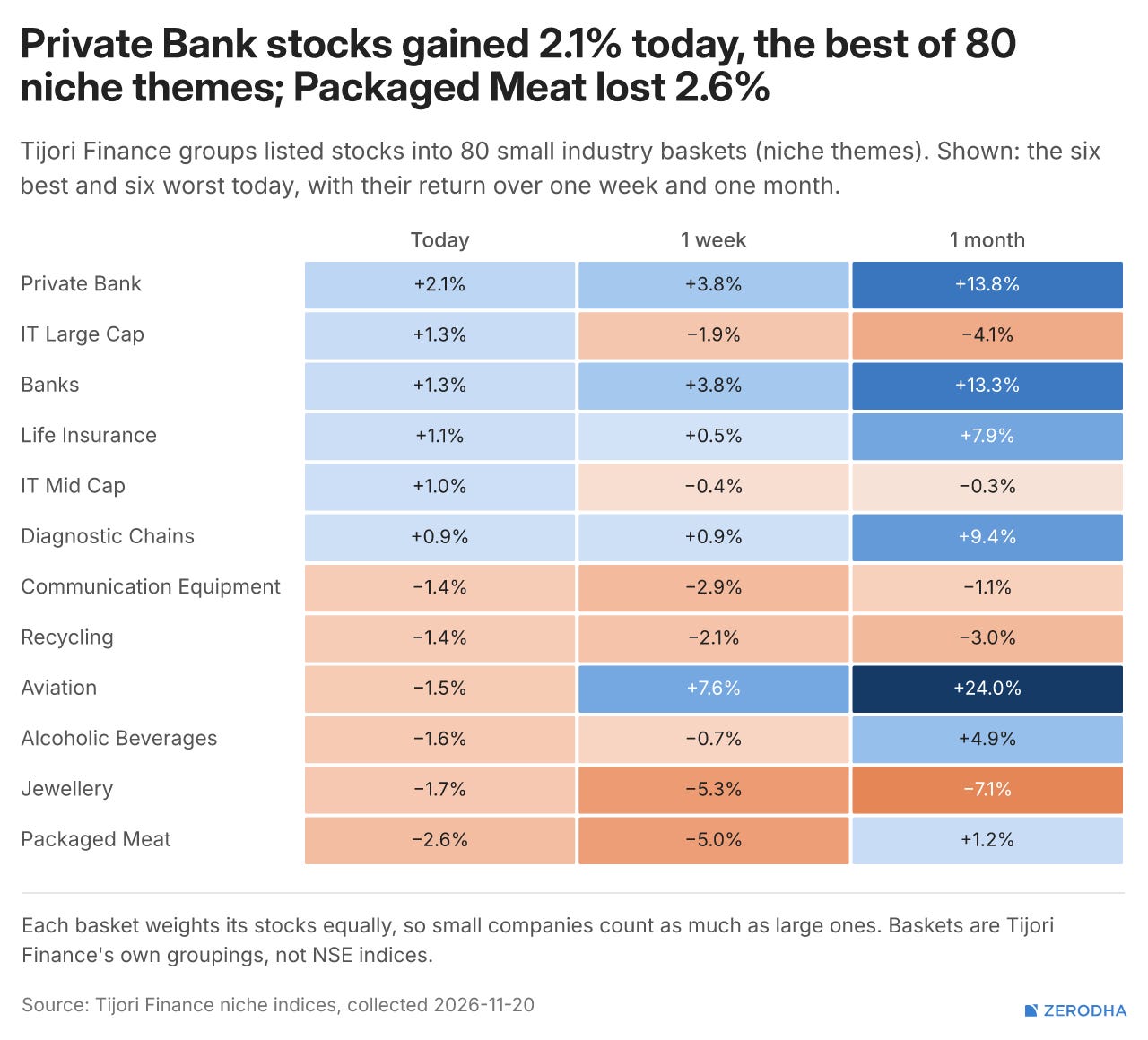
Tijori’s niche indices, where today’s move sorts pockets of the market beyond standard sector baskets. You can also track promoter buying and other interesting stuff, like Capex activity by the companies in the Tijori App’s idea dashboard
F&O Corner

Top Stories in India
India’s core sector output grew 10.9% in October, up from 8.2% in September, driven by strong growth in iron ore (26.4%), coal (23.1%), electricity (21.6%) and cement (15.4%). Cumulative growth during April–October reached 6%, compared with 2.3% a year earlier, although natural gas, crude oil and fertiliser production contracted. Dive deeper
The Indian rupee strengthened to 92.67 against the US dollar, crossing the 93 mark for the first time since April, supported by foreign equity inflows and falling crude oil prices. The currency has recovered sharply, reducing its year-to-date losses to around 3%, while the Nifty 50 recorded its fourth consecutive weekly gain despite a global selloff in AI-linked stocks. Dive deeper
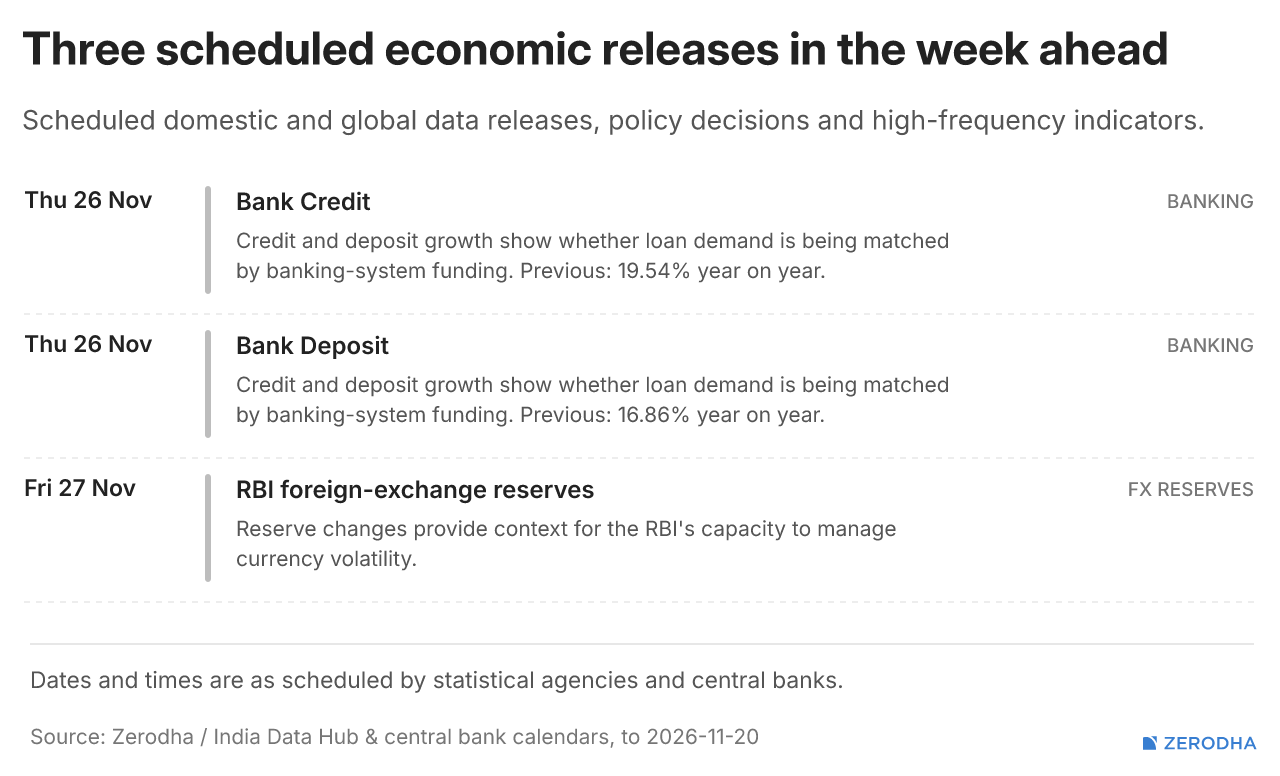
India’s foreign exchange reserves declined by $14.2 billion to $705.34 billion in the week ended November 13, according to RBI data. Foreign currency assets fell $7.89 billion to $583.45 billion, while gold reserves declined by $6.18 billion, accounting for most of the overall reduction. Dive deeper
India’s smartphone market recorded its steepest quarterly contraction since late 2022, with shipments declining 20–23% YoY in Q3 CY2026. Rising memory costs pushed up smartphone prices and weakened demand for budget devices, while premium smartphones remained relatively resilient, making it the weakest festive quarter in a decade. Dive deeper
Shares of textile companies surged up to 8%, with Welspun Living, Pearl Global Industries, Nitin Spinners and Indo Count Industries touching record highs. The rally followed strong Q2 FY27 results, with the textile sector reporting 26% YoY growth, supported by improving demand and higher order execution. Dive deeper
Urban Company raised ₹2,500 crore through a qualified institutional placement (QIP), attracting investor bids exceeding ₹15,000 crore, indicating strong institutional demand. The company plans to use the proceeds to expand its InstaHelp supply ecosystem, strengthen marketing and technology capabilities, invest in training and pursue acquisitions. Dive deeper
Top Stories Globally
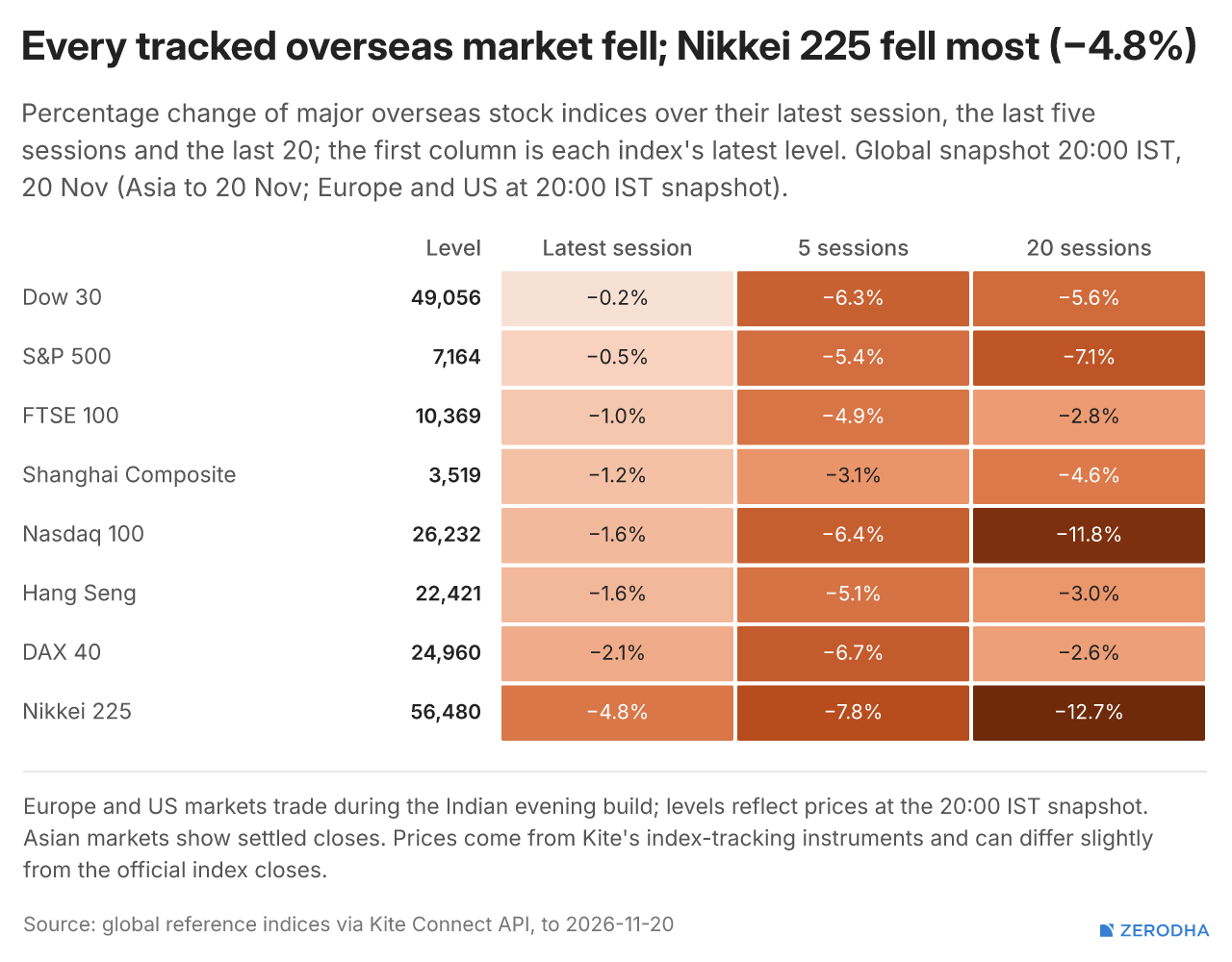
Global equity markets came under heavy selling pressure as Anthropic’s blockbuster IPO failed to restore confidence in AI-linked stocks. Japan’s Nikkei plunged 5%, South Korea’s KOSPI fell over 5%, and Taiwanese equities were down 17% for the week, their worst weekly performance since 1990, as Asian markets headed for their steepest weekly decline since 2020. Dive deeper
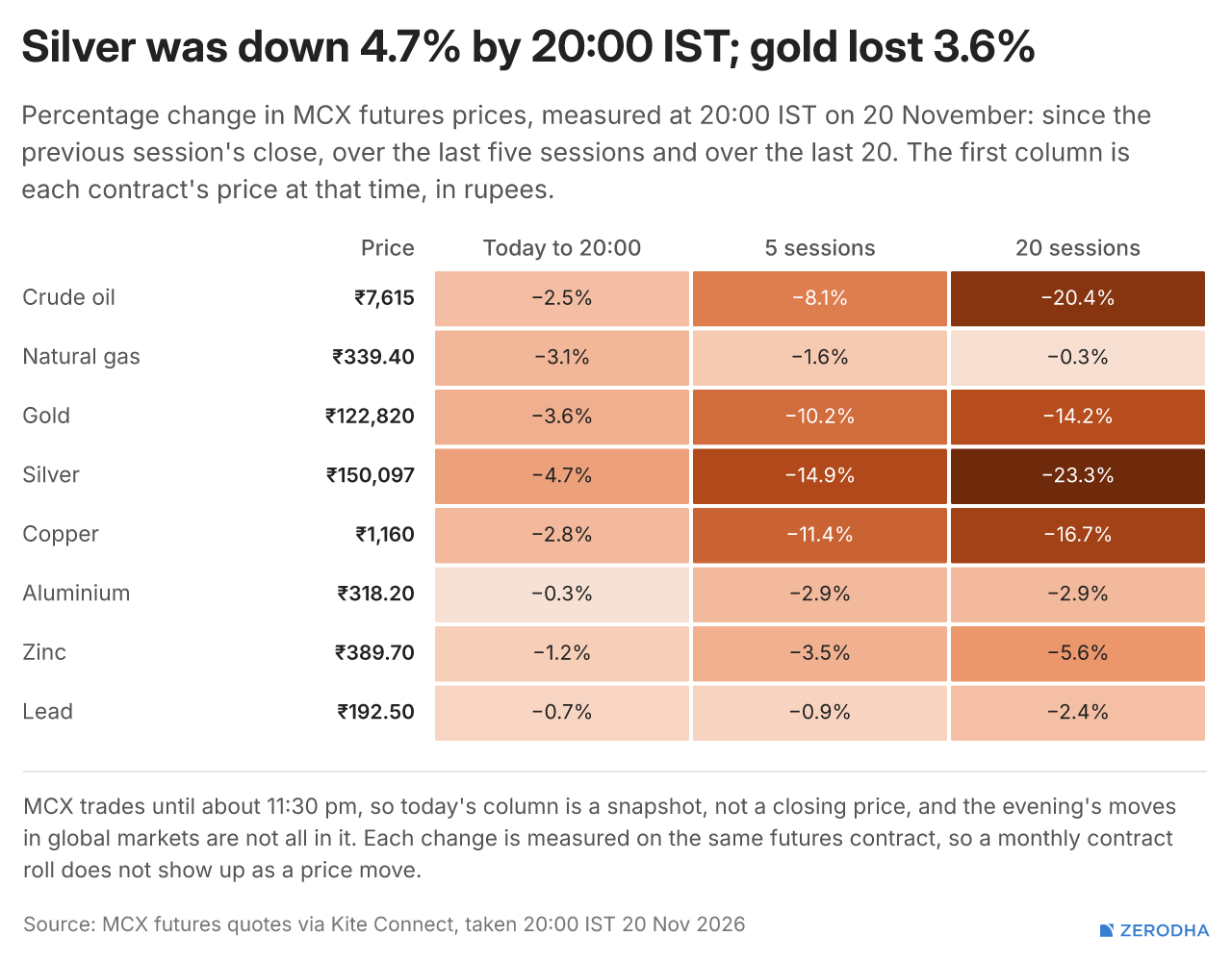
Brent crude declined 0.6% to $91.45 per barrel, while US WTI fell 1% to $82.40, with both benchmarks heading for weekly losses. Strong oil exports from the Middle East weighed on prices despite renewed geopolitical tensions, including Houthi attacks on Riyadh and reported tanker disruptions in the Strait of Hormuz. Dive deeper
The British pound traded just above $1.31, hovering near its weakest level in a year as mixed UK economic data weighed on sentiment. Expectations of further Federal Reserve interest rate hikes continued to support the US dollar, adding pressure on sterling. Dive deeper
Gold prices briefly slipped towards $3,500 per ounce before recovering to around $3,570, their lowest levels since September 2025. The precious metal was headed for a nearly 9% weekly decline as a stronger dollar and expectations of aggressive Federal Reserve tightening, including a potential 50-basis-point hike in December, weighed on prices. Dive deeper
Anthropic shares fell around 10% in premarket trading as a broader selloff in AI stocks intensified, reversing some of the gains from its first trading session. The Claude developer had closed its debut 17% above its $83 IPO price at just over $97 per share, giving it a market capitalisation of nearly $1.3 trillion and a fully diluted valuation of approximately $1.75 trillion. Dive deeper
Management Chatter
In this section, we highlight interesting comments from management at major companies and from policymakers in the Indian and Global Economies.
Dr. V. Anantha Nageswaran, Chief Economic Advisor on International investors positioning in the current market environment:
“As air lets out of the global AI bubble and questions around AI safety and valuations emerge, capital is rotating back toward India. In July and August, when initial doubts around AI surfaced alongside landed Indian crude oil prices dipping to $82 to $85 per barrel, India attracted $5.2 billion in net FII equity inflows. This month alone, net FII inflows have reached roughly $10 billion. Whenever US technology stocks sell off overnight, Indian equities almost invariably outperform the next day, establishing India as a safe haven insulated from an AI downturn.” - Link
Christopher Wood, global head of equity strategy at Jefferies on AI capex cycle:
"Financial markets continue to act like the AI capex cycle has peaked in spite of a lack of any compelling evidence as yet of any such development on the ground. We will continue to assume for now that the market signal is the correct one where the only issue is whether this is the peak of the cycle or a mid-cycle correction," - Link

Check out the latest edition of Chatter here
The week ahead & Corporate Actions
Corporate Actions
Published by Zerodha. Not investment advice. Data from NSE, BSE, and MCX.
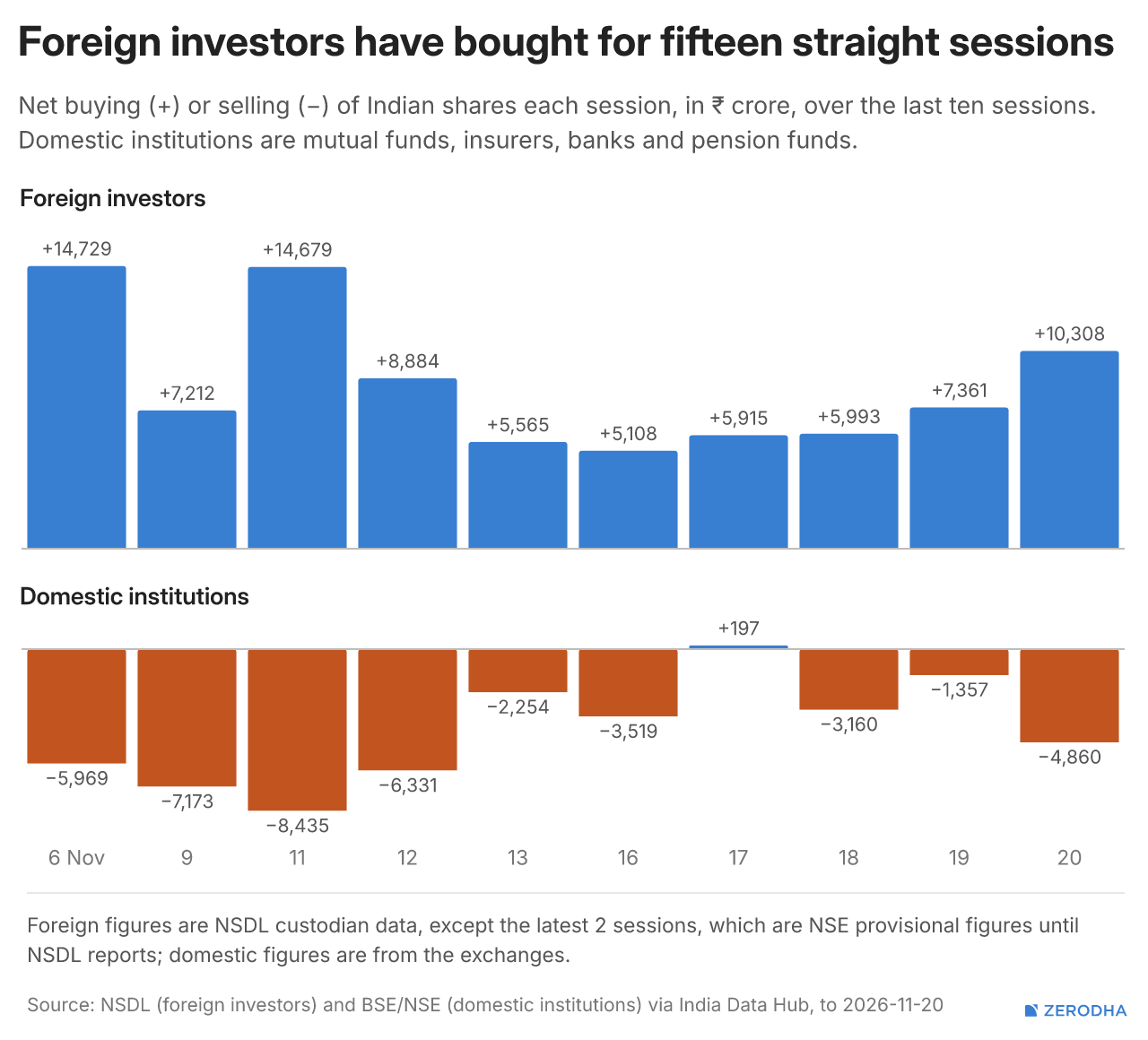
In our latest special episode of In The Money by Zerodha, We discuss the sharp return of foreign investor buying, with FIIs investing nearly ₹77,000 crore in just 10 sessions, and what this shift could mean for the Indian markets.
We also look at the US midterm election results, their potential impact on the AI trade, and what they could mean for India’s trade and tariff outlook.
We then examine India’s latest inflation numbers and whether rising food and core inflation could lead to further RBI rate hikes. The conversation also covers the latest earnings season, the sectors facing margin pressure due to higher raw material costs, and where foreign investor flows are concentrated.
To wrap up, we discuss the outlook for Nifty and the broader markets over the coming weeks, how earnings reactions are changing, and the sectors and opportunities that could attract investor interest.
That’s it from us for today. We’d love to hear your feedback in the comments, and feel free to share this with your friends to spread the word!
Very informative article..keep it coming
Strong outflows were clear as value of stock went down … strong inflows is not known as we dont know when they return…. What the mkt rejected as non performing share … Maruti and co outperformed on a single day or so … Analysis of mkt continues to be post mortem and also proving dependance on forex inflows