

Welcome to Aftermarket Report, a newsletter where we do a quick daily wrap-up of what happened in the markets, both in India and globally.
We’re trying out a new format for the Aftermarket Report, with much more comprehensive coverage of the data that shapes the trading day. Beyond the headline indices, we’re now looking at market breadth, new highs and lows, sector and thematic performance, delivery data, F&O positioning, global markets, commodities, flows, and more.
The idea is to bring different datasets together in one place and help traders and investors get a clearer picture of what’s actually happening beneath the surface of the market.
This is still a work in progress, so we’d really love your feedback. Tell us what you found useful, what you didn’t, what felt unnecessary, and what else you’d like us to add. Your feedback will help us shape the Aftermarket Report from here.
Markets Today
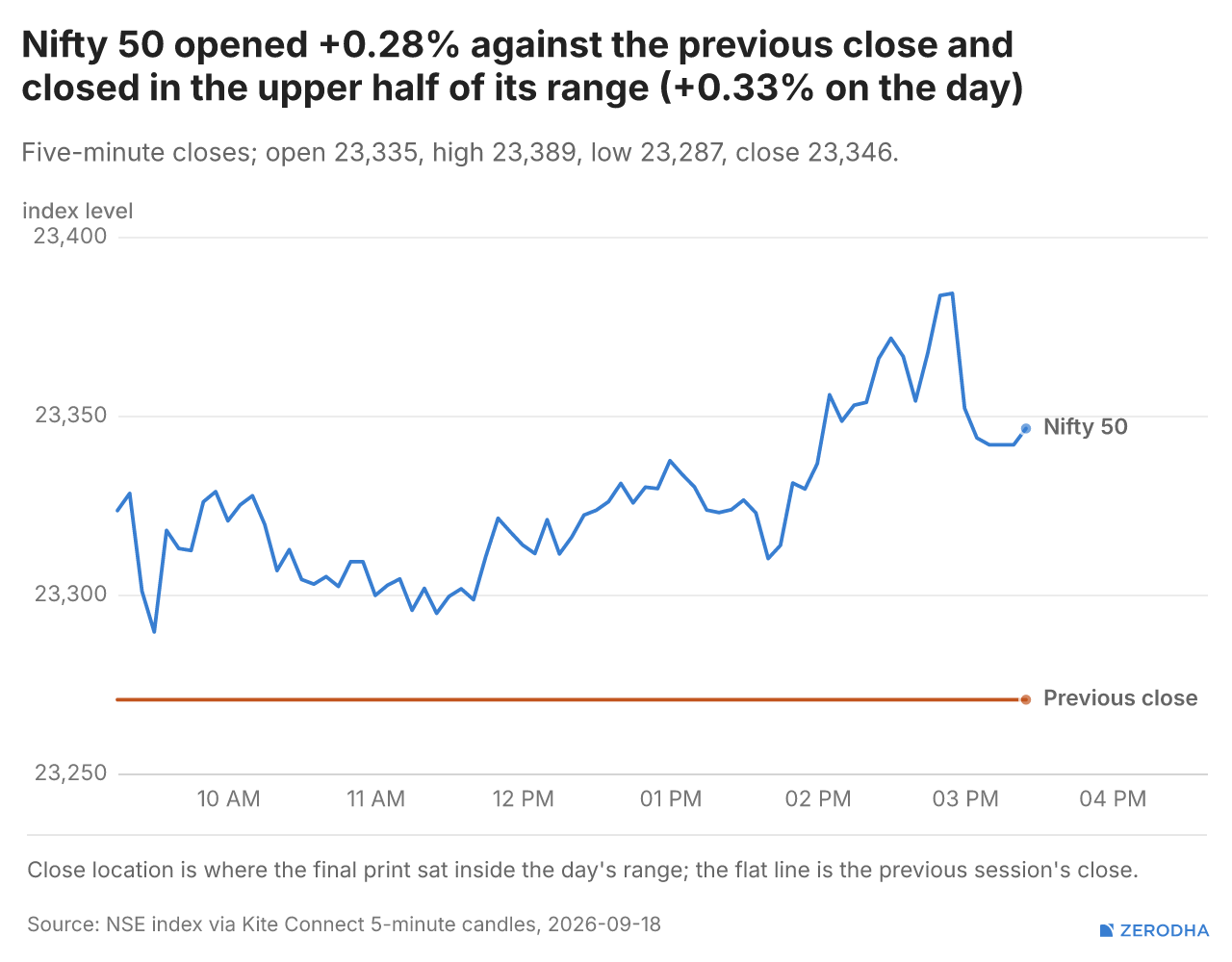
Nifty opened with a 65-point gap up at 23,335, encouraged by global equities brushing off post-rate-hike jitters, while relative calm in crude oil, which consolidated just above $100 per barrel, provided some relief.
However, the index struggled to build on the positive opening and turned volatile almost immediately, slipping towards 23,290 within the first half hour. A quick recovery took Nifty back towards 23,330, but the move failed to sustain, with the index gradually drifting towards the 23,295–23,310 zone by around 11 AM.
The index remained subdued through the remainder of the first half before sentiment gradually improved around noon. Nifty reclaimed 23,320 and continued to grind higher, reaching around 23,340 by 1 PM. After another brief dip towards 23,310 around 1:30 PM, buying momentum strengthened sharply. Nifty crossed 23,350 after 2 PM and extended the rally to an intraday high near 23,385-390 around 3 PM.
Some cool-down followed in the final half hour, pulling the index back towards 23,340, before a modest closing recovery. Nifty eventually settled at 23,346.40, around 11 points above its opening level, ending the session higher after a volatile but improving second half.
Market Breadth
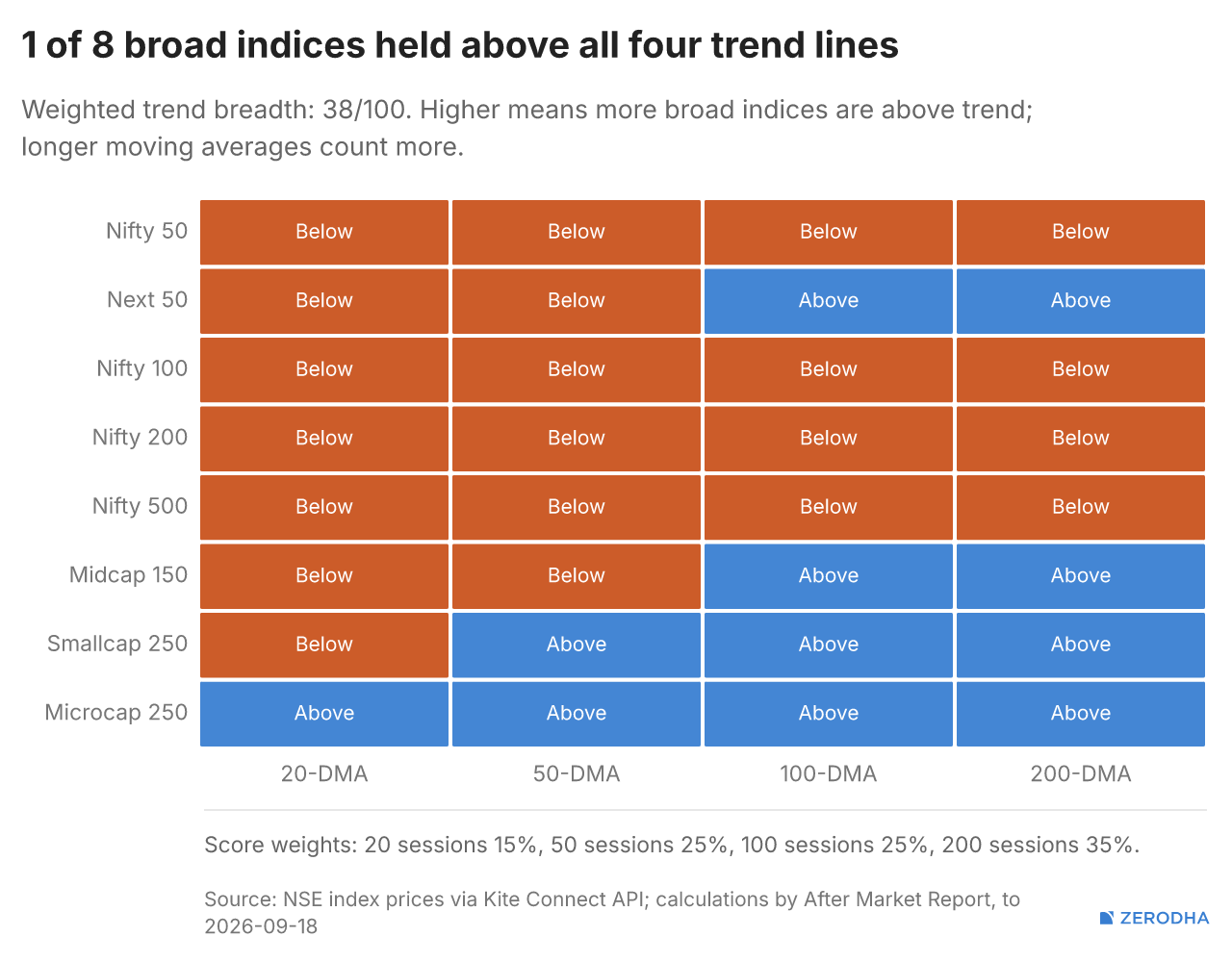
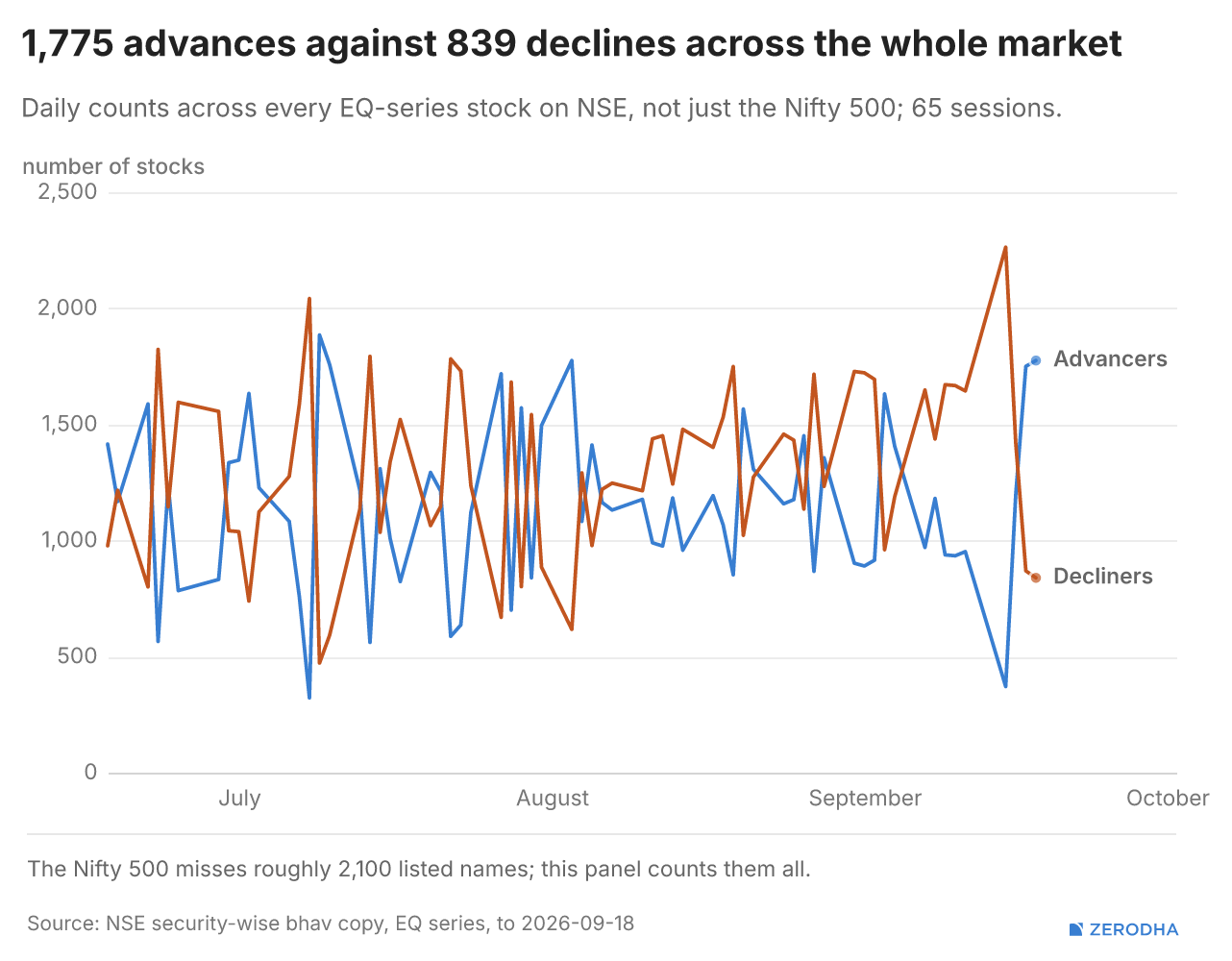
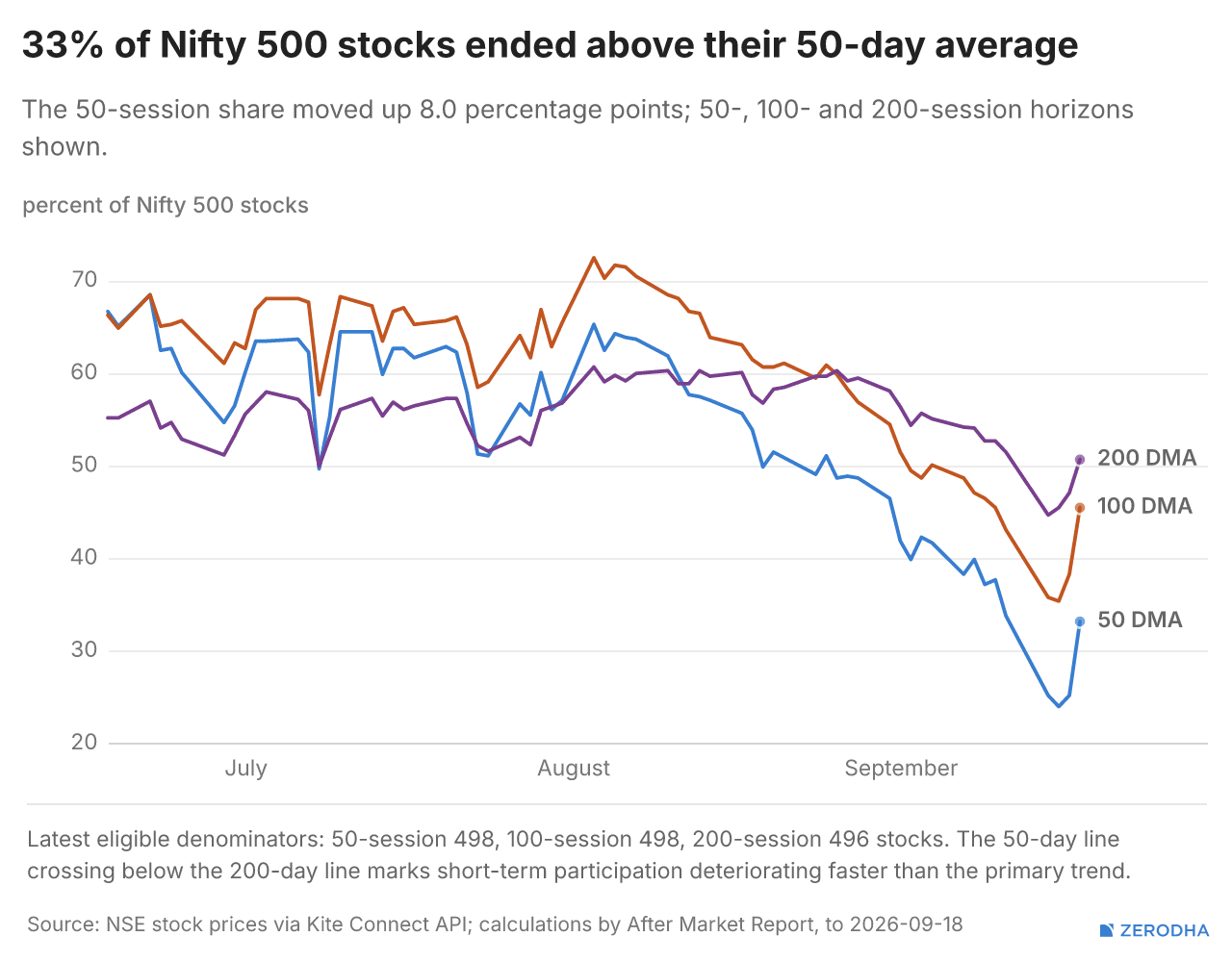
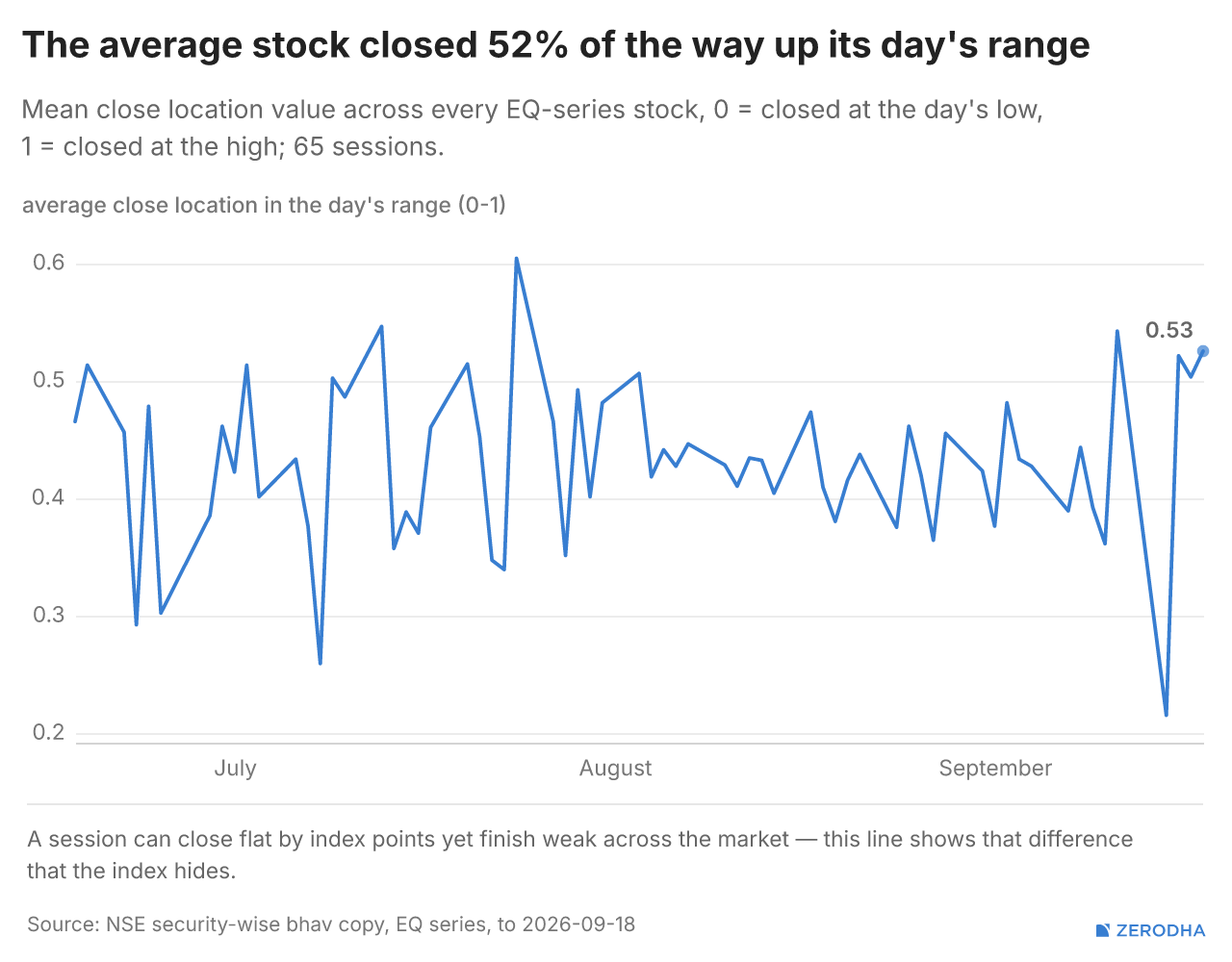
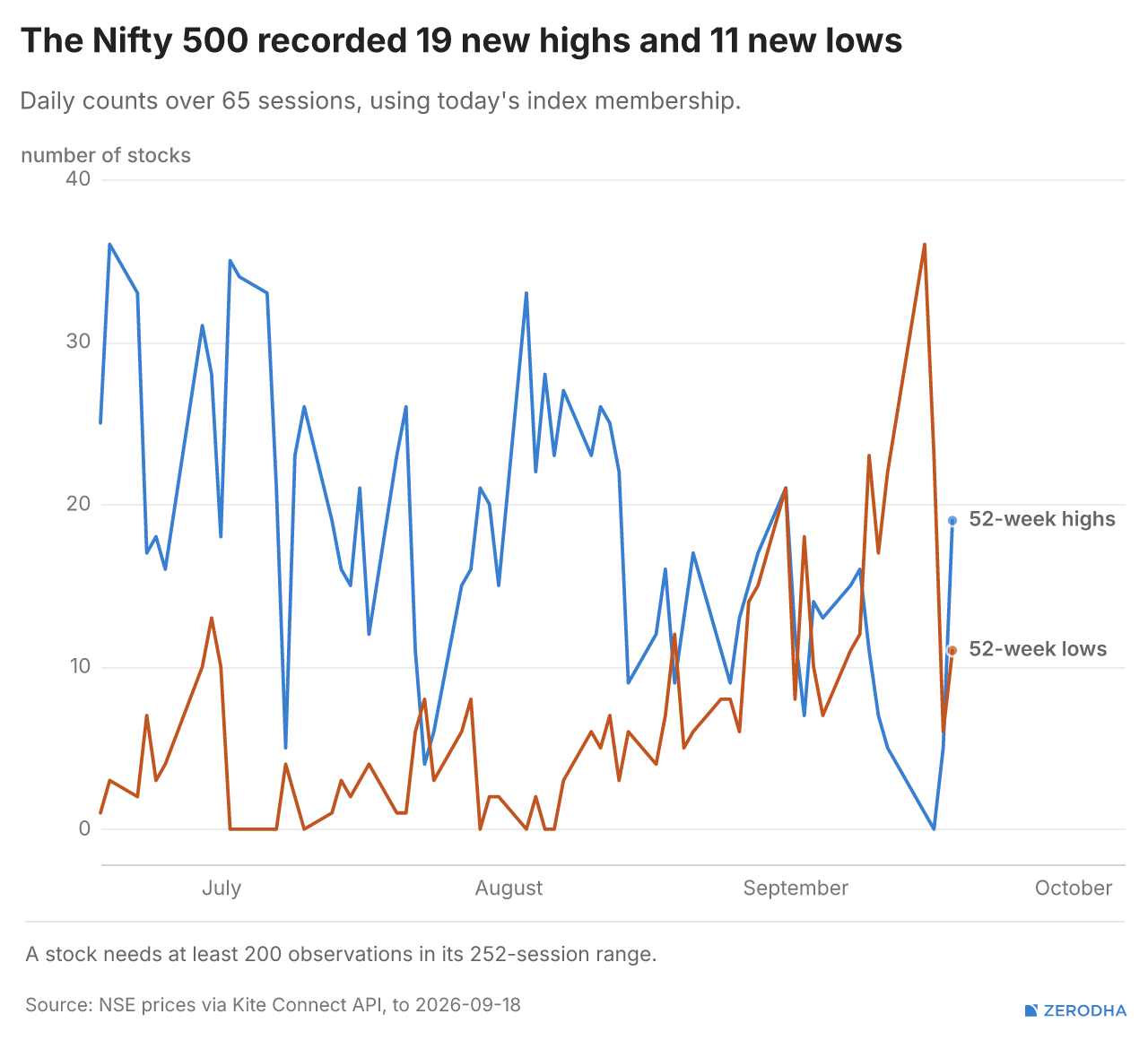
Breadth strengthened sharply, with 1,775 advancers against 839 decliners, while 33.1% of Nifty 500 stocks were above their 50-day average. New 52-week highs also outnumbered lows, 19 to 11.
52 Week Highs & Lows
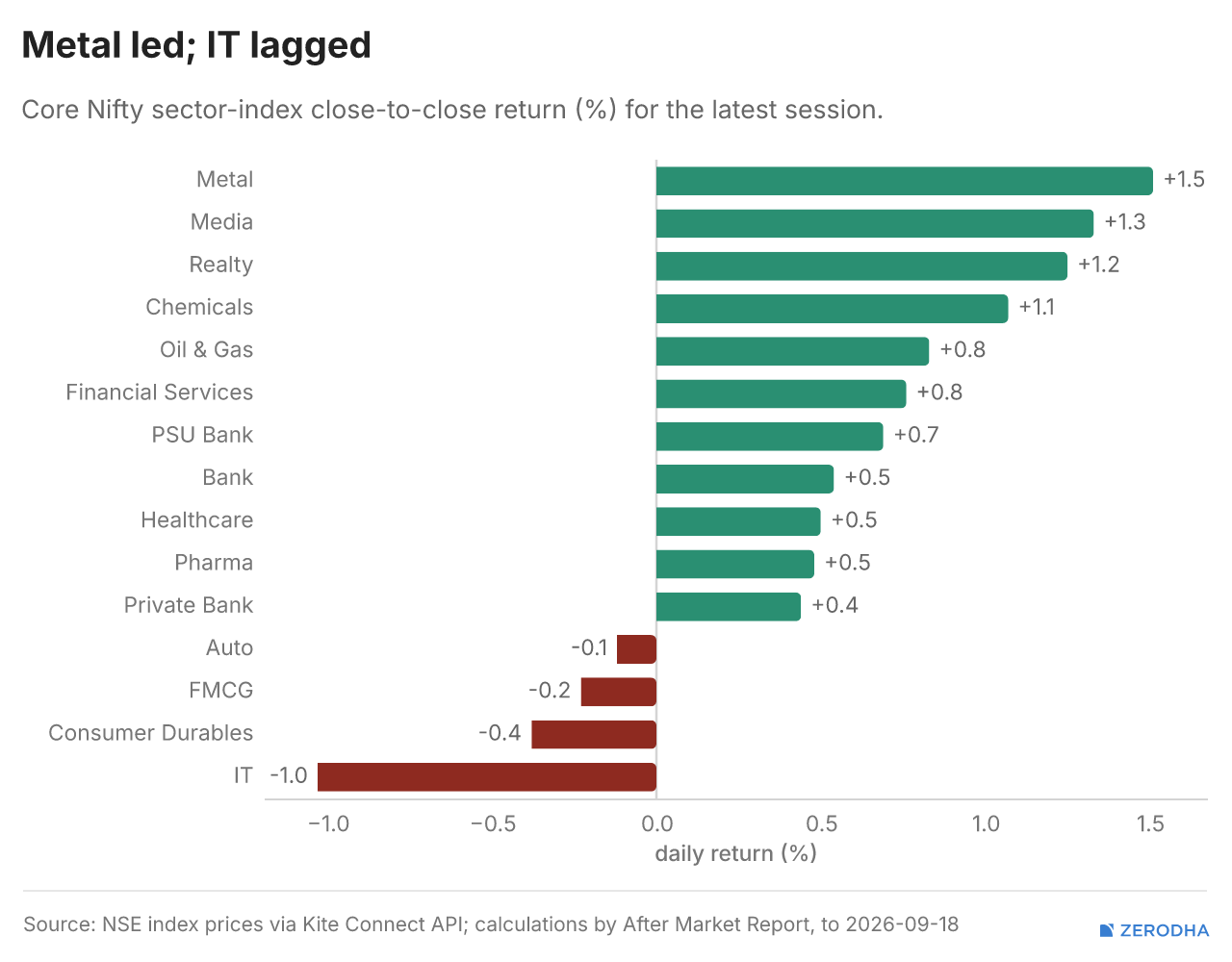
Sectoral Indices Performance
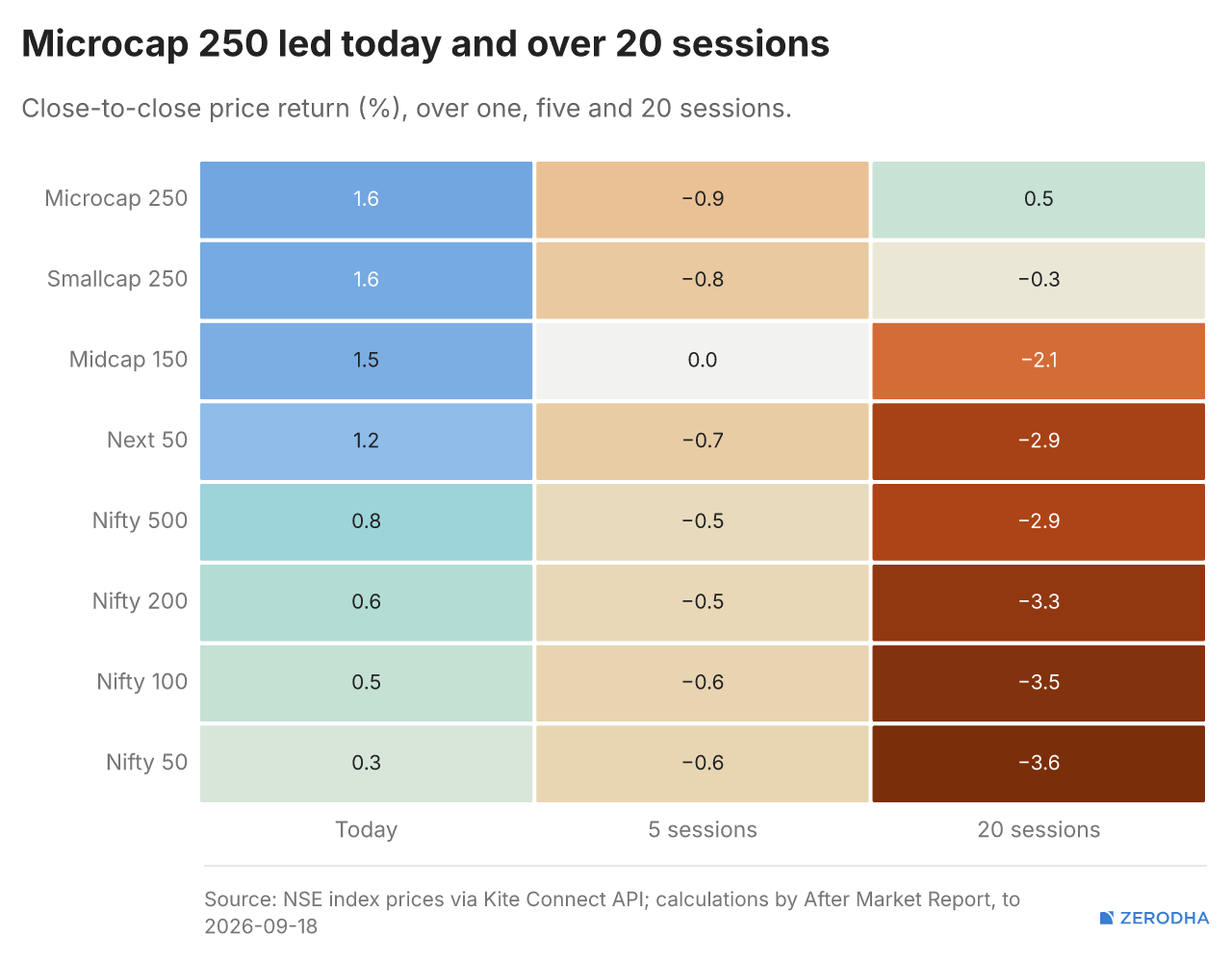
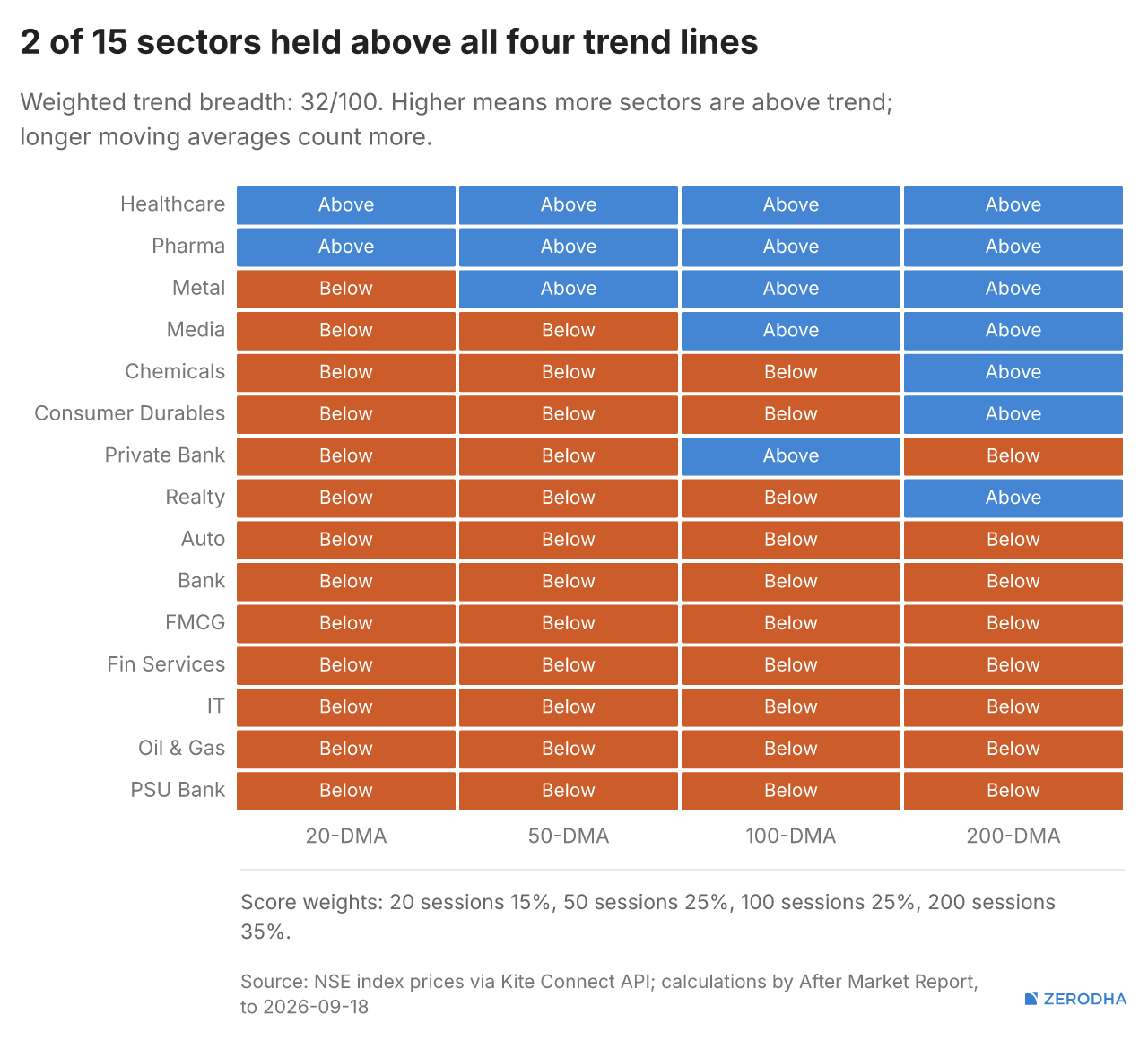
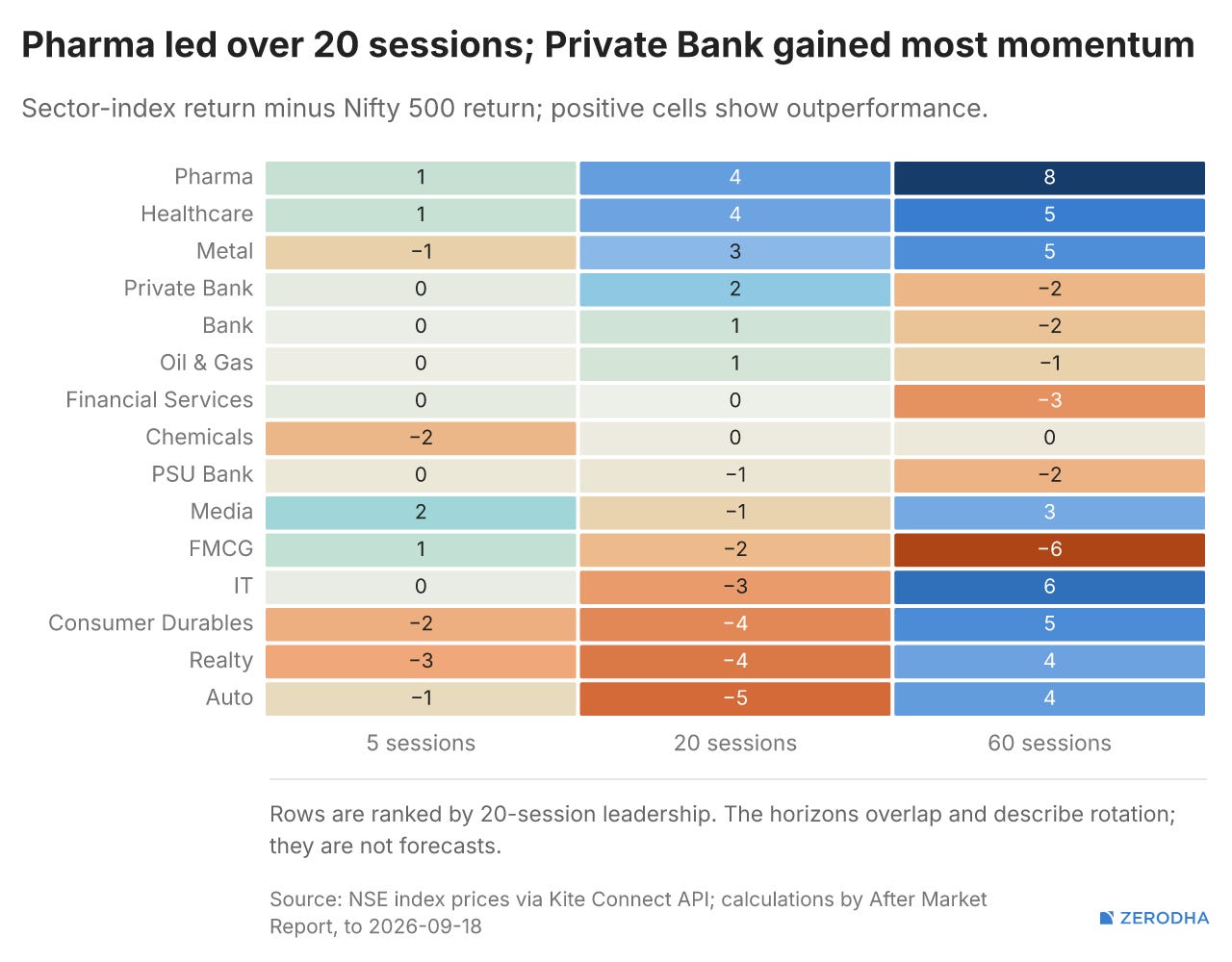
Metals (+1.51%) and Media (+1.33%) led, while IT fell 1.03%. Alpha 50 led factor performance, while Pharma, Healthcare and Metals continued to outperform Nifty 500 across key horizons.
Winners & Losers
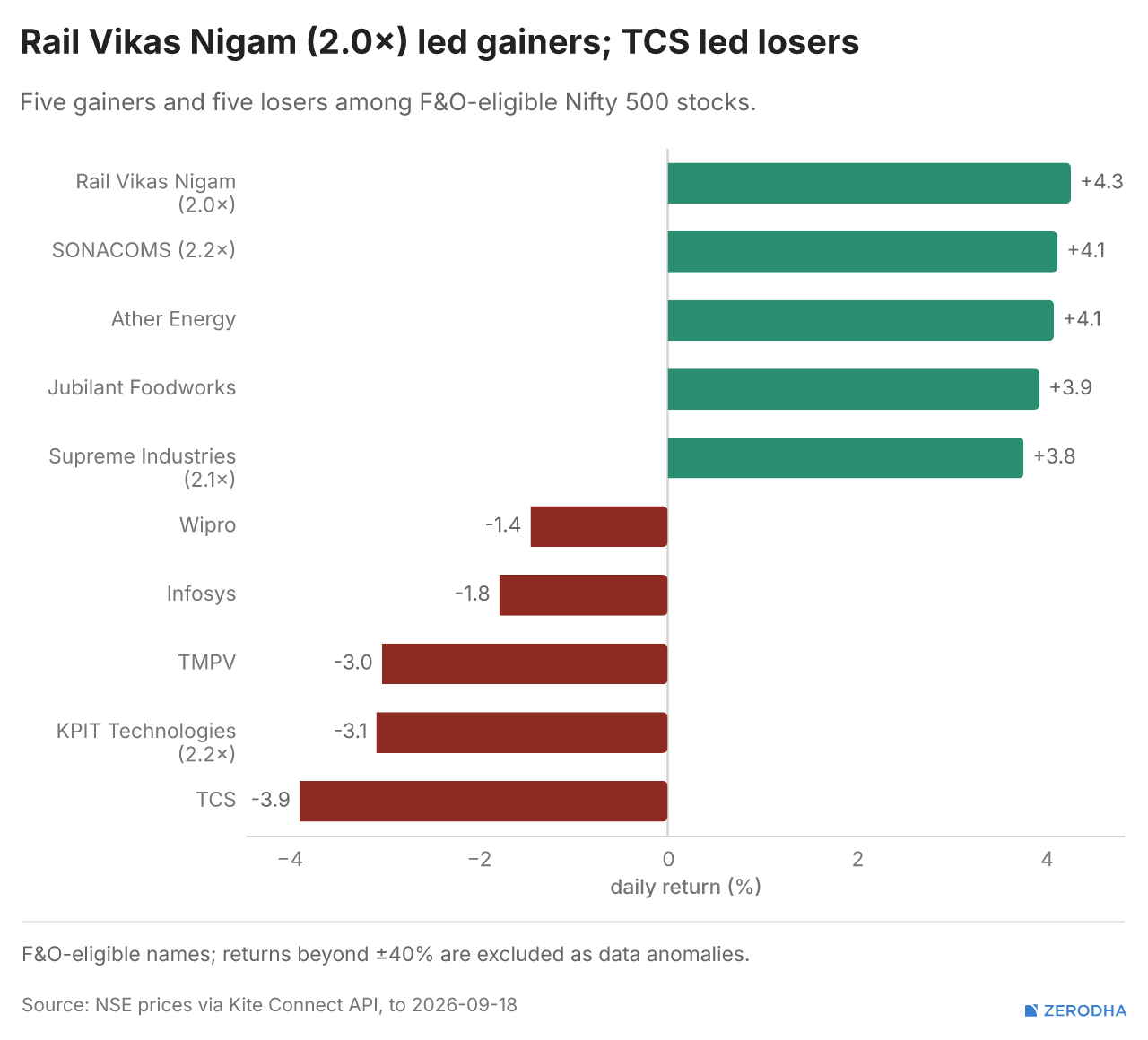
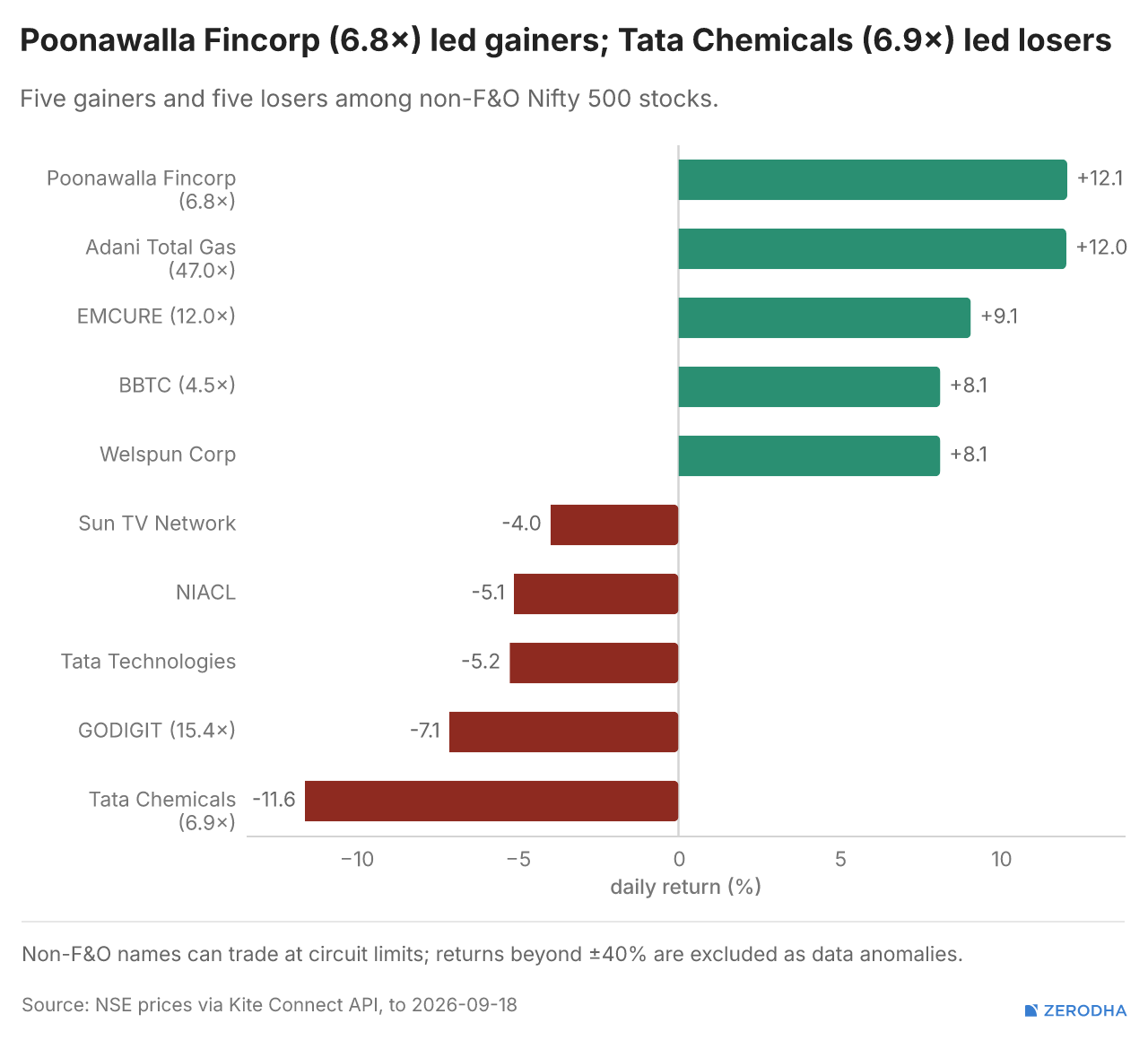
Rail Vikas Nigam (+4.26%) led F&O gainers while TCS (-3.89%) fell the most.
Delivery Data
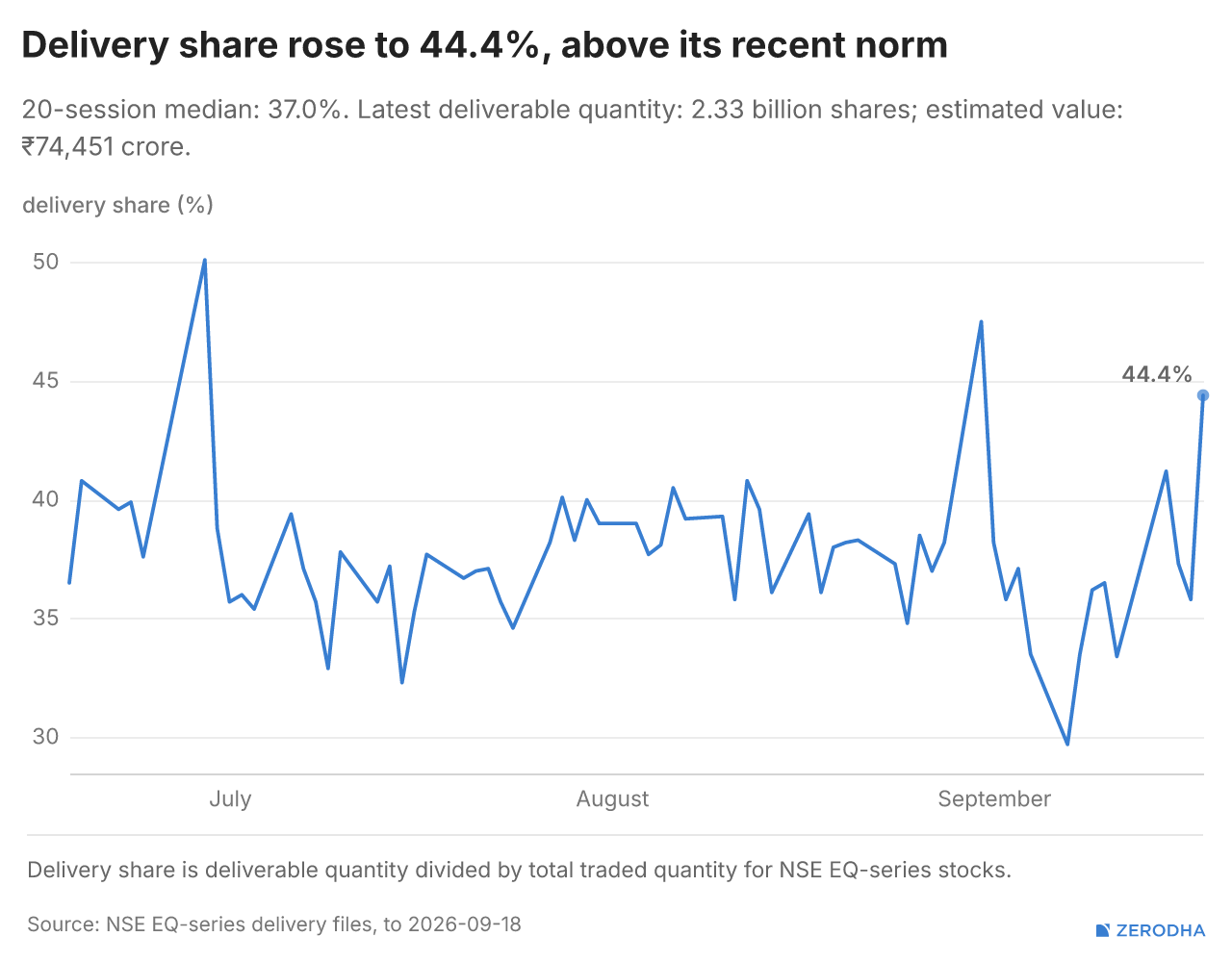
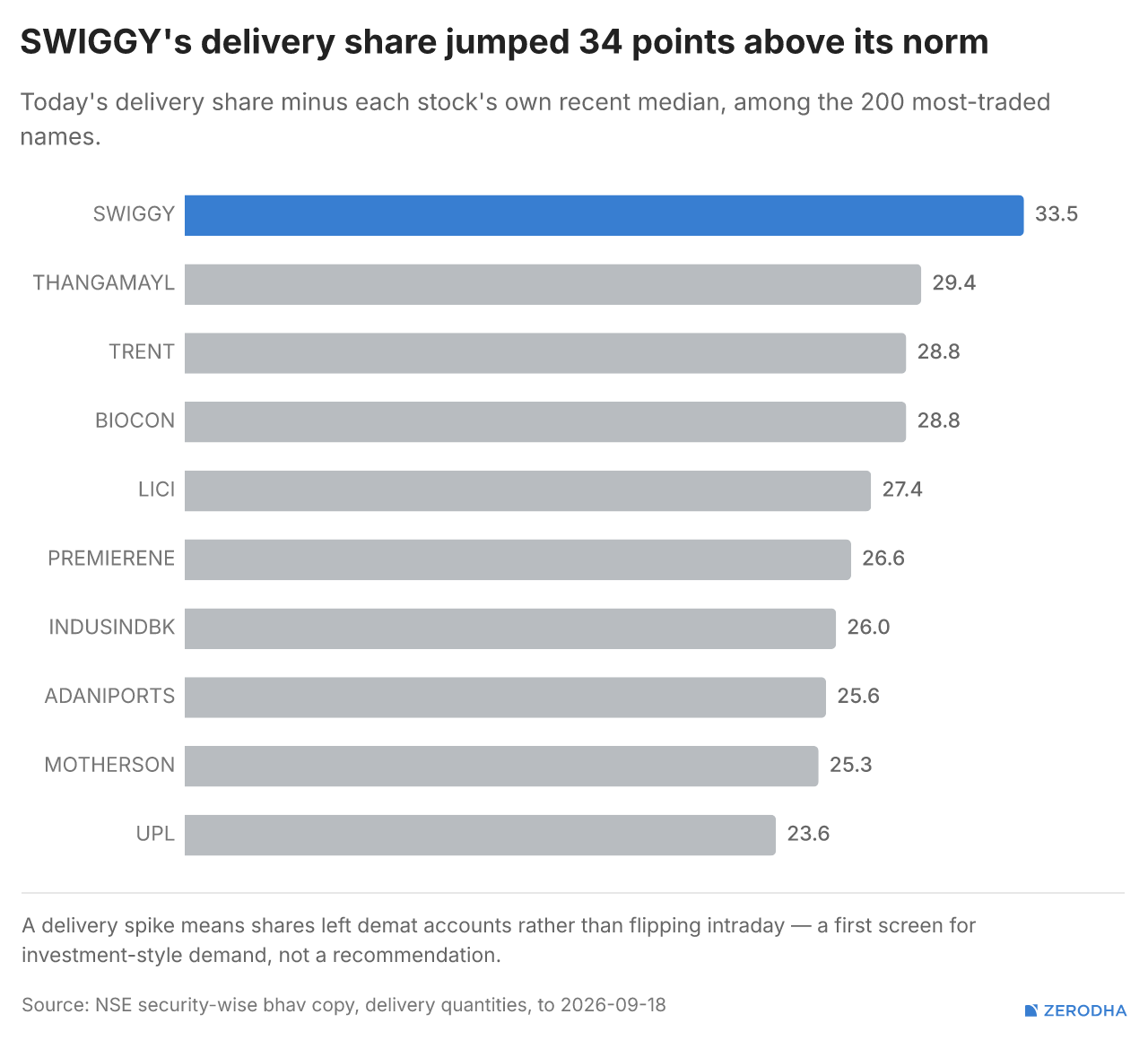
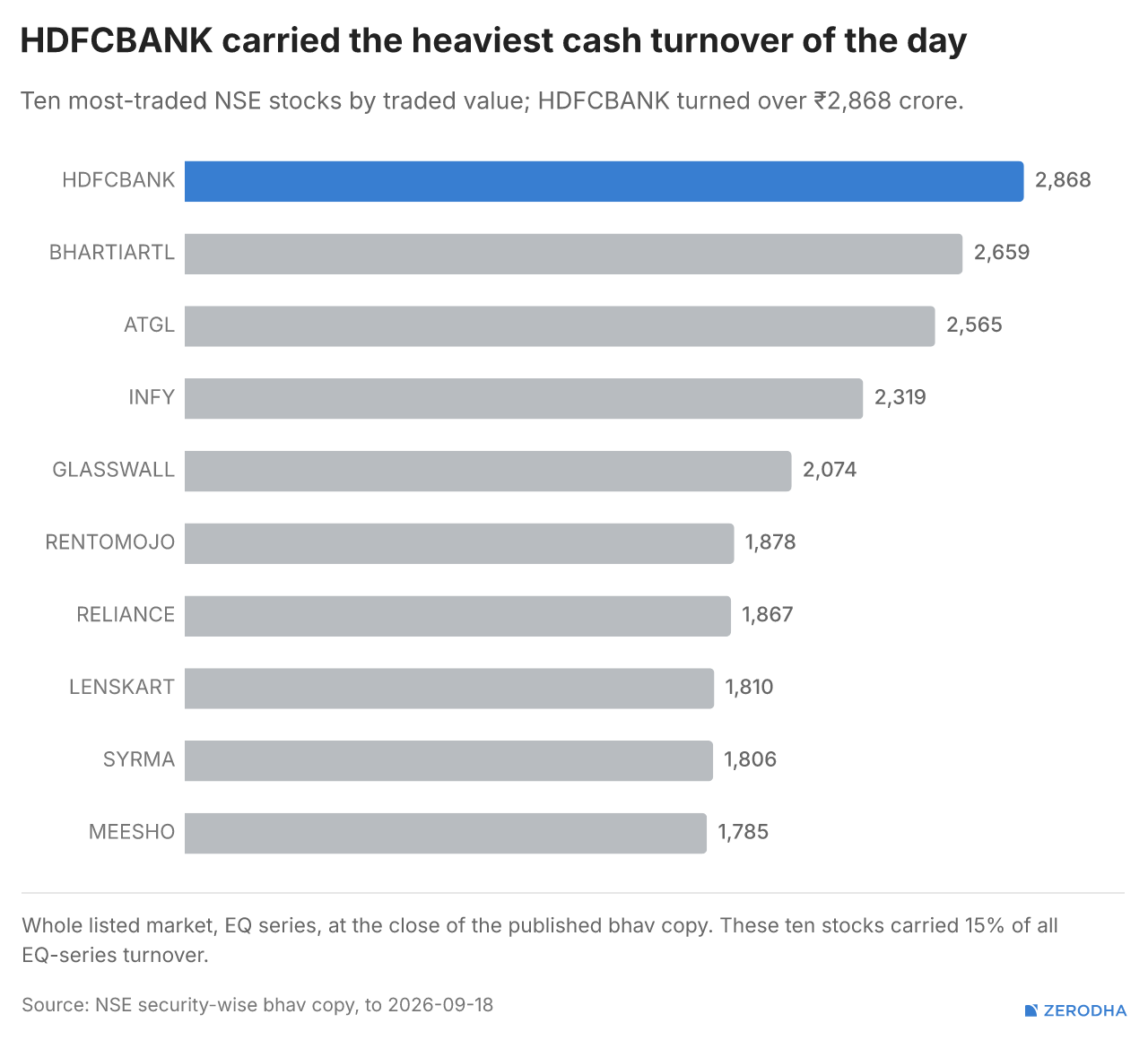
Swiggy’s delivery share jumped to 73% versus its 40% recent norm, while HDFC Bank recorded the highest cash turnover.
Global Markets
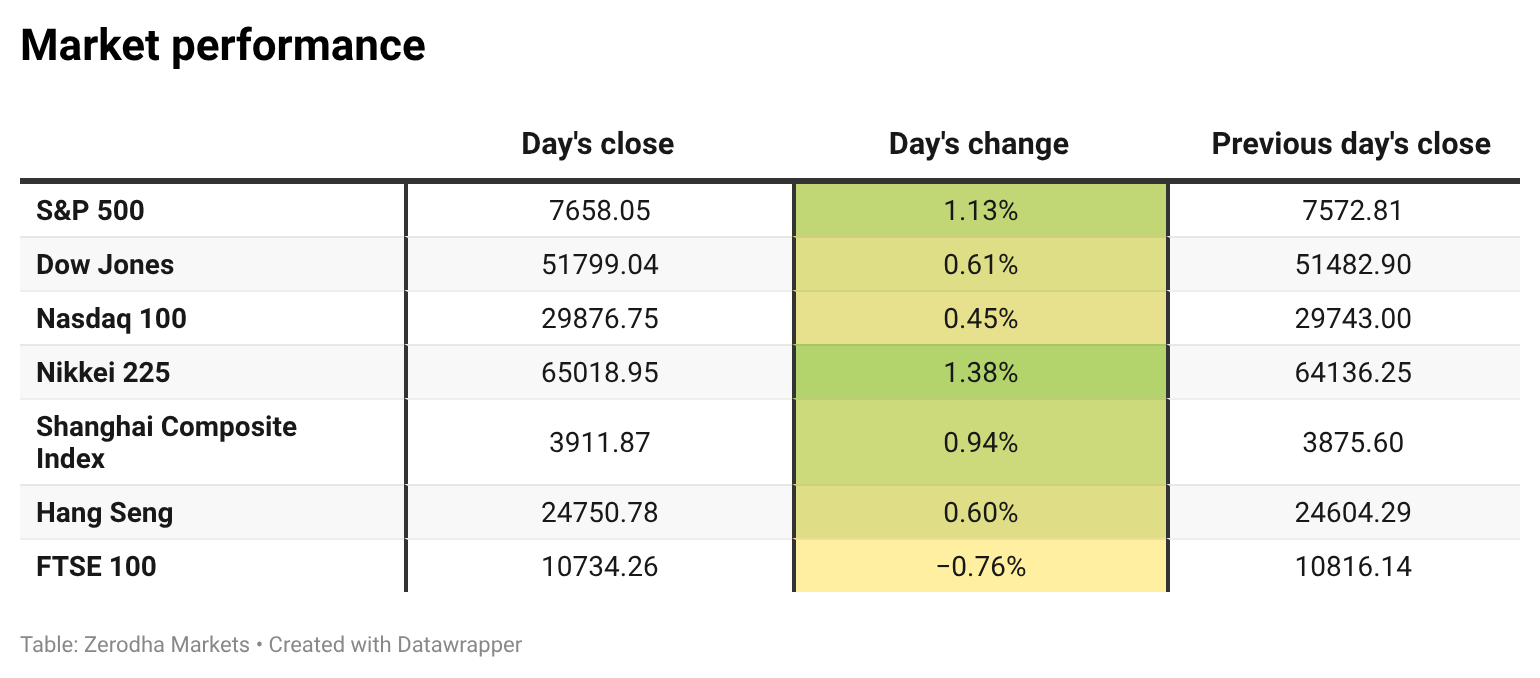
Nikkei 225 led the tracked overseas indices at +1.38%, while FTSE 100 lagged at -0.76%.
Commodities
Institutional Flows & Participant Positioning
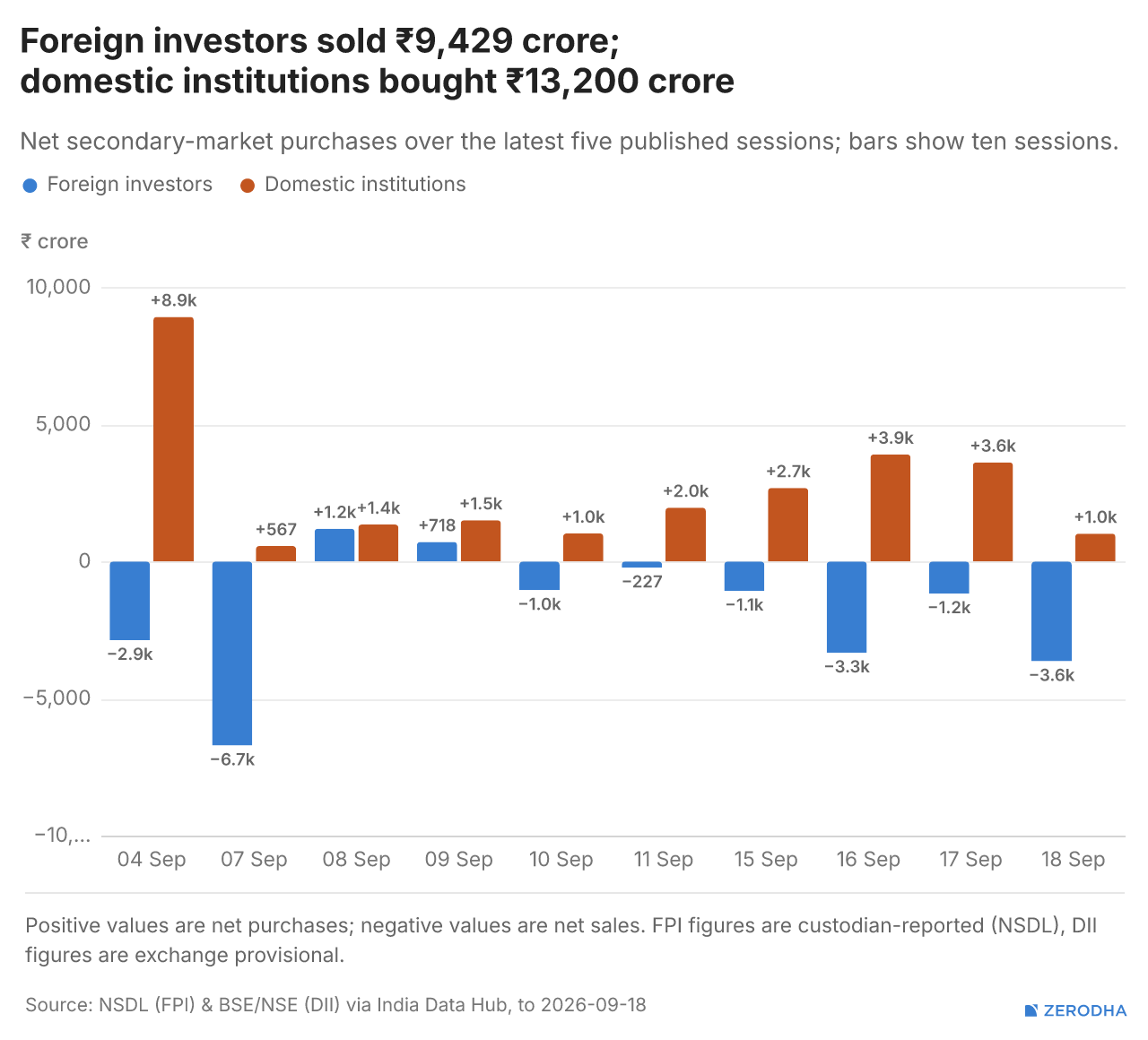
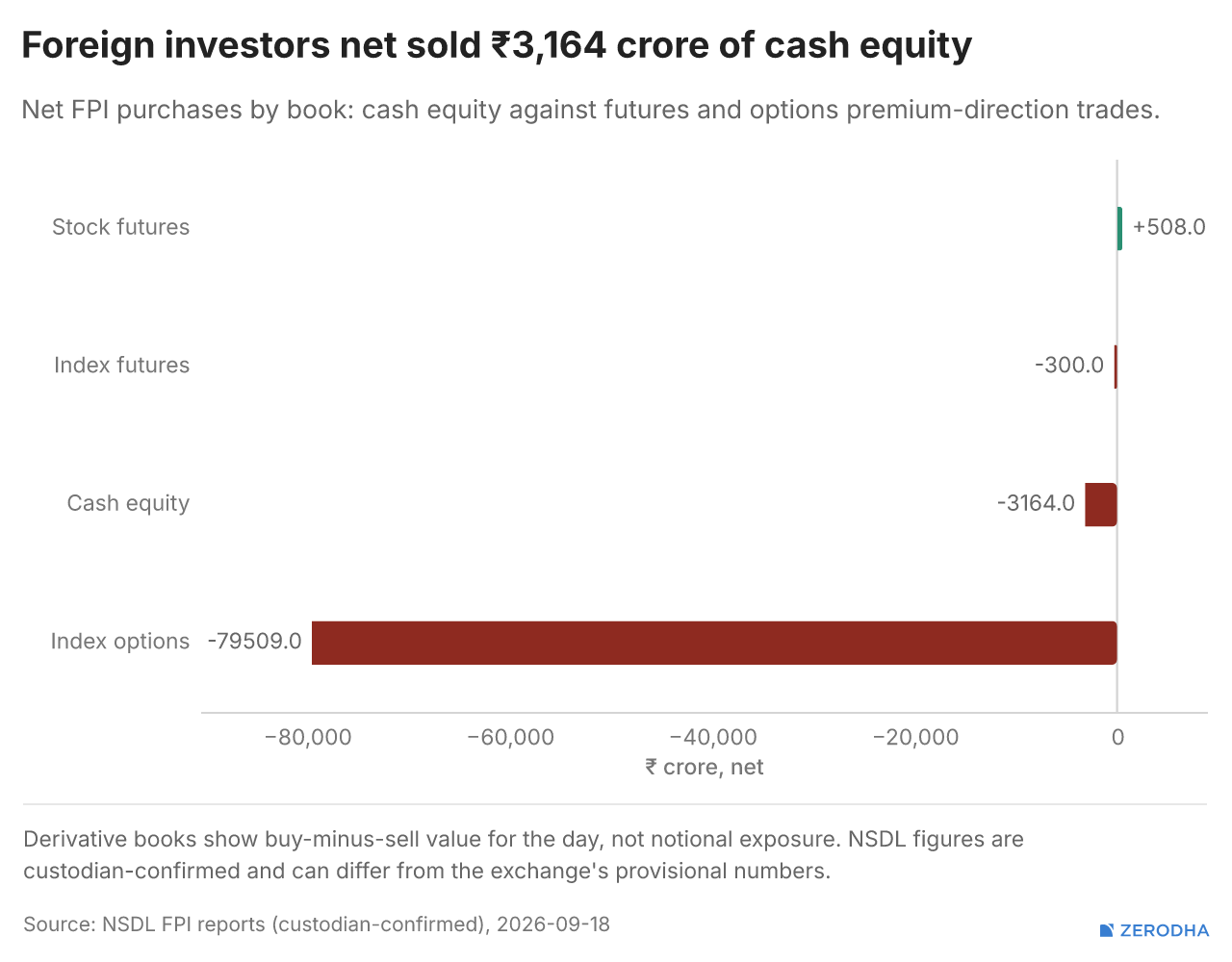
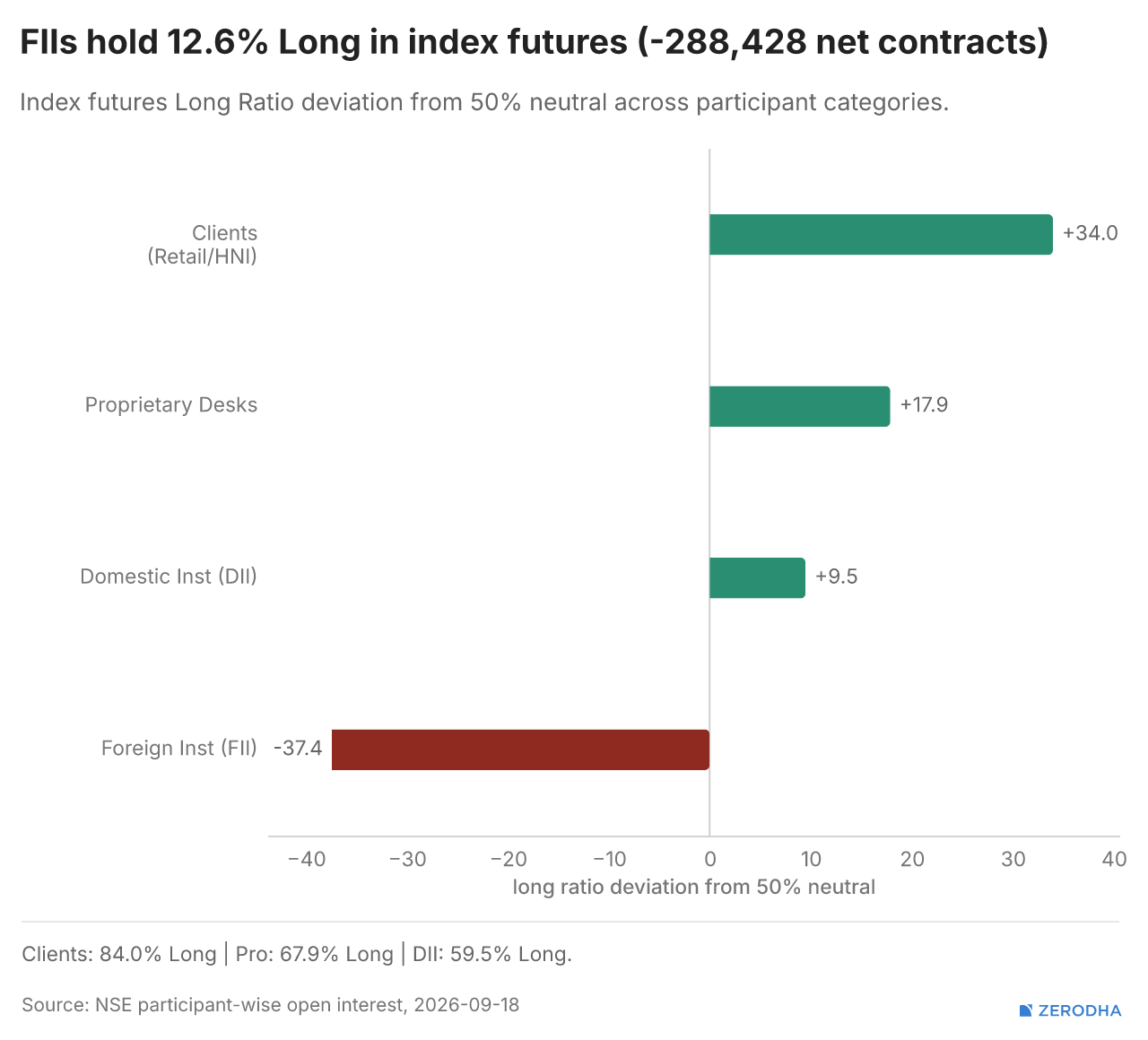
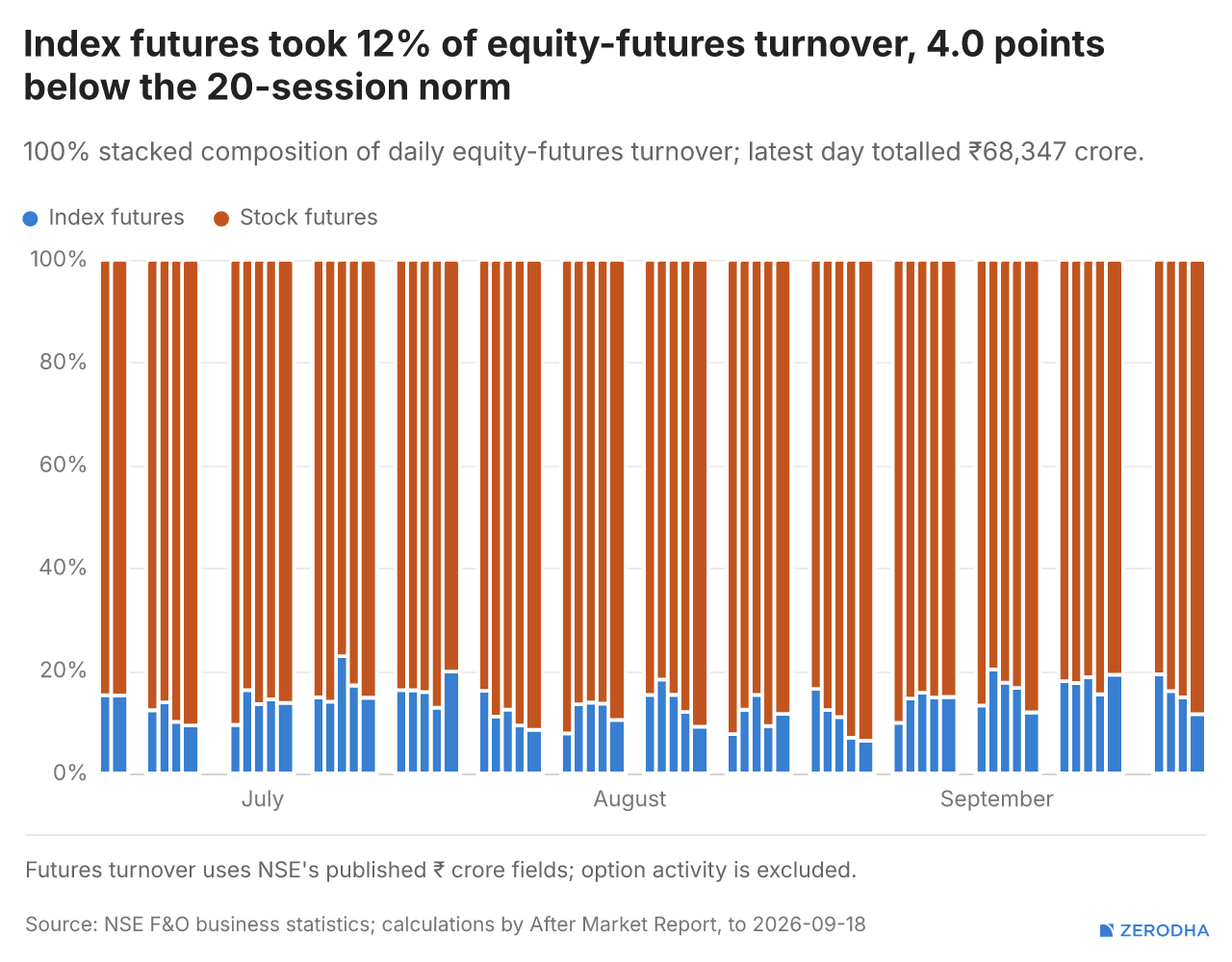
FIIs remained heavily short in index futures with just a 12.6% long ratio, versus retail at 84% long. FPIs sold ₹9,429 crore over the latest five sessions against ₹13,200 crore of DII buying.
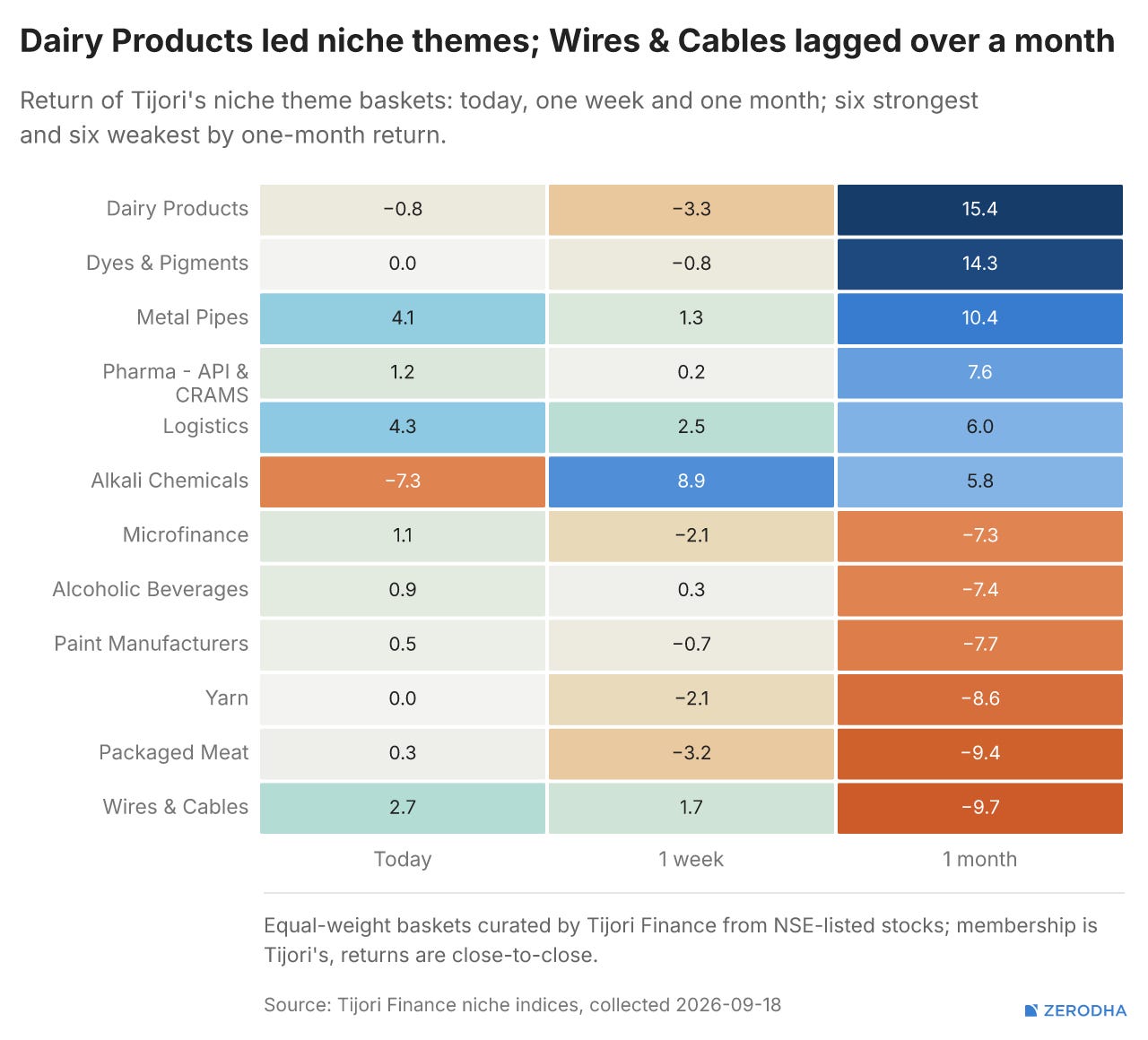
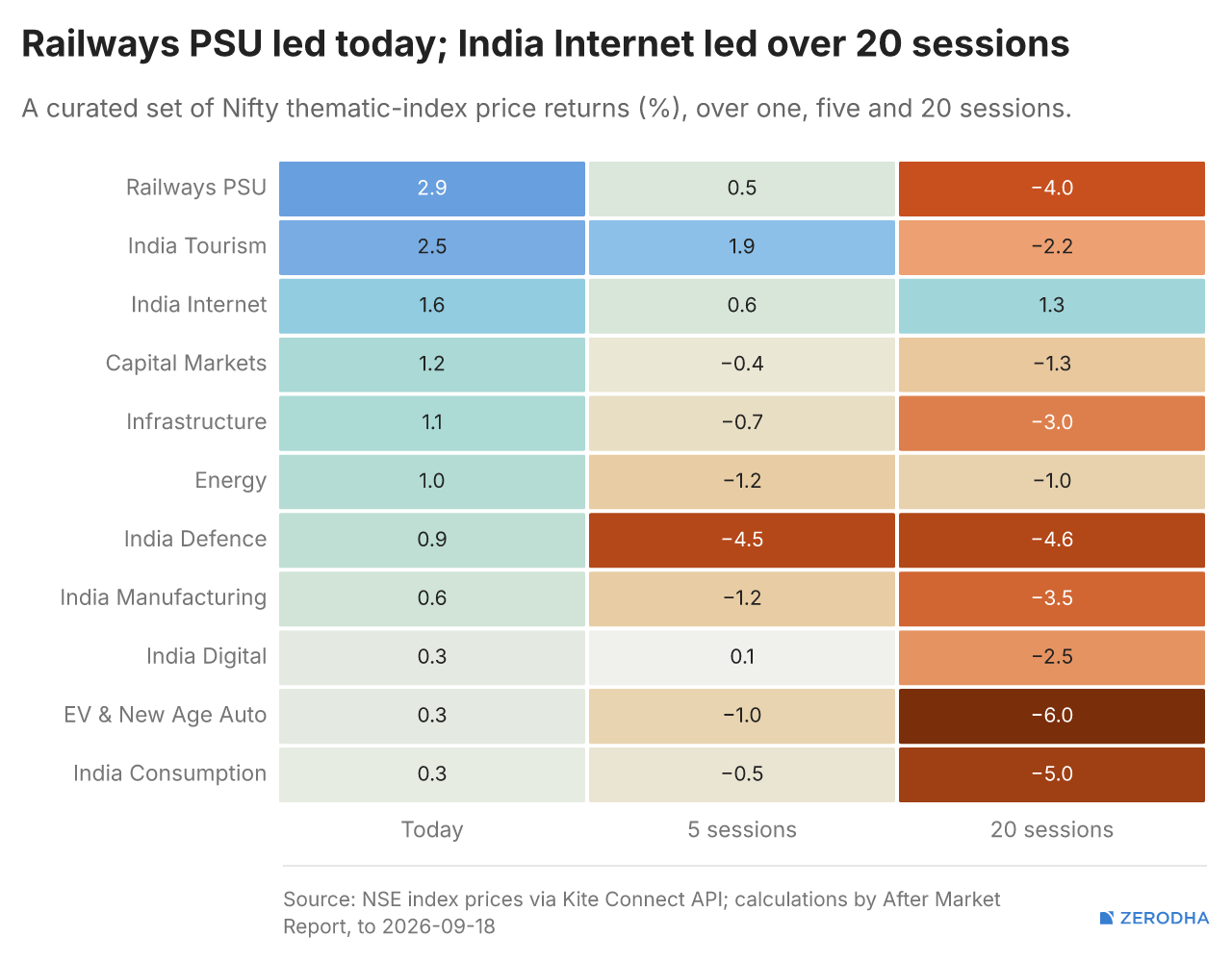
Thematic Indices
Tijori’s niche indices, where today’s move sorts pockets of the market beyond standard sector baskets. You can also track promoter buying and other interesting stuff, like Capex activity by the companies in the Tijori App’s idea dashboard
F&O Corner
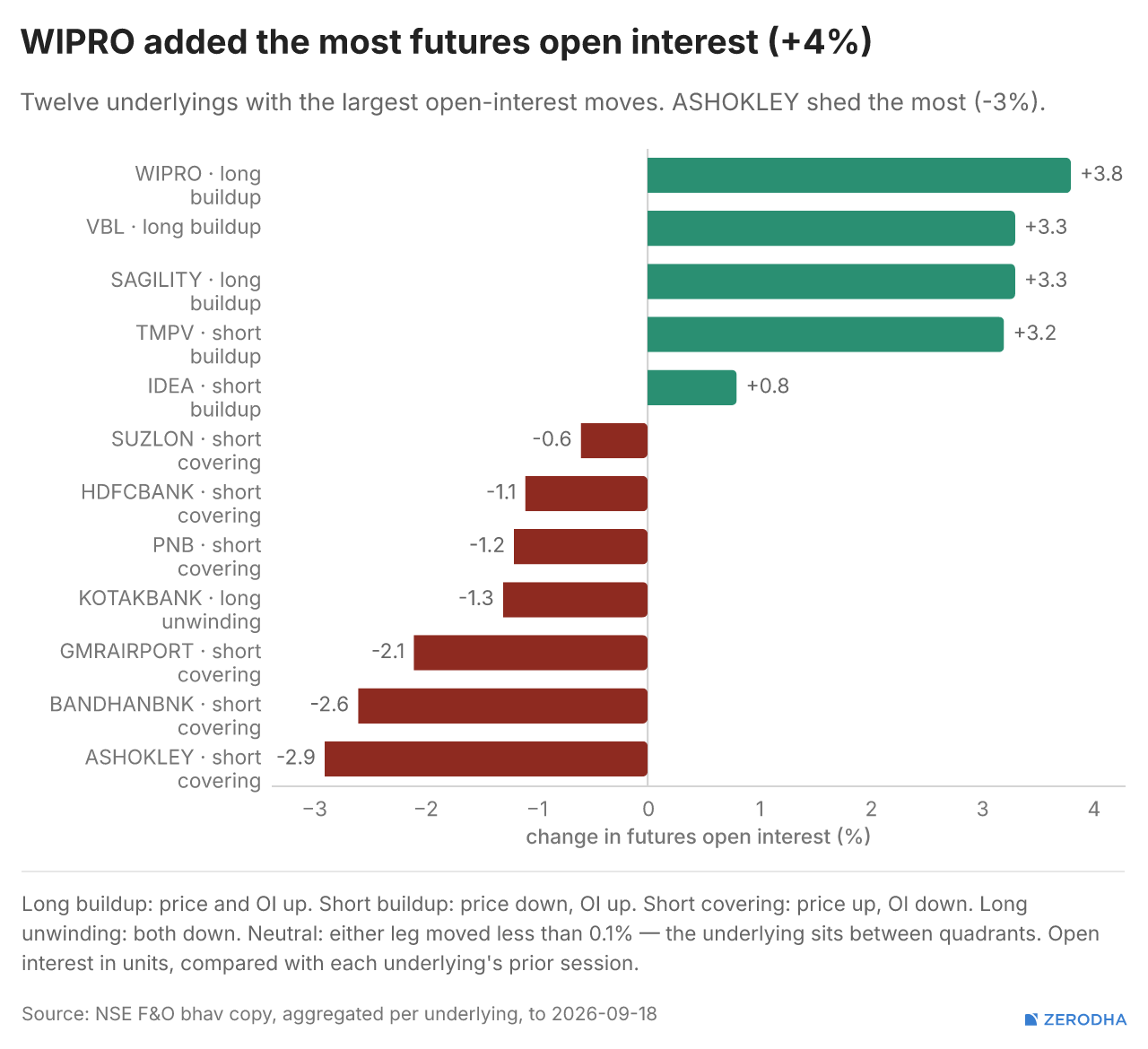
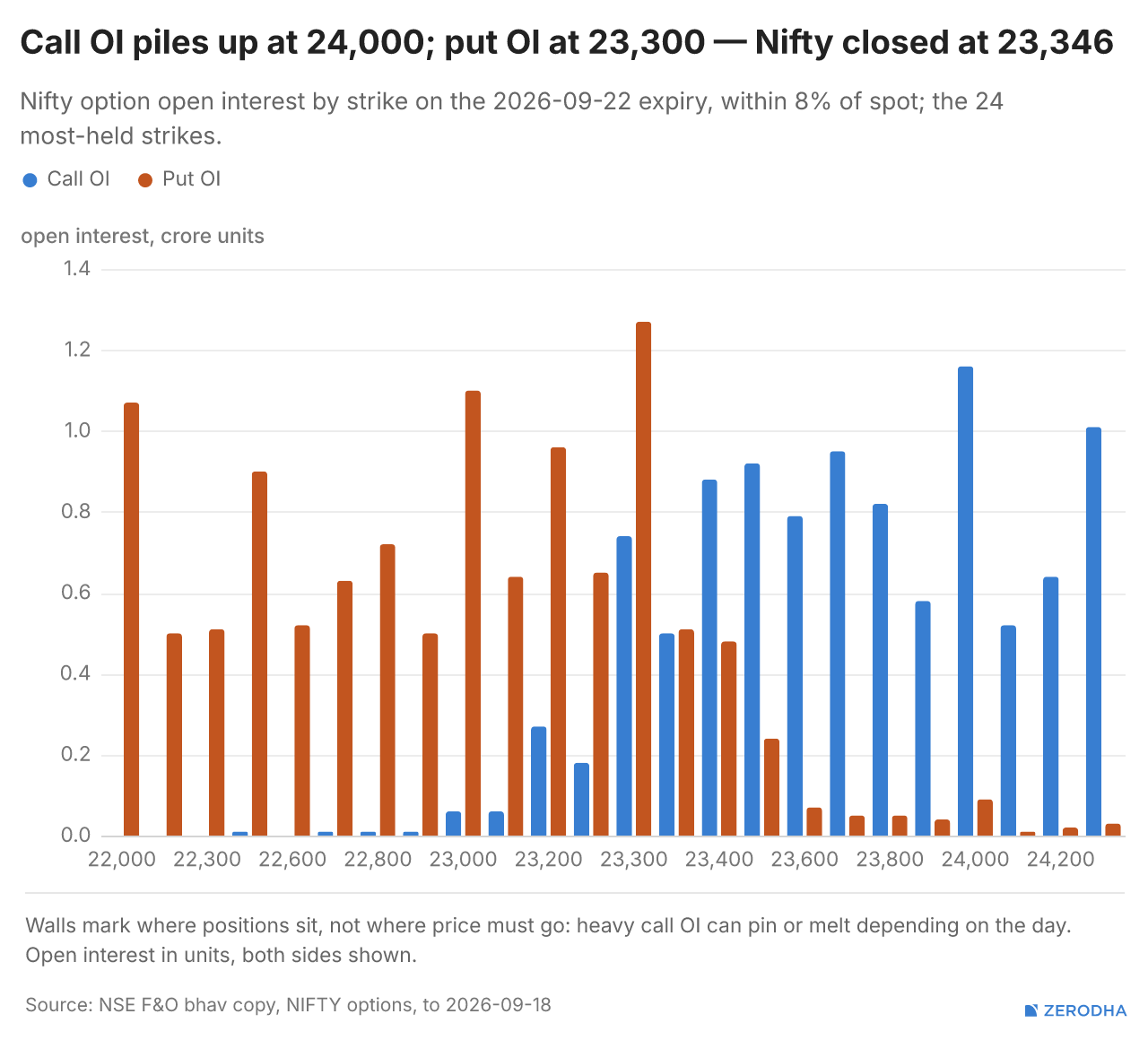
In options, the biggest Nifty OI blocks were at 24,000 Calls (1.2 crore) and 23,300 Puts (1.3 crore)

Top Stories in India
India’s net direct tax collections rose 13% YoY to over ₹12.12 lakh crore between April 1 and September 17, supported by higher advance tax collections. Corporate tax rose 19.5% to ₹5.56 lakh crore, while individual/HUF collections increased 6% to ₹6.16 lakh crore; STT collections jumped 53% to ₹40,214 crore. Refunds rose 29.2% to over ₹2.20 lakh crore. Dive deeper
Moody’s has raised India’s FY27 real GDP growth forecast to 7% from 6%, citing the economy’s resilience despite the Middle East conflict and broader global turbulence. It expects India to grow faster than all other G20 economies and similarly rated emerging markets, though high energy prices and El Niño-related food inflation remain key risks. Dive deeper
Most Tata Group stocks gave back some of their previous session’s gains, a day after the Shapoorji Pallonji Group reportedly proposed selling a portion of its stake in Tata Sons for at least ₹25,000 crore. Dive deeper
Mazagon Dock Shipbuilders plans to invest around ₹15,000 crore to develop a greenfield shipyard at Dugarajapatnam, Andhra Pradesh, with a design capacity of 1.2 million gross tonnage annually. The project, being developed with NSHIP-AP, is expected to generate around 45,000 direct and indirect jobs, subject to necessary approvals. Dive deeper
Tata Electronics and L&T Semiconductor Technologies have partnered to expand indigenous semiconductor manufacturing in India for domestic and global markets. The collaboration will combine LTSCT’s chip design capabilities with Tata Electronics’ fabrication, packaging and testing infrastructure, targeting automotive, industrial, communications, security and intelligent-edge applications. Dive deeper
Walgreens India has signed an MoU with the Tamil Nadu government to establish its first Global Capability Centre (GCC) in India in Chennai. Dive deeper
Tata Motors will raise prices of its commercial vehicles by up to 1% from October 1 to offset higher commodity and other input costs. The extent of the increase will vary across models and variants. Dive deeper
FSSAI has initiated legal action against Nestlé India over alleged non-compliances involving infant nutrition products NAN Excella Pro Stage 1 and Lactogen Pro 1. The regulator flagged issues including promotional claims made for the products and a laboratory finding related to biotin content. Dive deeper
Yatharth Hospital shares jumped over 10% to a record ₹1,184, extending their two-day gain to around 20%, after US-based private equity firm Advent International announced a ₹3,150 crore investment for a 24.9% stake in the hospital chain. Dive deeper
Top Stories Globally
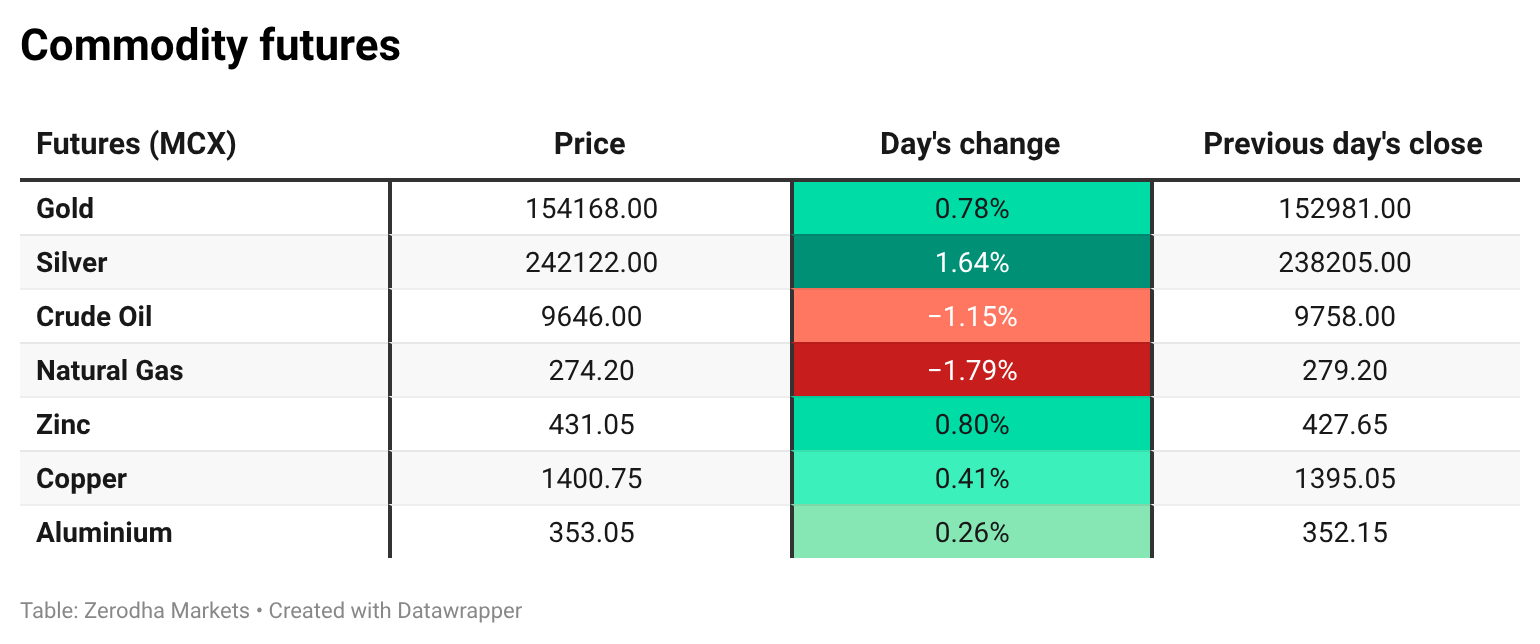
Crude oil eased toward $101 per barrel after touching a four-month high of $106 on Tuesday, as markets weighed the possibility of higher Middle East supply. Saudi Arabia said its East-West pipeline could restart in the coming days, potentially restoring an alternative route for up to 7 million barrels per day amid disruptions to tanker traffic in the Persian Gulf. Dive deeper
The Bank of Japan raised its policy rate by 25 bps to 1.25%, the highest in 31 years, in a 7–2 vote, while Governor Kazuo Ueda signalled scope for further hikes to prevent inflation from overshooting. Despite the hawkish message, the yen weakened as two policymakers dissented and argued for a more patient approach to tightening. Dive deeper
Global equity funds saw $23.21 billion in net outflows in the week through September 16, the largest weekly withdrawal in nine months. Investors turned cautious as surging oil prices fuelled inflation concerns and increased expectations of a Federal Reserve rate hike. Dive deeper
Warren Buffett, 96, is stepping down as chairman of Berkshire Hathaway after more than 50 years, becoming chairman emeritus with immediate effect. His son Howard Buffett, a Berkshire board member since 1993, will take over as chairman. Dive deeper
Management Chatter
In this section, we highlight interesting comments from management at major companies and from policymakers in the Indian and Global Economies.
Tata Electronics' CEO and MD Randhir Thakur says India's semiconductor journey looks "strong" :
"In our business, it is about continuity, and semiconductor is a roadmap-based journey. It is really very encouraging to see that after the Semiconductor 1.0 scheme, the government has come up with Semiconductor 2.0...so that continuity, that roadmap is very important. We believe that in this business, as we generate the cash flow, we will always be investing and continue on this," - Link
Nitin Rakesh, CEO of Mphasis, believes that while the global economy remains unpredictable, it is stable enough for them to focus on winning specific client deals:
“Over the last four to six quarters, we have maintained that the macroeconomic environment would remain uncertain. Themes across geopolitics, interest rates, and inflation have not changed significantly over the past 12 to 18 months. While the macro hasn’t improved, it hasn’t meaningfully deteriorated either. Our performance thesis is driven primarily by micro-level execution—focusing on deal flow, account-level activity, and pipeline closures across specific verticals and clients. From that standpoint, our stance remains unchanged from our earnings commentary six weeks ago. We are not calling out any shift in performance, given our focus on closing opportunities currently in the pipeline.” - Link
Corporate Actions & Events
Corporate Actions
Published by Zerodha. Not investment advice. Data from NSE, BSE, and MCX.
In our latest episode of In The Money by Zerodha, we break down what market depth and order flow charts actually show you — and what they don’t.
Market depth is a book of intentions: resting orders that may never get executed. Order flow looks at trades that have already happened and tries to measure buying and selling pressure through metrics like delta and cumulative delta.
But where do these numbers come from? Especially in India, where exchanges don’t explicitly tag which side crossed the spread, some of what you see is observed, while some is inferred.
In this edition, we explain how these tools work, how the numbers are constructed, and what they can actually tell you about the market.
That’s it from us for today. We’d love to hear your feedback in the comments, and feel free to share this with your friends to spread the word!