

Welcome to Aftermarket Report, a newsletter where we do a quick daily wrap-up of what happened in the markets, both in India and globally.
In our latest episode of In The Money by Zerodha, we get into the part guides treat as an afterthought – stock selection. Not a checklist, not a screener dump. A method.
Specifically, the Wagner and Pedicelli approach: find the strongest stock inside the strongest sector, and let the money flows do the heavy lifting.
We walk through two live examples using NSE sectoral indexes and the TJI sub-sector indexes, and share a custom TradingView script that builds a true equal-weighted basket — because market-cap weighting lies to you about what’s actually moving. There’s also a case for Renko charts if candlesticks are hiding more than they’re showing.
One thing worth flagging before you dive in: discretionary doesn’t mean no rules. It never has.
Markets Today
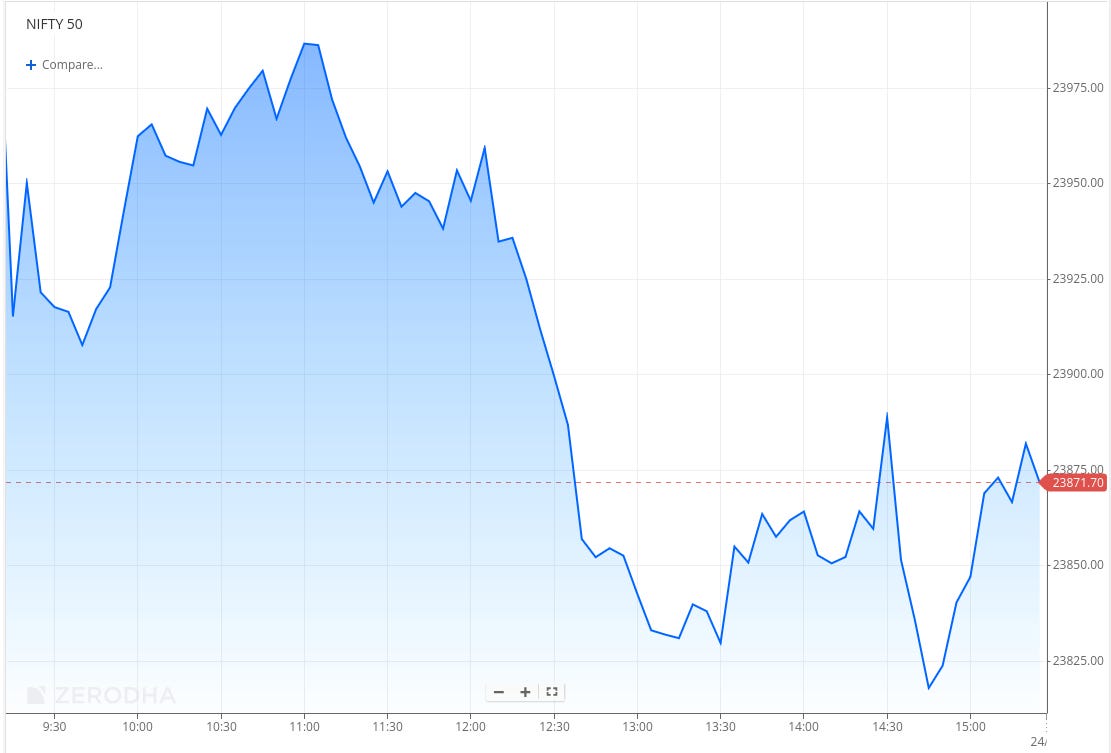
Nifty opened with a 91-point gap down at 23,905, extending the previous session’s weakness as Brent crude climbed above $98 per barrel, keeping sentiment under pressure amid escalating geopolitical tensions. Despite the weak start, the index recovered some ground in the opening minutes before turning range-bound through the first hour.
Buying interest gradually picked up, helping Nifty climb towards the 23,970–23,985 zone by 11 AM. However, the gains proved short-lived as fresh selling emerged around noon, dragging the index sharply lower. By 12:30 PM, Nifty had slipped below 23,860, giving up nearly all of its intraday recovery.
The second half remained volatile. The index initially extended its losses, hitting an intraday low near 23,820 shortly after 1 PM, before staging a gradual recovery through the afternoon. A sharp spike around 2:30 PM briefly lifted Nifty close to 23,890, but the move quickly reversed as selling resurfaced. In the final hour, the market witnessed another rebound from the day’s lows and eventually closed at 23,869.60, closing below 23,900 without much fight, reflecting continued caution amid elevated oil prices and geopolitical uncertainty.
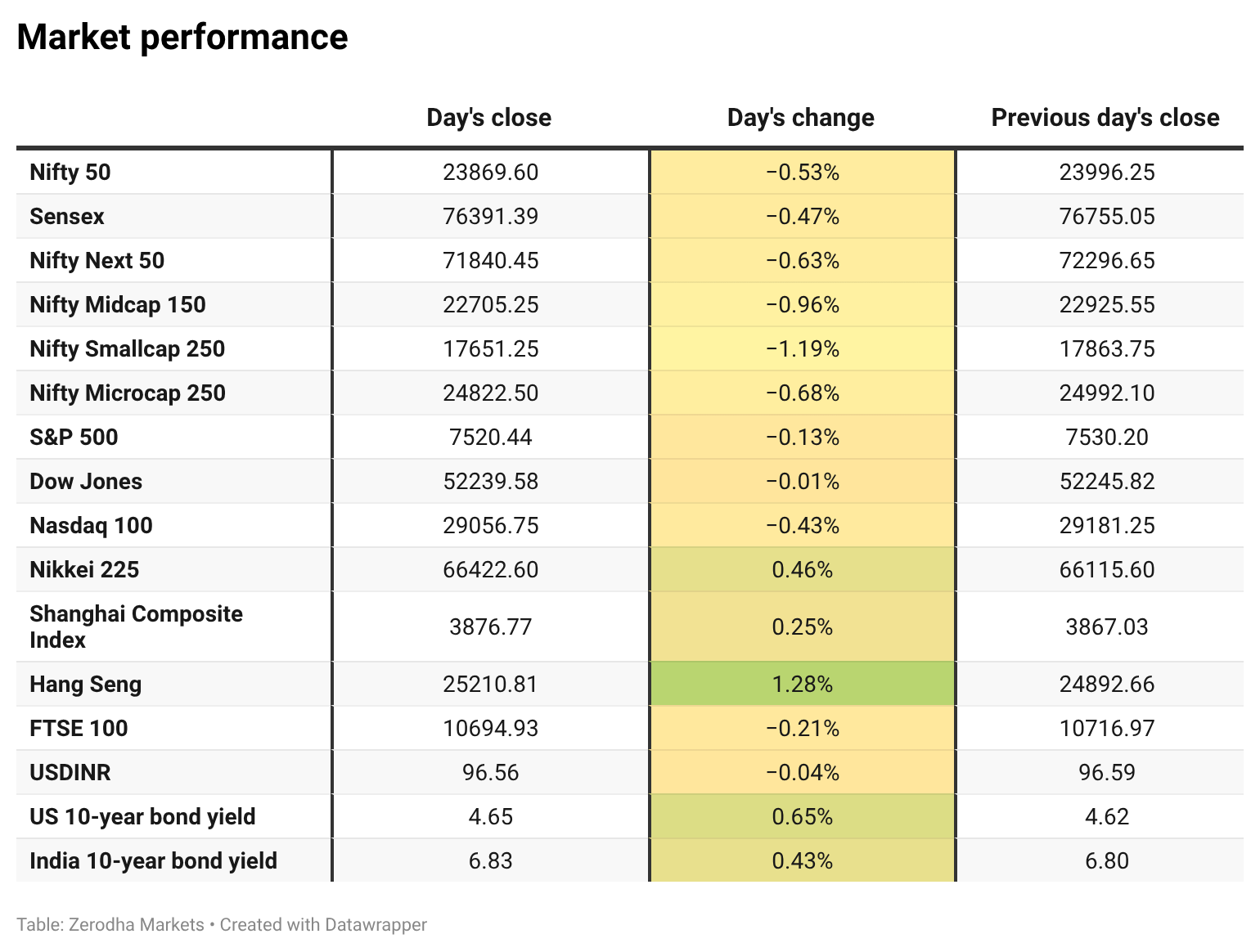
Sectoral Indices Performance
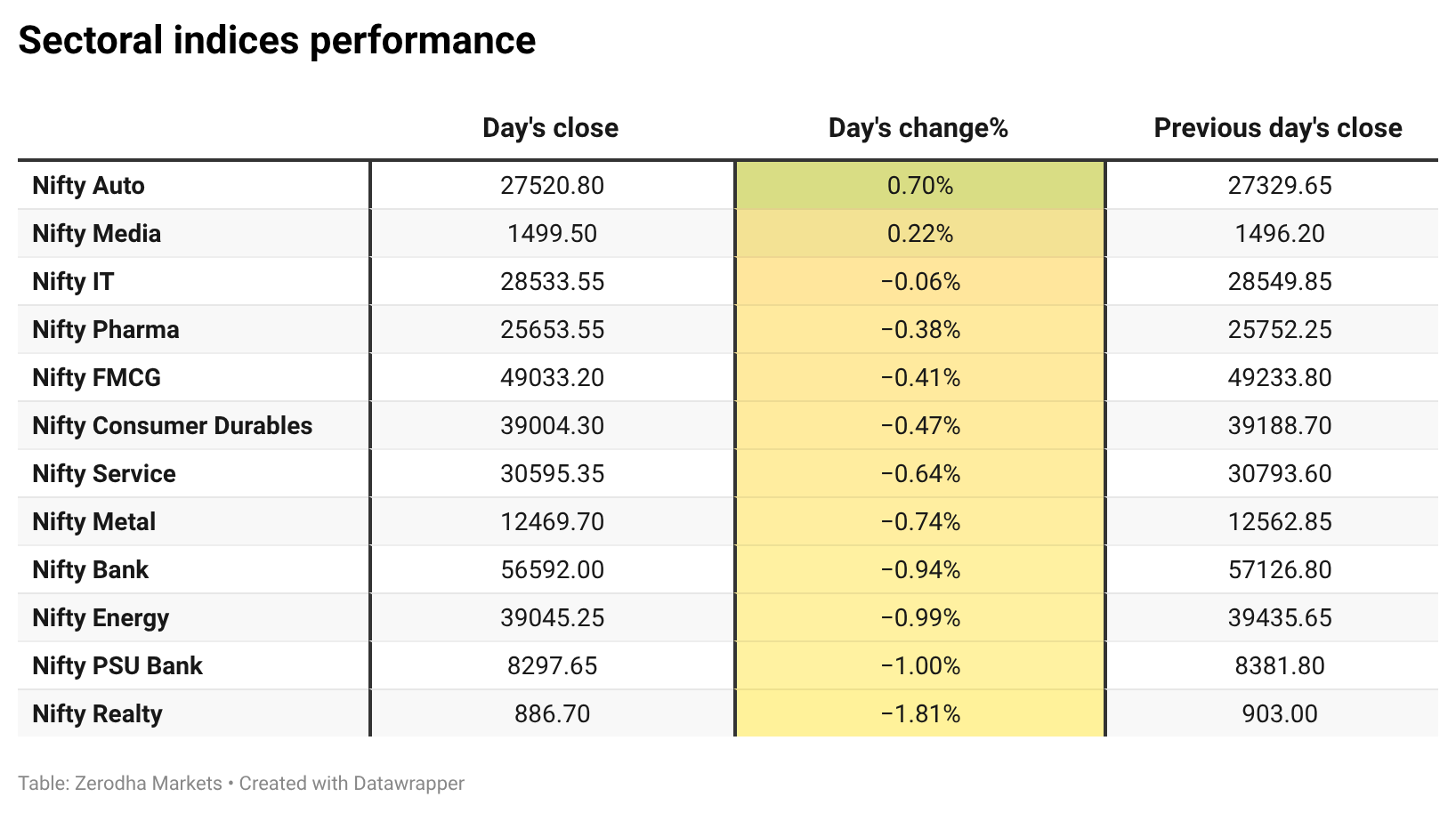
Winners & Losers
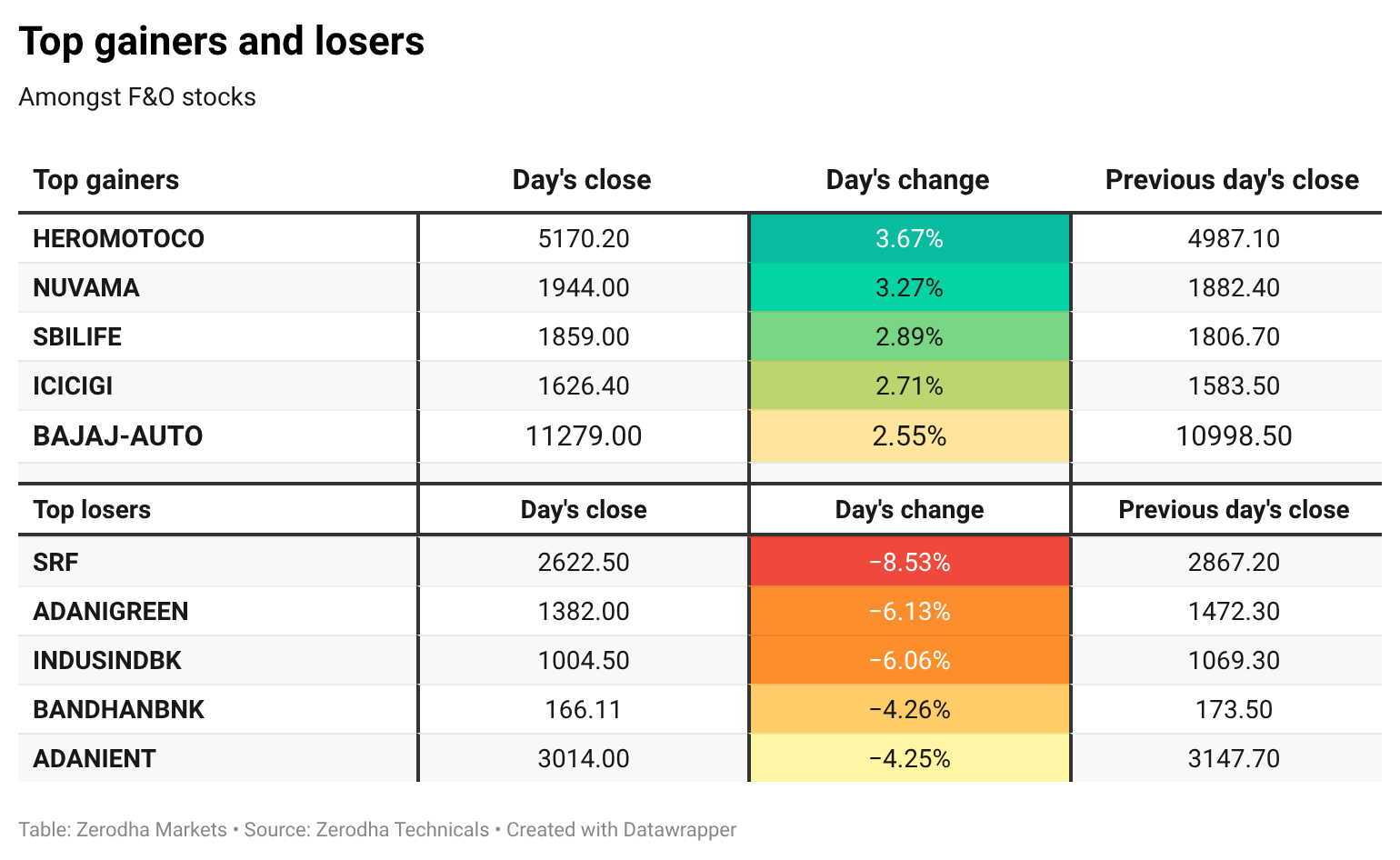
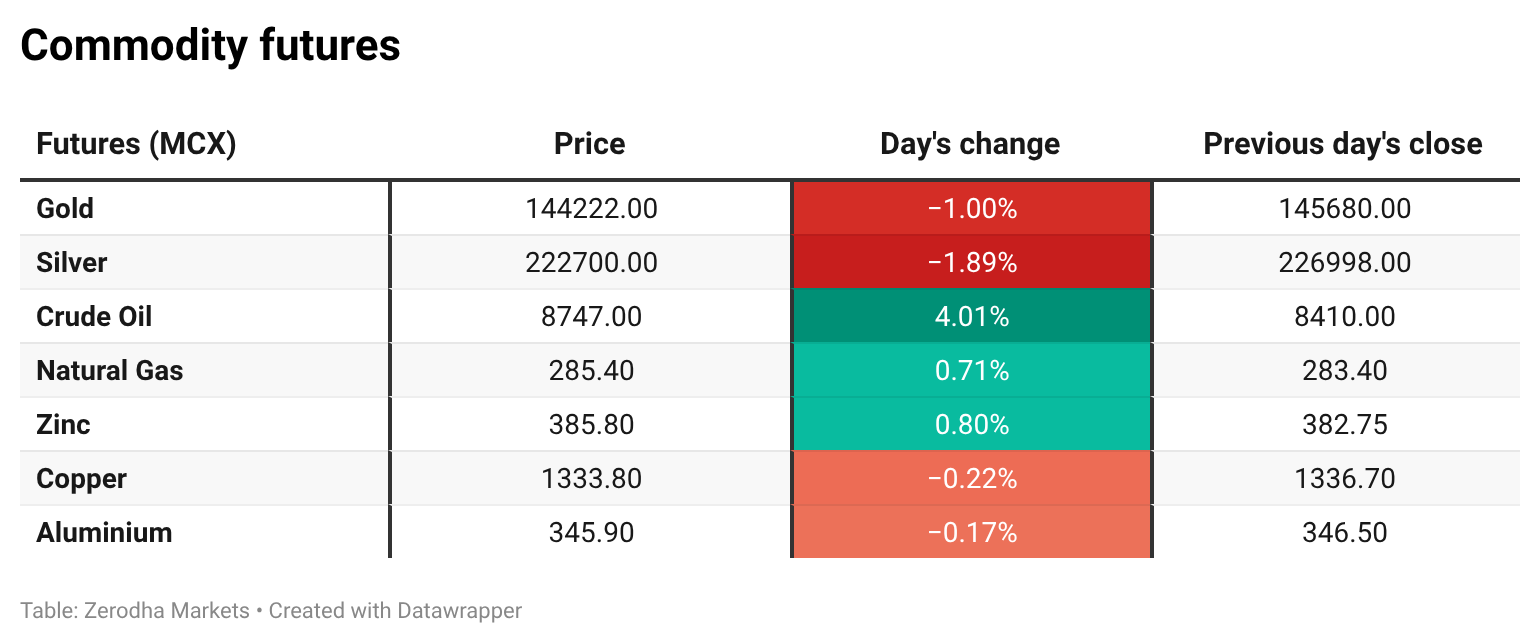
Commodities
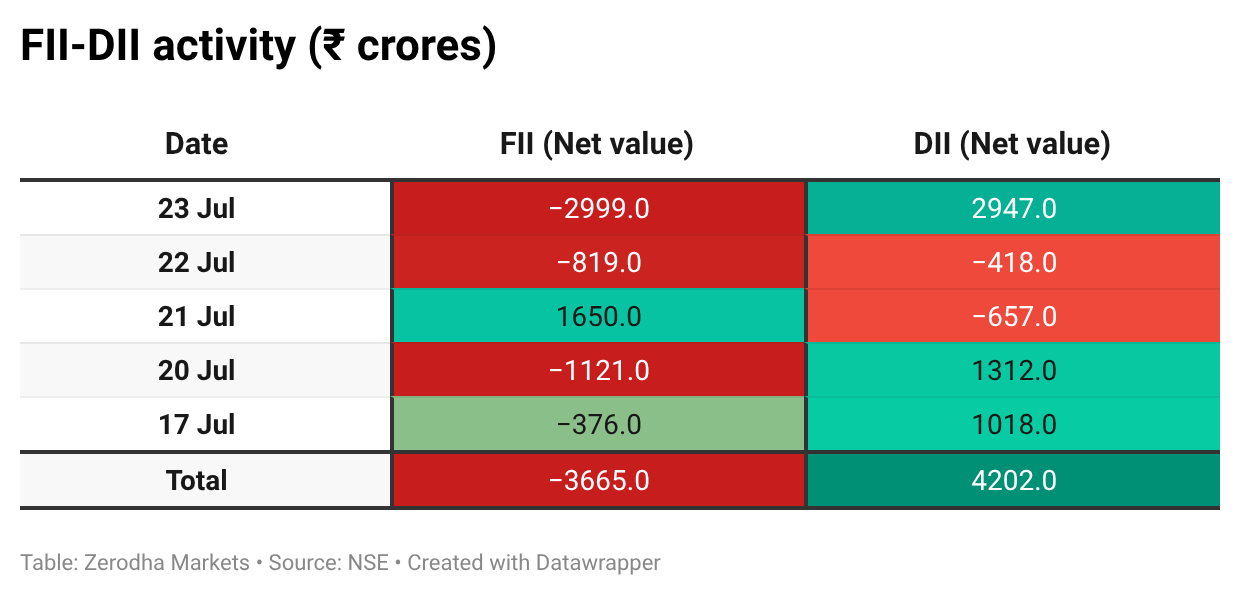
FII / DII Flows
Here’s the trend of FII-DII activity from the last 5 days:
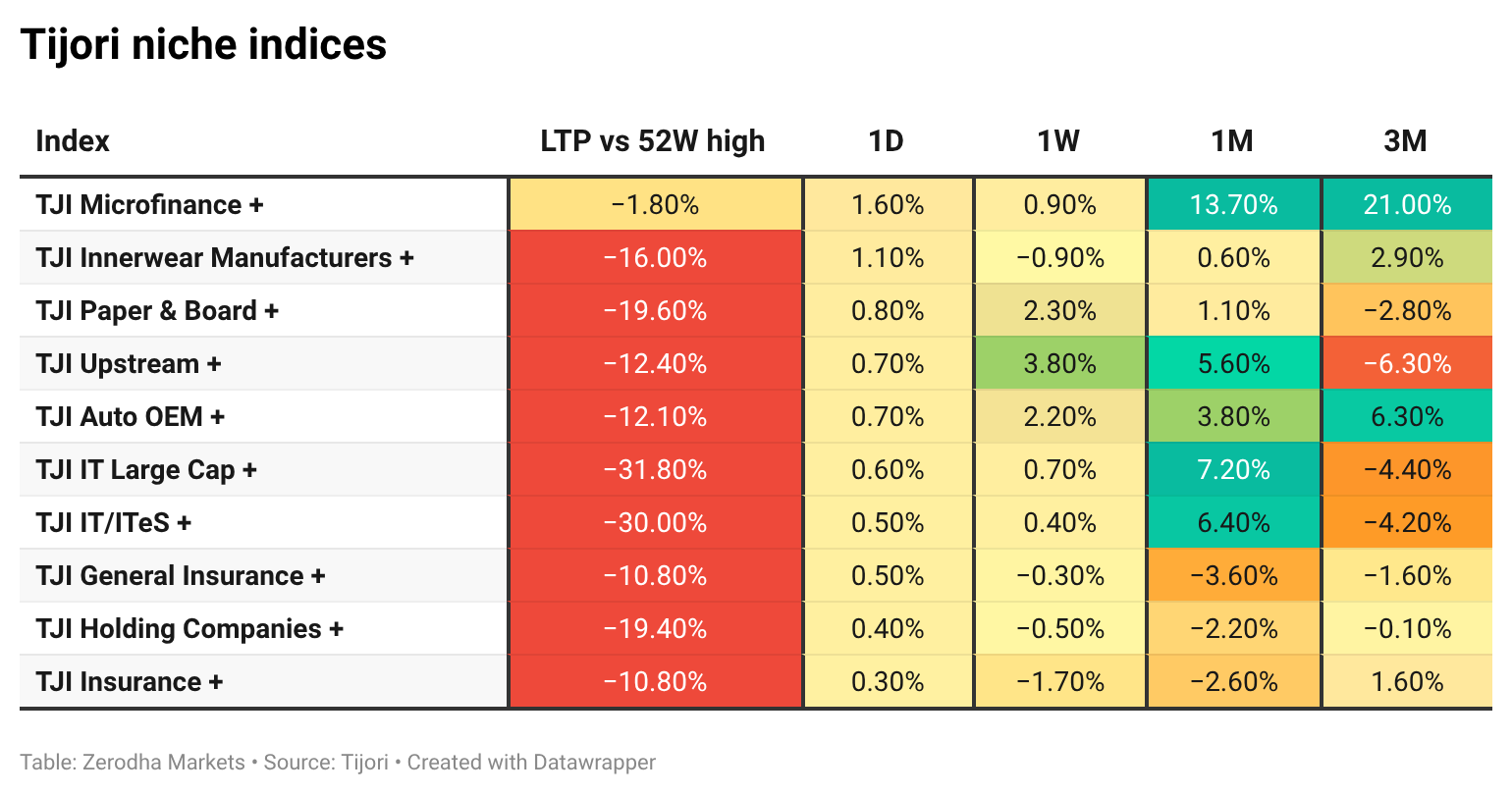
Thematic Indices
Tijori’s niche indices, where today’s move sorts pockets of the market beyond standard sector baskets. You can also track promoter buying and other interesting stuff, like Capex activity by the companies in the Tijori App’s idea dashboard
Change in OI for the day
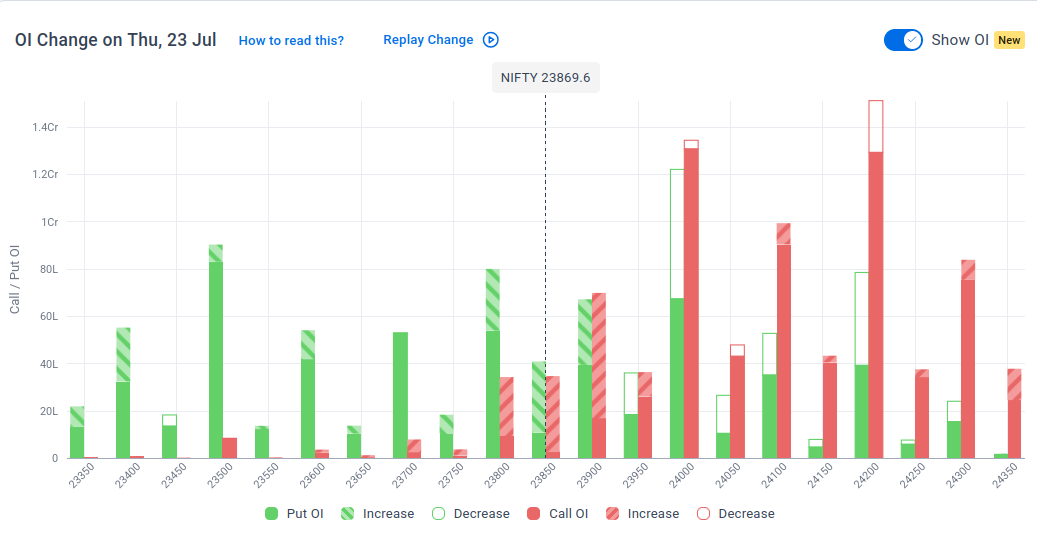
The following is the change in OI for Nifty contracts expiring on 28th July:
The maximum Call Open Interest (OI) is observed at 24,000, followed by 24,200, indicating potential resistance at the 24,000 -24,100 levels.
The maximum Put Open Interest (OI) is observed at 23,500, followed by 23,800, suggesting support at 23,700-23,600.
Note: OI is subject to multiple interpretations; however, generally, an increase in Call OI indicates resistance in a falling market, while an increase in Put OI indicates support in a rising market.
Source: Sensibull

Top Stories in India
Infosys reported a 12.2% YoY rise in Q1FY27 net profit to ₹7,769 crore, while revenue increased 14% to ₹48,211 crore, driven by the life sciences and financial services segments. The company also narrowed its FY27 revenue growth guidance to 1.5–3%, lowering the upper end of the range amid global uncertainty and subdued discretionary spending. Dive deeper
Infosys has appointed Ashish Kumar Dash as CEO designate until March 31, 2027, after which he will take over as CEO from April 1, 2027. The five-year appointment, recommended by the board’s Nomination and Remuneration Committee, is subject to shareholder approval. Dive deeper
InterGlobe Aviation reported a Q1FY27 consolidated net loss of ₹238 crore, compared with a profit of ₹2,176 crore a year earlier, as an 85.7% surge in aircraft fuel costs outpaced revenue growth. Revenue from operations rose 19.9% YoY to ₹24,584 crore, while total income increased 18.9% to ₹25,614 crore. Dive deeper
The government has allowed 100% foreign direct investment (FDI) in inventory-based e-commerce exclusively for export-oriented operations, aiming to boost India’s exports while protecting domestic small retailers. Under the revised policy, companies can export only goods that are manufactured or produced in India. Dive deeper
Cipla reported a 39% YoY decline in Q1FY27 consolidated net profit to ₹789 crore, missing Street estimates, as weak North America sales weighed on margins. Revenue from operations rose 2.3% YoY to ₹7,119 crore, marking a record quarterly revenue despite the earnings miss. Dive deeper
PVR INOX reported a Q1FY27 consolidated net profit of ₹56.5 crore, compared with a loss of ₹47.3 crore a year earlier. Revenue from operations rose 12% YoY to ₹1,622.2 crore from ₹1,449.6 crore in the corresponding quarter. Dive deeper
Top Stories Globally
Crude oil surged over 5% to trade above $91 per barrel, extending gains for a fifth straight session to its highest level since June 8, as escalating Middle East tensions fuelled supply concerns. The rally followed attacks by Iran-backed Houthi militants on two Saudi oil tankers in the Red Sea, raising fears of further disruptions to regional shipping and global energy supplies. Dive deeper
The European Central Bank (ECB) kept its key interest rates unchanged at its July meeting after a 25-basis-point hike in June, adopting a cautious, data-dependent approach. The decision reflects easing inflation, slower wage growth, softer economic activity, and moderating inflation expectations, reducing the need for an immediate rate increase. Dive deeper
The U.S. 10-year Treasury yield rose to 4.71%, its highest level since January 2025, extending gains for a fourth straight session as surging oil prices and geopolitical tensions reinforced expectations of further Federal Reserve rate hikes. Markets are now pricing in a 33% chance of a rate hike next week and a 78% probability of a September hike, up from 61% a day earlier. Dive deeper
Porsche is reportedly planning to cut an additional 5,000–6,000 jobs as part of a broader restructuring programme to improve profitability amid rising costs and weaker demand. If implemented, the move would take the company’s total planned workforce reduction to around 9,000 positions by 2035. Dive deeper
U.S. initial jobless claims fell by 22,000 to a seasonally adjusted 187,000 in the week ended July 18, well below economists' expectations of 212,000, signalling continued resilience in the labour market. Continuing claims also declined to 1.796 million, reinforcing expectations that the Federal Reserve can keep its focus on tackling inflation. Dive deeper
The Cigna Group said its AI-powered tools for identifying patients with chronic or complex conditions are expected to save customers $200 million in medical costs over the next three years. Dive deeper
Management Chatter
In this section, we highlight interesting comments from management at major companies and from policymakers in the Indian and Global Economies.
Sanjiv Puri, Chairman & MD of ITC on its ambition to be the number one FMCG company in India:
“We are premiumizing. We are also making structural investments. We are using digital. We are optimizing the backend. So consistently, our margins are improving, and we believe they will continue to improve over time. And the idea is not merely to be number one FMCG only in terms of size. We want to be there in all financial metrics, and not only financial metrics, but very importantly, in terms of serving the customer by having the best quality products and creating value for all the stakeholders in our ecosystem.” - Link
Dr. Gyanendra Shukla, MD & CEO of Rallis India, talks about the evolving monsoon situation:
“El Niño is certainly a reality. The country has seen deficient rainfall, but roughly 50% of the area in the country is irrigated and has some source of water; only the other 50% is highly rainfall-dependent. While there was delayed sowing due to delayed rain, there has also been a catch-up. Most of our farmers are small-scale and are able to quickly plant their crops.
The thing that changes is the crop shift. For example, the pulses area has gone up, but we know groundnut area in Saurashtra has gone down due to delayed rain. Cotton will be planted less, but rice seems to be on track. Maize is also being planted. Some coarse grains like Bajra in marginal areas in Rajasthan might be impacted. It is a mixed picture. Even in a worst-case scenario, 90–95% of the crop will get planted. Clarity is still emerging on farmer preferences. Soybean has been planted despite some seed challenges. If crops get established, farmers will try to protect them because commodity prices are firming up in anticipation of lower yields.” - Link
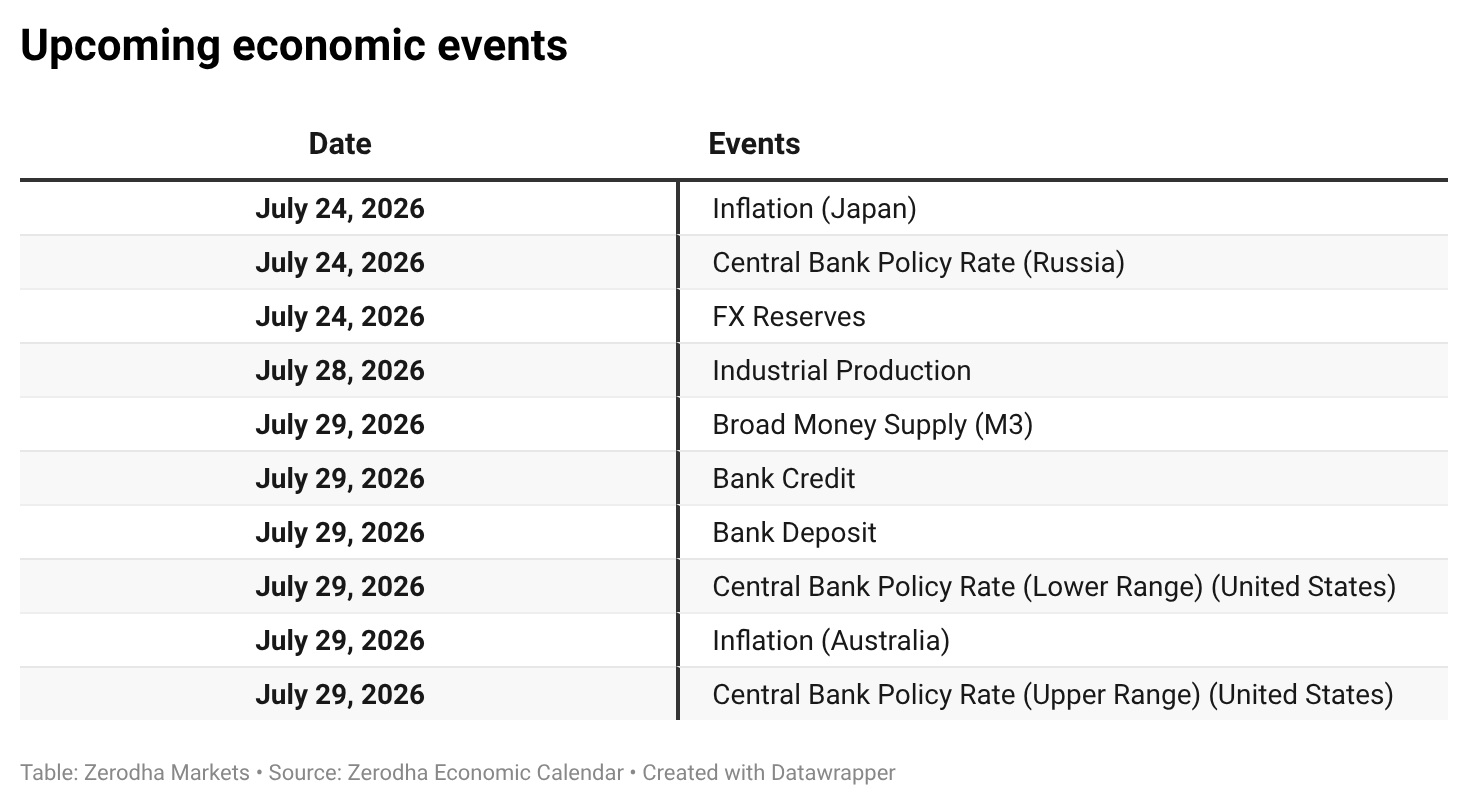
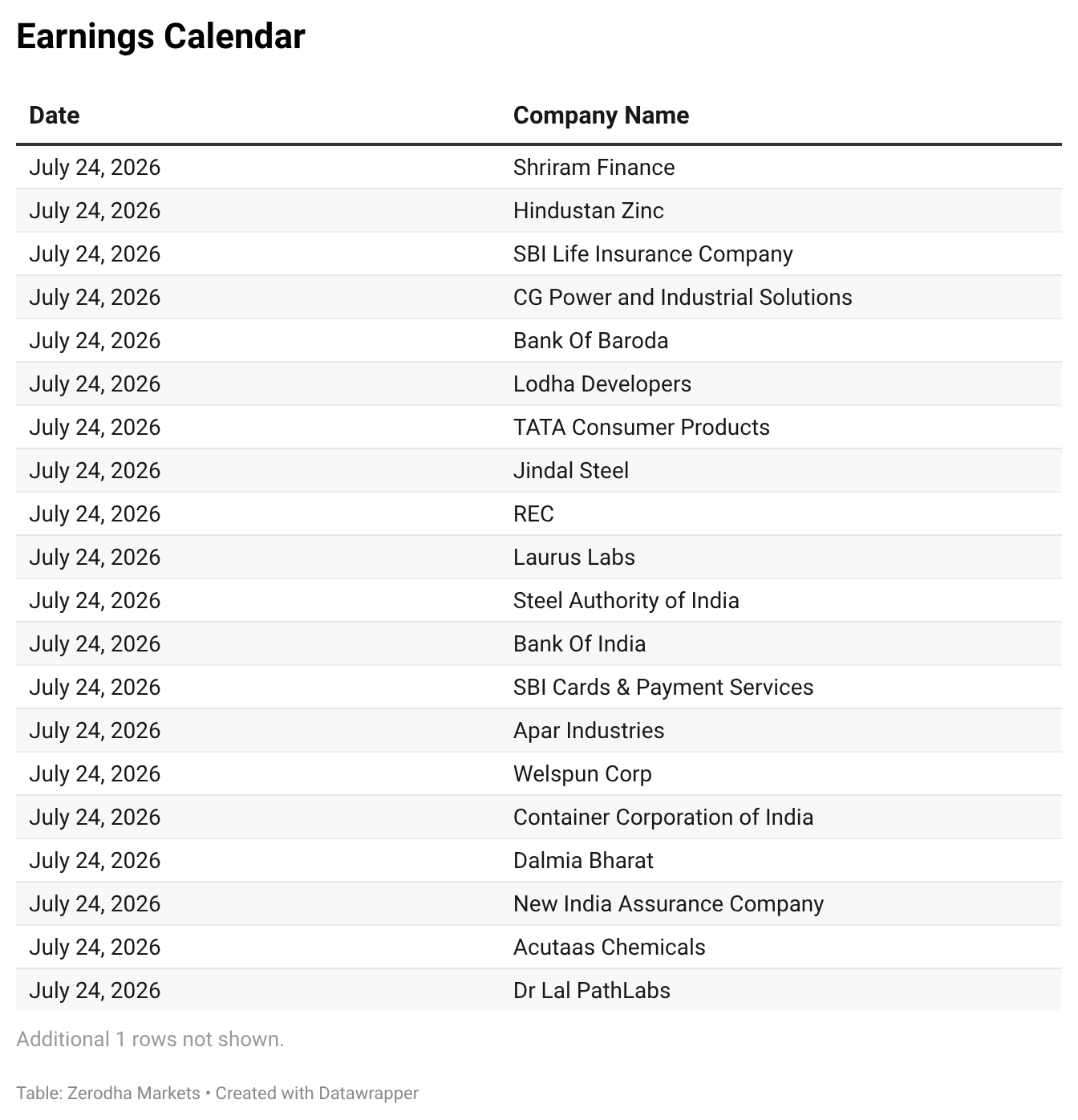
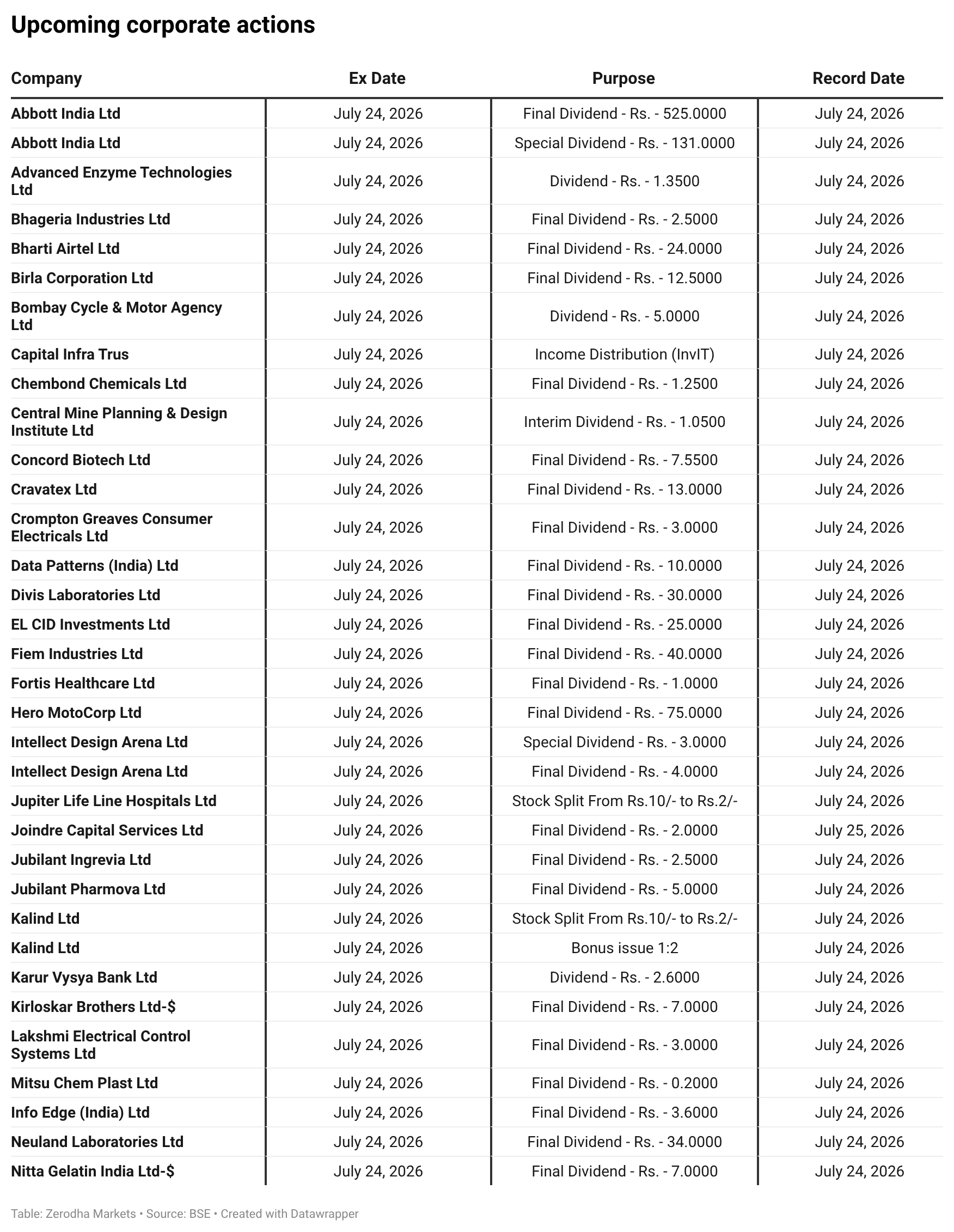
Corporate Actions & Events
Corporate Actions
Published by Zerodha. Not investment advice. Data from NSE, BSE, and MCX.
That’s it from us for today. We’d love to hear your feedback in the comments, and feel free to share this with your friends to spread the word!