

Welcome to Aftermarket Report, a newsletter where we do a quick daily wrap-up of what happened in the markets, both in India and globally.
In our latest episode of In The Money by Zerodha video series, we trace the remarkable journey of the 9:20 Straddle — from its explosive early days to its quieter, more mature present. We’ll uncover why it worked, what’s changed in the markets, and whether there’s still any alpha left to capture. Along the way, we’ll look at seven years of backtested data (2019–2025), analyze performance across different DTEs (Days to Expiry), and explore the subtle shifts in volatility and margin requirements that have reshaped this once “money-spinner” strategy.
If you’ve ever traded intraday straddles or are curious about how systematic option selling evolved in India, this deep dive will help you see where the real edge may lie and where it might be fading.
Market Overview
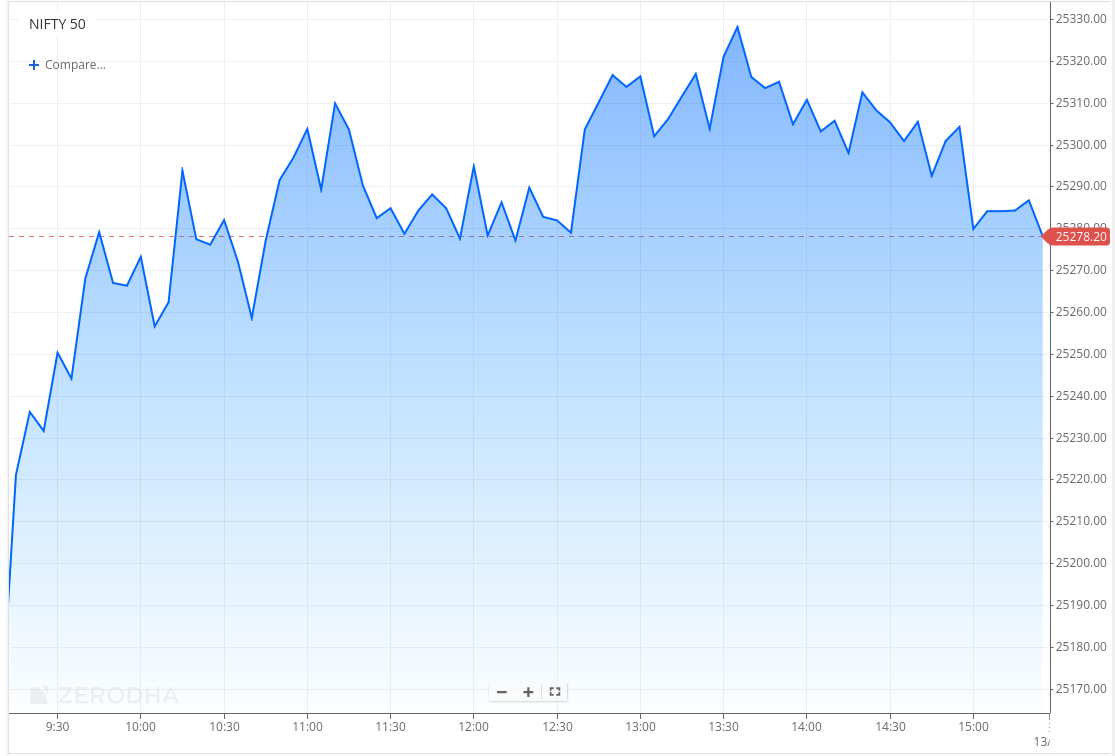
Nifty opened flat with a minor 15-point gap-down at 25,168 and traded with a positive bias through the early part of the session. The index steadily inched higher to cross 25,250 by mid-morning.
For most of the session, Nifty remained in a narrow band between 25,270 and 25,310, reflecting a calm yet constructive tone ahead of key macro data releases. In the final hour, mild profit-taking pulled the index slightly off its highs, but it managed to hold onto its gains. Nifty eventually closed at 25,285.35, up 0.4%, marking its second straight session of gains driven by broad-based sectoral strength and improving risk appetite.
Market sentiment has once again turned optimistic on demand revival following GST cuts, despite the cautious sentiment prevailing on the global trade front with high tariffs from the U.S. Going forward, investors will closely track quarterly results, festival season sales, and management commentary on demand trends across various industries.
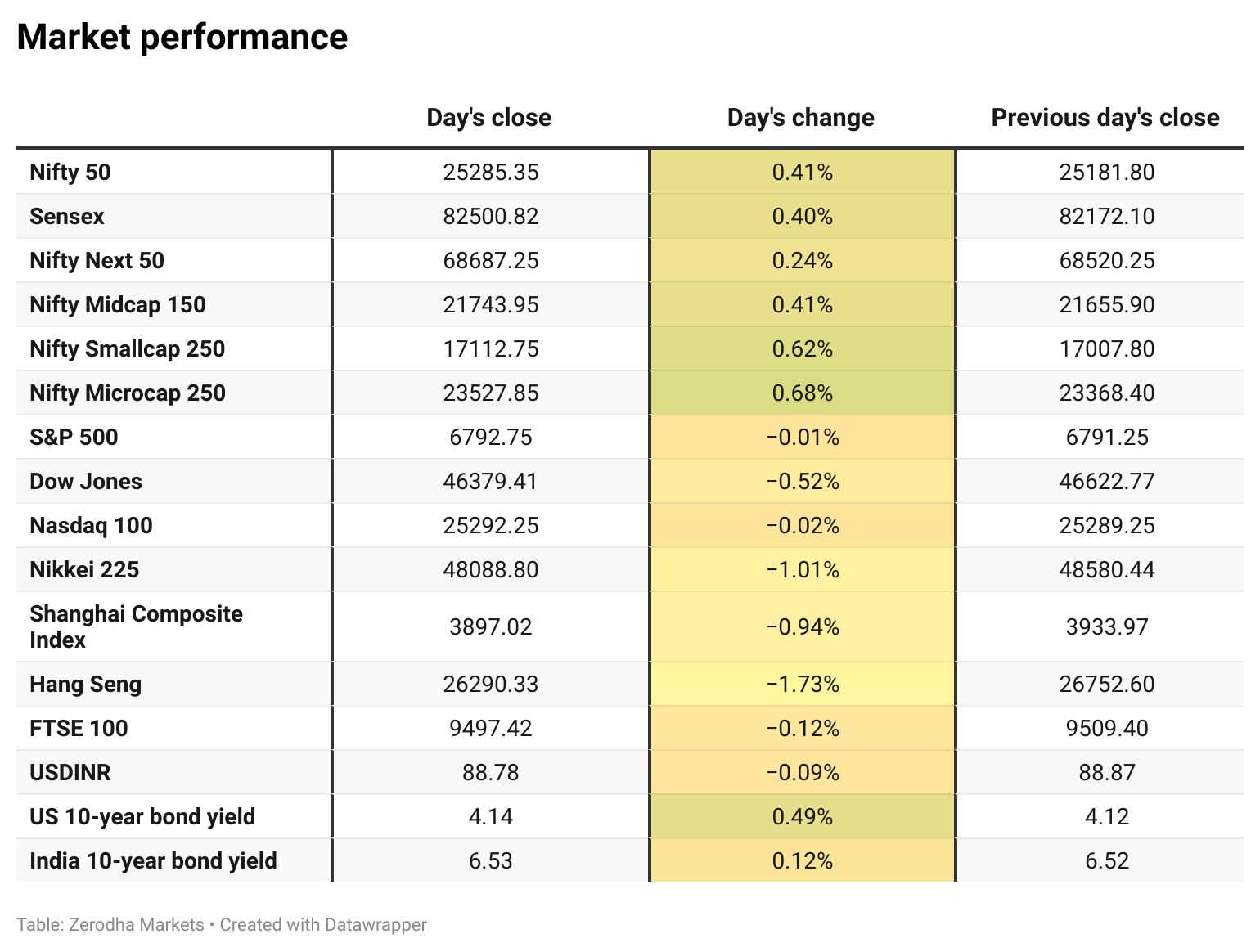
Broader Market Performance:
Broader markets had a strong positive bias today. Of the 3,151 stocks traded on the NSE, 1,890 advanced, 1,164 declined, and 97 remained unchanged.
Sectoral Performance
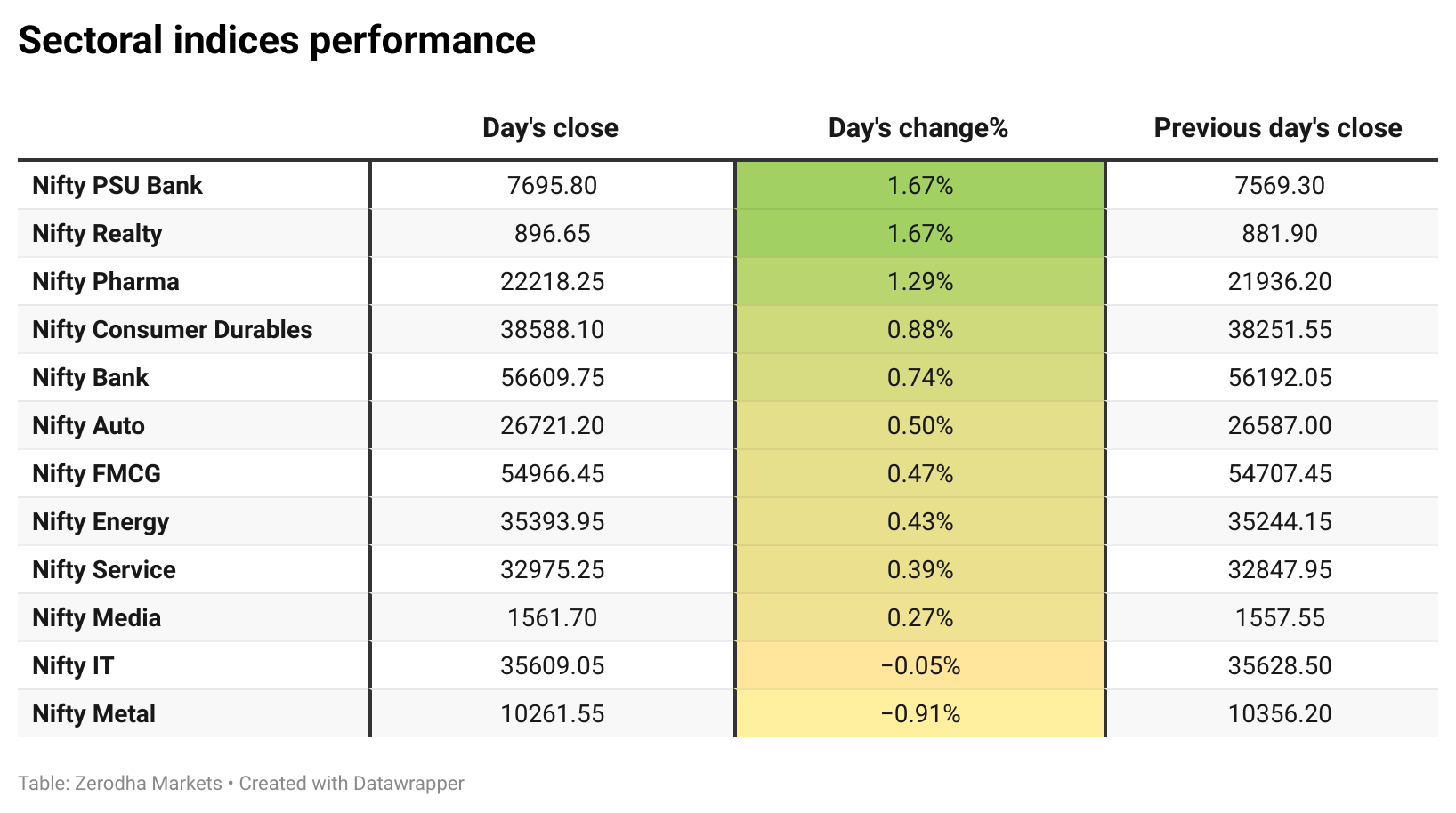
Nifty PSU Bank and Nifty Realty were the top gainers of the day, each rising 1.67%, followed closely by Nifty Pharma, which added 1.29%. On the other end, Nifty Metal was the biggest laggard with a 0.91% drop, while Nifty IT slipped marginally by 0.05%. Out of the 12 sectoral indices, 10 ended in the green while only 2 closed in the red, indicating broad-based buying across sectors.
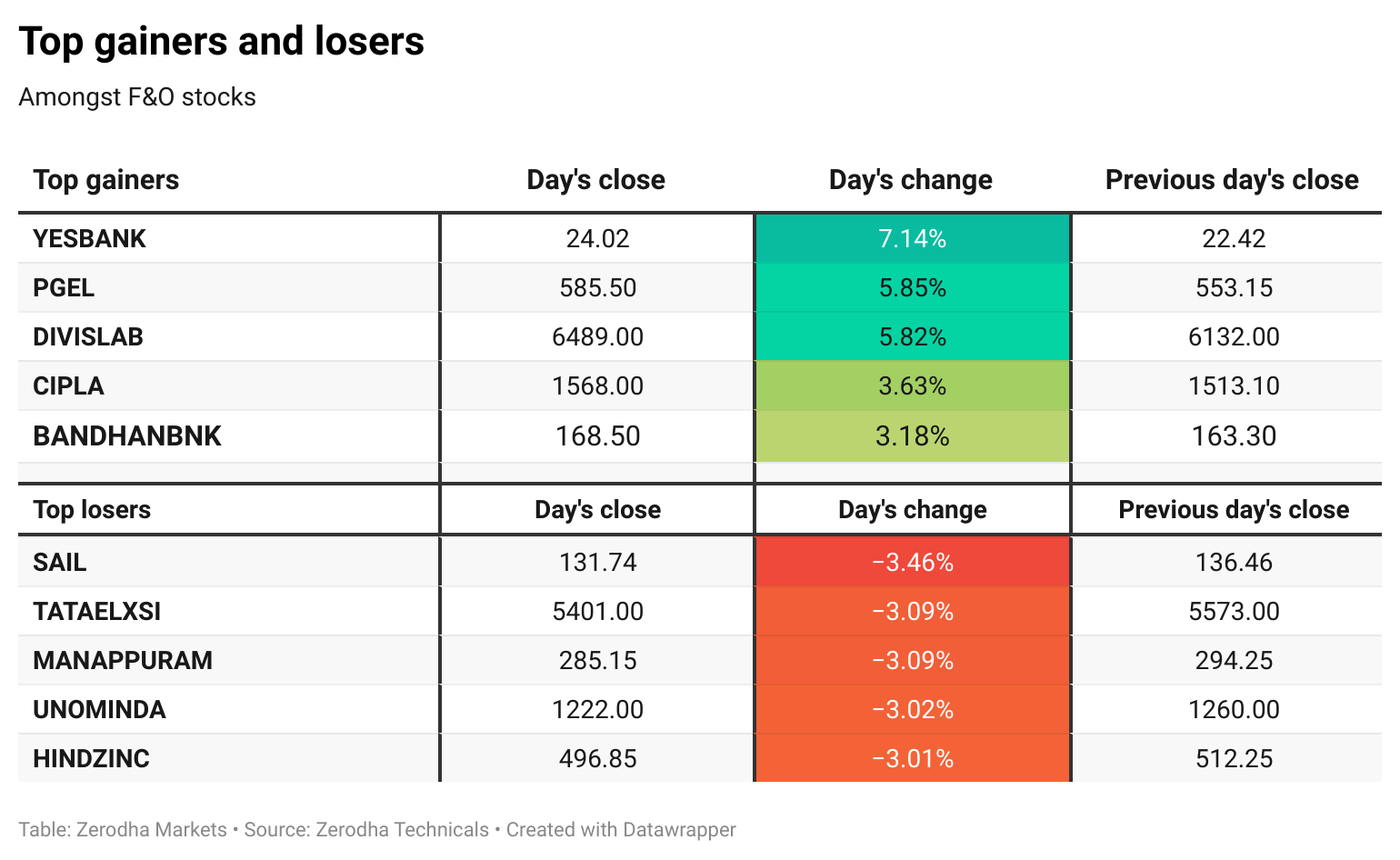
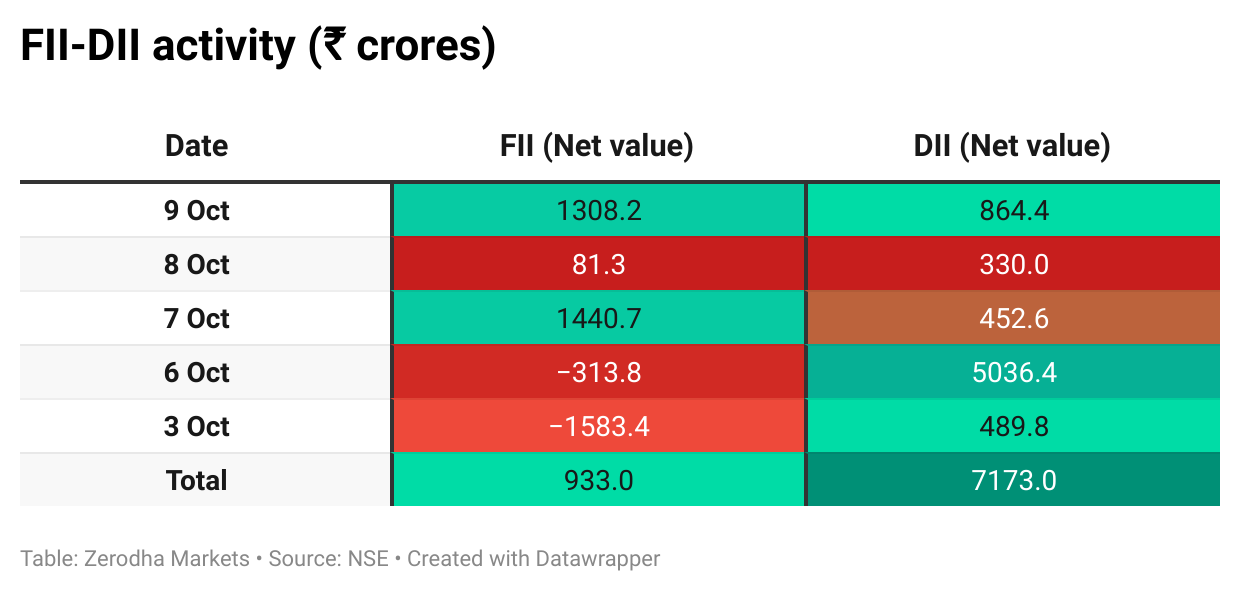
Here’s the trend of FII-DII activity from the last 5 days:
Change in OI for the day
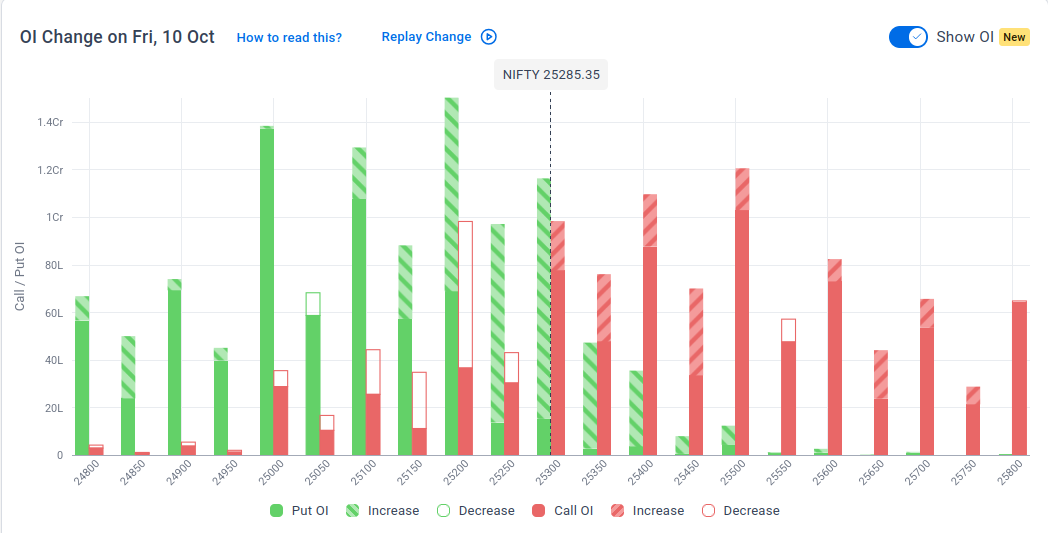
The following is the change in OI for Nifty contracts expiring on 14th October:
The maximum Call Open Interest (OI) is observed at 25,500, followed by 25,400, indicating potential resistance at the 25,400 -25,500 levels.
The maximum Put Open Interest (OI) is observed at 25,200, followed by 25,000, suggesting strong support at 25,200 to 25,100 levels.
Note: OI is subject to multiple interpretations, but generally, an increase in Call OI indicates resistance in a falling market, and an increase in Put OI indicates support in a rising market.
Source: Sensibull
Tijori is an investment research platform, and they have constructed niche indices for various themes and sub-sectors. They help you understand the market performance of narrow slices of the market. You can also track the Promoter buying and other interesting stuff like Capex activity by the companies in the Tijori App’s idea dashboard
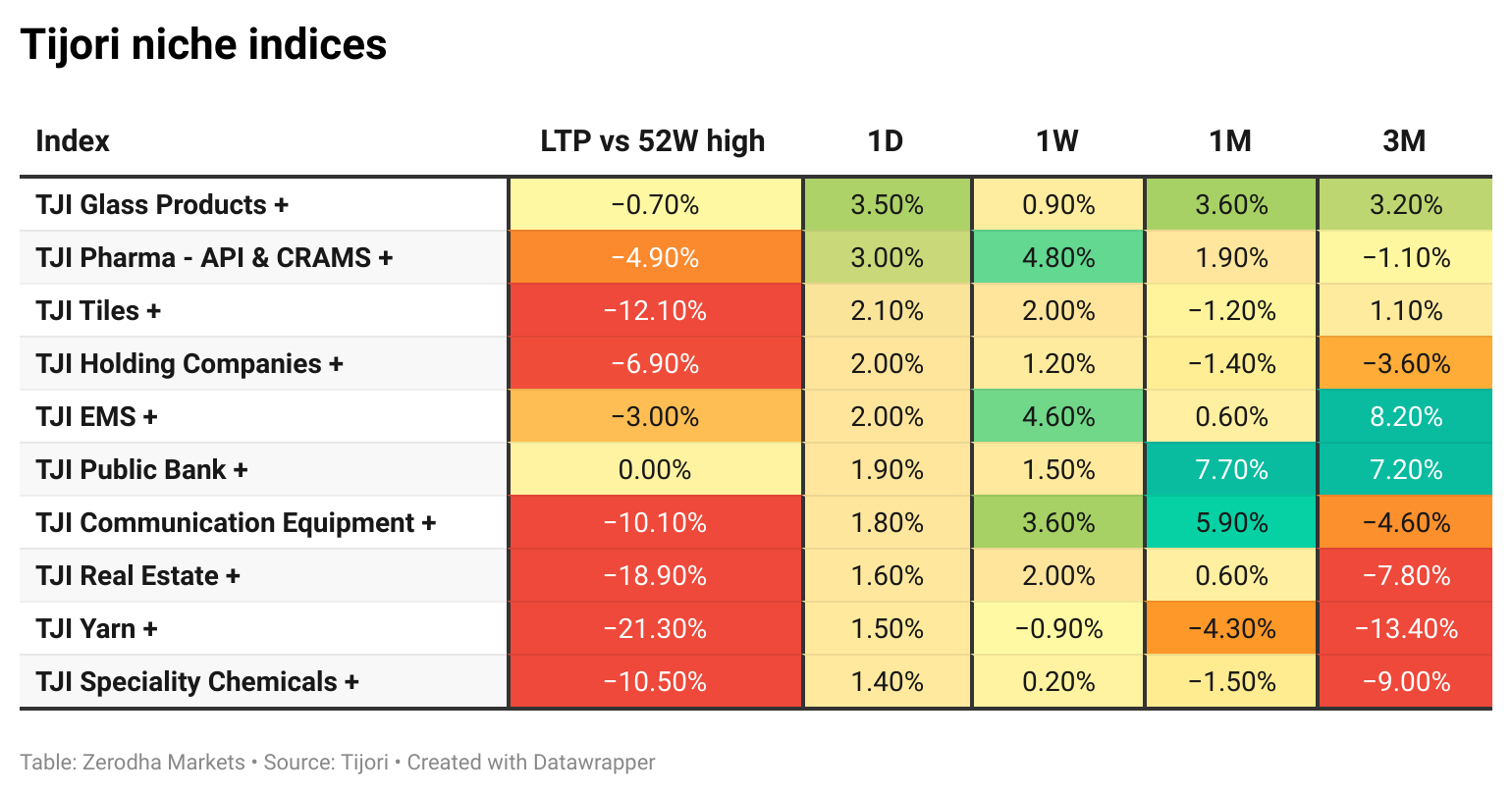
What’s happening in India
Prime Minister Narendra Modi and U.S. President Donald Trump spoke over the phone on Thursday, discussing the Gaza peace initiative and progress on the ongoing India–U.S. trade agreement. Dive deeper
Life insurers’ new business premium rose 15% in September to ₹40,206 crore, led by group single-premium growth despite fewer policies sold. For H1 FY26, total new business increased 7.6% to ₹2.04 lakh crore, driven by private insurers. Dive deeper
India and the U.K. signed a £350 million missile deal and a £250 million agreement to develop electric engines for naval ships. Sixty-four Indian firms pledged £1.3 billion in U.K. investments, expected to create 7,000 jobs. The U.K. also gained approval for Lancaster and Surrey universities to open campuses in India. Dive deeper
Shirish Chandra Murmu assumed charge as RBI Deputy Governor for three years, overseeing communication, regulation, and enforcement. Sanjay Kumar Hansda was appointed Executive Director from March 3 to lead economic and policy research. Dive deeper
Sammaan Capital, formerly Indiabulls Housing Finance, raised $450 million through a five-year dollar bond at a 7.5% coupon, its first overseas issue since Abu Dhabi’s IHC acquired a 43.46% stake. The issue was oversubscribed over three times, taking Sammaan’s total outstanding international bonds to about $1.1 billion. Dive deeper
Signature Global will raise ₹875 crore next week through non-convertible debentures with an 11% coupon and a tenure of over three years. The allotment is scheduled for October 16, 2025, with maturity on January 15, 2029. Dive deeper
NTPC signed an MoU with the Gujarat government to explore opportunities in conventional and renewable energy sectors, strengthening its presence in the state. The pact aligns with NTPC’s goal of expanding green capacity as part of India’s energy transition. Dive deeper
Tata Elxsi’s Q2FY26 net profit fell 32.5% year-on-year to ₹154.8 crore, though it rose 7.2% sequentially, with revenue at ₹918.1 crore and EBITDA margin at 21%. Dive deeper
Bharti Telecom, the holding company of Bharti Airtel, will launch a ₹150 billion ($1.7 billion) bond sale next week, its largest this fiscal, with maturities of two and three years. The bonds will carry coupons of 7.35% and 7.45%, marking its cheapest fundraising in four years amid lower rates and a CRISIL AAA rating. Dive deeper
State Bank of India plans to raise up to ₹75 billion through 10-year Basel III-compliant tier II bonds, marking its return to the rupee debt market after a year. The issue, expected this month, will include a call option after five years, with mutual funds seen as key bidders. Dive deeper
What’s happening globally
Brent crude fell below $65 per barrel as geopolitical tensions eased after an Israel-Hamas ceasefire plan, though it remained set for a weekly gain. Prices found support from new U.S. sanctions on Iran’s energy trade and OPEC+’s modest output hike. Dive deeper
Gold hovered just below $4,000 on Friday after touching a record $4,059 earlier in the week, up 52% so far this year and heading for its eighth straight weekly gain. Dive deeper
Silver rose above $50 per ounce on Friday, near its record $51.30, marking an eighth straight weekly gain driven by safe-haven demand and supply shortages. Dive deeper
Japan’s producer prices rose 2.7% year-on-year in September, matching August’s pace but exceeding forecasts of 2.5%. Gains were broad-based across sectors, while chemicals and steel prices declined. On a monthly basis, prices increased 0.3%, reversing a 0.2% fall in August. Dive deeper
Norway’s inflation rose to 3.6% in September, up from 3.5% in August and above forecasts, driven by higher food and transport costs. Core inflation eased slightly to 3%, while monthly CPI increased 0.4%, rebounding from a 0.6% drop in August. Dive deeper
Indonesia raised $2.54 billion through a dual-currency bond issue in U.S. dollars and euros, with tenors of 5.5, 10.5, and 8 years. The proceeds will fund the 2025 state budget and sustainable development projects, reflecting continued global investor confidence. Dive deeper
OpenAI has urged EU regulators to address competition issues in AI, citing challenges against dominant players like Google. It called for action to prevent large platforms from locking in users as EU reviews tech giants’ market practices. Dive deeper
Former UK Prime Minister Rishi Sunak has joined Microsoft and AI startup Anthropic as a senior adviser, focusing on strategy and global trends. Dive deeper
Management chatter
In this section, we pick out interesting comments made by the management of major companies and policymakers of the Indian and Global Economy.
K. Krithivasan, CEO & Managing Director, TCS, on AI-led transformation and data centre expansion
“Every project at TCS will be AI-led. We are embedding artificial intelligence into all our client engagements and internal operations.”
“We’ve trained over 1.6 lakh employees in AI tools and plan to expand into data centres and sovereign cloud to strengthen our AI ecosystem.”
“Our goal is to make TCS the world’s largest AI-led technology services provider, combining human creativity with machine intelligence for scalable impact.” - Link
R. Venkataraman, Managing Director, IIFL Capital, on India’s IPO market and market outlook
“India’s IPO market is contributing nearly 1% to GDP, reflecting strong investor confidence and vibrant primary market activity.”
“With marquee companies like Hyundai, Tata Capital, LG, Jio, and Flipkart preparing listings, the IPO ecosystem will continue to remain dynamic.”
“Despite global headwinds, economic reforms, rate cut prospects, and improving corporate earnings are expected to drive double-digit market returns over the next six months.” - Link
Dario Amodei, Co-founder and CEO, Anthropic, on India expansion and AI growth
“Anthropic will open its first India office in Bengaluru in early 2026 to serve the country’s rapidly growing demand for AI tools.”
“India has become our second-largest consumer market for Claude, reflecting the nation’s deepening engagement with generative AI.”
“We aim to tap into India’s skilled talent base and expanding enterprise tech ecosystem as we scale our global operations.” - Link
🧑🏻💻Have you checked out The Chatter?
Every week, we listen to the big Indian earnings calls—Reliance, HDFC Bank, and even smaller logistics firms—and copy the full transcripts. We then remove the fluff and keep only the sentences that could move a share price: a surprise price hike, a cut-back on factory spending, a warning about weak monsoon sales, or a hint from management on RBI liquidity. We add a quick, one-line explainer and a timestamp so you can trace the quote back to the call. The whole thing lands in your inbox as one sharp page of facts you can read in three minutes—no 40-page decks, no jargon, just the hard stuff that matters for your trades and your macro view.
Go check out The Chatter here.
So, we’re now on Reddit!
We love engaging with the perspectives of readers like you. So we asked ourselves - why not make a proper free-for-all forum where people can engage with us and each other? And what’s a better, nerdier place to do that than Reddit?
So, do join us on the subreddit, chat all things markets and finance, tell us what you like about our content, and where we can improve! Here’s the link — alternatively, you can search r/marketsbyzerodha on Reddit.
See you there!
Calendars
In the coming days, we have the following significant events and corporate actions:
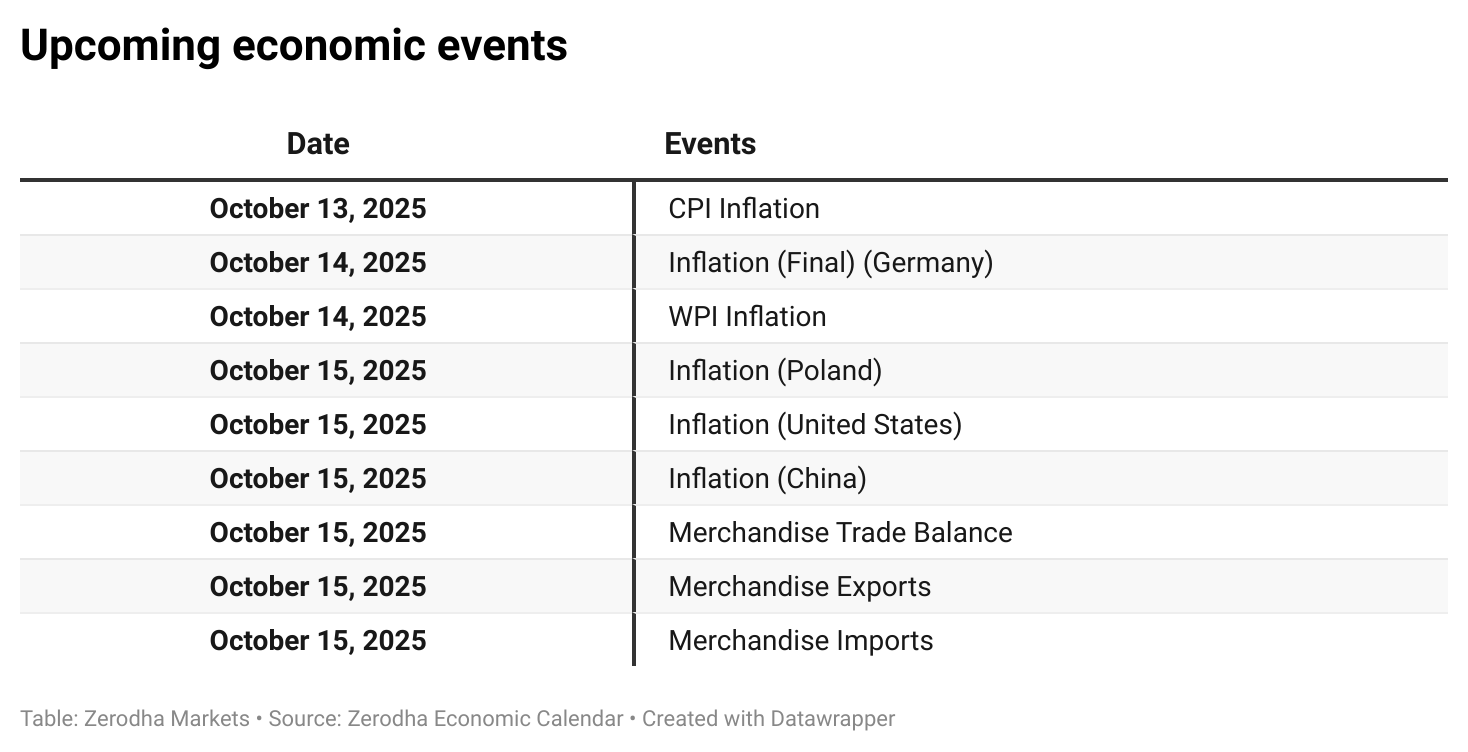
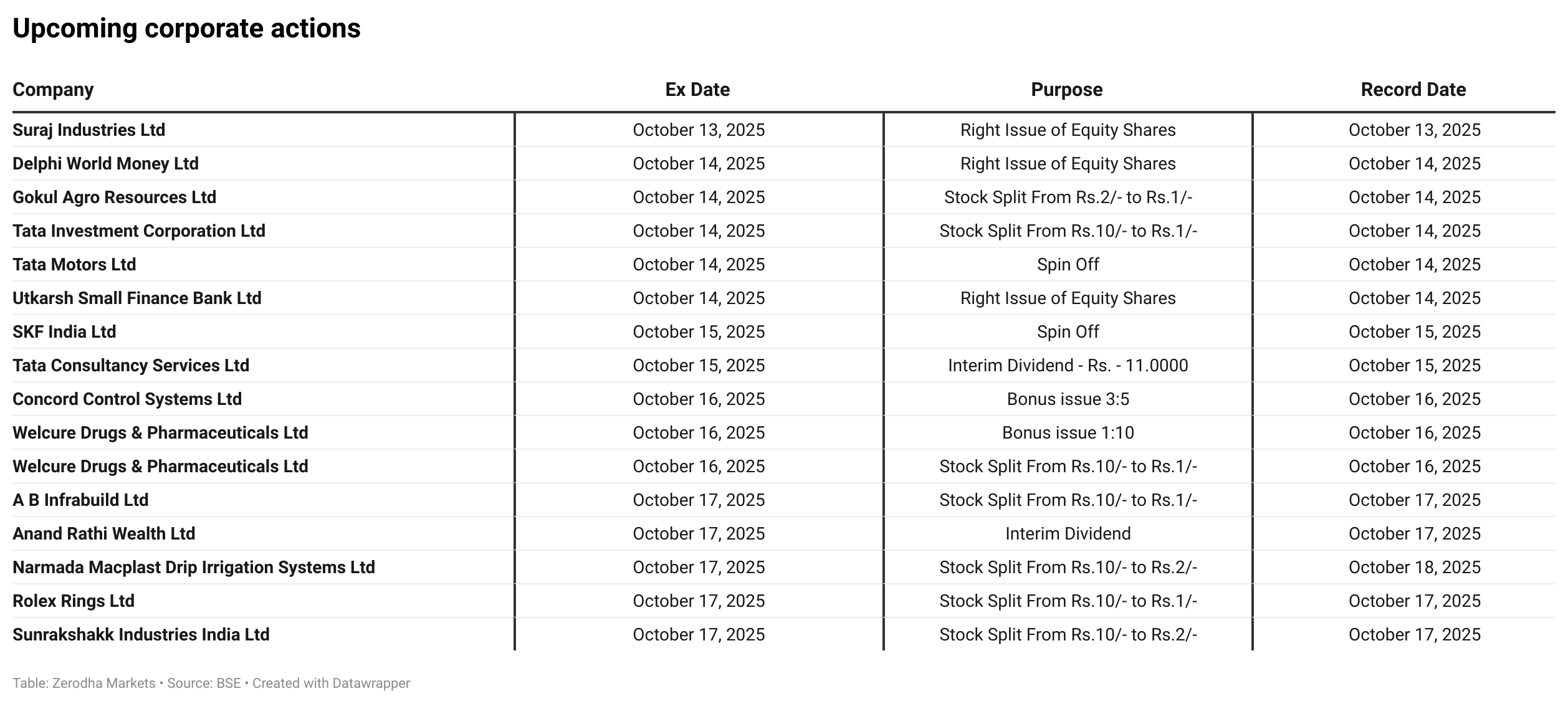
That’s it from us for today. We’d love to hear your feedback in the comments, and feel free to share this with your friends to spread the word!
Really timely piece — thanks for putting this together. A few thoughts:
1. Breadth of recovery vs concentrated gains
The article rightly points out that PSU banks, real estate, and power stocks are showing strength. But the question is: is this a broad-based market revival, or selective sector rotation? If only a few sectors lead, the broader rally is fragile.
2. Credit risk / balance sheet caution for PSU banks
Gains in PSU bank stocks are encouraging, but their performance depends heavily on recovery in corporate credit, asset quality, and provisioning norms. There’s still latent risk if the economy slows.
3. Realty’s rebound depends on demand durability
Real estate always lags in cycles. The revival must be supported by sustained demand (especially from metros), interest rates, and consumer confidence. One quarter of uptick isn’t enough to call a full recovery.
4. Power / utilities and capital costs
For power stocks, regulatory clarity, fuel cost pass-through, and tariff policies are crucial. Growth is promising only if the regulatory & tariff regimes remain favourable.
5. Valuation & downside buffers
As the market rotates, valuations can get stretched quickly. It’s important to keep downside protection — either through allocations to defensives or stop-loss frameworks.
6. Macro / policy tailwinds
The direction of interest rates, inflation, government infrastructure spending, and global liquidity will heavily influence whether these sector gains can sustain.
In summary: The sector rotation is promising, but the risks are still high. For long-term gains, we’ll need confirmatory signs like sustained earnings upgrades, credit recovery, and policy consistency.