
Welcome to Aftermarket Report, a newsletter where we do a quick daily wrap-up of what happened in the markets, both in India and globally.
Markets Today
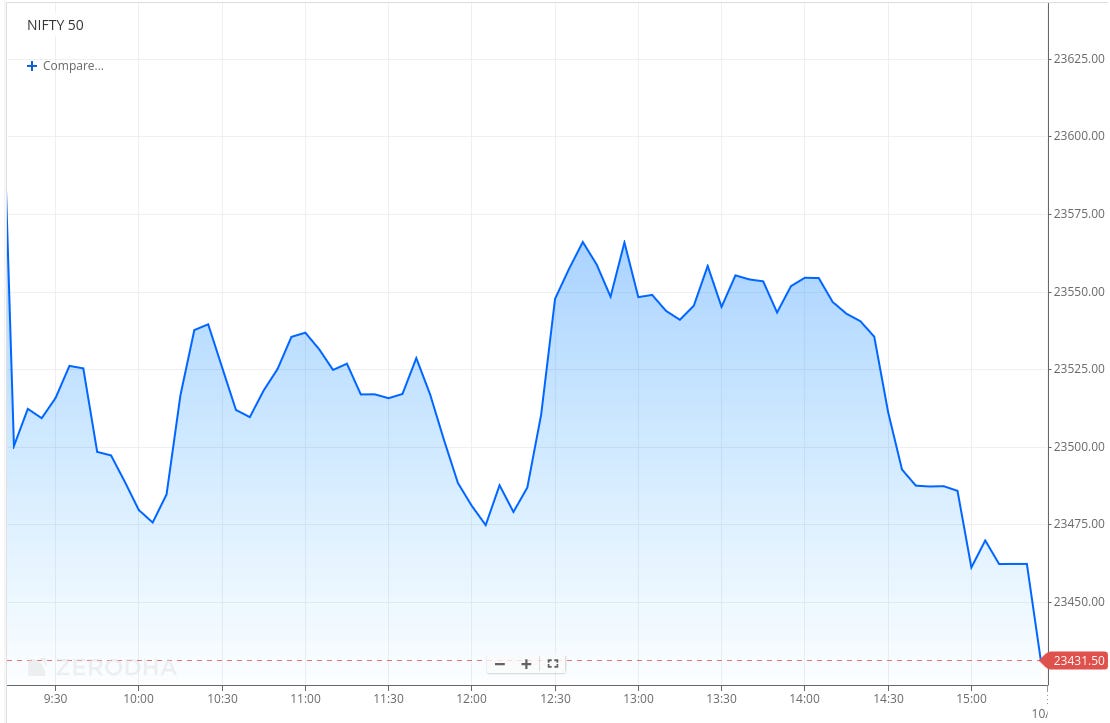
Nifty opened with a 113-point gap down at 23,522, tracking weak global cues amid a sharp flare-up in oil prices, with Brent crude crossing the psychological $ 100-per-barrel mark. The index came under pressure immediately after the open, slipping towards 23,500, before briefly recovering towards 23,530.
Selling resumed soon after, dragging Nifty towards 23,475–23,480 around 10 AM. The index then staged a recovery towards 23,540–23,545 by 10:30 AM and remained choppy around the 23,510–23,530 zone through the rest of the first half.
In the second half, Nifty initially slipped back toward 23,480 before staging a sharp recovery after 12:30 PM that took it above 23,550 and toward an intraday high near 23,570. However, the recovery failed to sustain. After remaining around 23,540–23,550 until 2 PM, selling pressure intensified sharply in the final hour, pushing the index below 23,500 and eventually towards 23,450. Another leg of selling towards the close, followed by weakness during the closing auction session, dragged Nifty to 23,431.50, near the day’s low and around 90 points below its opening level.
Sectoral Indices Performance
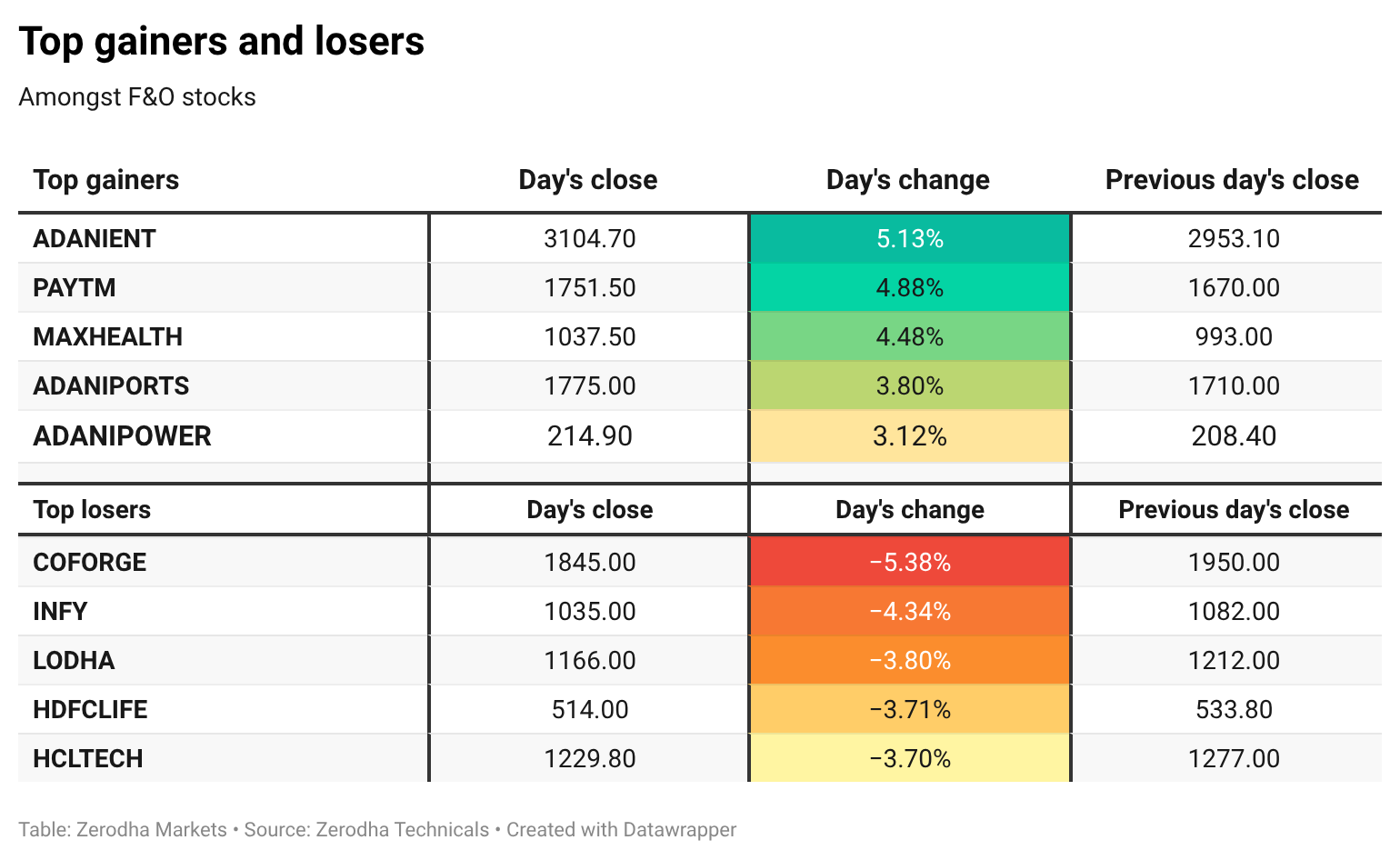
Winners & Losers
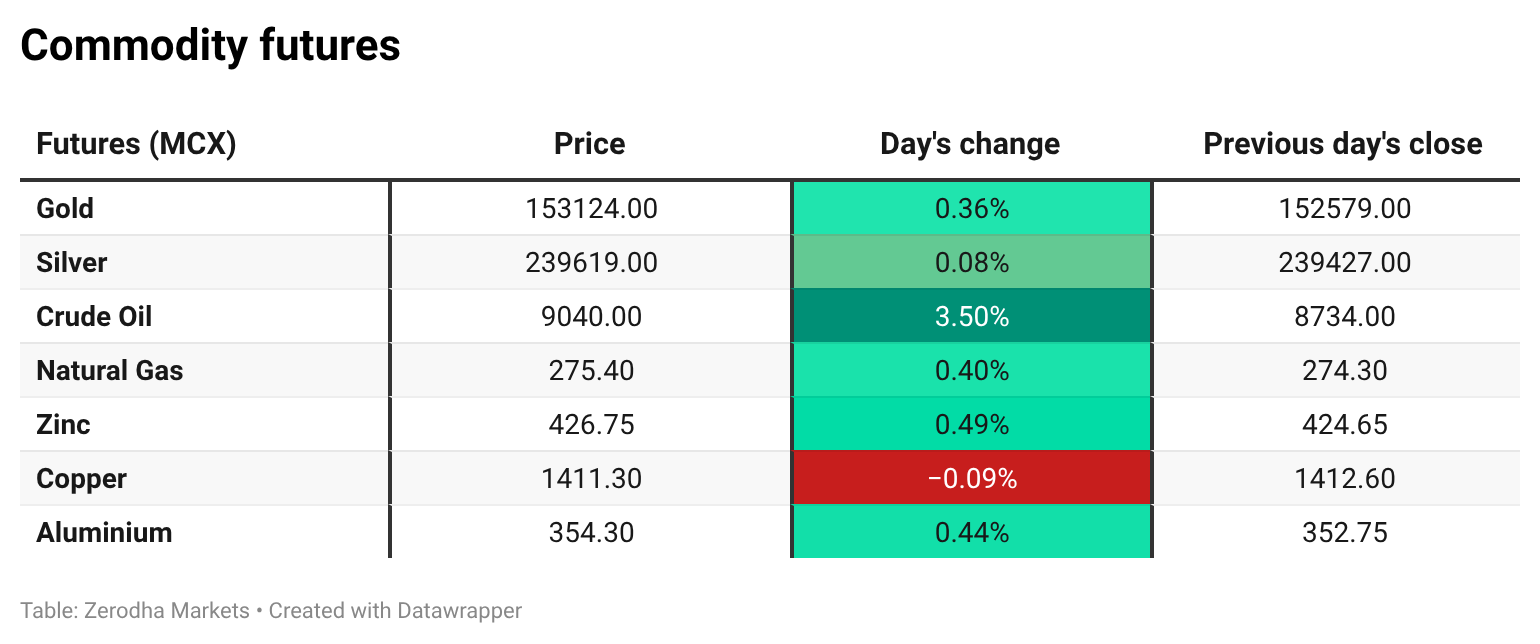
Commodities
FII / DII Flows
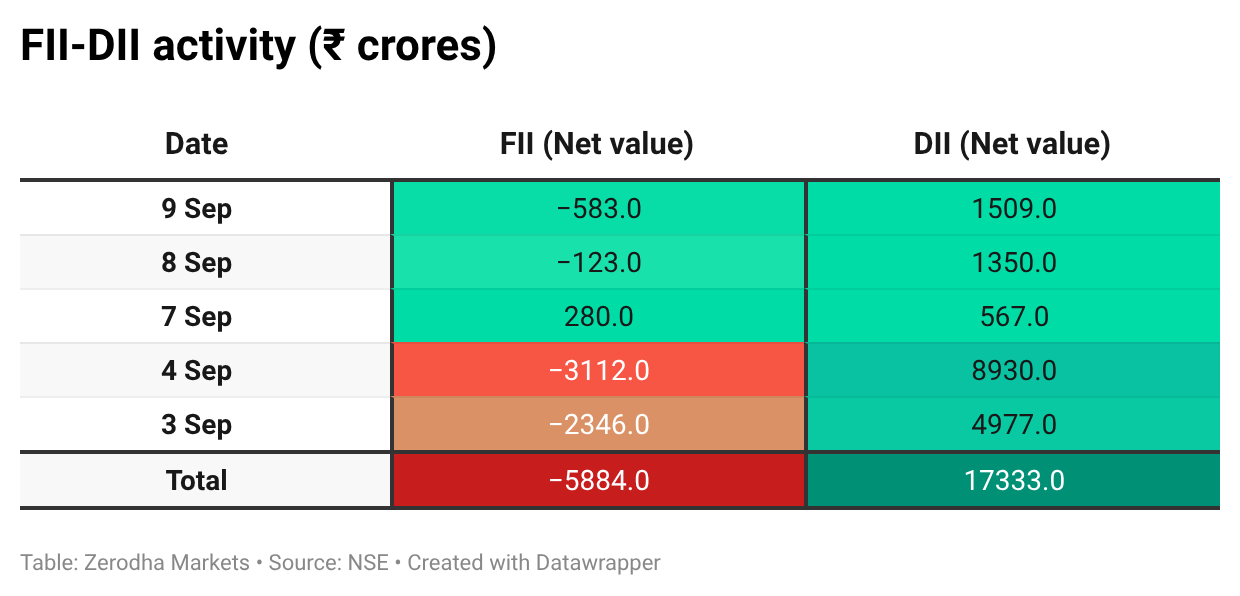
Here’s the trend of FII-DII activity from the last 5 days:
Thematic Indices
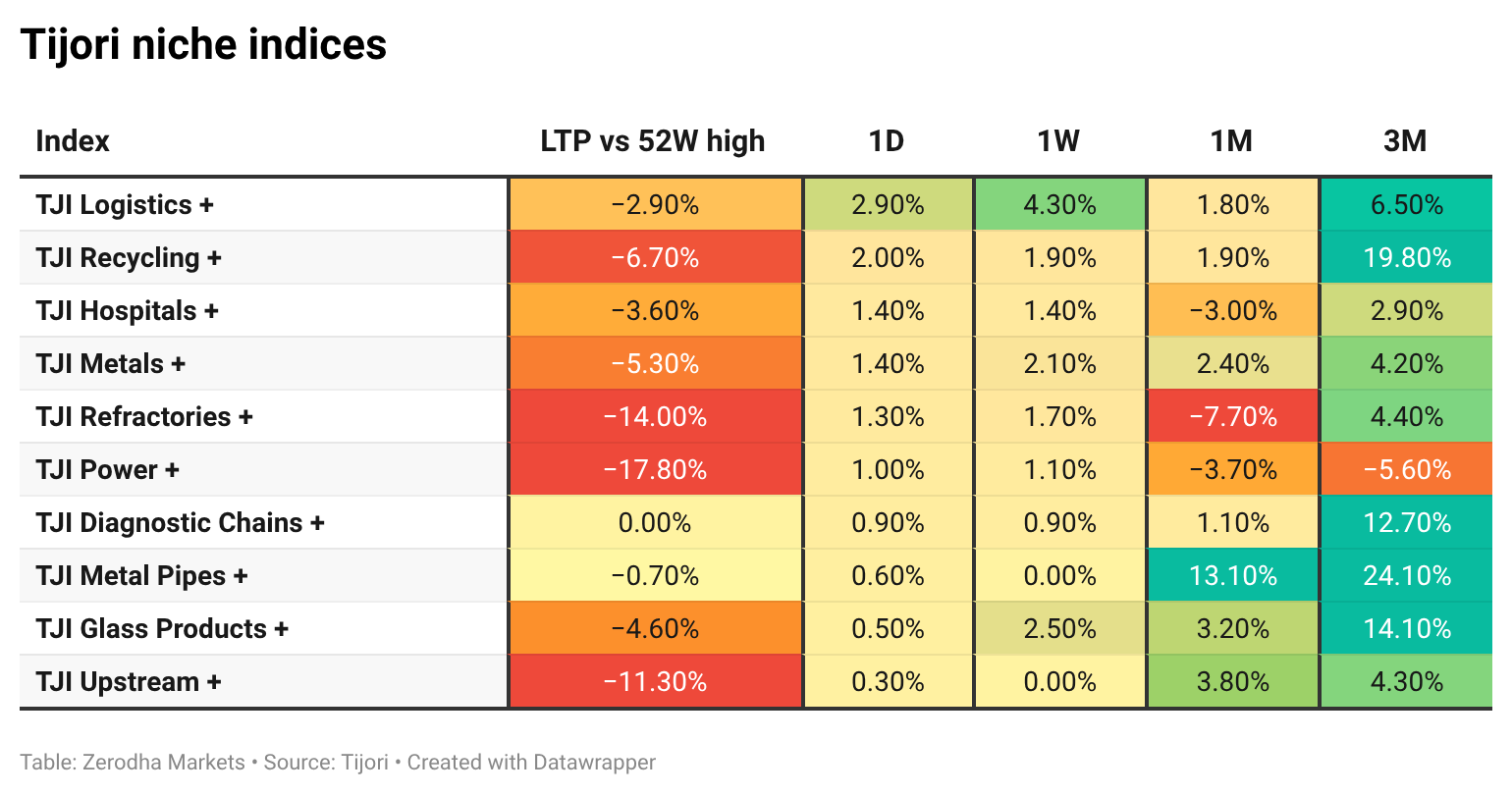
Tijori’s niche indices, where today’s move sorts pockets of the market beyond standard sector baskets. You can also track promoter buying and other interesting stuff, like Capex activity by the companies in the Tijori App’s idea dashboard
Change in OI for the day
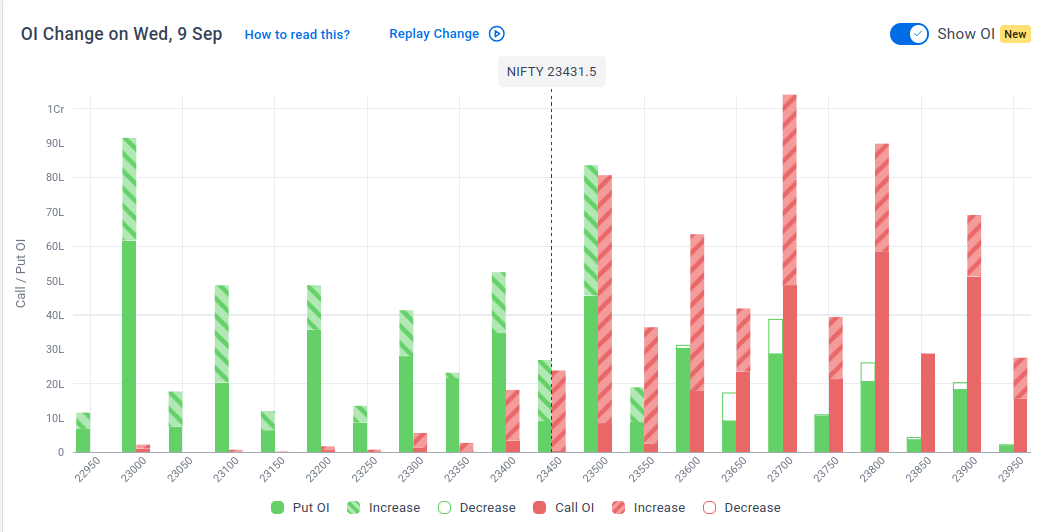
The following is the change in OI for Nifty contracts expiring on 15th September:
The maximum Call Open Interest (OI) is observed at 23,700, followed by 23,800, indicating potential resistance at the 23,600- 23,700 levels.
The maximum Put Open Interest (OI) is observed at 23,000, followed by 23,500, suggesting support at 23,300-23,200.
Note: OI is subject to multiple interpretations; however, generally, an increase in Call OI indicates resistance in a falling market, while an increase in Put OI indicates support in a rising market.
Source: Sensibull

Top Stories in India
The Indian rupee weakened past ₹95 per dollar, as escalating Middle East tensions pushed Brent crude above $100 per barrel, raising concerns for the world’s third-largest oil importer. Dive deeper
The Cabinet approved eight railway multitracking projects worth ₹20,804 crore, covering 31 districts across nine states. The projects will add around 1,196 km to the Indian Railways network and are targeted for completion by 2029-30, with five projects worth ₹10,021 crore located across Tamil Nadu, Andhra Pradesh, Karnataka and Telangana. Dive deeper
Adani Enterprises’ airport unit will raise ₹9,825 crore in fresh equity from BlackRock-managed funds, Temasek, Premji Invest and Alpha Wave Global, giving the business a pre-money valuation of around $18 billion. The investors will collectively acquire about 5.54% in Adani Airport Holdings, with the funds used to expand and modernise airports, develop airport-linked commercial infrastructure and scale adjacent businesses. Dive deeper
Graphite India shares surged 15%, while HEG also gained after U.S.-based GrafTech announced an immediate minimum 30% hike in graphite electrode prices. The move, coupled with GrafTech’s recent 51,000-tonne capacity reduction, raised expectations of tighter global supply and better realisations and margins for Indian graphite electrode producers. Dive deeper
Steel Exchange India signed a four-year MoU with NMDC for long-term procurement of iron ore fines with 61–63%+ iron content from NMDC’s upcoming Visakhapatnam facility. The proximity to SEIL’s Vizianagaram plant is expected to improve raw-material security, lower logistics costs and support future capacity expansion. Dive deeper
Top Stories Globally
Brent crude breached $100 per barrel for the first time since July 24, hitting a six-week high, as the escalating Middle East conflict intensified concerns over oil supplies. The rally followed U.S. strikes that destroyed five Iranian oil tankers and Iran’s retaliation against ships near the Strait of Hormuz and a U.S. base in Jordan, further disrupting a key route for global energy supplies. Dive deeper
Copper futures hovered near record highs around $6.75 per pound, as traders booked profits following a sharp rally earlier this week. Prices remain supported by uncertainty over potential U.S. tariffs on refined copper and tightening global mine supply, alongside strong longer-term demand from power grids, AI data centres and electrification. Dive deeper
U.S. mortgage rates climbed to their highest level in over 14 months as escalating Middle East tensions pushed oil prices higher, fueling inflation concerns and lifting Treasury yields. The average 30-year fixed mortgage rate rose 6 bps to 6.85% in the week ended September 4, its highest level since June 2025. Dive deeper
Argentina’s corn exports are expected to hit a record 10 million tonnes in August–September, more than three times typical volumes, as buyers seek alternatives to disrupted Ukrainian supplies and heat-hit European crops. The surge is supported by a record 71.7-million-tonne harvest, nearly 20% above the previous record. Dive deeper
U.S. equity futures fell for a third straight session, with the S&P 500 and Dow down around 0.5% and Nasdaq 100 futures falling as much as 1%, as rising Treasury yields and oil prices weighed on sentiment. The 10-year Treasury yield hovered around 4.8%, raising borrowing costs and concerns over corporate margins and consumer demand ahead of key U.S. inflation data. Dive deeper
Management Chatter
In this section, we highlight interesting comments from management at major companies and from policymakers in the Indian and Global Economies.
Phanindranath Kakarla, MD & CEO, Asset Reconstruction Company (India) Ltd., highlighted the role ARCs have played in India’s credit ecosystem:
“The ARC industry has been an invisible but critical part of the credit cycle. This being the first ARC to list will give visibility to the whole industry. The industry has been around for 25 years, starting with Arcil itself.
Over this period, the industry has given back about ₹2.5 lakh crore to the banking and NBFC industry through recoveries, and we ourselves have given over ₹30,000 crore back to the lending industry.” - Link
Sahil Goyal, MD & CEO of Shiprocket, sees Indian e-commerce penetration as still being at an early stage, particularly outside metros. Shiprocket already derives a majority of its GMV from Tier-2 and Tier-3 cities:
“Today, India has about 8% retail penetration, which is fairly low compared with the US and China. India is at the beginning of its digitization journey, particularly in tier 2 and 3 cities, where half of India’s e-commerce today is already in tier 2-plus cities. Shiprocket has a majority of its GMV coming from tier 2 and 3 cities, so there is a lot of growth happening in that segment.” - Link
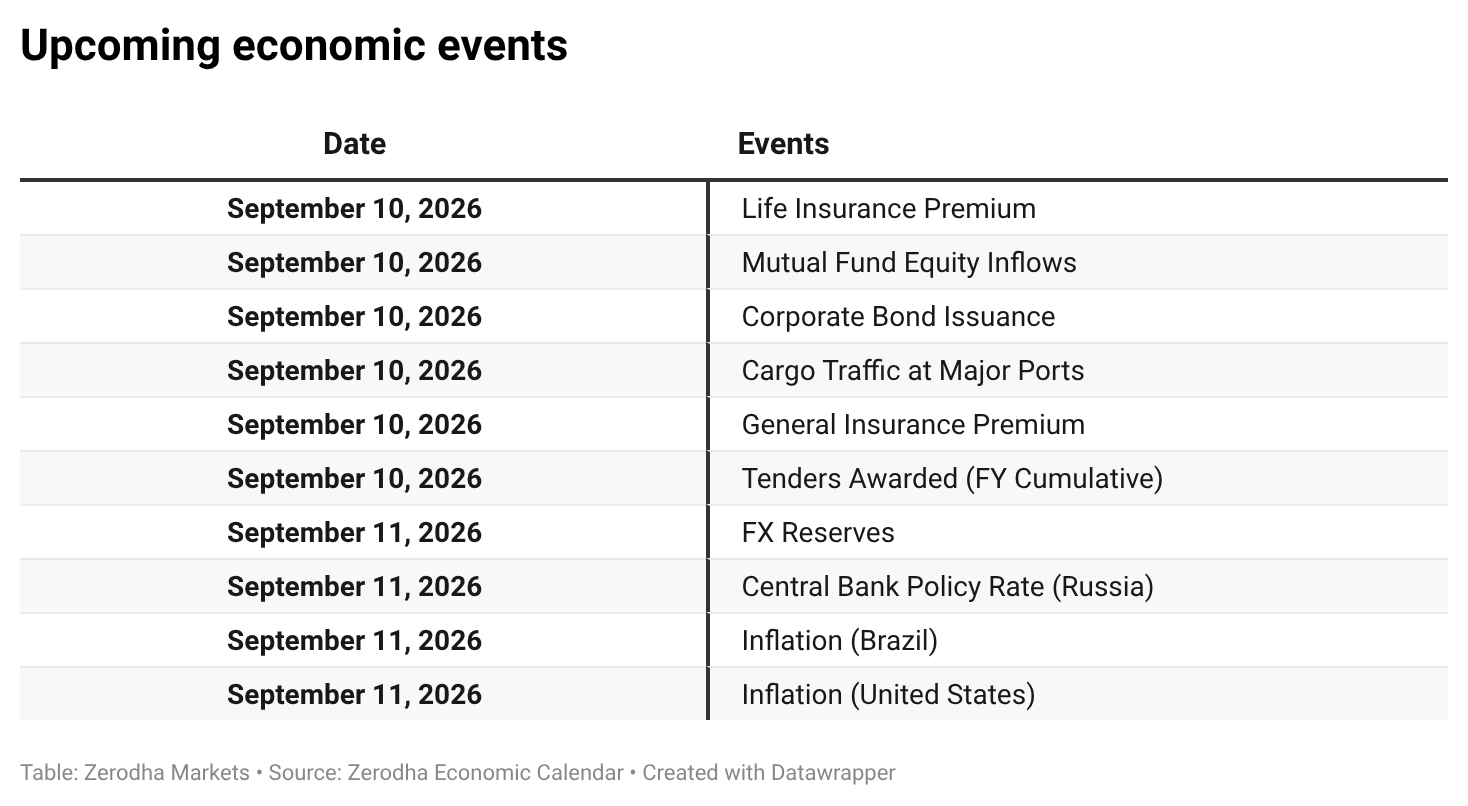
Corporate Actions & Events
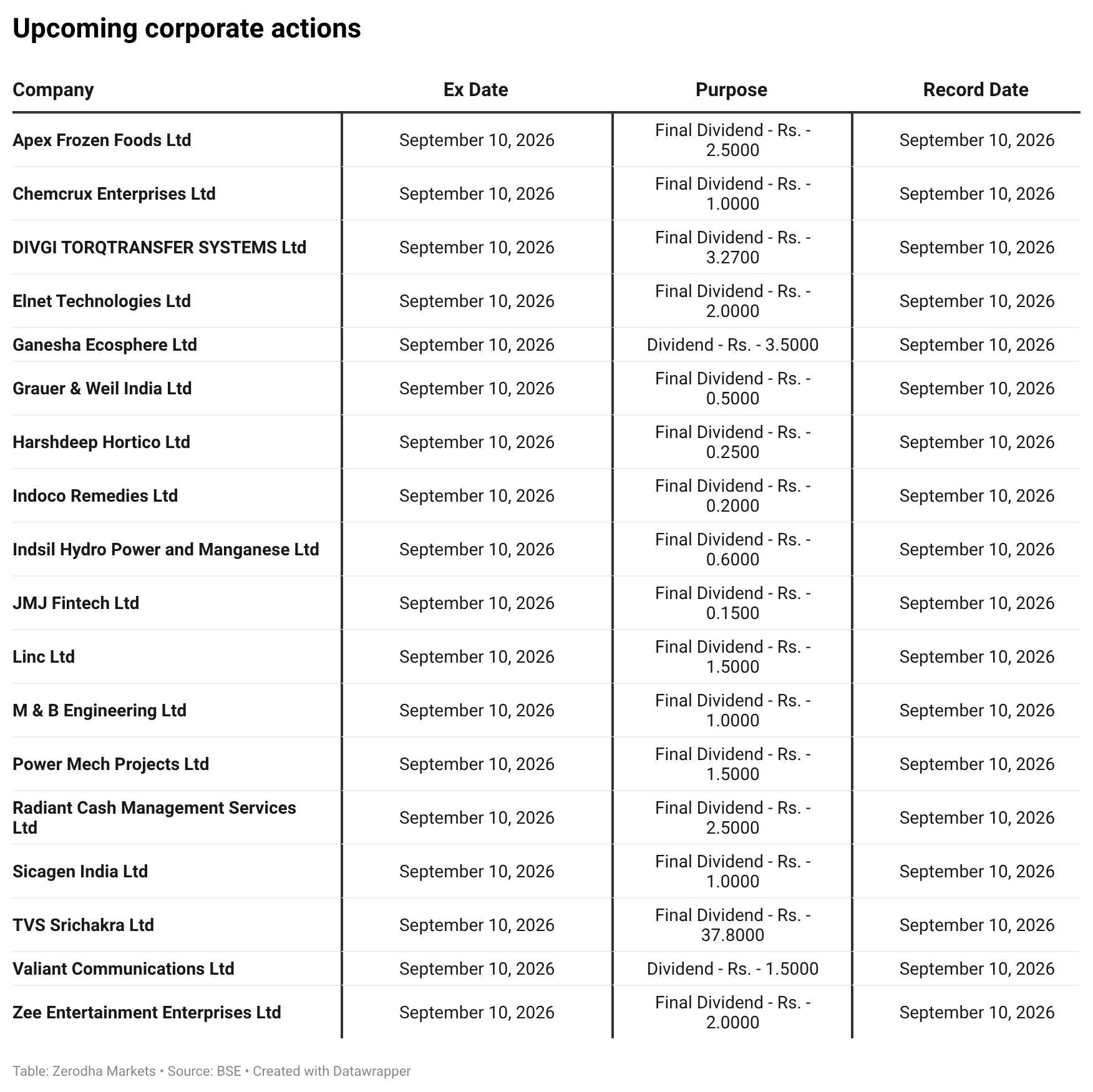
Corporate Actions
Published by Zerodha. Not investment advice. Data from NSE, BSE, and MCX.
In our latest episode of In The Money by Zerodha, we trace the story of Fibonacci levels, from their origins in ancient India to their use on modern stock charts. We look at how the Fibonacci sequence was connected to Sanskrit poetry, how Leonardo of Pisa brought the numbers to Europe, and how they eventually found their way into market analysis.
We also examine whether Fibonacci levels actually work in markets, and what psychology and anchoring have to do with why traders use them. Finally, we explore why our brains are so good at finding patterns, even when those patterns may not really exist.
That’s it from us for today. We’d love to hear your feedback in the comments, and feel free to share this with your friends to spread the word!