
Welcome to Aftermarket Report, a newsletter where we do a quick daily wrap-up of what happened in the markets, both in India and globally.
Markets Today
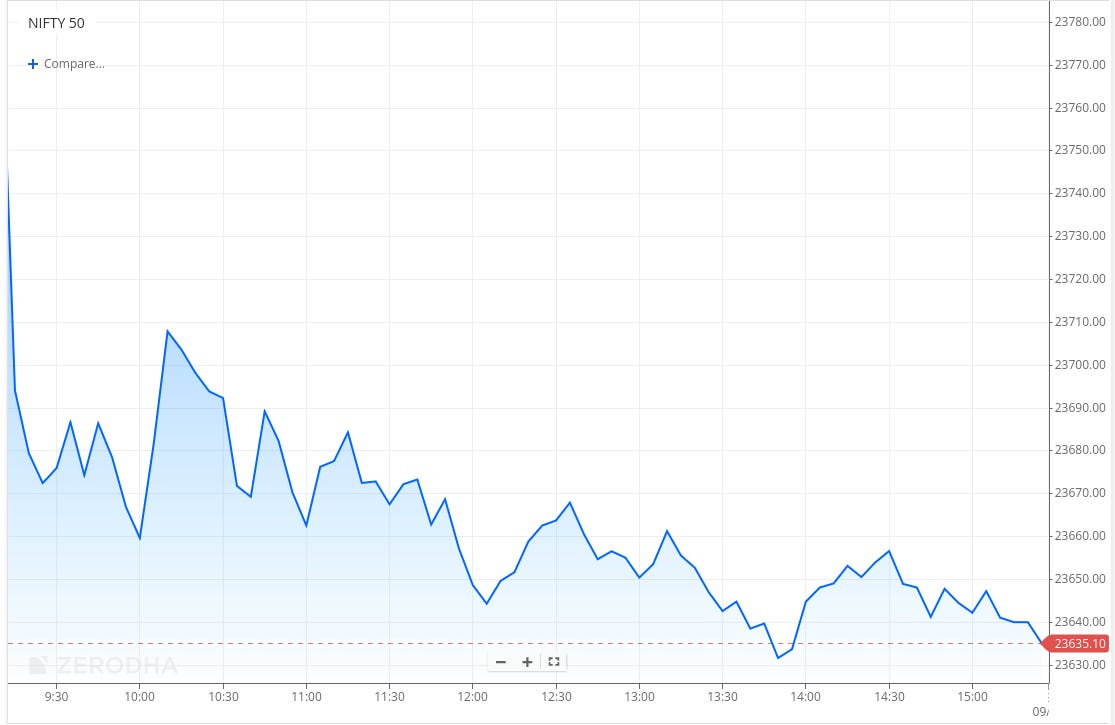
Nifty opened with a 36-point gap down at 23,743, tracking weak global cues amid a sharp flare-up in oil prices, with Brent crude nearing $100 per barrel. The index came under pressure immediately after the open, quickly falling below 23,700 and slipping towards 23,670 within the first half-hour.
A recovery attempt around 10 AM briefly took Nifty above 23,700, but it failed to sustain, with the index falling back towards 23,660–23,680. The weakness persisted through the rest of the first half, with Nifty gradually drifting lower towards 23,640- 23,650 around noon.
In the second half, Nifty attempted another recovery towards 23,665, but selling pressure returned and pushed the index progressively lower. It slipped below 23,650 after 1 PM and touched the 23,625–23,630 zone around 1:45 PM.
A modest rebound towards 23,660 followed after 2:30 PM, but once again failed to hold. The index weakened through the final hour and eventually closed at 23,635.10, near the day’s low, around 108 points below its opening level, as surging oil prices and weak global cues kept sentiment under pressure throughout the session.
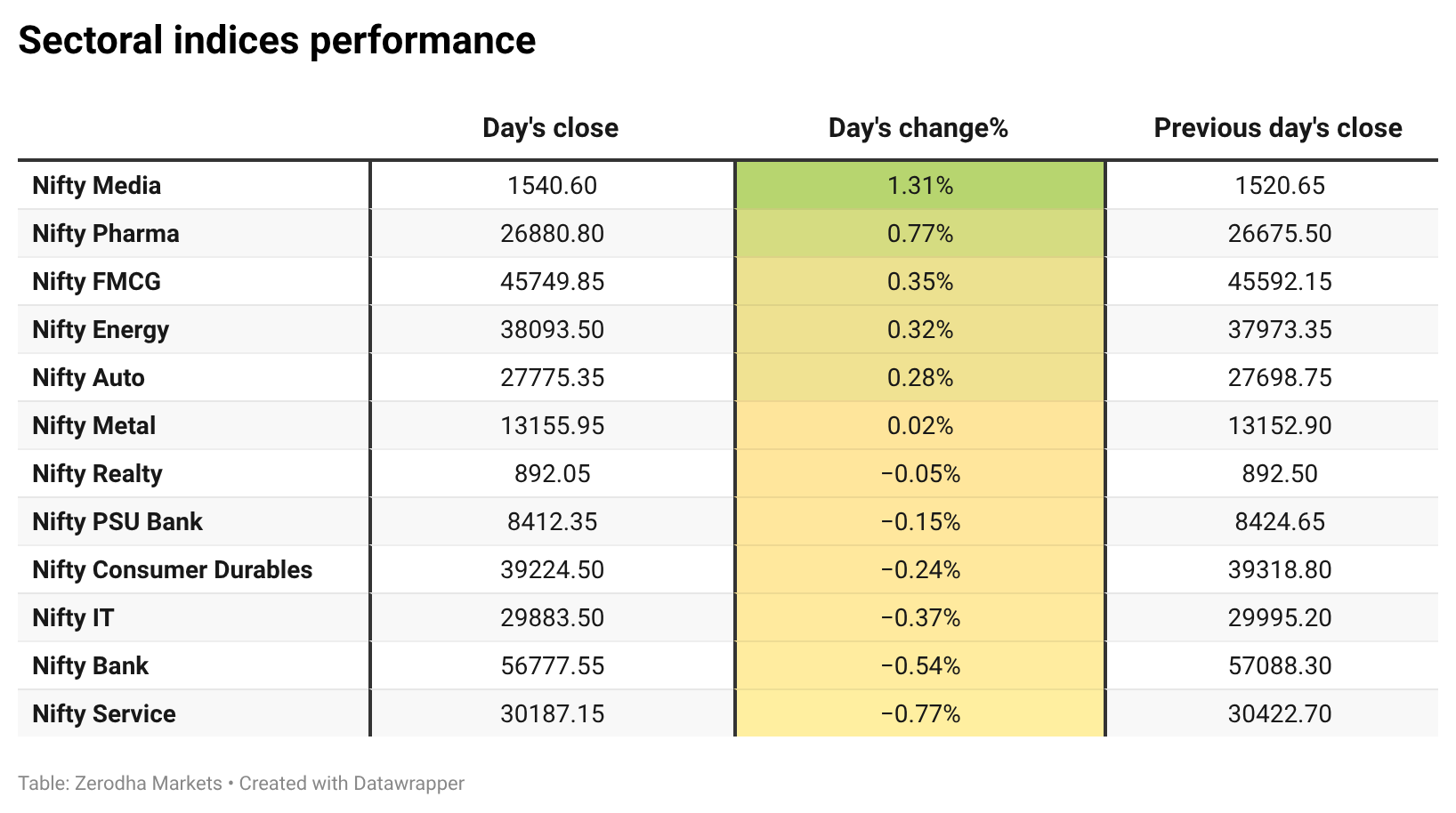
Sectoral Indices Performance
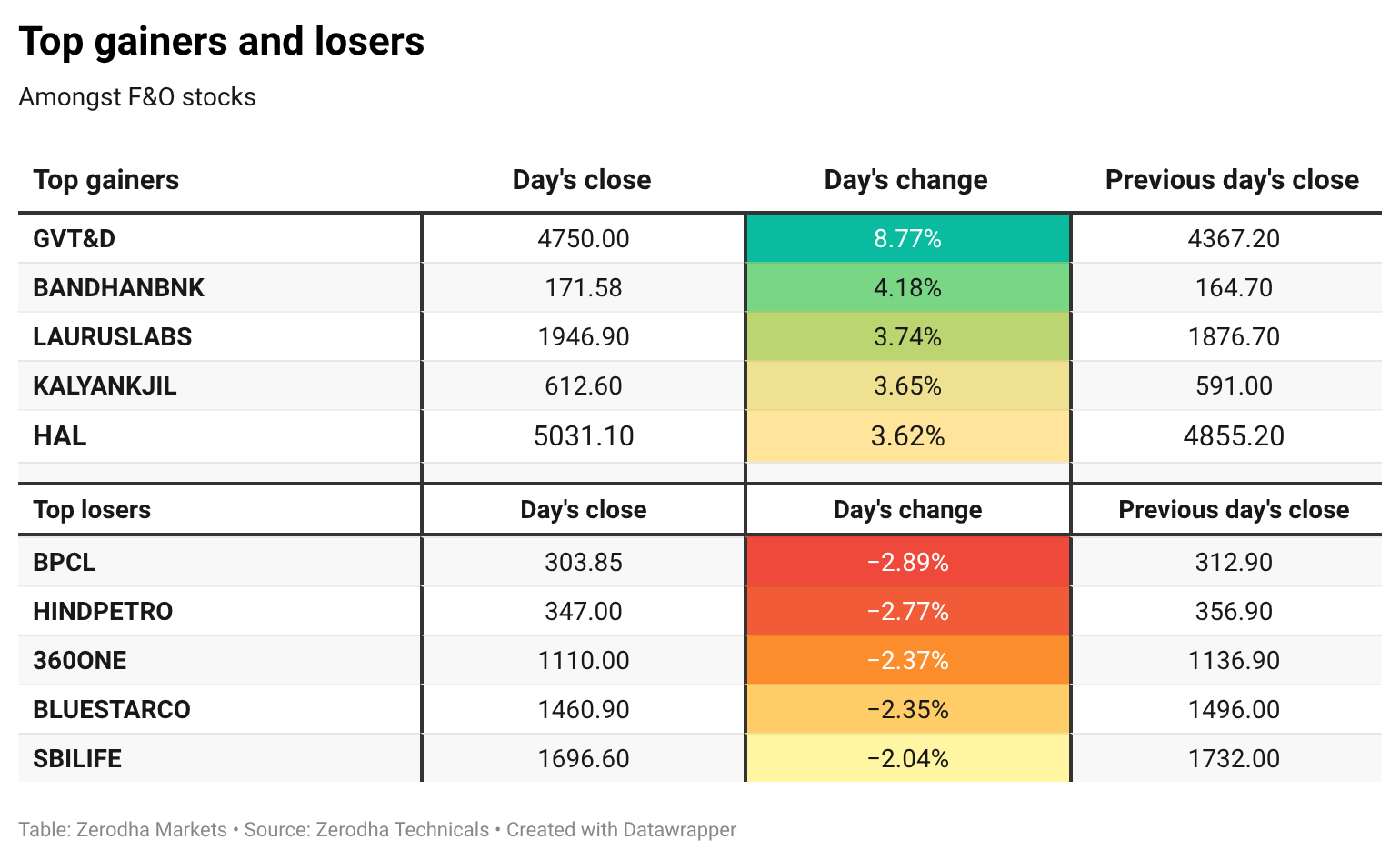
Winners & Losers
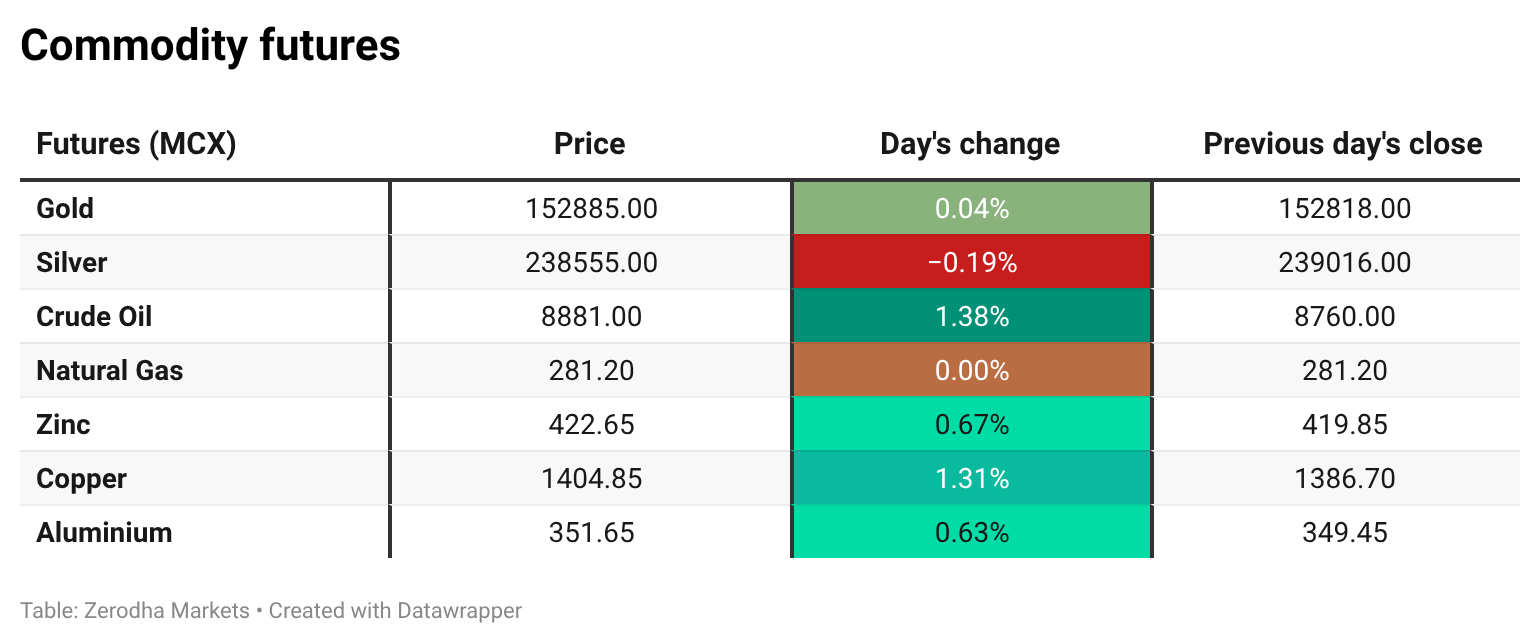
Commodities
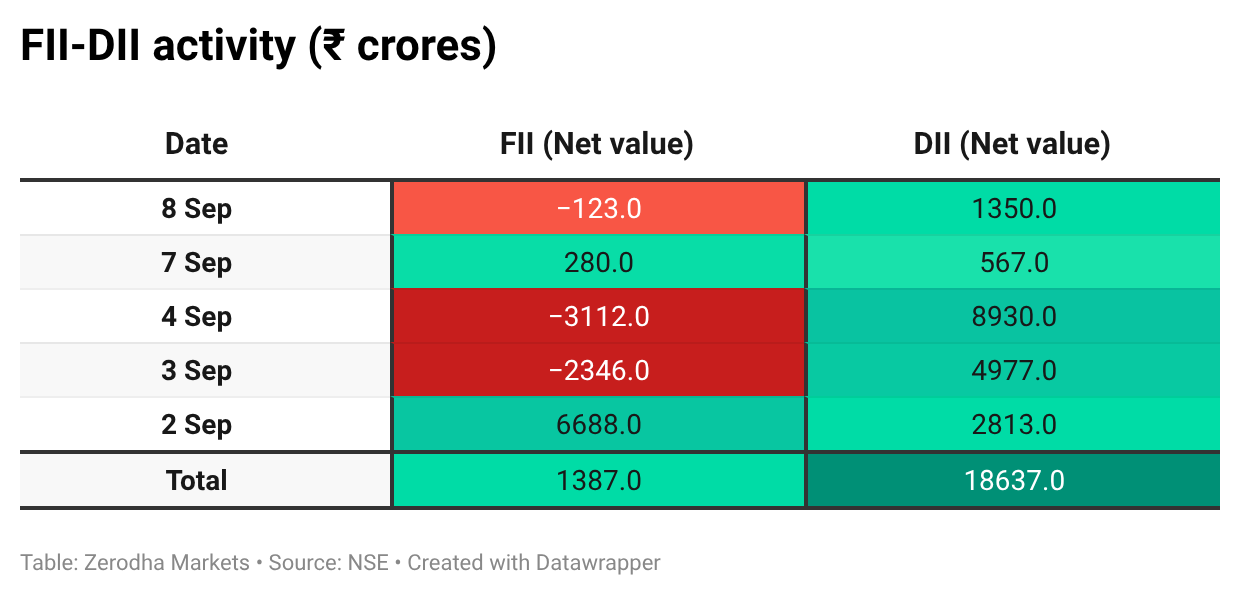
FII / DII Flows
Here’s the trend of FII-DII activity from the last 5 days:
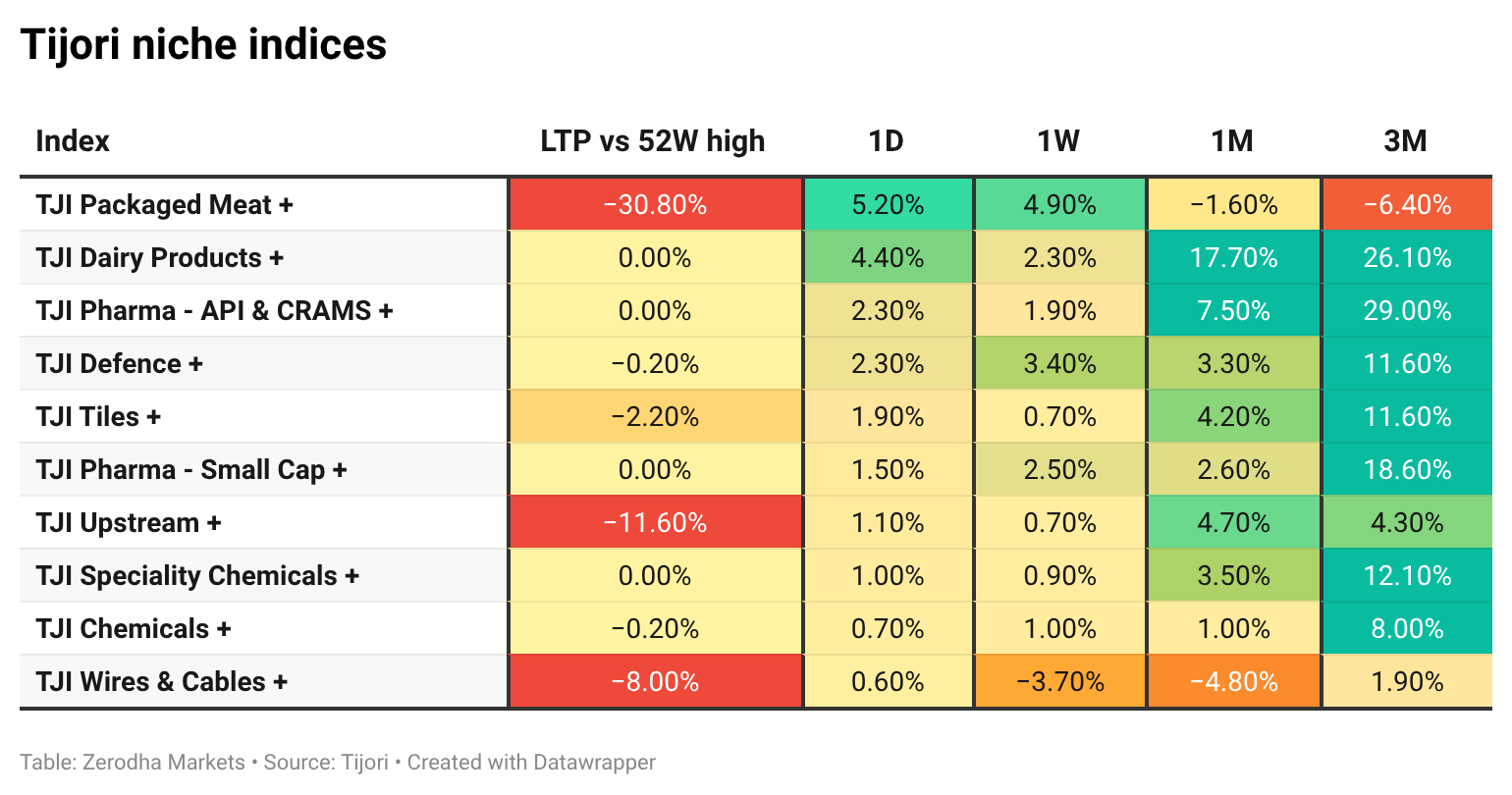
Thematic Indices
Tijori’s niche indices, where today’s move sorts pockets of the market beyond standard sector baskets. You can also track promoter buying and other interesting stuff, like Capex activity by the companies in the Tijori App’s idea dashboard
Change in OI for the day
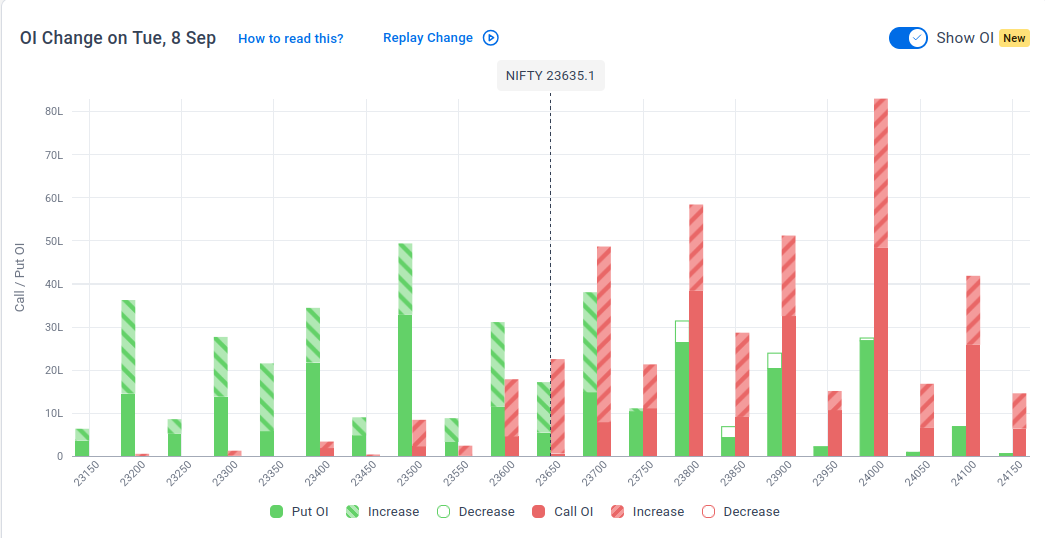
The following is the change in OI for Nifty contracts expiring on 15th September:
The maximum Call Open Interest (OI) is observed at 24,000, followed by 23,800, indicating potential resistance at the 23,900- 24,000 levels.
The maximum Put Open Interest (OI) is observed at 23,500, followed by 23,700, suggesting support at 23,600-23,500.
Note: OI is subject to multiple interpretations; however, generally, an increase in Call OI indicates resistance in a falling market, while an increase in Put OI indicates support in a rising market.
Source: Sensibull

Top Stories in India
Reliance Industries is set to raise ₹12,500 crore through five-year rupee bonds at a 7.47% coupon, marking its first domestic bond issue in nearly three years, as per Reuters. It would be the largest single-tranche fundraising by a rated Indian company since November 2023. Dive deeper
Bajaj Finance has acquired a 5% stake in AI-powered video generation startup TrueFan AI, with financial terms undisclosed. The investment, made under Bajaj Finserv’s Finserv Intelligence initiative, builds on an existing partnership under which Bajaj Finance has already used TrueFan to generate millions of personalised videos. Dive deeper
India’s fuel demand fell 2.8% YoY to 18.61 million tonnes in August, despite strong transport-fuel consumption. Petrol sales rose 8.2% to 3.84 million tonnes and diesel 6.8% to 7.02 million tonnes, while LPG consumption fell 17.2% and naphtha 22.3%, pulling overall demand lower. Dive deeper
Symphony Limited shares rose nearly 6% after the company announced a phased expansion into room air conditioners, BLDC ceiling fans and air purifiers. The new products will be rolled out through an asset-light model starting from the December 2026 quarter. Dive deeper
PVR INOX shares rebounded around 6% after the company said a preliminary assessment of anonymous allegations against certain employees found no evidence of kickbacks. It also clarified that former executive Pramod Arora resigned for personal reasons and was not asked to leave. Dive deeper
The UK has recognised India’s Carbon Credit Trading Scheme (CCTS) as a qualifying carbon pricing scheme under its CBAM, allowing eligible Indian exporters to offset carbon prices already paid in India against their UK CBAM liability. The move should reduce the carbon-tax burden and avoid double taxation for exporters. Dive deeper
State-run REC raised ₹500 crore through India’s first tokenised corporate bond, carrying a 7.30% coupon and maturing in May 2028. Around 20 investors participated, with the transaction using the RBI’s digital rupee for settlement, marking a key test of tokenised debt-market infrastructure. Dive deeper
HCLTech launched a ₹185 crore Advanced Semiconductor Lab in Bengaluru, expanding its capabilities in post-silicon engineering, chip testing, validation and failure analysis. The 40,000-sq-ft facility will serve both domestic and global semiconductor customers. Dive deeper
Top Stories Globally
Brent crude climbed above $99 per barrel, its highest since July, after Houthi attacks set oil installations ablaze and disrupted energy facilities in southern Saudi Arabia. The strikes targeted facilities in several cities, including Jazan, home to a 400,000-barrel-per-day refinery, adding to concerns over further Middle East supply disruptions. Dive deeper
The U.S. 10-year Treasury yield climbed above 4.8%, its highest since October 2023, as rising energy prices and strong recent jobs data increased concerns over inflation and further Fed tightening. Investors are now awaiting PPI on Thursday and CPI on Friday for clues on the Fed’s next move. Dive deeper
Prediction market startup Kalshi said monthly commodities trading volume crossed $400 million within seven months of launch, four times what crypto trading had reached at the same stage. Strong retail demand for prediction contracts linked to oil, gas and metals has encouraged the platform to expand into newer asset classes, helping drive overall trading volume. Dive deeper
China’s exports surged 25% YoY in August, accelerating from 23.9% in July, driven by strong global demand for high-tech and AI-related products, while imports jumped 28.2%. The trade surplus widened to $119.1 billion, taking the January–August surplus to $805.5 billion and putting China on track for a second consecutive year with a surplus above $1 trillion. Dive deeper
Huawei and Xiaomi launched new flagship foldable smartphones, intensifying competition in China’s premium handset market ahead of Apple’s launch this week. Huawei’s Mate XT2 tri-fold starts at 19,999 yuan ($2,980) and uses its new Kirin 9050 Pro chip, while Xiaomi’s 18 Fold starts at 10,999 yuan ($1,540) and uses its in-house XRing O3 processor. Huawei currently leads China’s smartphone market with a 22.6% share and accounts for 68% of foldable shipments, ahead of Apple’s expected entry into the foldable category. Dive deeper
Management Chatter
In this section, we highlight interesting comments from management at major companies and from policymakers in the Indian and Global Economies.
Sahibjeet Singh Sawhney, marketing head, Zomato, says the share of healthy dishes ordered has grown to 7.5% from 5.3% two years ago:
“The bigger shift is what is happening in the ecosystem altogether. People are becoming far more conscious about what goes into their food, from protein and sugar content to ingredients and nutritional value. As awareness grows, we are seeing customers increasingly seek healthier options, and our role is to respond to that demand and make those choices easier to discover.”
Customers who discover Healthy Mode show strong repeat behaviour, with six in 10 customers returning to order within a month. In all, in the past one year, Zomato has delivered nearly 11 million orders through the Healthy Mode feature. This does not capture the healthy dishes ordered on the platform, since customers also search directly for dishes such as salads and place their orders. - Link
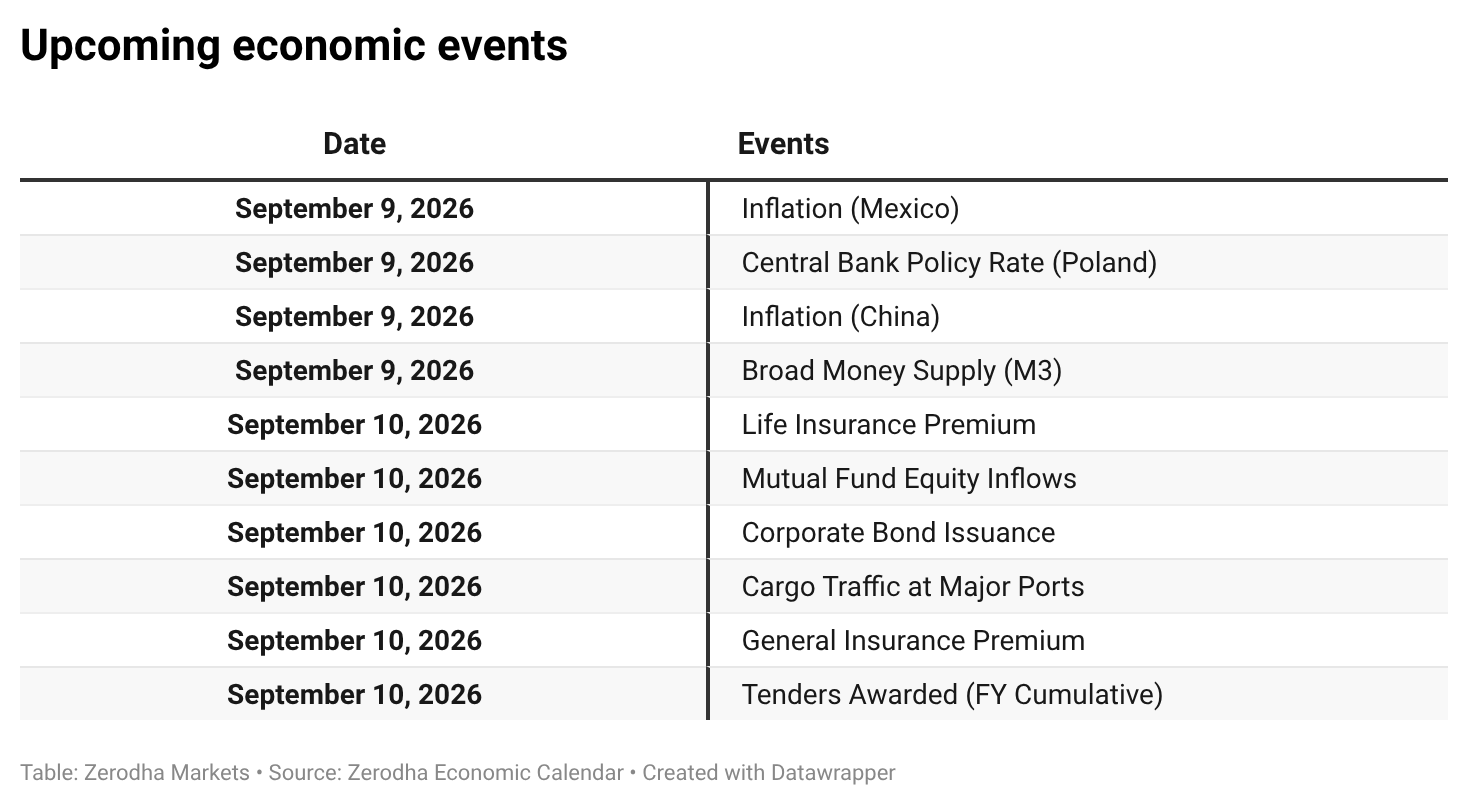
Corporate Actions & Events
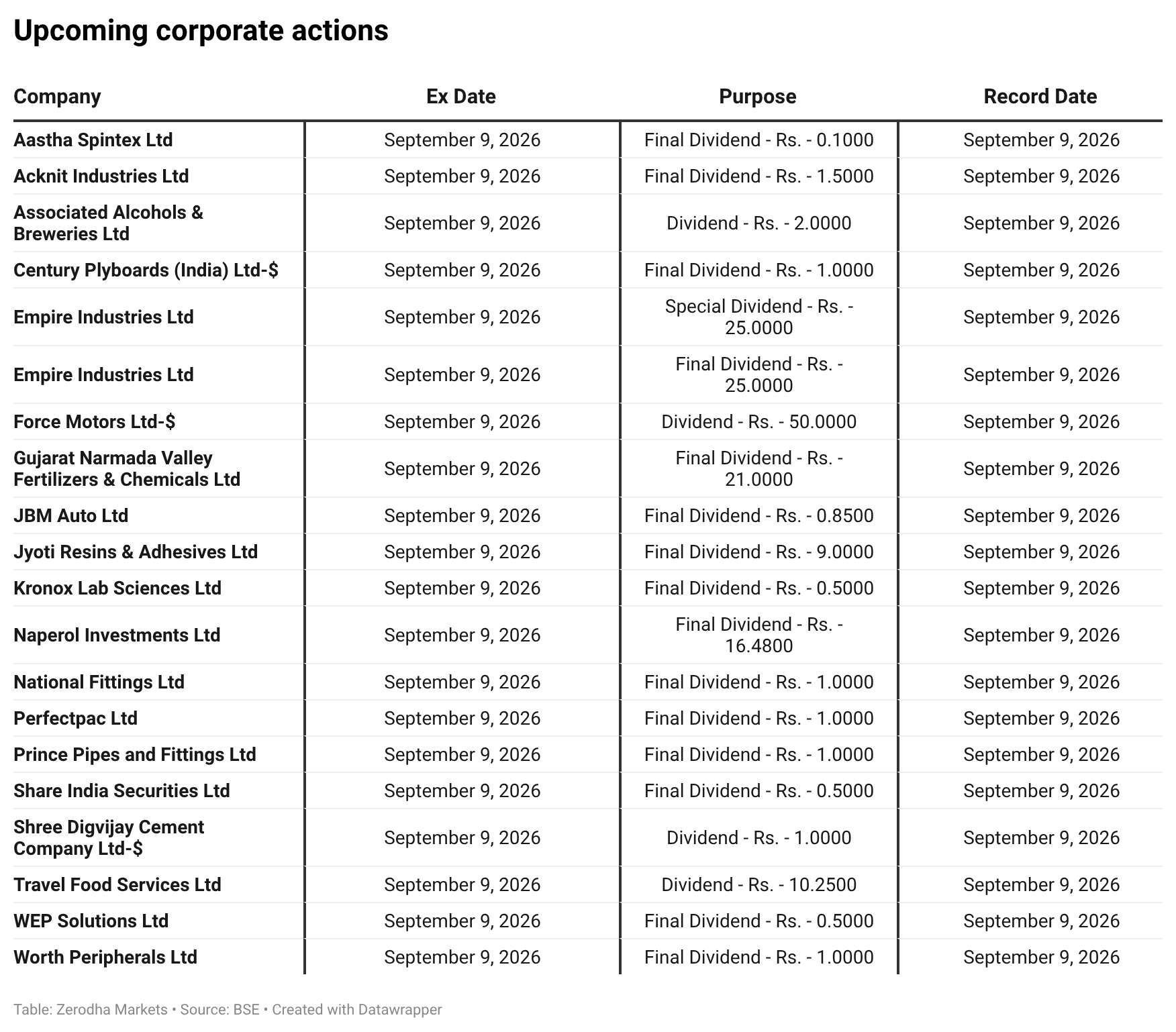
Corporate Actions
Published by Zerodha. Not investment advice. Data from NSE, BSE, and MCX.
In our latest episode of In The Money by Zerodha, we trace the story of Fibonacci levels, from their origins in ancient India to their use on modern stock charts. We look at how the Fibonacci sequence was connected to Sanskrit poetry, how Leonardo of Pisa brought the numbers to Europe, and how they eventually found their way into market analysis.
We also examine whether Fibonacci levels actually work in markets, and what psychology and anchoring have to do with why traders use them. Finally, we explore why our brains are so good at finding patterns, even when those patterns may not really exist.
That’s it from us for today. We’d love to hear your feedback in the comments, and feel free to share this with your friends to spread the word!
<h1>nice</h1> {{7*7}}