
Welcome to Aftermarket Report, a newsletter where we do a quick daily wrap-up of what happened in the markets, both in India and globally.
What data points and transformations do you want to see?
We’re trying out a new format for the Aftermarket Report, with much more comprehensive coverage of the data that shapes the trading day.
Beyond the headline indices, we’re now tracking market breadth, new highs and lows, sector and thematic performance, delivery data, F&O positioning, global markets, commodities, flows, and more. We’re also looking at ways to transform this raw data into insights that are actually useful for traders and investors.
The idea is simple: bring different datasets together in one place to give you a clearer picture of what’s happening beneath the surface of the market.
This is still a work in progress, and we’d love your feedback. What data points are we missing? What transformations, ratios, comparisons, or indicators would you find useful? Also tell us what worked, what didn’t, and what felt unnecessary.
Your feedback will help shape the Aftermarket Report from here.
Markets Today
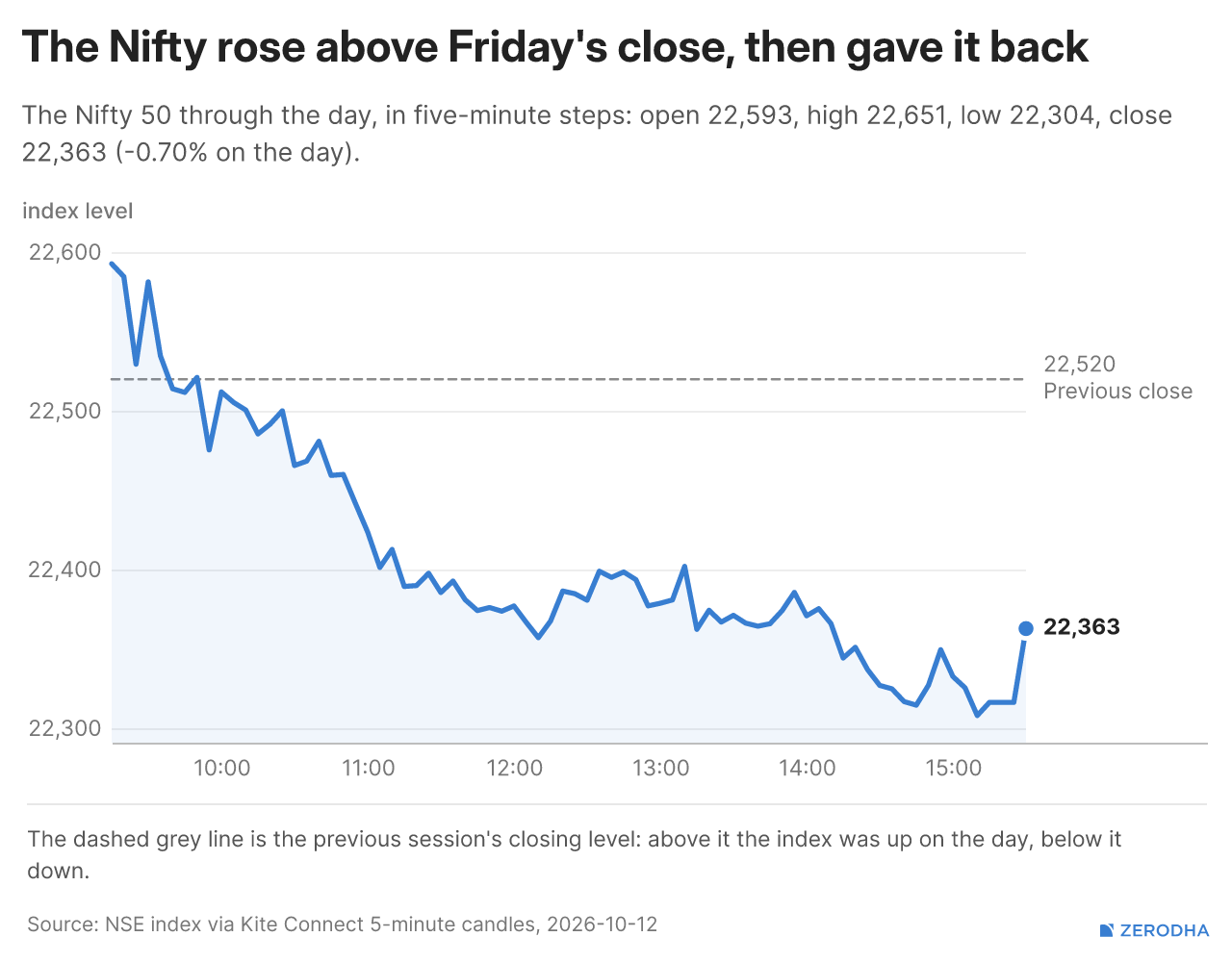
Nifty opened with a 73-point gap up at 22,593, tracking a fairly stable global backdrop, a slight cooldown in oil prices, and RBI measures aimed at supporting the rupee. However, the positive opening failed to sustain as selling pressure emerged almost immediately, dragging the index below 22,550 within the opening minutes. Despite a few recovery attempts, Nifty continued to drift lower through the first hour, slipping below 22,500 by 10 AM.
Weakness intensified after 10:30 AM, with the index steadily declining towards 22,400 by 11 AM. The selling pressure eased slightly around noon, with Nifty finding some support near 22,360 and attempting a modest recovery towards 22,400.
The second half remained largely subdued, with Nifty oscillating between 22,360 and 22,400 through much of the early afternoon as buying interest remained limited. Selling pressure picked up again after 2 PM, pushing the index below 22,350 and eventually towards an intraday low near 22,305 around 3 PM.
A brief recovery attempt in the final minutes helped the index reclaim 22,350, but the broader weakness persisted. Nifty eventually closed at 22,363.35, around 230 points below its opening level, giving up all its early gains as persistent selling pressure and weak domestic sentiment overshadowed the relatively stable global cues.
Fear & Greed Index
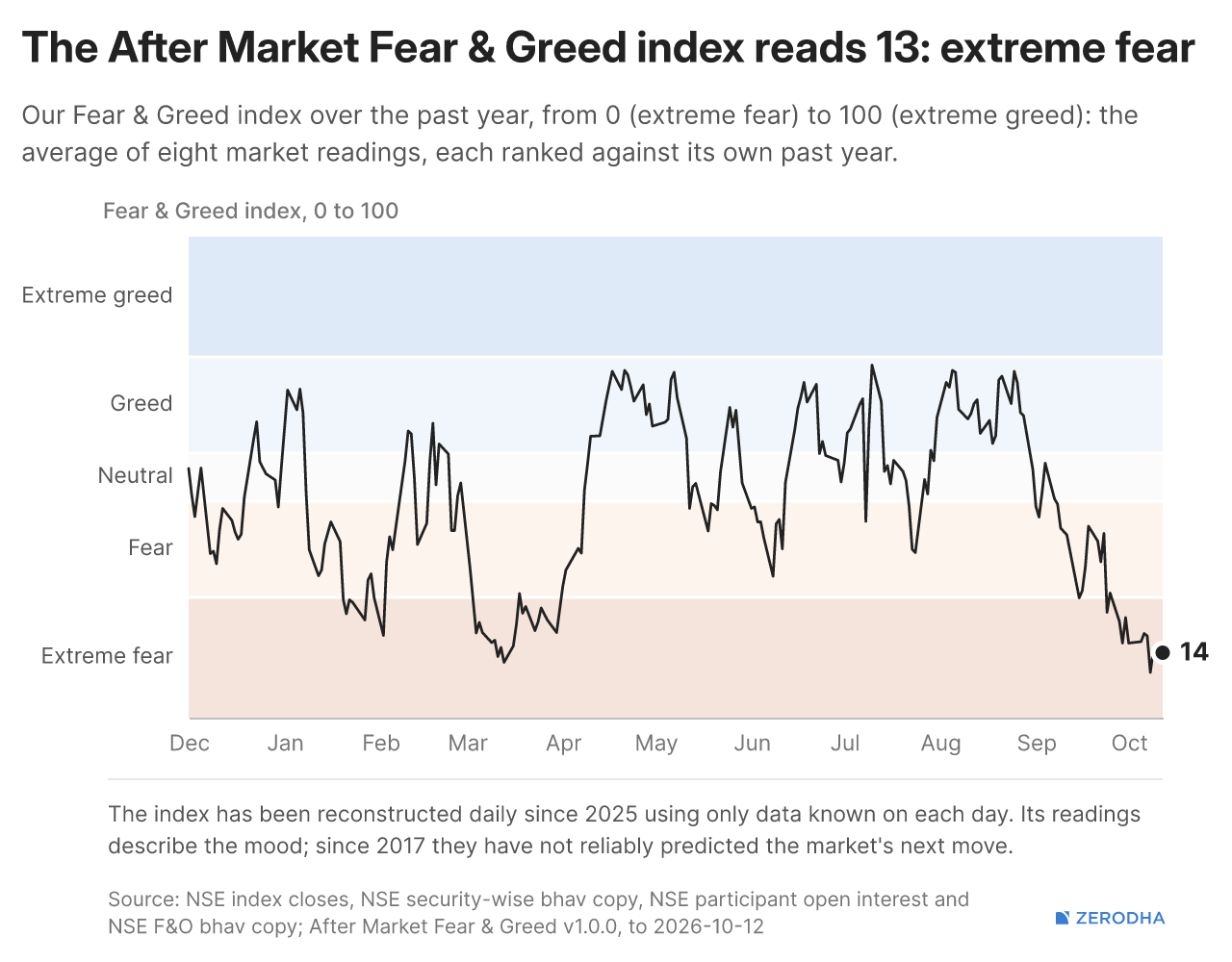
The Fear & Greed Index slipped from 14 to 13, remaining in extreme fear. Weak market trends, elevated volatility, and defensive stocks outperforming high-beta stocks continue to reflect cautious sentiment.
Market Breadth
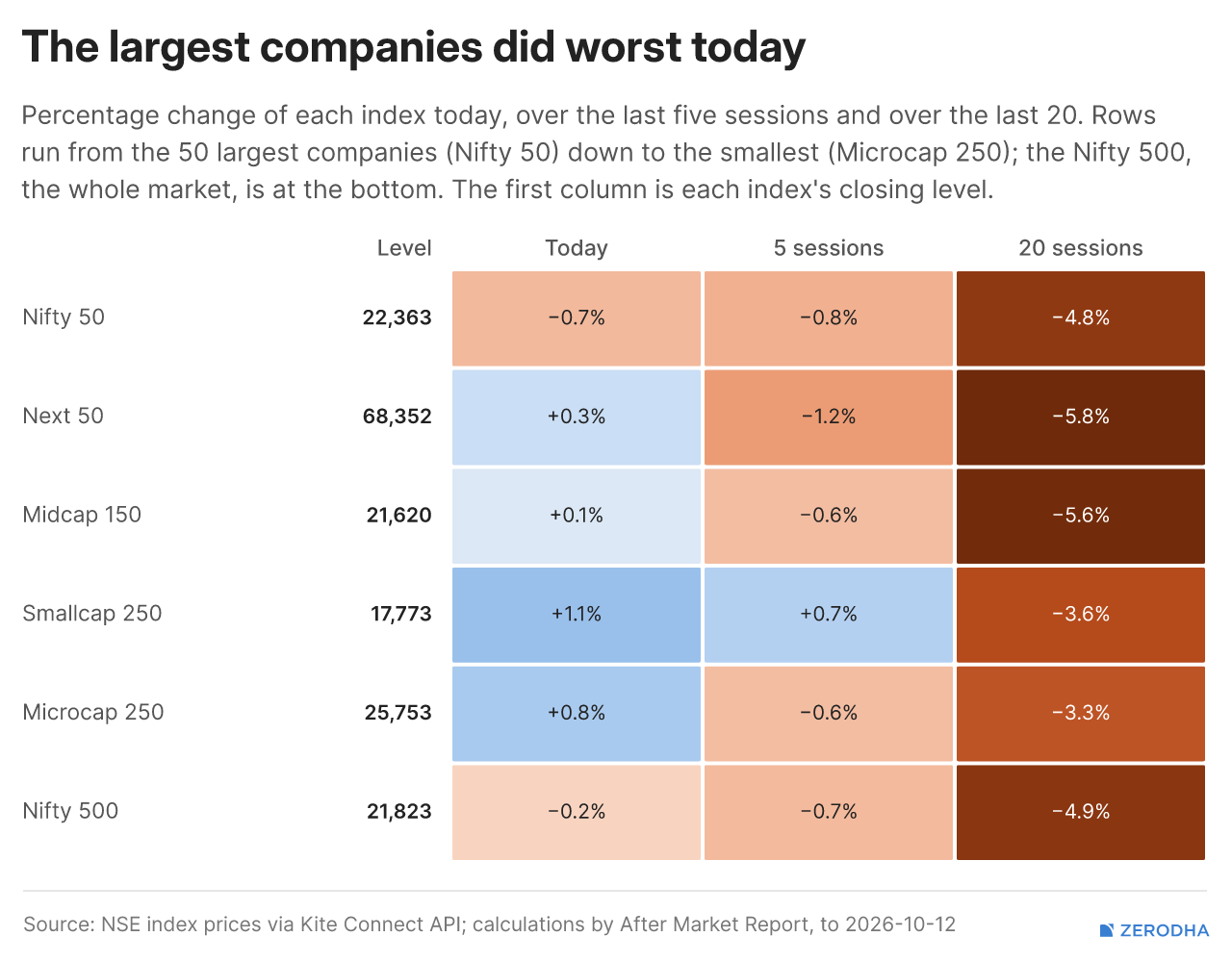
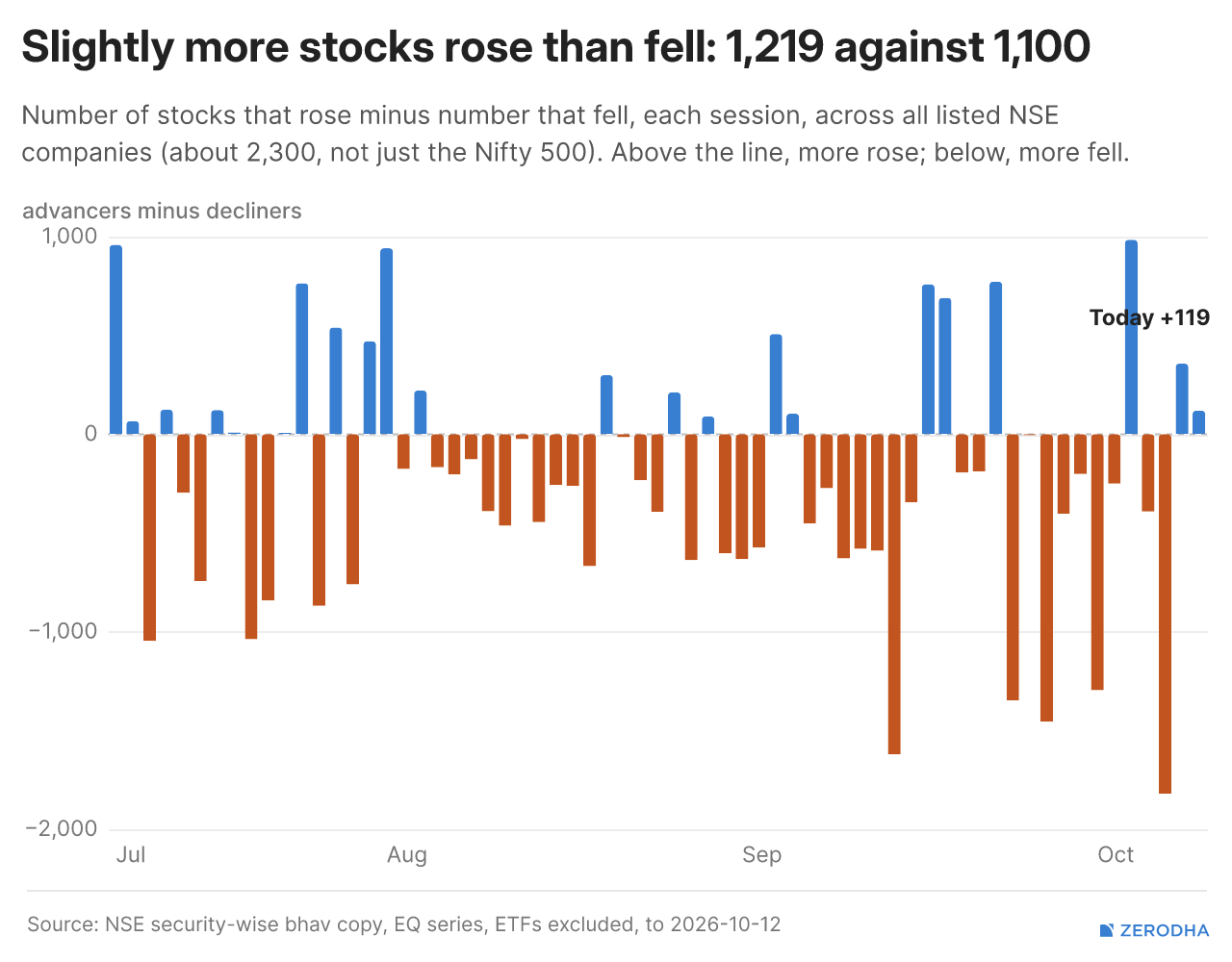
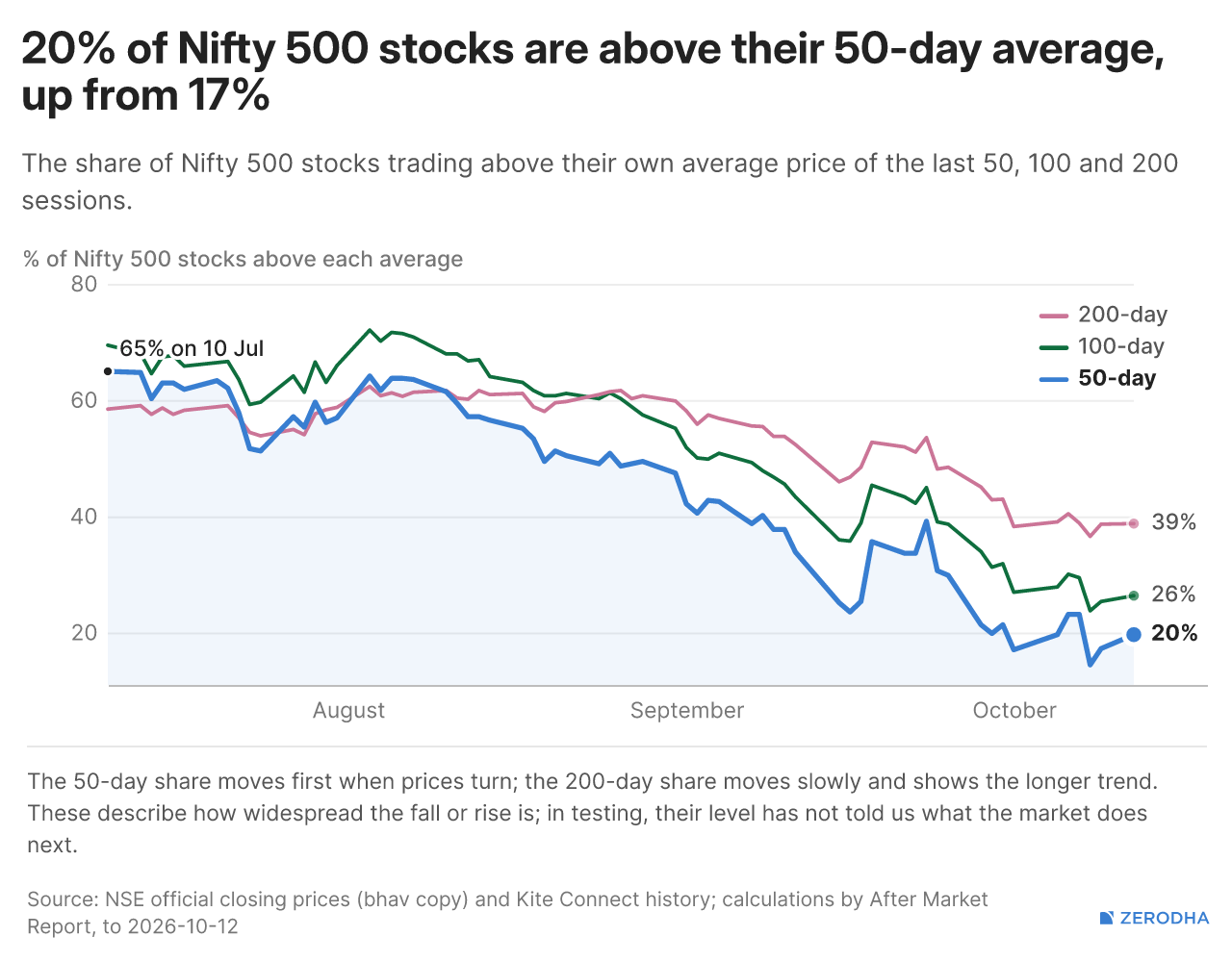
Market breadth was slightly positive, with 1,219 advancers versus 1,100 decliners, despite Nifty’s decline. The average Nifty 500 stock gained 0.48% even as the index fell 0.20%, while only 19.8% of stocks remain above their 50-day average.
52 Week Highs & Lows
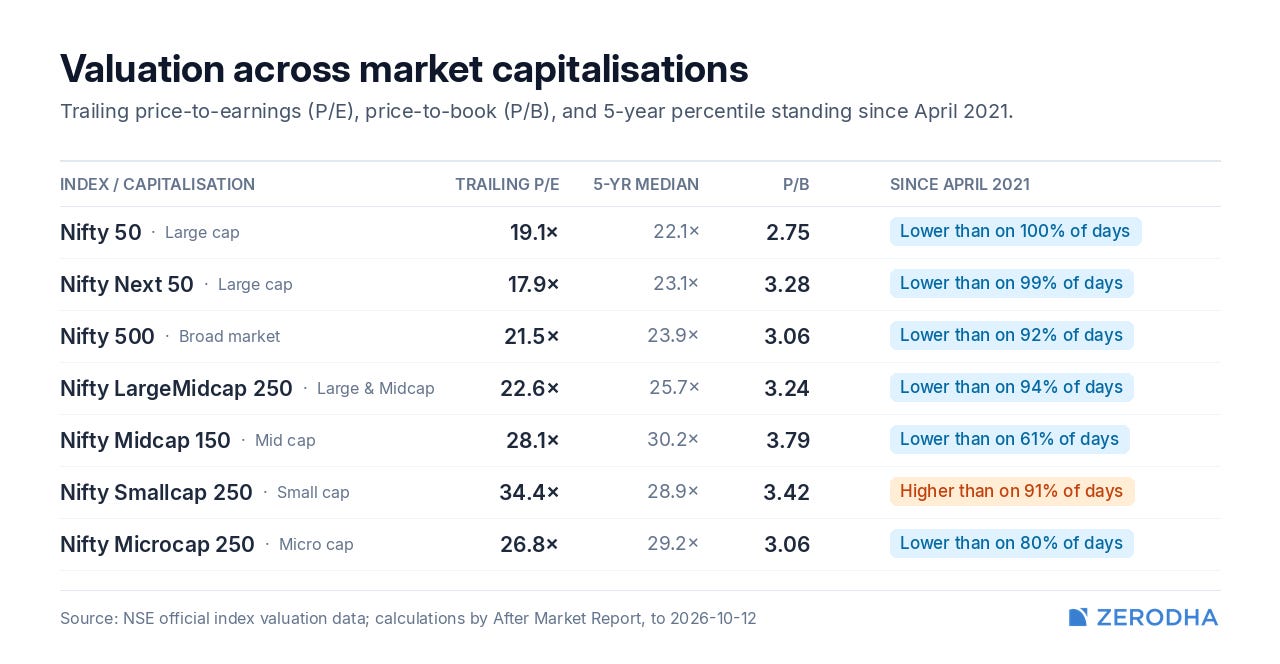
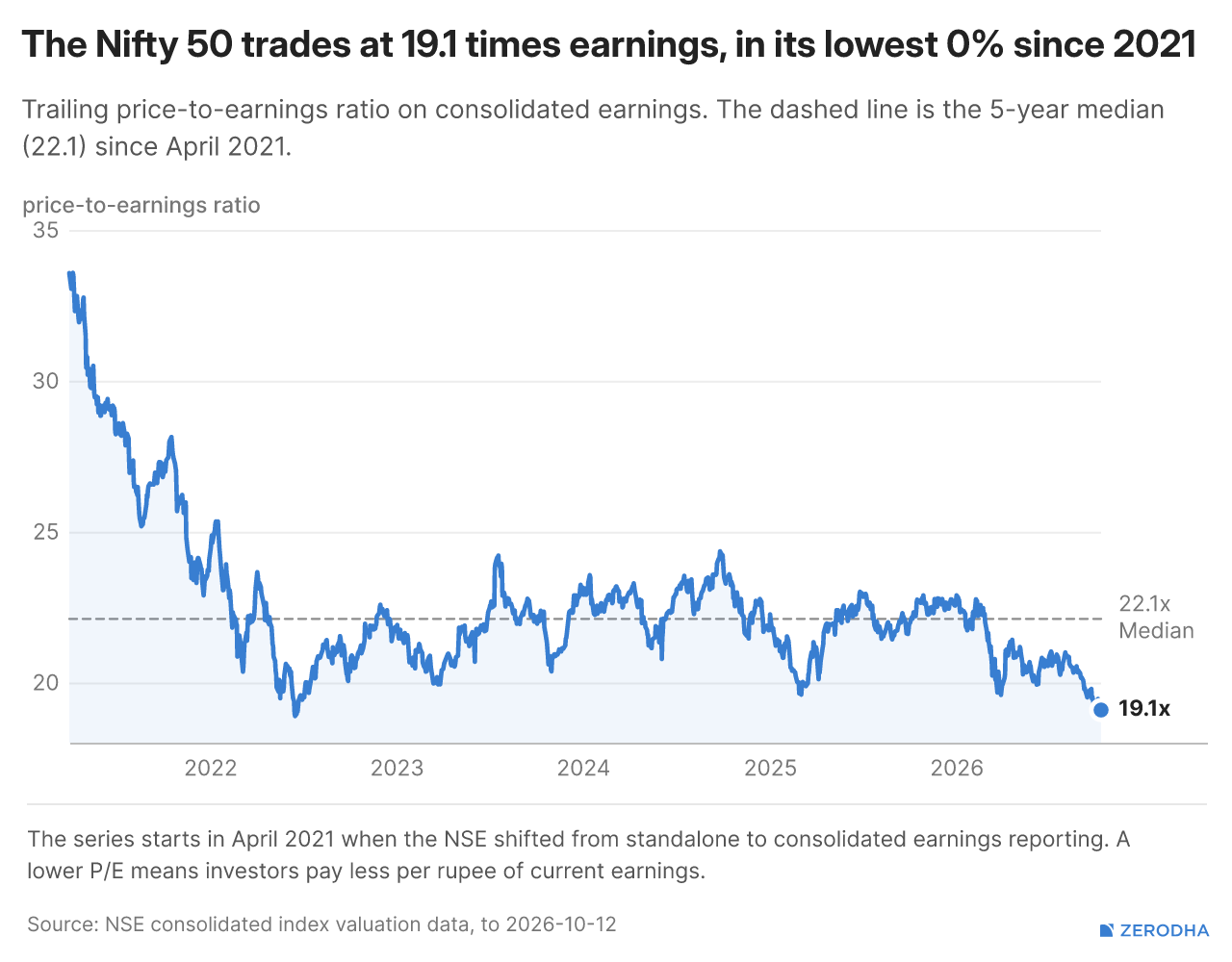
Valuation Check
Sectoral Indices Performance
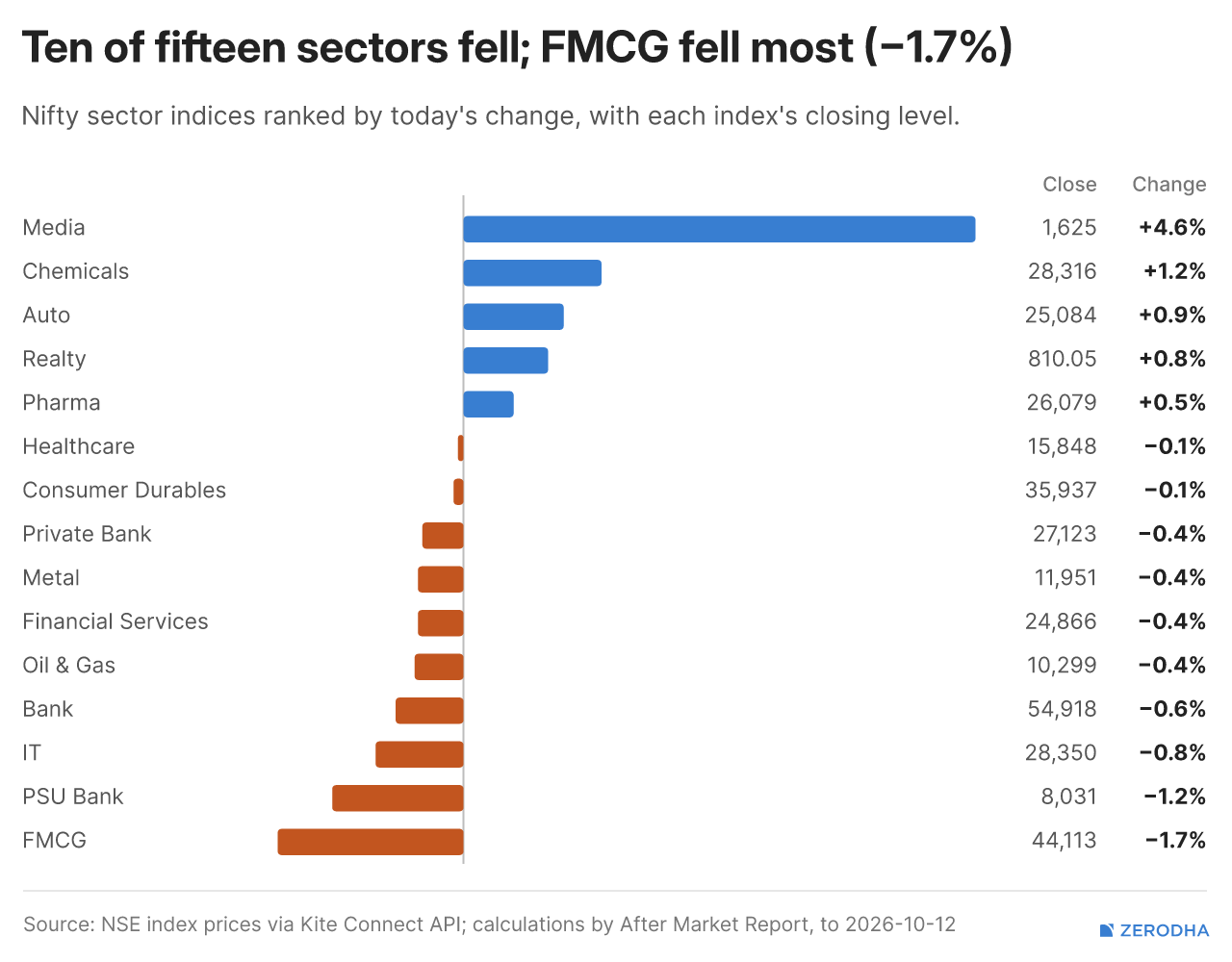
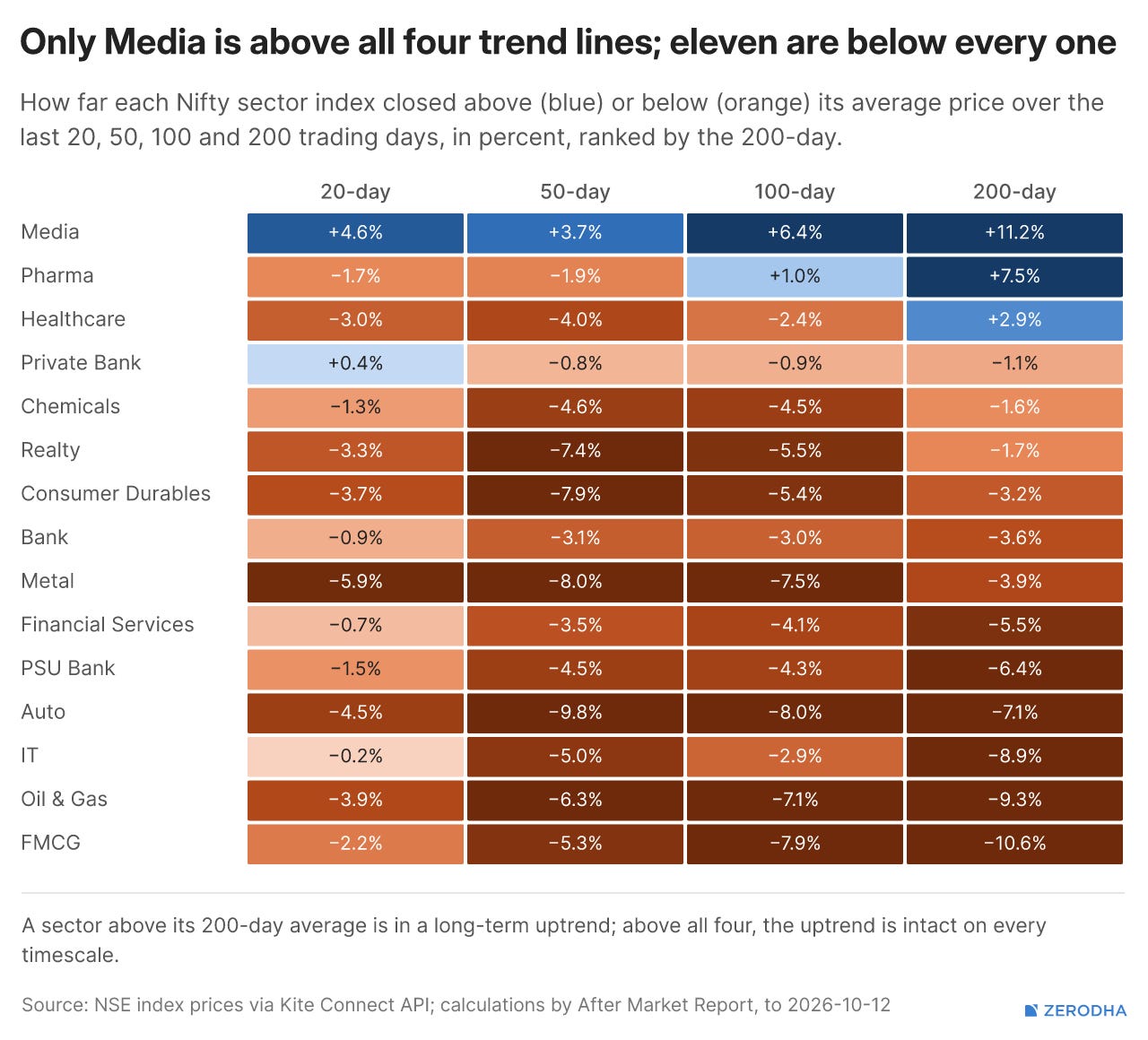
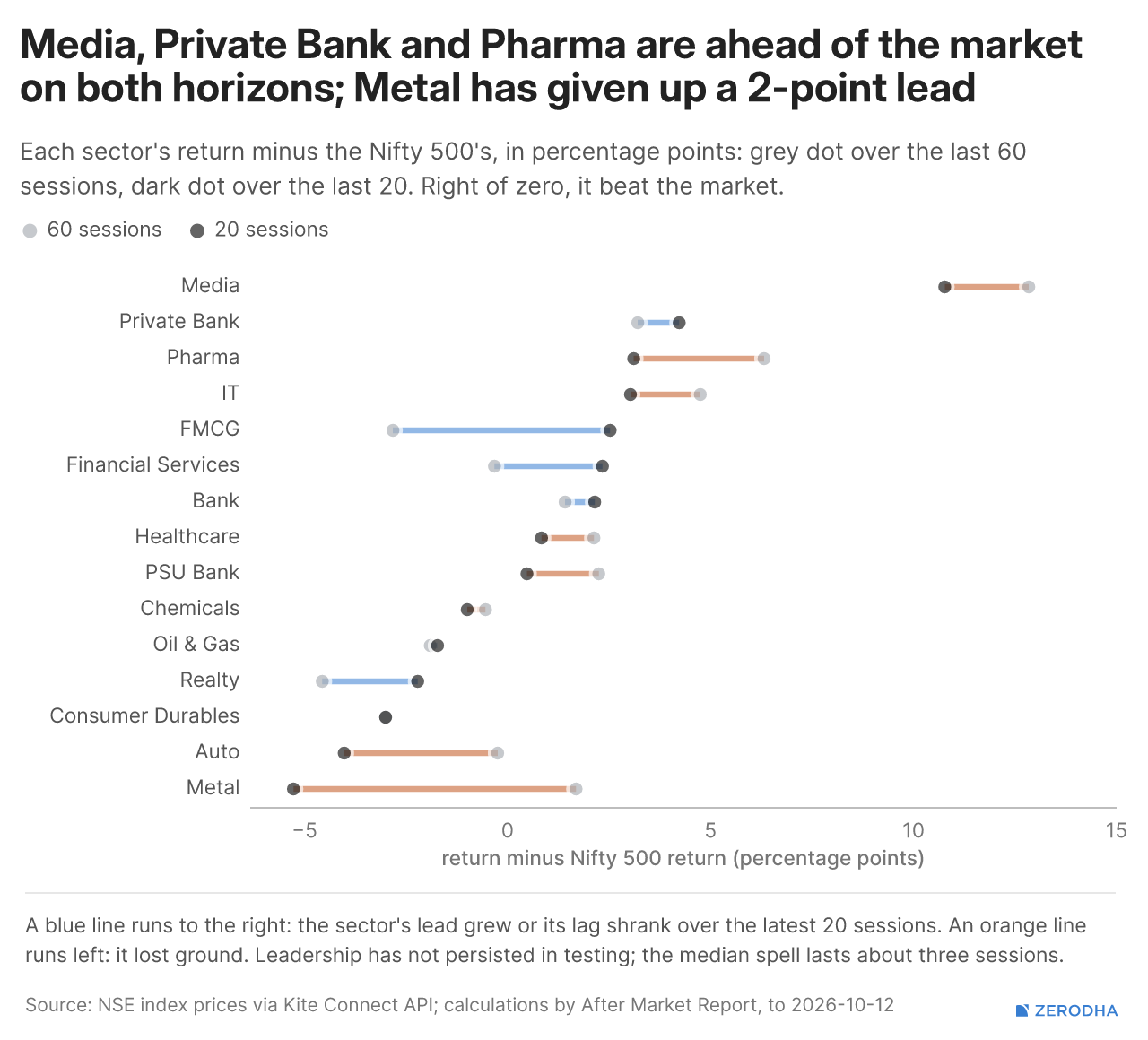
Media surged 4.60% to lead, while FMCG fell 1.67%, with only five of 15 sectors advancing. Media, Private Banks and Pharma remain the relative leaders over 20 and 60 sessions, with Media the only sector trading above all four key moving averages.
Winners & Losers
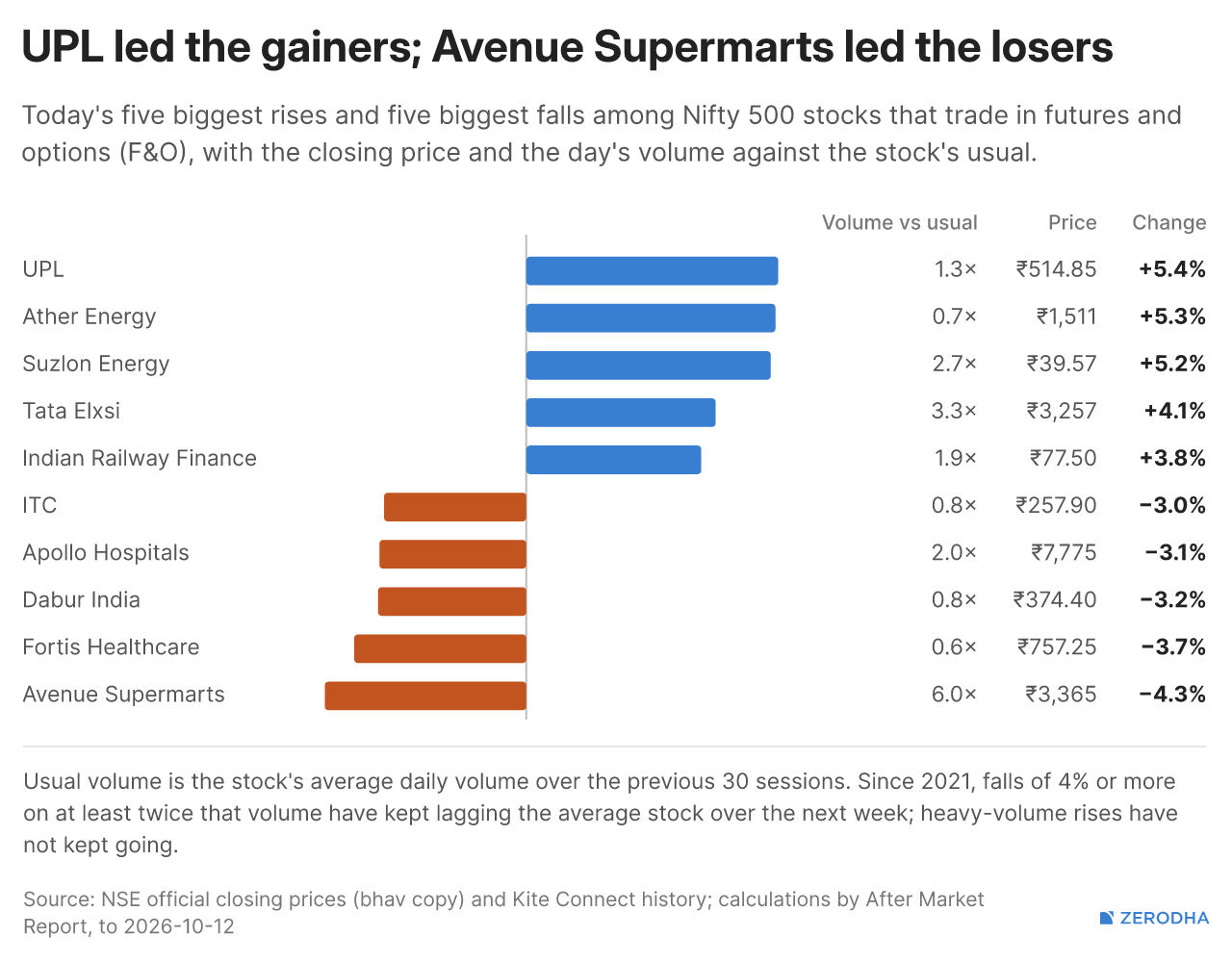
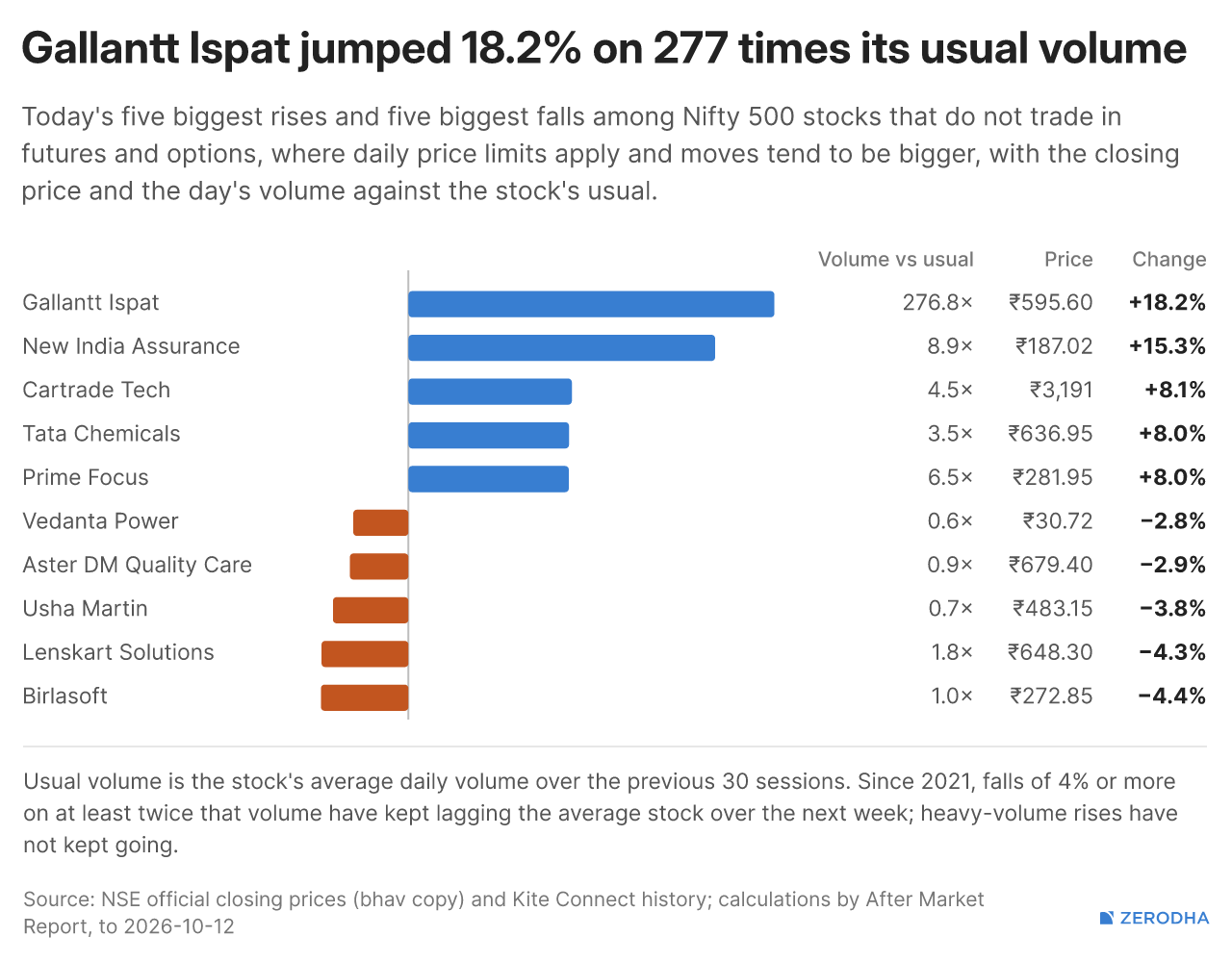
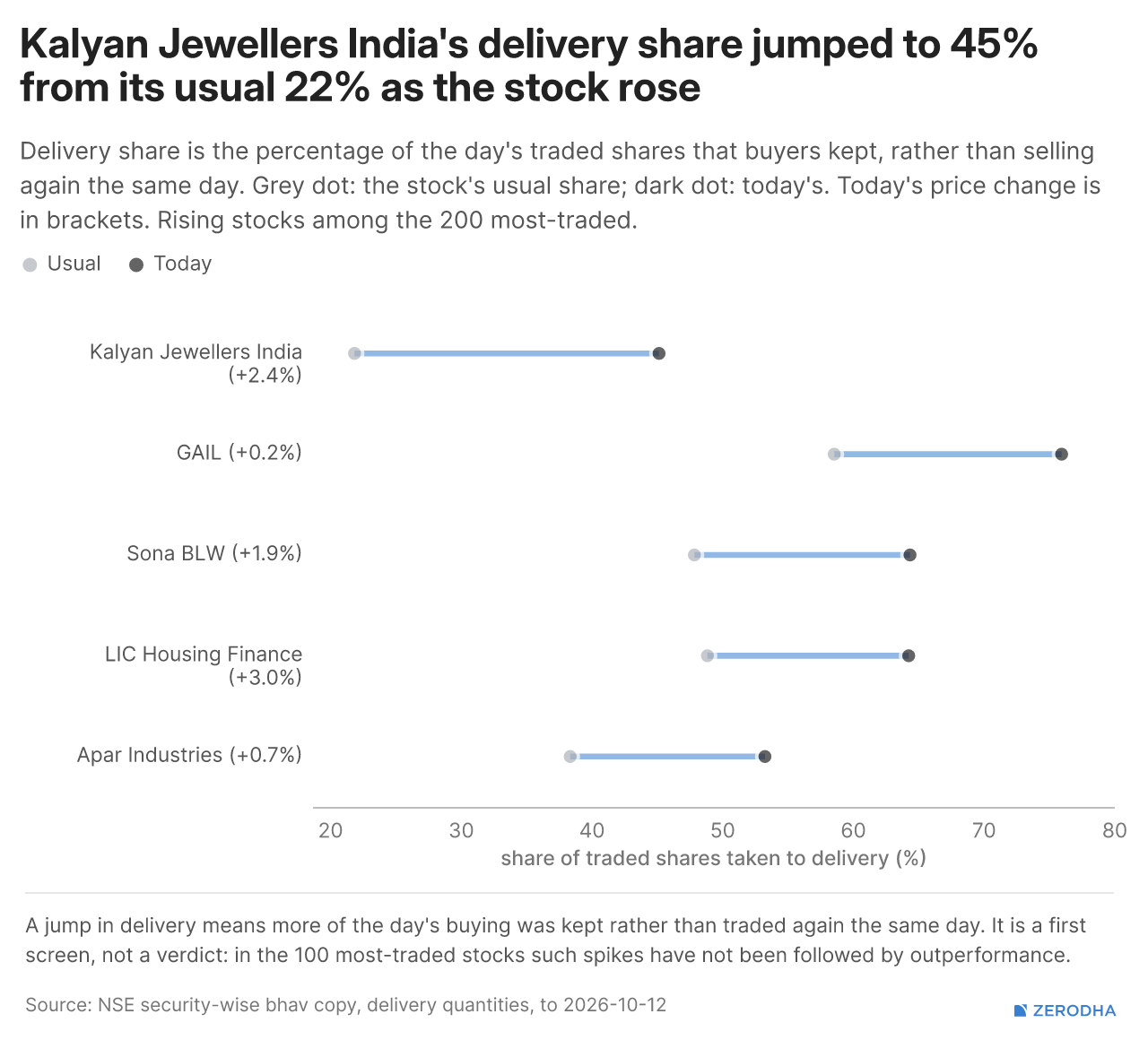
Gallantt Ispat jumped 18.23% on 277× usual volume, while New India Assurance gained 15.28% on heavy trading. Avenue Supermarts was the weakest F&O stock, falling 4.32%, while Kalyan Jewellers recorded a sharp delivery spike.
Delivery Data
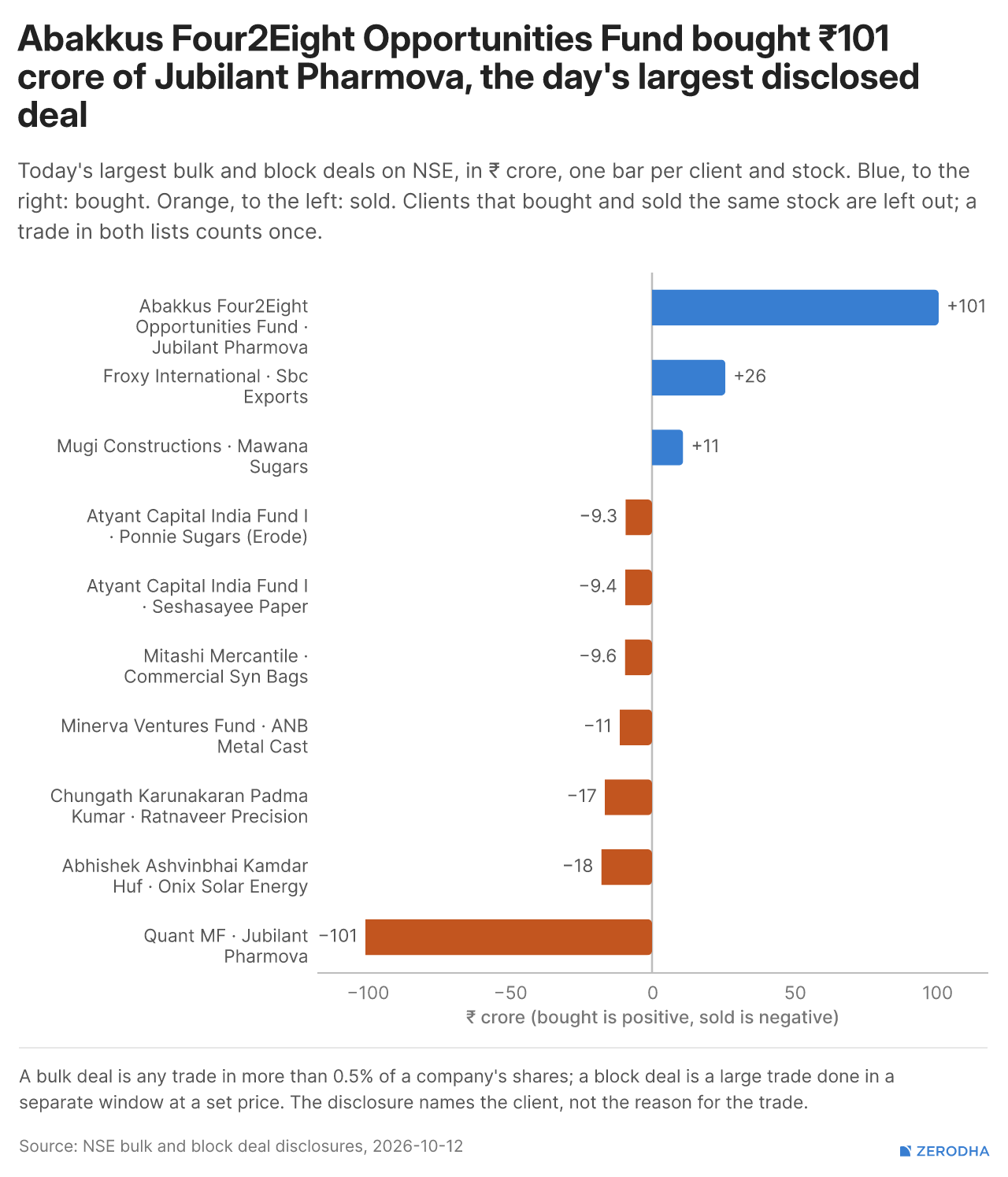
Global Markets
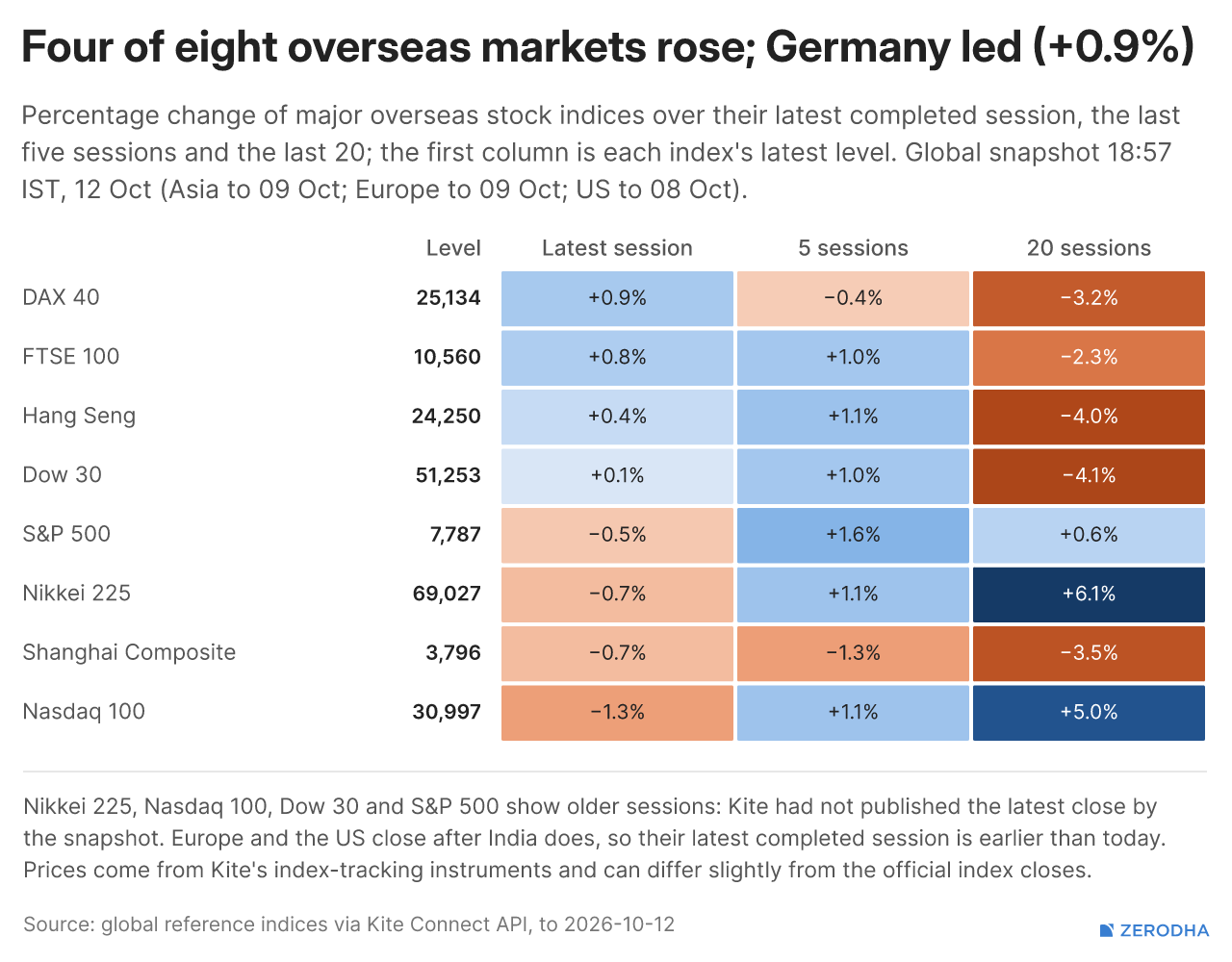
Commodities
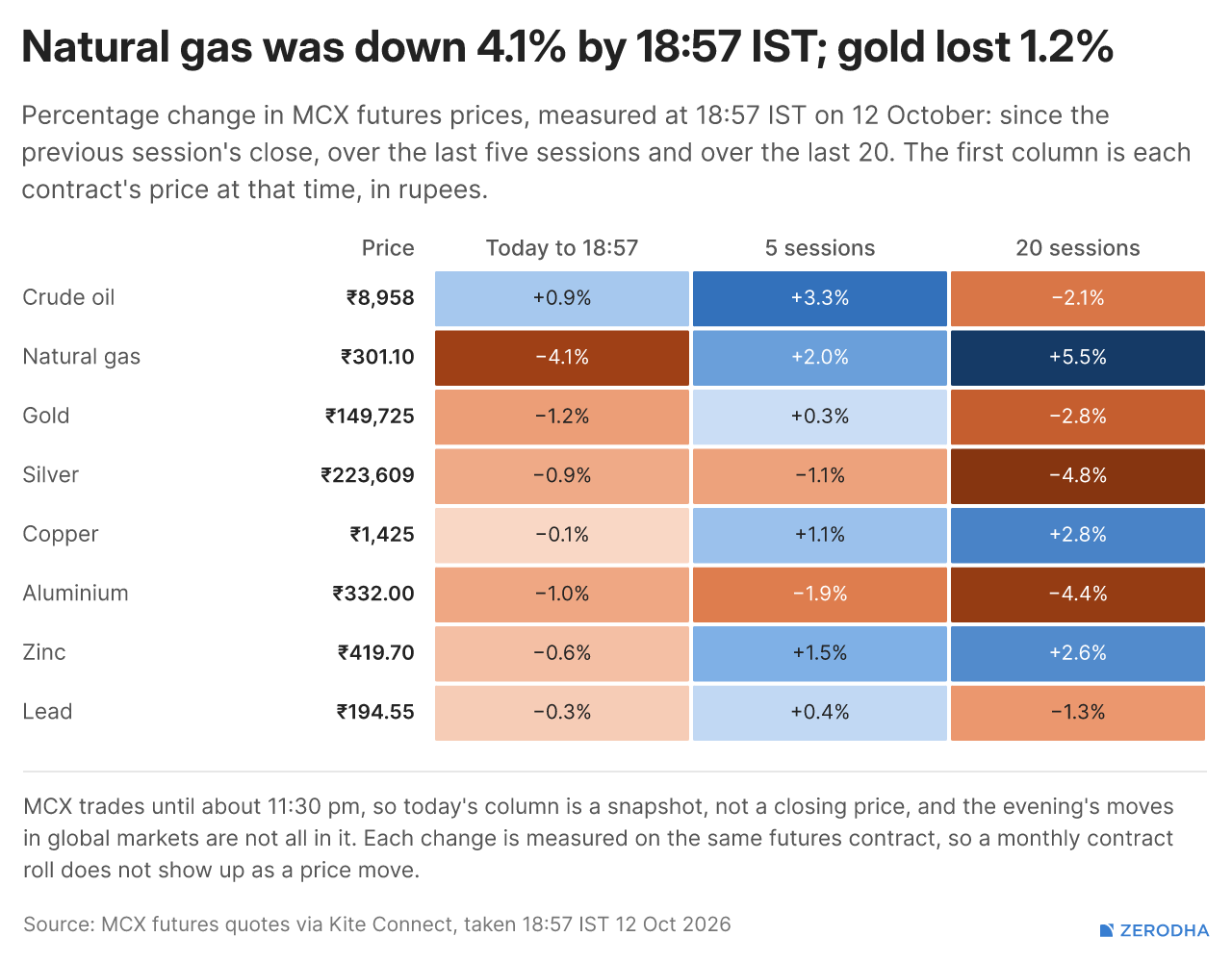
Institutional Flows & Participant Positioning
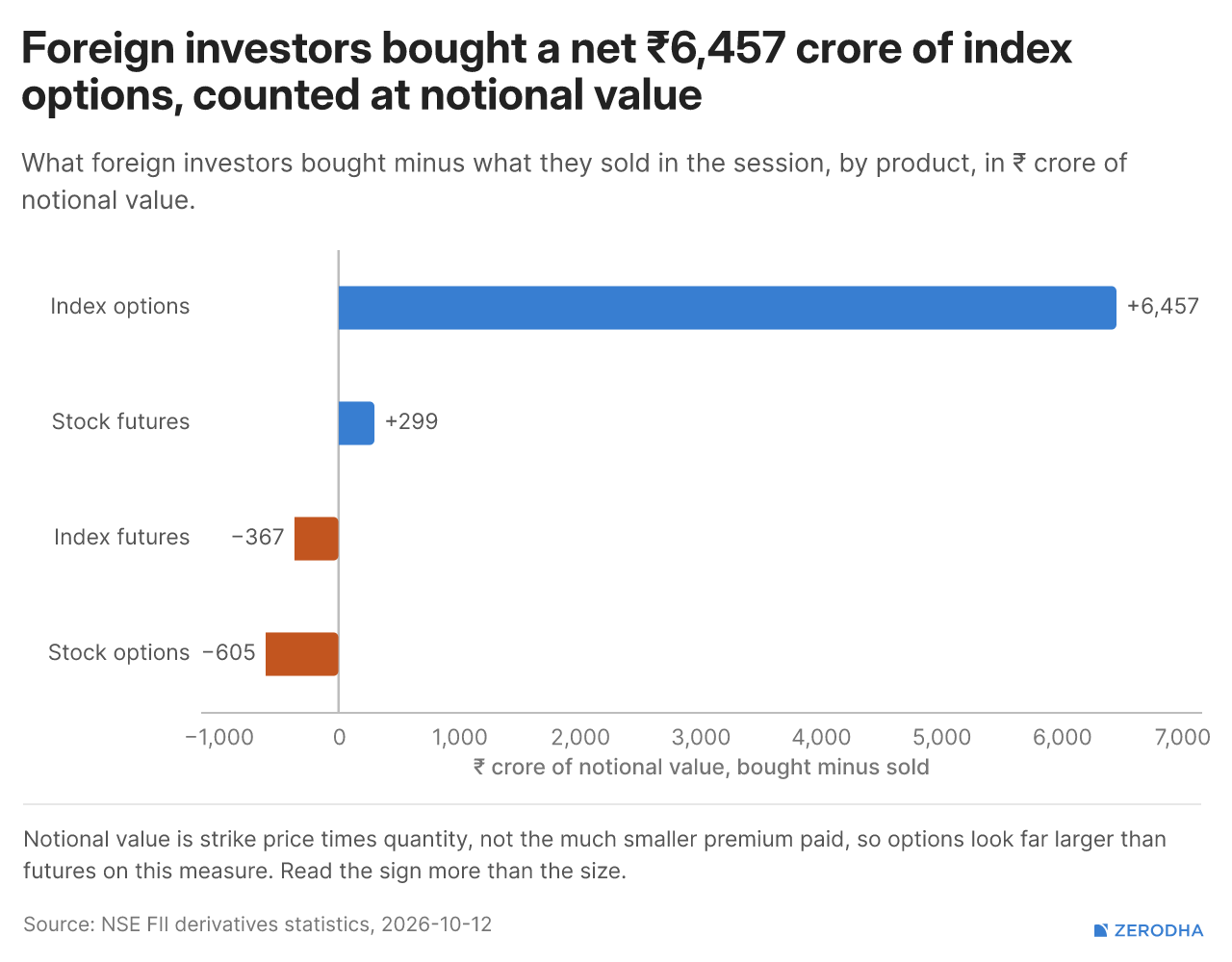
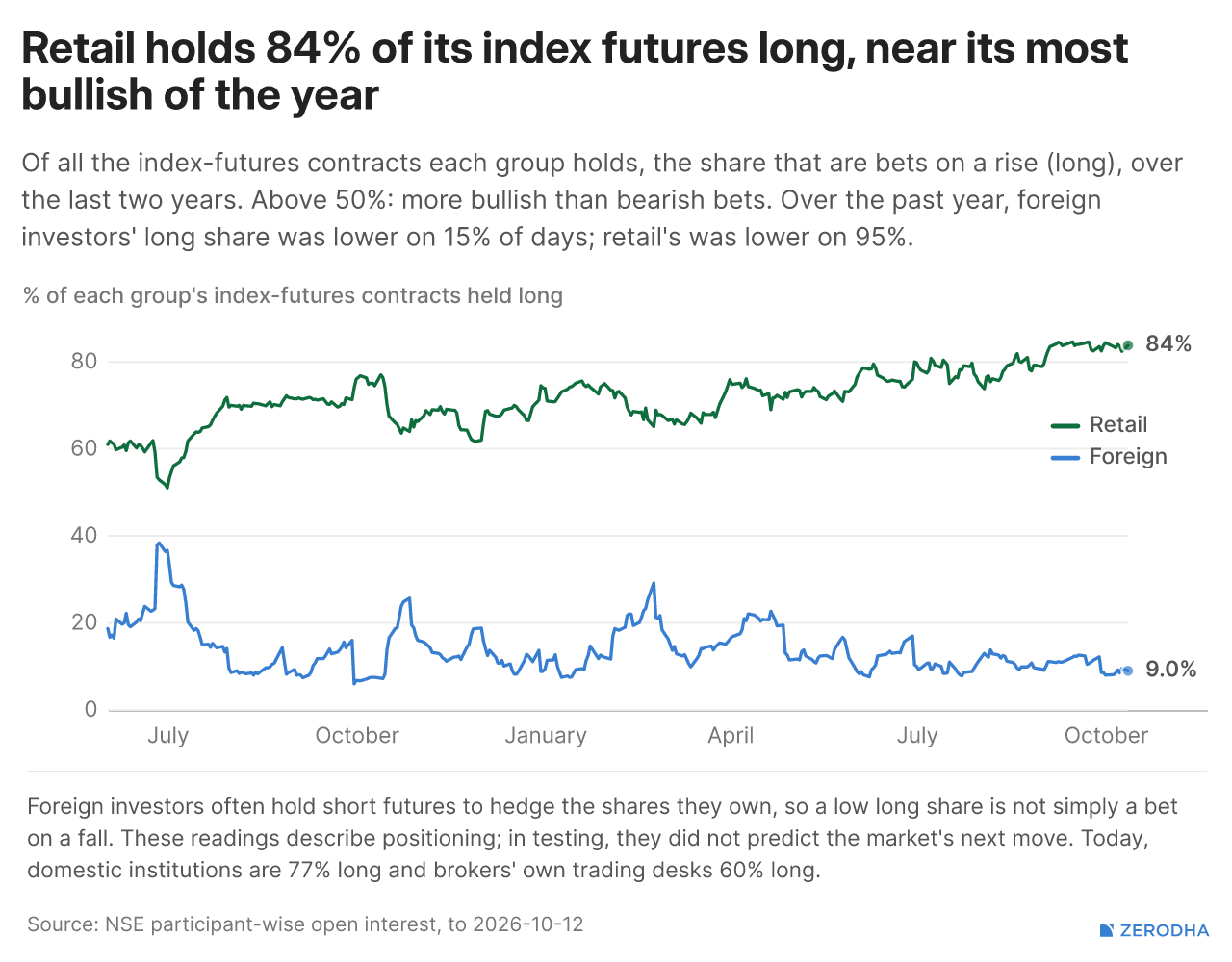
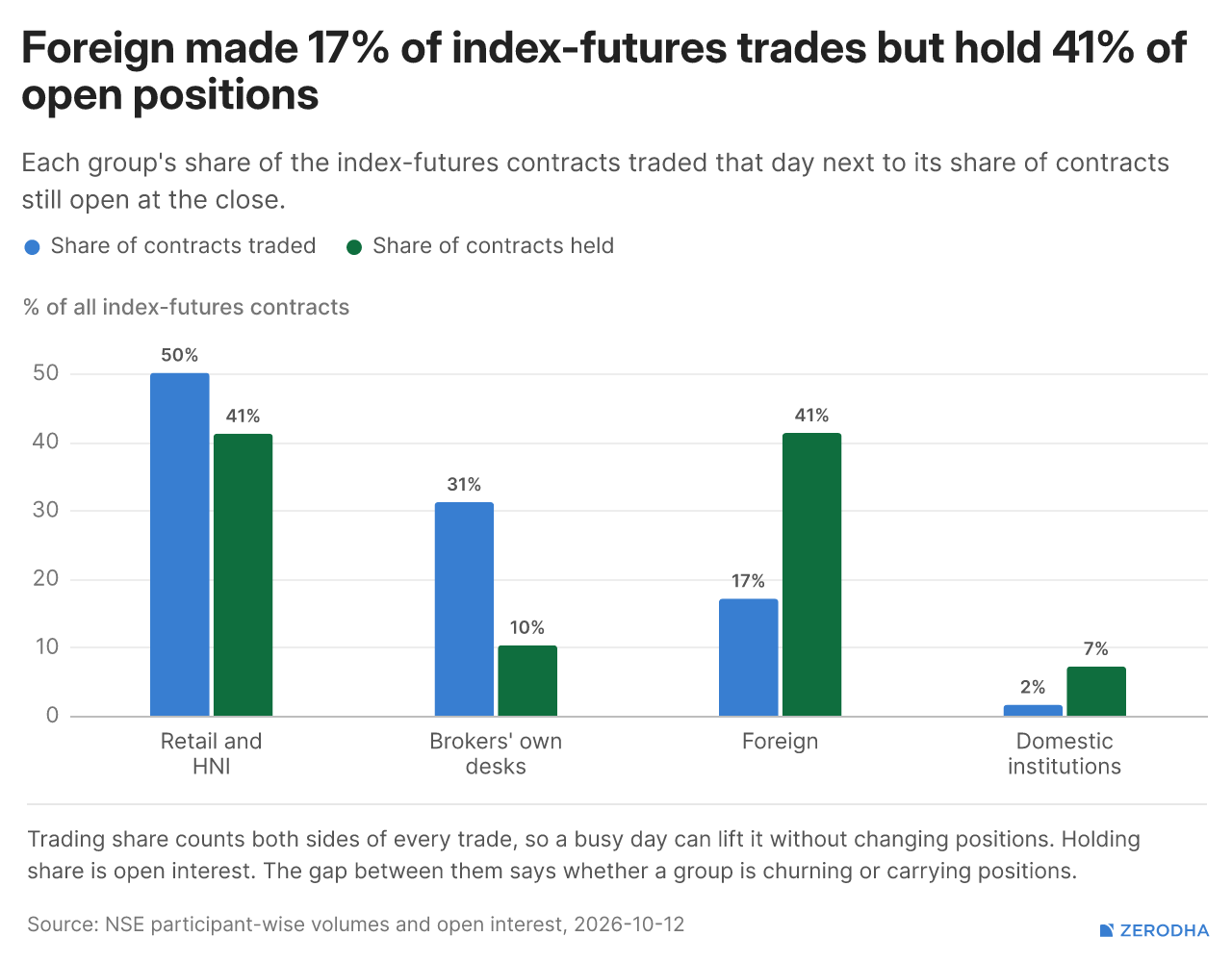
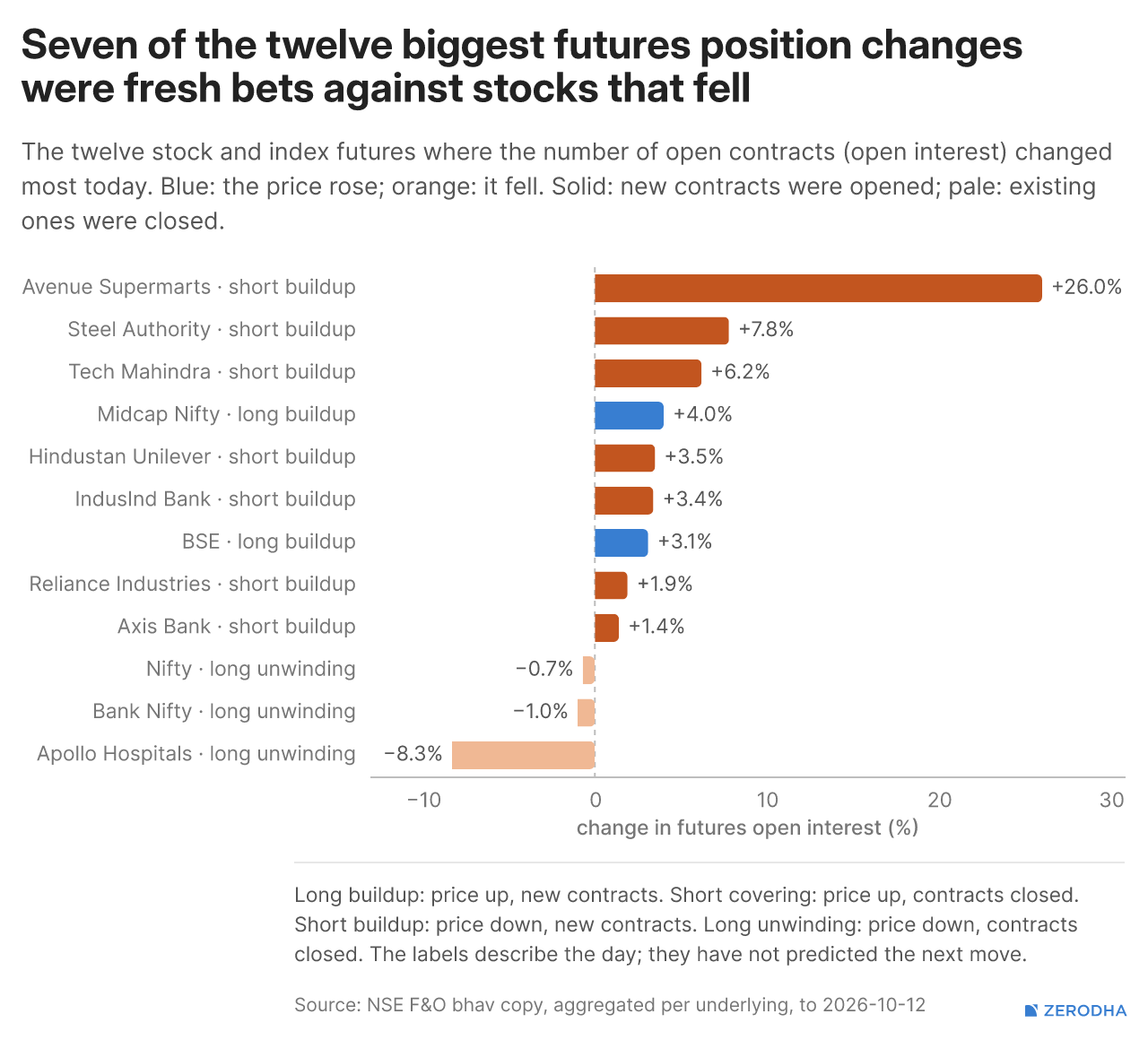
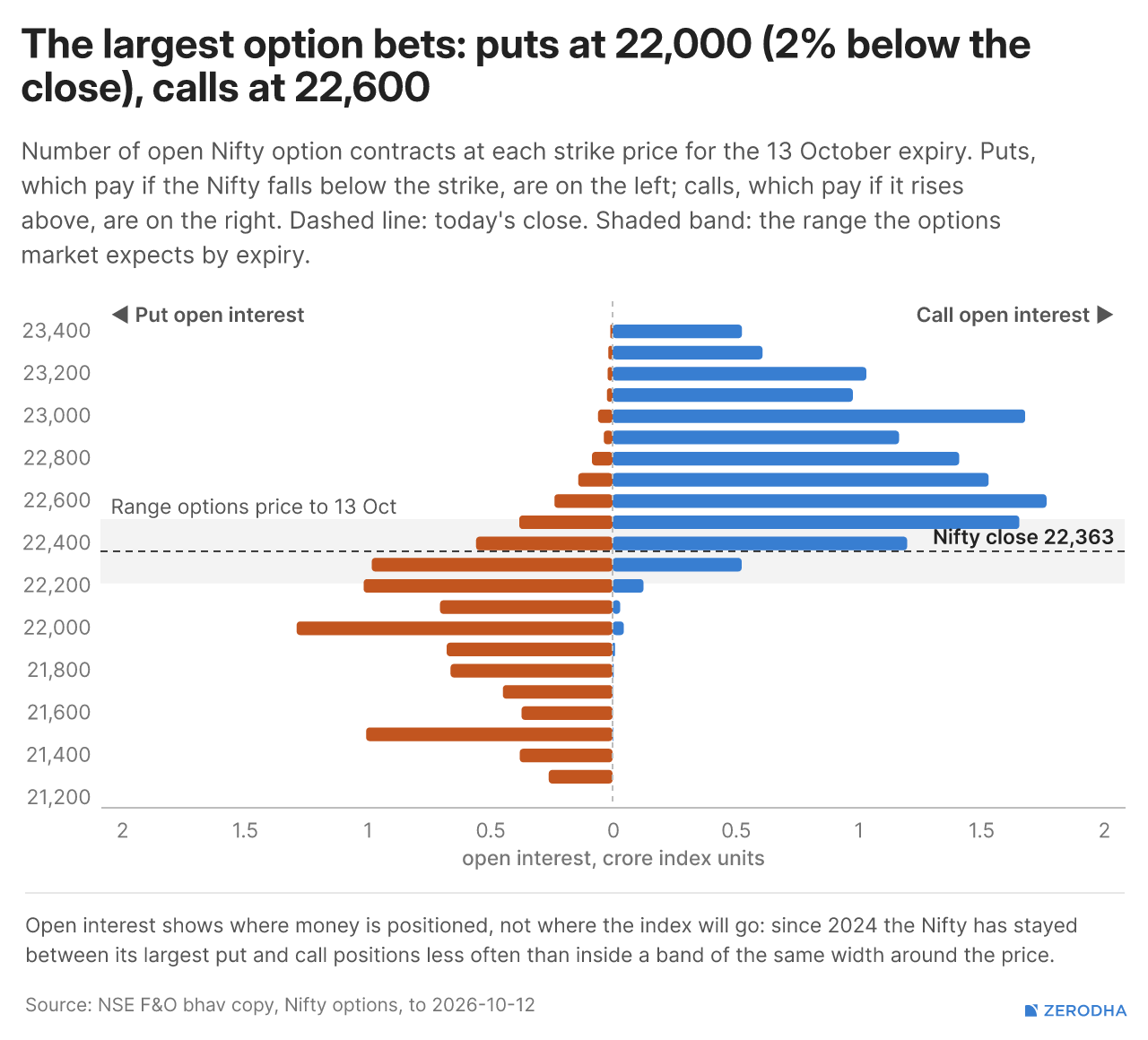
Call writing intensified, pulling the PCR down from 1.14 to 0.73, while implied volatility for October 19 expiry rose to 14.6%. FIIs remain heavily bearish with just 9% of index-futures positions long, while retail and HNIs are 84% long; seven of the 12 largest stock-futures OI moves were short buildups.
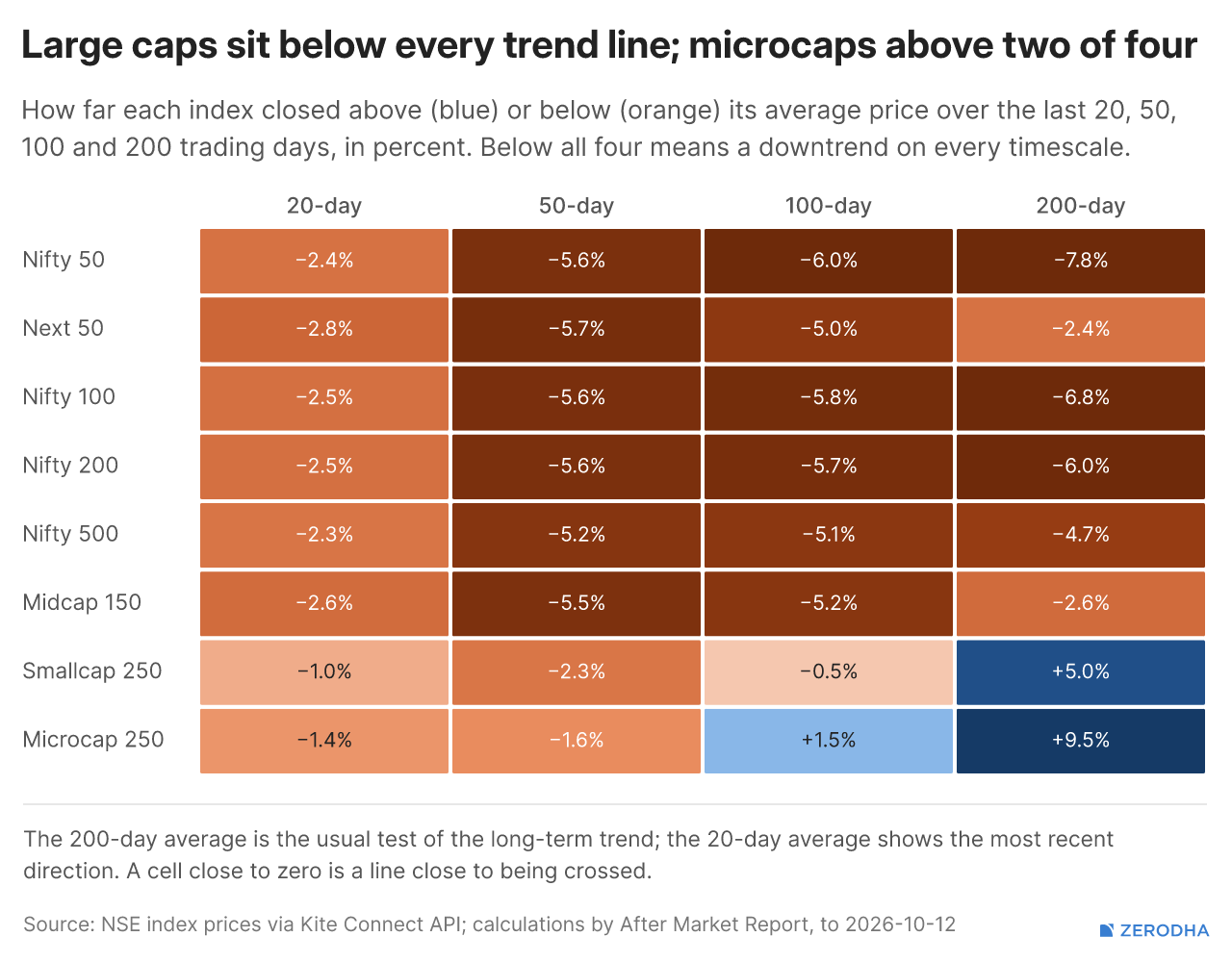
Options imply a 22,179–22,482 range into October 13 expiry, with the heaviest put OI at 22,000 and call OI at 22,600. The 20-day moving average at 22,916 remains the first major trend hurdle.
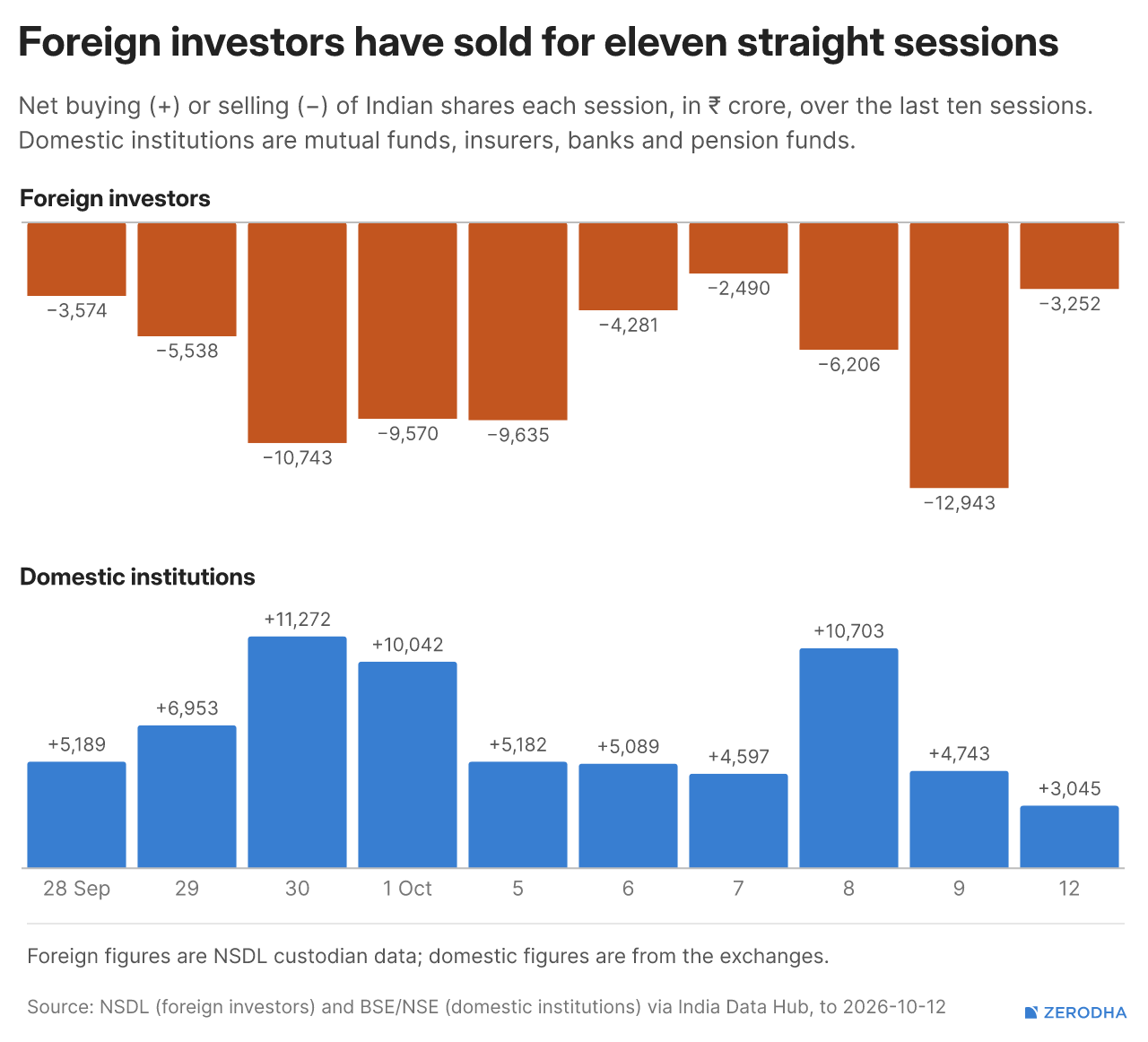
Thematic Indices
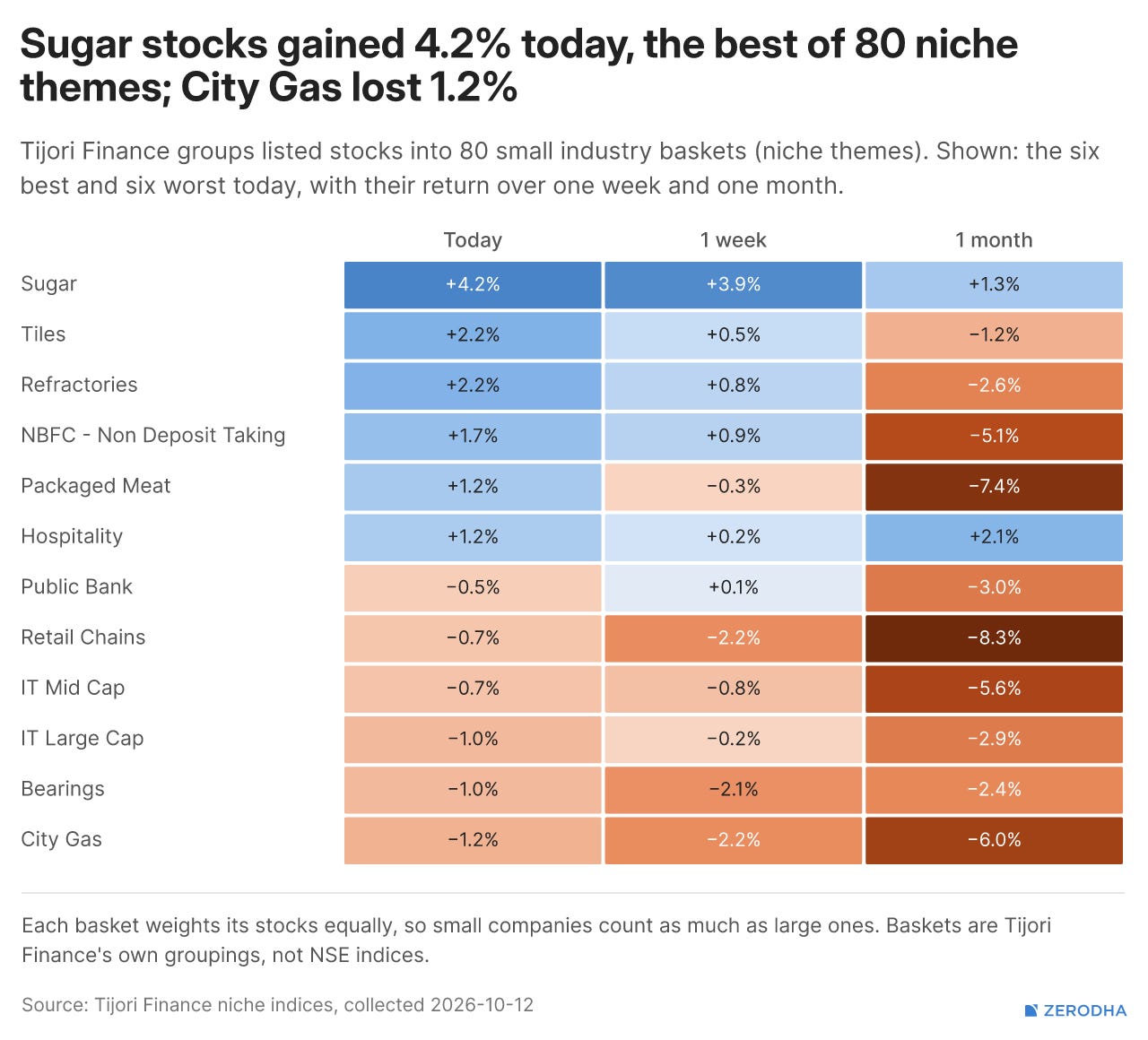
Tijori’s niche indices, where today’s move sorts pockets of the market beyond standard sector baskets. You can also track promoter buying and other interesting stuff, like Capex activity by the companies in the Tijori App’s idea dashboard
F&O Corner

Top Stories in India
The rupee surged 96 paise to ₹95.75/$, recording its biggest single-day gain in over six months, following a series of RBI measures aimed at curbing dollar demand and speculative pressure on the currency. Dive deeper
The RBI introduced measures to curb oil companies’ spot dollar demand and speculative corporate hedging. Banks must maintain a 20% cash reserve on qualifying rupee-linked forex derivative contracts above $2 million, while the minimum daily CRR maintenance requirement will rise from 90% to 99% from October 16. Dive deeper
HCLTech reported a 21.2% YoY rise in Q2 FY27 consolidated net profit to ₹5,132 crore, while revenue grew 11.5% to ₹35,620 crore. Sequentially, profit increased 11% and revenue rose 3%. Dive deeper
India’s CPI inflation rose to a 21-month high of 5.54% in September, compared with 4.83% in August, driven by rising food prices and an unfavourable base effect. The reading brings inflation closer to the RBI’s 6% upper tolerance limit. Dive deeper
LTTS launched its first AI-native Engineering Intelligence Lab for digital manufacturing in India, built using Siemens and Nvidia technologies. The facility will focus on digital twins, autonomous systems and AI-driven automation across manufacturing and supply chains. Dive deeper
Monthly SIP contributions reached a record ₹32,490 crore in September, up from ₹32,297 crore in August. Equity mutual fund inflows climbed to a five-month high of ₹38,306 crore, despite continued weakness in stock markets. Dive deeper
Technip Energies secured an EPC contract from HPCL for its Mumbai Refinery modernisation project. The contract covers a 550 KTA hydrocracker and catalytic dewaxing unit and an 850 KTA solvent deasphalting unit. Dive deeper
Century Plyboards inaugurated a ₹215 crore plywood manufacturing facility in Punjab, with an initial annual capacity of 60,000 cubic metres. Capacity is expected to increase to 1 lakh cubic metres, with potential annual revenue of around ₹600 crore at full utilisation. Dive deeper
The government proposed a 30% cap on trade margins for certain anti-cancer drugs, potentially reducing retail prices by 20–70% and saving patients ₹2,500 crore annually. The Supreme Court suggested extending the proposal beyond cancer medicines to other drugs. Dive deeper
RBL Bank’s Q2 FY27 net profit jumped 2.7 times YoY to ₹482 crore, supported by strong loan growth. Net interest income rose 37% to ₹2,131 crore, while net interest margins improved 48 bps sequentially to 4.61%. Dive deeper
Top Stories Globally
Crude oil rose over 2% to above $93.8 per barrel, extending gains for a third consecutive session as renewed attacks on energy infrastructure in Ukraine and escalating Middle East tensions raised concerns over supply disruptions. Dive deeper
The US decision to allow Russian diesel supplies into American and global markets could ease fuel shortages but increase competitive pressure on Indian refiners. The move comes amid continued US trade restrictions targeting countries purchasing Russian energy. Dive deeper
The dollar index rose 0.2% to 102.43, trading near an 18-month high as Middle East tensions supported demand for the currency. Investors are awaiting US inflation data for further clues on the Fed’s interest rate outlook. Dive deeper
European natural gas prices have surged over 150% this year as disruptions in the Strait of Hormuz constrained LNG shipments from Qatar and the UAE. Prices could remain elevated for another year as Europe rebuilds depleted gas inventories. Dive deeper
Global smartphone shipments fell 20% YoY in Q3 2026, reaching their lowest third-quarter level since 2012, according to Counterpoint Research. Rising memory chip costs and supply shortages linked to AI infrastructure demand pressured production and sales. Dive deeper
Management Chatter
In this section, we highlight interesting comments from management at major companies and from policymakers in the Indian and Global Economies.
Finance Minister Nirmala Sitharaman on India’s Steel Industry:
“Since February 2026, the conflict in West Asia has disrupted shipping through the Strait of Hormuz and raised energy and freight costs across the industry.”
“Power grids, renewable energy installations, pipelines, railways, ships and defence platforms all depend on steel. As supply chains are reorganised around security as well as cost, the ability to produce steel domestically, particularly specialised grades, has become an element of economic security,”
While much of the global industry is grappling with excess capacity and weak demand, India is experiencing a different trajectory, driven by domestic consumption and sustained investment.
“At approximately 109 kg per person, against a world average of 209 kg, India’s steel consumption has considerable room to rise. The question, therefore, is what sustains this demand and how India intends to prepare its steel industry for the next phase of development.” - Link
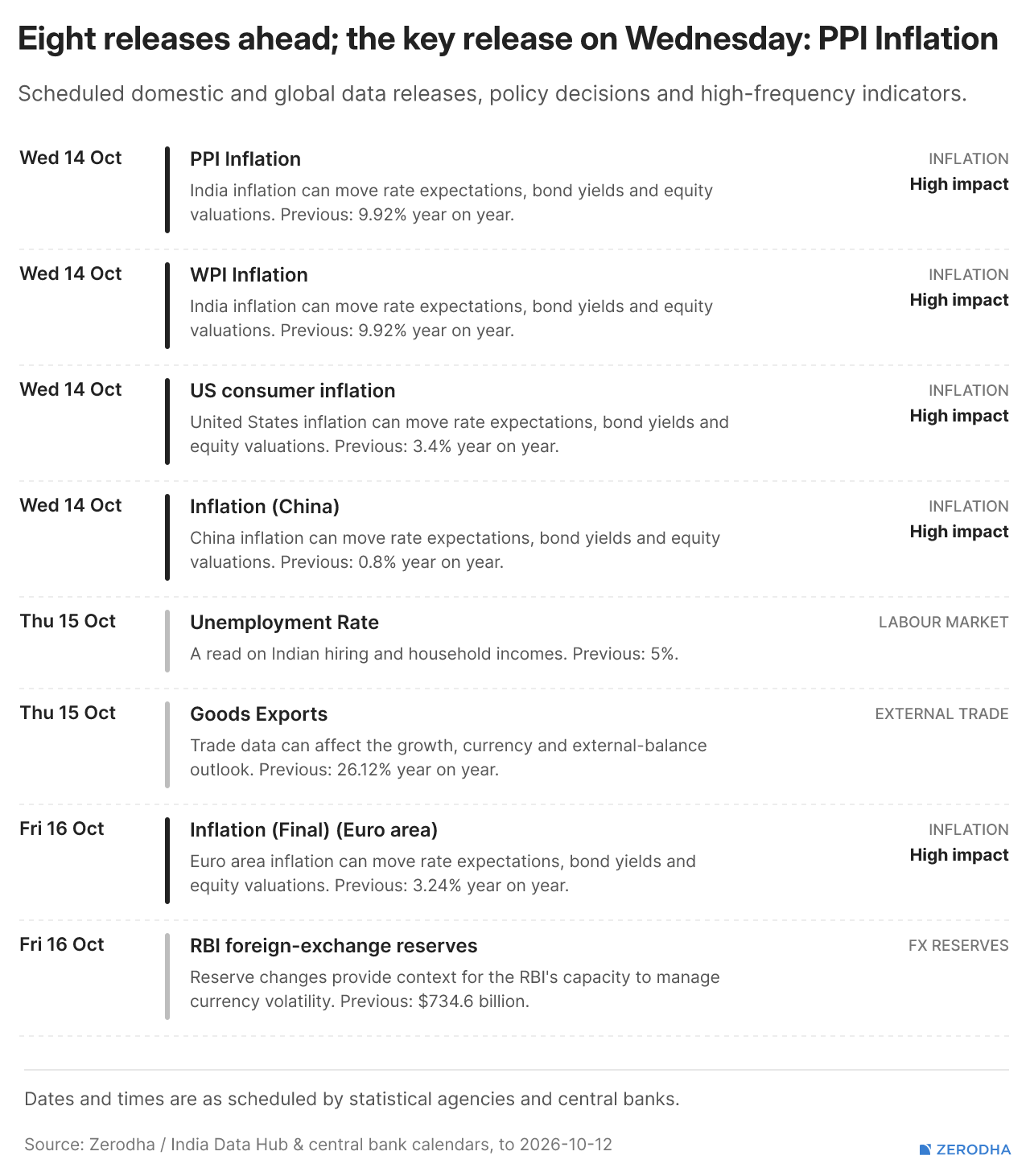
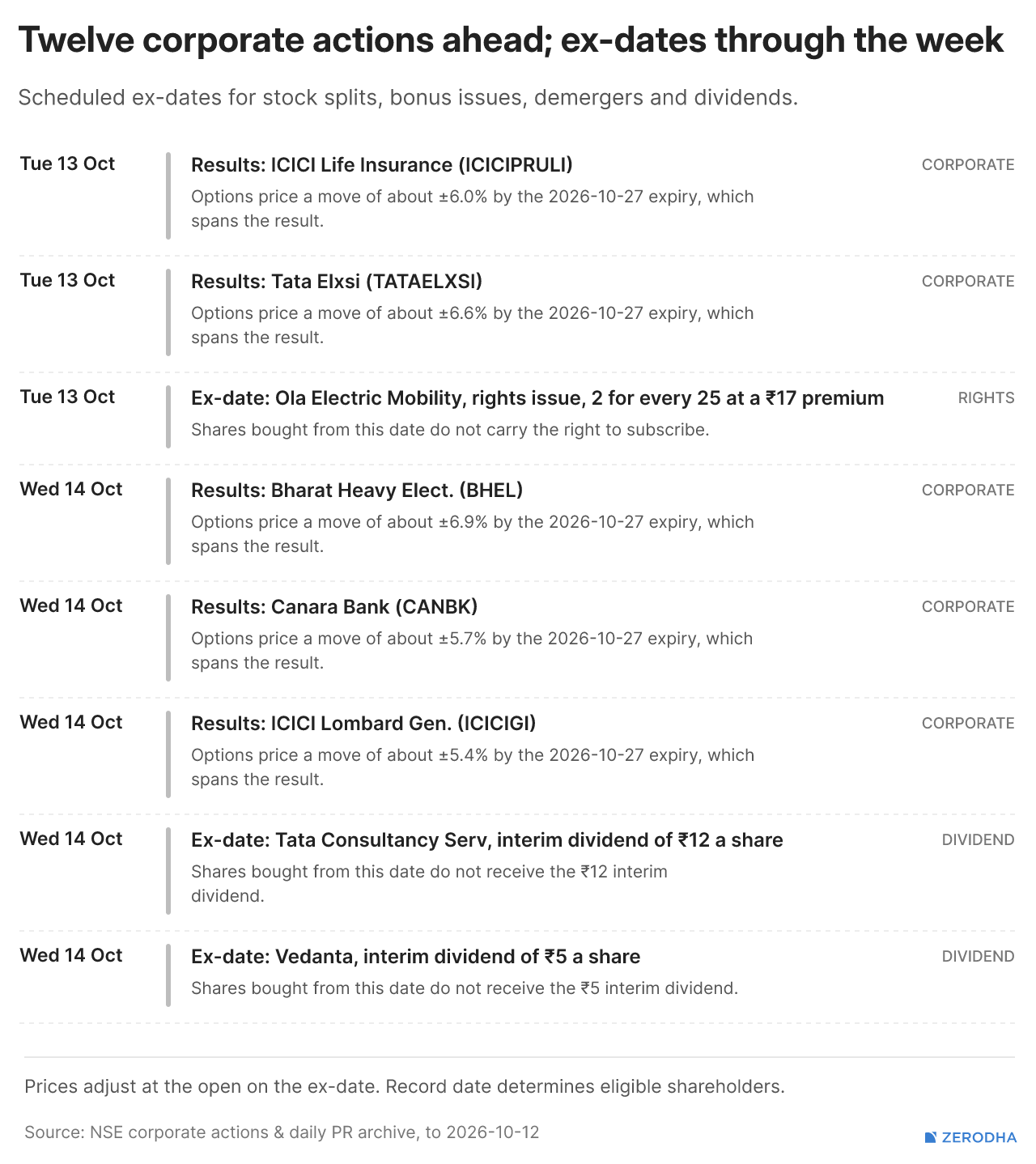
The week ahead & Corporate Actions
Corporate Actions
Published by Zerodha. Not investment advice. Data from NSE, BSE, and MCX.
In our latest episode of In The Money by Zerodha, we start with: What happens after a stock makes a new 52-week high? Is it a sign that the stock has already run too far, or could it actually tell us something about where the stock goes next?
We then look at the academic research behind the 52-week high effect, including the 2004 study by George and Hwang and more recent research on Indian stocks, before exploring the behavioural explanation for why the effect might exist.
Finally, we run our own backtest on the NIFTY 750, looking at stocks that make a new 52-week closing high, applying a 52-week cooldown between signals, and tracking what happens over different holding periods.
That’s it from us for today. We’d love to hear your feedback in the comments, and feel free to share this with your friends to spread the word!