
Welcome to Aftermarket Report, a newsletter where we do a quick daily wrap-up of what happened in the markets, both in India and globally.
In our latest episode of In The Money by Zerodha, we go through 12 documentaries on financial markets, grouped into 6 categories, and tell you why each one is worth your time and what we personally took away from them.
Movies entertain first and educate along the way. Documentaries do the opposite. And financial markets have produced enough unbelievable stories that they don’t need any Hollywood exaggeration.
Markets Today
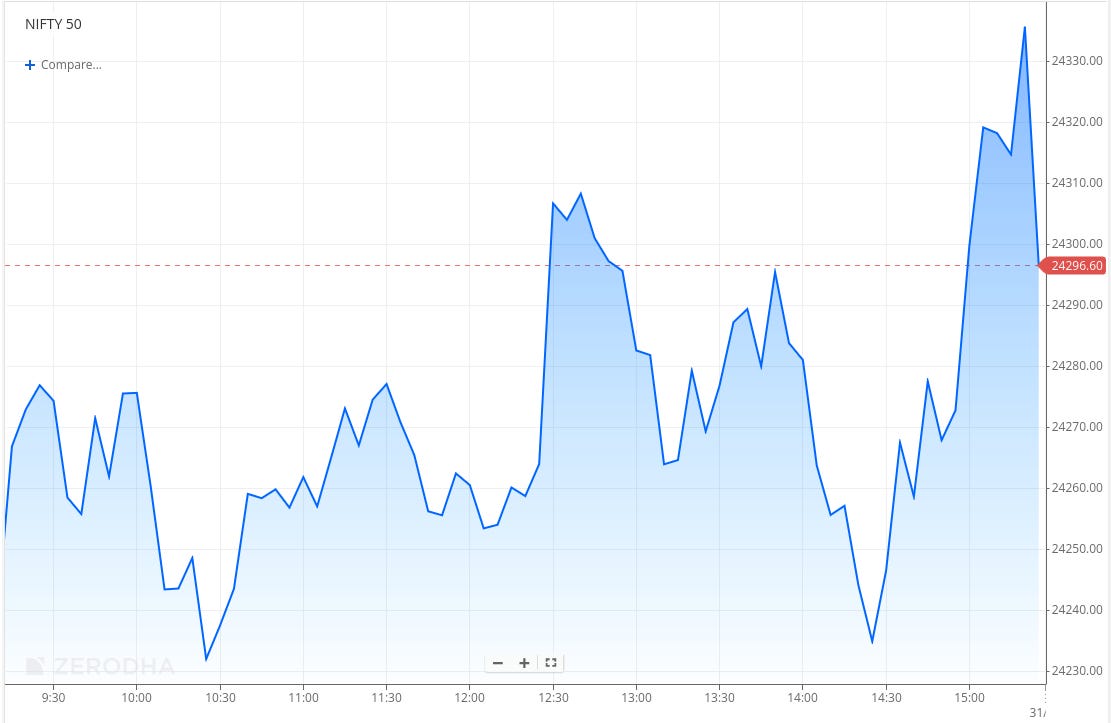
Nifty opened absolutely flat at 24,249, shrugging off the sharp overnight weakness in global markets and continuing to outperform amid the ongoing AI-led sell-off overseas. After a choppy start, the index slipped to an intraday low near 24,190 in the opening minutes before gradually recovering and oscillating in a narrow range between 24,240 and 24,280 through the morning.
Around 12:30 PM, Nifty witnessed a sharp intraday spike above 24,300, but the move quickly faded as profit booking pulled the index back below the 24,280 mark. Selling pressure intensified again around 2 PM, dragging the index close to 24,230. However, the market staged a strong final-hour recovery, reclaiming the 24,300 level & touching day’s high around 24,340 levels before briefly before easing slightly into the close.
Nifty eventually ended the session at 24,317.15, comfortably above its opening level, extending its relative outperformance despite continued weakness in global equities.
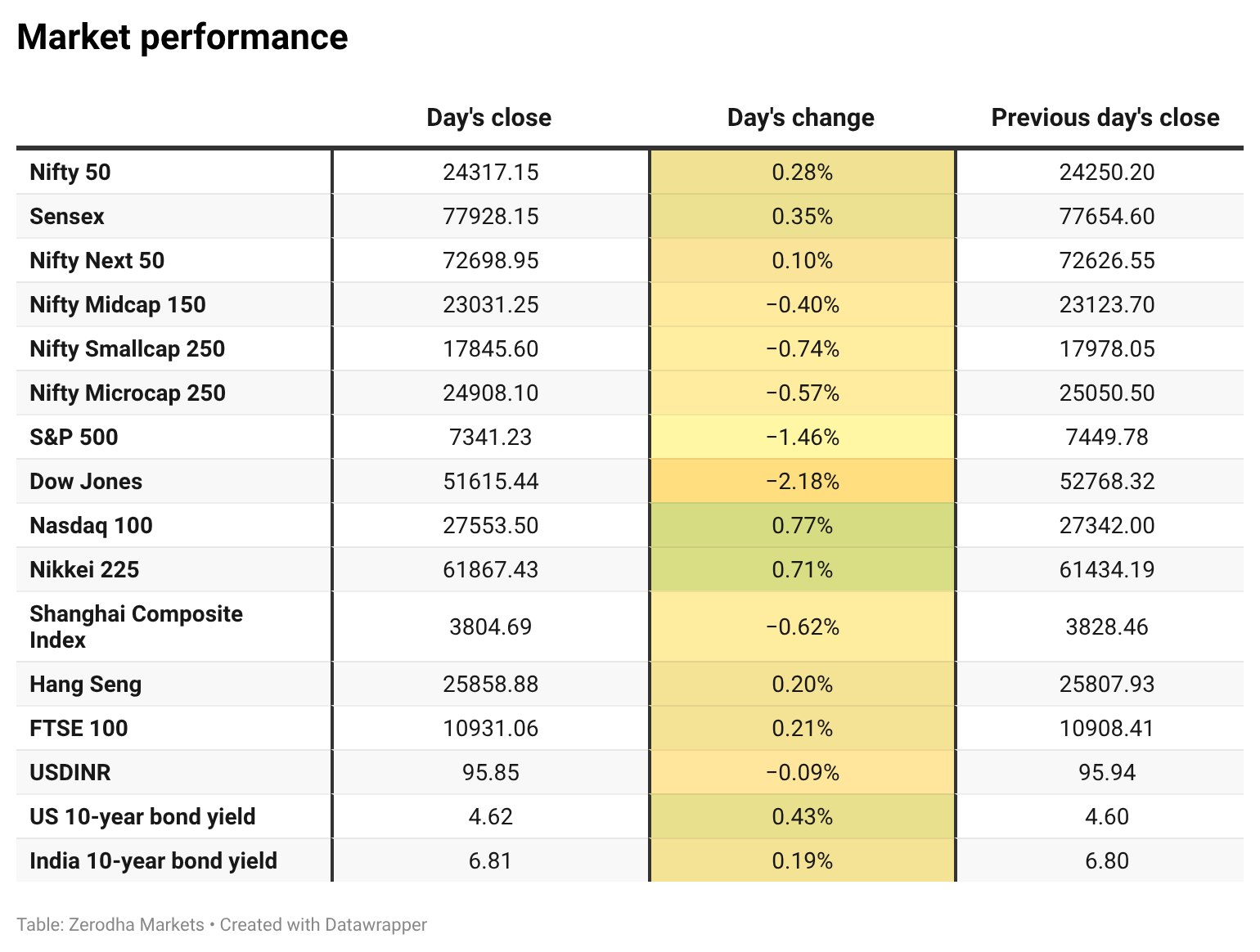
Sectoral Indices Performance
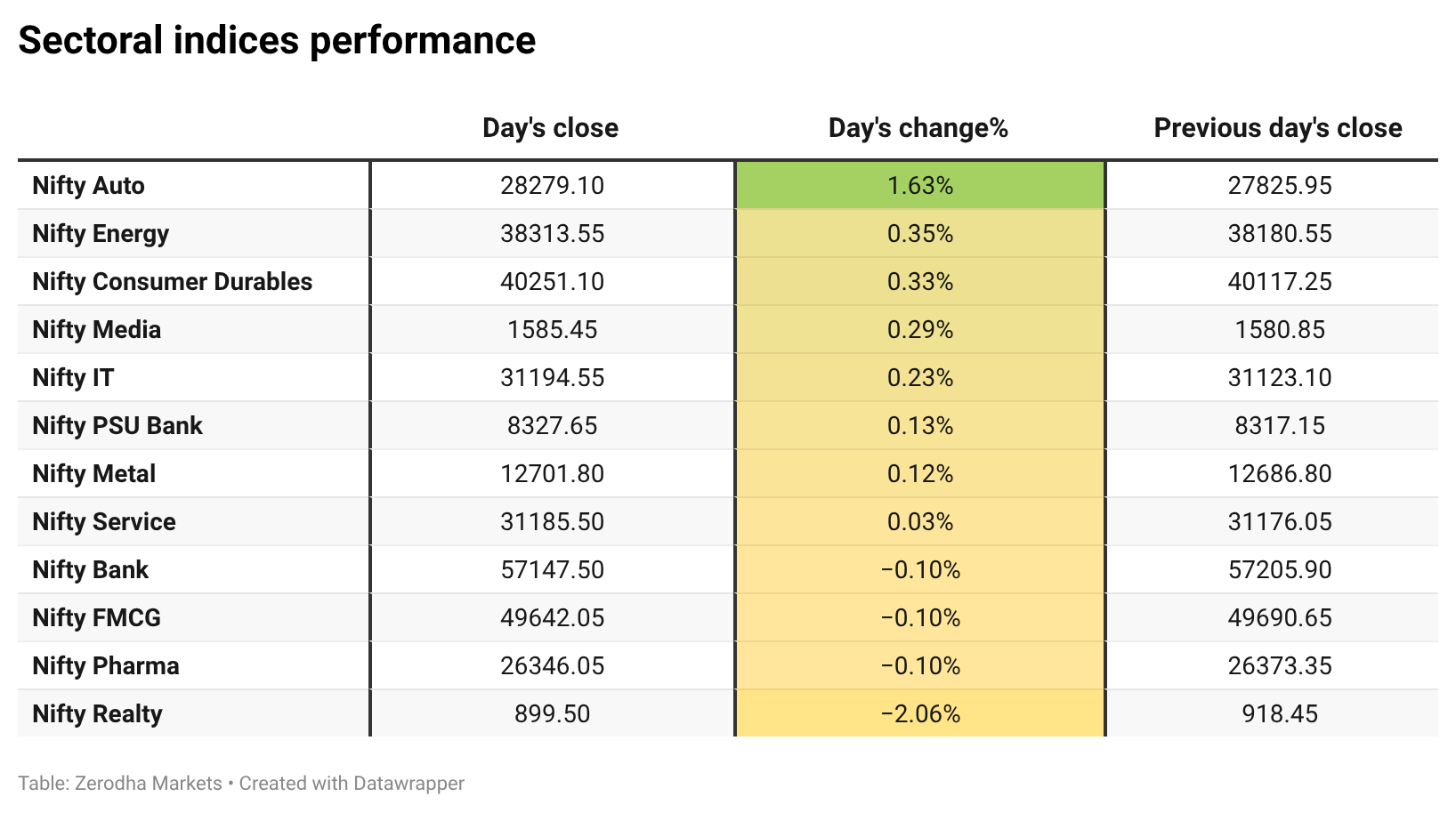
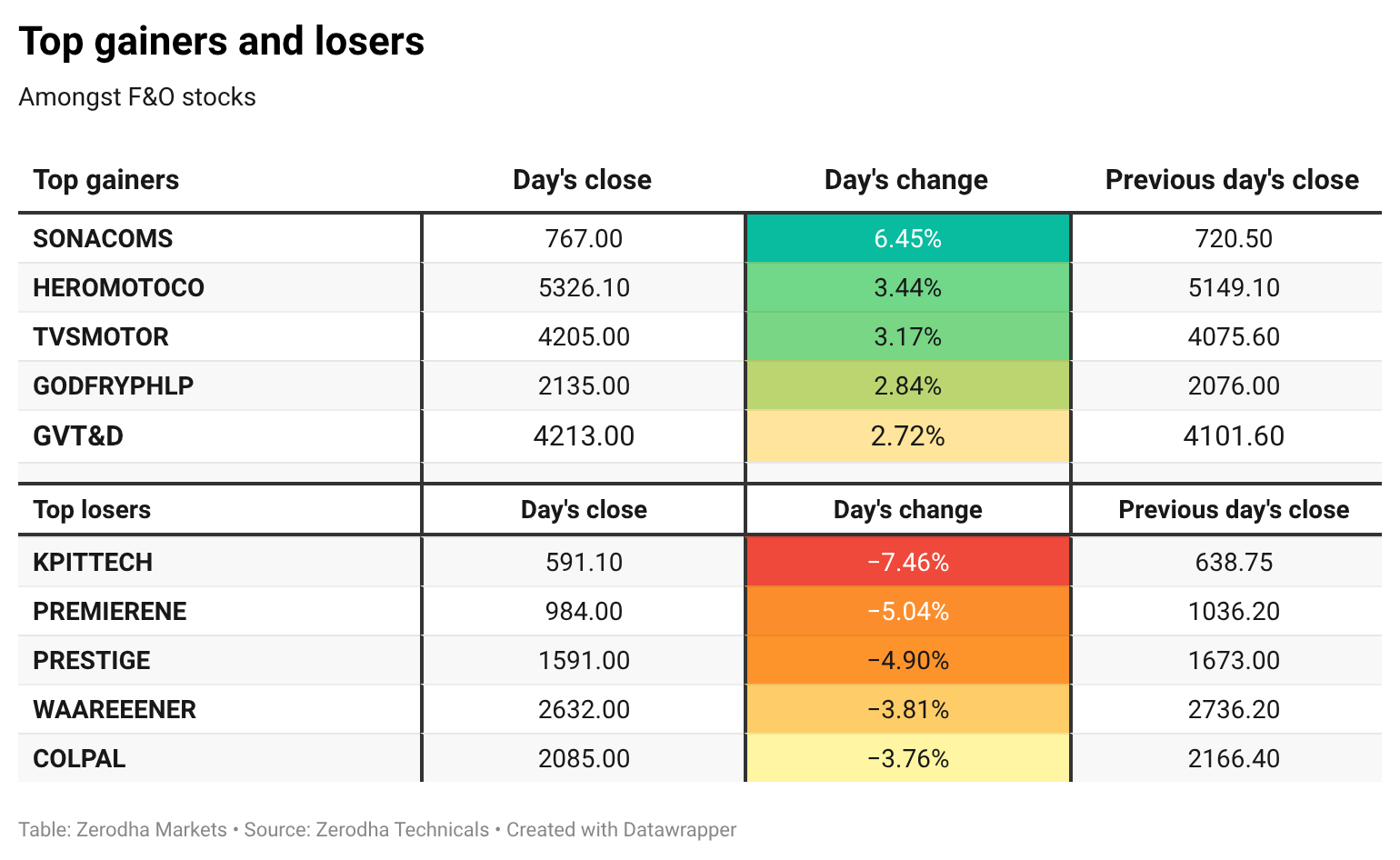
Winners & Losers
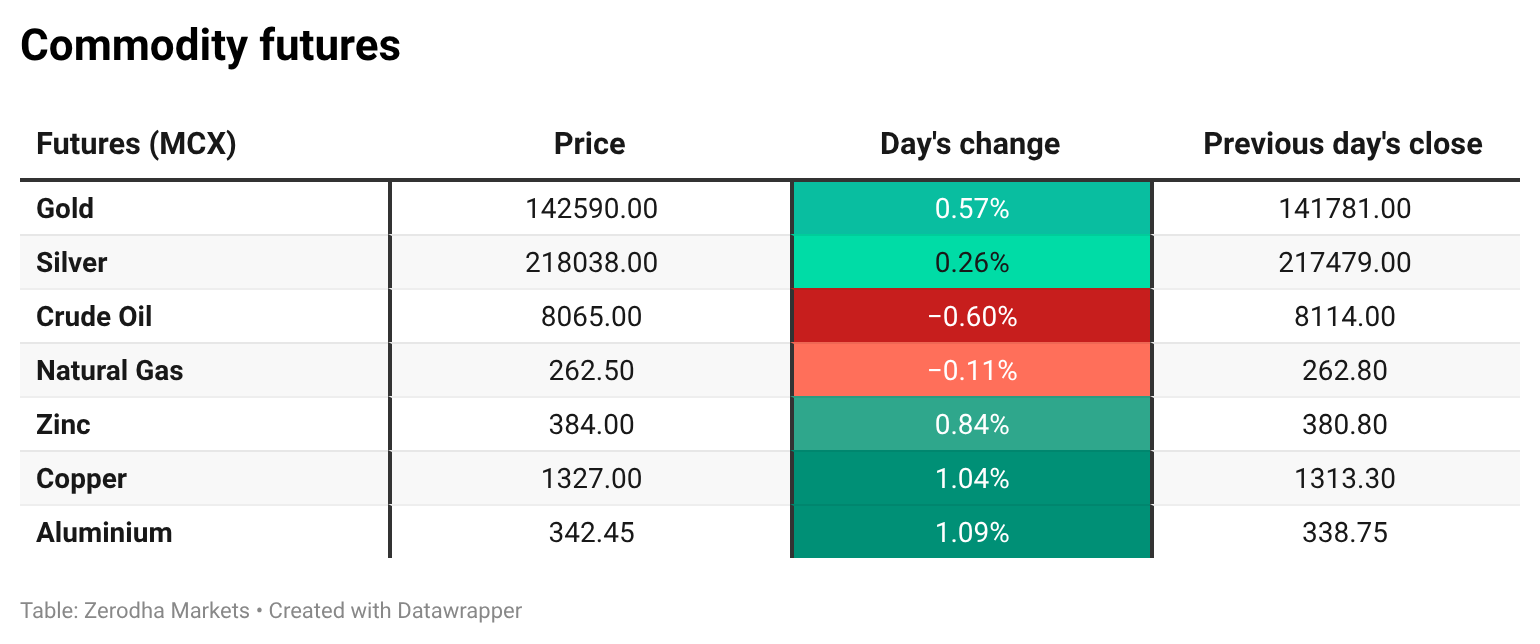
Commodities
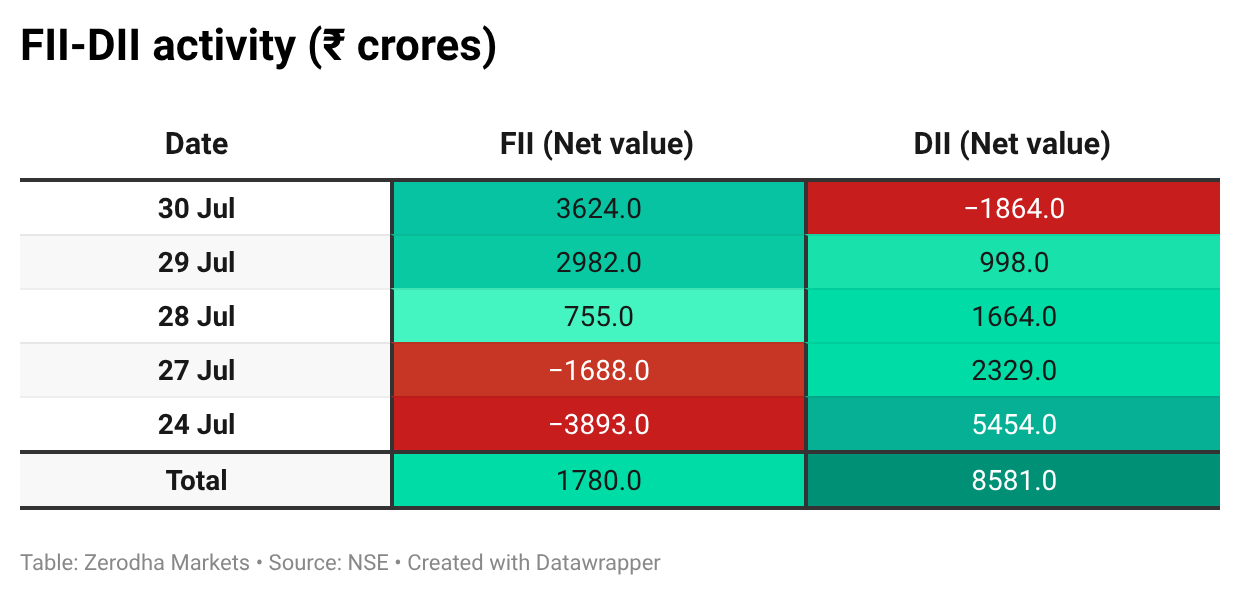
FII / DII Flows
Here’s the trend of FII-DII activity from the last 5 days:
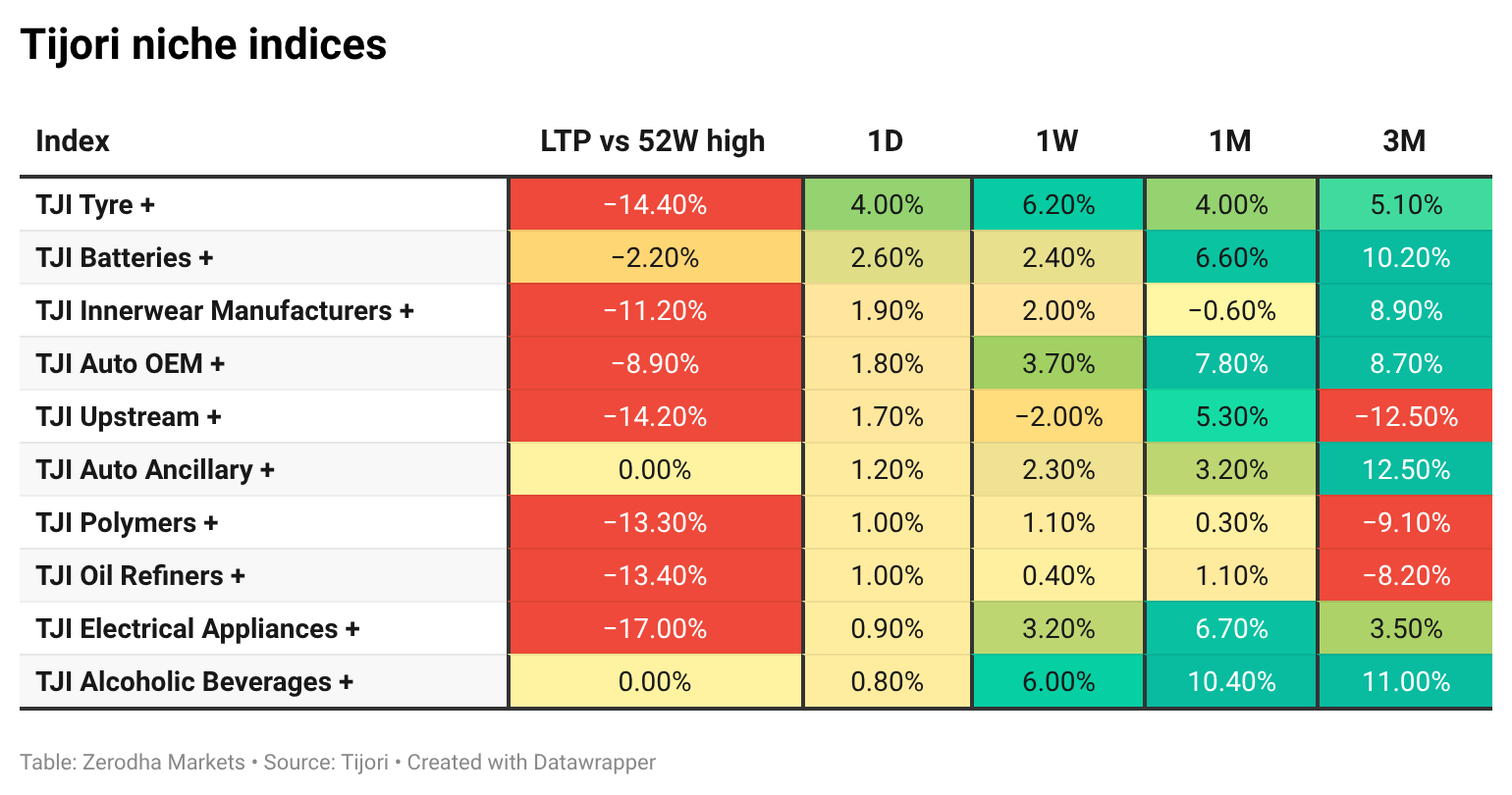
Thematic Indices
Tijori’s niche indices, where today’s move sorts pockets of the market beyond standard sector baskets. You can also track promoter buying and other interesting stuff, like Capex activity by the companies in the Tijori App’s idea dashboard
Change in OI for the day
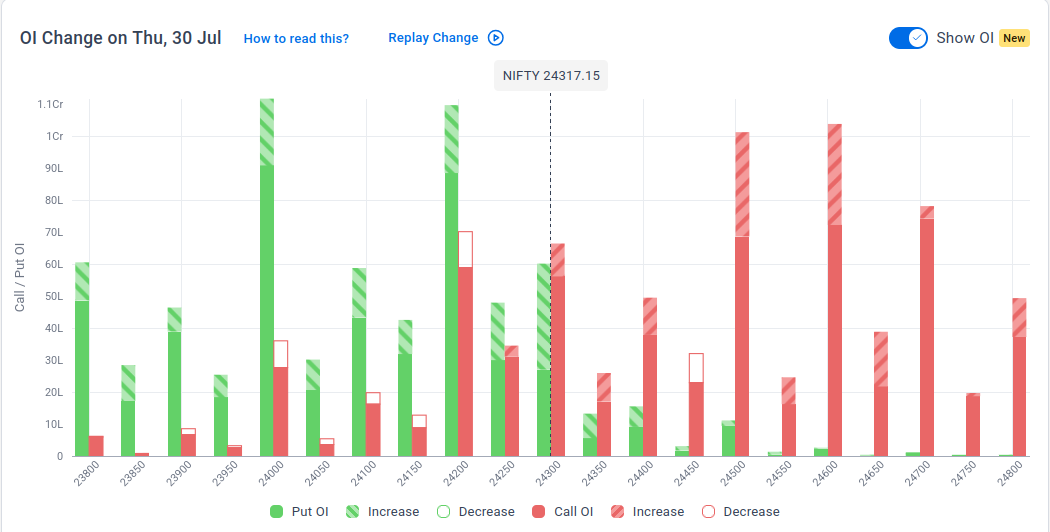
The following is the change in OI for Nifty contracts expiring on 4th August:
The maximum Call Open Interest (OI) is observed at 24,600, followed by 24,500, indicating potential resistance at the 24,500 -24,600 levels.
The maximum Put Open Interest (OI) is observed at 24,000, followed by 24,200, suggesting support at 24,200-24,100.
Note: OI is subject to multiple interpretations; however, generally, an increase in Call OI indicates resistance in a falling market, while an increase in Put OI indicates support in a rising market.
Source: Sensibull

Top Stories in India
Bajaj Finance reported a 27% YoY increase in Q1FY27 net profit to ₹5,986 crore, driven by healthy retail credit demand and a 24% YoY rise in net interest income to ₹11,495 crore. The company’s assets under management (AUM) grew 23% YoY to ₹4 lakh crore, reflecting continued strength in its lending business. Dive deeper
Swiggy reported a 34% YoY decline in Q1FY27 net loss to ₹791 crore, while revenue from operations rose 37% YoY to ₹6,812 crore. The company's loss also improved slightly on a sequential basis from ₹800 crore in the previous quarter. Dive deeper
Vedanta reported an 18% sequential decline in Q1FY27 net profit to ₹5,473 crore, while revenue slipped 1% QoQ to ₹23,456 crore. Despite the sequential decline, net profit margin expanded to 22% from 12% a year ago, supported by strong growth across its India zinc & lead, copper, and silver businesses, with silver revenue more than doubling. Dive deeper
Hyundai Motor India reported a 35% YoY decline in Q1FY27 consolidated net profit to ₹889 crore, while revenue remained largely flat at ₹16,335 crore, down 0.5% YoY. EBITDA margin contracted to 9.3% from 13.3% a year ago, although the company recorded its highest-ever quarterly domestic sales for the new Venue and saw CNG vehicles account for 18% of total sales, with record penetration for the Aura and Exter models. Dive deeper
India’s gold demand fell 6% YoY to 131.4 tonnes in Q2 2026, as seasonally weaker buying, higher customs duty, and the Prime Minister’s appeal to curb gold purchases weighed on demand. However, the value of gold consumption hit a record ₹1.98 lakh crore, up 50% YoY, reflecting resilient consumer spending despite elevated gold prices, according to the World Gold Council. Dive deeper
M&M reported a 34% YoY increase in Q1FY27 consolidated net profit to ₹5,455 crore, while revenue rose 28% YoY to ₹58,188 crore. The strong performance was driven by robust volume growth in its automotive and farm businesses, along with improved profitability at M&M Financial Services and margin expansion at Tech Mahindra. Dive deeper
Top Stories Globally
The U.S. Federal Reserve kept its benchmark interest rate unchanged at 3.50%–3.75% for a fifth consecutive meeting, with policymakers voting 9–3 in favour of holding rates. Fed Chair Kevin Warsh said there is no “magic wand” to ease the cost of living, reiterating the Fed’s commitment to bringing inflation back to its 2% target, while warning that Middle East tensions could keep price pressures elevated. Dive deeper
Brent crude held steady at around $84 per barrel after surging 6.6% in the previous session, as escalating U.S.-Iran tensions kept supply concerns elevated. Donald Trump pledged retaliation following an Iranian strike on a U.S. military base in Jordan, raising fears of a prolonged conflict that could disrupt energy supplies from the Persian Gulf. Dive deeper
The U.S. economy grew at an annualized 1.5% in Q2 2026, slowing from 2.1% in the previous quarter and missing expectations of 2.1%. Growth was supported by consumer spending, investment, and exports, but was weighed down by weaker government spending, slower investment and exports, alongside higher imports. Dive deeper
The U.S. 10-year Treasury yield rose to 4.69%, its highest level since January 2025, while the 30-year Treasury yield climbed to 5.23%, a 19-year high, as investors assessed the Federal Reserve’s latest policy decision. Dive deeper
South Korea’s Finance Minister Koo Yun-cheol apologised after retail investors suffered heavy losses from single-stock leveraged ETFs, acknowledging the products were introduced without sufficient consideration. South Korea’s Financial Services Commission (FSC) is now considering stricter rules, including limiting investment in these products to professional investors. Dive deeper
Shell reported Q2 net profit of $9.84 billion, more than doubling from a year ago and marking its second-highest quarterly profit on record, as higher energy prices and increased market volatility during the Middle East conflict boosted earnings. Strong oil and LNG trading, along with improved chemicals margins, offset lower production volumes caused by disruptions to its Qatar operations. Dive deeper
Management Chatter
In this section, we highlight interesting comments from management at major companies and from policymakers in the Indian and Global Economies.
Christopher Wood, Global Head of Equity Strategy at Jefferies on what’s happening with Indian markets:
Yes. The Indian market has had some issues. But what’s been horrible in India last year was the relative performance of India compared to other Asian markets, most particularly Korea and Taiwan. And that performance was made worse by the weakness of the rupee.
But, in absolute return terms, the Indian stock market was not disastrous last year for rupee-based investors. And the interesting part of the Indian market where I’ve been most positive – but it’s obviously already now outperformed – has been mid-cap stocks. So the mid-cap stocks have done extremely well.
They’ve had better earnings growth than the blue chips. And the very impressive momentum of the flows into Indian domestic mutual funds has been maintained. So in Rupee terms, the Indian markets have done perfectly OK.
But, I would say in the big blue chips in the Indian market, there’s a lack of exciting thematics. The biggest thematic affecting Indian blue chips in the last 18 months has been a negative one. India has been the reverse AI trade. So you’d be dealing in global stock markets obsessed with AI. India is reverse AI. - Link
Rahul Bothra, Group CFO of Swiggy quantified the path toward EBITDA breakeven:
“The next 20 rupees, which we need to achieve to hit break-even on EBITDA, are roughly going to come from the monetization side... roughly a half-and-half split between product margins from brands and around 10 rupees from advertising.” - Link
Corporate Actions & Events
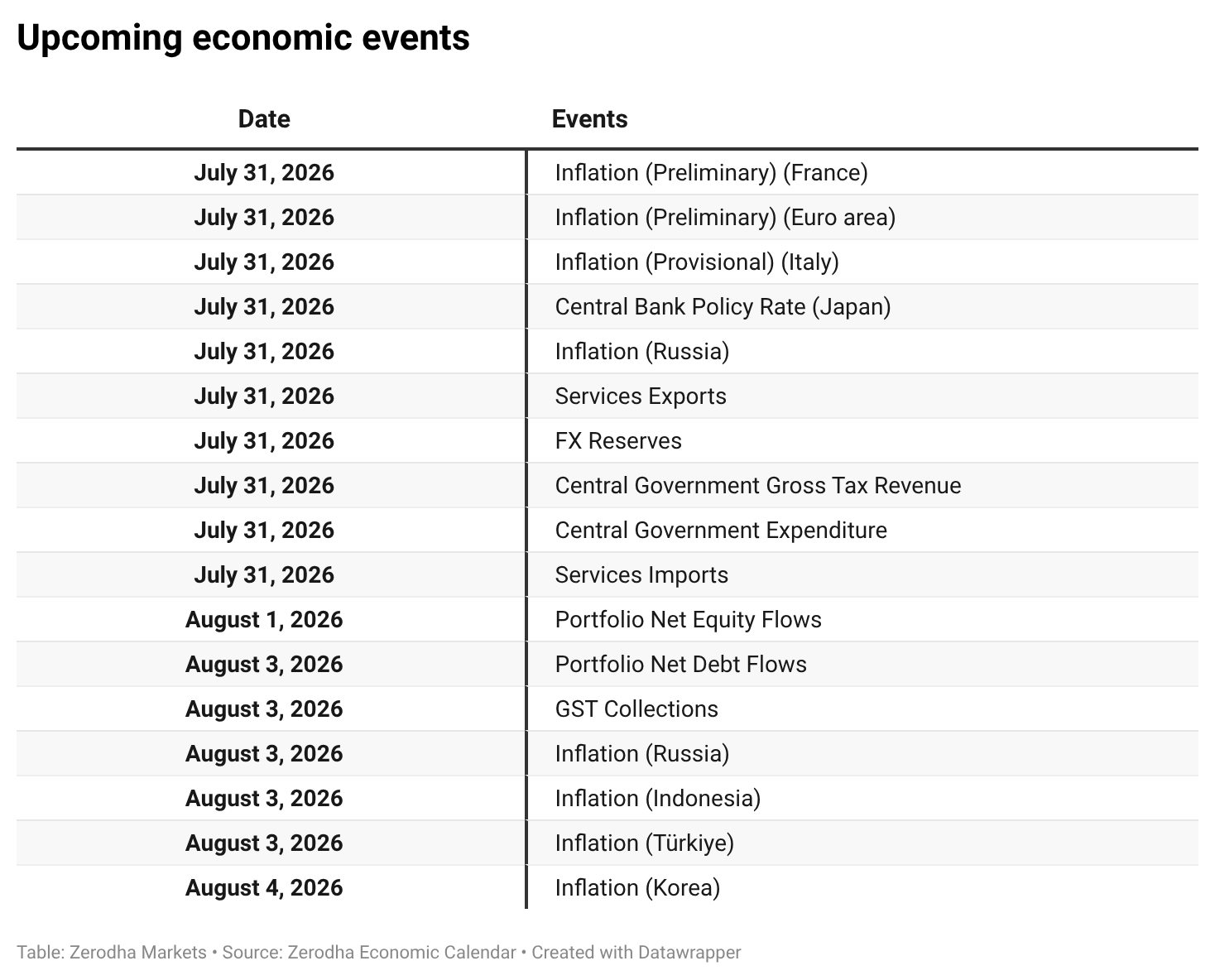
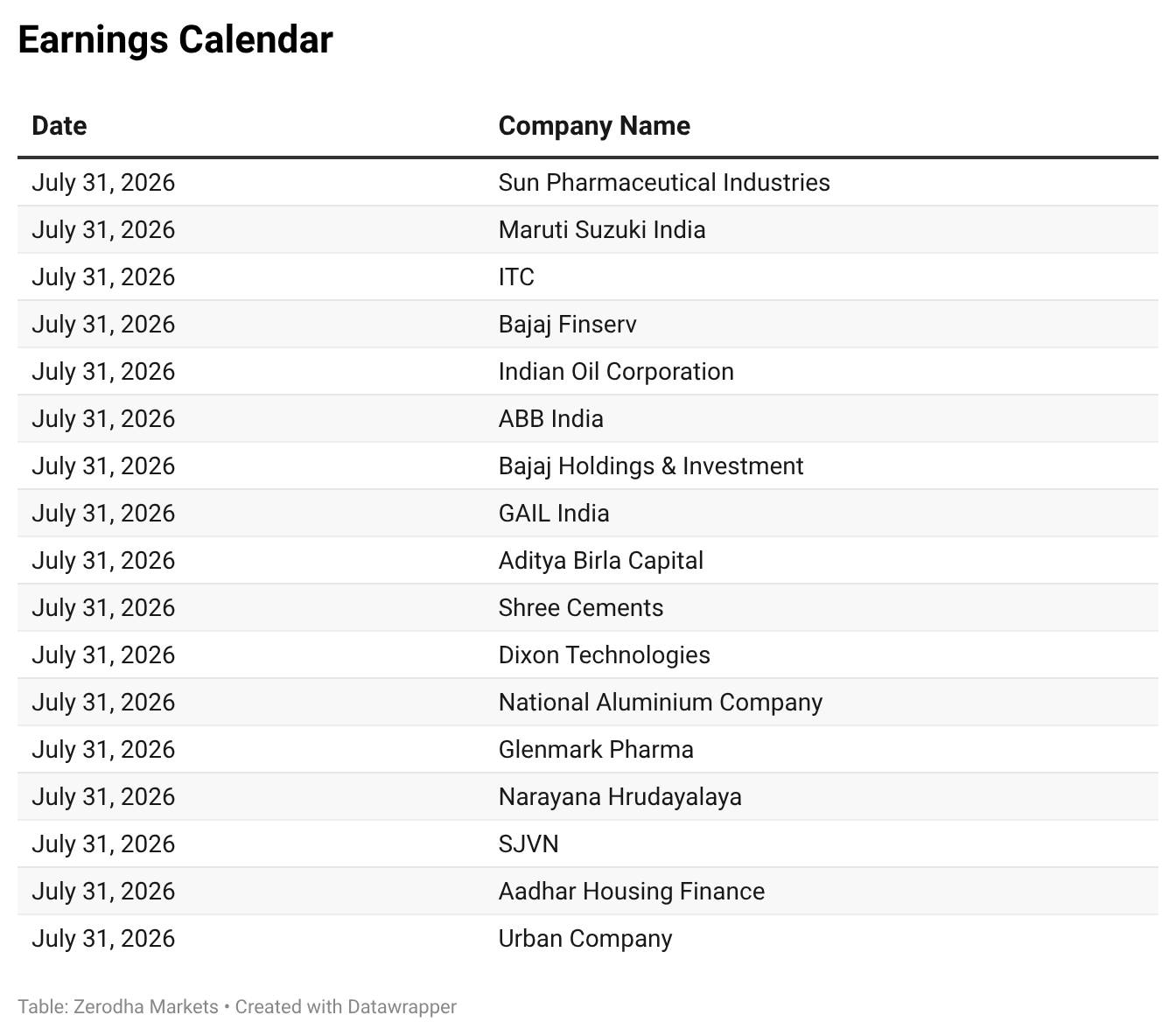
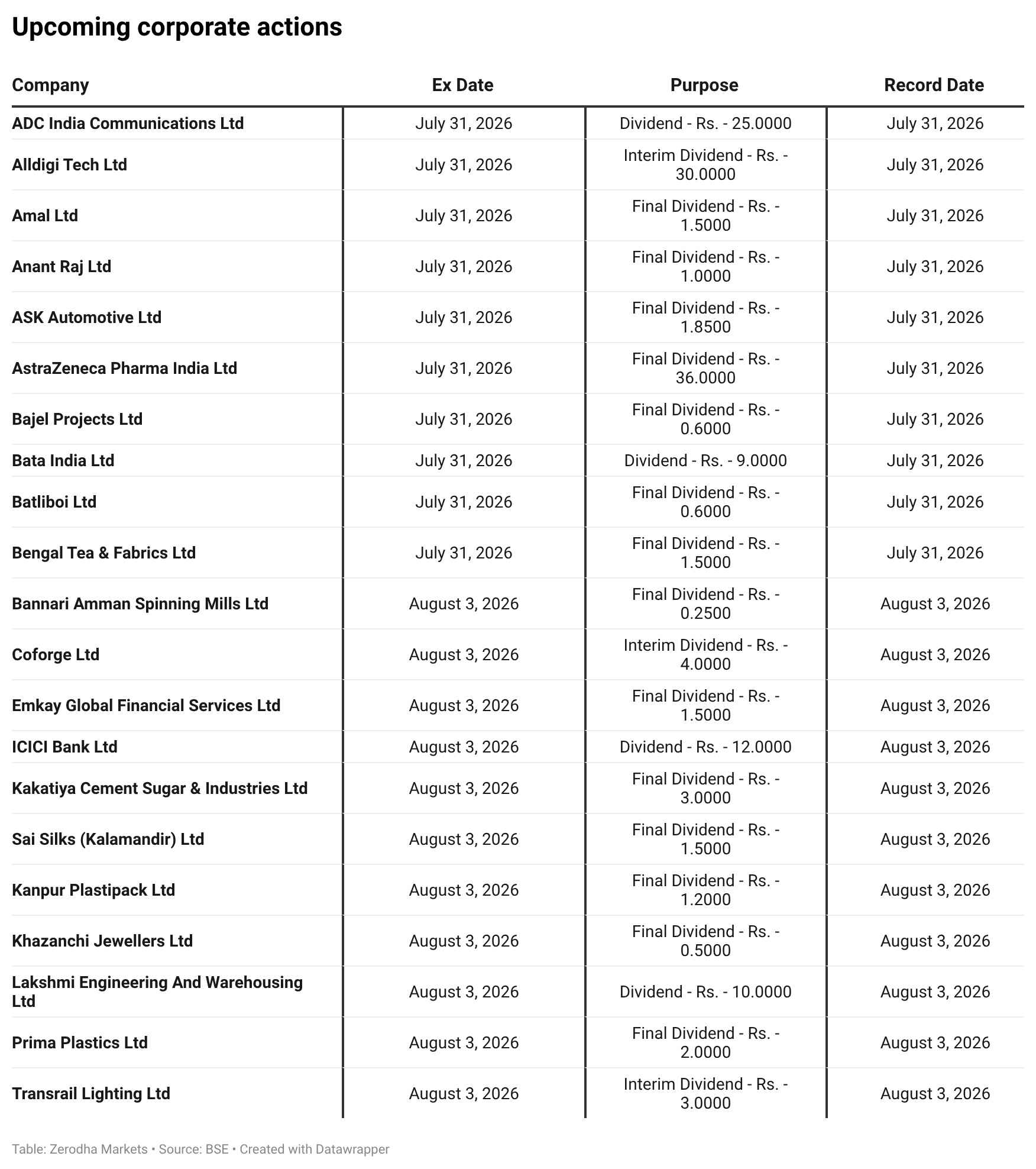
Corporate Actions
Published by Zerodha. Not investment advice. Data from NSE, BSE, and MCX.
That’s it from us for today. We’d love to hear your feedback in the comments, and feel free to share this with your friends to spread the word!
Damnnn, it is more than expected.