
Welcome to Aftermarket Report, a newsletter where we do a quick daily wrap-up of what happened in the markets, both in India and globally.
What data points and transformations do you want to see?
We’re trying out a new format for the Aftermarket Report, with much more comprehensive coverage of the data that shapes the trading day.
Beyond the headline indices, we’re now tracking market breadth, new highs and lows, sector and thematic performance, delivery data, F&O positioning, global markets, commodities, flows, and more. We’re also looking at ways to transform this raw data into insights that are actually useful for traders and investors.
The idea is simple: bring different datasets together in one place to give you a clearer picture of what’s happening beneath the surface of the market.
This is still a work in progress, and we’d love your feedback. What data points are we missing? What transformations, ratios, comparisons, or indicators would you find useful? Also tell us what worked, what didn’t, and what felt unnecessary.
Your feedback will help shape the Aftermarket Report from here.
Markets Today
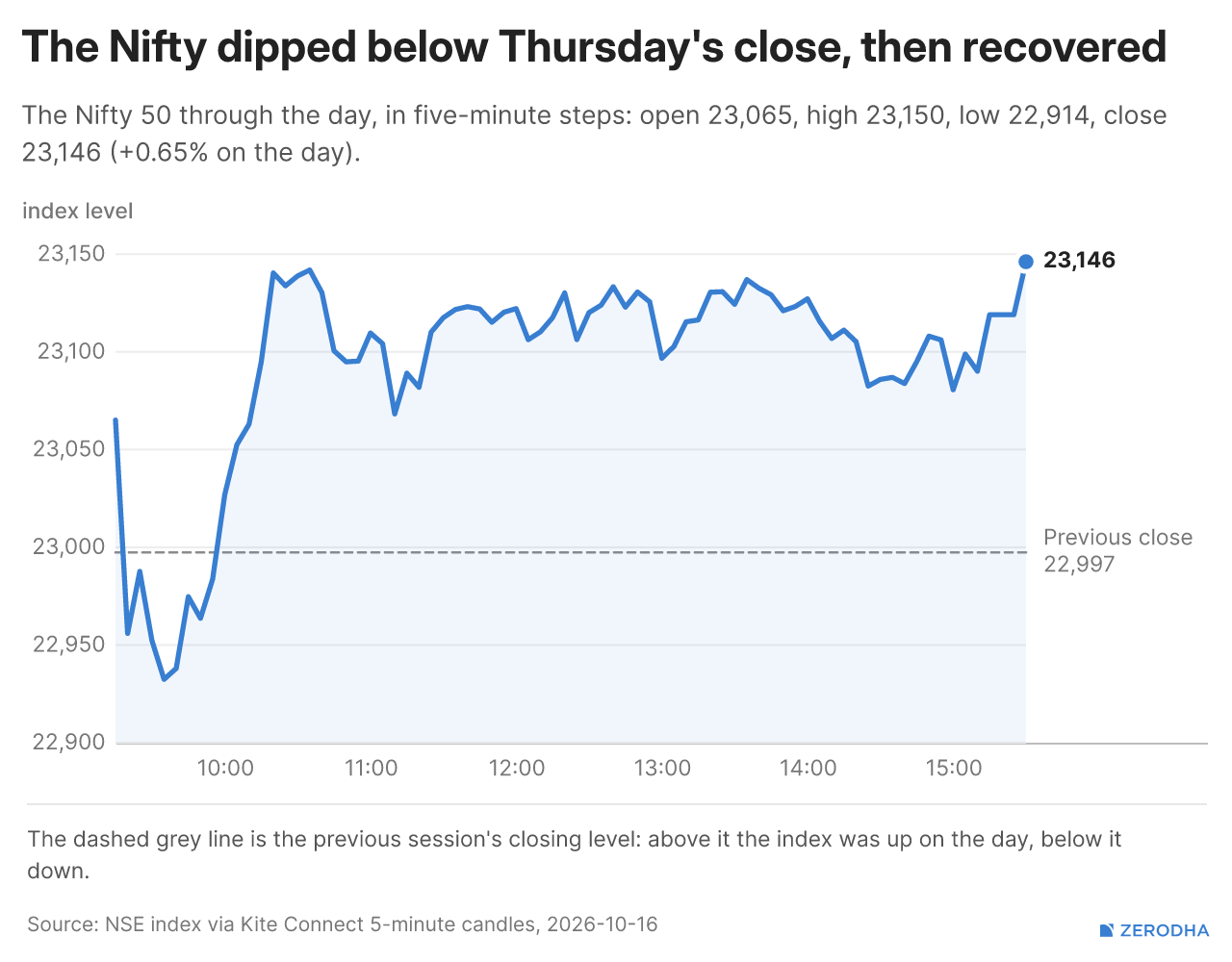
Nifty opened with a 68-point gap up at 23,065, extending the previous session’s positive momentum despite mixed global cues and a spike in oil prices. However, the index came under immediate selling pressure, slipping sharply below 23,000 within the opening minutes and towards 22,920 by 9:40 AM.
Buying emerged from the lows, triggering a strong recovery that pushed Nifty back above 23,000 around 10 AM and towards 23,140 by 10:15 AM. The rally lost some momentum after 10:30 AM, with Nifty slipping towards 23,075 around 11:15 AM before recovering again to trade near 23,125 by noon.
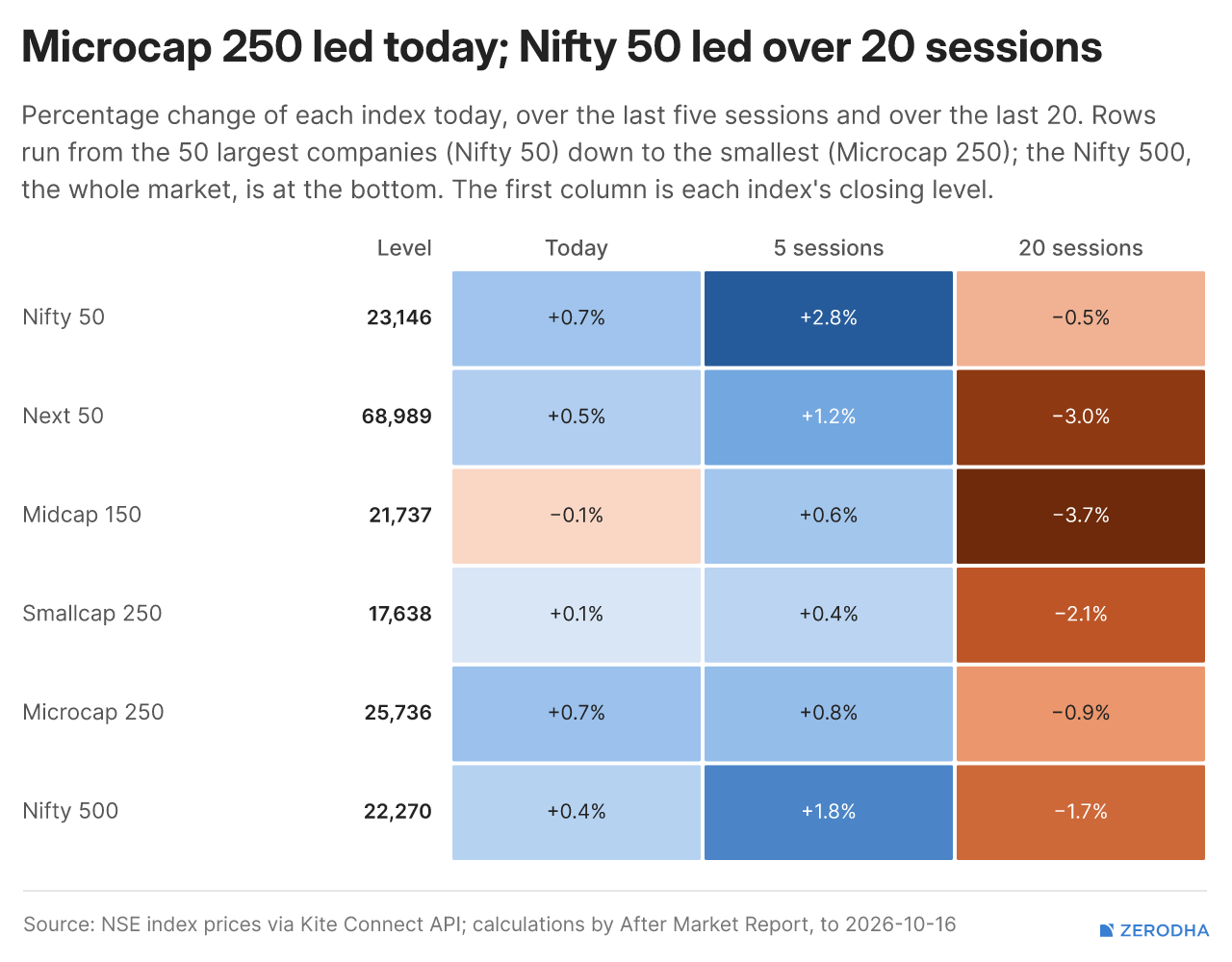
The second half remained largely range-bound, with Nifty oscillating between 23,100 and 23,140 through much of the early afternoon as buying momentum struggled to sustain at higher levels. Selling pressure picked up after 2 PM, dragging the index below 23,100 and towards 23,080 by 2:20 PM. Despite a brief recovery attempt, Nifty remained volatile through the final hour. However, buying interest returned in the closing minutes, helping the index reclaim 23,125 and move towards the day’s highs. Nifty eventually closed at 23,146.15, about 80 points above its open, marking a second consecutive positive session and ending the week on a strong note despite the uncertain global backdrop.
Fear & Greed Index
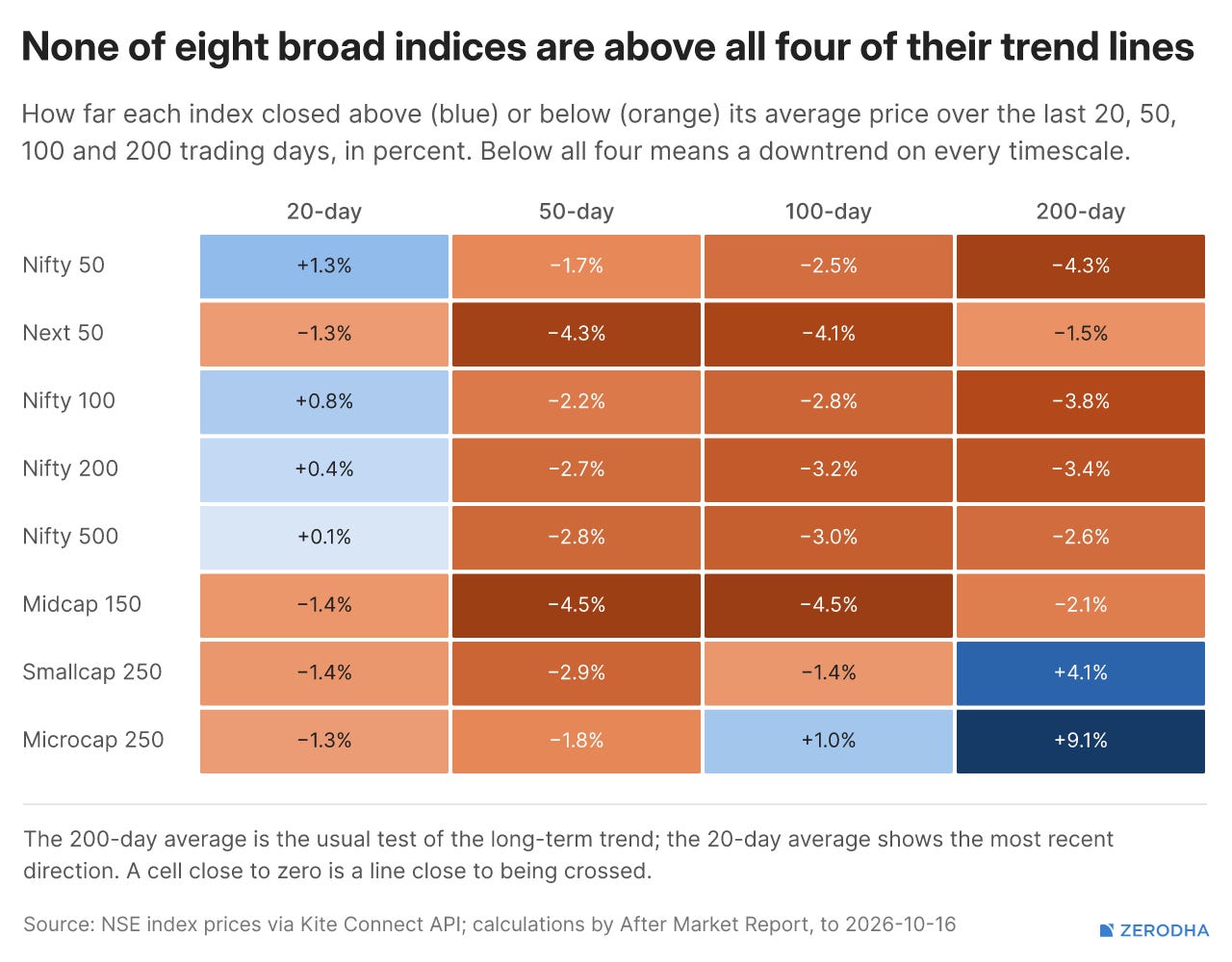
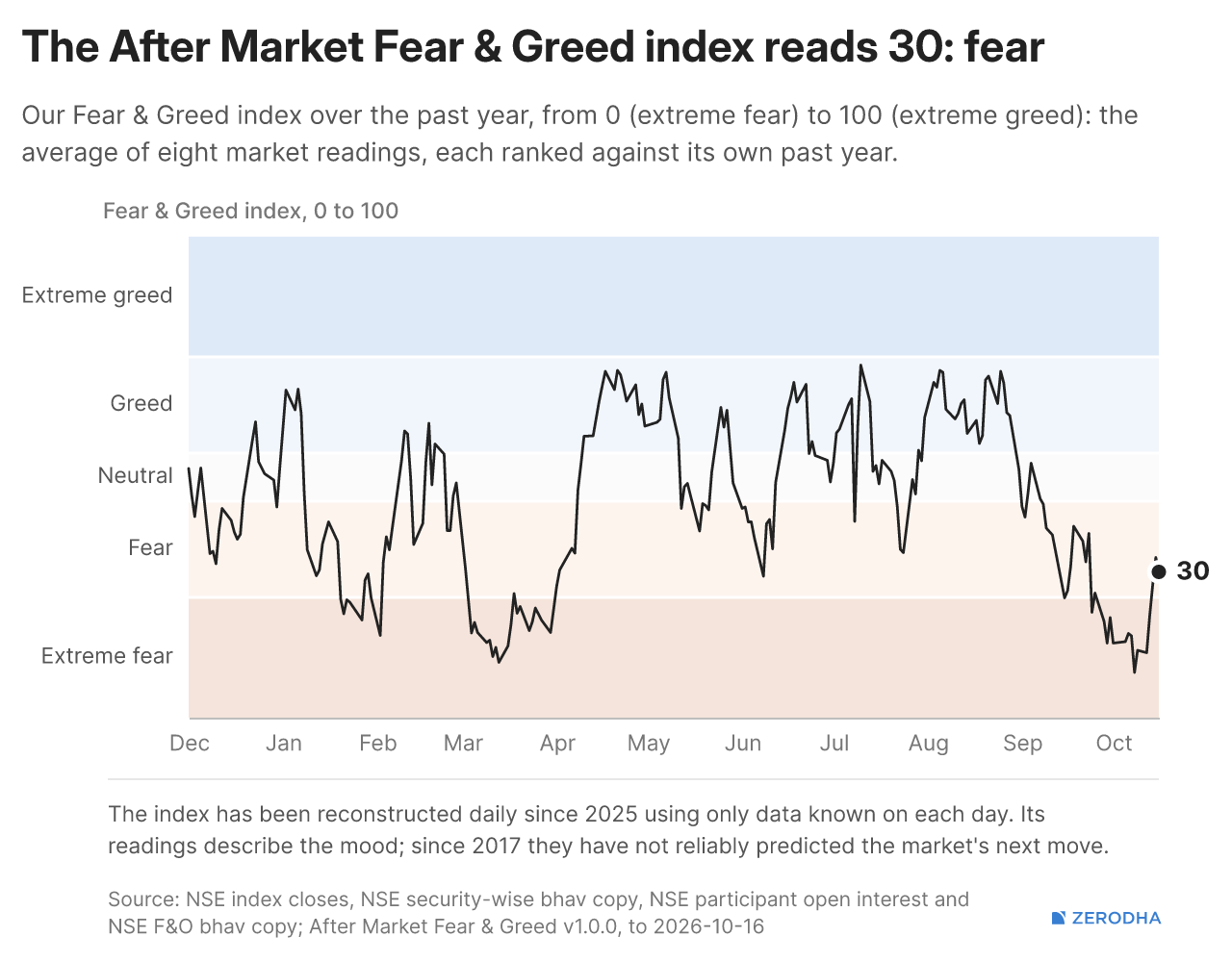
The Fear & Greed Index slipped from 33 to 30, remaining in the fear zone. Despite the market’s gains, weak underlying trends, elevated volatility, and defensive stocks outperforming high-beta stocks continue to reflect cautious sentiment.
Market Breadth
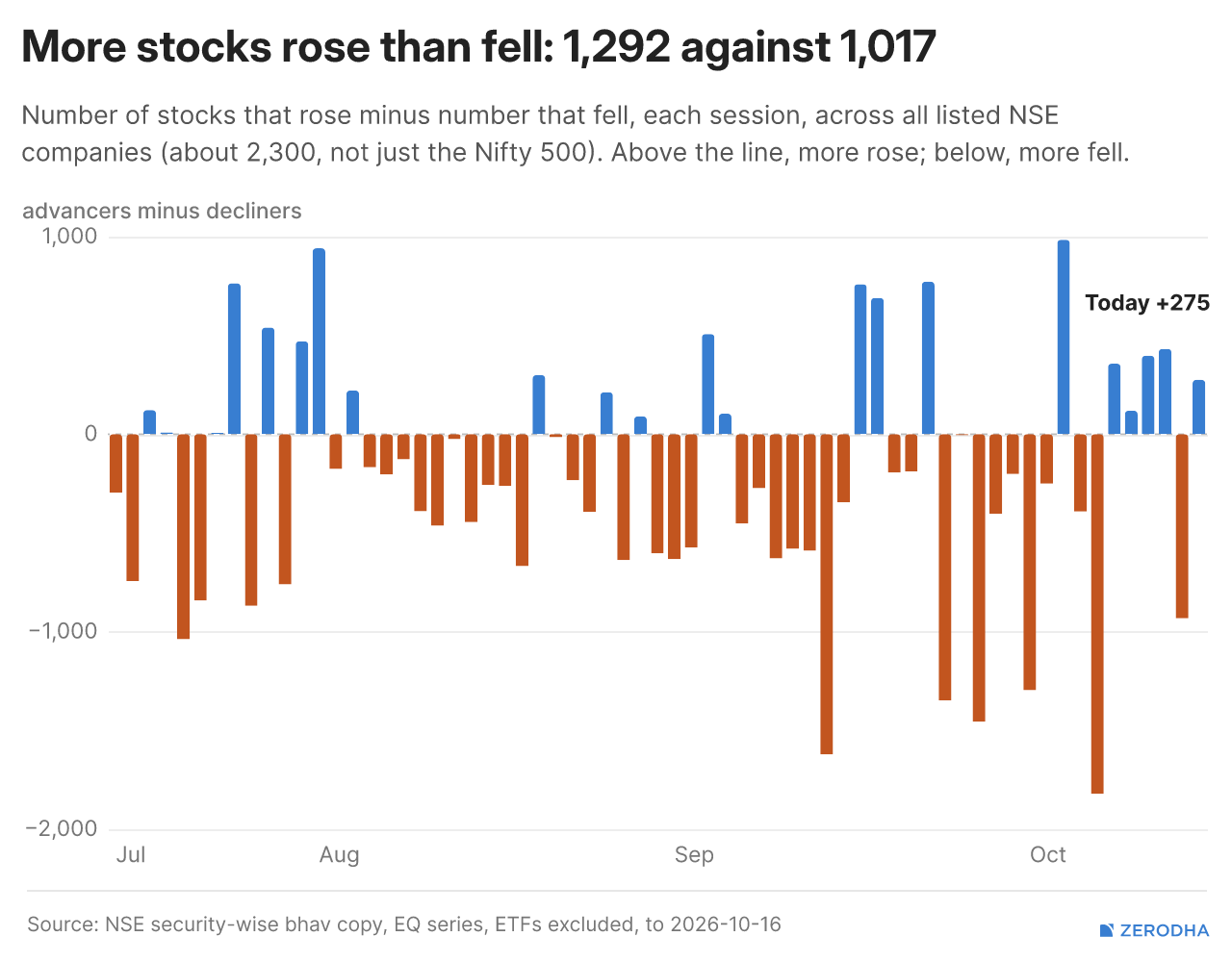
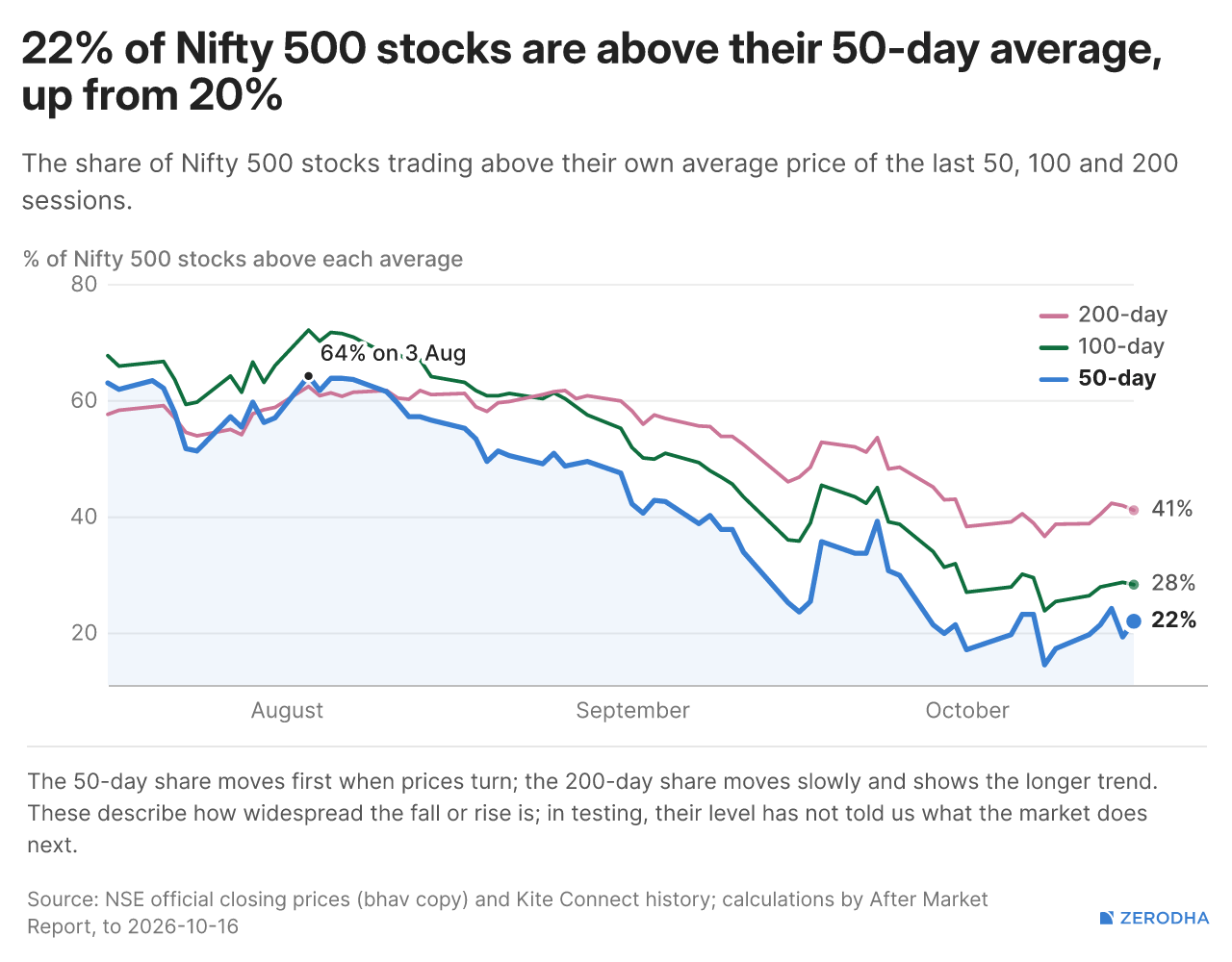
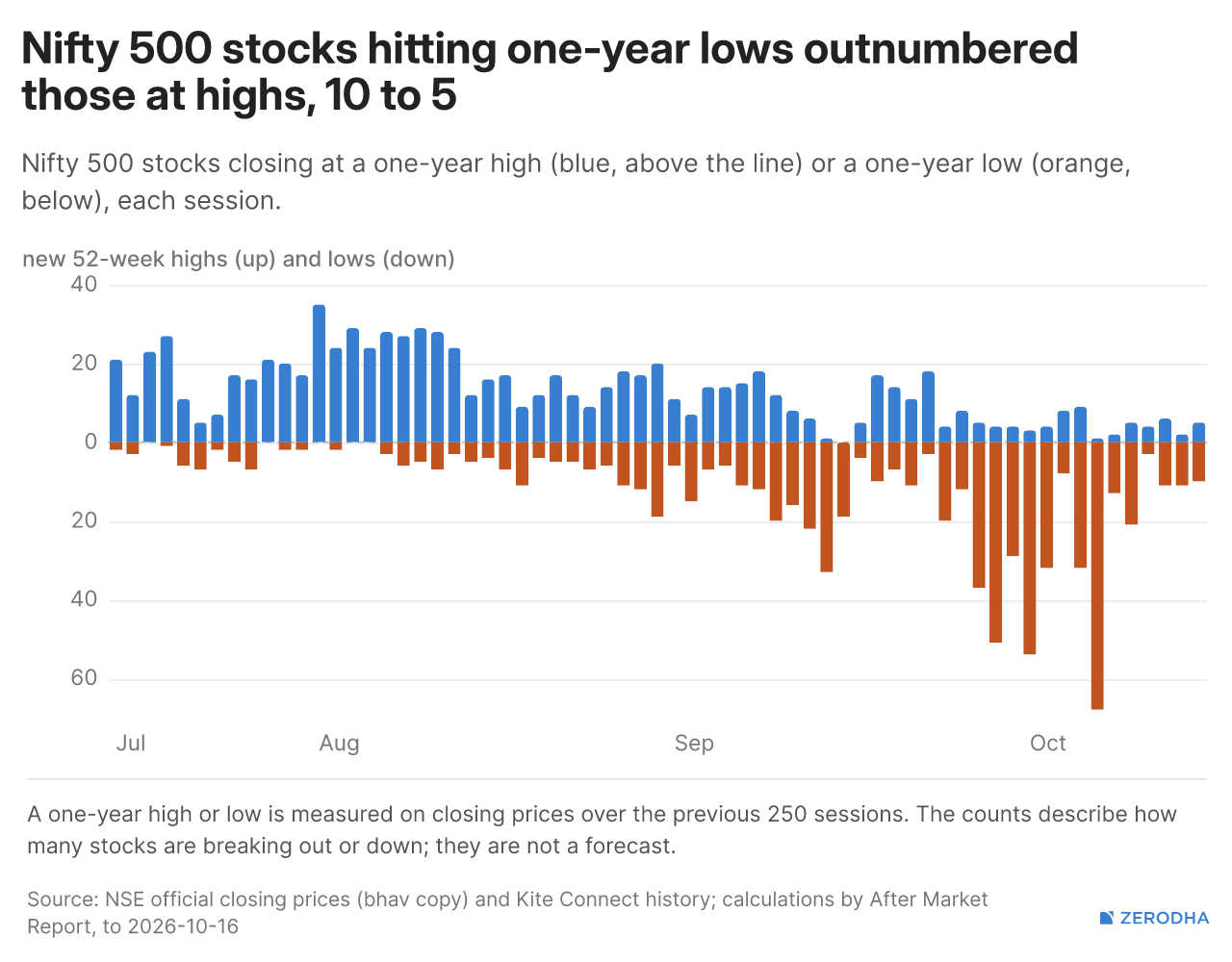
Market breadth was positive, with 1,292 advancers against 1,017 decliners, although heavyweight stocks continued to drive much of the gains. Only 22.1% of Nifty 500 stocks are above their 50-day average, while 10 stocks hit fresh 52-week lows against five new highs.
52 Week Highs & Lows
Valuation Check
Sectoral Indices Performance
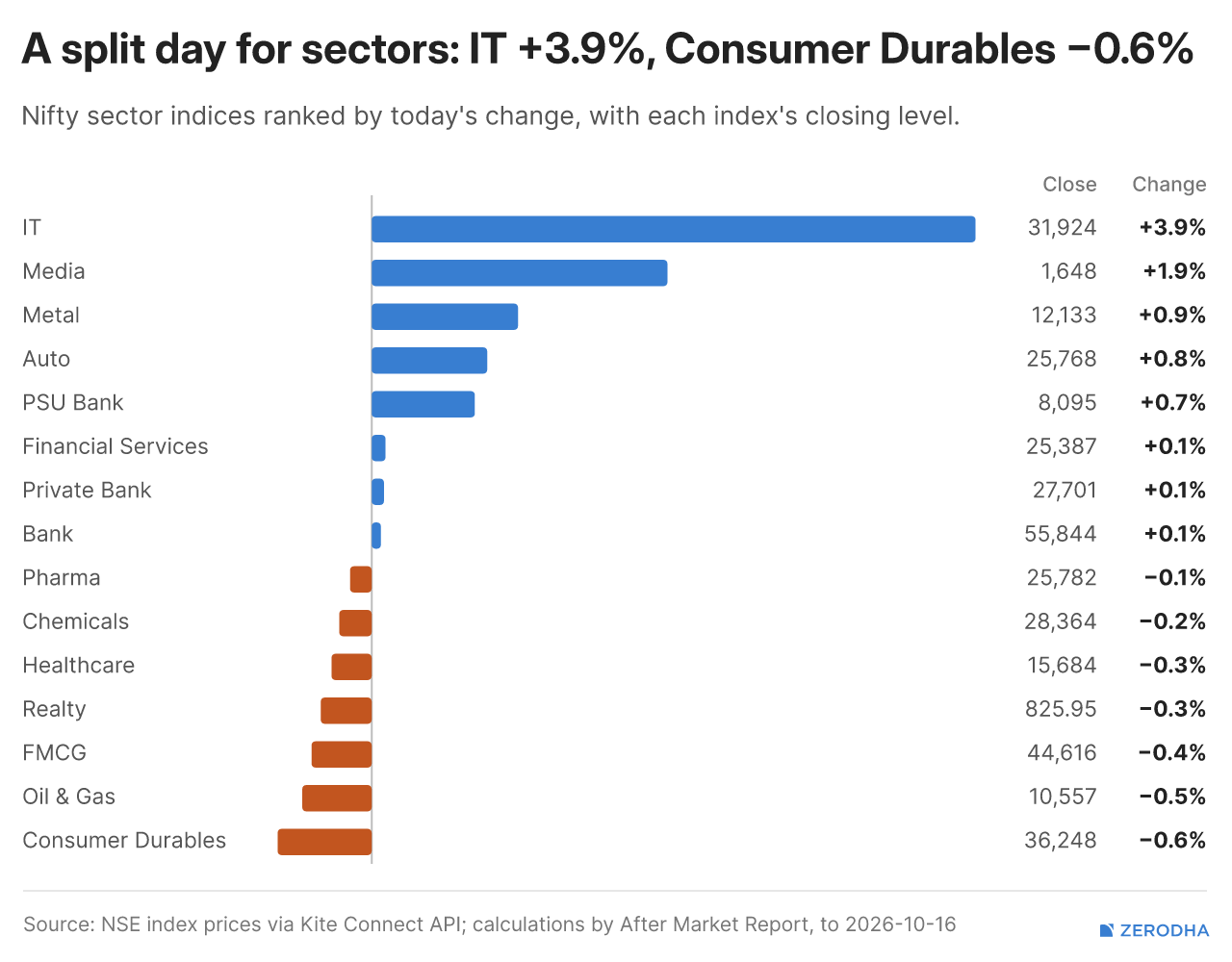
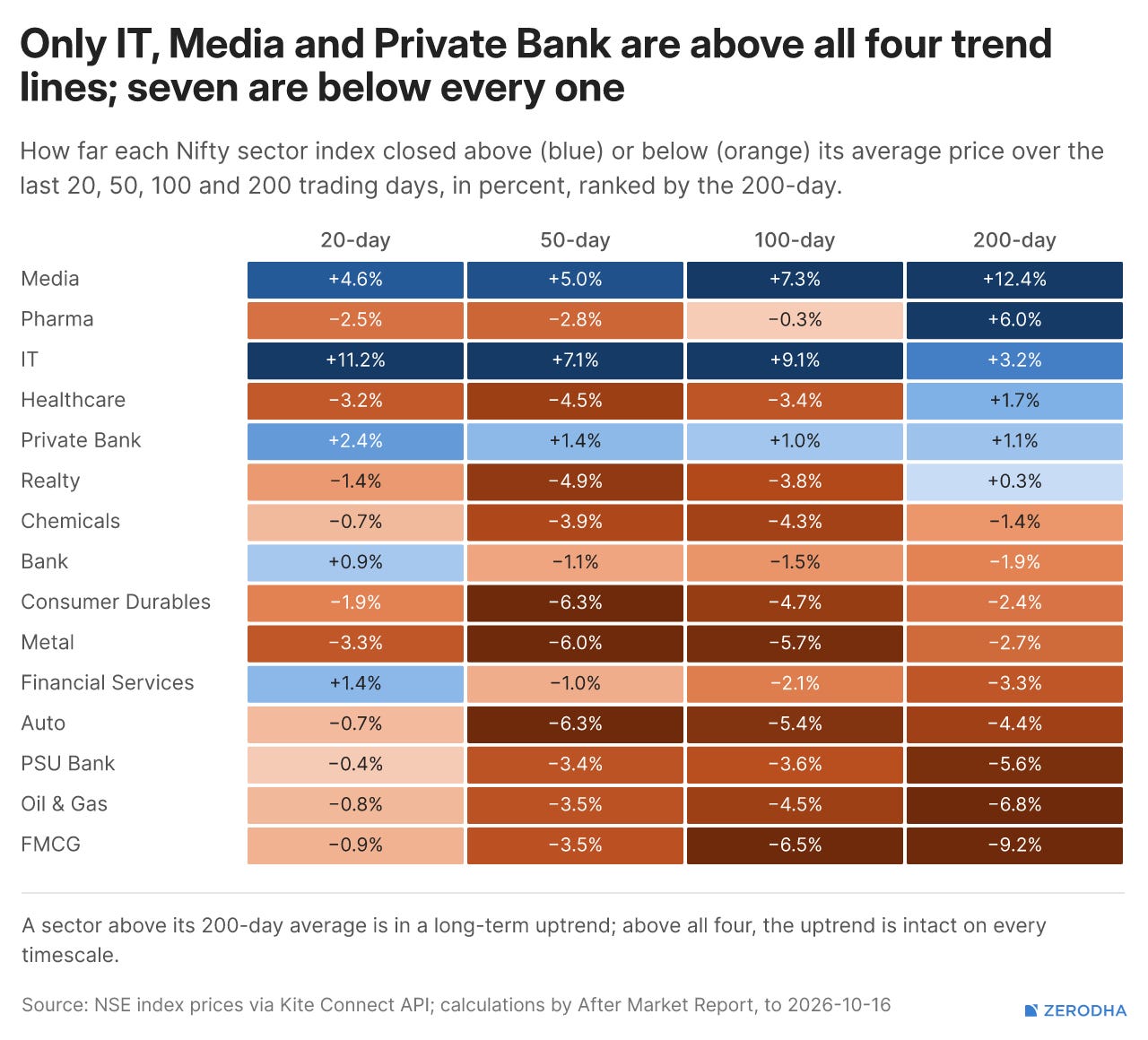
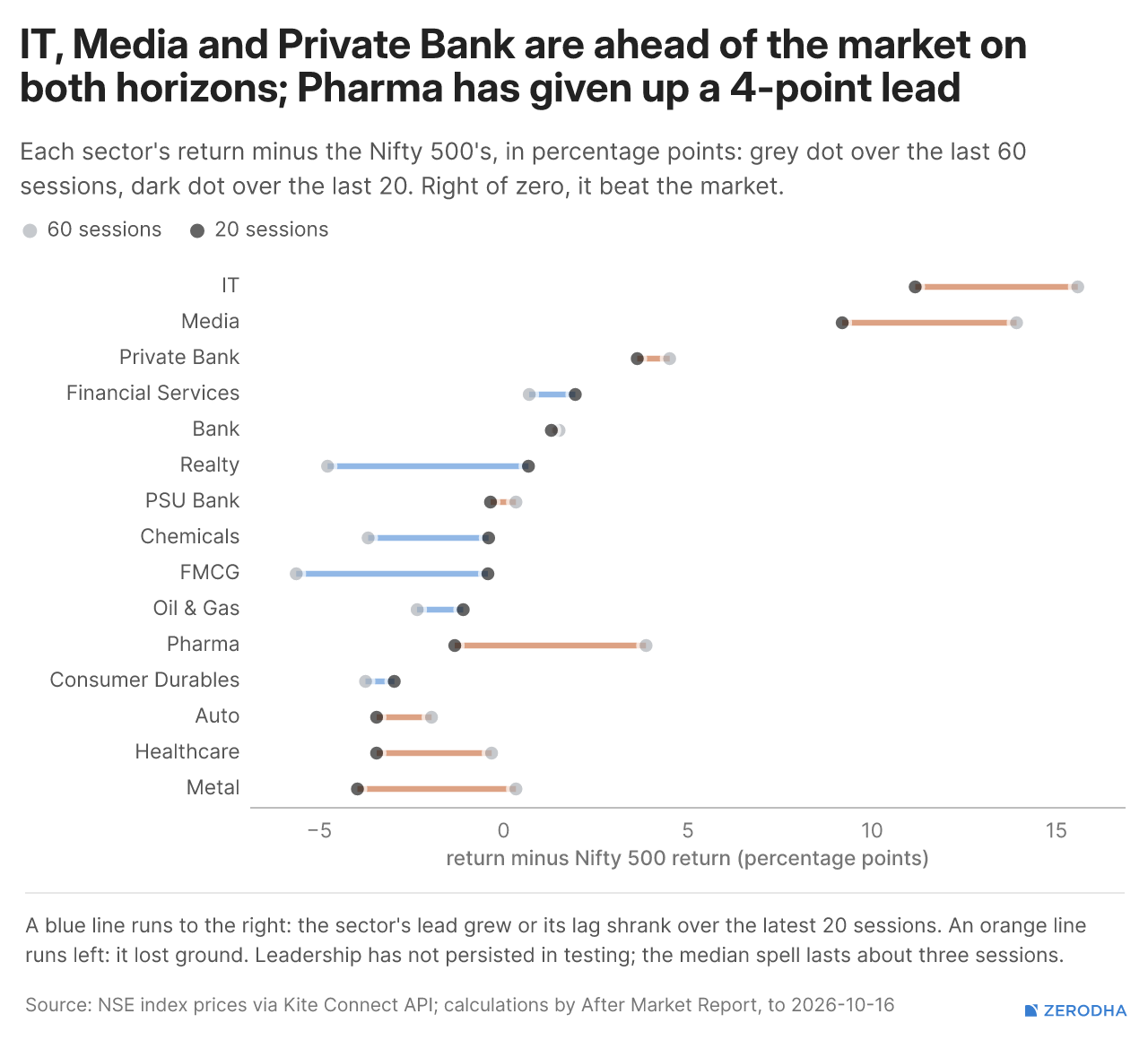
IT surged 3.92%, leading gains across eight of 15 sectors, while Consumer Durables fell 0.61%. IT, Media and Private Banks remain the relative leaders over 20 and 60 sessions, with all three sectors now trading above their four key moving averages.
Winners & Losers
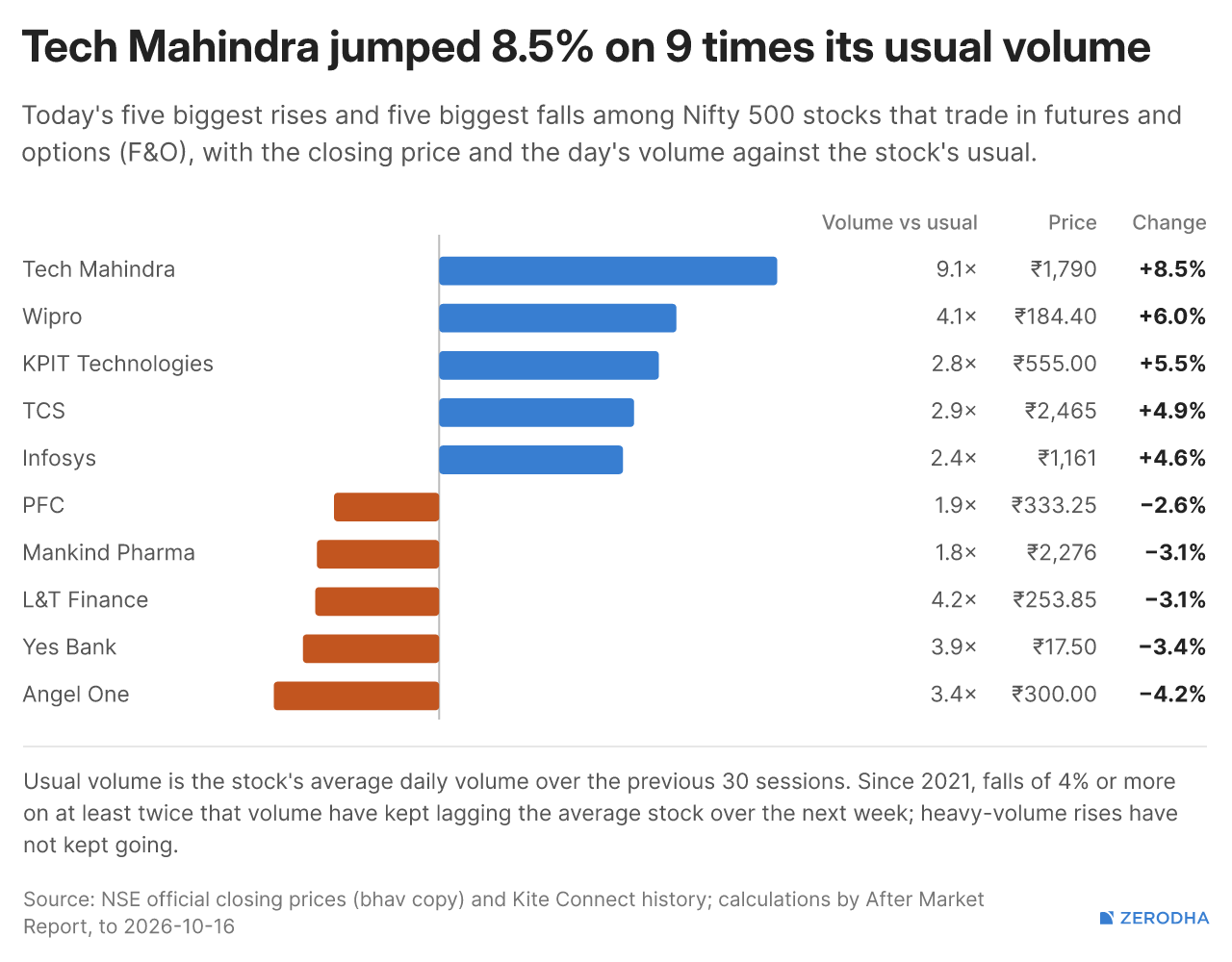
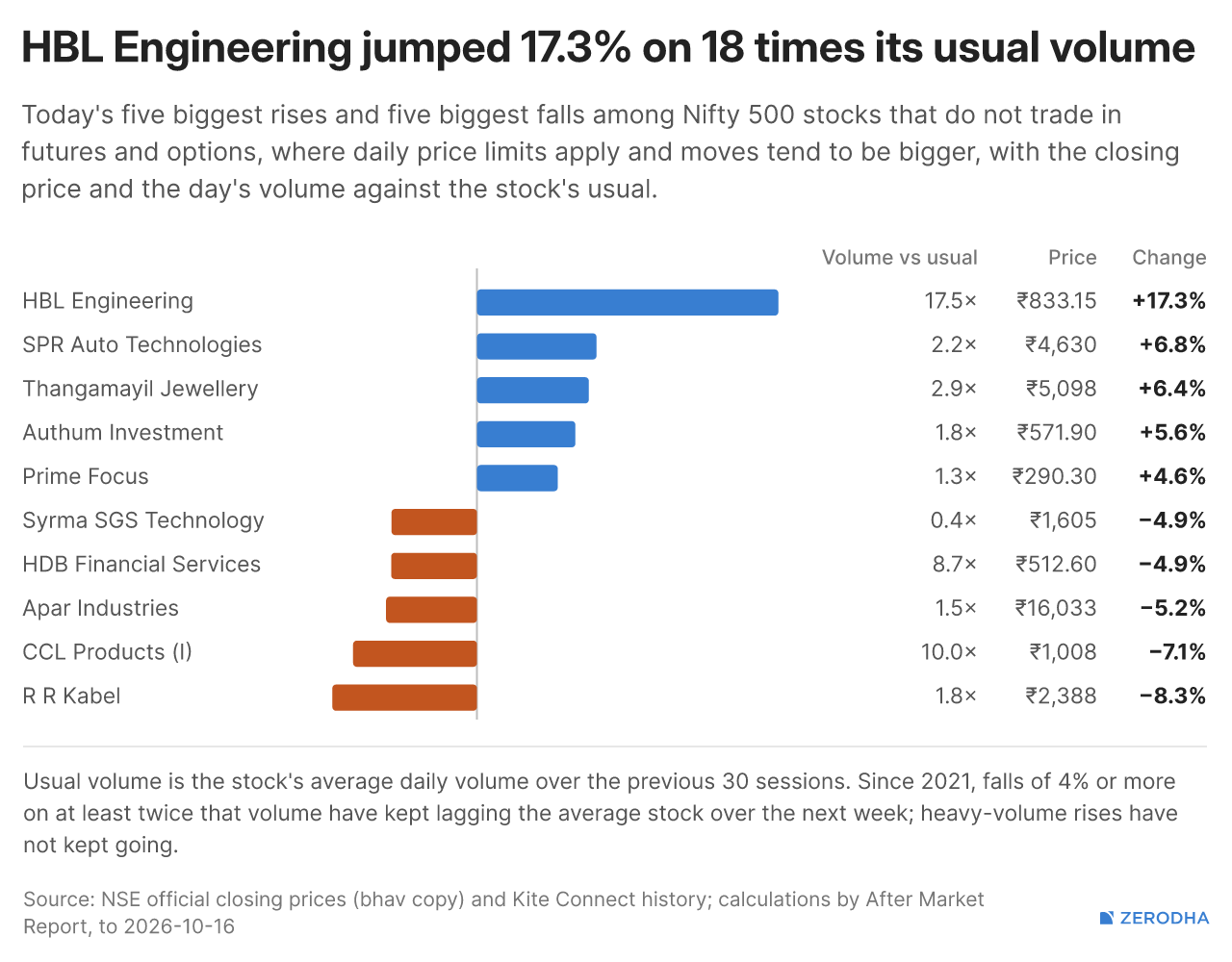
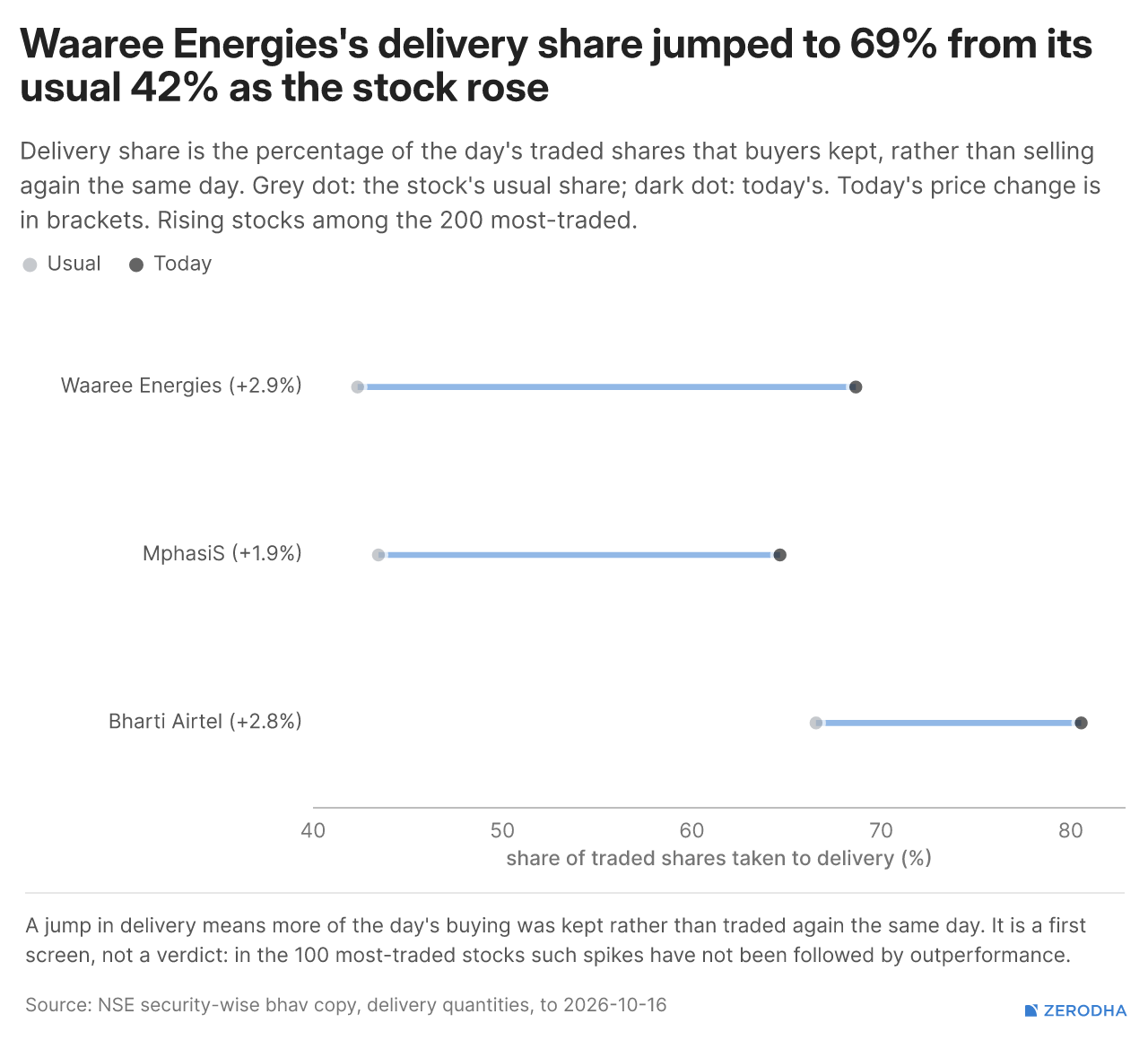
HBL Engineering jumped 17.27% on nearly 18× usual volume, while Tech Mahindra surged 8.48% on heavy trading and hit a fresh 52-week high. Angel One led F&O losers with a 4.15% decline, while Waaree Energies recorded a sharp delivery spike.
Delivery Data
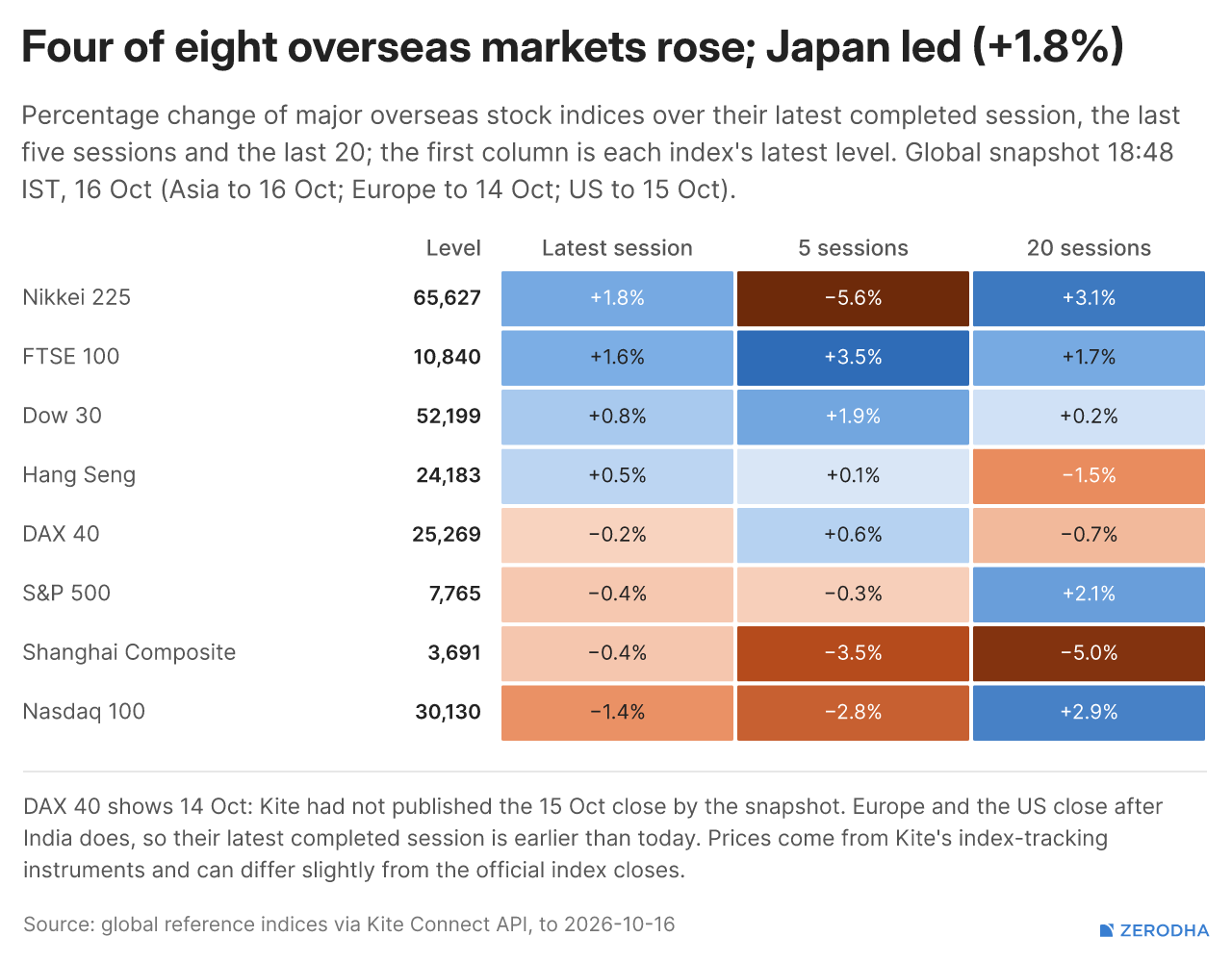
Global Markets
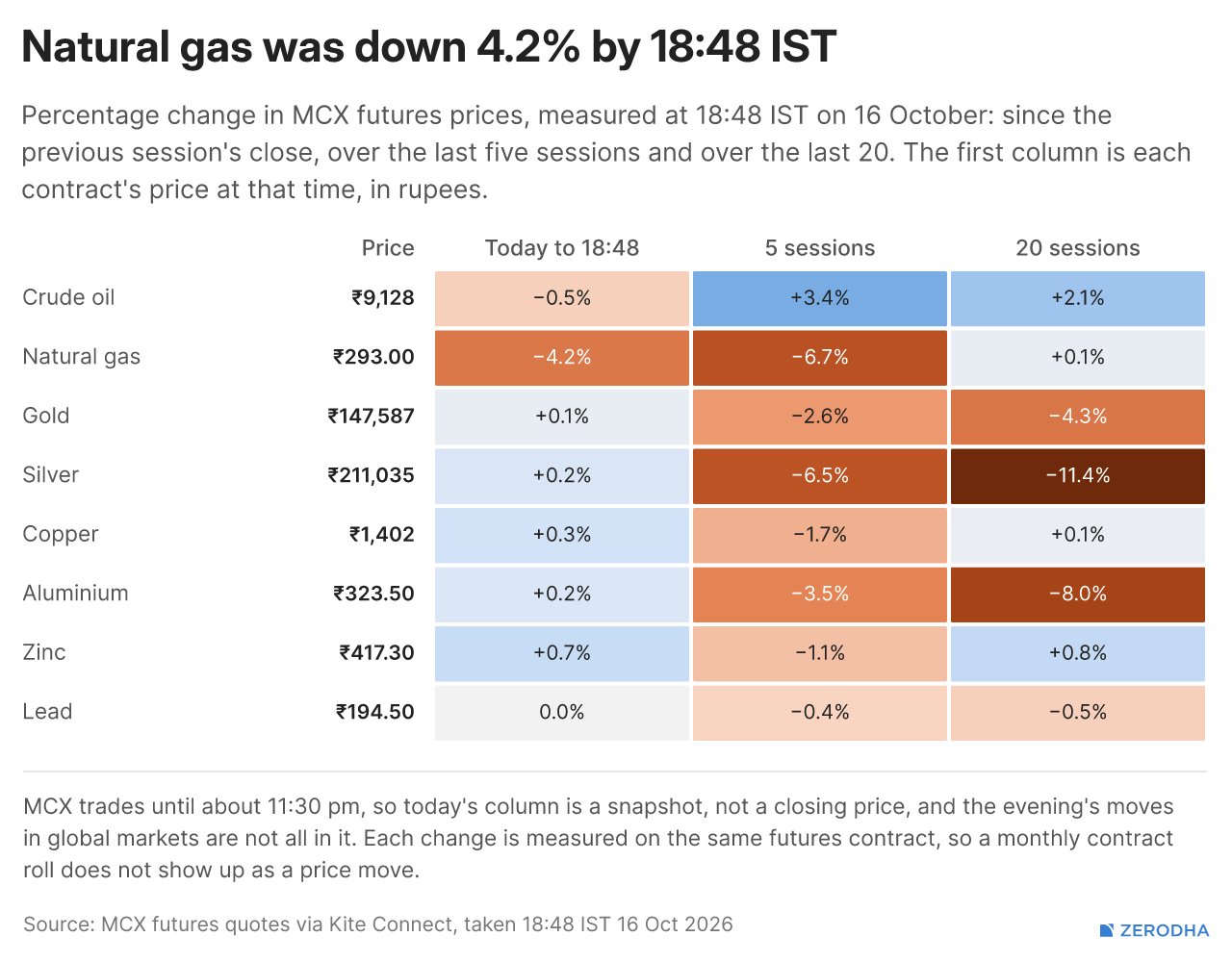
Commodities
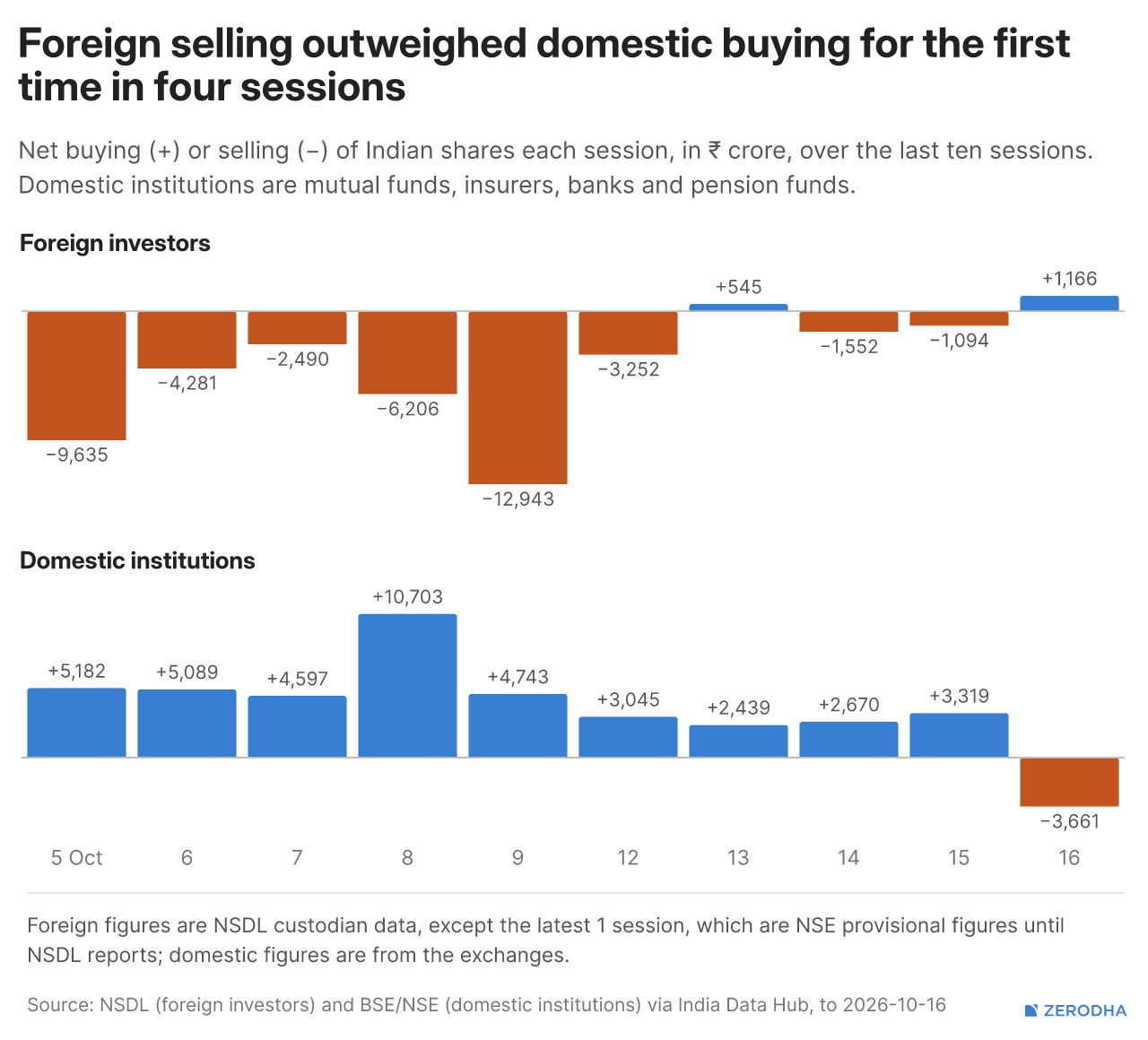
Institutional Flows & Participant Positioning
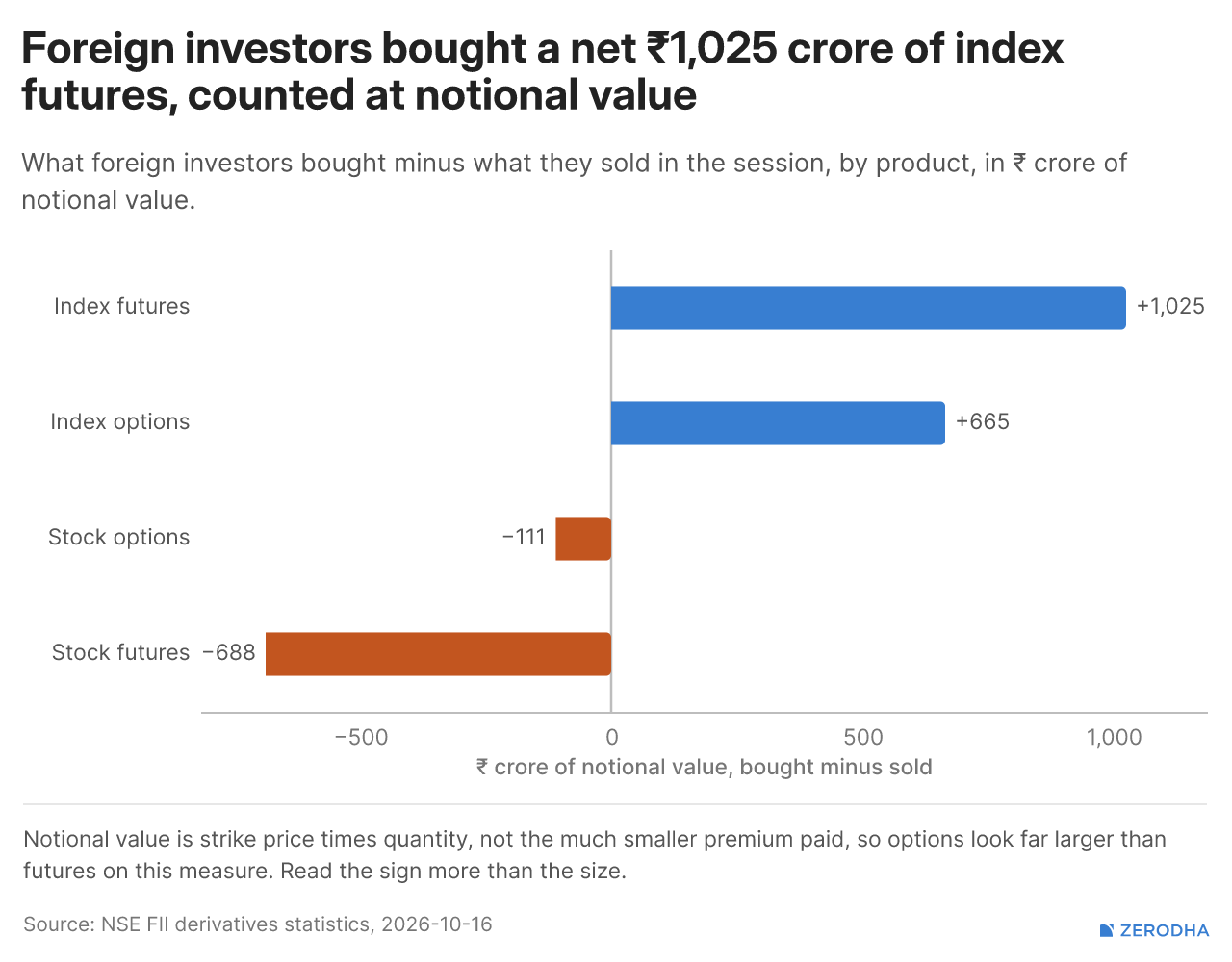
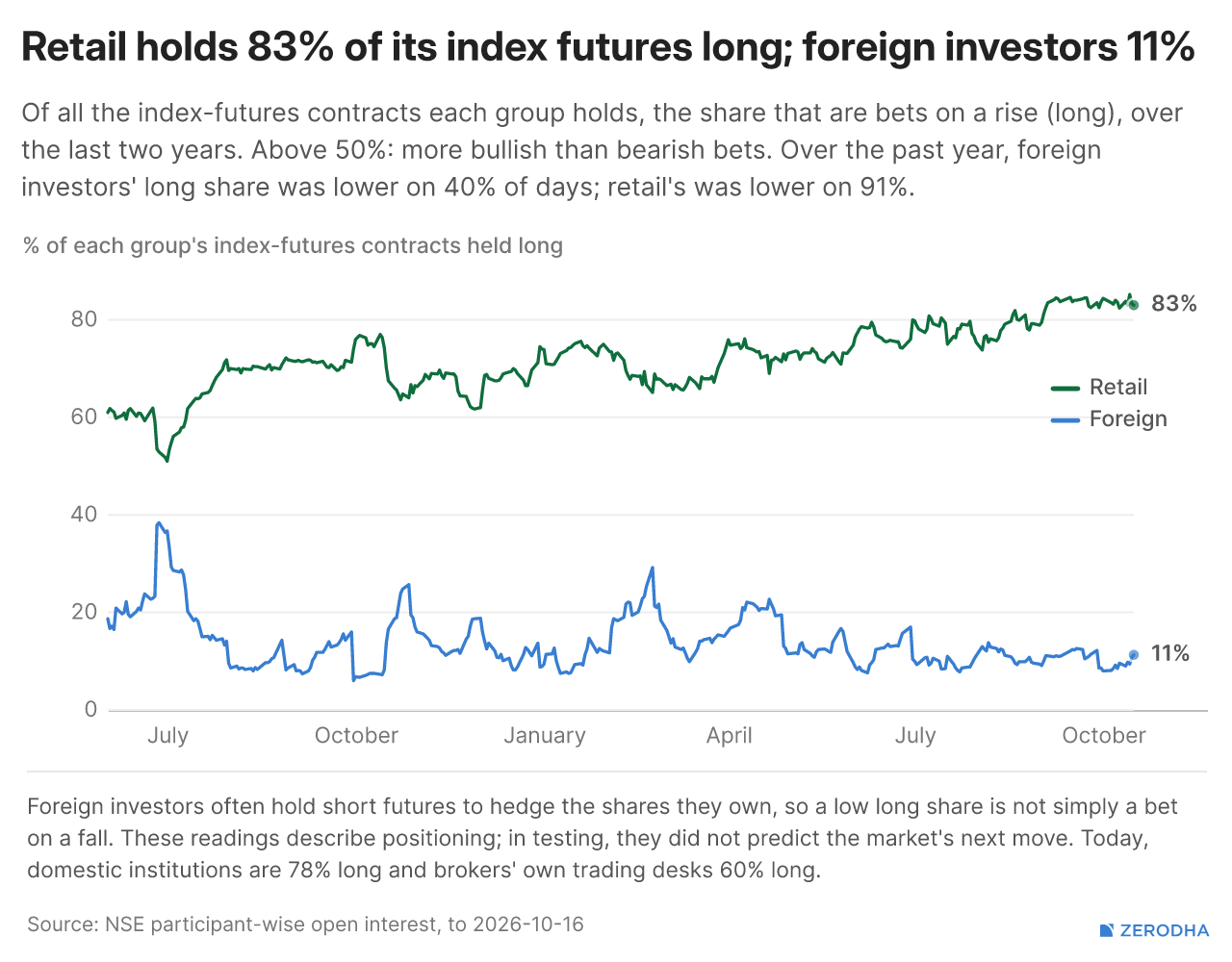
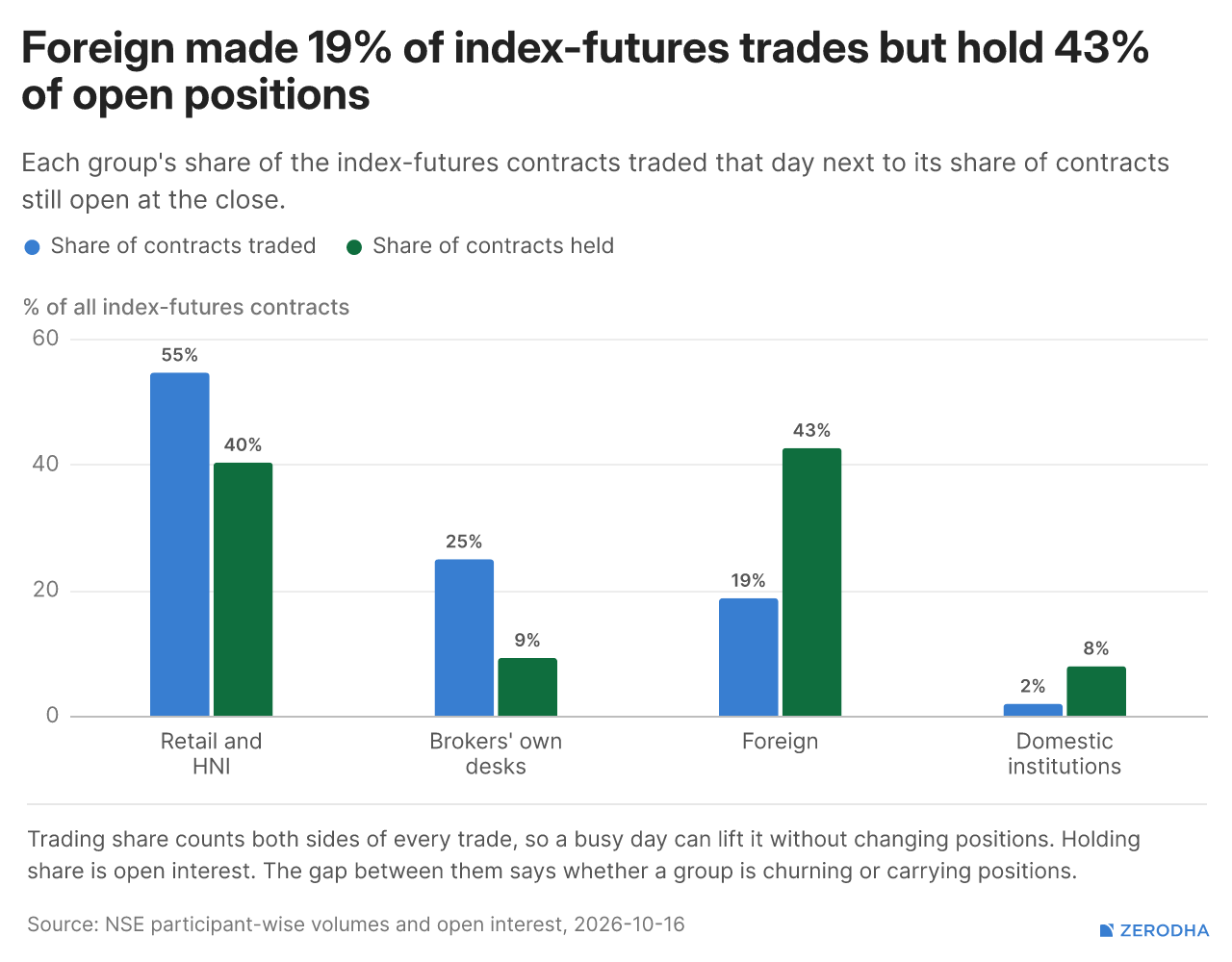
Call writing picked up, pulling the PCR down from 1.37 to 1.21, while implied volatility fell from 12% to 10.8%. FIIs increased their index-futures long ratio to 11.3% and bought a net 6,828 contracts, while retail and HNIs remained heavily long at 83%.
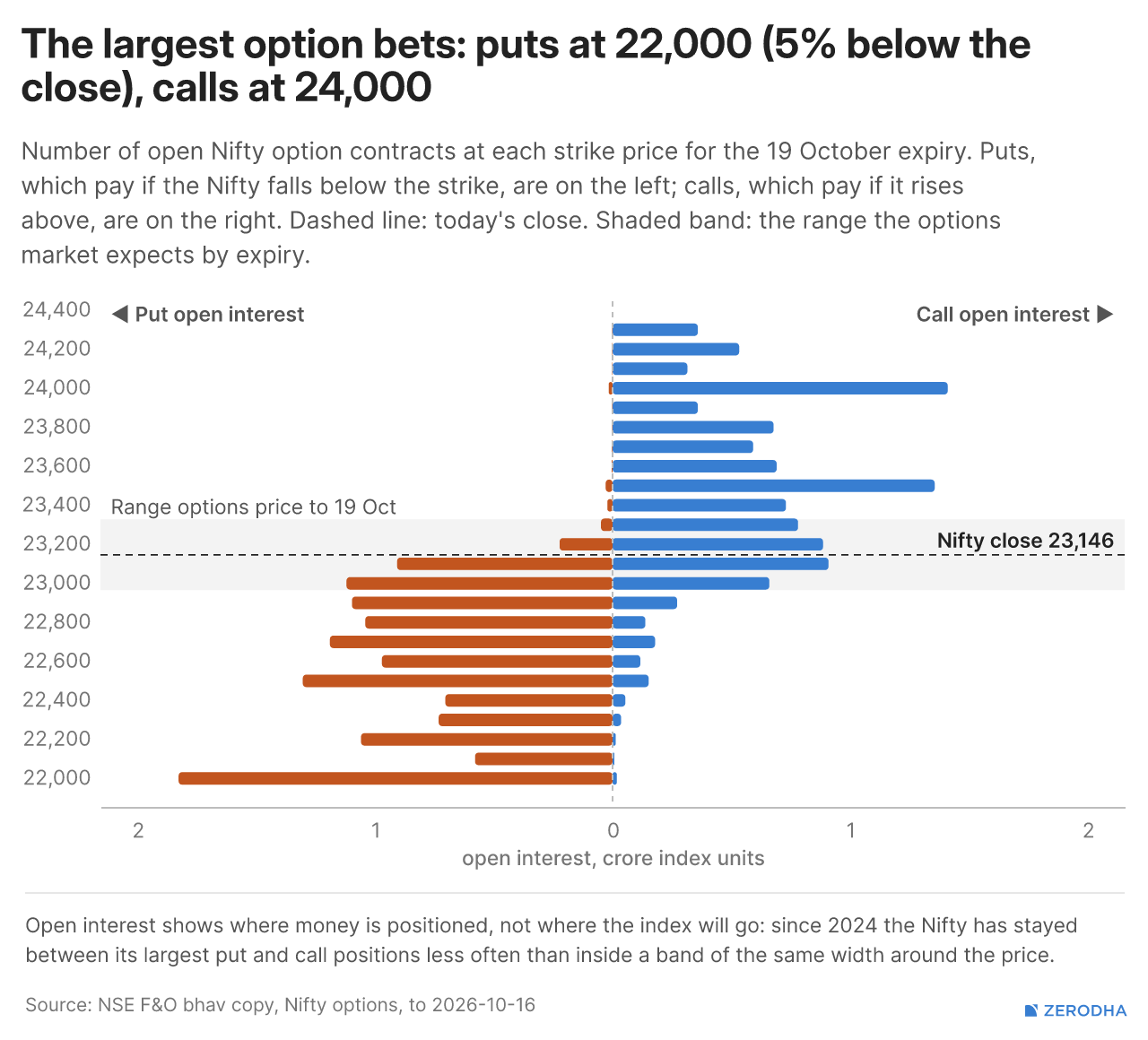
Options imply a 22,922–23,285 range into October 19 expiry, with the heaviest put OI at 22,000 and call OI at 24,000. The 50-day moving average at 23,549 remains the next major trend hurdle.
Thematic Indices
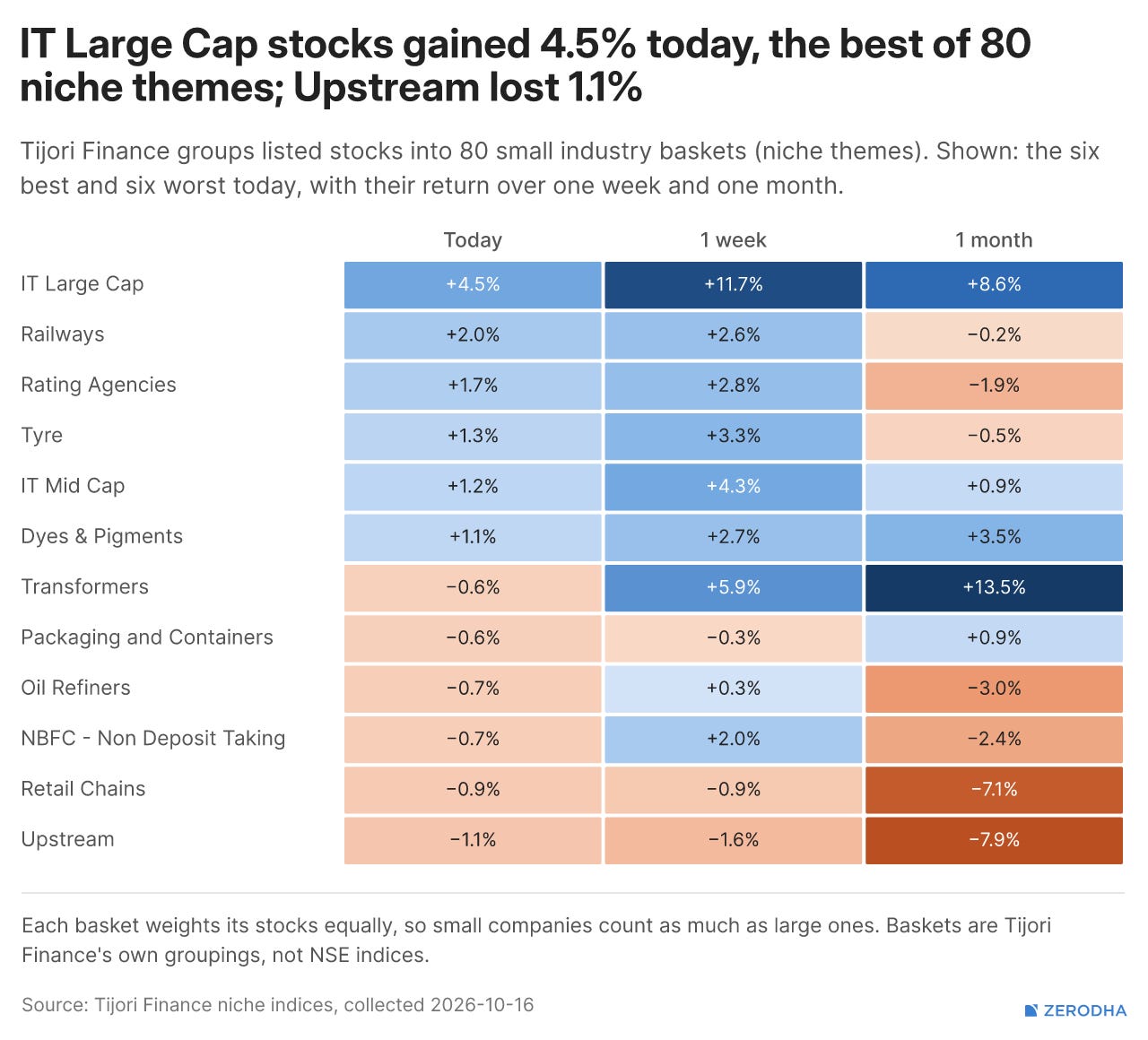
Tijori’s niche indices, where today’s move sorts pockets of the market beyond standard sector baskets. You can also track promoter buying and other interesting stuff, like Capex activity by the companies in the Tijori App’s idea dashboard
F&O Corner
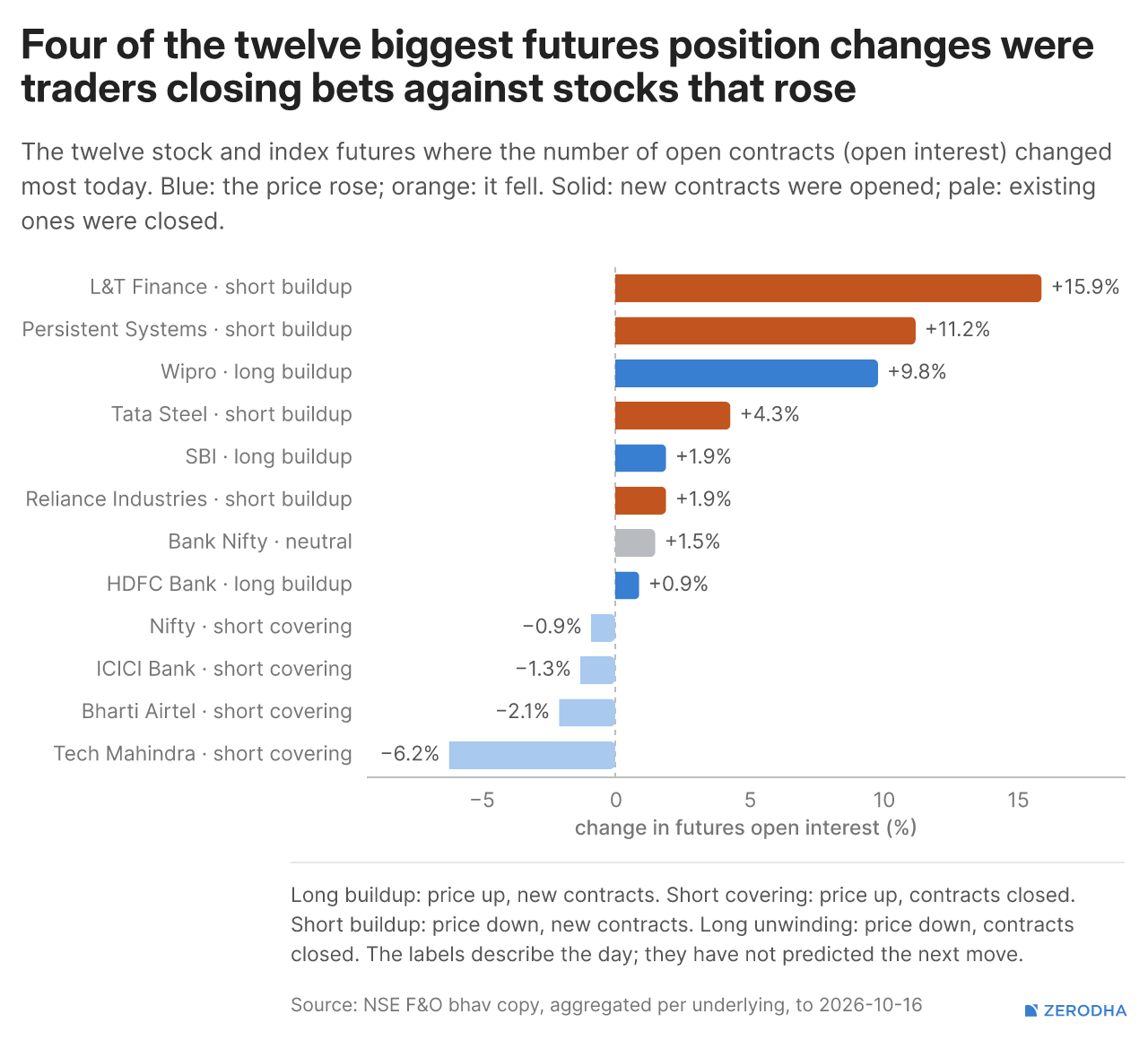

Top Stories in India
India received 76.86 cm of rainfall between June 4 and October 15, around 15% below the long-period average of 90.63 cm, according to IMD data. The significant rainfall deficit highlights a weaker-than-normal southwest monsoon season. Dive deeper
DLF reported a 10% YoY rise in consolidated net profit to ₹1,301 crore in Q2 FY27, compared to ₹1,180 crore last year. Total income increased marginally to ₹2,297 crore from ₹2,262 crore. Dive deeper
Punjab National Bank reported a 13% YoY rise in net profit to ₹5,532 crore in Q2 FY27, while total income increased 5.4% to ₹38,185 crore. Interest income grew 8.5% to ₹34,585 crore, while asset quality improved, with gross NPA declining to 2.55% from 3.45% a year ago. Dive deeper
Reliance Industries pushed back against Elon Musk’s criticism over delays in Starlink’s India entry, clarifying that Jio’s satellite services are also awaiting government approvals. The company maintained that it has never feared competition and sought to set the record straight. Dive deeper
India’s foreign exchange reserves declined by $8.58 billion to $726.03 billion for the week ended October 9, marking another consecutive weekly fall. Reserves have dropped nearly $60 billion from their September 4 record high of $785.71 billion. Dive deeper
Federal Bank posted its highest-ever quarterly net profit of ₹1,386 crore in Q2 FY27, up 45.1% YoY. Net interest income rose 26.4% to ₹3,153 crore, while net interest margin improved to 3.32%. Asset quality also strengthened, with gross and net NPAs reaching decade-low levels. Dive deeper
Top Stories Globally
Crude oil prices hovered around $98 per barrel, gaining over 6% during the week as escalating Middle East tensions raised supply concerns. The sinking of a container ship following an Iranian strike in the Strait of Hormuz added to uncertainty, despite some shipping traffic continuing through the waterway. Dive deeper
Indonesia’s benchmark stock index crashed 11.57%, its biggest single-day decline since 1998, after MSCI outlined plans to remove the country from its emerging-market indexes. The announcement triggered a sharp sell-off, while the rupiah briefly weakened to 18,070 against the dollar. Dive deeper
Global equity funds recorded $20.01 billion in net inflows during the week ended October 14, marking their fourth consecutive week of inflows. Easing US Treasury yields and optimism around corporate earnings supported sentiment, although investors withdrew money from technology funds amid rising debt concerns. Dive deeper
Global electric vehicle sales fell 2% in September, ending six consecutive months of growth. Record European sales failed to offset weakness in China and North America, where demand continues to face pressure following the expiration of US federal EV tax credits. Dive deeper
Federal Reserve Chair Kevin Warsh avoided signalling the outcome of October’s policy meeting, saying stronger-than-expected inflation had not changed his broader economic outlook. His comments prompted traders to further reduce expectations of an October interest rate hike. Dive deeper
Management Chatter
In this section, we highlight interesting comments from management at major companies and from policymakers in the Indian and Global Economies.
K. V. R. Murty, Whole-Time Member of SEBI on CAS overhaul & New rules:
“While CAS remains active for price discovery, we tweaked how the settlement price for derivative contracts is calculated. Under the revised circular, derivative contract settlement will be determined using the continuous trading session from 3:00 PM to 3:30 PM. Over the past two months, liquidity and participation in CAS have built up steadily.” - Link
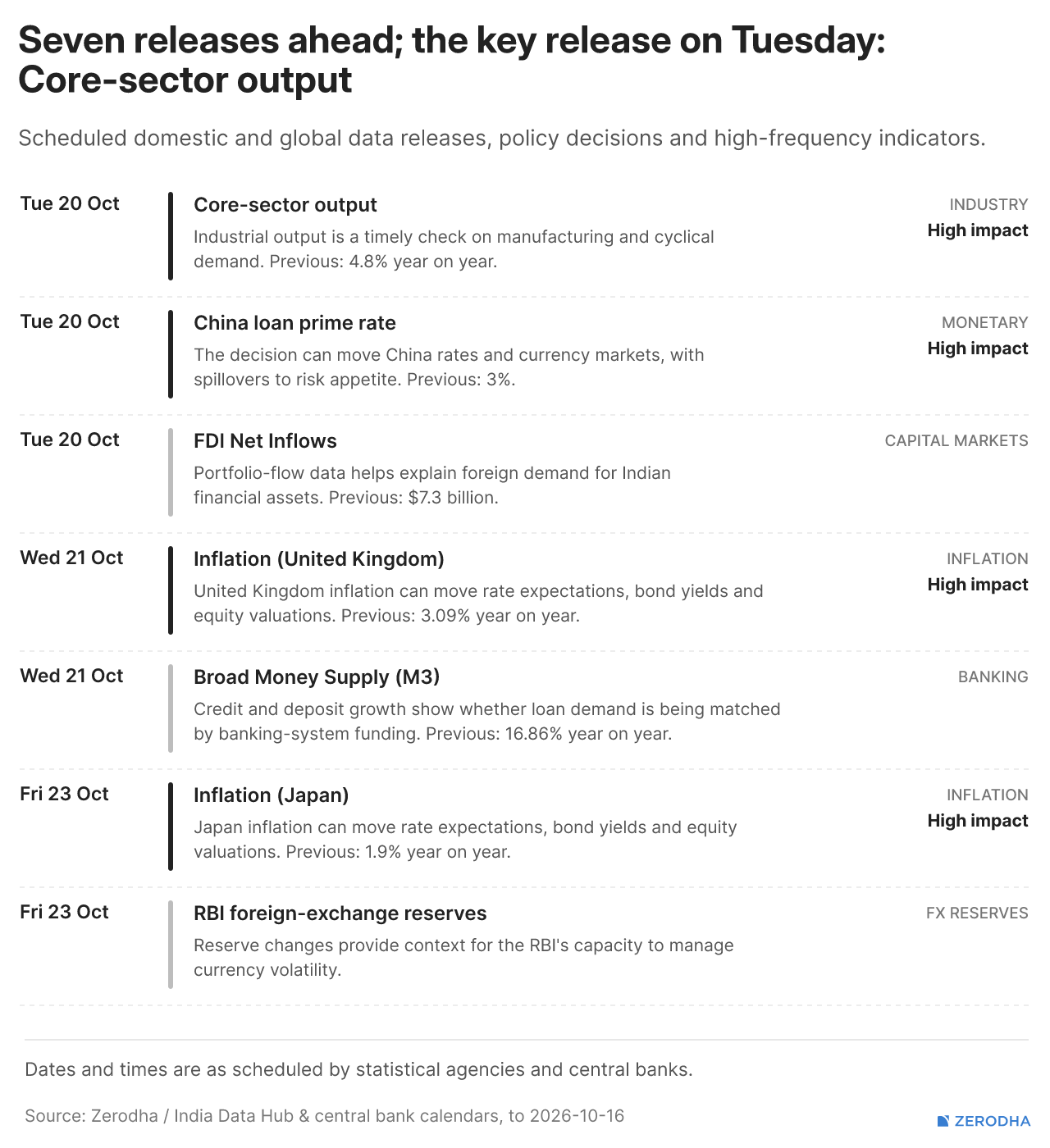
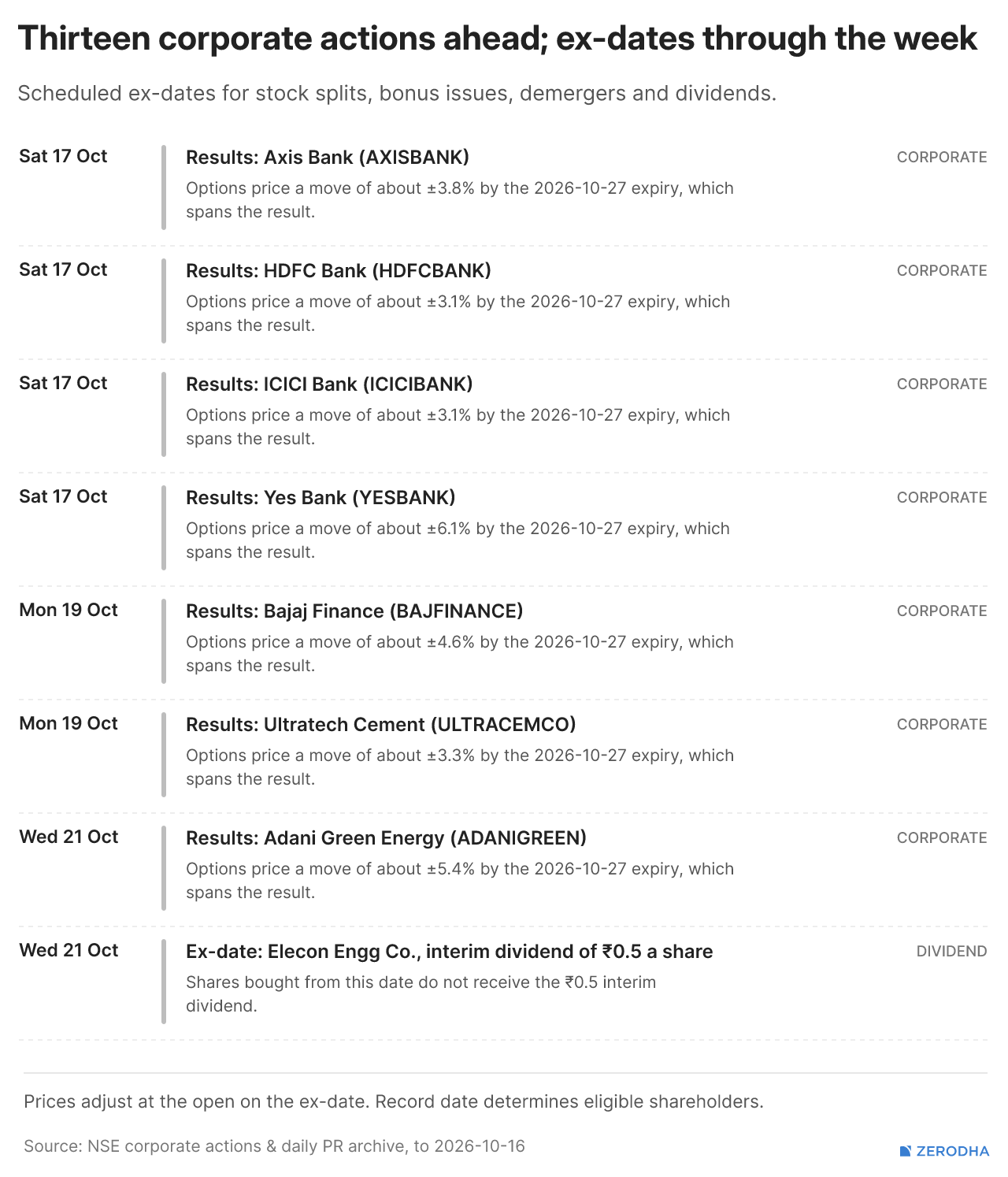
The week ahead & Corporate Actions
Corporate Actions
Published by Zerodha. Not investment advice. Data from NSE, BSE, and MCX.
In our latest episode of In The Money by Zerodha, we explore the story of Paul Tudor Jones, the legendary macro trader known for his approach to risk management and his role during the 1987 stock market crash.
From an early career setback in cotton trading to the lessons he took away from Silver Thursday, we look at the experiences that shaped his trading philosophy.
How did Jones approach risk? What did he learn from his early losses? And what can his career teach us about surviving the markets over the long run?
That’s it from us for today. We’d love to hear your feedback in the comments, and feel free to share this with your friends to spread the word!