
Welcome to Aftermarket Report, a newsletter where we do a quick daily wrap-up of what happened in the markets, both in India and globally.
What data points and transformations do you want to see?
We’re trying out a new format for the Aftermarket Report, with much more comprehensive coverage of the data that shapes the trading day.
Beyond the headline indices, we’re now tracking market breadth, new highs and lows, sector and thematic performance, delivery data, F&O positioning, global markets, commodities, flows, and more. We’re also looking at ways to transform this raw data into insights that are actually useful for traders and investors.
The idea is simple: bring different datasets together in one place to give you a clearer picture of what’s happening beneath the surface of the market.
This is still a work in progress, and we’d love your feedback. What data points are we missing? What transformations, ratios, comparisons, or indicators would you find useful? Also tell us what worked, what didn’t, and what felt unnecessary.
Your feedback will help shape the Aftermarket Report from here.
Markets Today
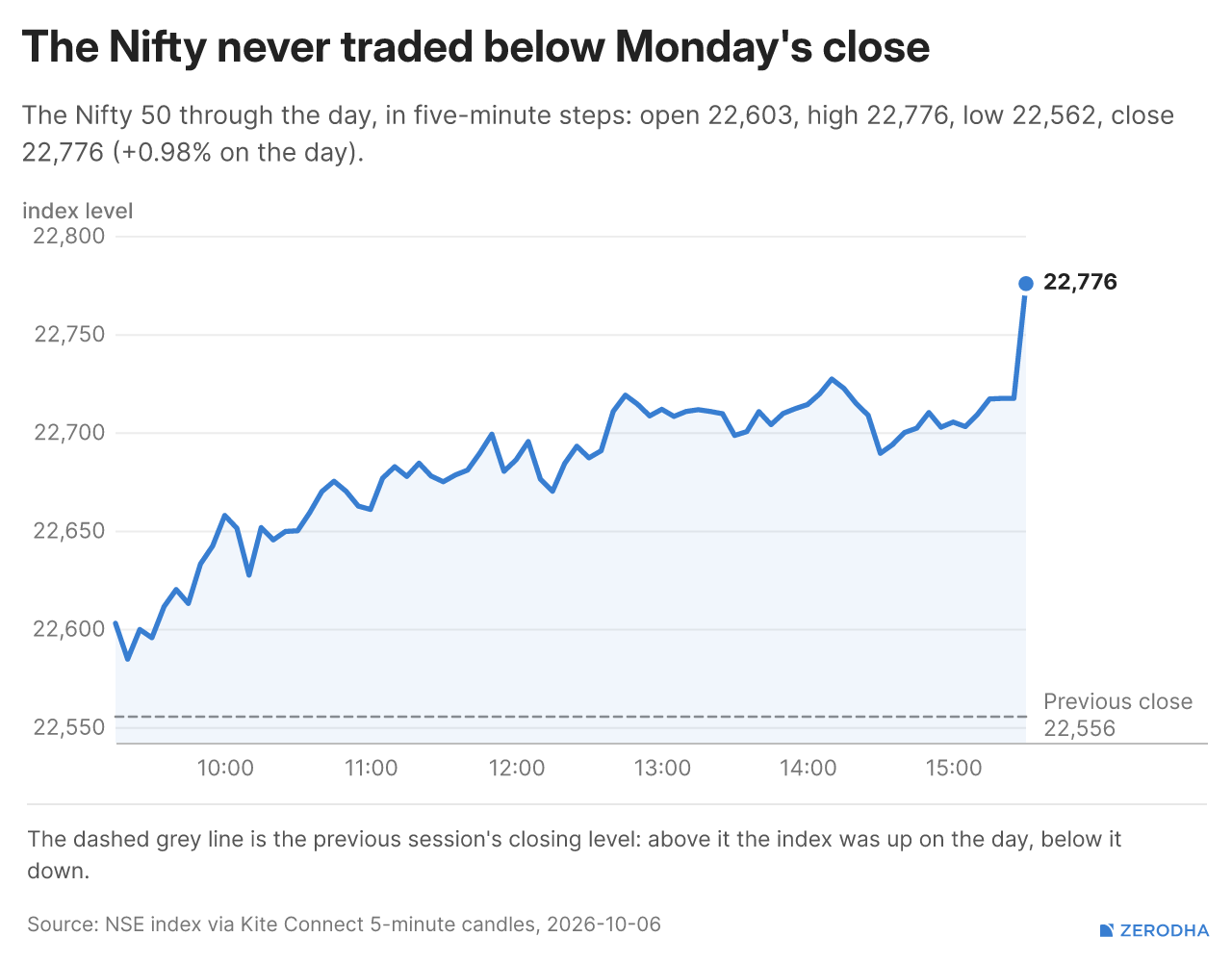
Nifty opened with a 47-point gap up at 22,603, tracking positive global cues as US markets traded at record highs, while range-bound oil prices and some easing in negative positioning ahead of the RBI event supported sentiment.
After some volatility in the opening minutes, the index steadily moved higher, crossing 22,650 before briefly testing 22,700 around noon. Minor profit-booking bouts were quickly absorbed, with Nifty maintaining a gradual upward trend through most of the first half.
Buying strengthened after 12:30 PM, pushing the index above 22,700 and towards 22,730 by early afternoon. Nifty briefly slipped below 22,700 around 2:20 PM but quickly recovered and stayed largely in the 22,700–22,725 range through the final hour. A sharp surge in the closing minutes took the index to the day’s high, with Nifty eventually closing at 22,776.10, around 170 points above its opening level, marking a strong session ahead of the RBI event.
Fear & Greed Index
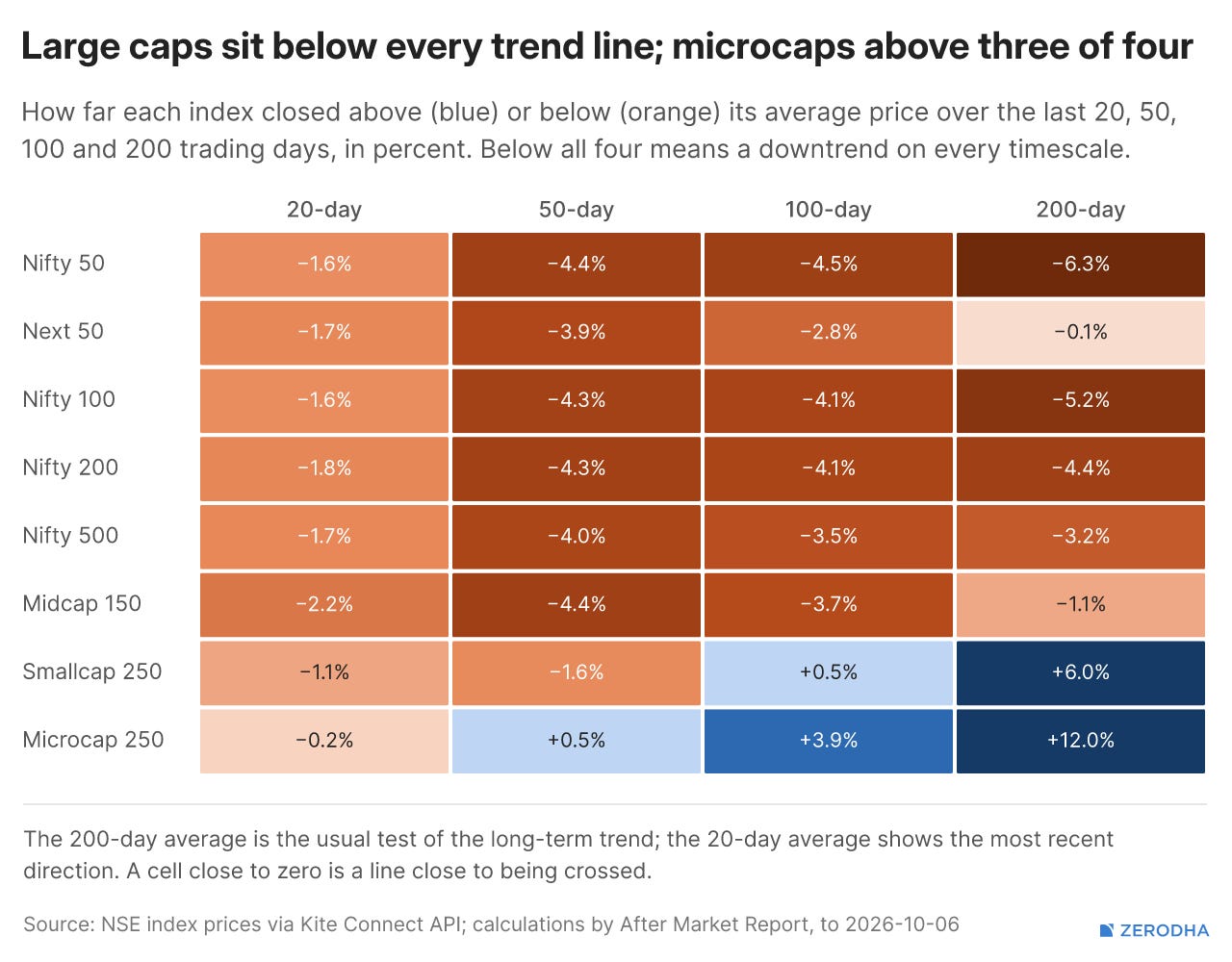
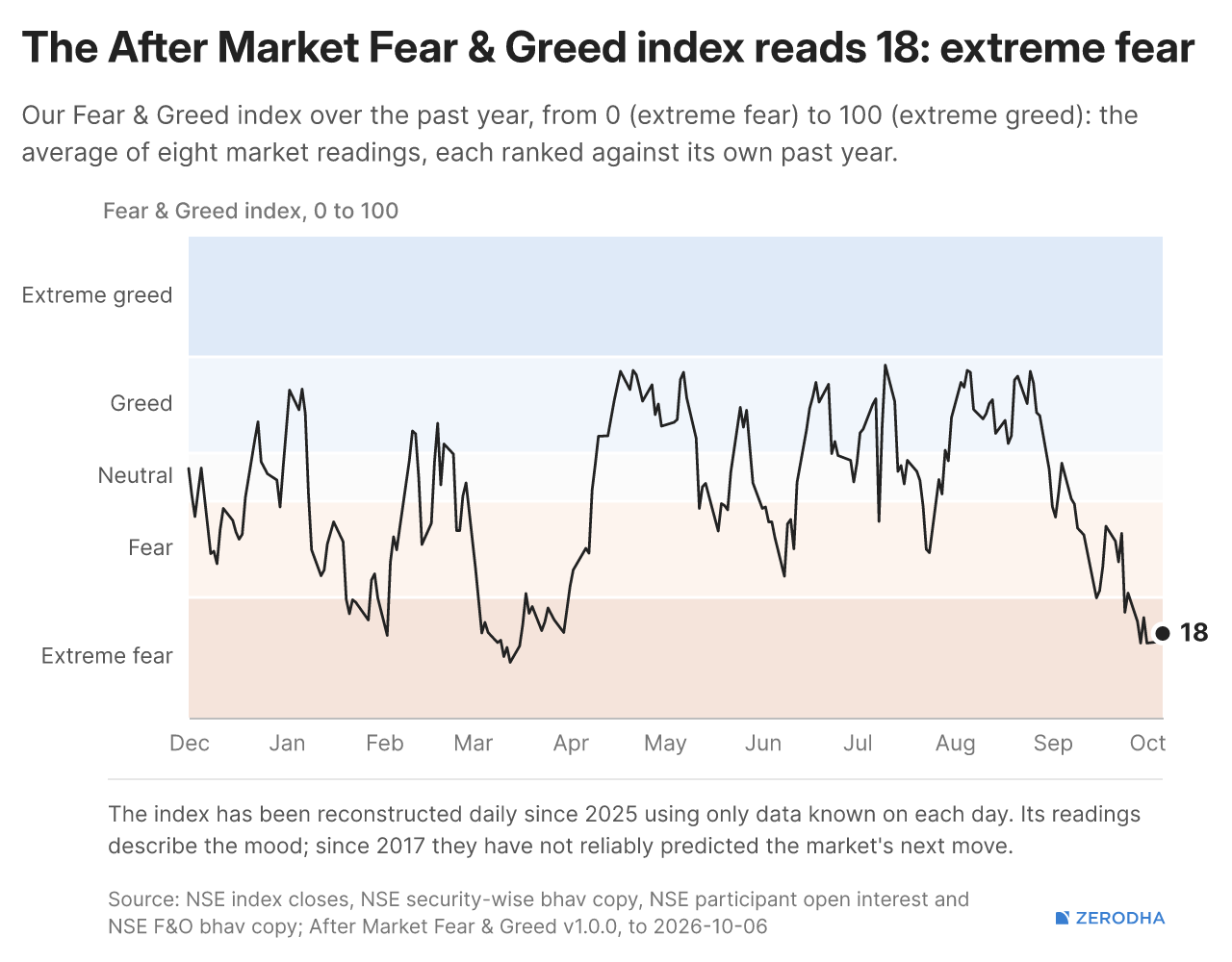
The Fear & Greed Index improved from 16 to 18 but remained in extreme fear. Foreign investors remain unusually short, while weak market trends and bonds outperforming equities continue to weigh on sentiment.
Market Breadth
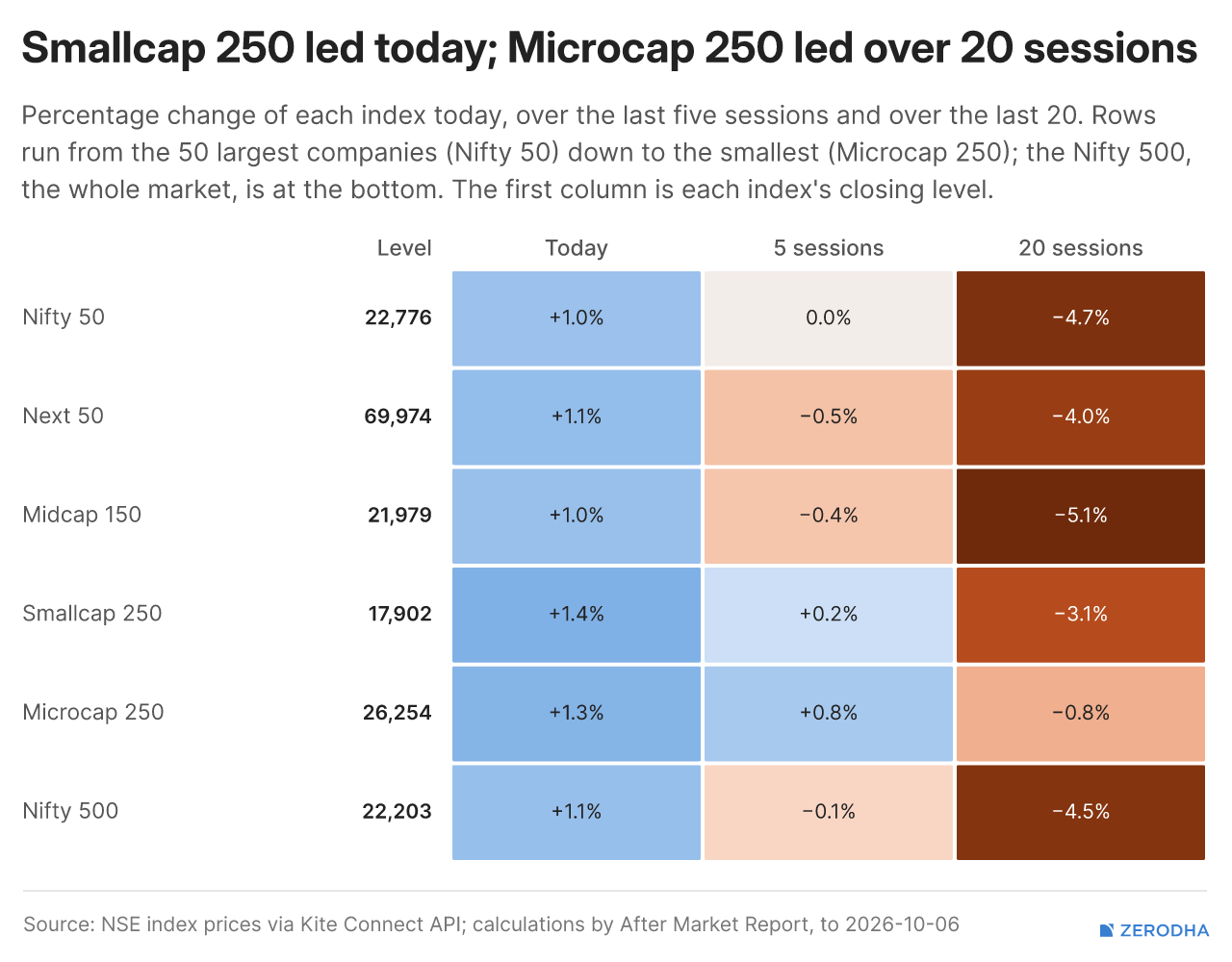
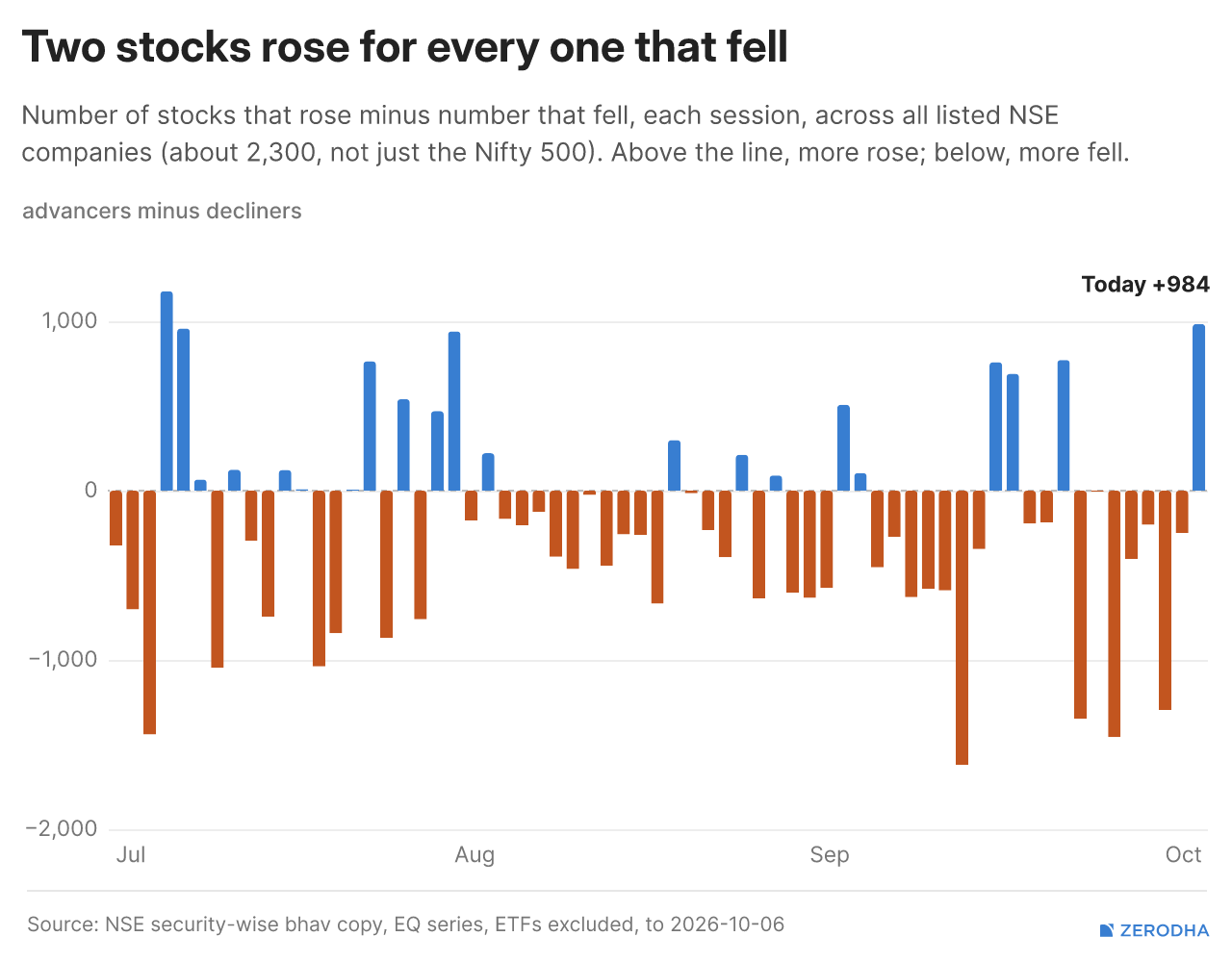
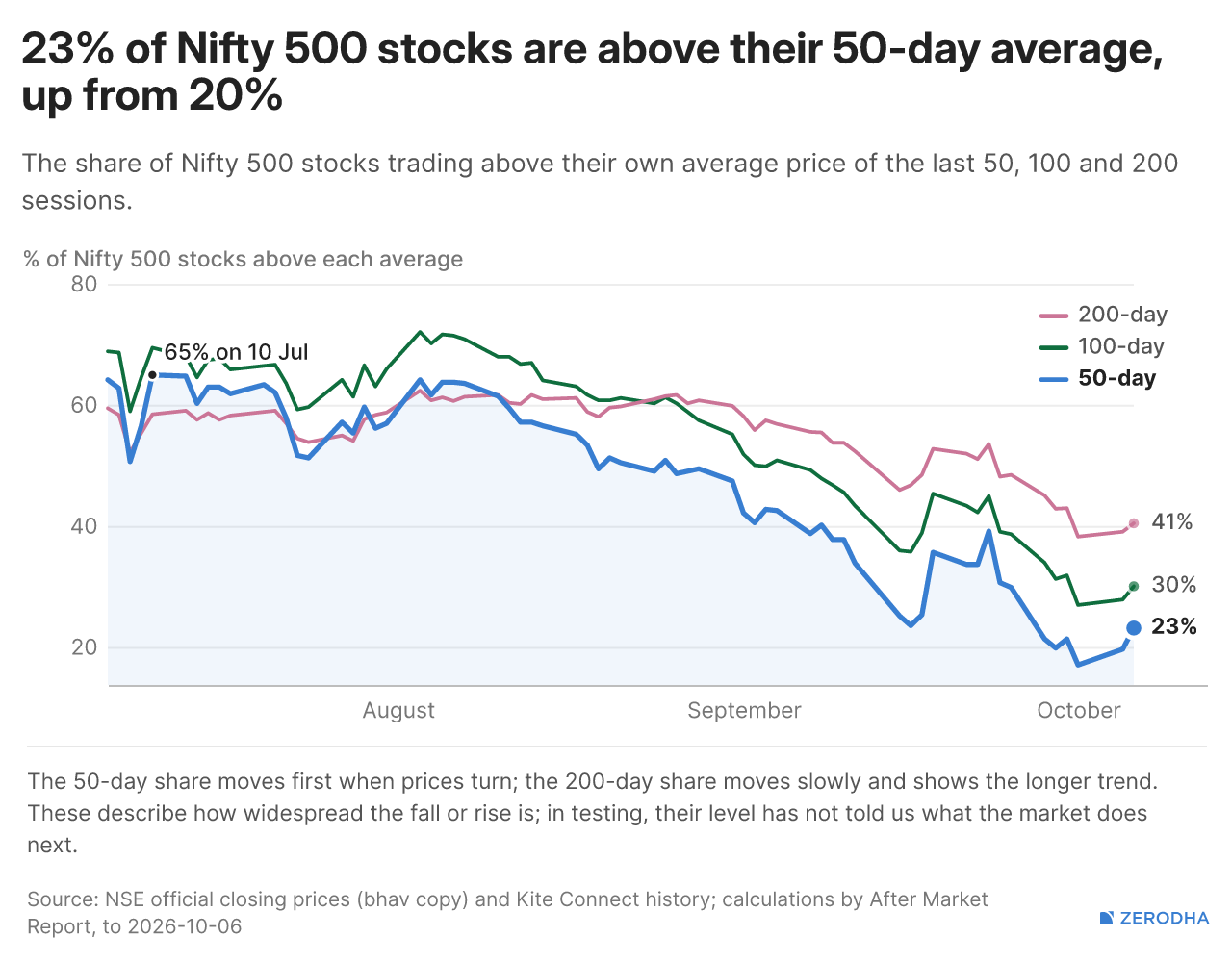
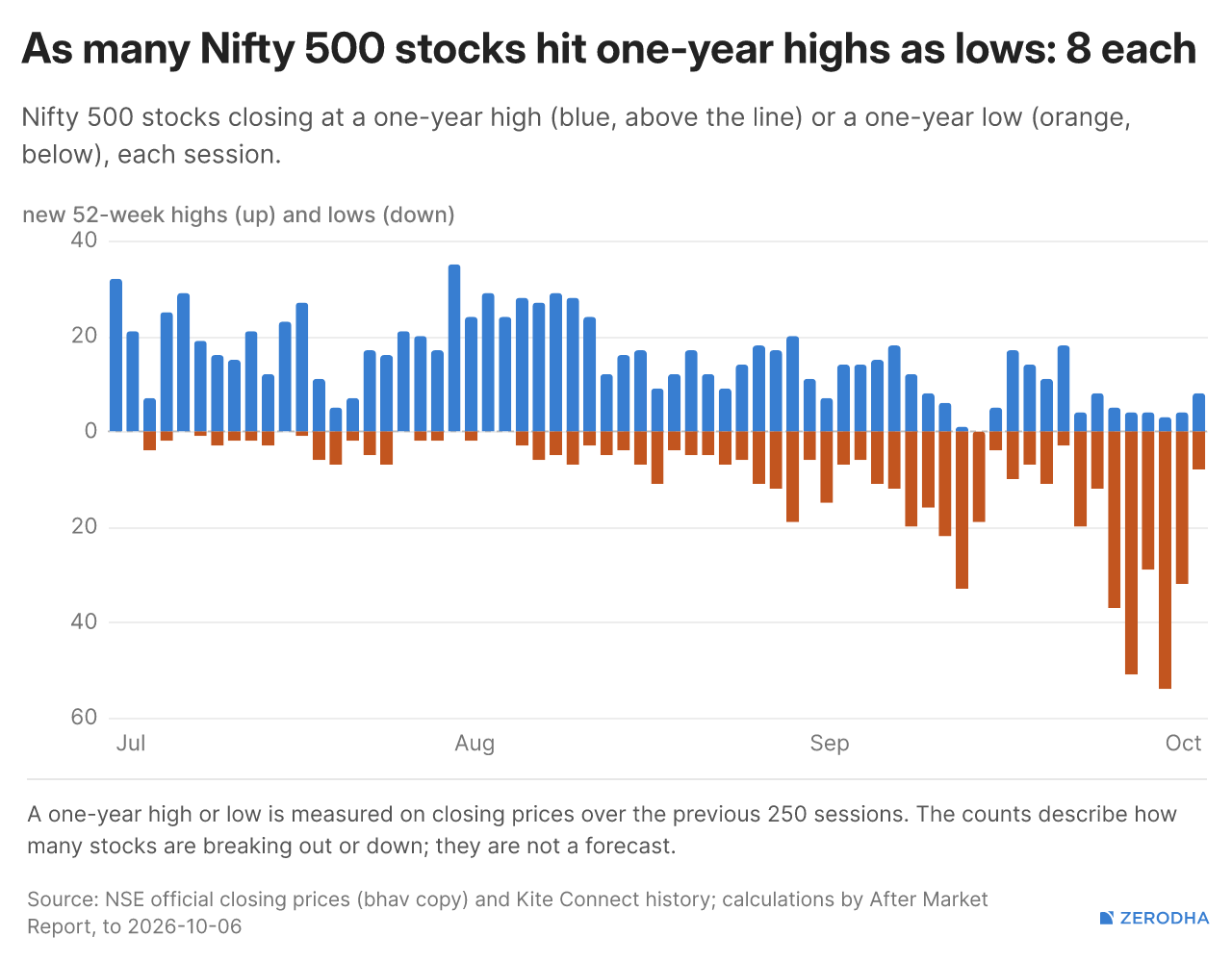
Participation improved sharply, with 1,643 advancers versus 659 decliners, while 23.3% of Nifty 500 stocks are now above their 50-day average. However, new 52-week highs and lows were evenly matched at eight each, showing the longer trend remains damaged.
52 Week Highs & Lows
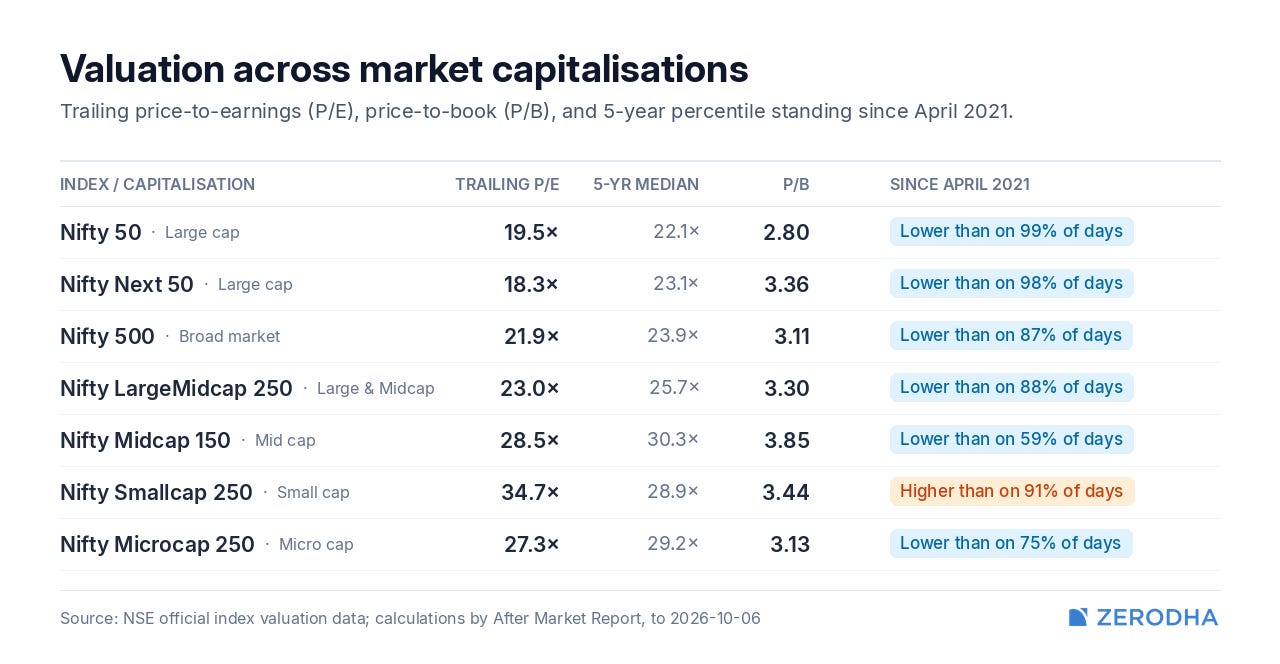
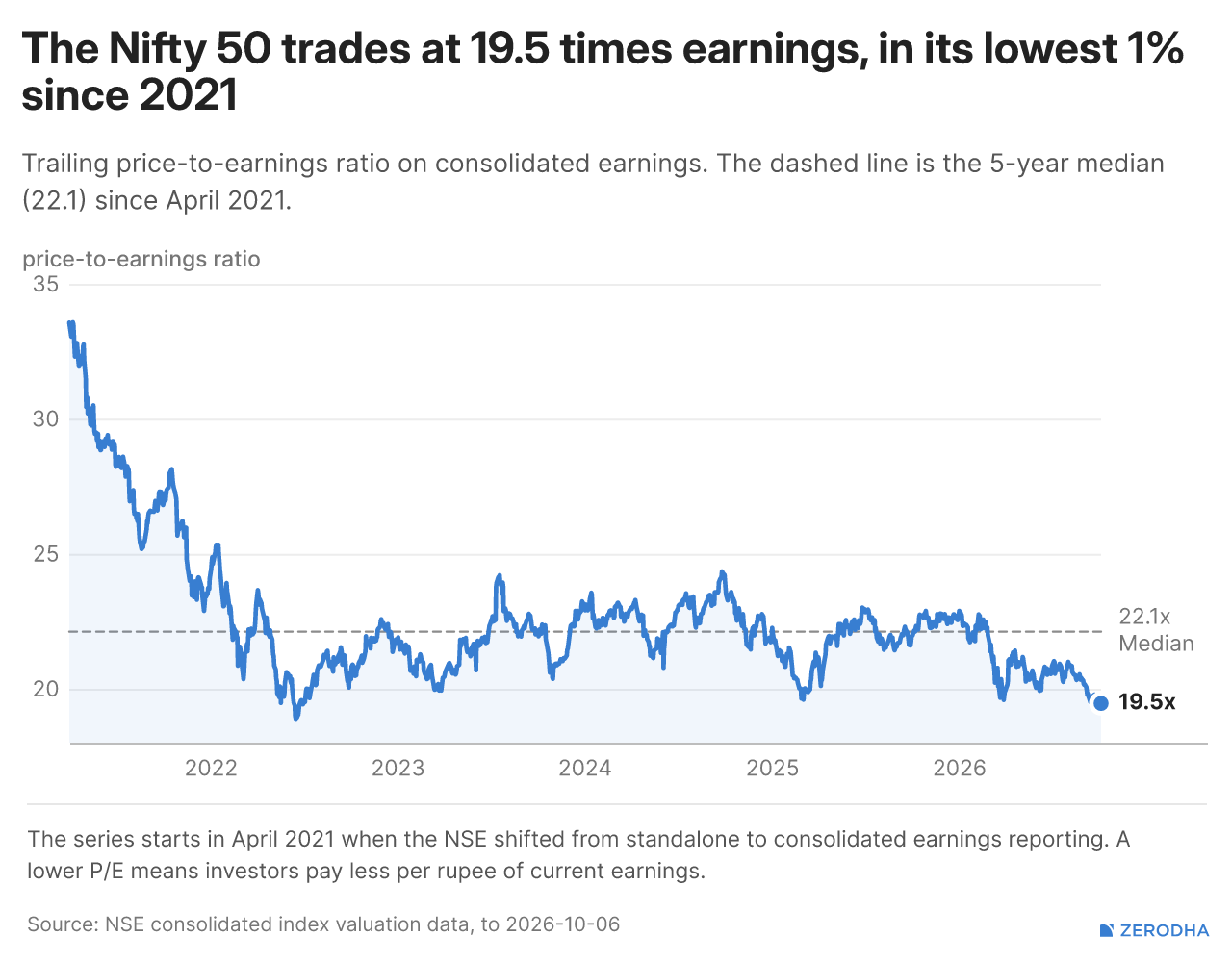
Valuation Check
Sectoral Indices Performance
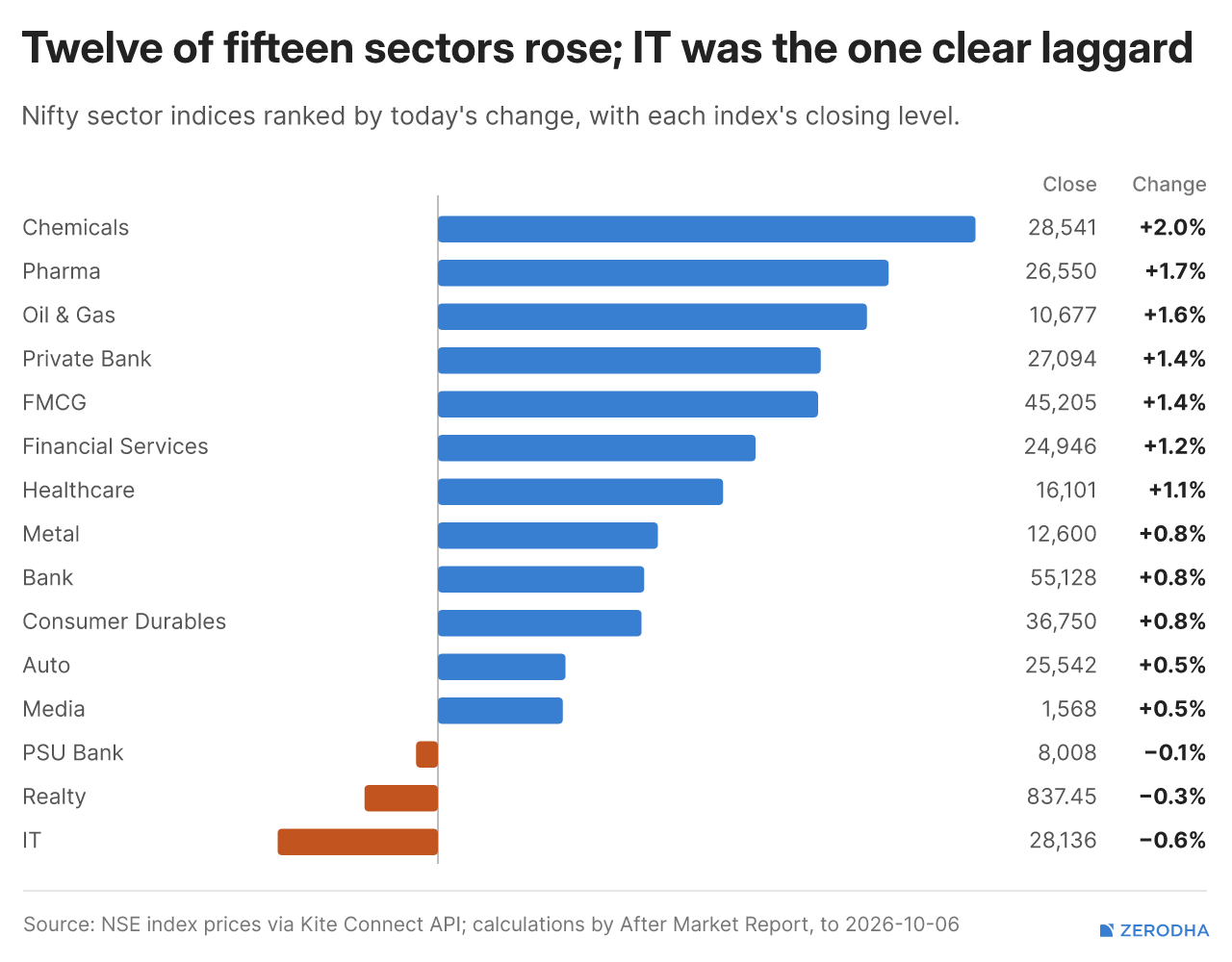
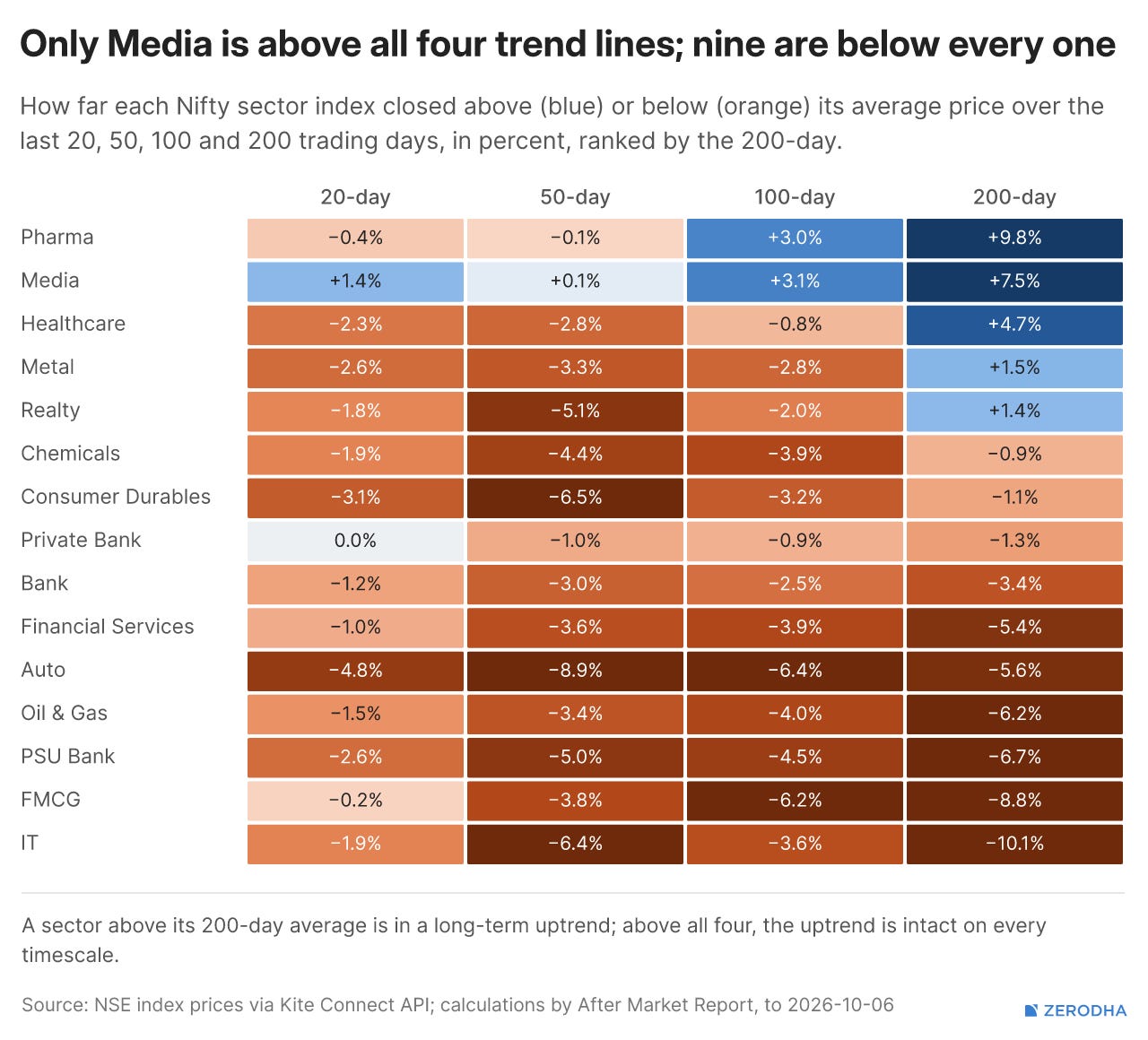
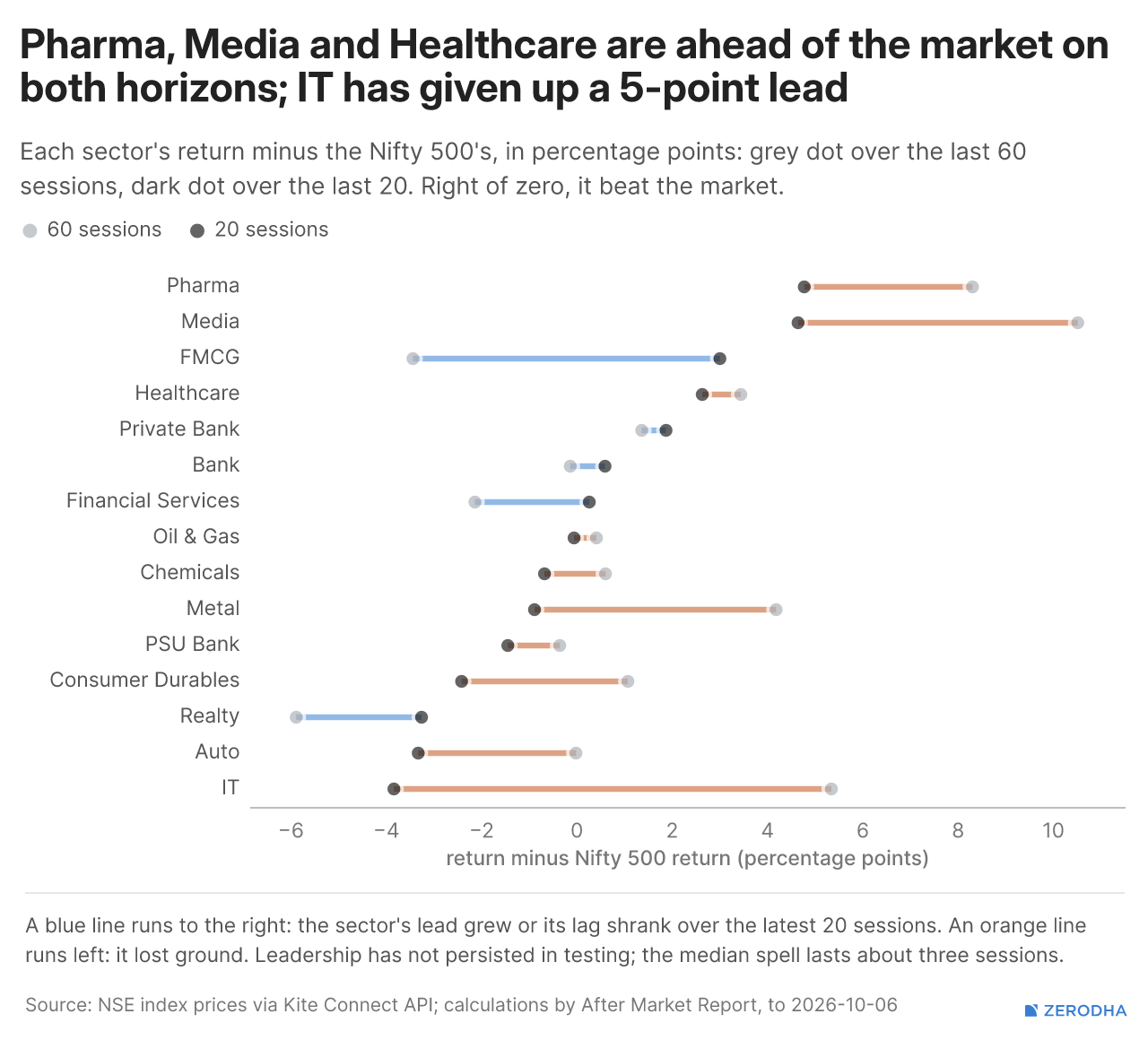
Chemicals gained 1.98% to lead as 12 of 15 sectors advanced, while IT fell 0.59%. Pharma, Media and Healthcare remain the relative leaders over both 20 and 60 sessions, with Media now the only sector above all four key moving averages.
Winners & Losers
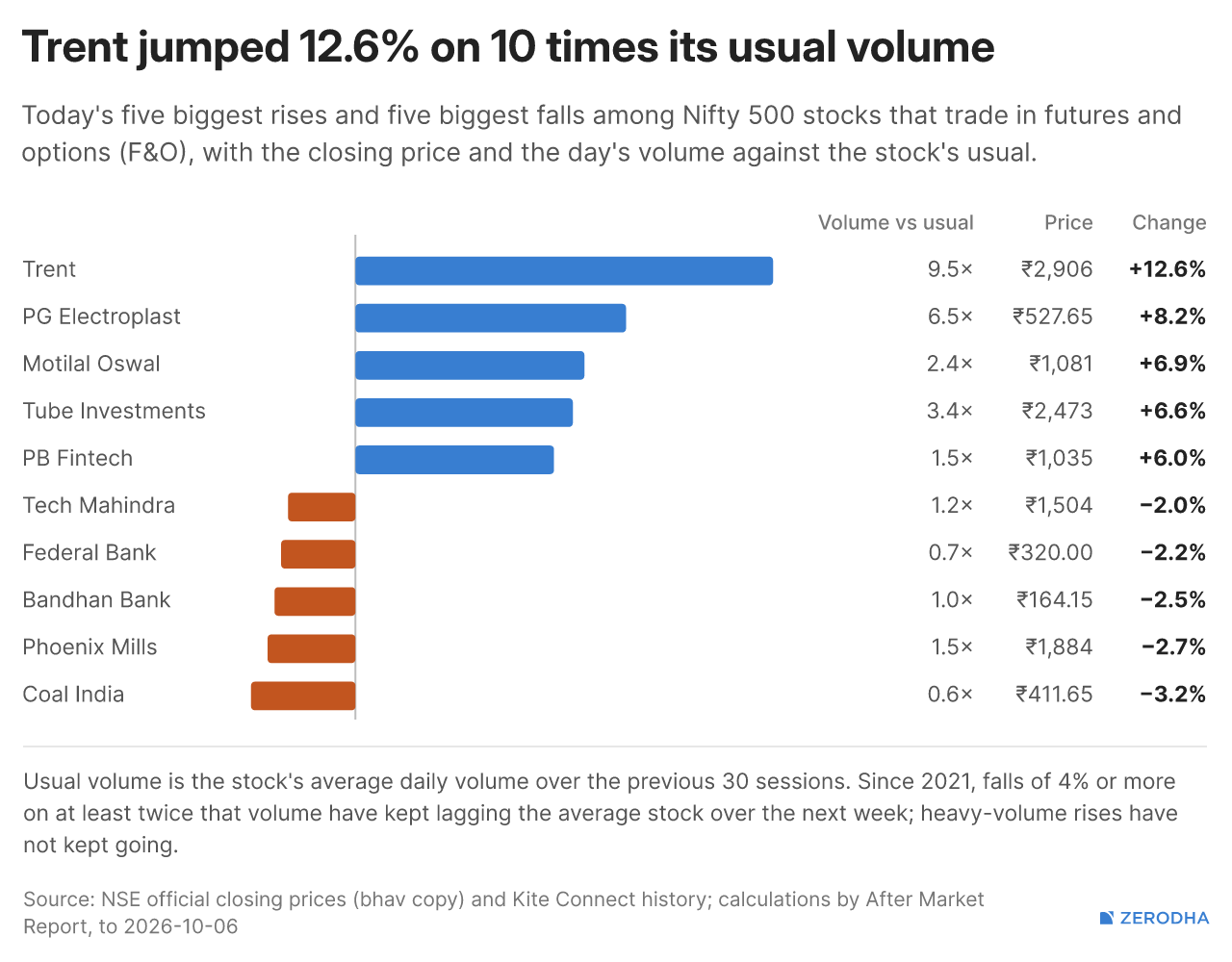
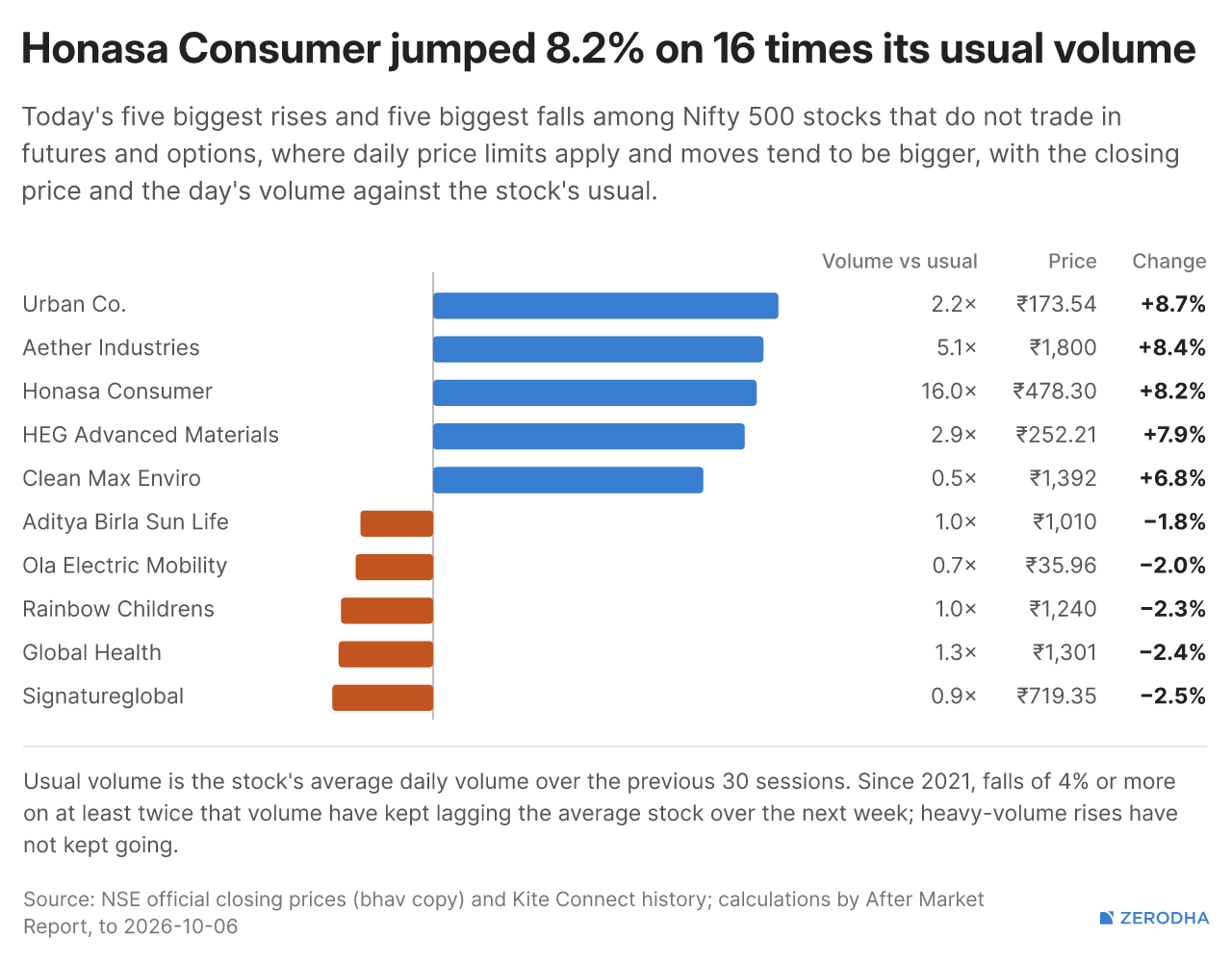
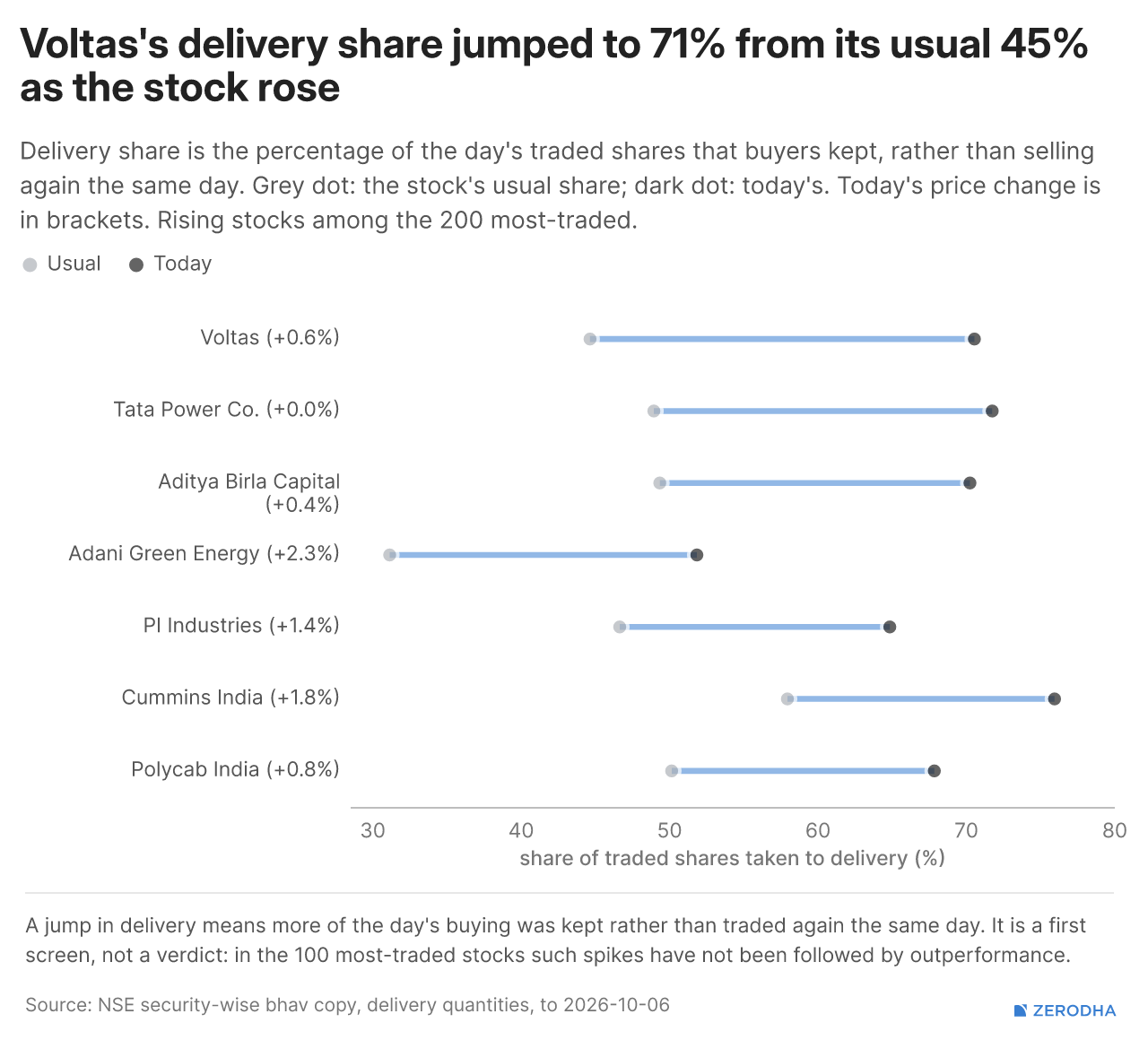
Honasa Consumer jumped 8.19% on 16× usual volume, while Trent surged 12.64% on 9.5× volume. Voltas saw a sharp delivery spike, while GMR Airports recorded the biggest jump in implied volatility.
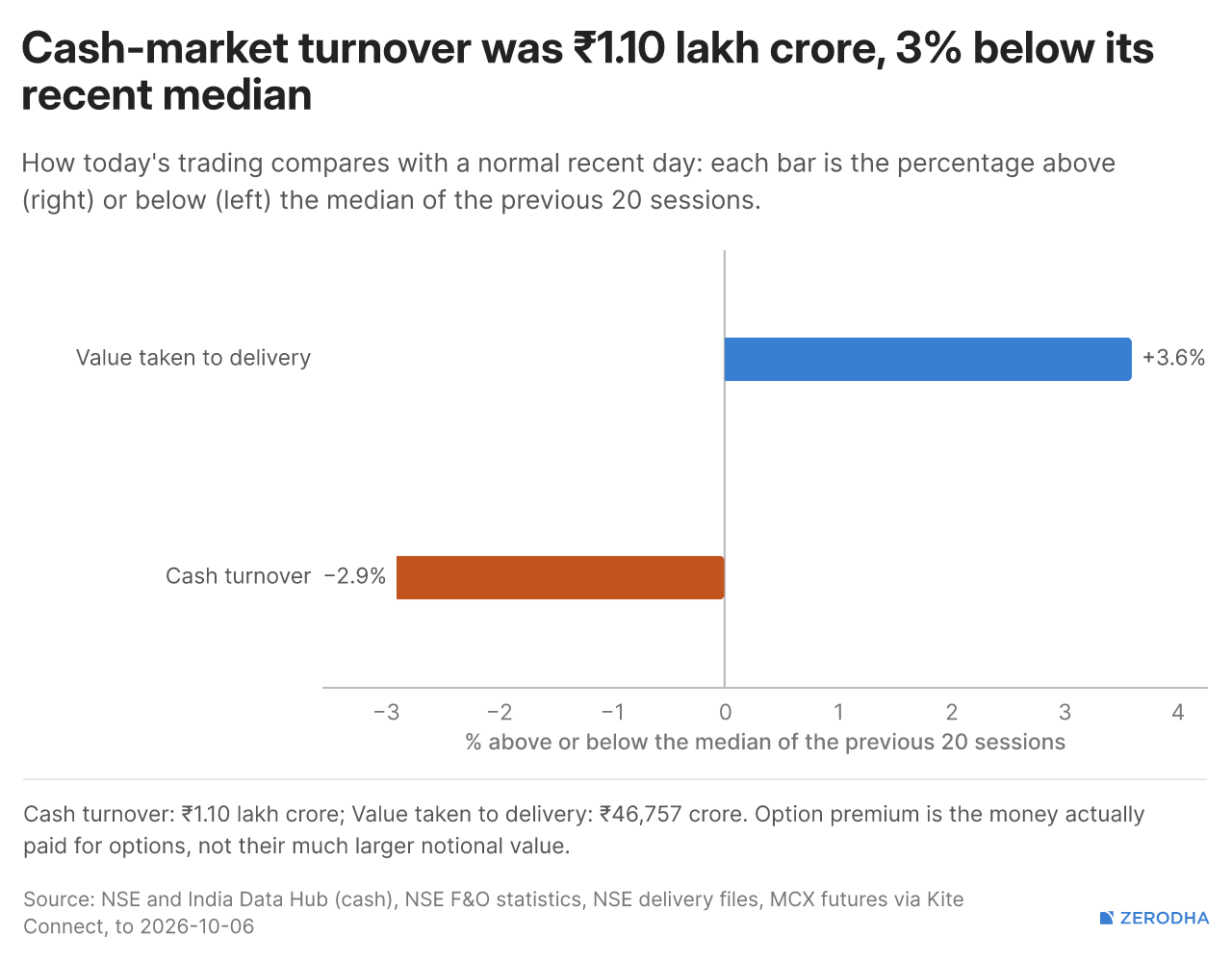
Delivery Data
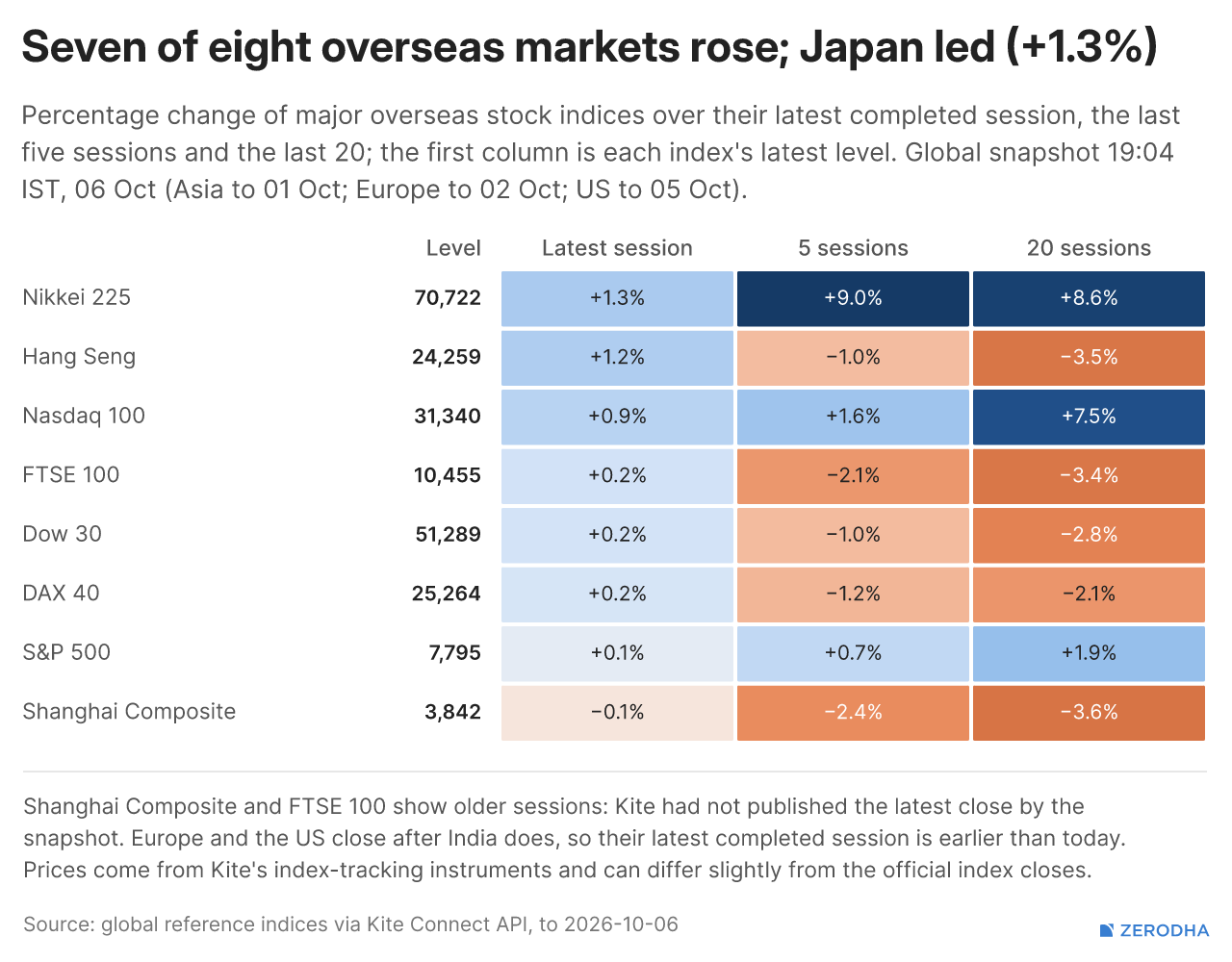
Global Markets
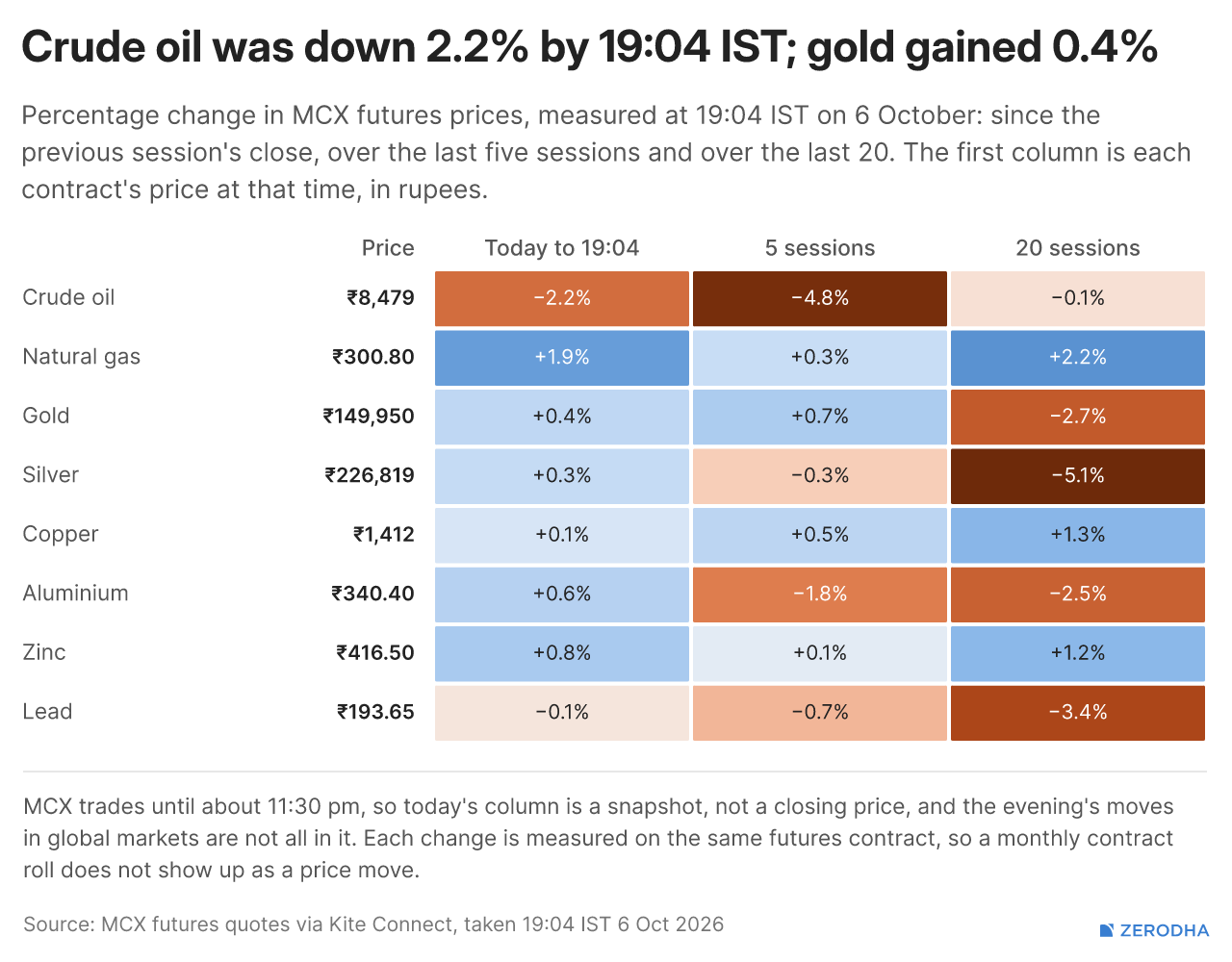
Commodities
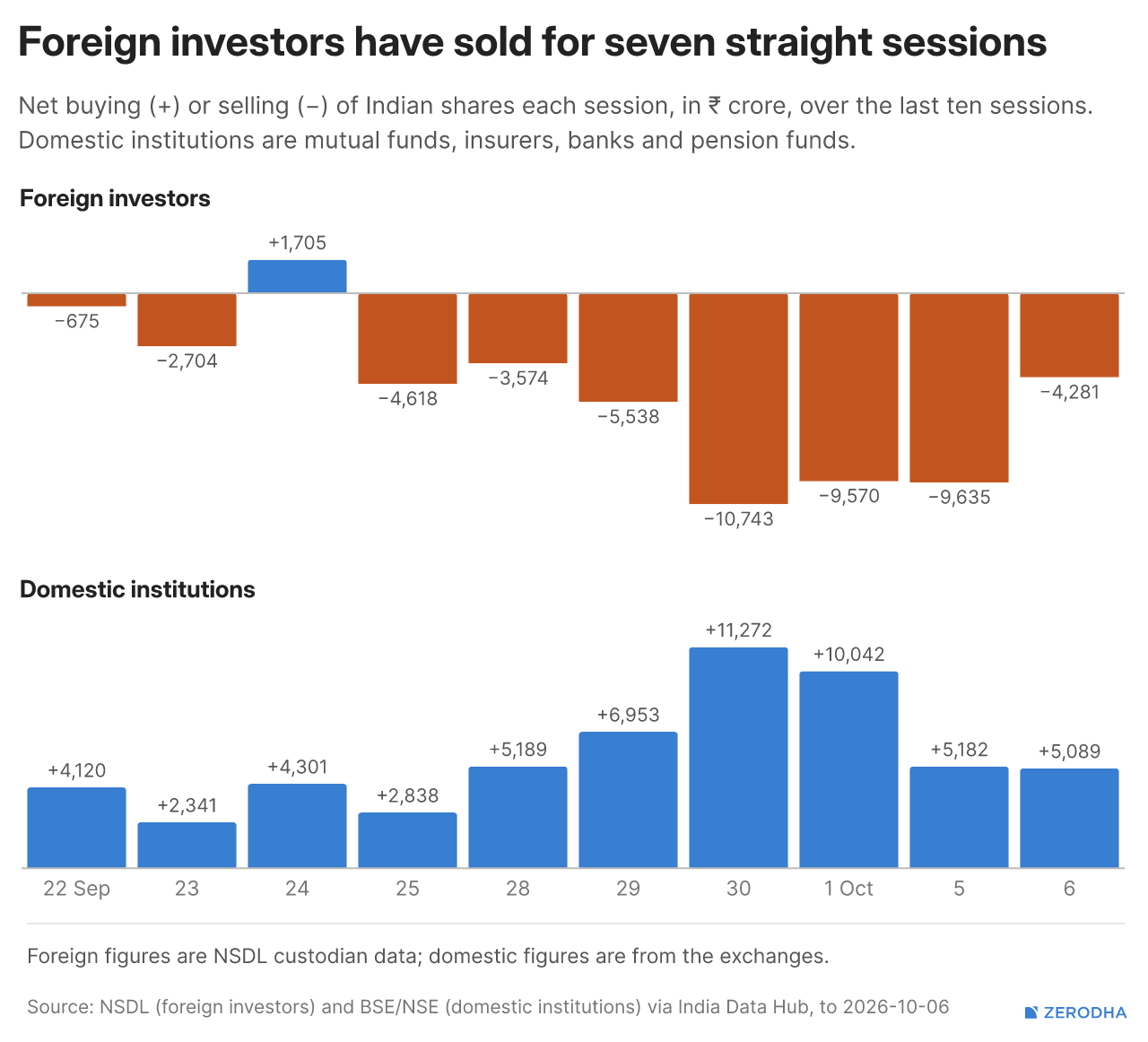
Institutional Flows & Participant Positioning
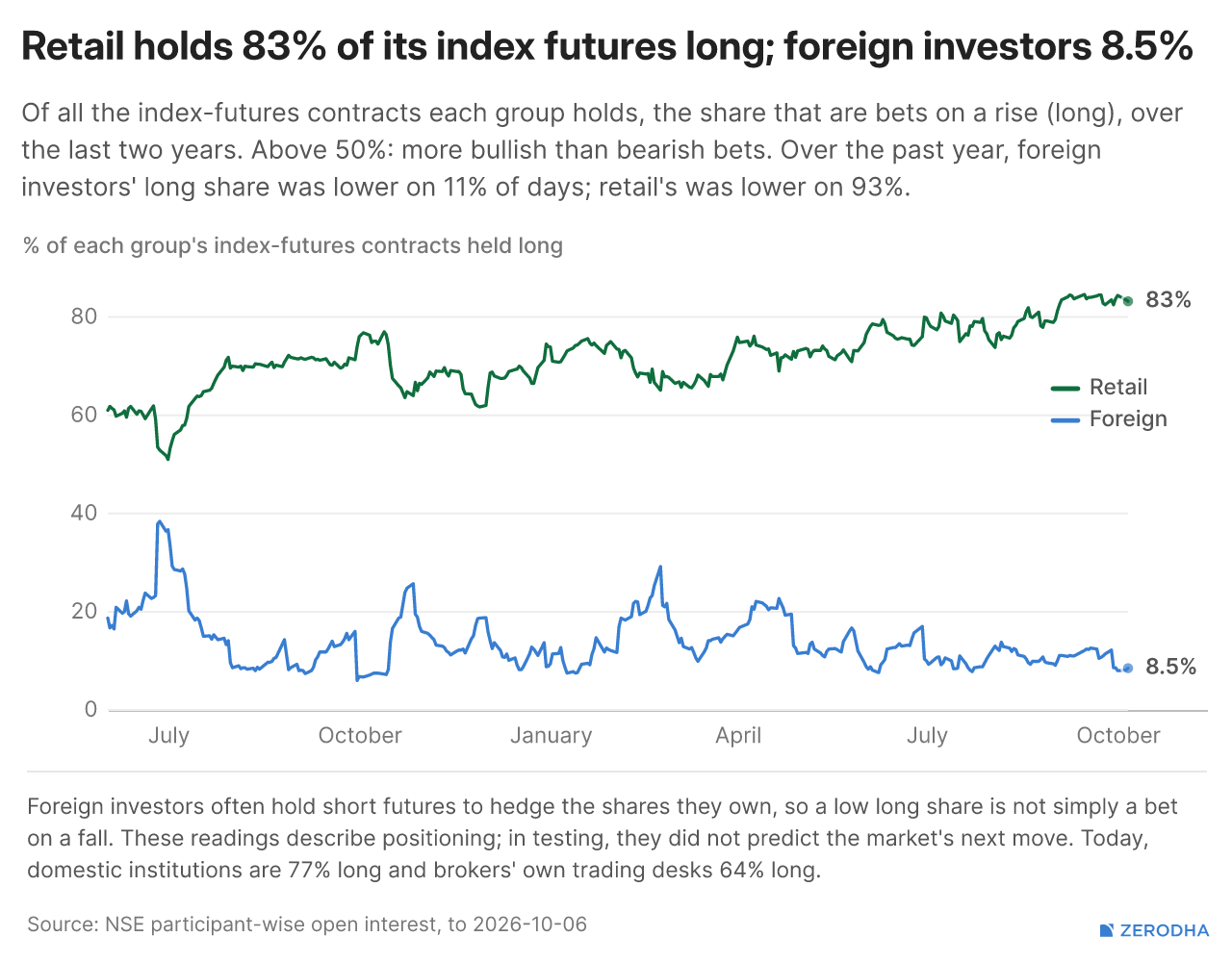
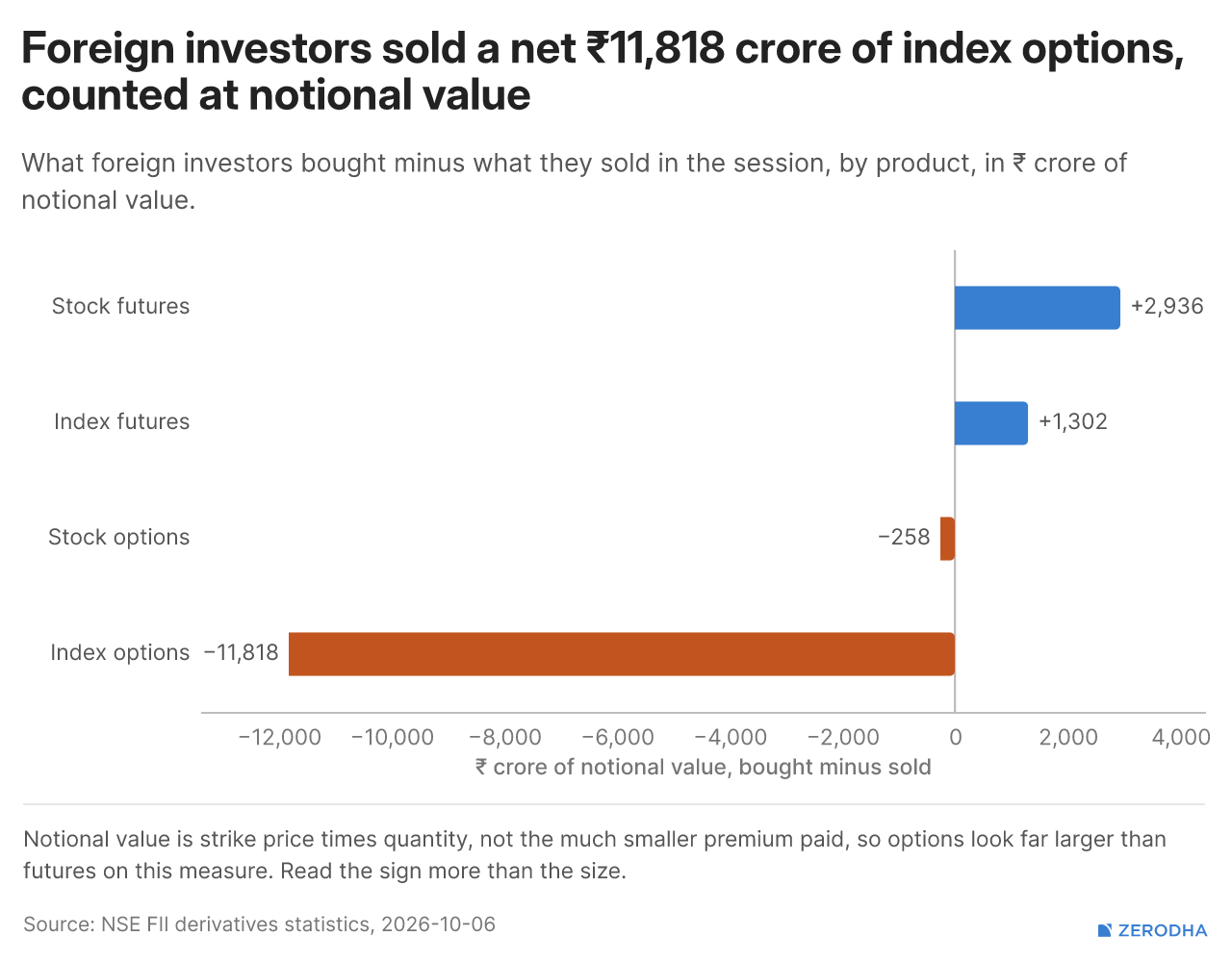
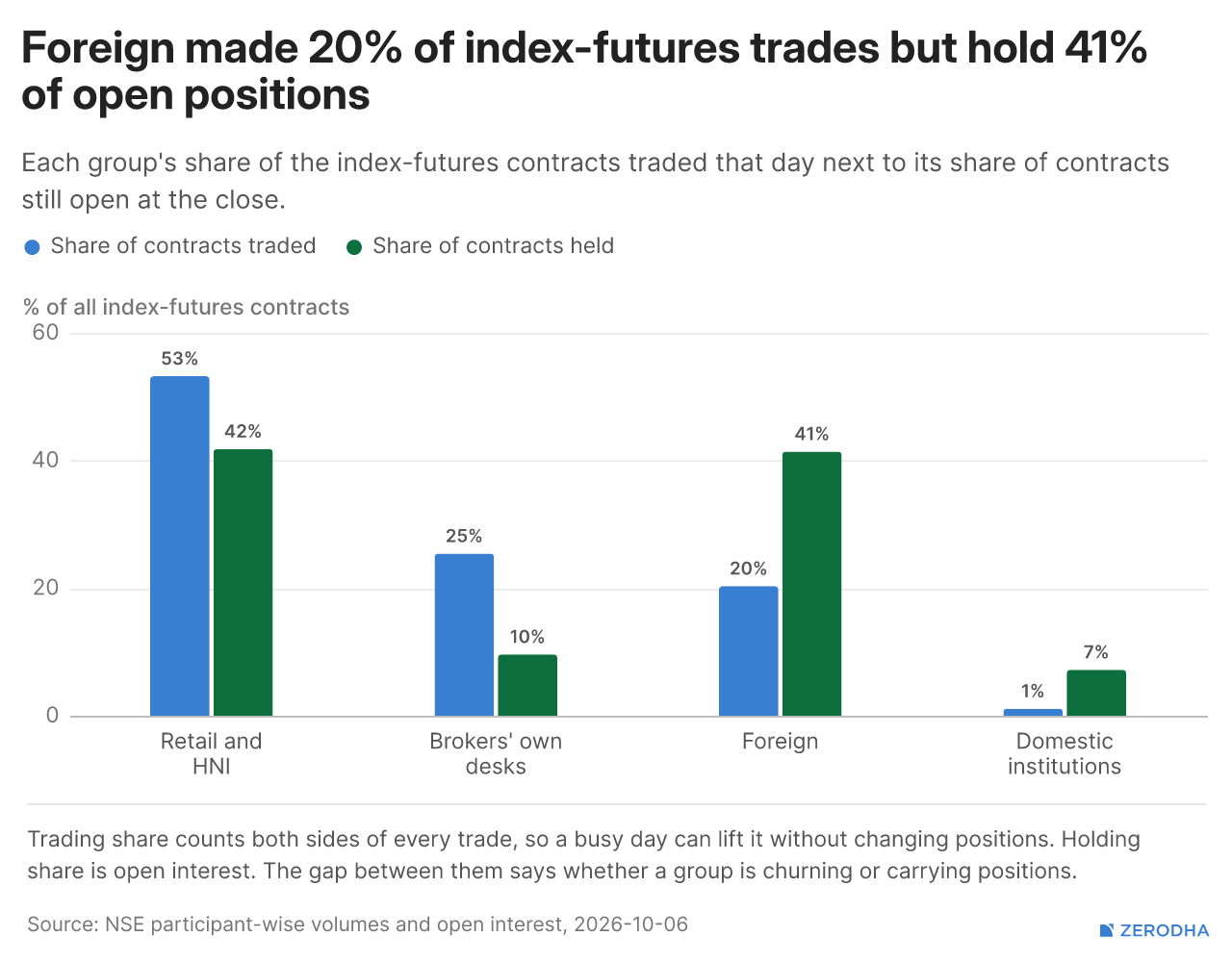
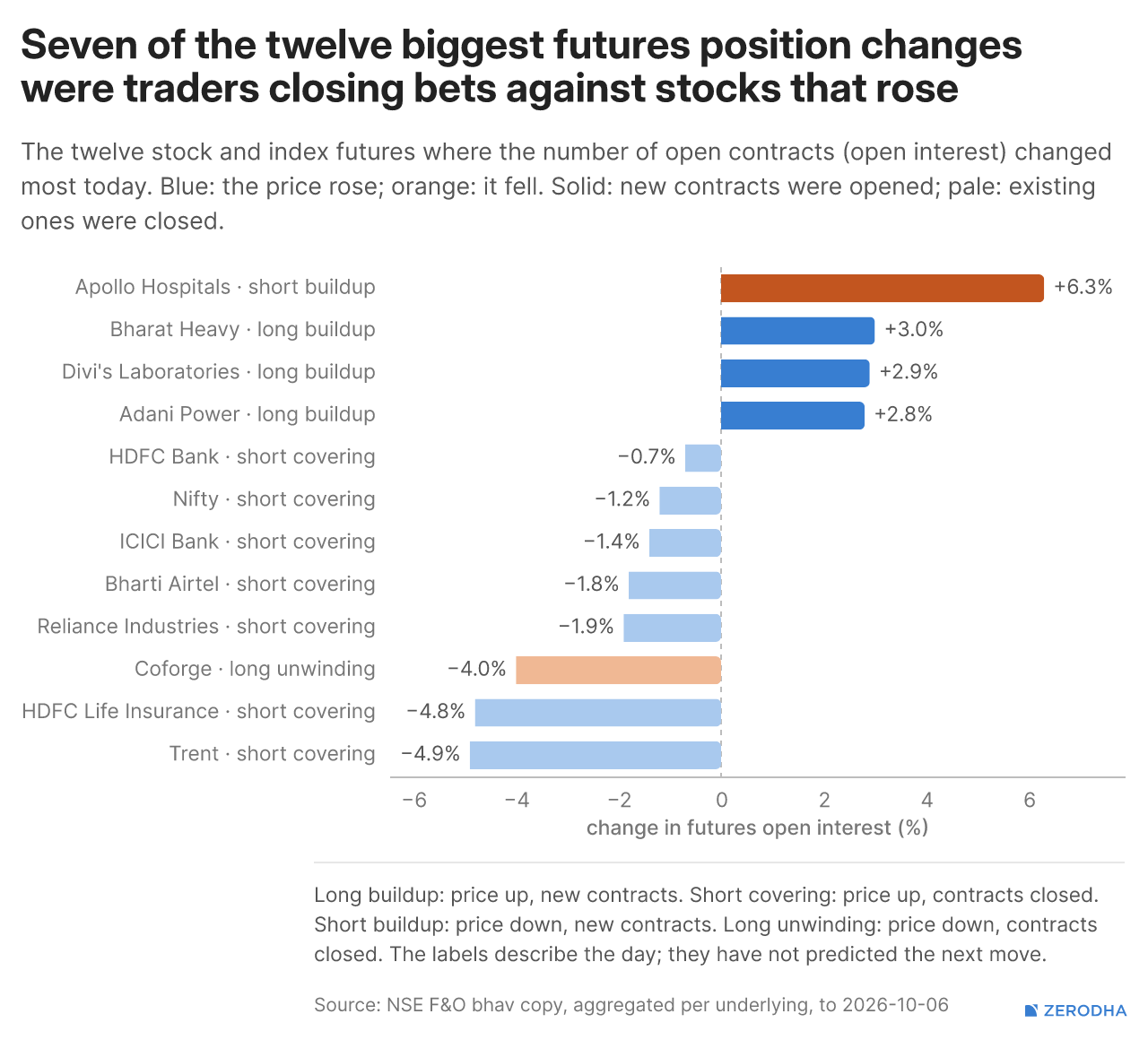
Downside protection eased as IV fell from 14.5% to 12.2%, while stronger put writing pushed PCR from 0.94 to 1.24. FIIs remain heavily bearish with just 8.5% of index-futures positions long, although they were net buyers of 8,666 contracts during the session.
Thematic Indices
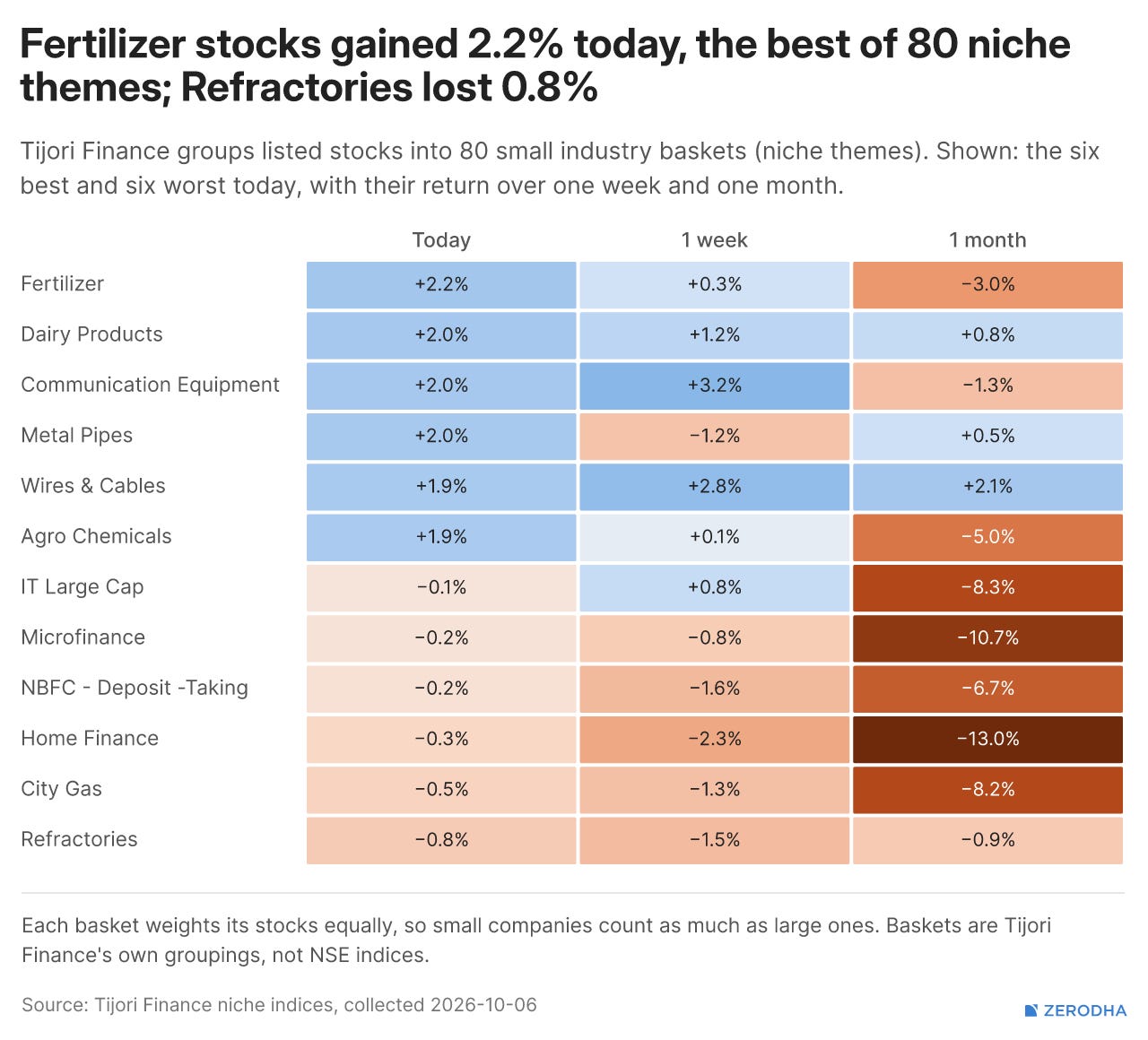
Tijori’s niche indices, where today’s move sorts pockets of the market beyond standard sector baskets. You can also track promoter buying and other interesting stuff, like Capex activity by the companies in the Tijori App’s idea dashboard
F&O Corner
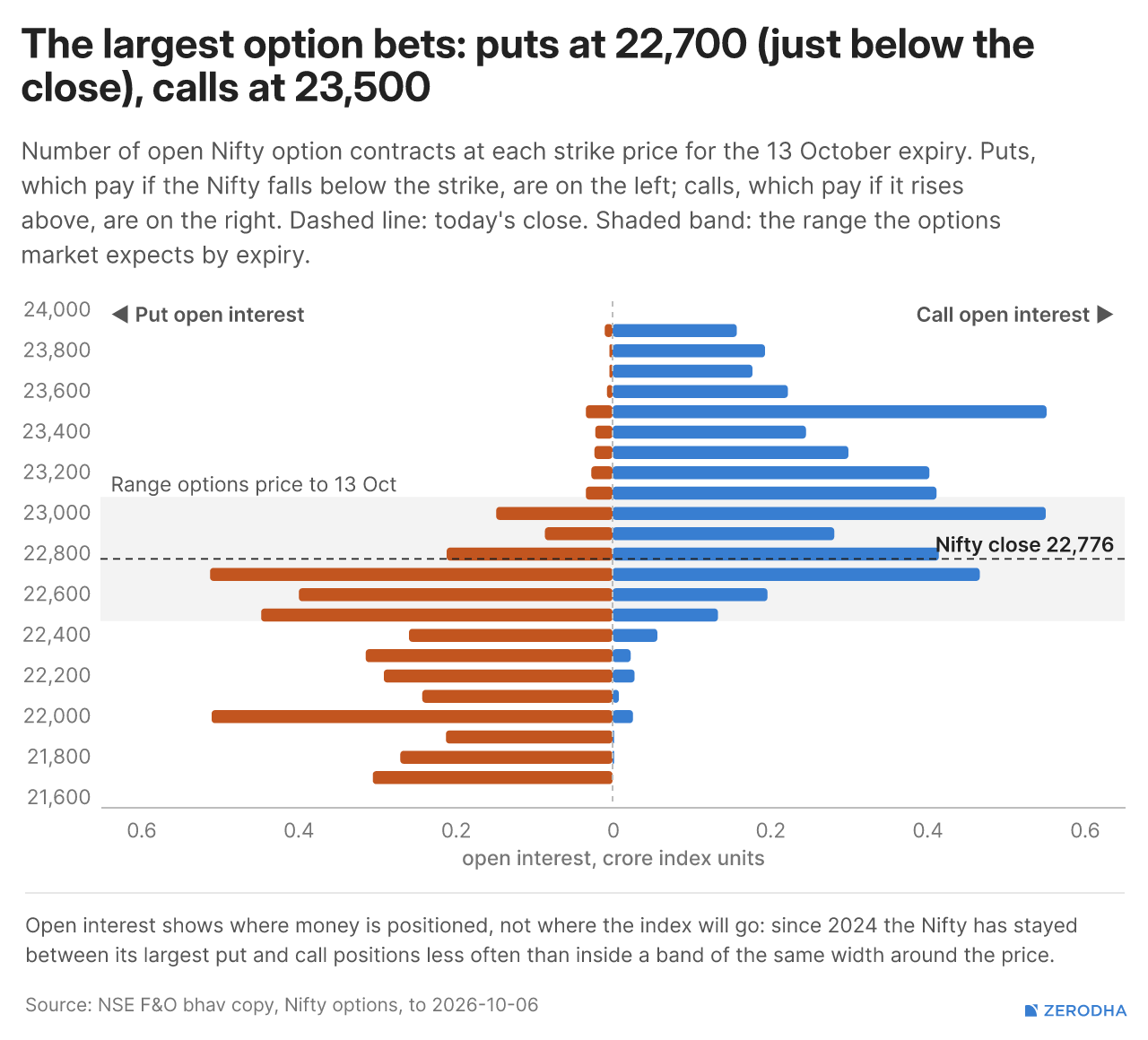
Options imply a 22,442–23,052 range into October 13 expiry, with the heaviest put OI at 21,500 and call OI at 24,000. The 20-day moving average at 23,146 is the first major trend hurdle.

Top Stories in India
India’s services PMI rose to a three-month high of 55.2 in September from 54.1 in August, supported by stronger demand for financial, consumer and digital services. However, quarterly services growth was the weakest in more than four years. Dive deeper
The World Bank raised India’s FY27 GDP growth forecast by 50 bps to 7.1%, supported by resilient domestic demand. It cautioned that growth could slow in the second half, with oil prices, El Niño and capital-flow volatility among the key risks. Dive deeper
The rupee fell to a more than two-month low of ₹96.42/$, pressured by foreign equity outflows ahead of the RBI policy decision. Dollar sales by state-run banks helped limit the decline. Dive deeper
The Cabinet approved a ₹10,000 crore government commitment to establish the SME Growth Fund, aimed at providing growth capital to small and medium businesses and improving their access to equity and professional support. Dive deeper
India’s festive hiring grew 7% YoY to 1.27 lakh jobs in 2026, led by quick commerce, e-commerce and logistics. This came despite overall white-collar hiring declining 11% YoY in September. Dive deeper
IEX’s Day-Ahead Market clearing price jumped 105% YoY to ₹7.3/unit in September, while Real-Time Market prices rose 108% to ₹6.9/unit amid strong electricity demand. IEX volumes increased 10.4% YoY to 12,220 million units. Dive deeper
India’s passenger vehicle retail sales jumped 32.1% YoY to a record 4.27 lakh units in September, while overall automobile sales grew 31.8%. Two-wheeler sales rose 33.1%, while three-wheeler sales grew 22.3%. Dive deeper
Lupin launched Formoflo-G MDI, a fixed-dose triple-combination inhaler for treating COPD in India, following approval from the DCGI. Dive deeper
Top Stories Globally
Brent crude fell below $100 per barrel as Middle East oil exports continued to recover. JPMorgan estimates crude shipments have returned to 98% of pre-war levels, easing supply concerns. Dive deeper
The S&P 500 and Nasdaq hit record highs as Treasury yields eased and oil prices declined. Nvidia gained 1.2%, taking its market capitalisation close to $6 trillion. Dive deeper
Paramount Skydance completed its $110 billion takeover of Warner Bros Discovery, creating a combined entertainment giant called Skydance under CEO David Ellison. Dive deeper
AT&T will form a fiber joint venture with BlackRock’s Global Infrastructure Partners and CPP Investments, aimed at accelerating the expansion of its fiber network across the US. Dive deeper
The US trade deficit widened 13.7% to $105.6 billion in August, more than expected, as strong domestic demand drove a surge in goods imports. The widening deficit could weigh on Q3 economic growth. Dive deeper
Management Chatter
In this section, we highlight interesting comments from management at major companies and from policymakers in the Indian and Global Economies.
Ajay Seth, Chairman, IRDAI, is highlighting a significant spike in operating costs across both life and general insurance sectors over the last few years:
“To look at the numbers: Life Insurance: In FY21, the industry’s cost of doing business was around 16.5%. Today, it has escalated to 22%. We are asking the industry to return to the 15% efficiency levels achieved five to six years ago. General Insurance: Operating costs were historically 30% plus, declined to around 26% between FY17 and FY19, but have now spiked back to 32%. Our expectation is simple: regain the efficiency levels achieved seven to eight years ago, and then build further productivity milestones from there.” - Link
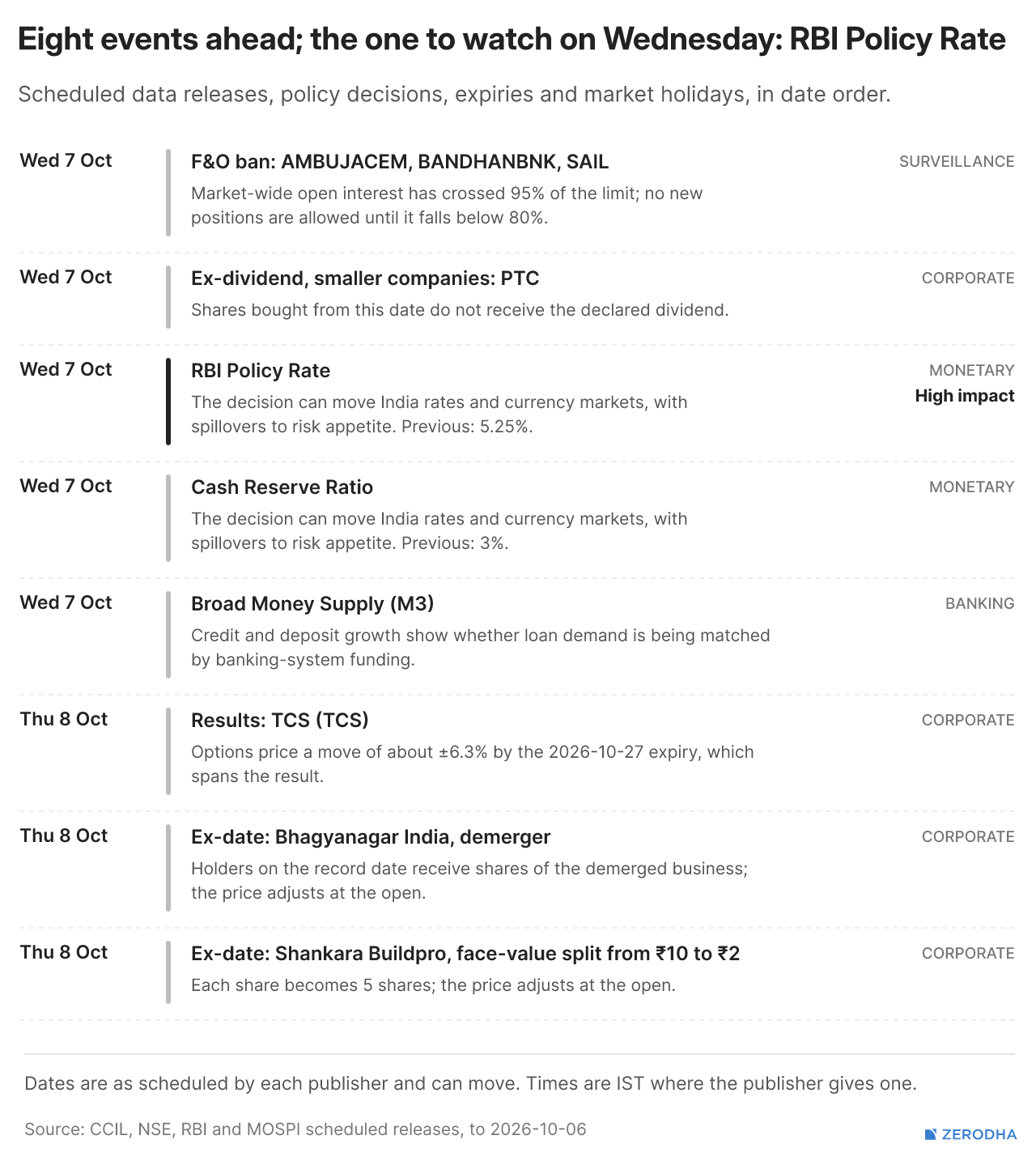
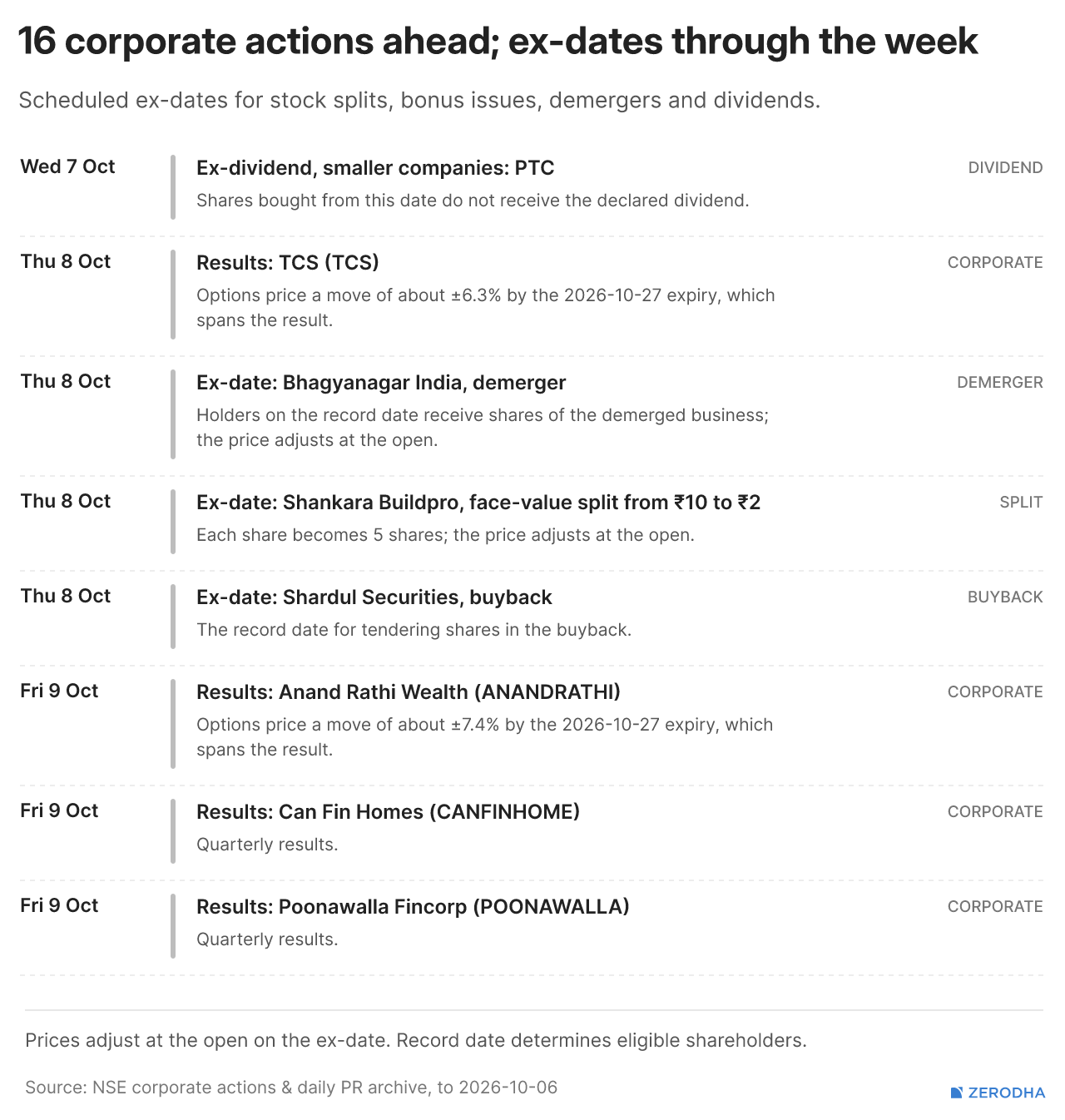
The week ahead & Corporate Actions
Corporate Actions
Published by Zerodha. Not investment advice. Data from NSE, BSE, and MCX.
In our latest episode of In The Money by Zerodha, we start with how covered calls are pitched to investors, as a way to earn “free money” on stocks you already own, and why even Fischer Black, co-creator of the Black-Scholes formula, was skeptical of the idea.
We then look at the history of the strategy, how it was sold by brokers over the decades, and what a behavioral study on Dutch investors revealed about why people find it attractive in theory but less so when they actually see the payoff.
The episode breaks down the mechanics of a covered call with real numbers, what happens when the stock falls, stays flat, or rallies, and why the strategy has a capped upside but nearly full downside.
Finally, we run a backtest on 10 of the most liquid large-cap Indian stocks from January 2022 onward, selling a 5% out-of-the-money call every month, and compare the results stock by stock to see whether covered calls actually add value to a buy-and-hold portfolio in India.
That’s it from us for today. We’d love to hear your feedback in the comments, and feel free to share this with your friends to spread the word!