

Welcome to Aftermarket Report, a newsletter where we do a quick daily wrap-up of what happened in the markets, both in India and globally.
In our latest episode of In The Money by Zerodha, we sit down with Nick Radge, a veteran trader and systematic strategist with nearly 40 years of market experience. From starting as a clerk in 1985 to working at global desks like HSBC and Macquarie, Nick later founded The Chartist and now manages the All Weather Fund.
We trace his evolution from hand-drawn charts in the 1980s to running nine global momentum and trend-following strategies today, exploring why factor momentum dominates his approach and how he builds portfolios to survive volatile markets.
Markets Today
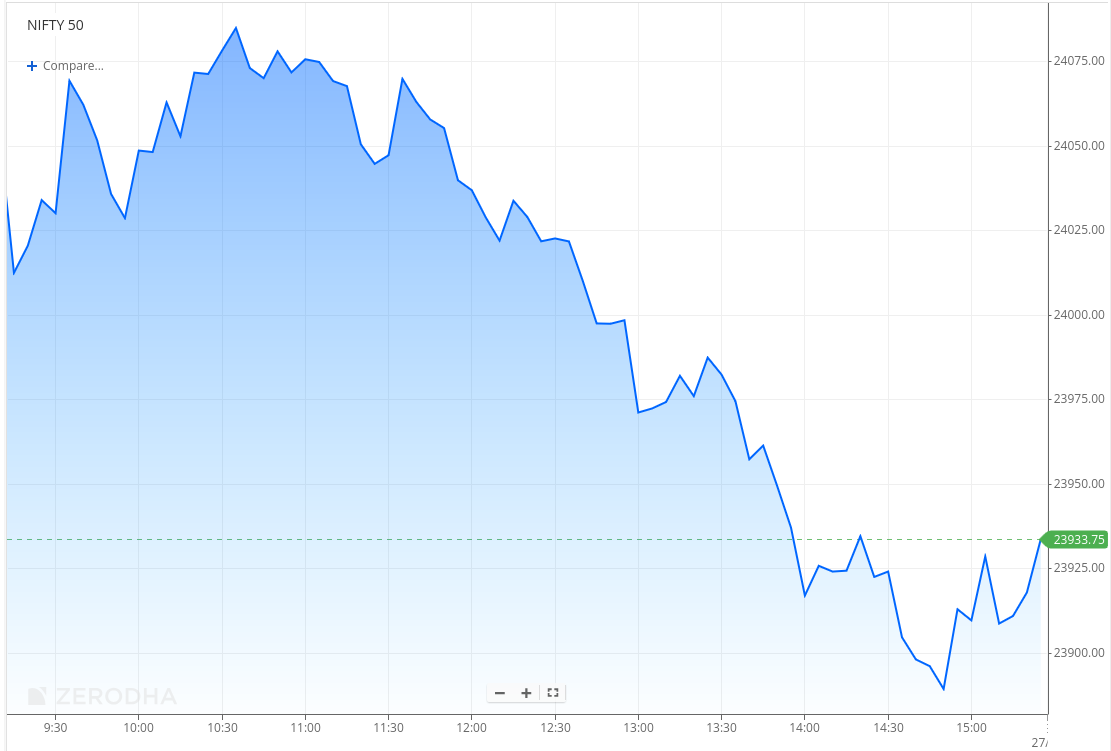
Nifty opened with a small 28-point gap down at 24,004, tracking shaky global cues after the US renewed military operations in southern Iran, even as crude oil prices remained only marginally higher. The index saw some early strength, climbing toward the 24,070–24,080 zone within the first hour.
However, the momentum faded quickly, and Nifty gradually drifted lower through the late morning session, slipping below the 24,000 mark around 12:30 PM and continued to weaken steadily.
In the second half, selling pressure intensified further, dragging Nifty toward the 23,950 zone by around 2 PM. The decline accelerated post 2 PM, with the index slipping sharply toward the 23,890–23,900 range, marking the day’s low in the final hour.
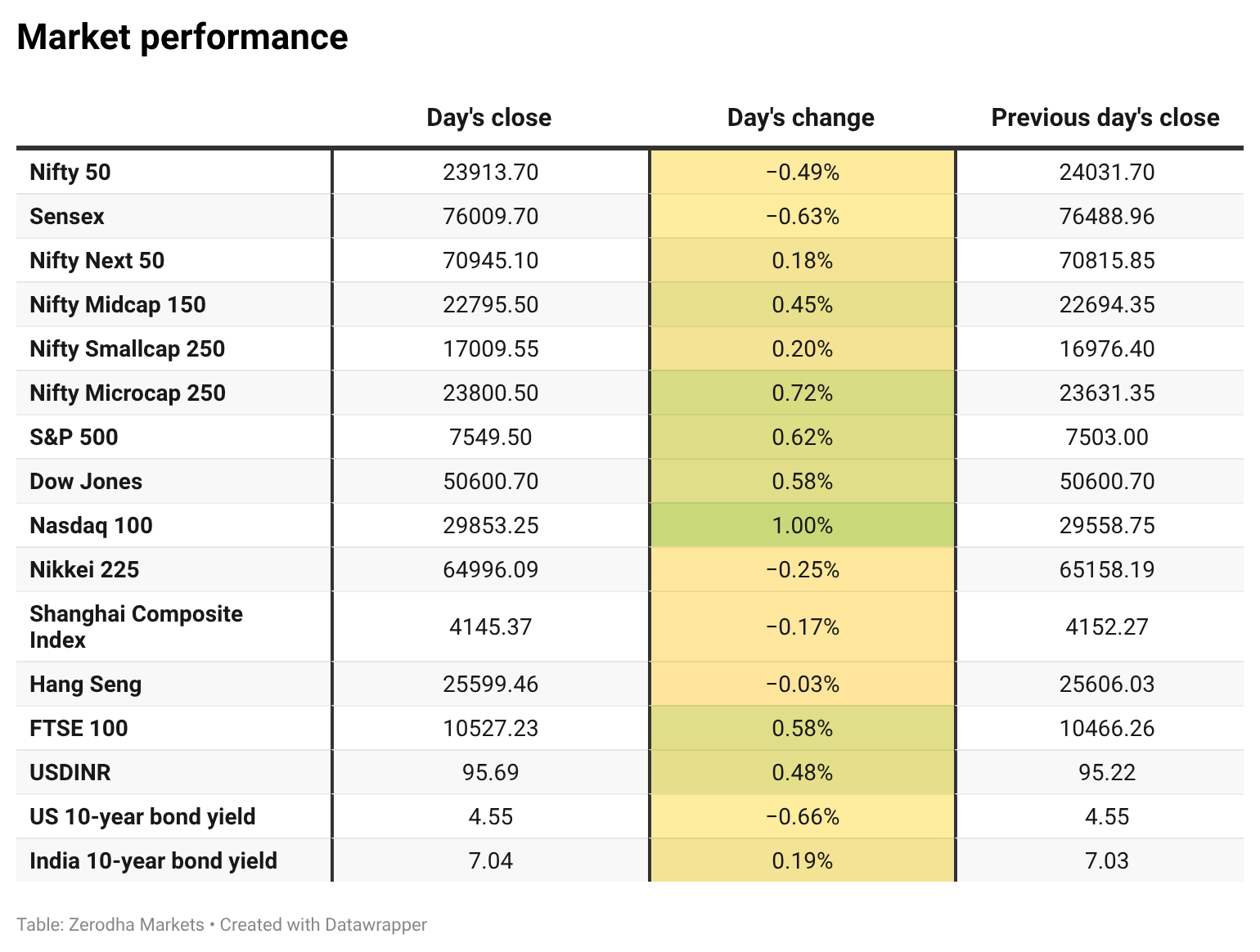
Despite a mild recovery attempt in the last 30 minutes, Nifty closed the day near the lows at 23,913.70. The session was marked by a weak second half, persistent selling pressure, and a lack of follow-through on early gains.
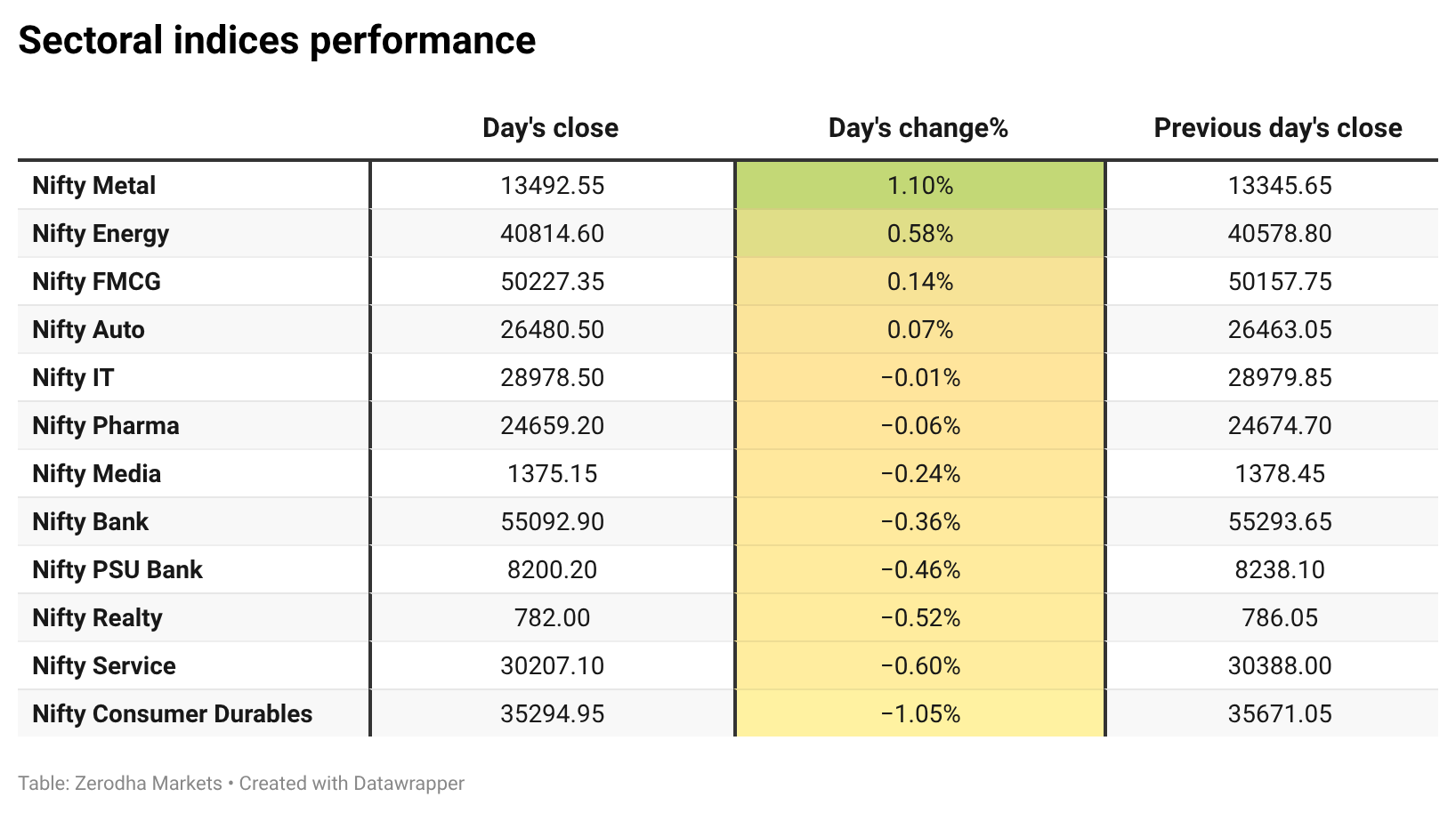
Sectoral Indices Performance
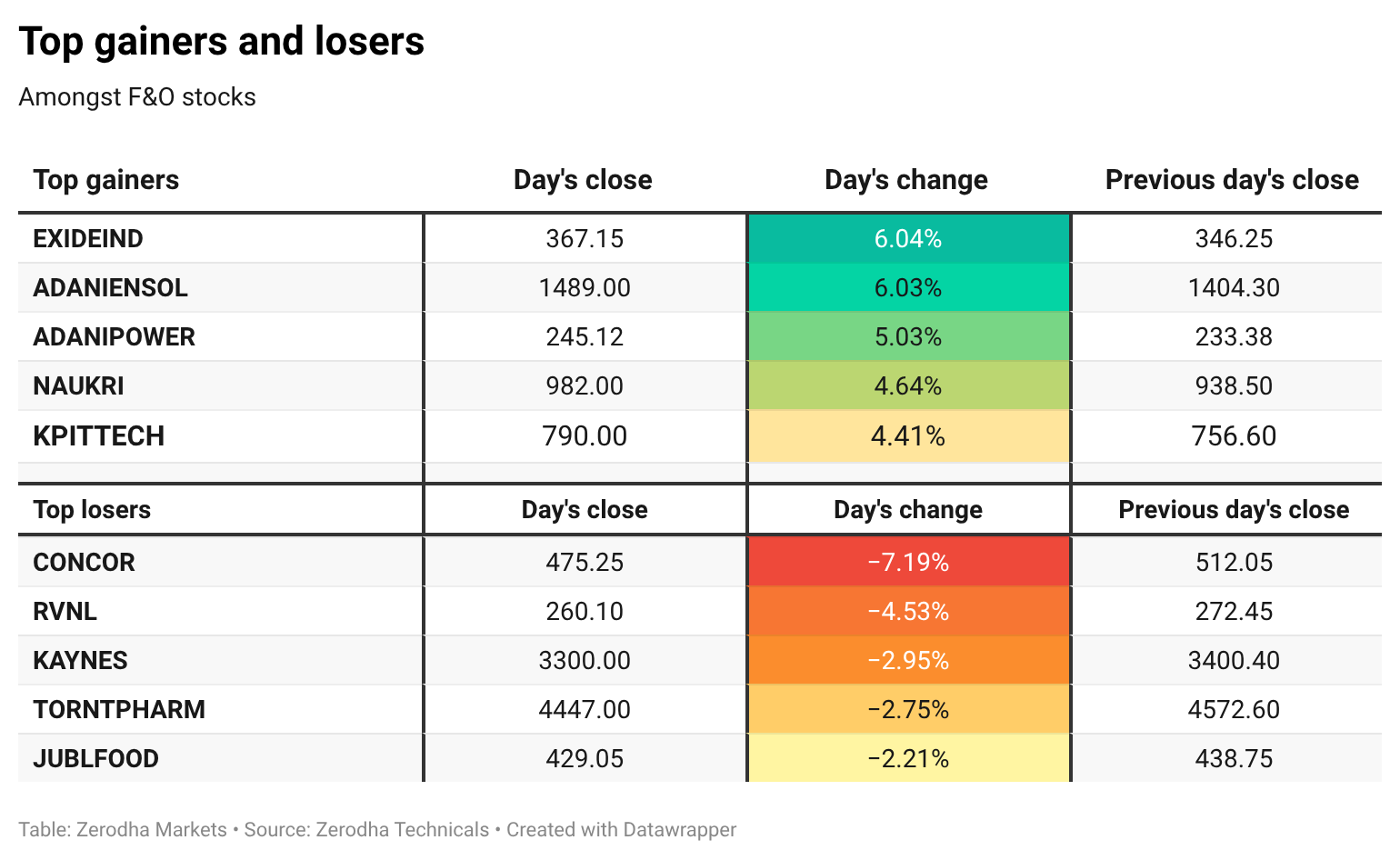
Winners & Losers
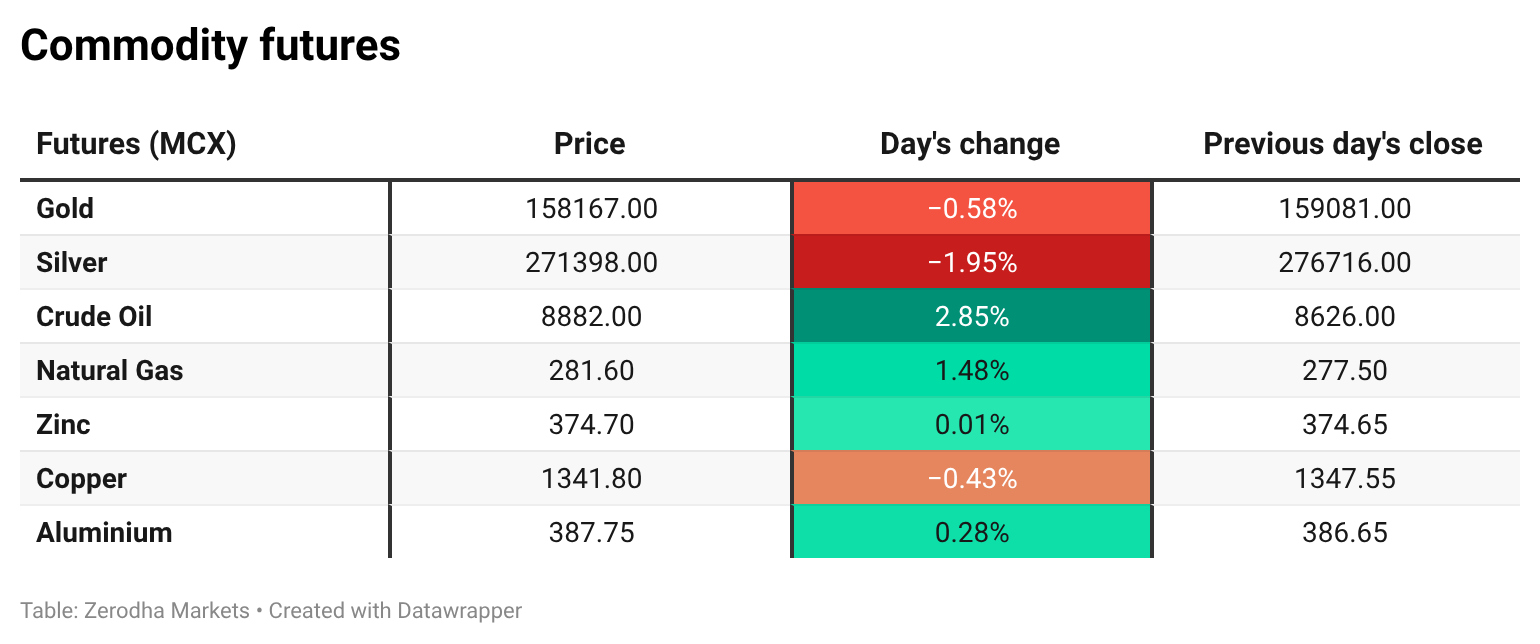
Commodities
FII / DII Flows
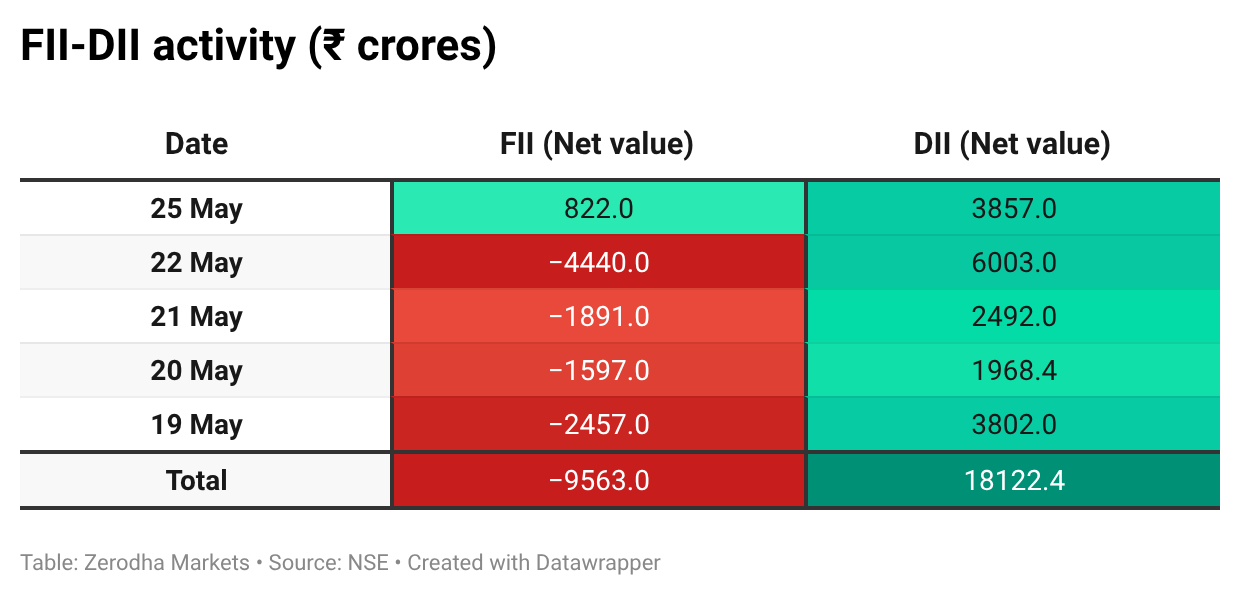
Here’s the trend of FII-DII activity from the last 5 days:
Thematic Indices
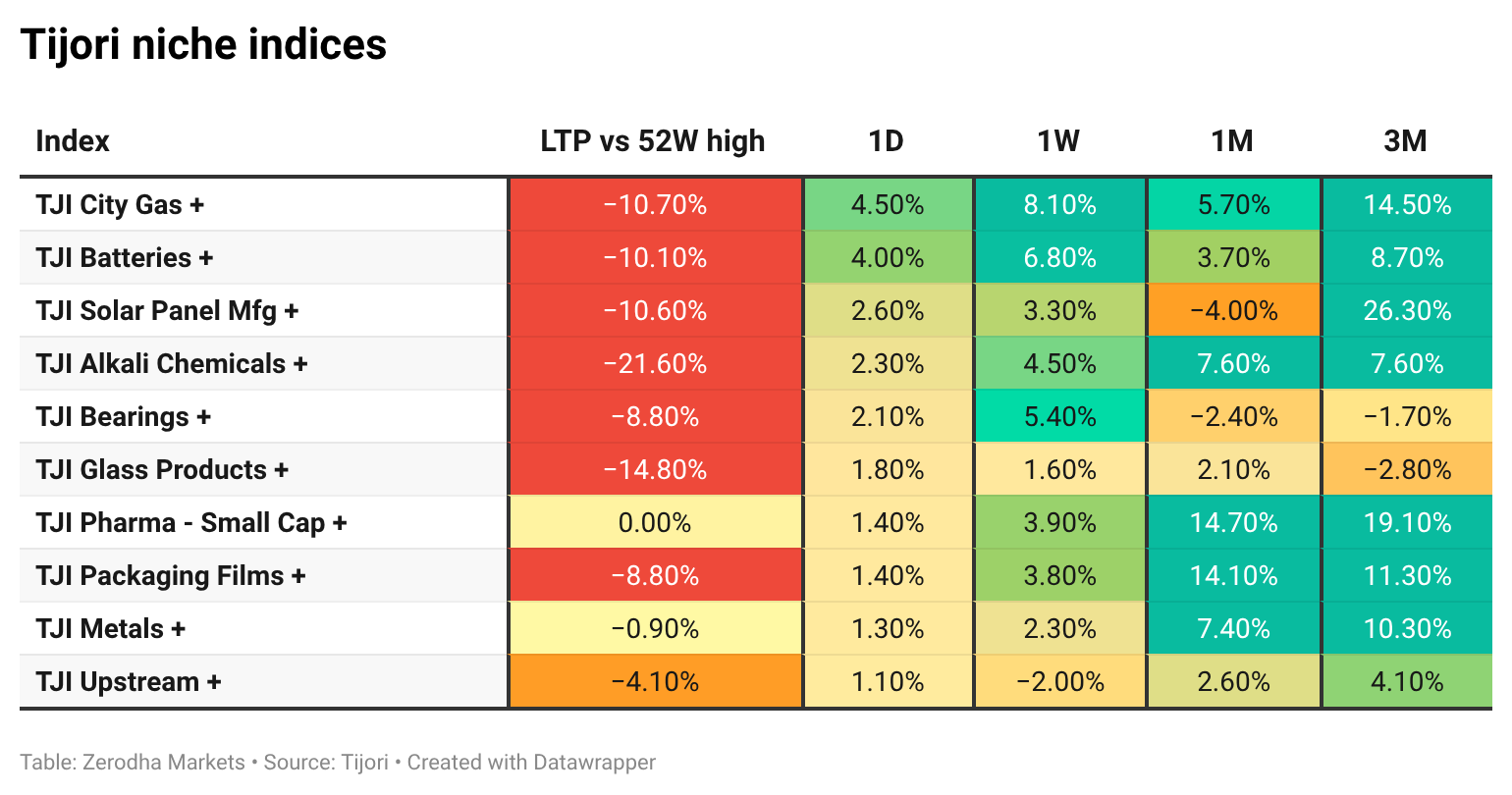
Tijori’s niche indices, where today’s move sorts pockets of the market beyond standard sector baskets. You can also track the Promoter buying and other interesting stuff, like Capex activity by the companies in the Tijori App’s idea dashboard
Change in OI for the day
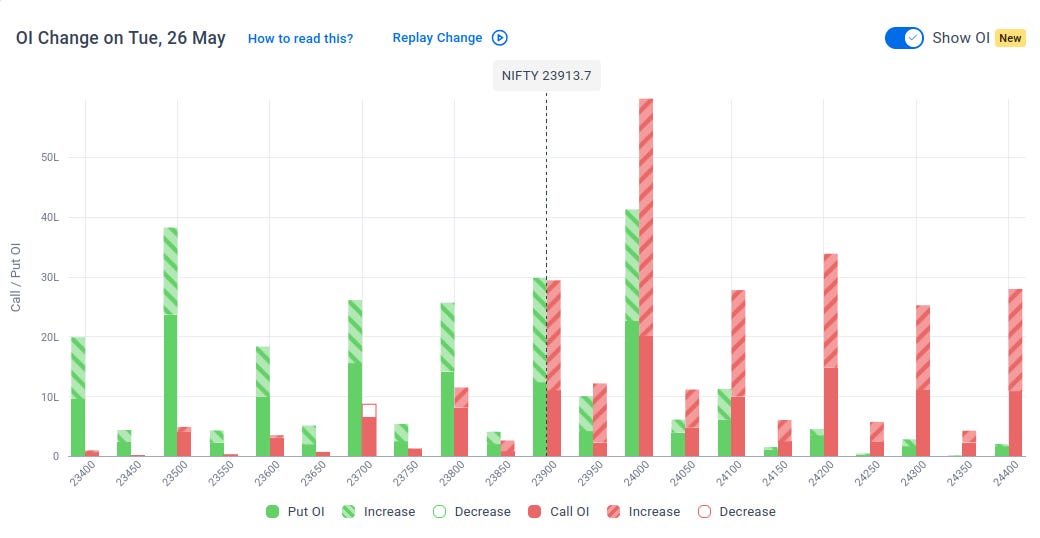
The following is the change in OI for Nifty contracts expiring on 2nd June:
The maximum Call Open Interest (OI) is observed at 24,000, followed by 24,200, indicating potential resistance at the 24,100 -24,200 levels.
The maximum Put Open Interest (OI) is observed at 24,000, followed by 23,500, suggesting support at 23,700-23,600.
Note: OI is subject to multiple interpretations; however, generally, an increase in Call OI indicates resistance in a falling market, while an increase in Put OI indicates support in a rising market.
Source: Sensibull
Top Stories in India
Adani Green Energy has commissioned a 3.37 GWh battery energy storage system at Khavda in Gujarat, making it the world’s largest single-location battery storage deployment outside China. The utility-scale project was completed within 10 months and significantly expands the company’s renewable energy storage capacity. Dive deeper
Marico has entered India’s shampoo market with the launch of Parachute Advansed Protein Shampoo. The range includes eight variants and a ₹1 sachet aimed at driving mass adoption across retail and e-commerce channels. Dive deeper
One MobiKwik Systems shares rose 4% after the company received in-principle approval from the RBI for a Payment Aggregator-Physical (PA-P) licence, strengthening its offline merchant payments business. Dive deeper
Larsen & Toubro said its subsidiary L&T GeoStructure has secured multiple domestic orders, including a contract from JSW Utkal Steel and two projects from the Inland Waterways Authority of India. Dive deeper
India has reportedly cancelled soymeal export contracts and begun importing soybeans for the first time in nearly five years as domestic prices surged amid tightening supplies. Local soymeal prices have jumped around 41% in a month to four-year highs, making export commitments unviable for traders. Dive deeper
BSNL’s revenue has risen nearly 19% to ₹25,000 crore over the past two years, driven by infrastructure improvements. The company also reported a sharp jump in EBITDA to nearly ₹7,000 crore from just ₹50 crore, indicating significant operational improvement. Dive deeper
Top Stories Globally
WTI crude oil futures traded below $93/bbl, near a five-week low, as markets weighed optimism around ongoing US-Iran negotiations against renewed military operations in southern Iran. Dive deeper
Taiwan has overtaken India to become the world’s fifth-largest equity market by market capitalisation, driven largely by the AI-fuelled rally in Taiwan Semiconductor Manufacturing Company. Taiwan’s market cap now stands at about $4.95 trillion, slightly ahead of India’s $4.92 trillion. Dive deeper
Xiaomi reported a sharper-than-expected decline in Q1 2026 earnings, with net profit plunging 57% to 4.72 billion yuan as rising memory chip prices hurt its smartphone business. Revenue fell 11%, marking the company’s first quarterly sales decline in nearly three years. Dive deeper
The yield on the US 10-year Treasury note fell around 6 basis points to 4.5% as investors grew cautiously optimistic that the US and Iran could still reach a near-term agreement despite ongoing tensions and recent military strikes. Dive deeper
Quad members India, the United States, Australia, and Japan have signed a framework to mobilise up to $20 billion for strengthening critical mineral supply chains across mining, processing, and recycling. The initiative aims to reduce dependence on China and improve resilience in strategic technologies and industrial supply chains. Dive deeper
Central Bank of Sri Lanka surprised markets with a 100-basis-point rate hike to 8.75%, its biggest increase in three years, as rising energy costs and currency weakness intensified inflationary pressures. The central bank also signalled the possibility of further tightening amid the ongoing geopolitical crisis in West Asia. Dive deeper
Management Chatter
In this section, we highlight interesting comments from the management of major companies and policymakers in the Indian and Global Economies.
OpenAI CEO Sam Altman, CEO of OpenAI believes that AI would not lead to a global "jobs apocalypse" :
“I’m delighted to be wrong about this. I thought there would have been more impact on entry-level white-collar jobs being eliminated by now than has actually happened.”
“People are like ‘oh you could have saved the world a lot of fear mongering and a lot of doom and gloom’ but at the time I was like ‘I see this is a real risk we should probably talk about it’ and it still may.”
“I don’t think we’re going to have the kind of jobs apocalypse that some of the companies in our space advocate or talk about.” - Link
Coal India assures that, despite peak summer, the coal stock is sufficient to meet demand:
Coal stocks at domestic coal-based plants stood at 47.6 million tonne (MT) as on May 23, while the coal inventory at Coal India’s own mine heads was at a comfortable level of 113.5 MT as on May 24, higher by 10 per cent year-on-year
“This level is sufficient to meet 19 days of consumption. Added to this, around 3 MTs of coal are awaiting at transit points such as goods sheds, private washeries and ports.” - Link
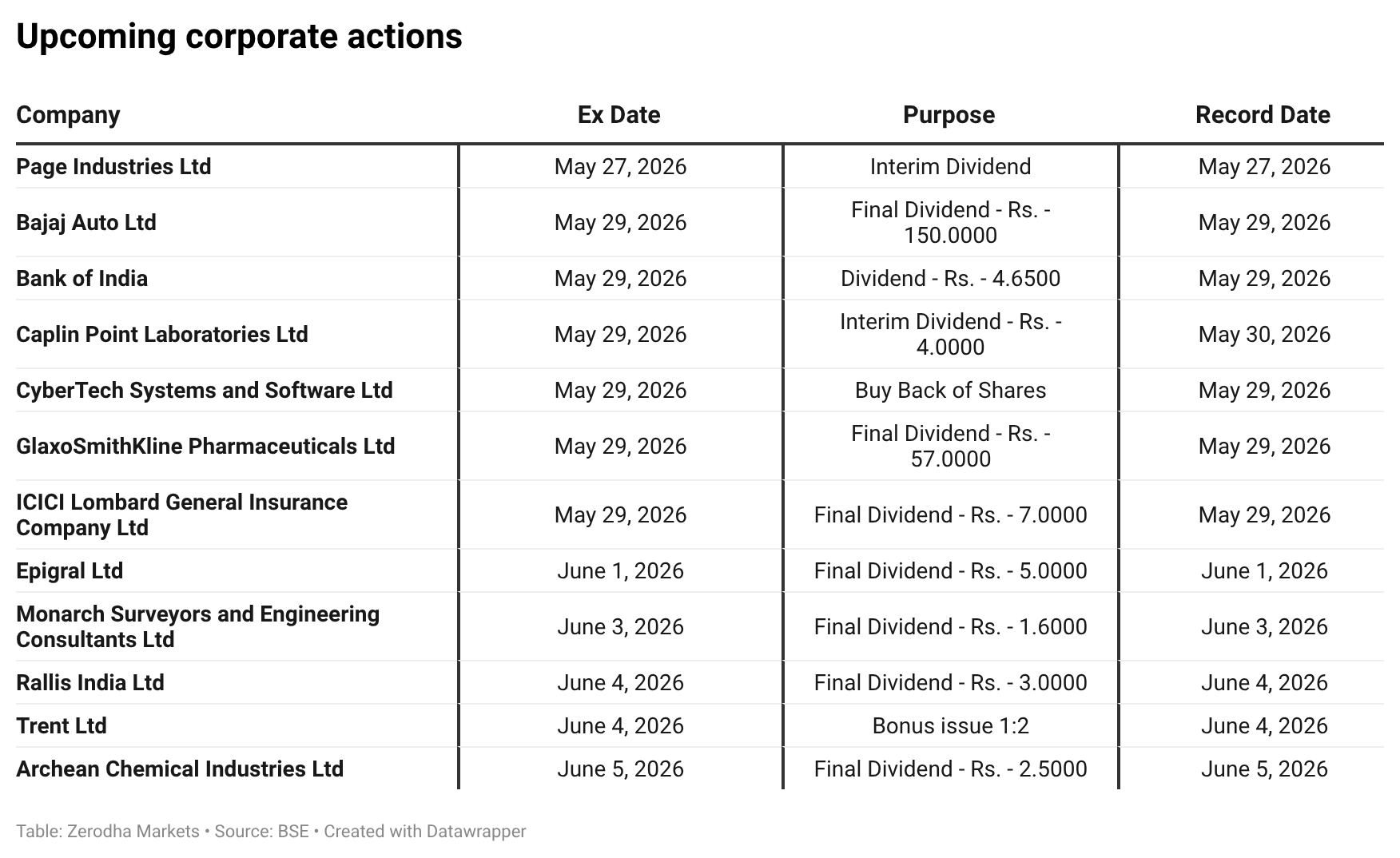
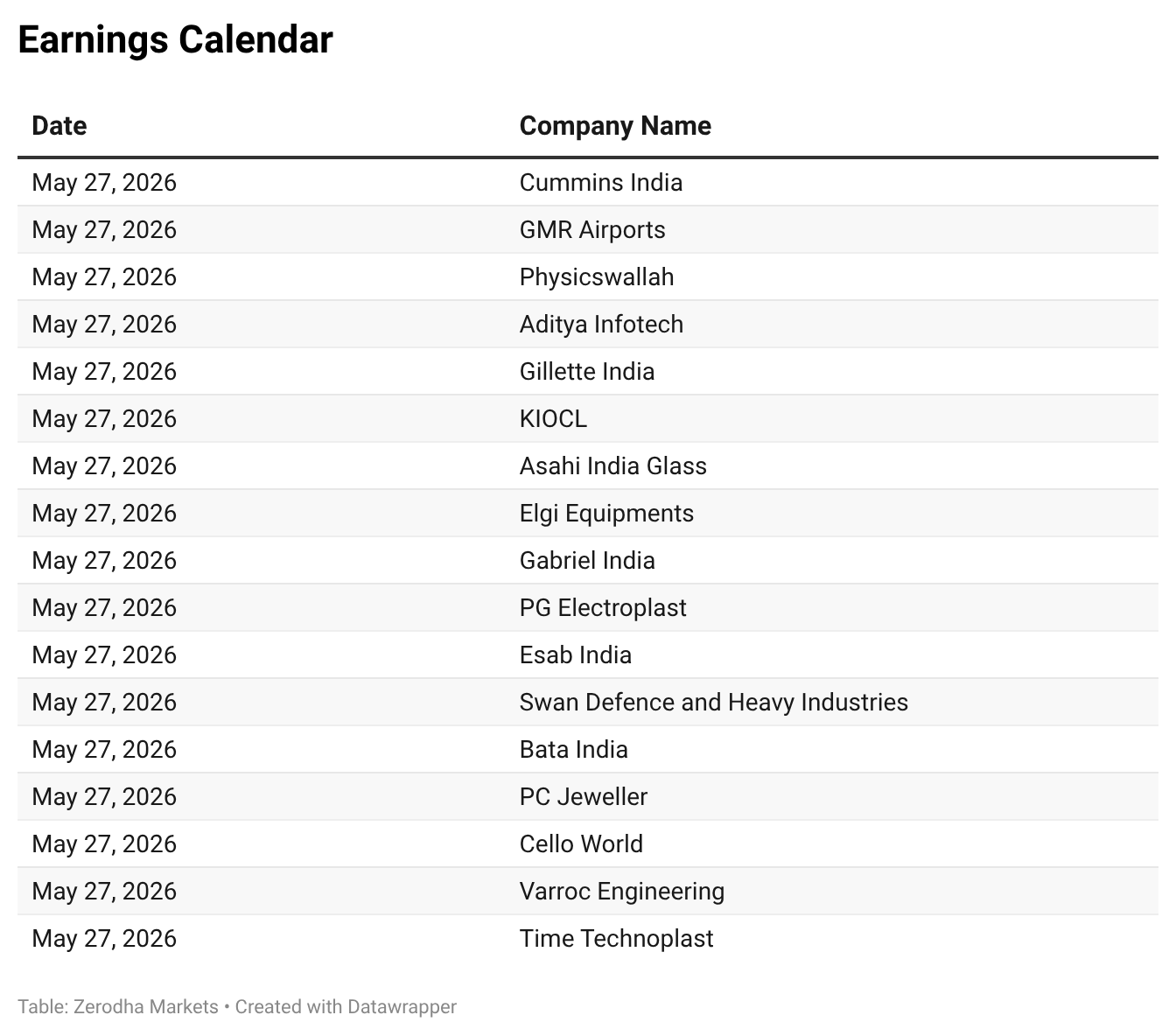
Corporate Actions & Events
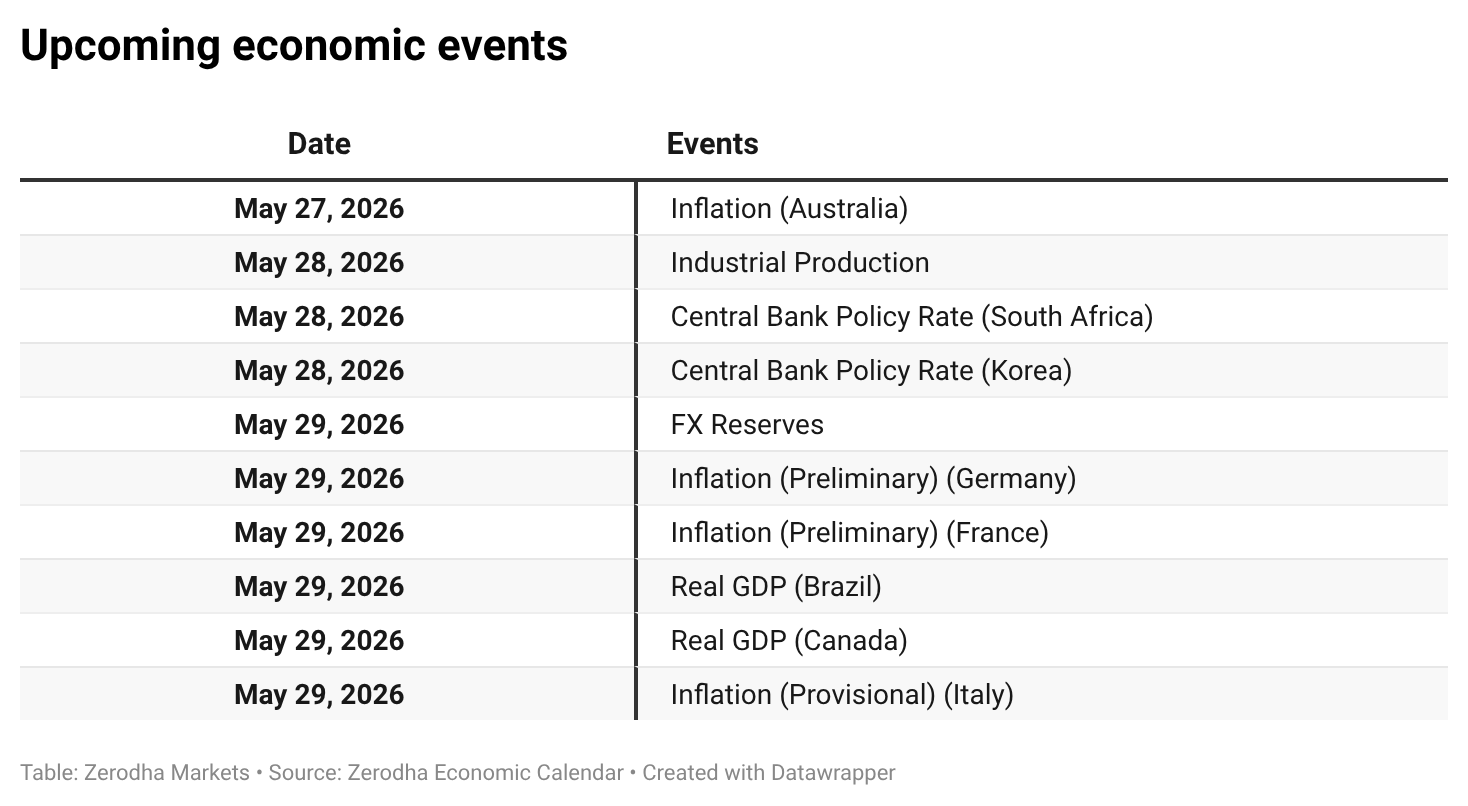
Corporate Actions
Earnings Calendar
Published by Zerodha. Not investment advice. Data from NSE, BSE, and MCX.
That’s it from us for today. We’d love to hear your feedback in the comments, and feel free to share this with your friends to spread the word!