
Welcome to Aftermarket Report, a newsletter where we do a quick daily wrap-up of what happened in the markets, both in India and globally.
What data points and transformations do you want to see?
We’re trying out a new format for the Aftermarket Report, with much more comprehensive coverage of the data that shapes the trading day.
Beyond the headline indices, we’re now tracking market breadth, new highs and lows, sector and thematic performance, delivery data, F&O positioning, global markets, commodities, flows, and more. We’re also looking at ways to transform this raw data into insights that are actually useful for traders and investors.
The idea is simple: bring different datasets together in one place to give you a clearer picture of what’s happening beneath the surface of the market.
This is still a work in progress, and we’d love your feedback. What data points are we missing? What transformations, ratios, comparisons, or indicators would you find useful? Also tell us what worked, what didn’t, and what felt unnecessary.
Your feedback will help shape the Aftermarket Report from here.
Markets Today
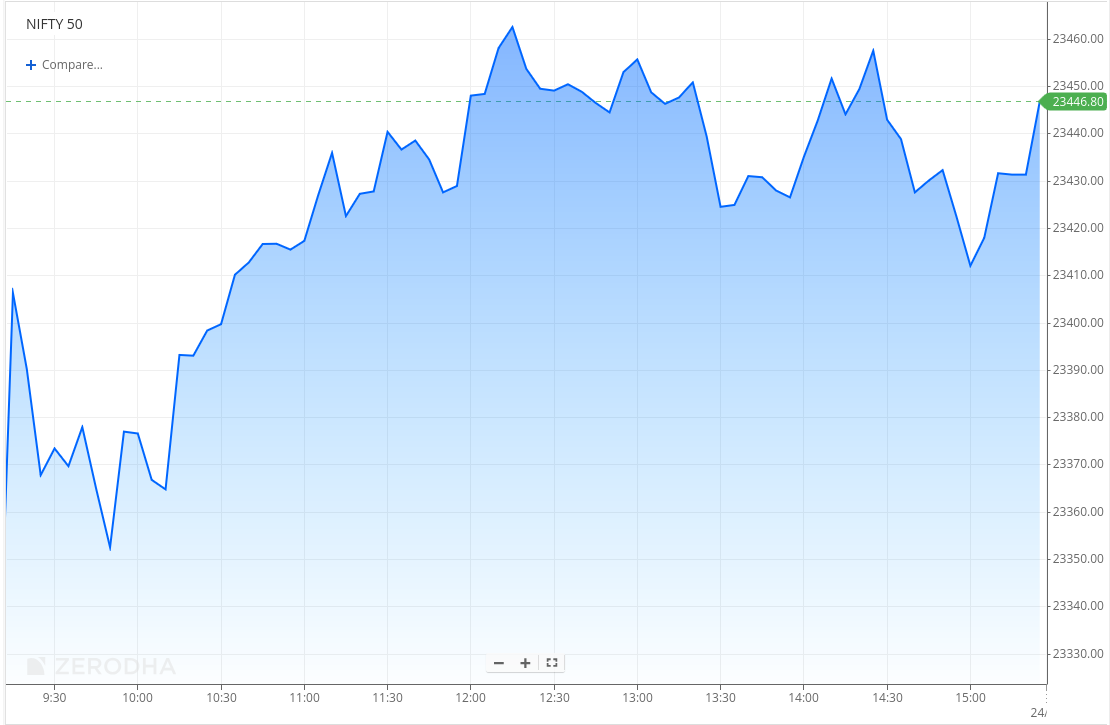
Nifty opened flat with a small 23-point gap up at 23,352, tracking stable global cues, while crude oil continued to hover near the lower end of its recent range, providing some relief compared with the elevated levels seen a couple of weeks ago. The index was volatile in the opening hour, initially rising to 23,410 in the opening minutes before slipping towards 23,350.
Buying gradually emerged thereafter, taking the index back above 23,400 by 10:30 AM and towards 23,440 by 11:30 AM.
The recovery strengthened towards the end of the first half, with Nifty crossing 23,450 and touching around 23,465 shortly after noon. The index largely consolidated in the 23,440–23,455 zone thereafter before briefly slipping towards 23,420 around 1:30 PM. Buying returned quickly, pushing Nifty to 23,460 around 2:30 PM.
The final hour saw some profit-taking, with the index falling towards 23,410, before a late recovery helped it regain ground. Nifty eventually closed at 23,446.80, nearly 95 points above its opening level, after a positive but volatile session.
Fear & Greed Index
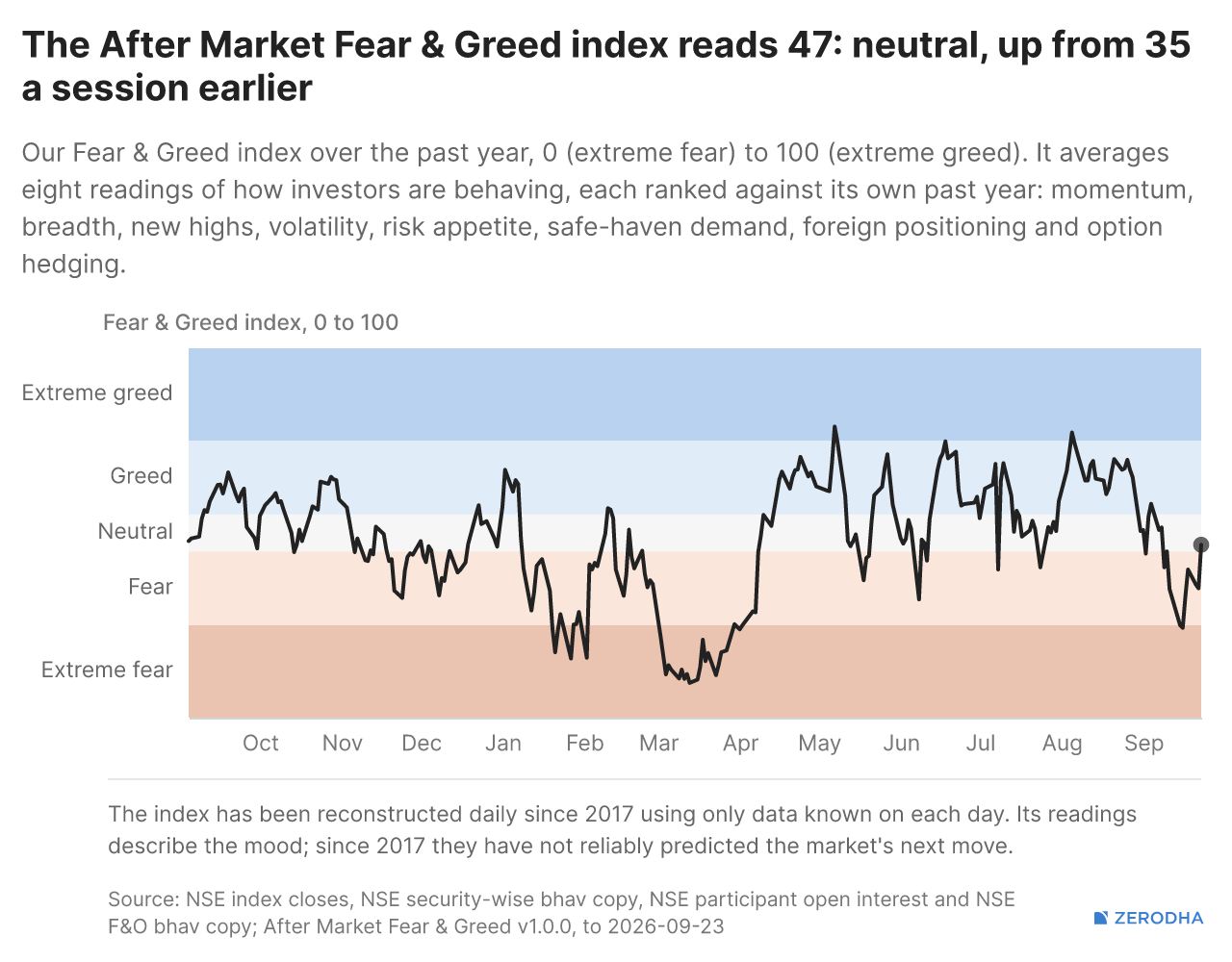
The Fear & Greed Index jumped from 35 to 47, moving back into neutral territory. Improving new highs versus lows and low volatility drove much of the improvement in sentiment.
Market Breadth
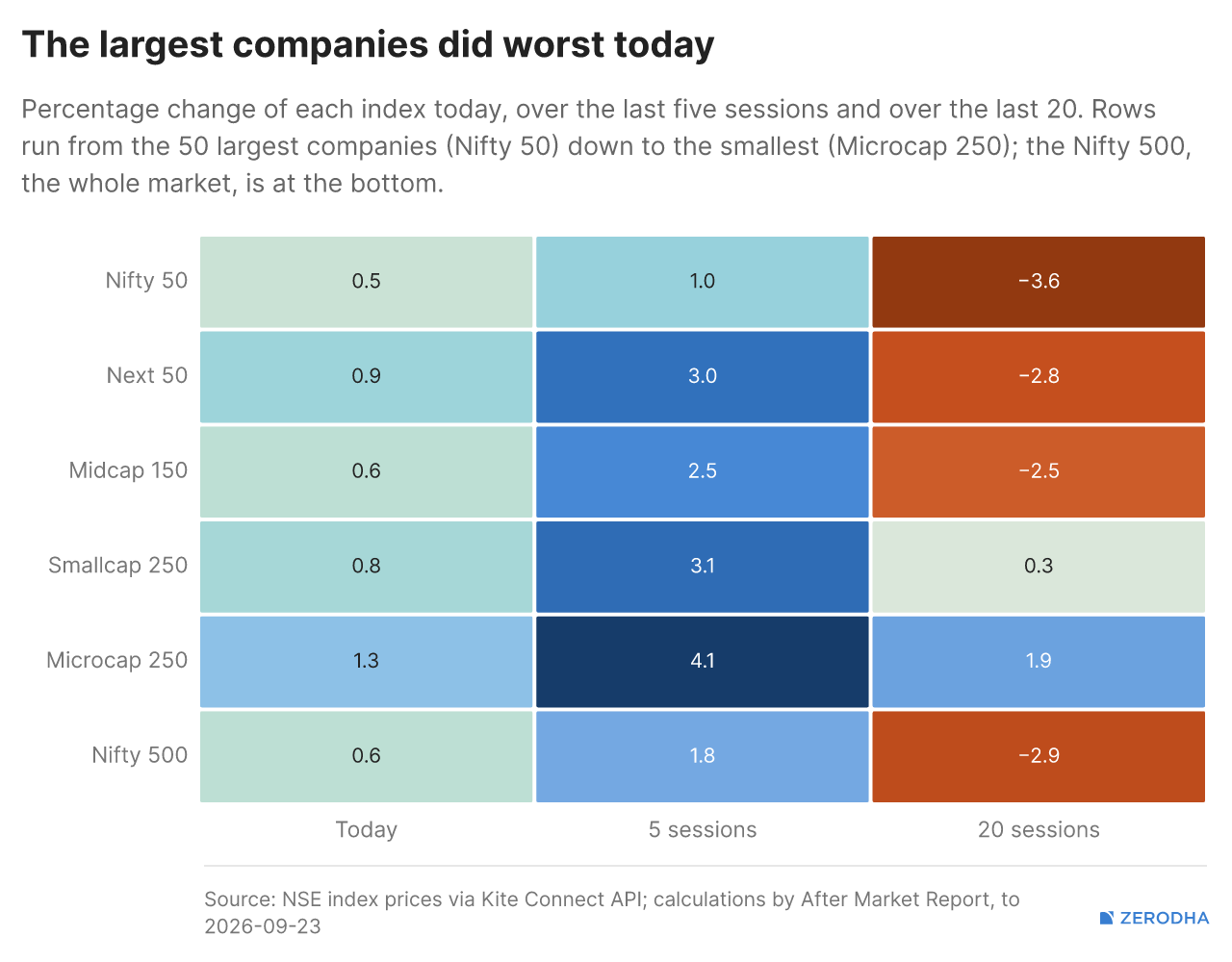
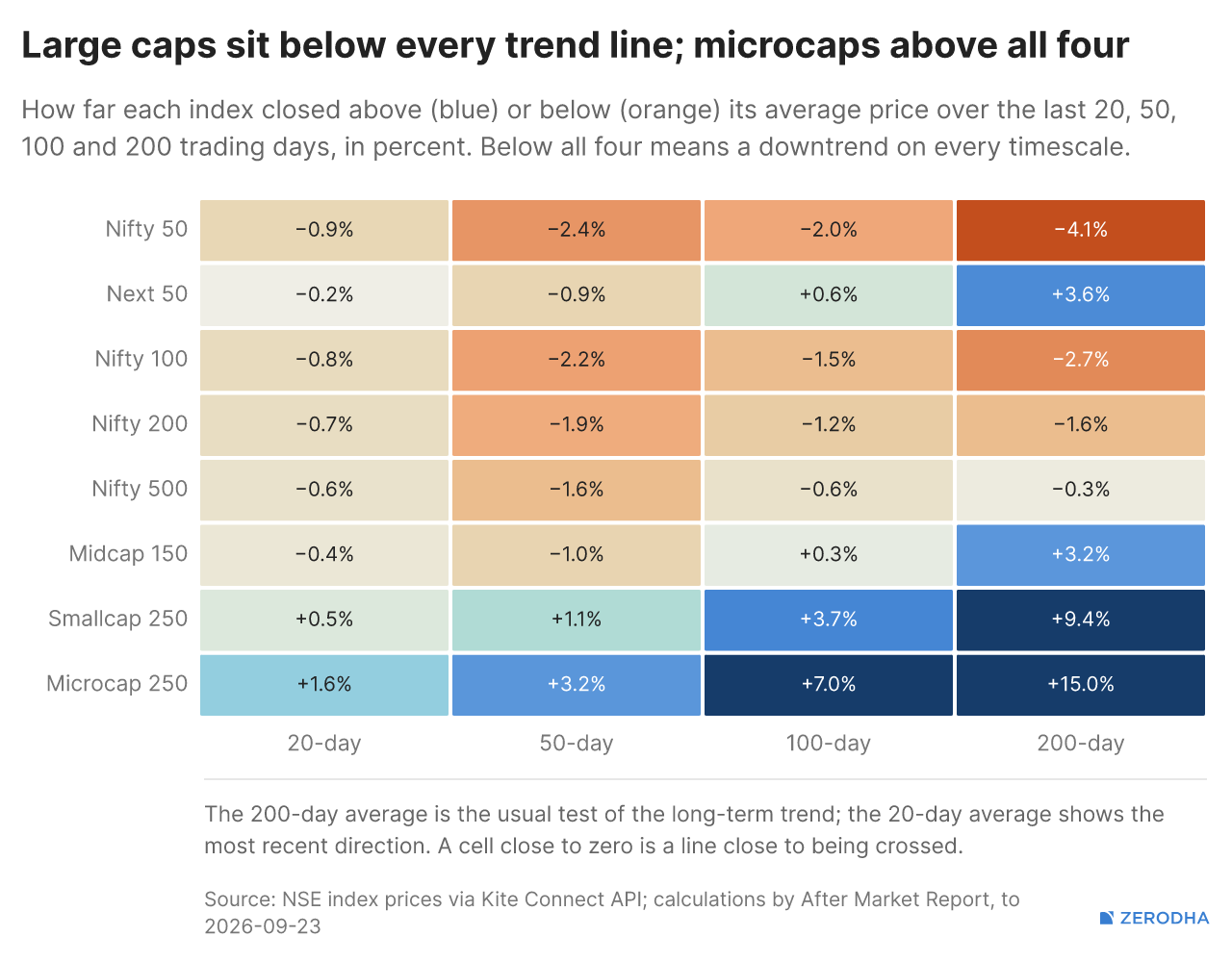
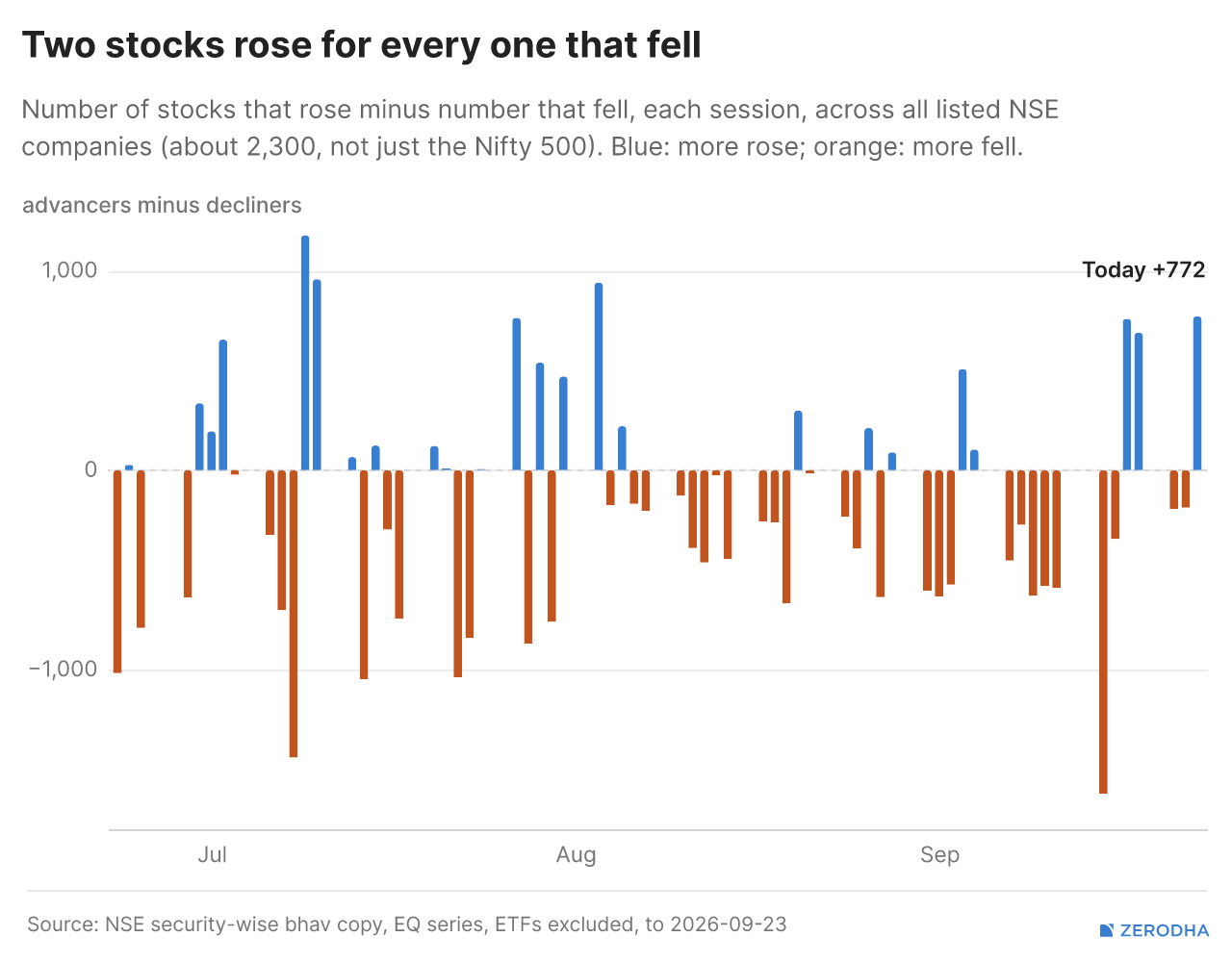
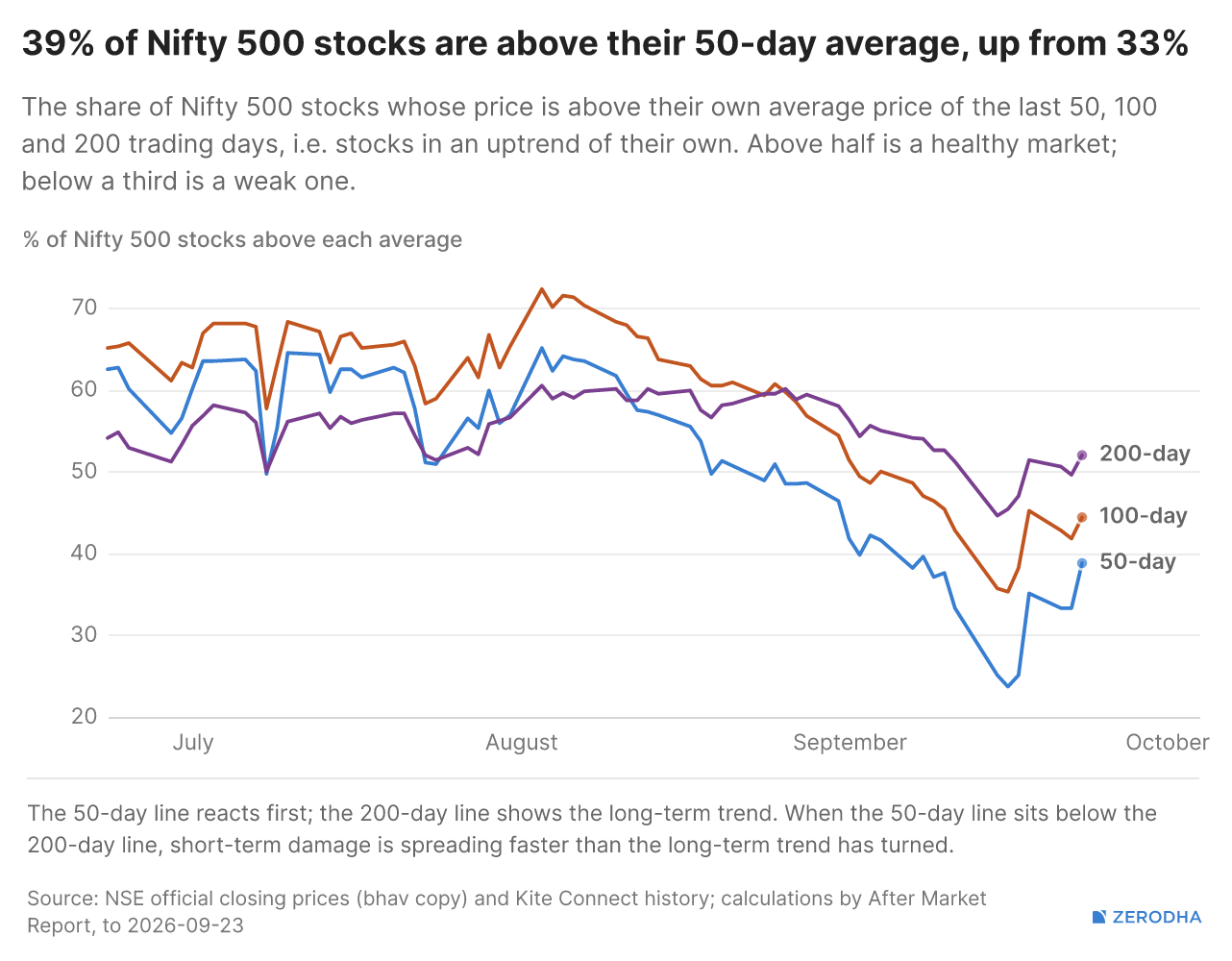
Breadth was strong with 1,532 advancers versus 760 decliners, while the share of Nifty 500 stocks above their 50-day average jumped 5.4 points to 38.8%. Longer-term participation remains weaker, with just over half of eligible NSE stocks above their 200-day average
52 Week Highs & Lows
Sectoral Indices Performance
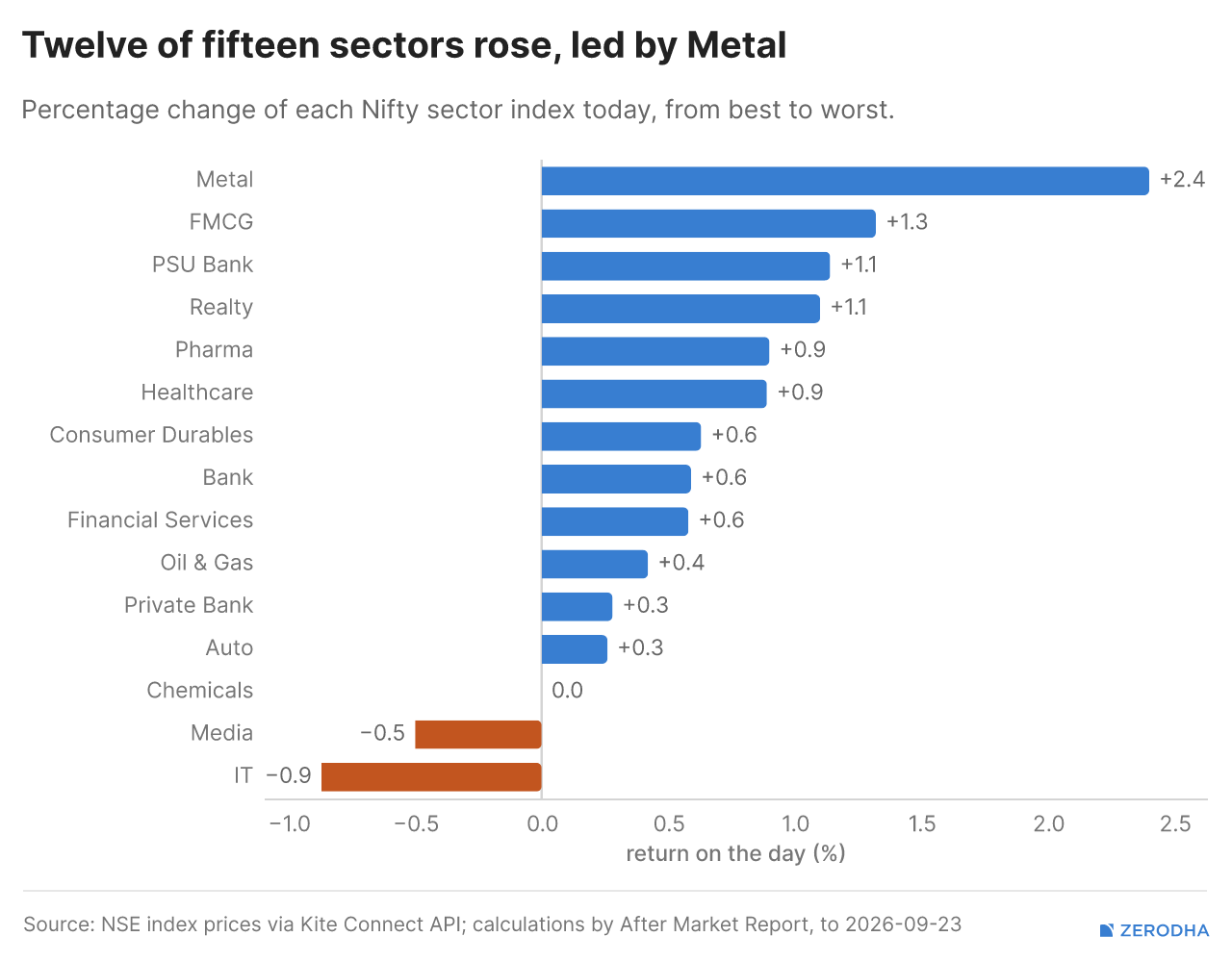
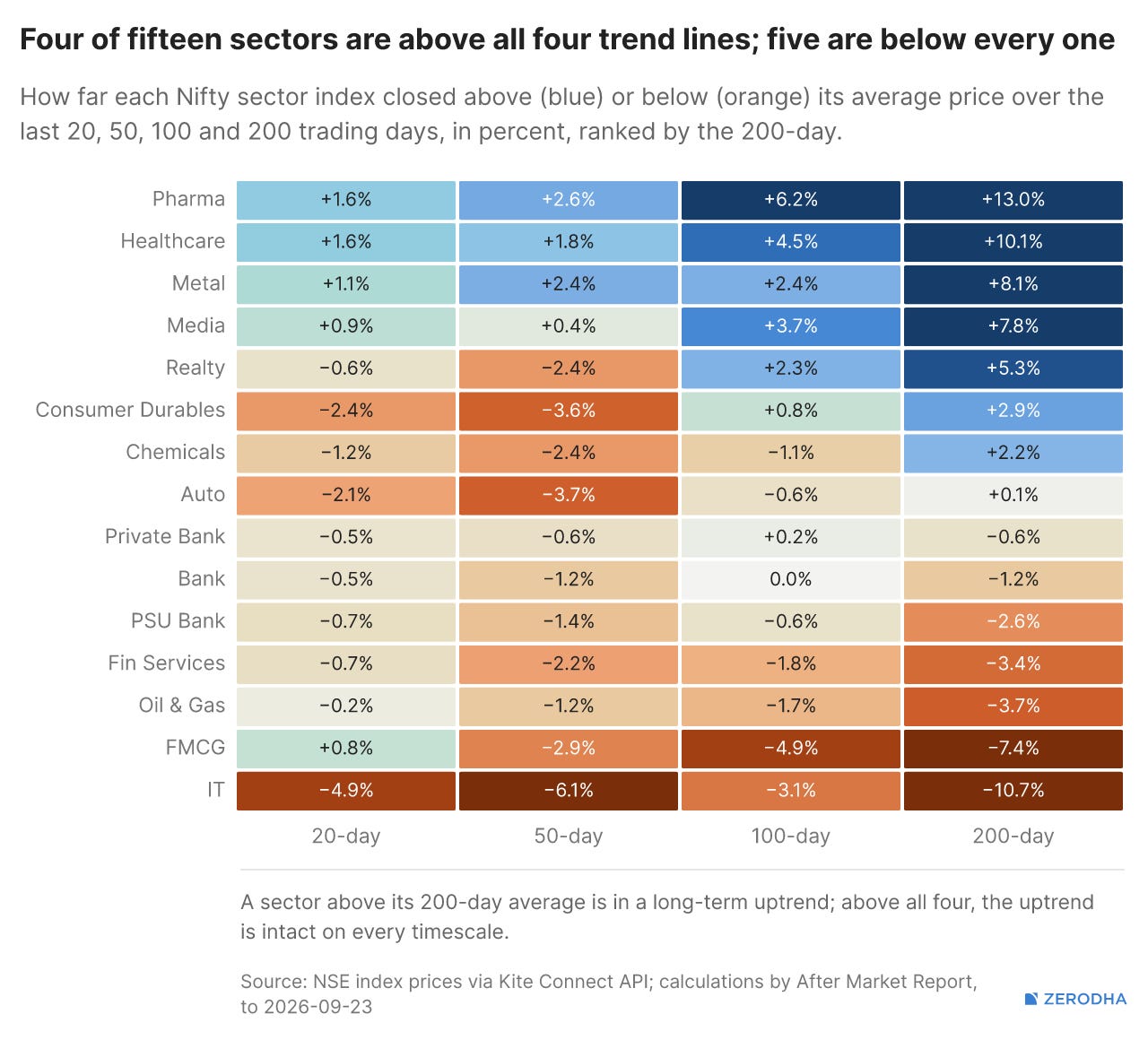
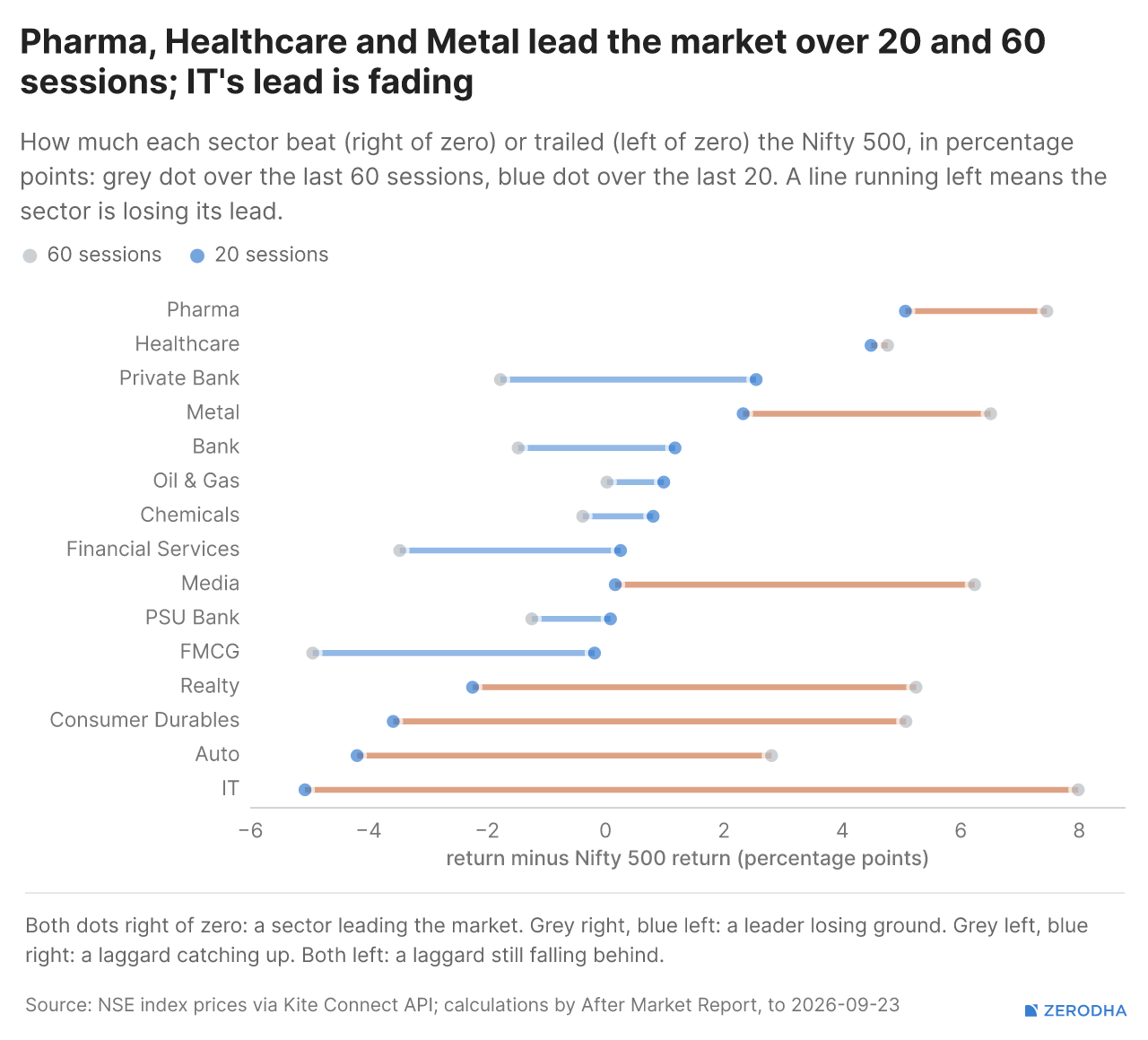
Metals surged 2.40% to lead as 12 of 15 sectors gained, while IT fell 0.87%. Pharma and Healthcare remain the strongest longer-term leaders, while Private Banks and PSU Banks are showing improving short-term relative strength.
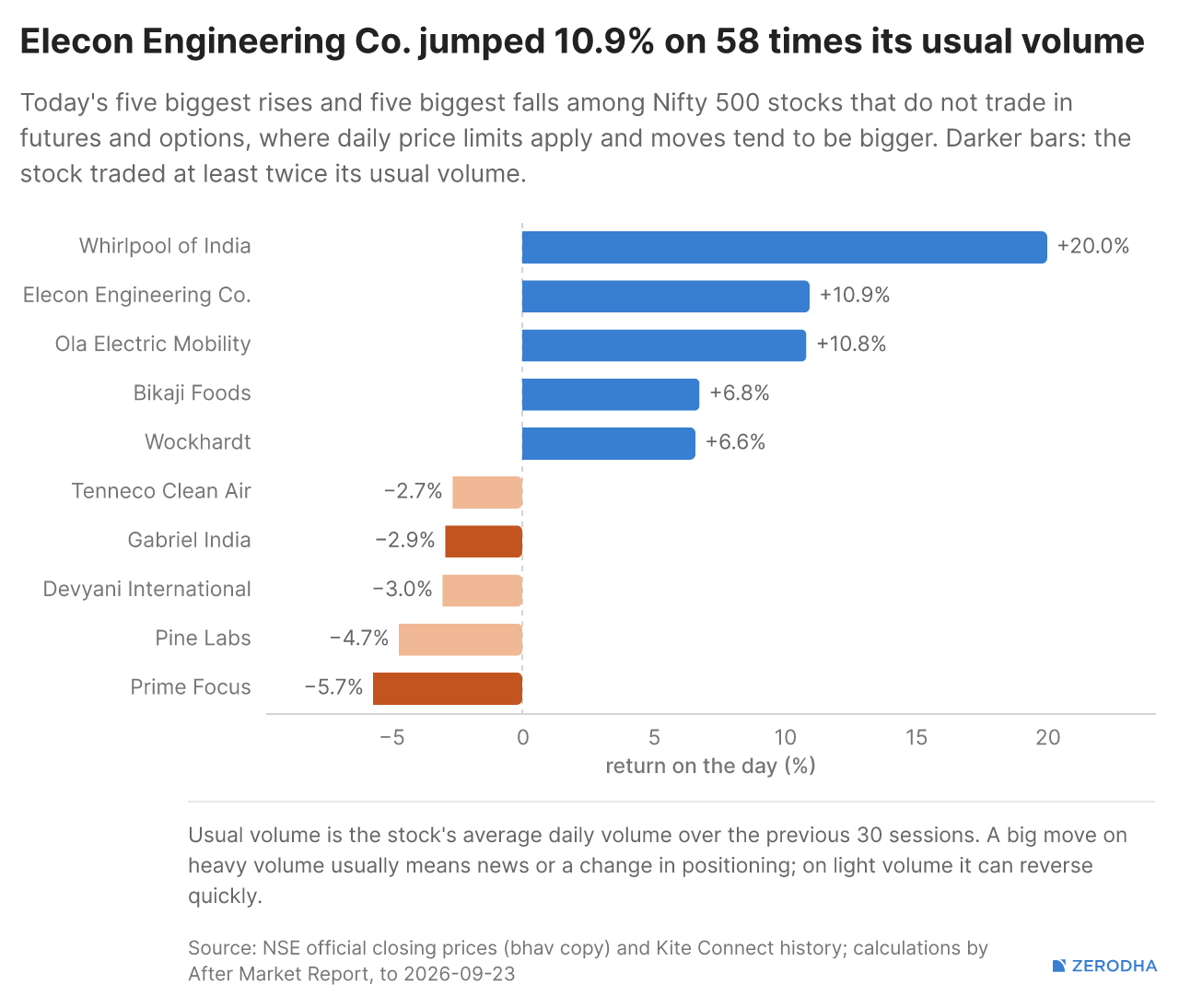
Winners & Losers
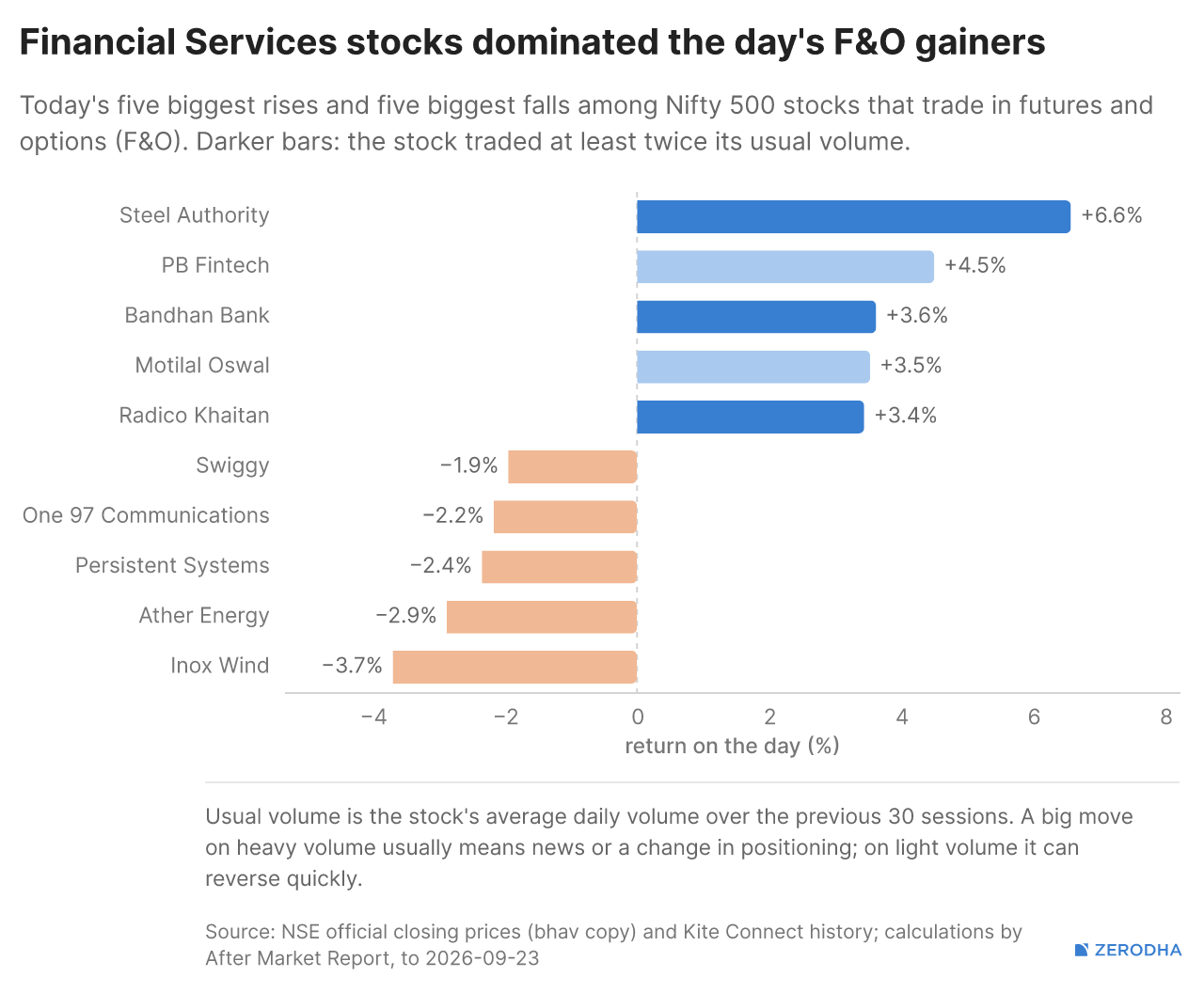
Elecon Engineering jumped 10.95% on 58× usual volume, while Whirlpool surged 20% on 24× volume.
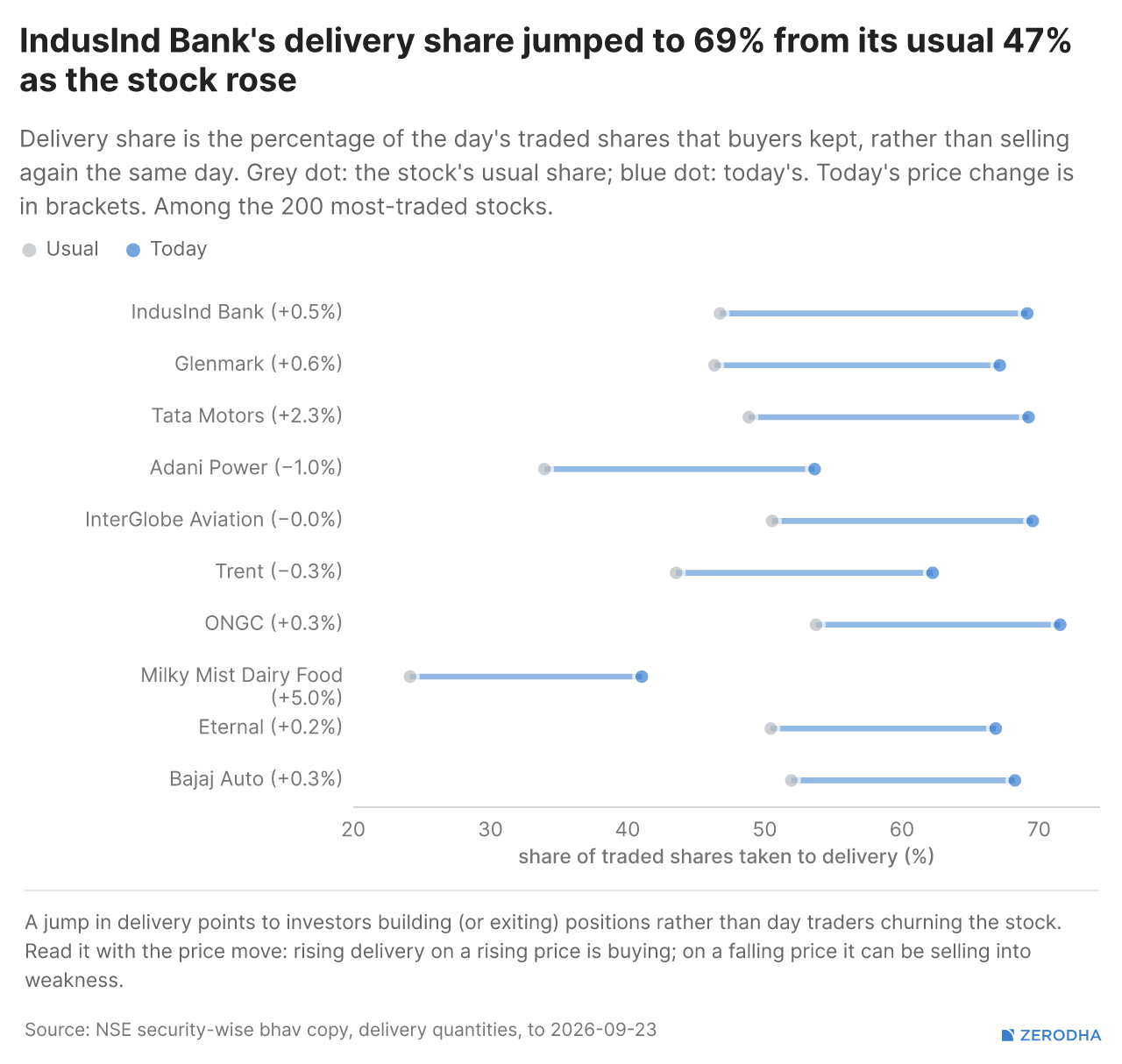
Delivery Data
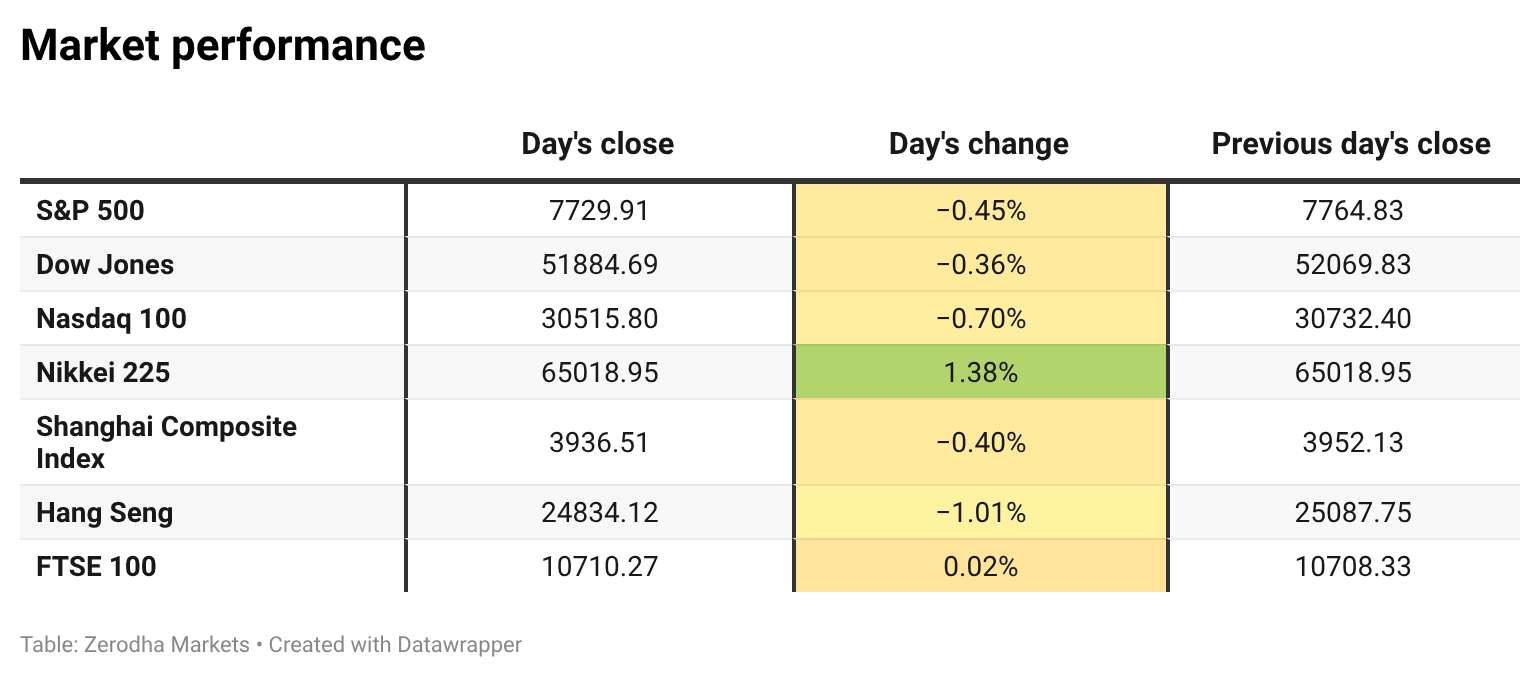
Global Markets
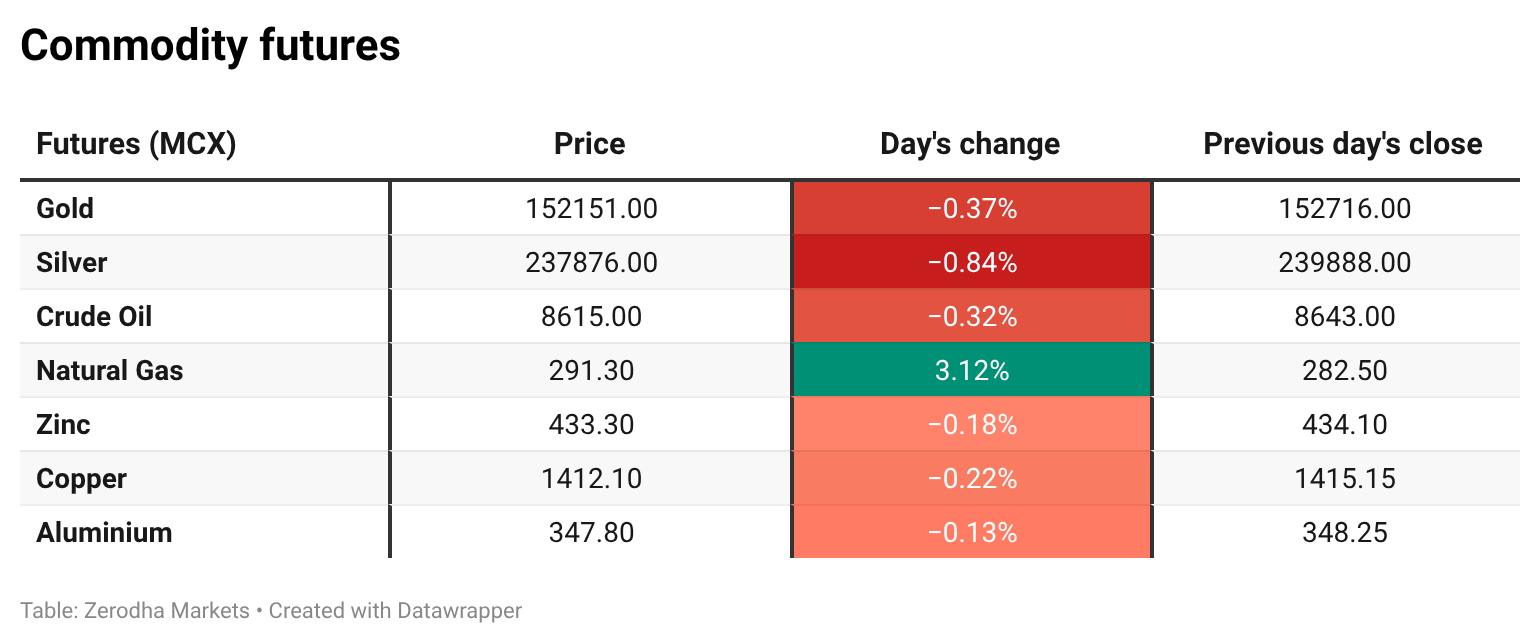
Commodities
Institutional Flows & Participant Positioning
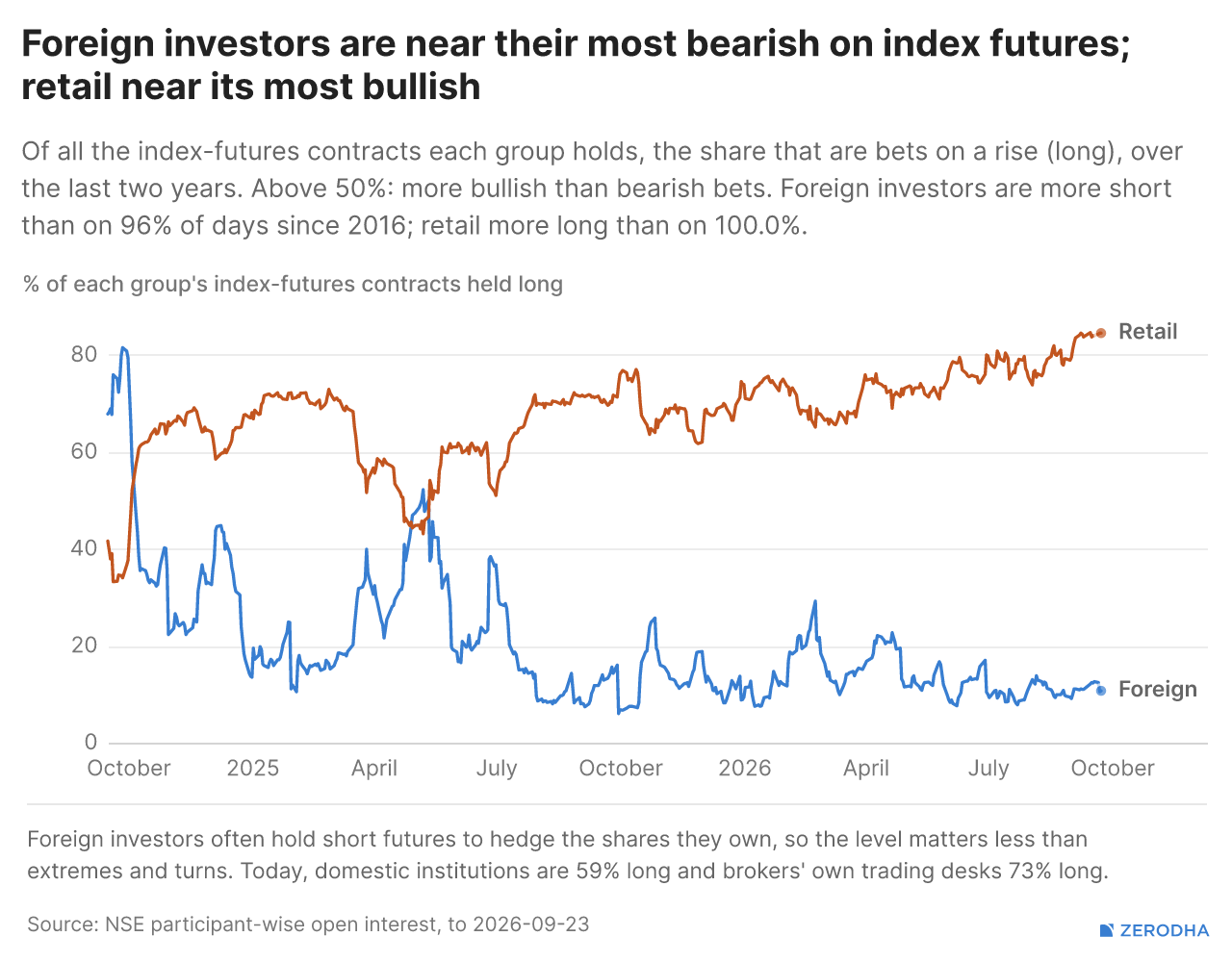
FIIs remain heavily short, with just 10.7% of index-futures positions long.
Thematic Indices
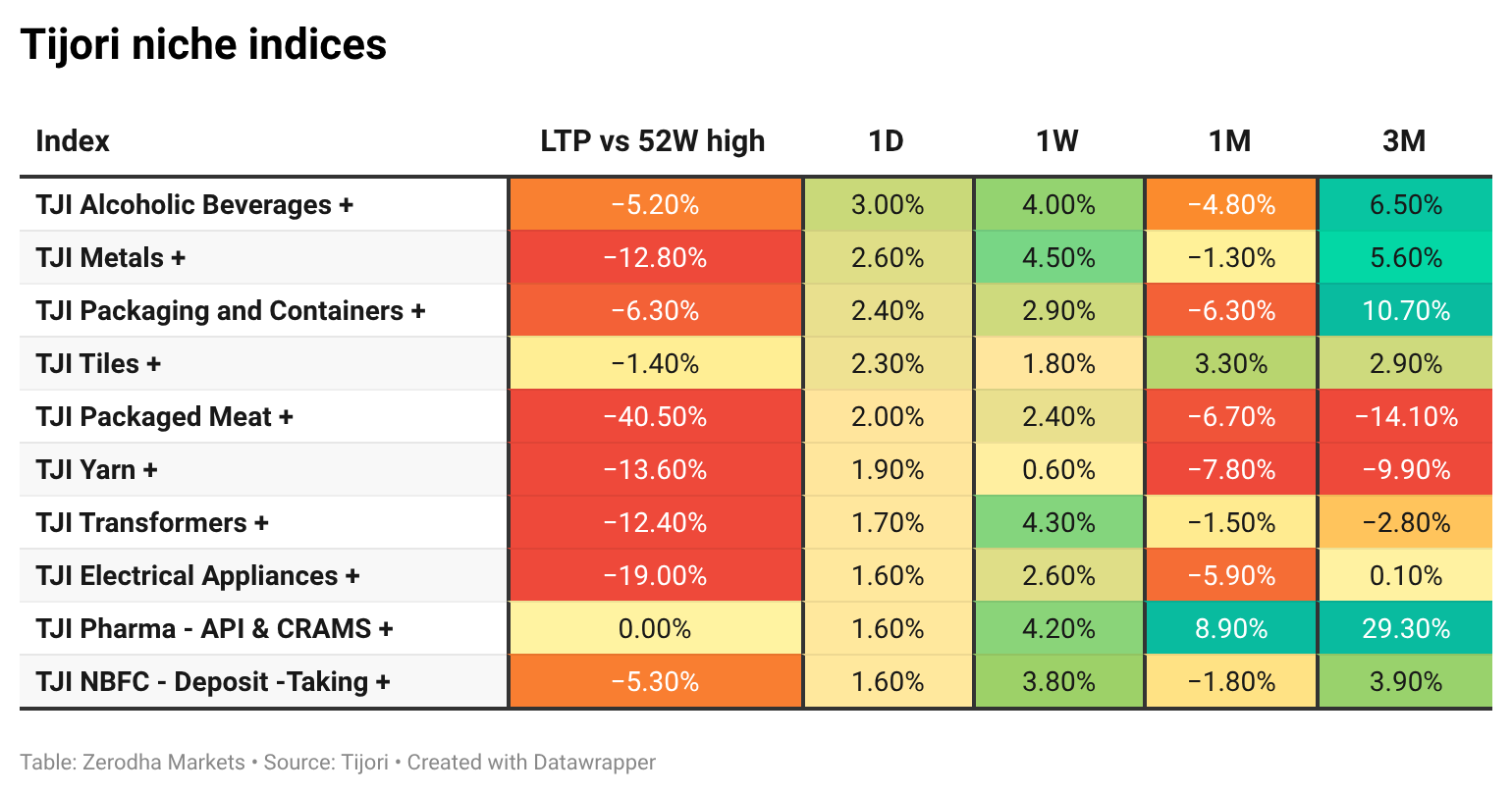
Tijori’s niche indices, where today’s move sorts pockets of the market beyond standard sector baskets. You can also track promoter buying and other interesting stuff, like Capex activity by the companies in the Tijori App’s idea dashboard
F&O Corner
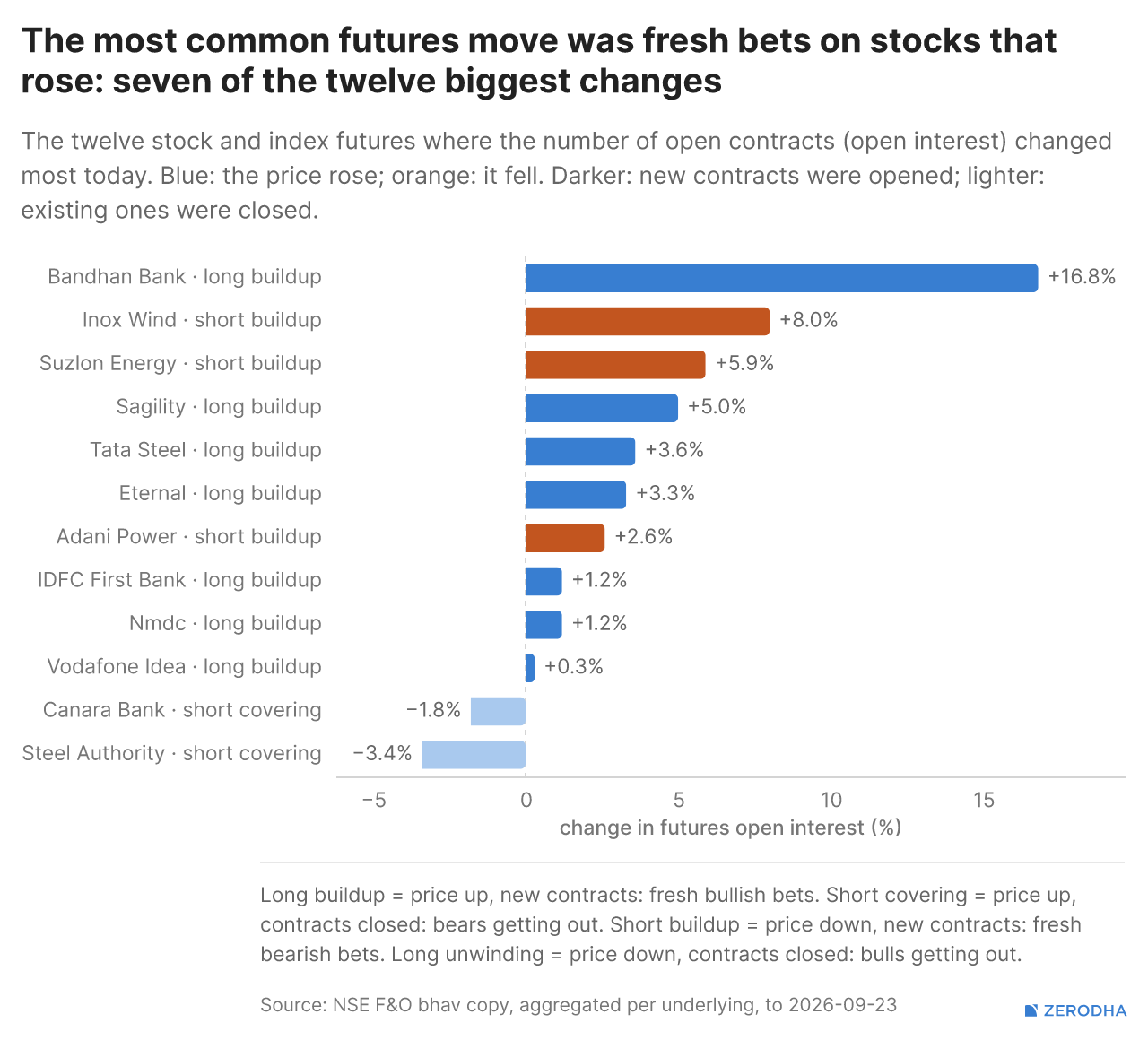
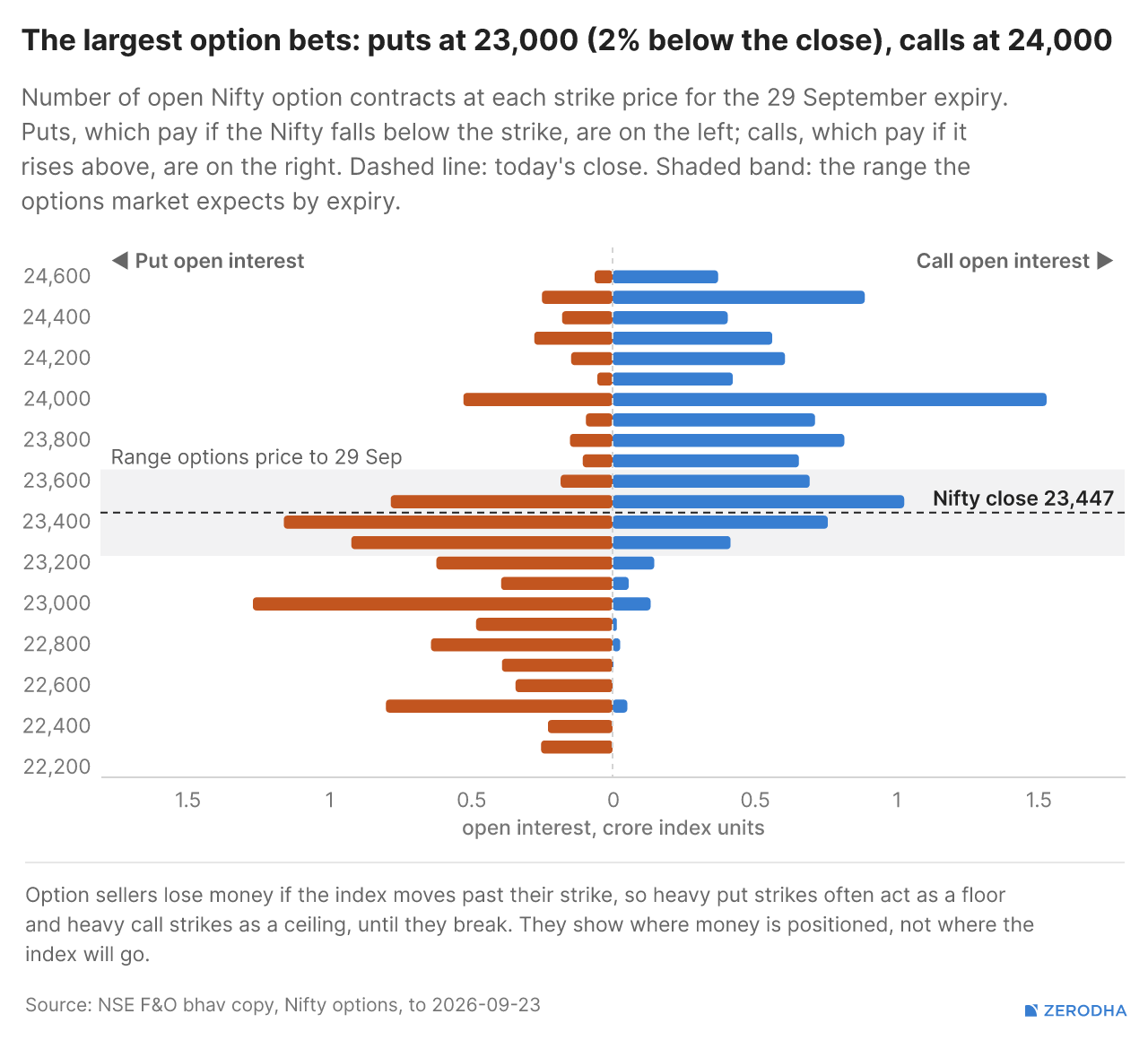
Options price a roughly 212-point move either way into September 29 expiry, while PCR rose from 0.91 to 1.03 as put writers were relatively busier. While seven of the 12 biggest single-stock futures OI moves were long buildups.

Top Stories in India
The Asian Development Bank raised India’s FY27 GDP growth forecast to 7% from 6.6%, citing stronger-than-expected Q1 growth of 7.8%. Robust investment, resilient consumption and strength in manufacturing and services supported the upgrade. Dive deeper
NSE shares will begin trading on the Metropolitan Stock Exchange from September 24 under the “permitted to trade” category. NSE has chosen BSE as its designated stock exchange, but other exchanges can also permit trading in its shares. Dive deeper
The RBI absorbed ₹75,026 crore through an overnight VRRR auction at 5.24% as it continued efforts to manage excess banking-system liquidity. System liquidity remained in surplus by around ₹4.45 lakh crore as of September 22. Dive deeper
Jindal Supreme made a strong market debut, listing 31% above its ₹93 issue price at ₹121.90 on BSE and at ₹120 on NSE. The stock extended gains to close at ₹128. Dive deeper
India’s port volumes rose 7% YoY in August, while global container freight rates were 132% above February levels, according to Jefferies. Middle East tensions, early peak-season shipments and China’s Golden Week contributed to the surge in freight rates. Dive deeper
Airtel Africa’s mobile payments arm Airtel Money Commerce has filed for a London IPO, potentially the city’s largest listing in five years. The proposed offering would allow existing shareholders to sell their stakes. Dive deeper
Top Stories Globally
Brent crude rose 1.3% to $100.58, while WTI gained 0.7% to $91.17, recovering slightly from more-than-two-week lows. Improving Gulf crude supplies kept prices under pressure, while diesel refining margins hit a record high amid possible US export restrictions. Dive deeper
The dollar index rose 0.36% to 100.92, its strongest level in nearly two months, amid expectations of further US rate hikes. The euro fell to $1.1405 and sterling to $1.3273, although easing oil prices could temper the inflation and rate outlook. Dive deeper
Verizon is investing $70 million in a nationwide AI training initiative for job seekers, small businesses and educators. It aims to train hundreds of thousands of people using resources from IBM, Google, Anthropic, Microsoft and OpenAI. Dive deeper
The average 30-year fixed US mortgage rate rose 15 bps to 7.12%, its highest level since May 2024. The increase followed the Fed’s rate hike and higher Treasury yields driven by inflation and oil-price concerns. Dive deeper
Management Chatter
In this section, we highlight interesting comments from management at major companies and from policymakers in the Indian and Global Economies.
Rallis India MD & CEO Gyanendra Shukla on farm-input demand in India:
“When rainfall certainty is very low, farmers tend to save on resources,”
“Farmers are not very certain of full harvest as they would have anticipated.”
“There will be compression in the overall use of crop protection products, fertilisers and seed,” - Link
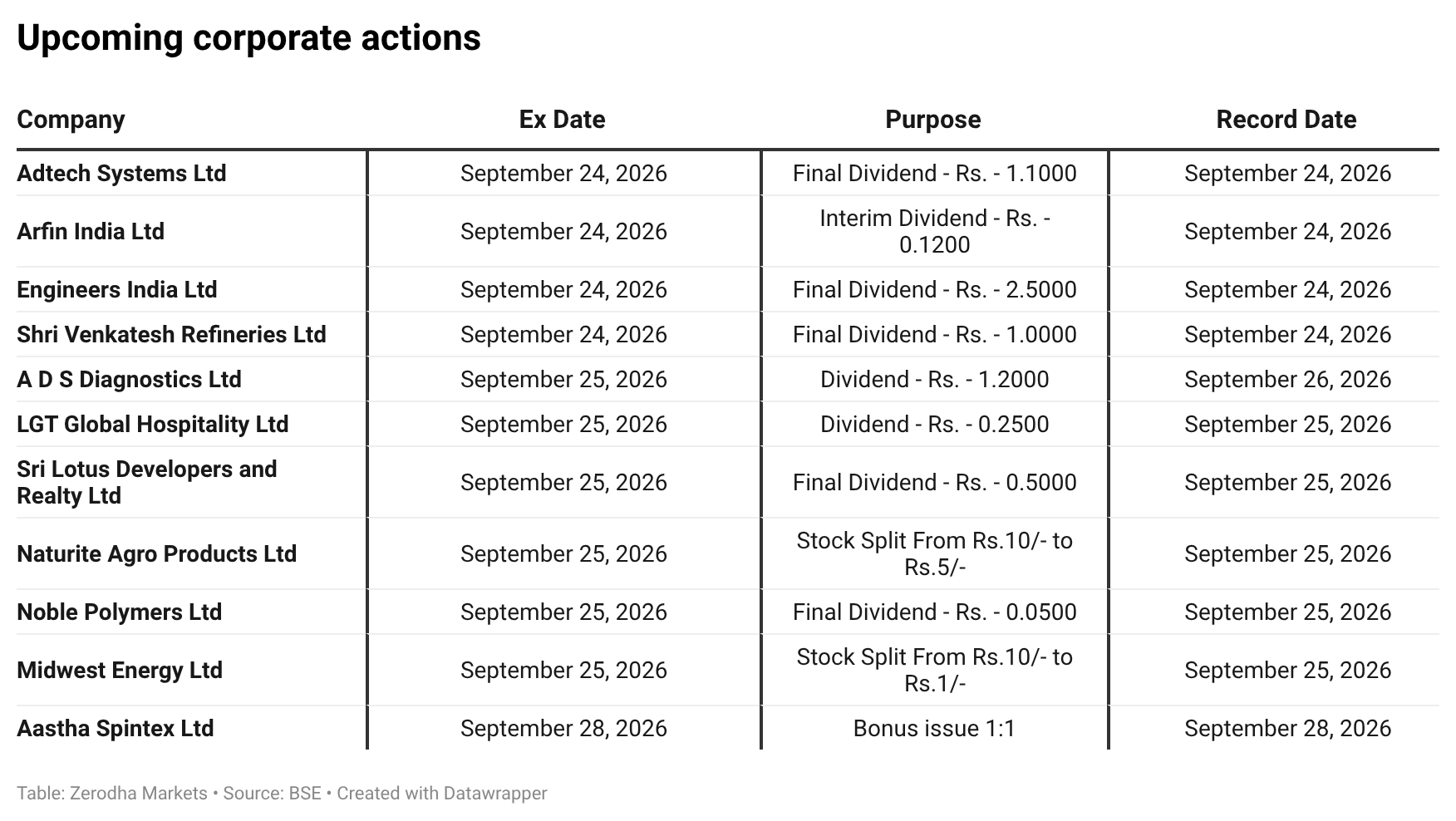
The week ahead & Corporate Actions
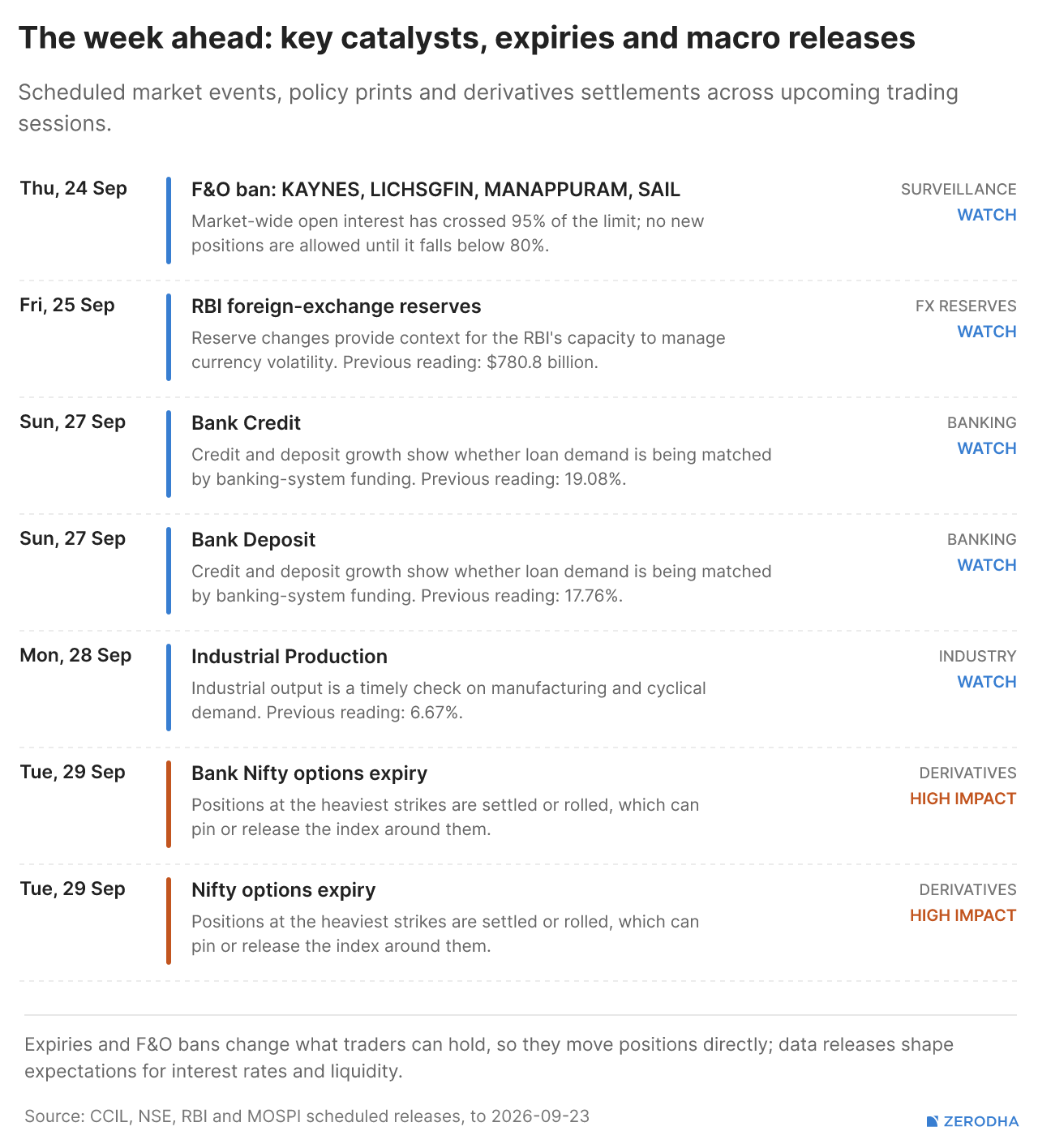
Corporate Actions
Published by Zerodha. Not investment advice. Data from NSE, BSE, and MCX.
In our latest episode of In The Money by Zerodha, we look at Simons’ early life, his time at MIT and Harvard, his work as a codebreaker, and how he eventually got interested in trading.
We then follow the shift from instinct-driven trading to quantitative and systematic strategies, and look at the people, data, and technology that helped build Renaissance.
We also look at how Medallion traded, why the fund became increasingly secretive, and why it eventually stopped taking outside money. Along the way, we explore some of the ideas behind quantitative trading and the people who helped shape Simons’ approach.
This is the first episode of Market Legends, a new series where we look at some of the traders, investors, and fund managers who shaped the world of markets, how they thought, how they built their edge, and what we can learn from their stories.
That’s it from us for today. We’d love to hear your feedback in the comments, and feel free to share this with your friends to spread the word!