
Welcome to Aftermarket Report, a newsletter where we do a quick daily wrap-up of what happened in the markets, both in India and globally.
What data points and transformations do you want to see?
We’re trying out a new format for the Aftermarket Report, with much more comprehensive coverage of the data that shapes the trading day.
Beyond the headline indices, we’re now tracking market breadth, new highs and lows, sector and thematic performance, delivery data, F&O positioning, global markets, commodities, flows, and more. We’re also looking at ways to transform this raw data into insights that are actually useful for traders and investors.
The idea is simple: bring different datasets together in one place to give you a clearer picture of what’s happening beneath the surface of the market.
This is still a work in progress, and we’d love your feedback. What data points are we missing? What transformations, ratios, comparisons, or indicators would you find useful? Also tell us what worked, what didn’t, and what felt unnecessary.
Your feedback will help shape the Aftermarket Report from here.
Markets Today
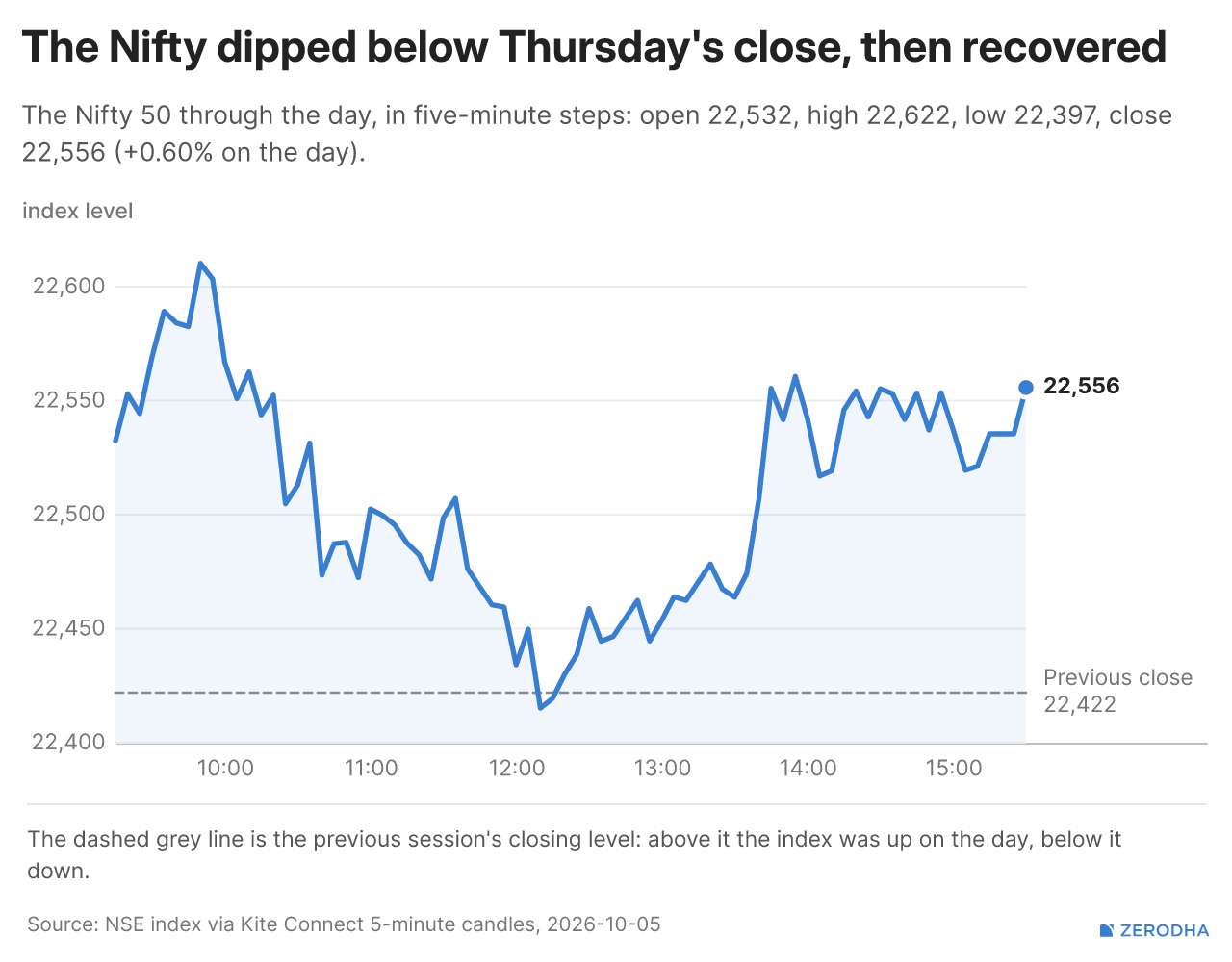
Nifty opened with a 110-point gap up at 22,532, tracking positive global cues, range-bound oil prices and stock-specific reactions to quarterly business updates. The index extended gains immediately after the open, climbing above 22,600 and briefly testing 22,620 in the first 30 minutes.
However, the early strength faded quickly, with Nifty slipping below 22,550 by 10 AM before selling intensified further. The index continued to drift lower through the rest of the morning, eventually falling below 22,450 and touching an intraday low near 22,400 around noon.
The trend reversed gradually from the lows, with Nifty recovering towards 22,475 by early afternoon. Buying then picked up sharply after 1:30 PM, pushing the index back above 22,500 and towards 22,550. Nifty largely consolidated around the 22,520-22,560 zone through the final hour, despite some volatility.
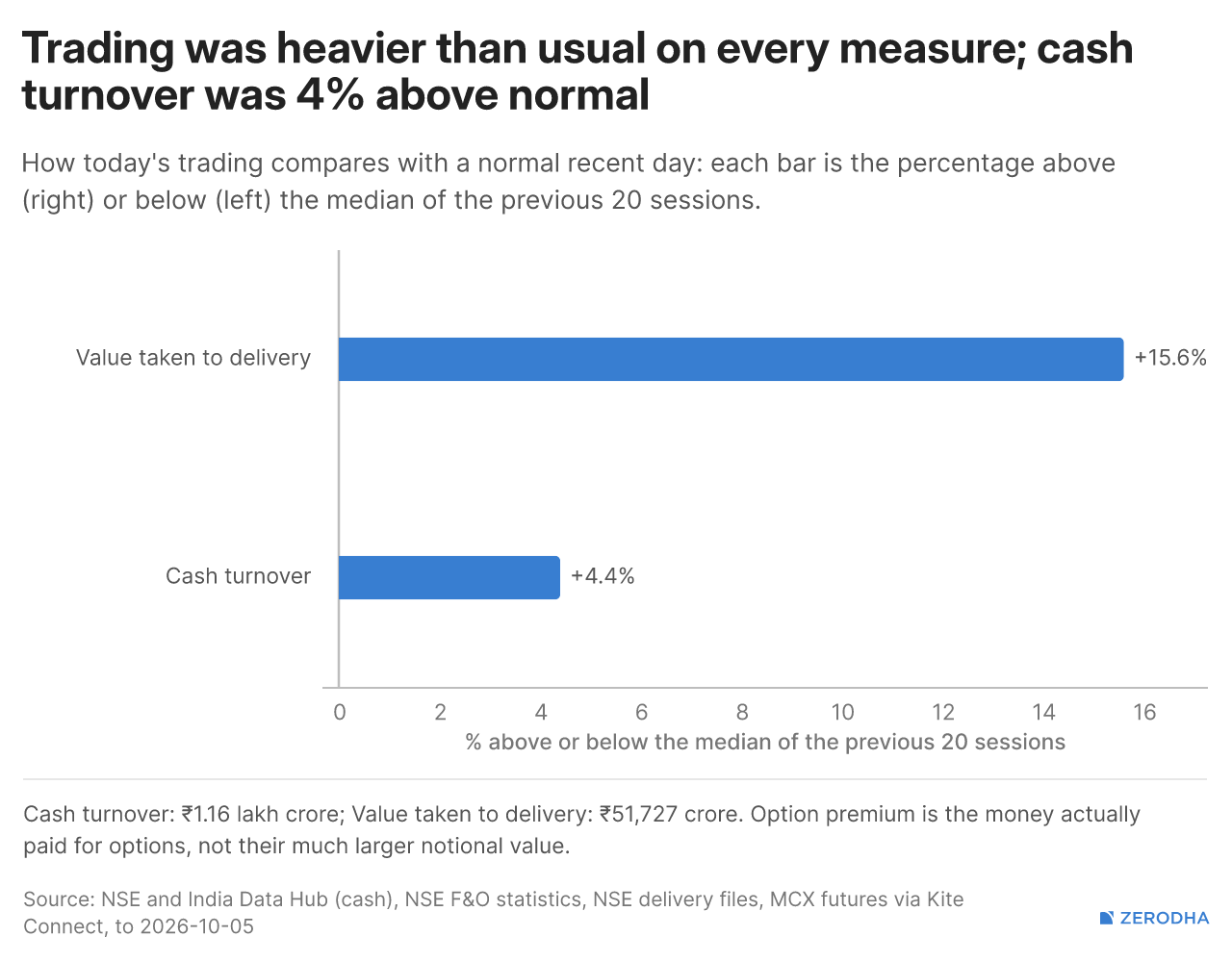
The index eventually closed at 22,555.75, about 24 points above its open and more than 150 points above the day’s low, after a strong second-half recovery erased morning weakness.
Market Breadth
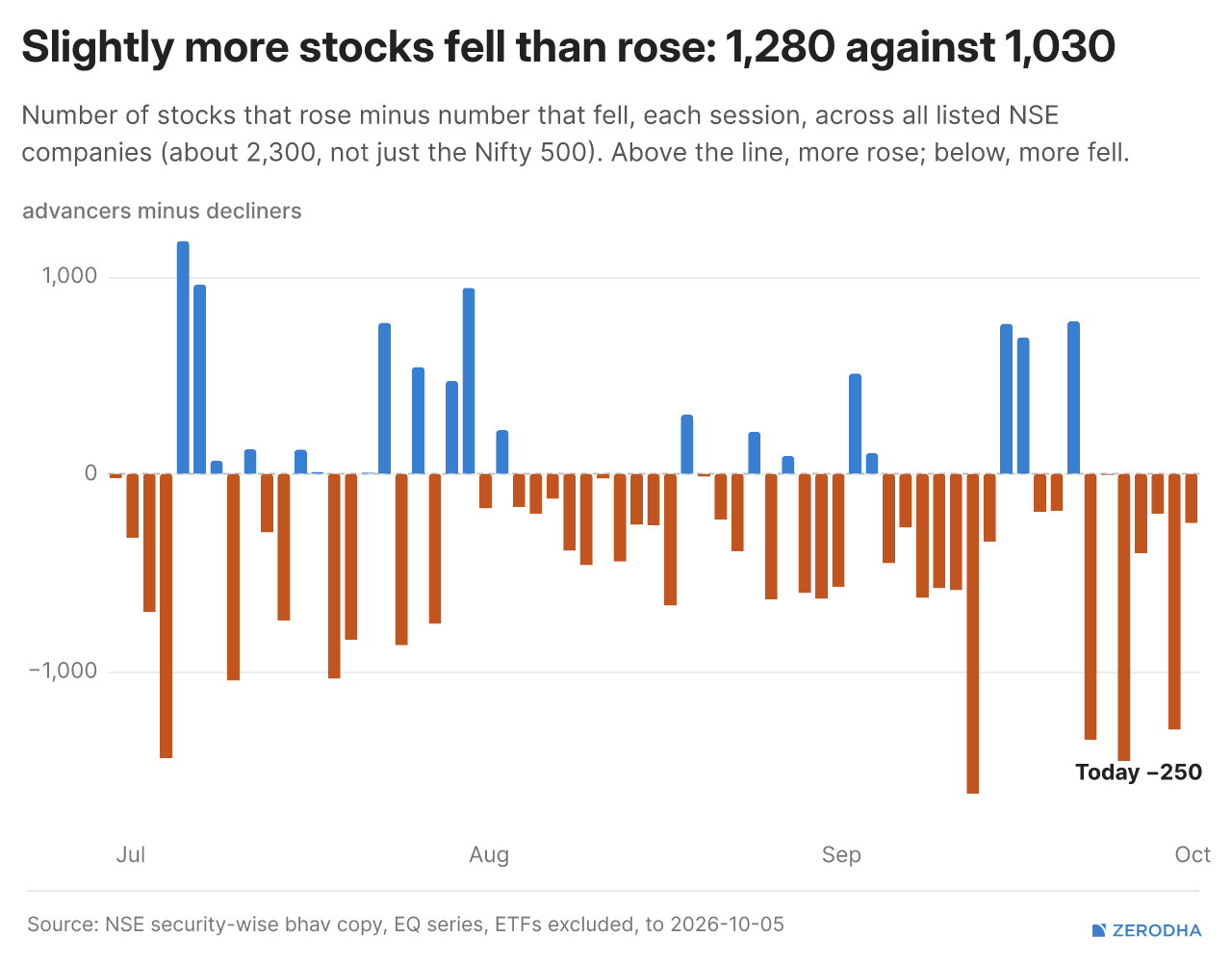
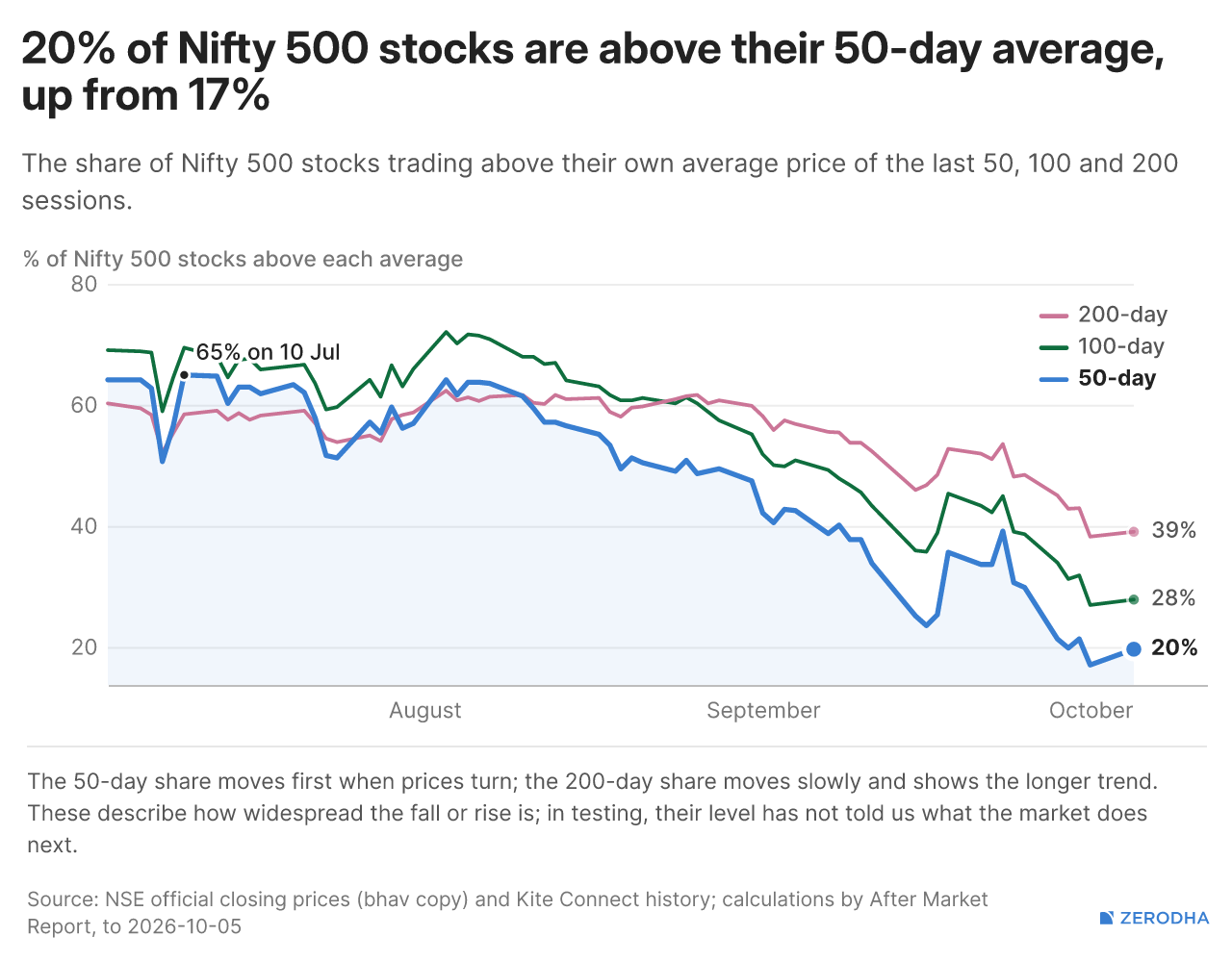
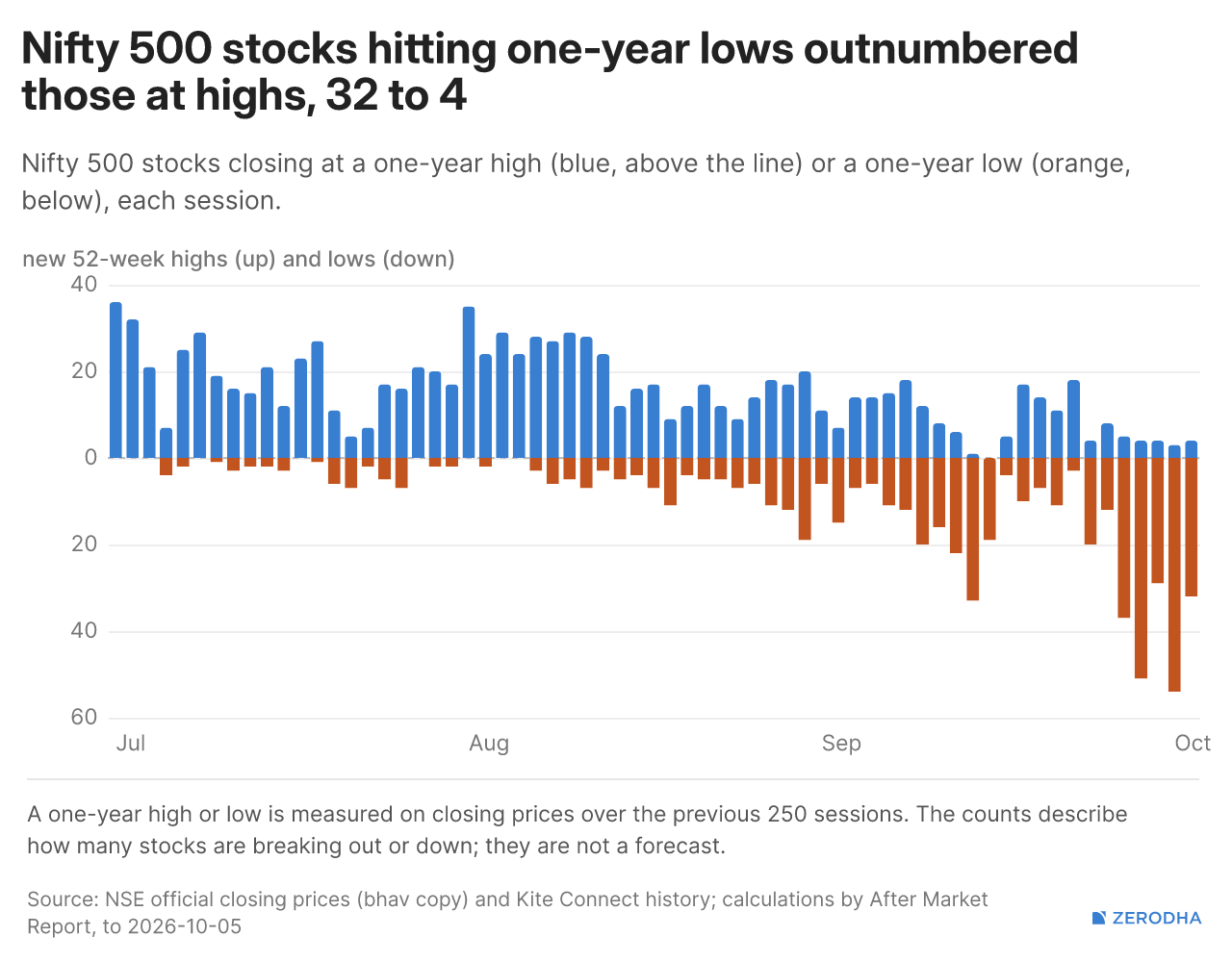
Breadth remained mixed with 1,030 advancers versus 1,280 decliners, though the share of Nifty 500 stocks above their 50-day average improved to 19.8%. New 52-week lows still dominated highs by 32 to 4.
52 Week Highs & Lows
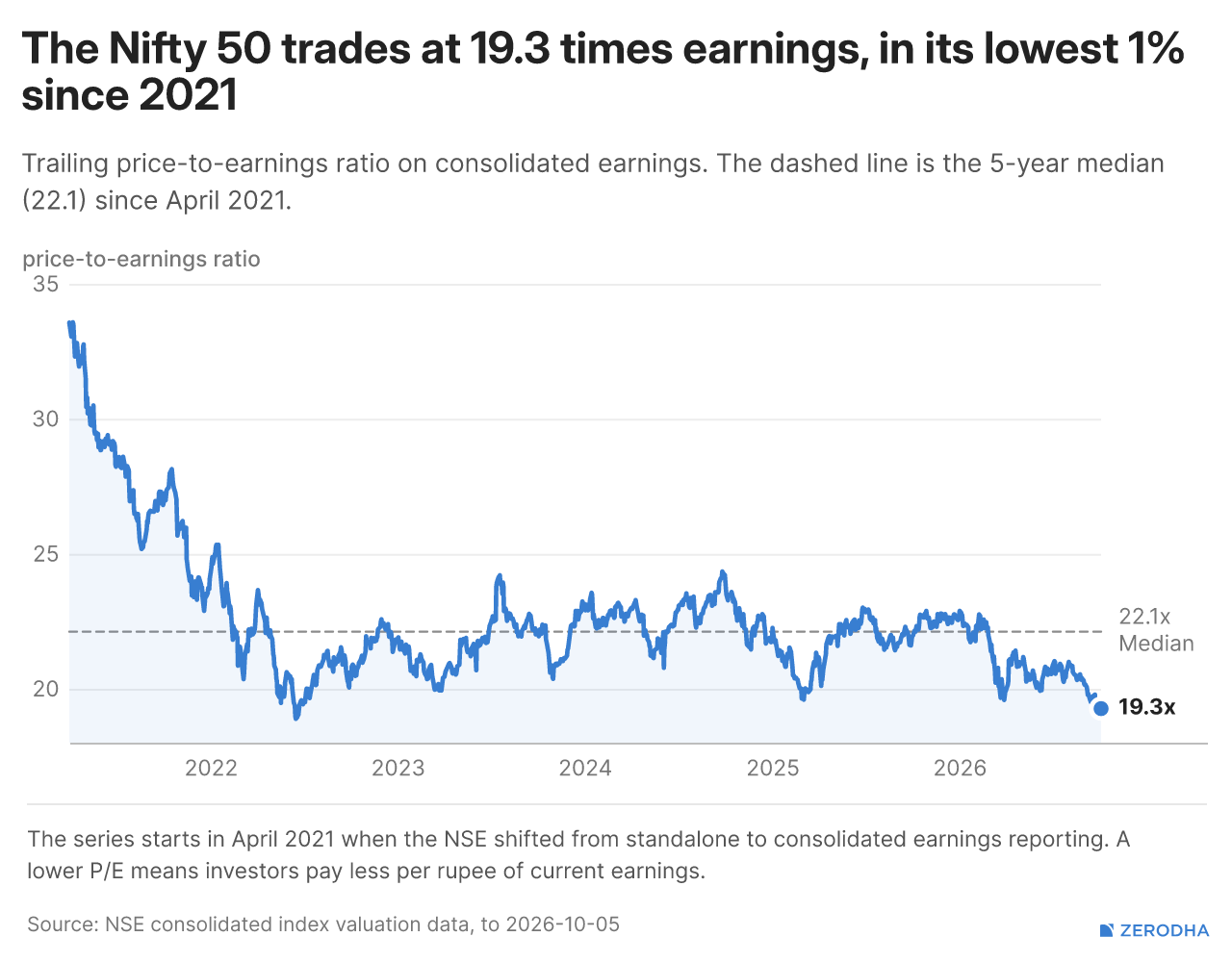
Valuation Check
Sectoral Indices Performance
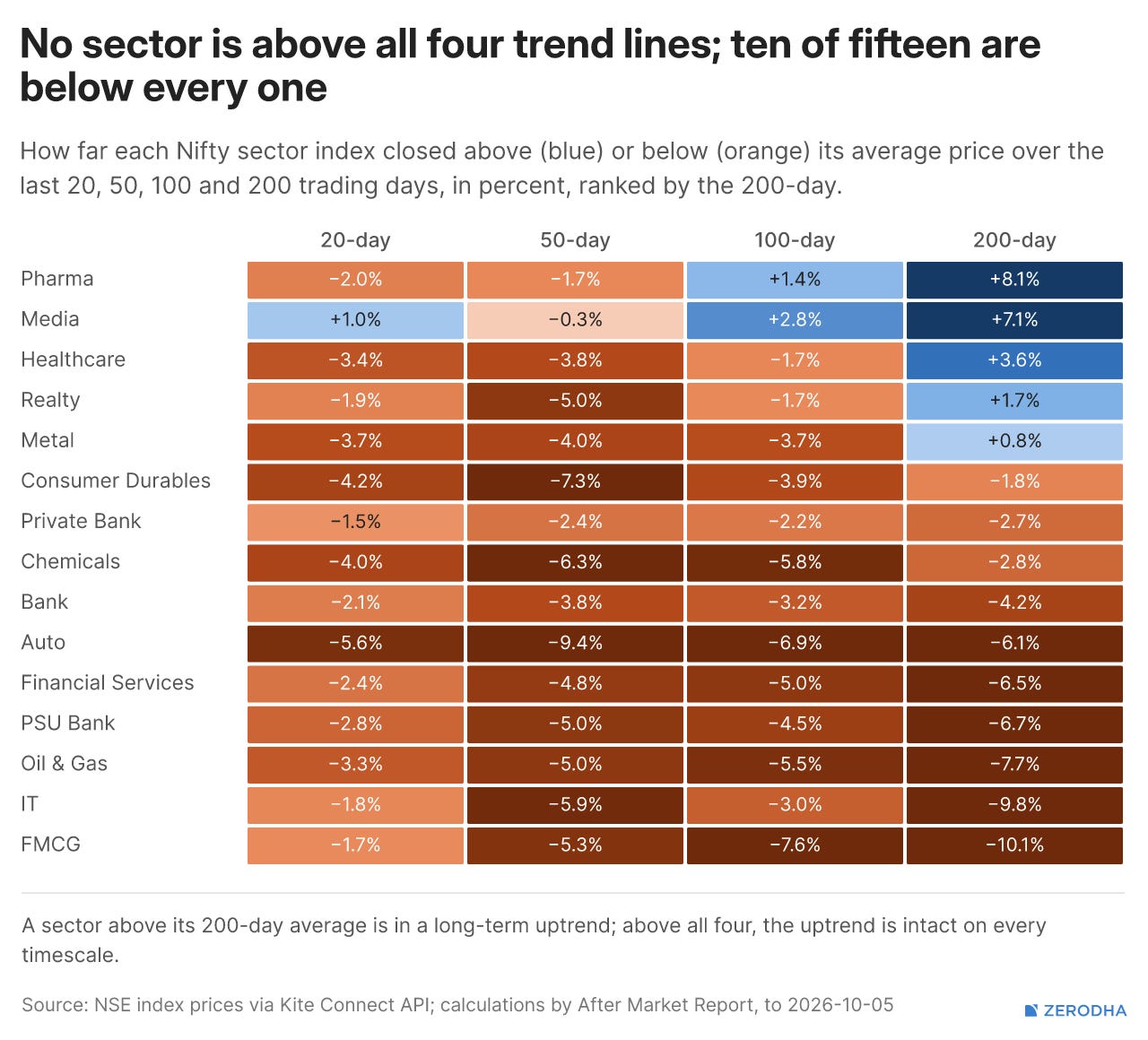
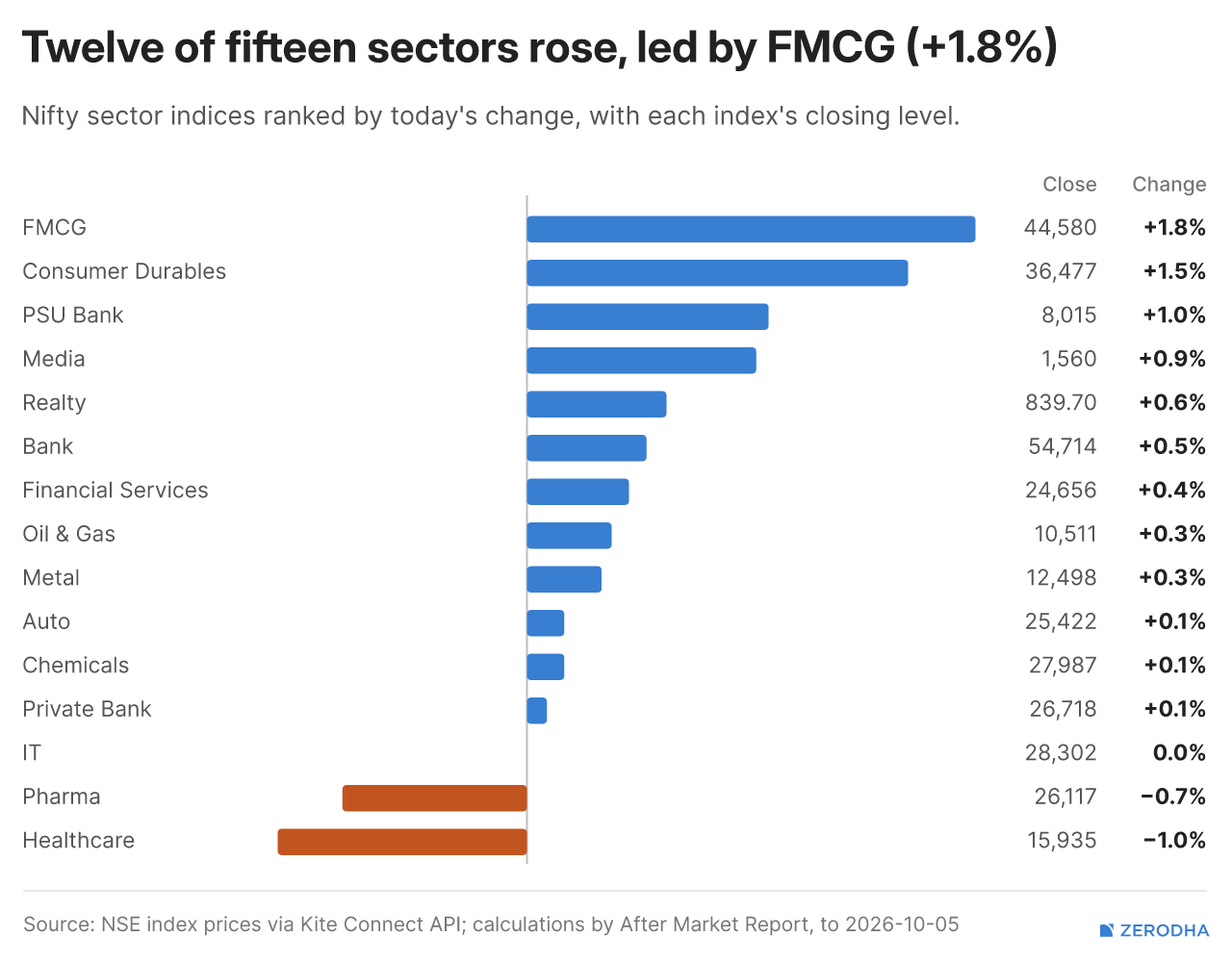
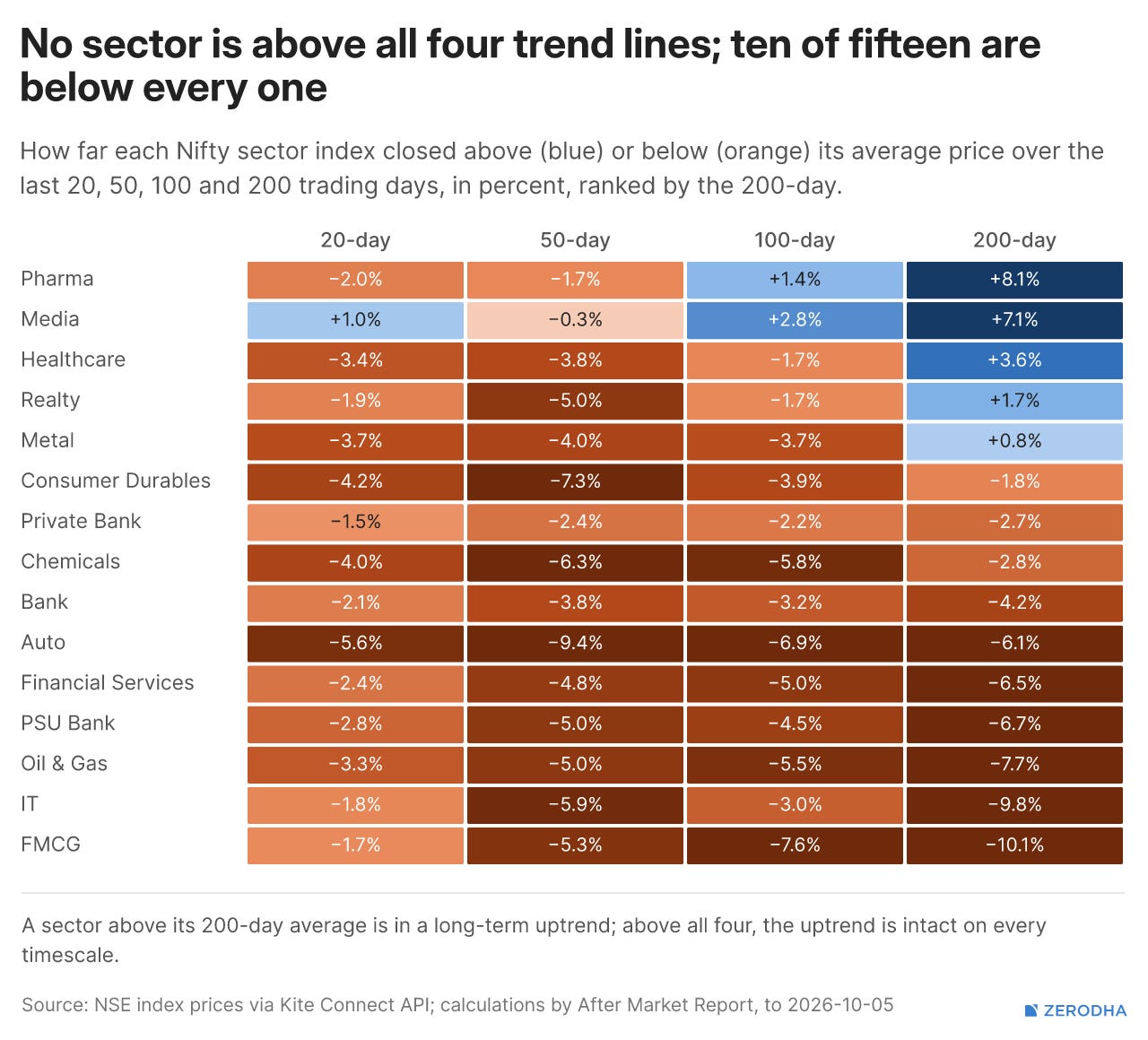
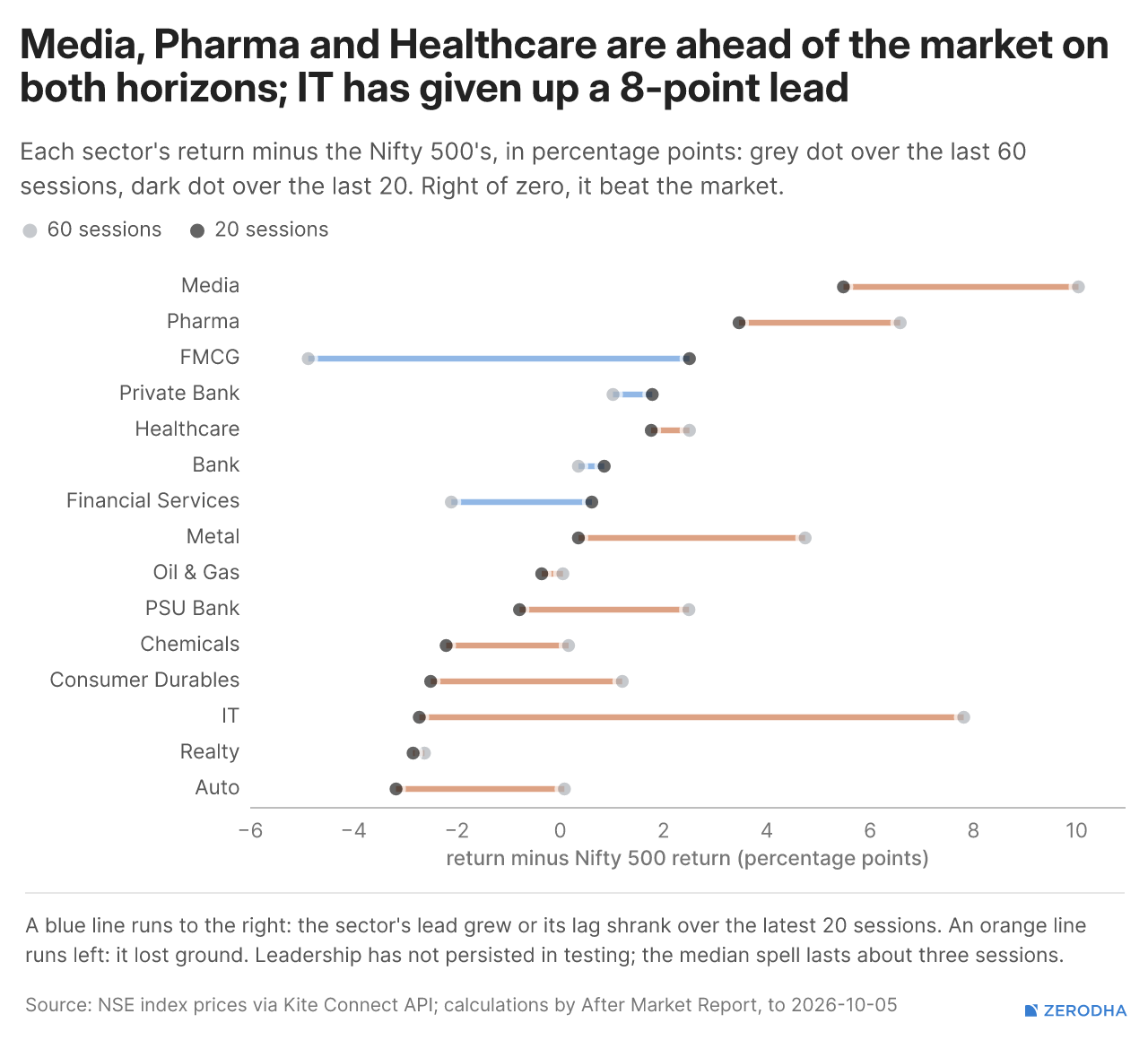
FMCG gained 1.80% to lead as 12 of 15 sectors advanced, while Healthcare fell 1%. Media, Pharma and Healthcare remain the relative leaders over both 20 and 60 sessions, though no sector is above all four key moving averages.
Winners & Losers
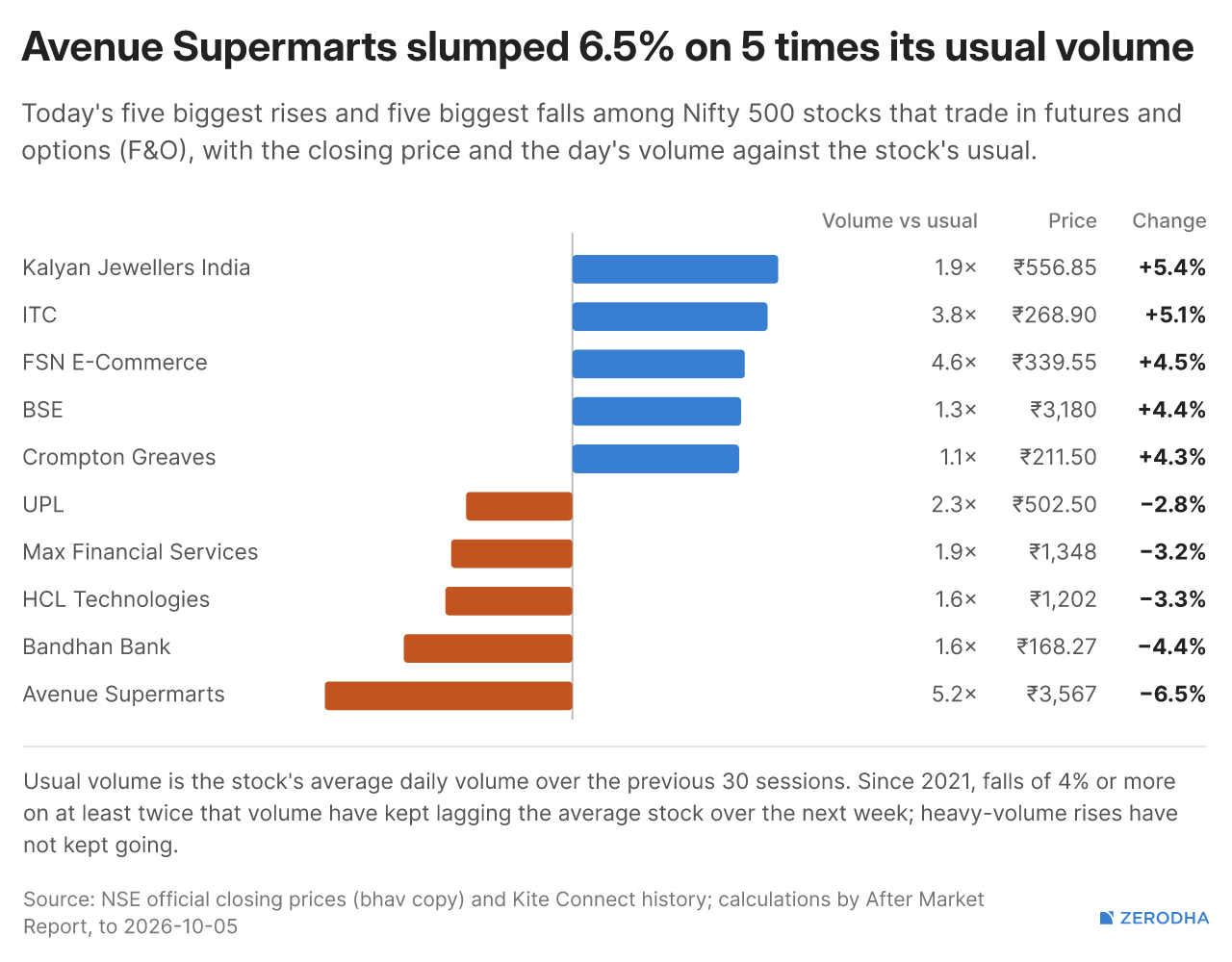
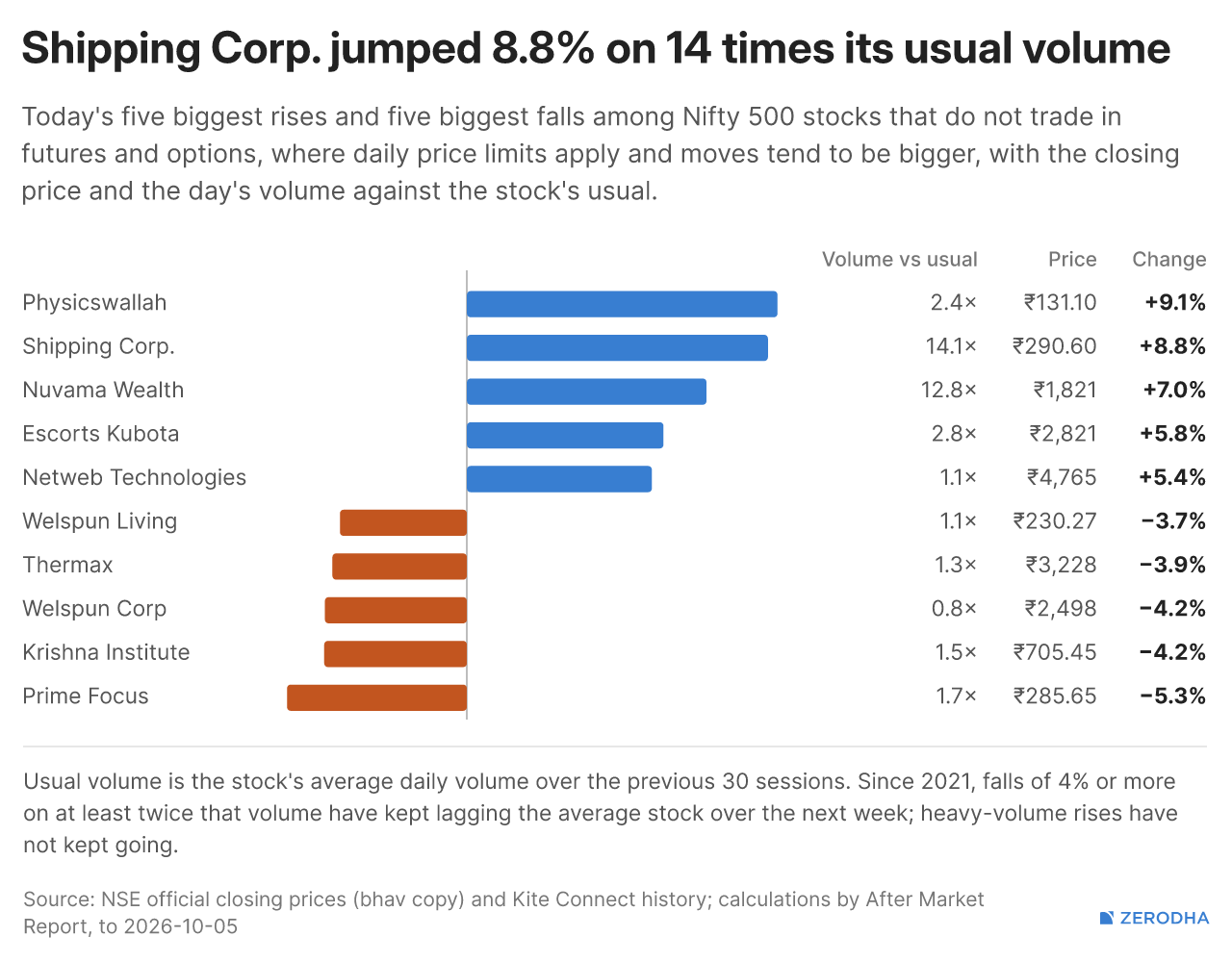
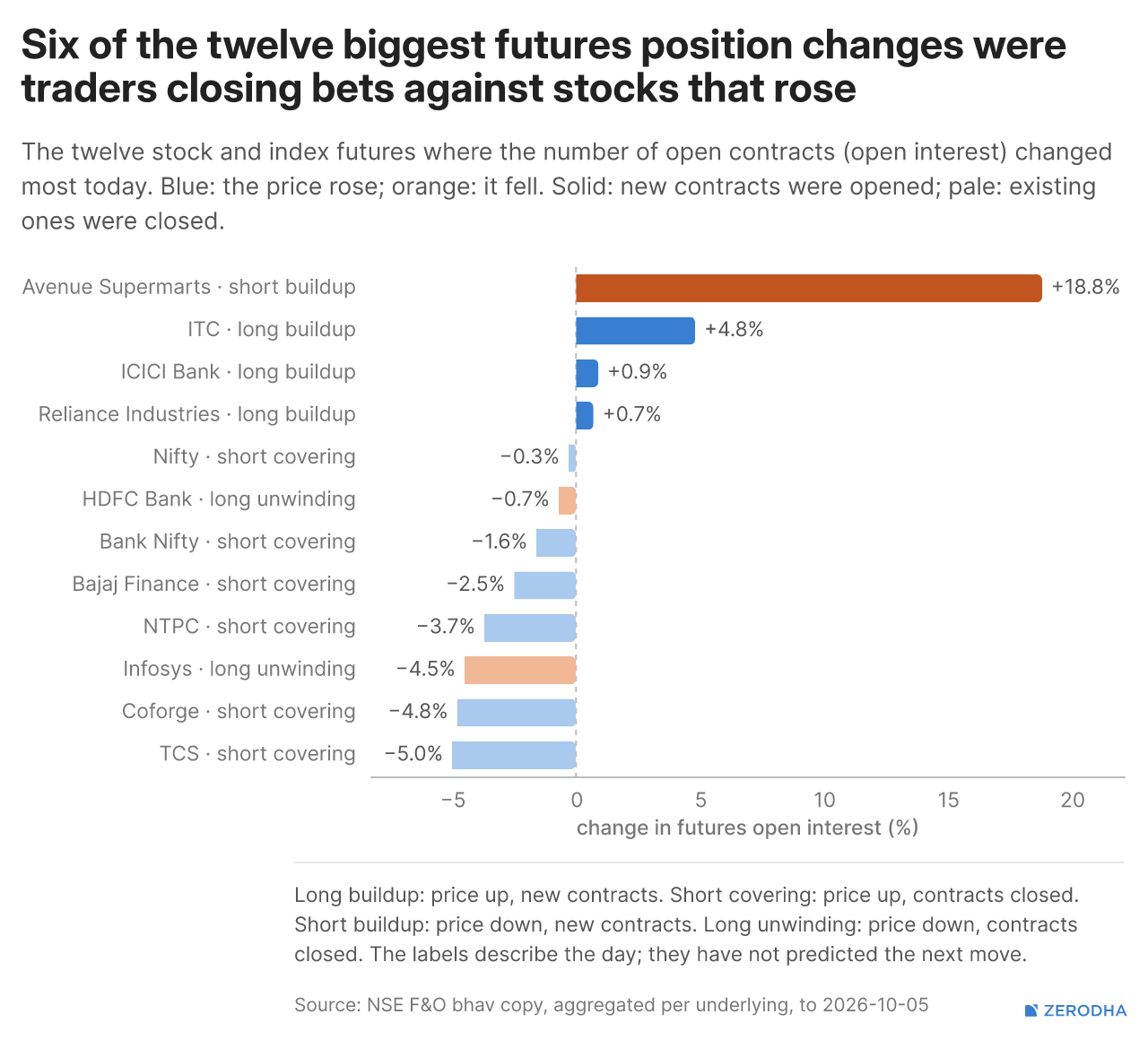
Shipping Corporation of India jumped 8.82% on 14× usual volume, while Nuvama Wealth gained 7.02% on 13× volume. Avenue Supermarts was the weakest F&O stock, falling 6.45% on heavy volumes.
Delivery Data
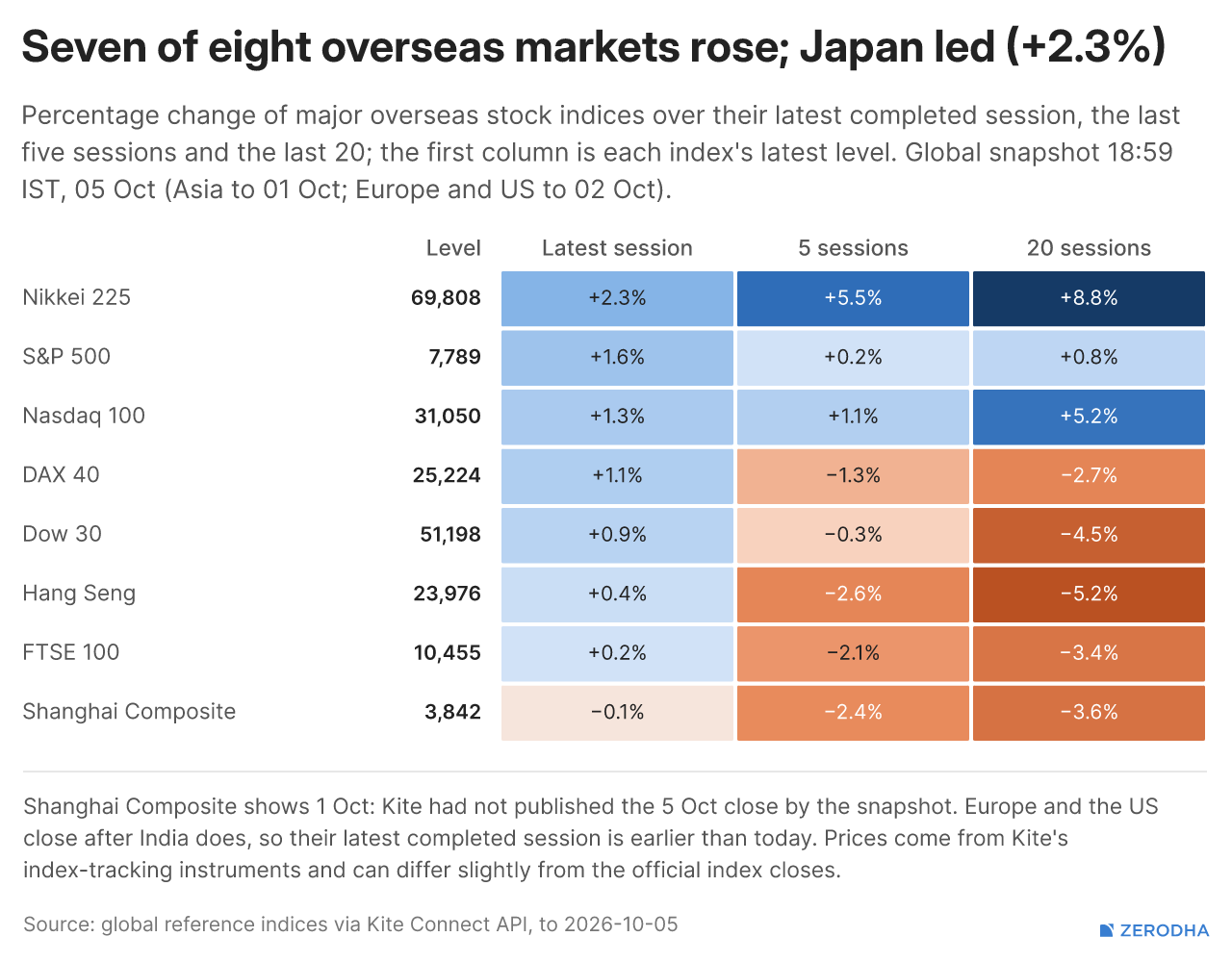
Global Markets
Commodities
Institutional Flows & Participant Positioning
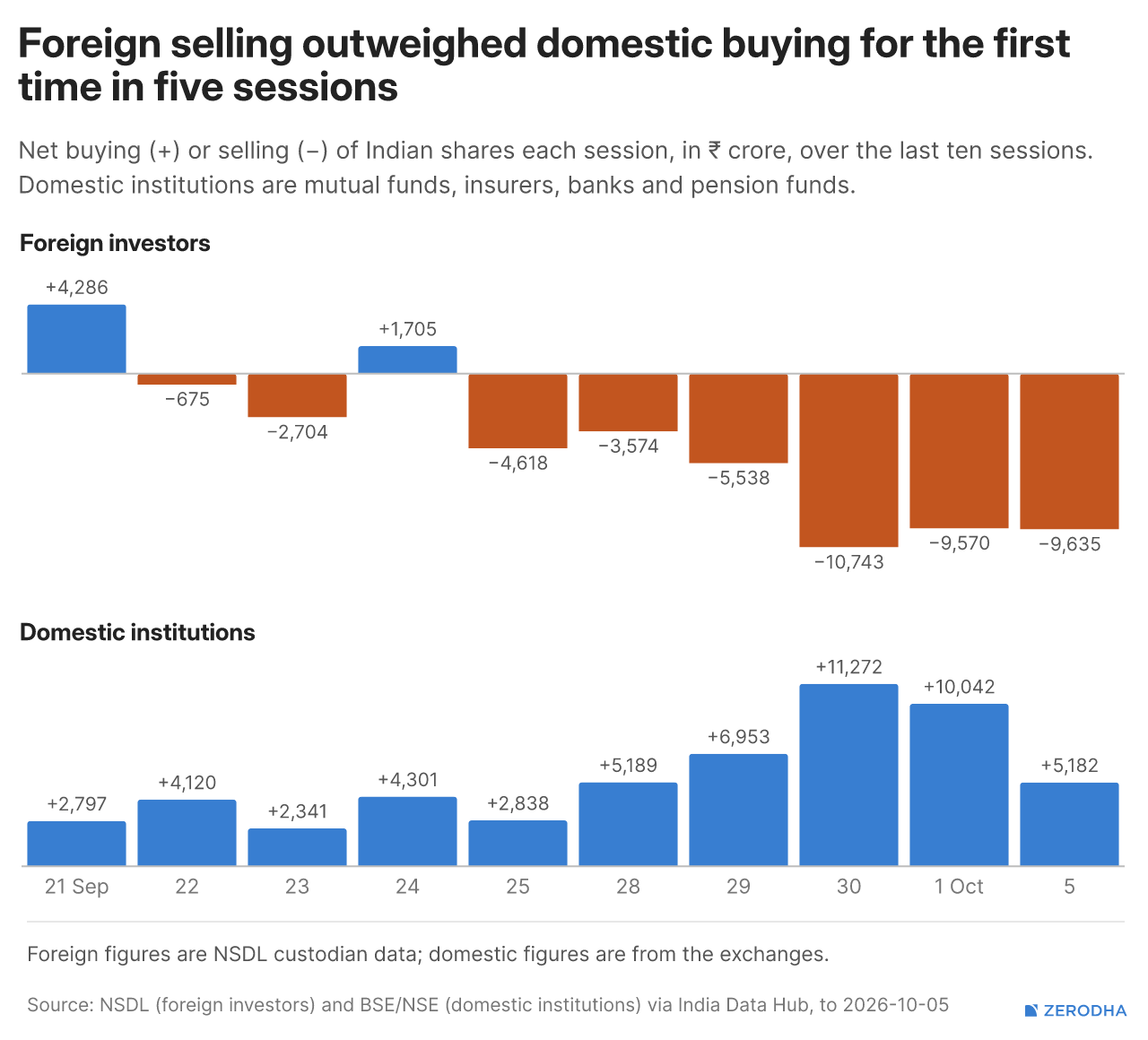
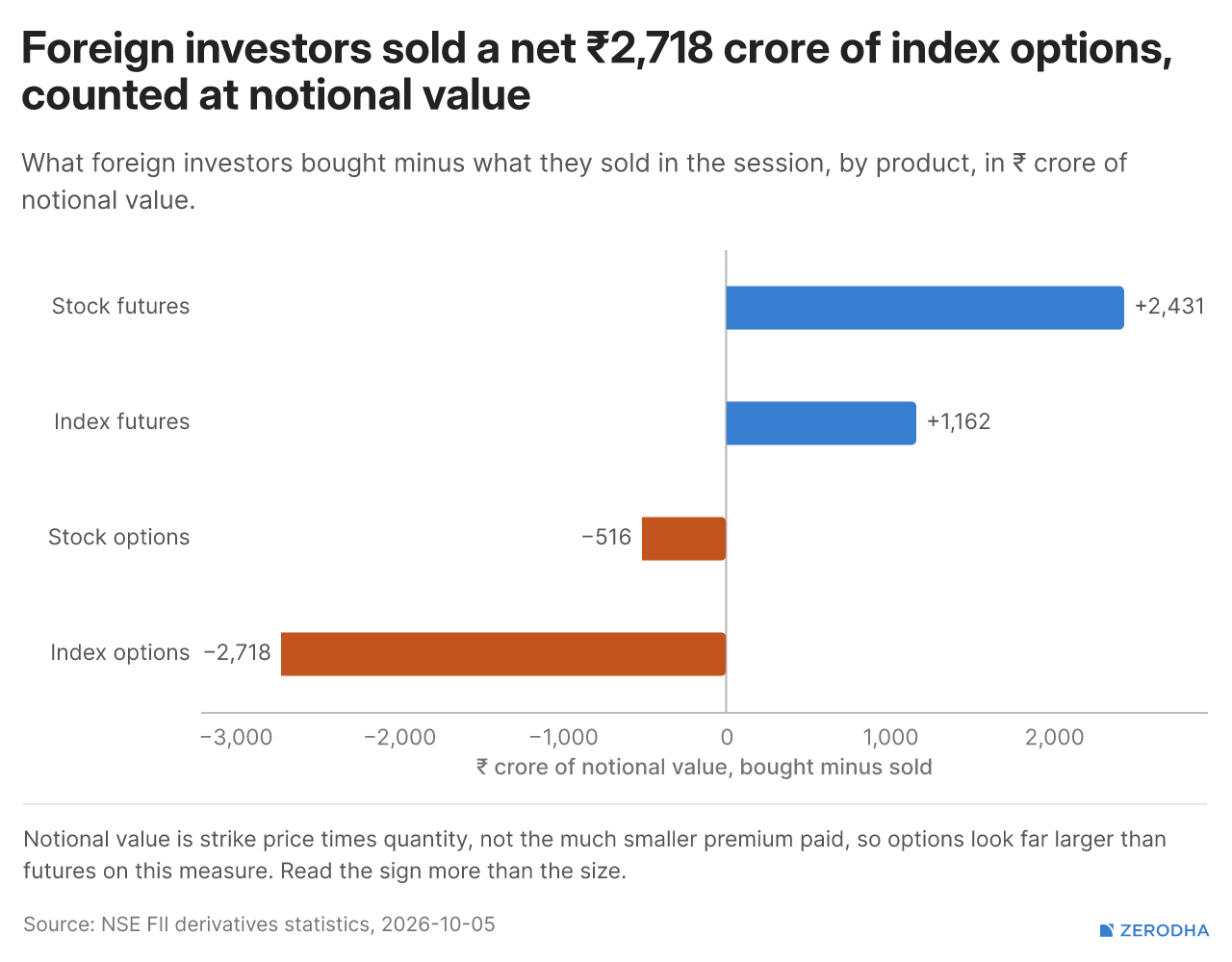
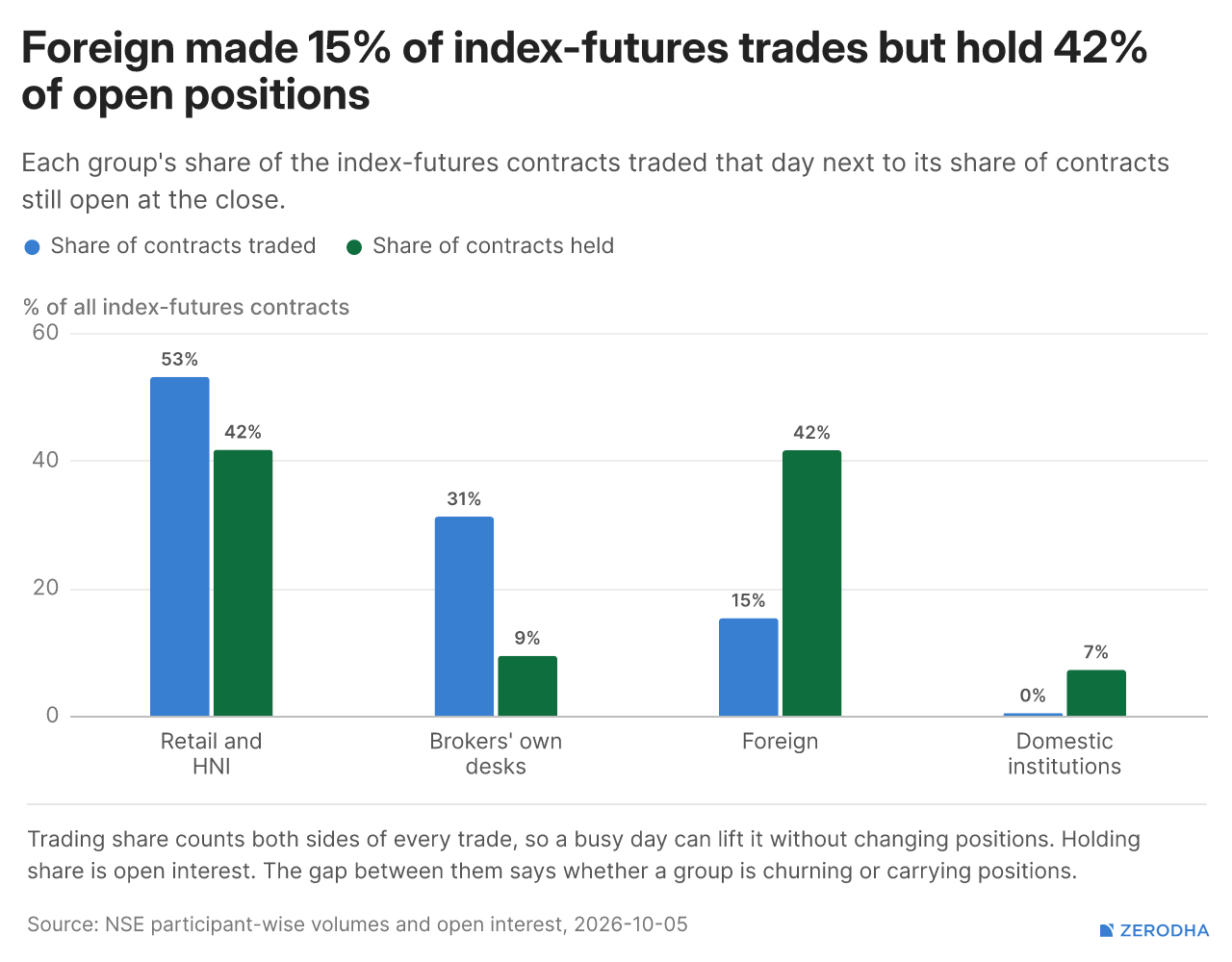
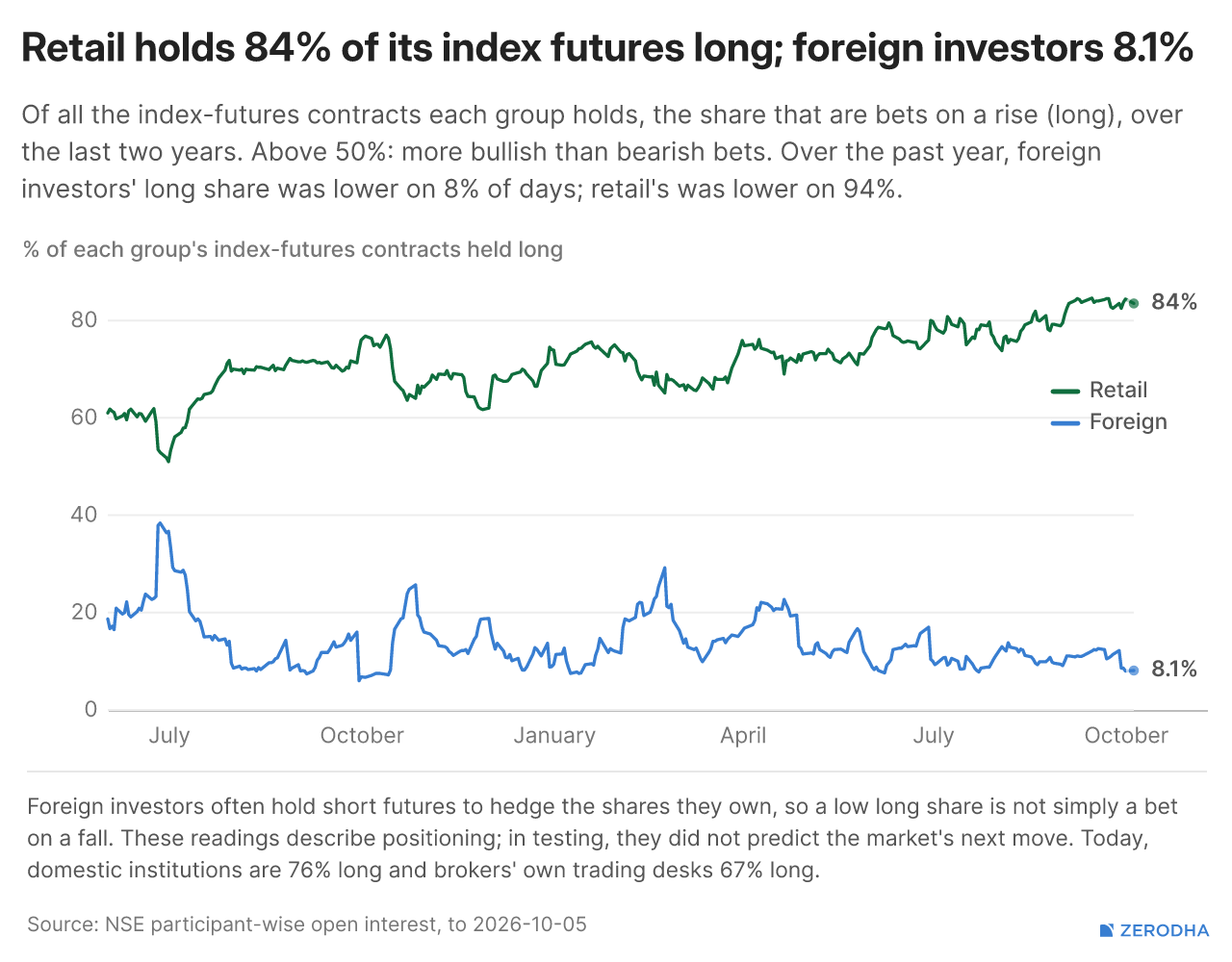
FIIs remain heavily bearish with only 8.1% of index-futures positions long, while retail and HNIs remain 84% long.
Thematic Indices
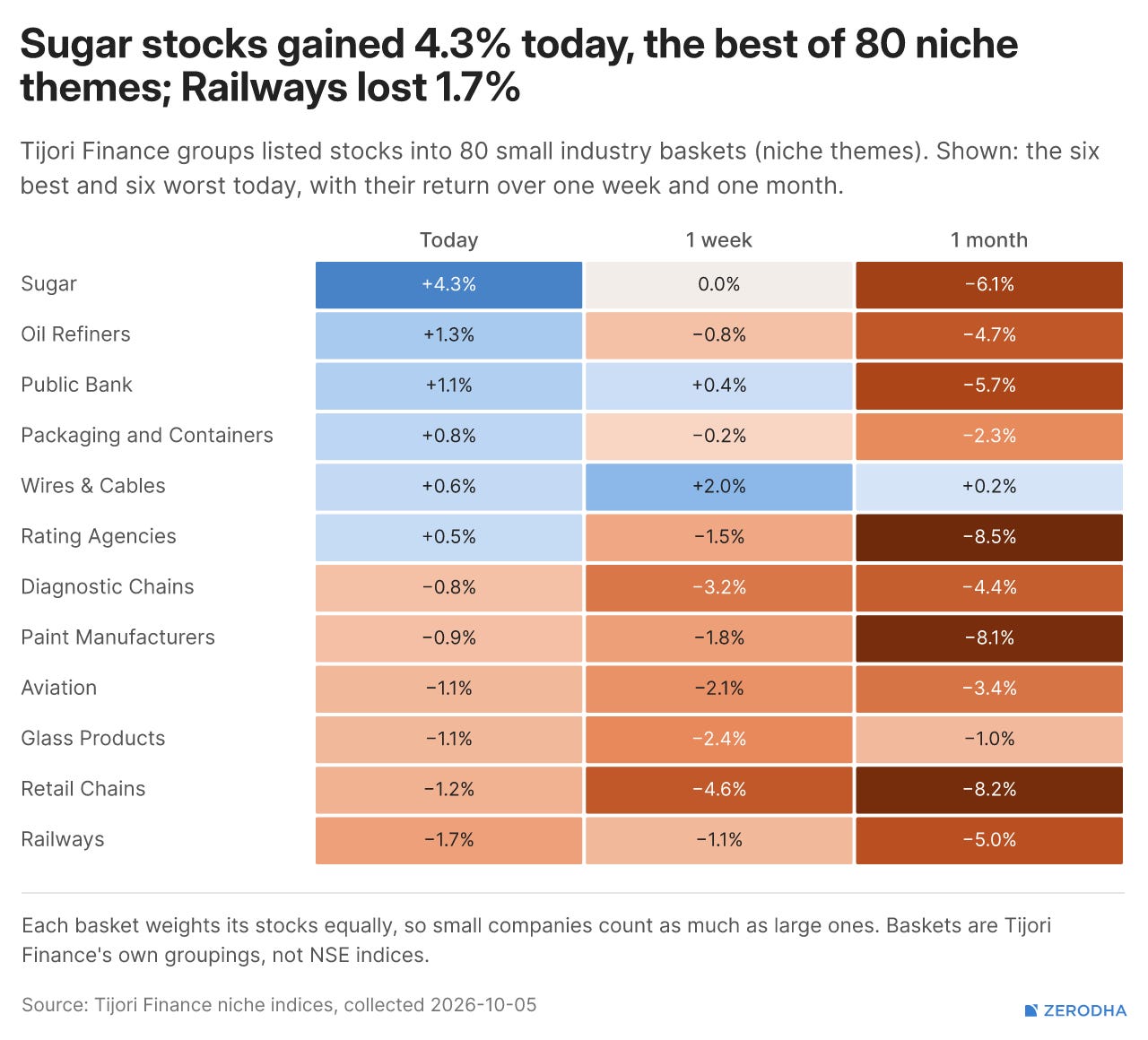
Tijori’s niche indices, where today’s move sorts pockets of the market beyond standard sector baskets. You can also track promoter buying and other interesting stuff, like Capex activity by the companies in the Tijori App’s idea dashboard
F&O Corner
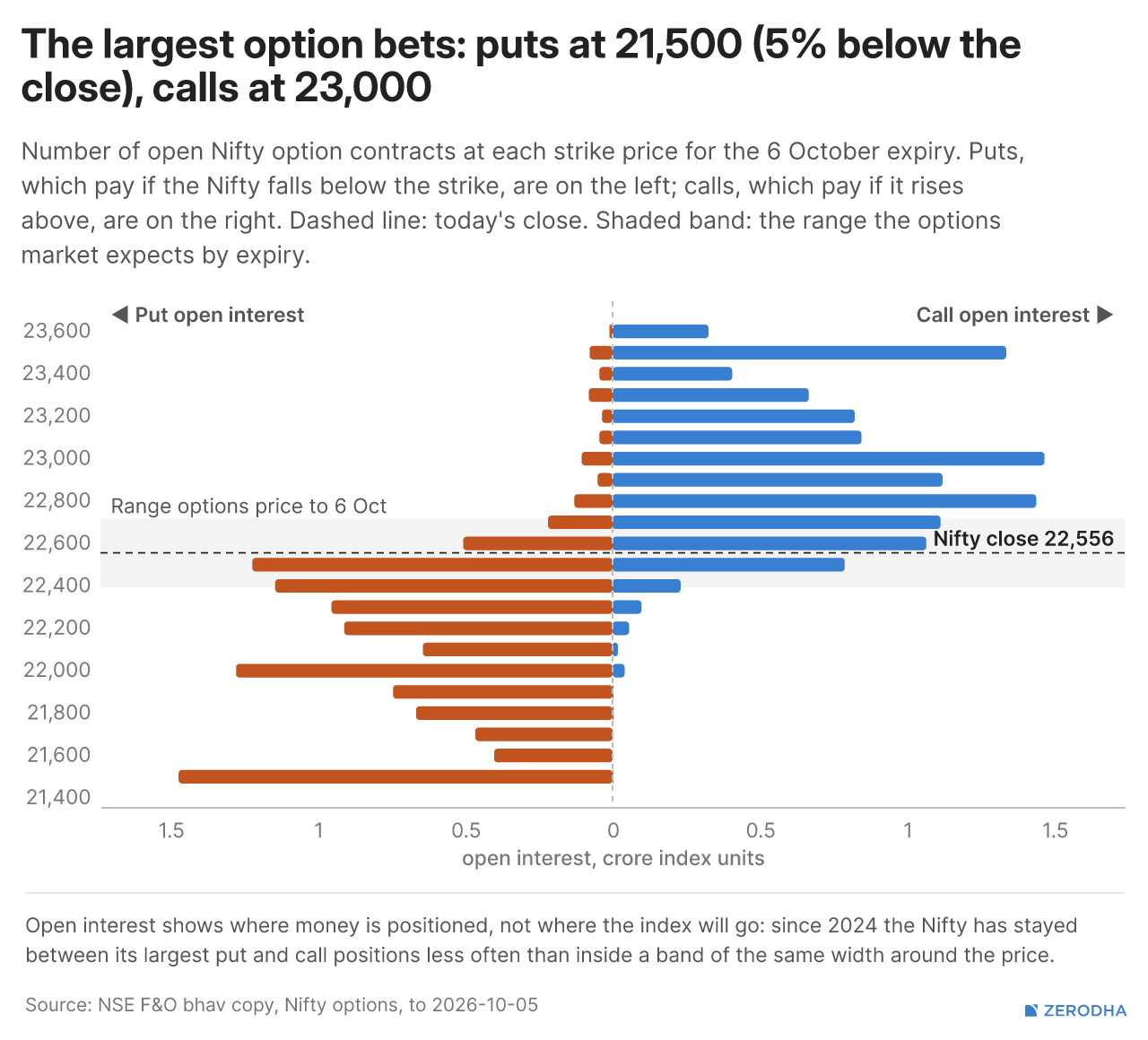
Options price a roughly 162-point move either way into Tuesday’s expiry, while PCR rose from 0.77 to 0.94 as put writers became more active.

Top Stories in India
L&T’s Power Transmission & Distribution business secured multiple EPC orders worth around ₹10,000 crore across India, Saudi Arabia and the UAE. The projects include transmission lines and substations aimed at strengthening grids and enabling renewable energy evacuation. Dive deeper
DMart operator Avenue Supermarts shares fell over 6.5% despite standalone Q2 FY27 revenue rising 18.4% YoY to ₹19,206 crore. Dive deeper
V2 Retail shares slumped nearly 17% to a 52-week low after same-store sales declined 14.9% in Q2 FY27, partly due to the shift in the festive calendar. On a festival-normalised basis, SSSG was broadly flat at 0.5%. Dive deeper
Kotak Mahindra Bank’s net advances rose 24.7% YoY to ₹5.77 lakh crore at the end of September, while deposits grew 23.2% to ₹6.51 lakh crore. CASA deposits increased 11.3% YoY to ₹2.49 lakh crore. Dive deeper
Top Stories Globally
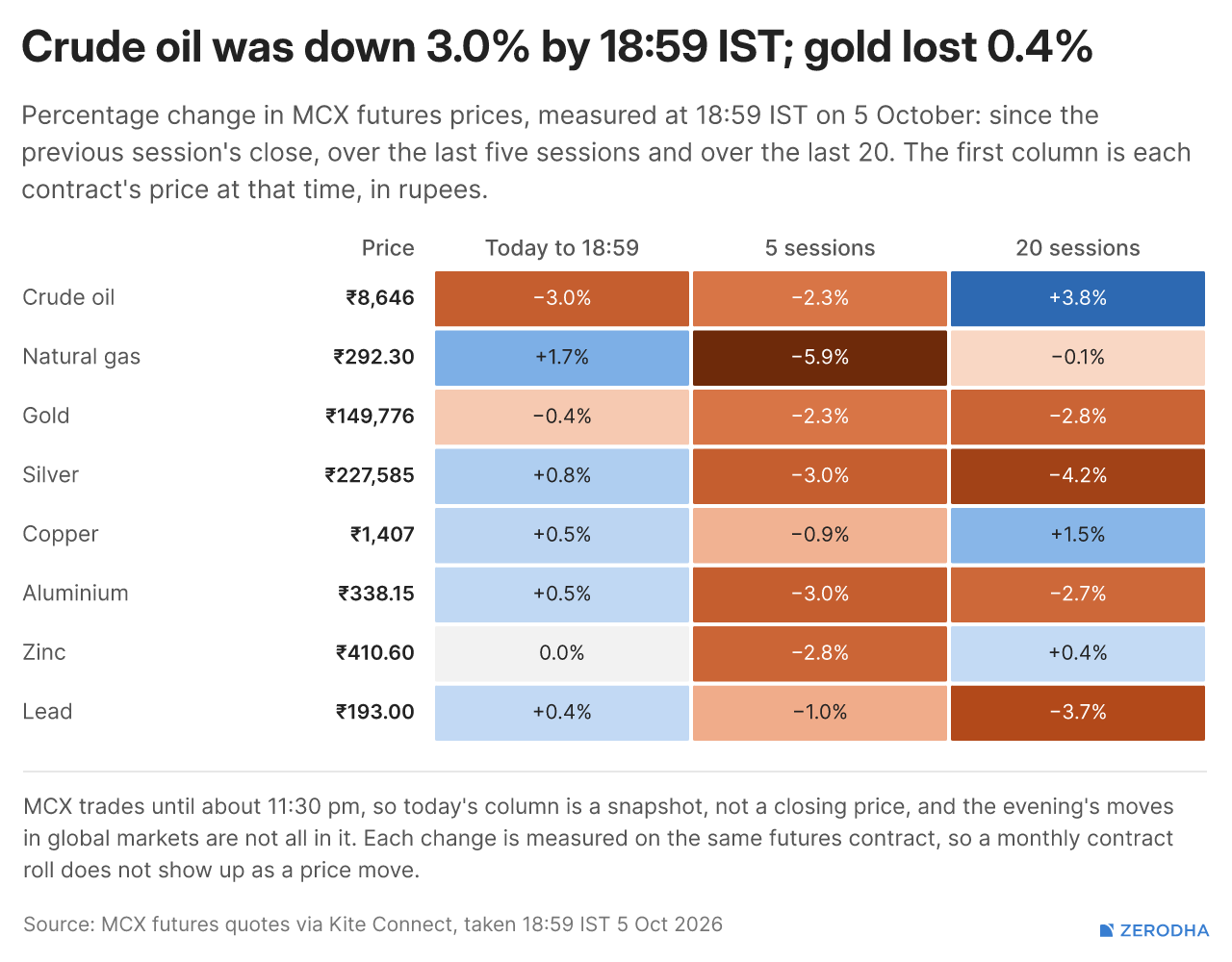
Saudi Arabia cut its November Arab Light crude price for Asian buyers to a $5-per-barrel discount to the Oman-Dubai benchmark, the widest discount since June 2020. Prices for northwest Europe and the Mediterranean were raised. Dive deeper
Inflows into US-listed ETFs have already reached over $1.54 trillion in 2026, surpassing the full-year record of $1.52 trillion set in 2025, with three months of the year still remaining. Dive deeper
Schneider Electric agreed to acquire US software company PTC for around $22.6 billion, its largest-ever deal, as it expands its exposure to data centres. Schneider shares fell nearly 10% as investors weighed the deal’s size and acquisition premium. Dive deeper
Foxconn’s Q3 revenue jumped 47% YoY to T3.03trillion(95.4 billion), beating market expectations. Strong AI demand drove its cloud and networking business, while consumer electronics also posted strong growth. Dive deeper
Huawei signed a broad multi-year patent licensing agreement with Qualcomm covering AI, 5G, computing and networking technologies. Huawei expects the deal to take the total value of its patent licensing agreements above $6.9 billion. Dive deeper
The euro fell to a 17-month low against the dollar amid concerns over France’s fiscal position and the recent bond sell-off. The dollar index rose to 102.23, after touching its highest level since April 2025. Dive deeper
Management Chatter
In this section, we highlight interesting comments from management at major companies and from policymakers in the Indian and Global Economies.
Finance Minister Nirmala Sitharaman on the India-US interim trade deal:
“It’s been a hard and very rigorously negotiated agreement. The negotiations are still ongoing, although I’d like to believe that the both sides have reached a plateau beyond which giving or taking might be very, very difficult,” - Link
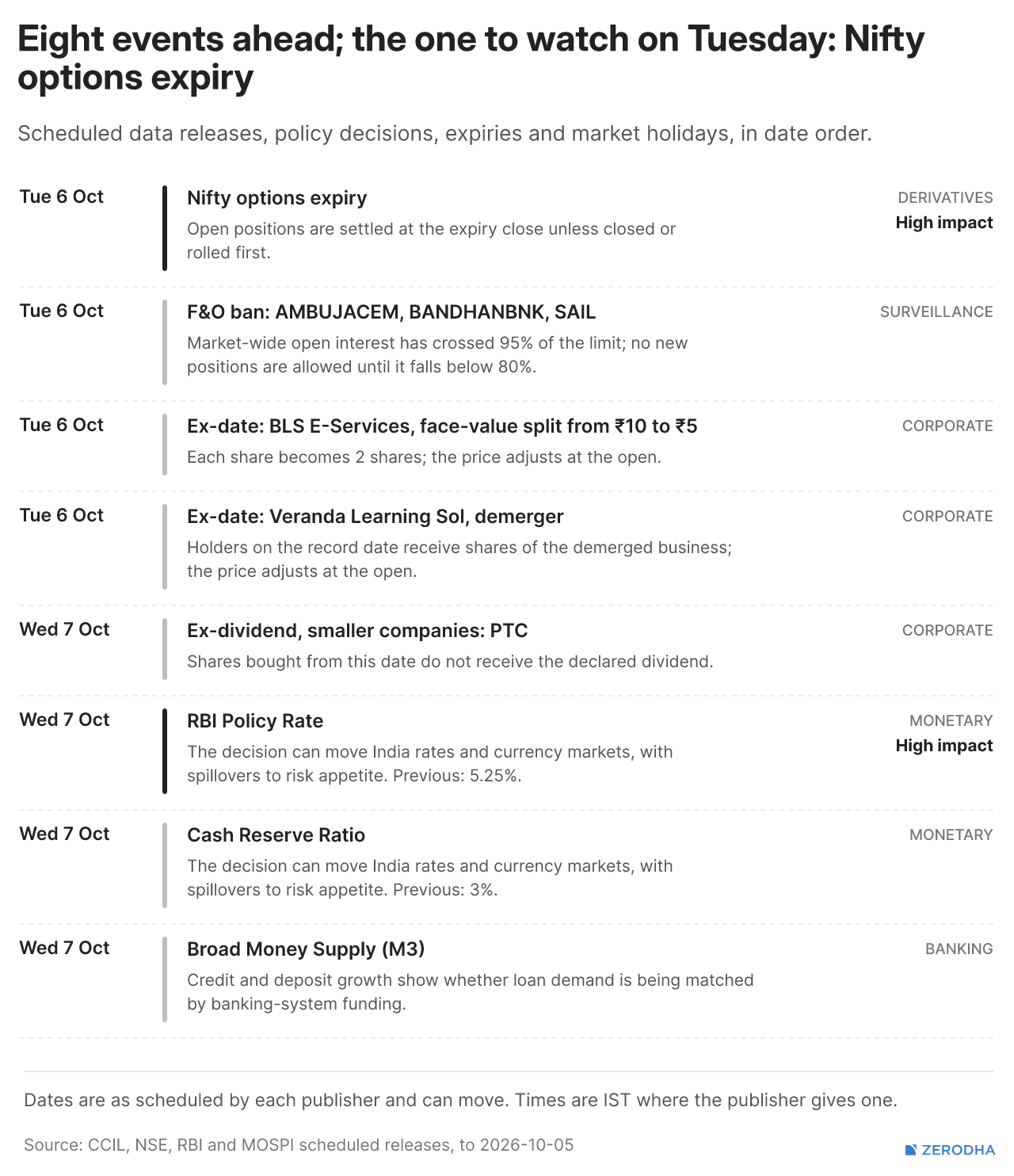
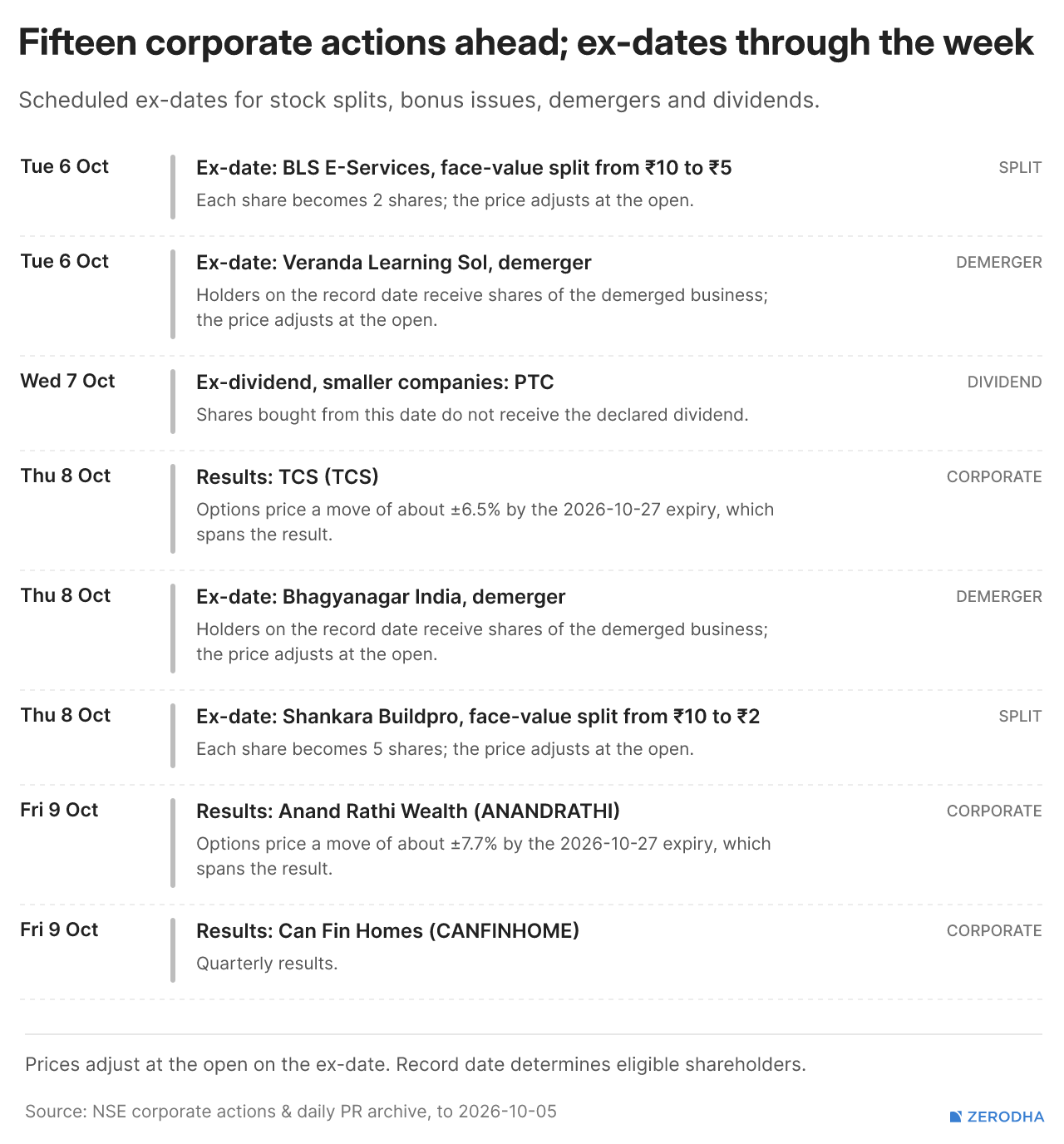
The week ahead & Corporate Actions
Corporate Actions
Published by Zerodha. Not investment advice. Data from NSE, BSE, and MCX.
In our latest episode of In The Money by Zerodha, we start with how covered calls are pitched to investors, as a way to earn “free money” on stocks you already own, and why even Fischer Black, co-creator of the Black-Scholes formula, was skeptical of the idea.
We then look at the history of the strategy, how it was sold by brokers over the decades, and what a behavioral study on Dutch investors revealed about why people find it attractive in theory but less so when they actually see the payoff.
The episode breaks down the mechanics of a covered call with real numbers, what happens when the stock falls, stays flat, or rallies, and why the strategy has a capped upside but nearly full downside.
Finally, we run a backtest on 10 of the most liquid large-cap Indian stocks from January 2022 onward, selling a 5% out-of-the-money call every month, and compare the results stock by stock to see whether covered calls actually add value to a buy-and-hold portfolio in India.
That’s it from us for today. We’d love to hear your feedback in the comments, and feel free to share this with your friends to spread the word!
The FII split is the line I'd build out. 8.1% long in index futures against 84% for retail and HNIs is a wide gap, but a single day's reading doesn't tell me whether it's extreme. A percentile against the last two or three years would. Worth putting USD/INR beside it too, with the dollar index at 102.23, so readers can see whether the FII short is tracking the dollar or Indian earnings.