
Welcome to Aftermarket Report, a newsletter where we do a quick daily wrap-up of what happened in the markets, both in India and globally.
Markets Today
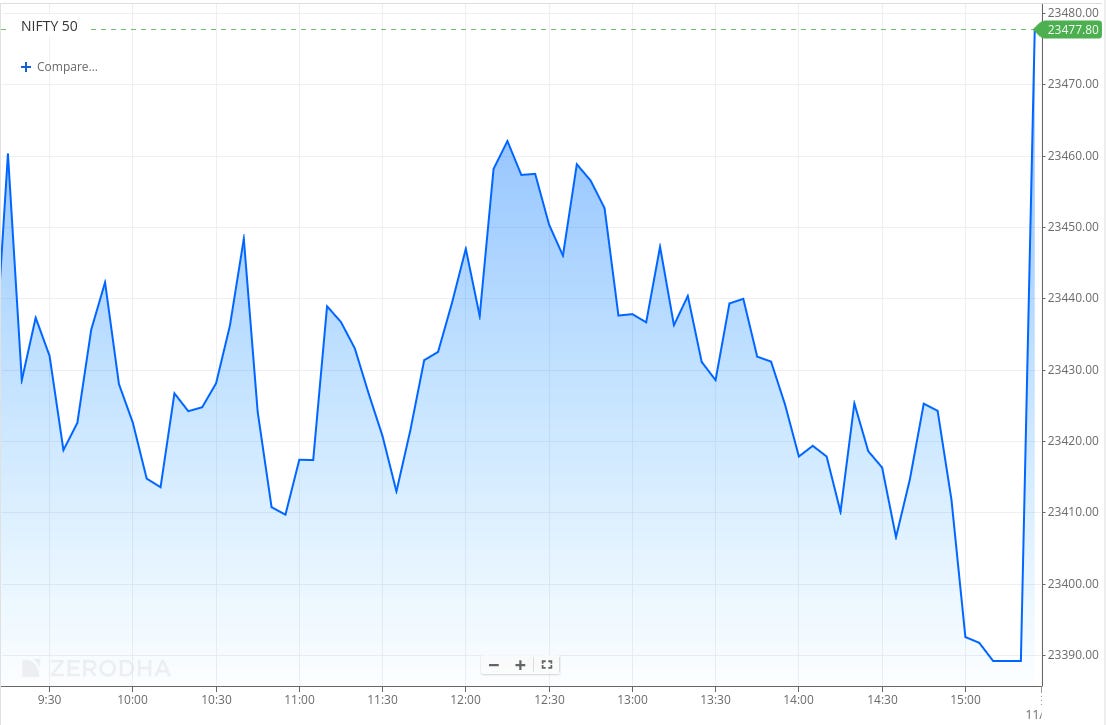
Nifty opened flat at 23,447, with little change in the global and domestic backdrop as crude remained above $100 per barrel and sentiment continued to remain weak, particularly in domestic markets.
The index saw choppy movement immediately after the open as Volatility continued through the first hour, with Nifty repeatedly moving between the 23,410 and 23,445 zones. After11 AM, the index staged a stronger recovery and climbed steadily to an intraday high near 23,470 around noon.
However, the recovery failed to sustain as Nifty gradually gave up its gains and slipped back towards 23,430 by early afternoon. The index remained volatile but largely range-bound between 23,420 and 23,450 for much of the second half before selling pressure picked up after 2 PM. Nifty eventually fell to the day’s low near 23,380 in the final half hour. A sharp move during the closing session, however, helped the index recover nearly 100 points from the lows to settle at 23,477.80, around 31 points above its opening level and near the day’s high.
Sectoral Indices Performance
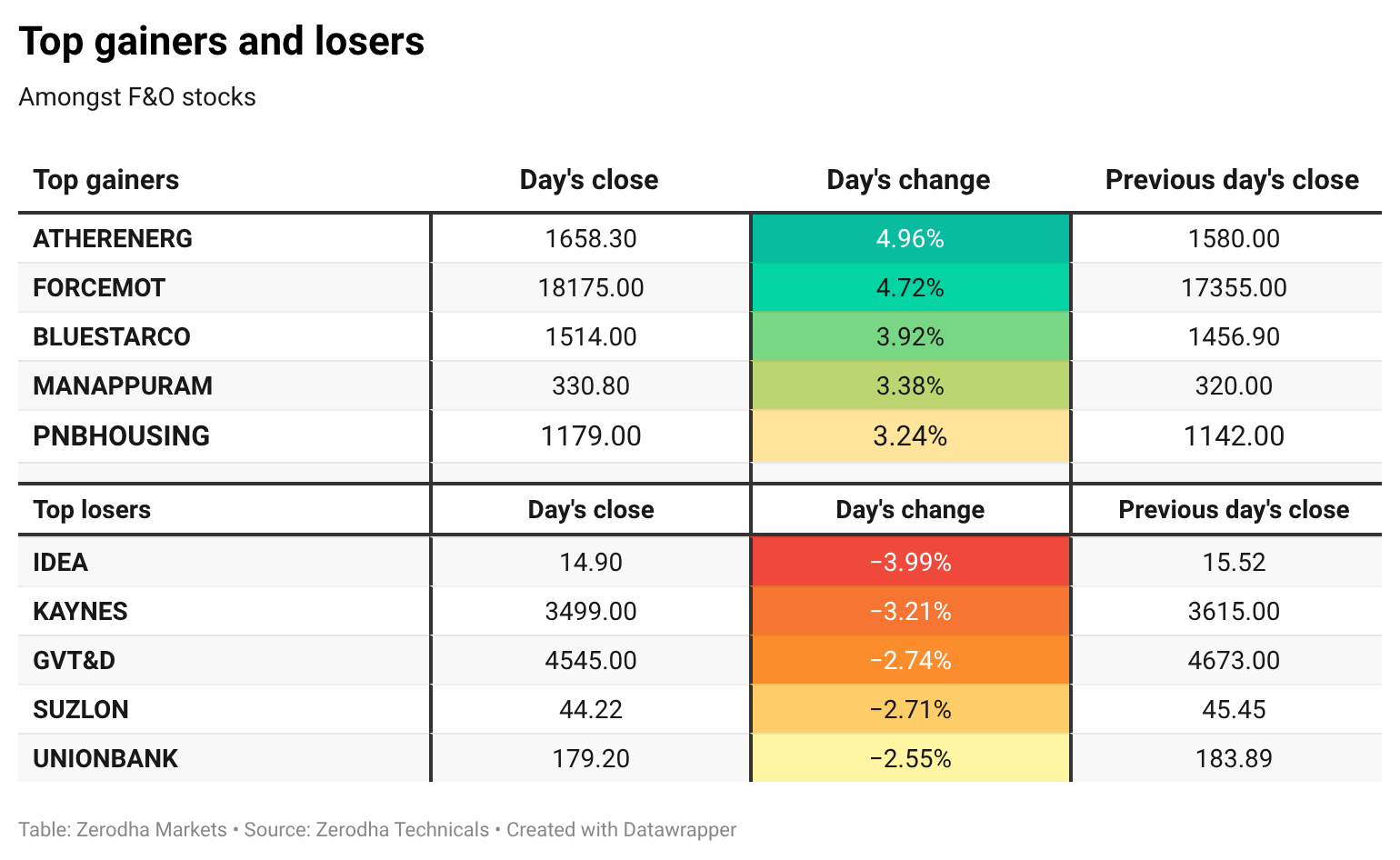
Winners & Losers
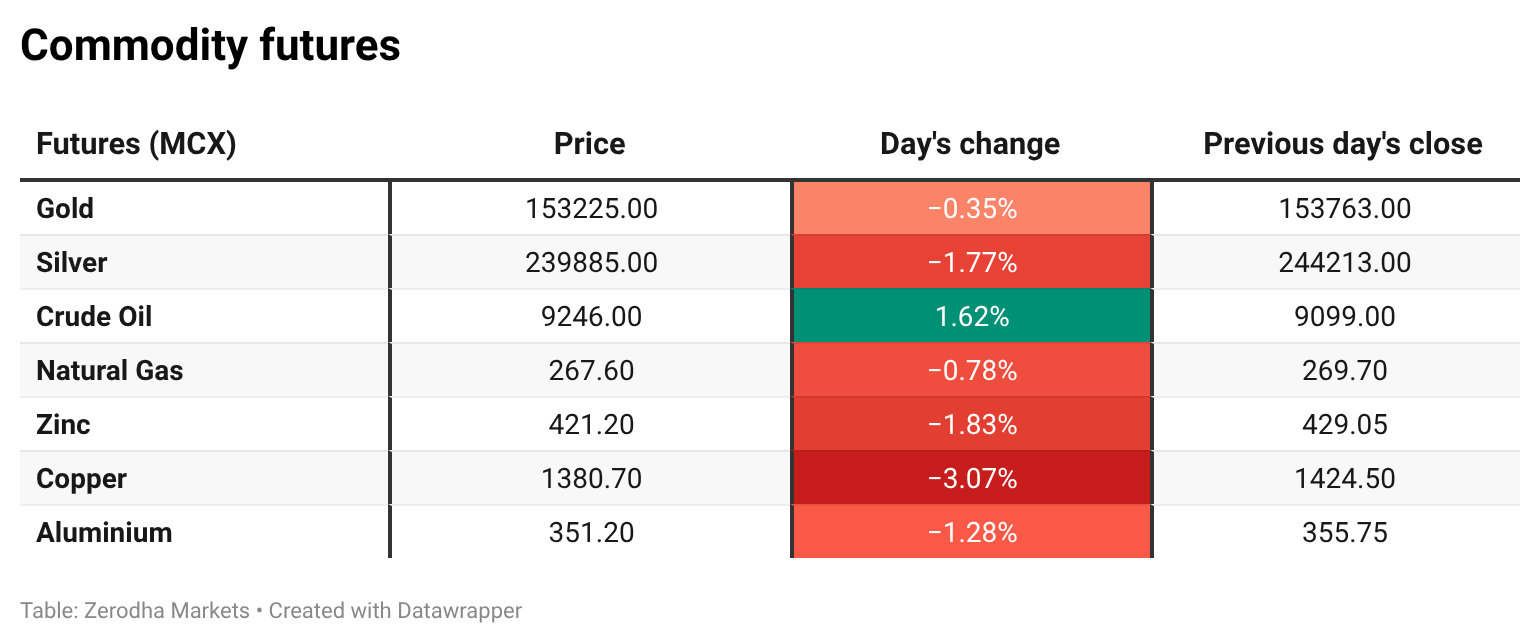
Commodities
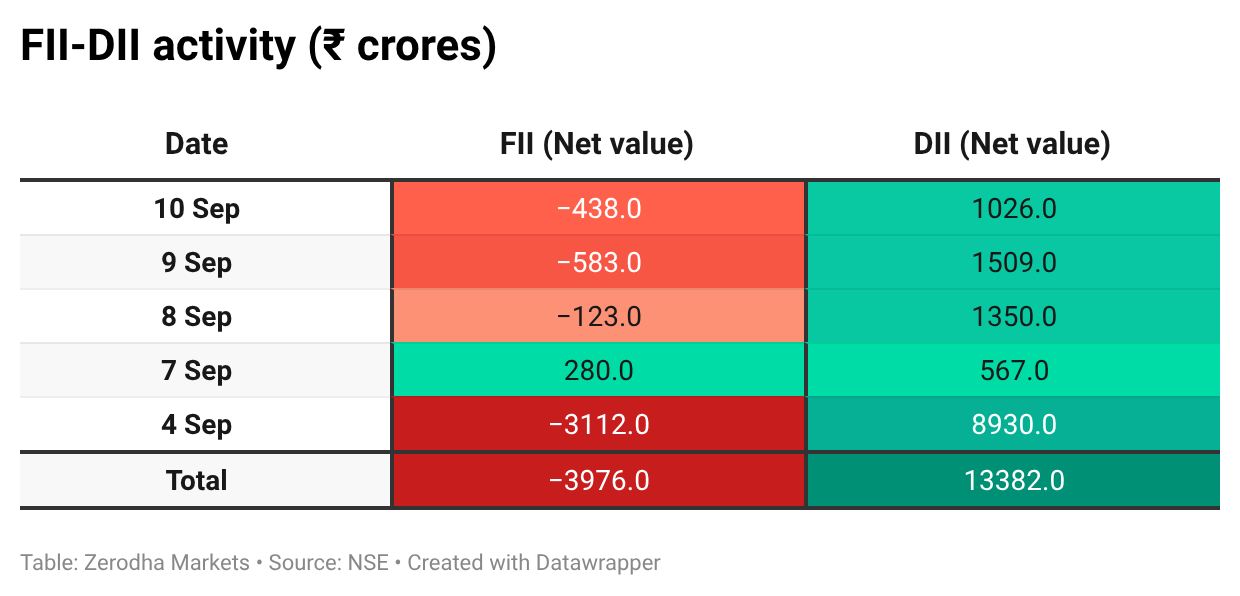
FII / DII Flows
Here’s the trend of FII-DII activity from the last 5 days:
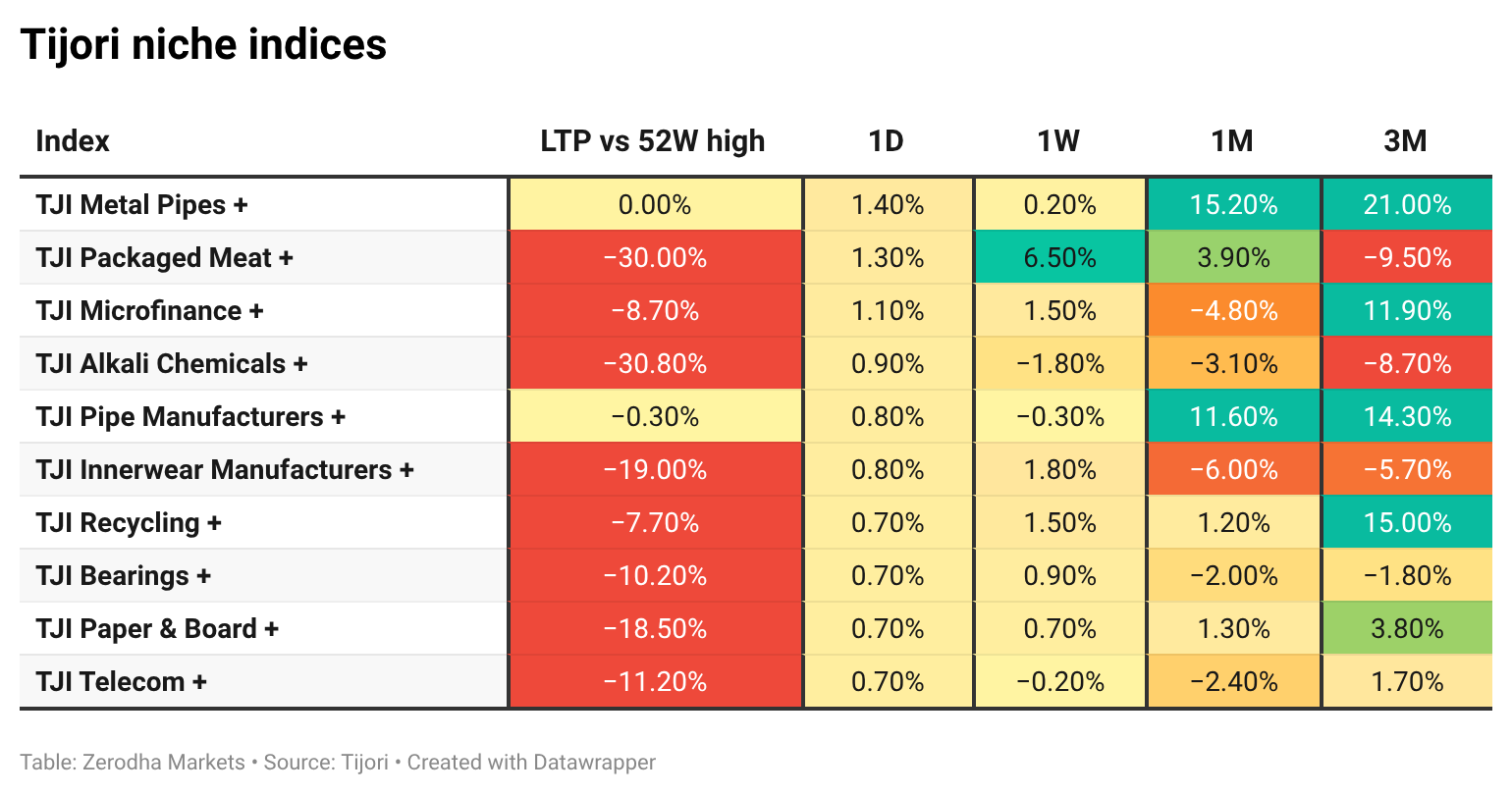
Thematic Indices
Tijori’s niche indices, where today’s move sorts pockets of the market beyond standard sector baskets. You can also track promoter buying and other interesting stuff, like Capex activity by the companies in the Tijori App’s idea dashboard
Change in OI for the day
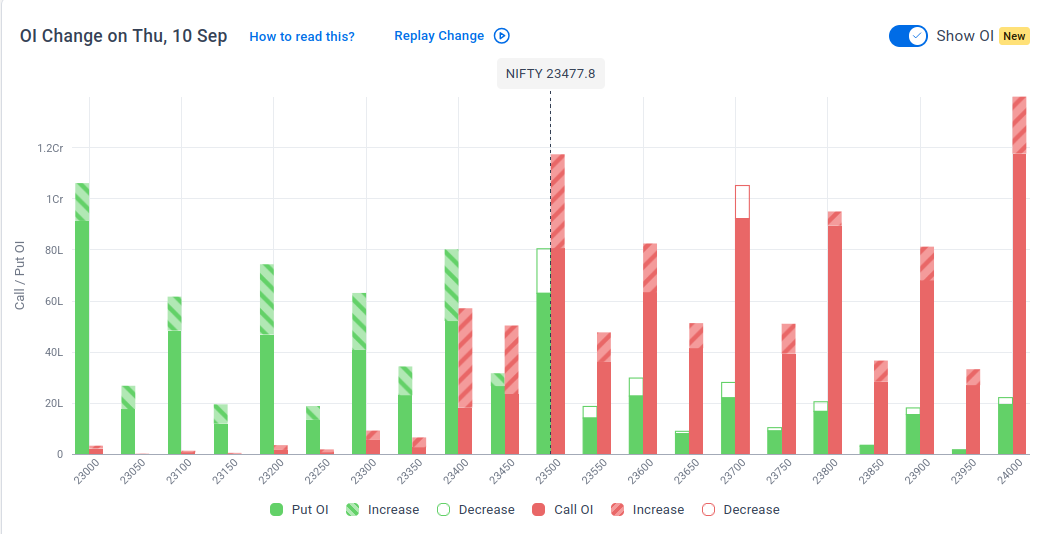
The following is the change in OI for Nifty contracts expiring on 15th September:
The maximum Call Open Interest (OI) is observed at 24,000, followed by 23,500, indicating potential resistance at the 23,600- 23,700 levels.
The maximum Put Open Interest (OI) is observed at 23,000, followed by 23,400, suggesting support at 23,300-23,200.
Note: OI is subject to multiple interpretations; however, generally, an increase in Call OI indicates resistance in a falling market, while an increase in Put OI indicates support in a rising market.
Source: Sensibull

Top Stories in India
SEBI is reviewing how derivative settlement prices are calculated on expiry days following the rollout of the Closing Auction Session (CAS), after concerns raised by market participants. Chairman Tuhin Kanta Pandey said “CAS is here to stay,” indicating that SEBI plans to modify the settlement-price methodology rather than roll back the auction mechanism. Dive deeper
Indian investors poured a record ₹32,297 crore into mutual funds through SIPs in August, up 1.1% MoM, despite continued market volatility. Overall equity fund inflows jumped 18.8% to ₹29,329 crore, with small-cap and mid-cap funds receiving record ₹7,973 crore and ₹6,989 crore, respectively. Dive deeper
The Indian rupee fell for a third straight session, declining 0.3% to ₹95.44 per dollar, its steepest single-day fall since mid-July. Oil prices above $100, dollar demand from derivative maturities and corporate hedging weighed on the currency, despite RBI intervention through dollar sales and FX swaps. Dive deeper
HDFC Bank won all seven cases filed against it in Bahrain by investors over Credit Suisse AT1 bonds, with the Bahrain High Civil Court rejecting claims including alleged misrepresentation and failure to disclose risks. The court found insufficient evidence to establish wrongdoing or link the investors’ losses to the bank, and ordered the claimants to bear legal costs. Dive deeper
Chinese President Xi Jinping will visit India on September 12–13 for the 18th BRICS Summit in New Delhi, marking his first trip to India in seven years. The visit comes amid a gradual thaw in India-China relations following years of tensions after the 2020 border clashes, with a Modi-Xi bilateral meeting expected during the summit. Dive deeper
SEBI has launched Demat 2.0, a pilot for tokenised corporate bonds, aimed at enabling bonds to be issued, held, traded and settled using tokenisation technology. Three issuers have already issued tokenised bonds under the pilot, which is being led by CDSL and NSDL with participation from exchanges, banks, investors, NPCI and regulators, as SEBI looks to build a more integrated and programmable securities-market infrastructure. Dive deeper
Top Stories Globally
Brent crude surged to around $105 per barrel, while WTI breached $100, as Iran-aligned Houthi militants seized Yemen’s strategic port city of Mocha, raising fears of further disruptions to global energy supplies. The capture gives the Houthis greater leverage over the Bab el-Mandeb Strait, a crucial Red Sea shipping route, at a time when flows through the Strait of Hormuz are already heavily disrupted by the Iran war. Dive deeper
OPEC cut its 2026 global oil demand growth forecast to 380,000 barrels per day from 580,000 bpd, marking its fifth consecutive downward revision. Despite the Iran war, OPEC remains more optimistic than the IEA, which expects global oil demand to decline in 2026; OPEC also raised its 2027 demand-growth forecast. Dive deeper
U.S. producer prices rose 0.4% MoM in August, the sharpest increase in three months, as goods prices jumped 1.1% following two months of declines. Energy costs drove much of the increase, with diesel prices surging 24.1%, while gasoline, jet fuel and heating oil also became more expensive, adding to inflation concerns. Dive deeper
Apple unveiled the iPhone 18 Pro and Pro Max, powered by its new 2nm A20 Pro chip, with major upgrades to on-device AI, cameras, battery life and thermal management. The models feature a 48MP main camera with variable aperture, a new vapor-chamber cooling system, and Siri AI, with U.S. prices starting at $1,199 for the Pro and $1,299 for the Pro Max. Dive deeper
The ECB raised interest rates by 25 bps, its second hike since the Middle East war began, taking the deposit rate to 2.50% and the main refinancing rate to 2.65%. The central bank said the conflict continues to drive energy-led inflationary pressures, with inflation expected to remain above its 2% target for an extended period. Dive deeper
Management Chatter
In this section, we highlight interesting comments from management at major companies and from policymakers in the Indian and Global Economies.
SBI Chairman Challa Sreenivasulu Setty on liquidity deployment generated from the Foreign Currency Non-Resident (Bank) deposits:
“I think everybody will be more responsible. It will take about three to four months for the deployment of the liquidity. I don’t think it will happen in the next month.”
“And as we speak, also contributed by the FCNR(B) flows, we have excess SLR of ₹4 lakh crore.”
Overall, if you include the undisbursed term loans, unutilized working capital and pipeline, it exceeds ₹9 lakh crore. So, there is a strong pipeline for corporate credit,” he said. - Link
Corporate Actions & Events
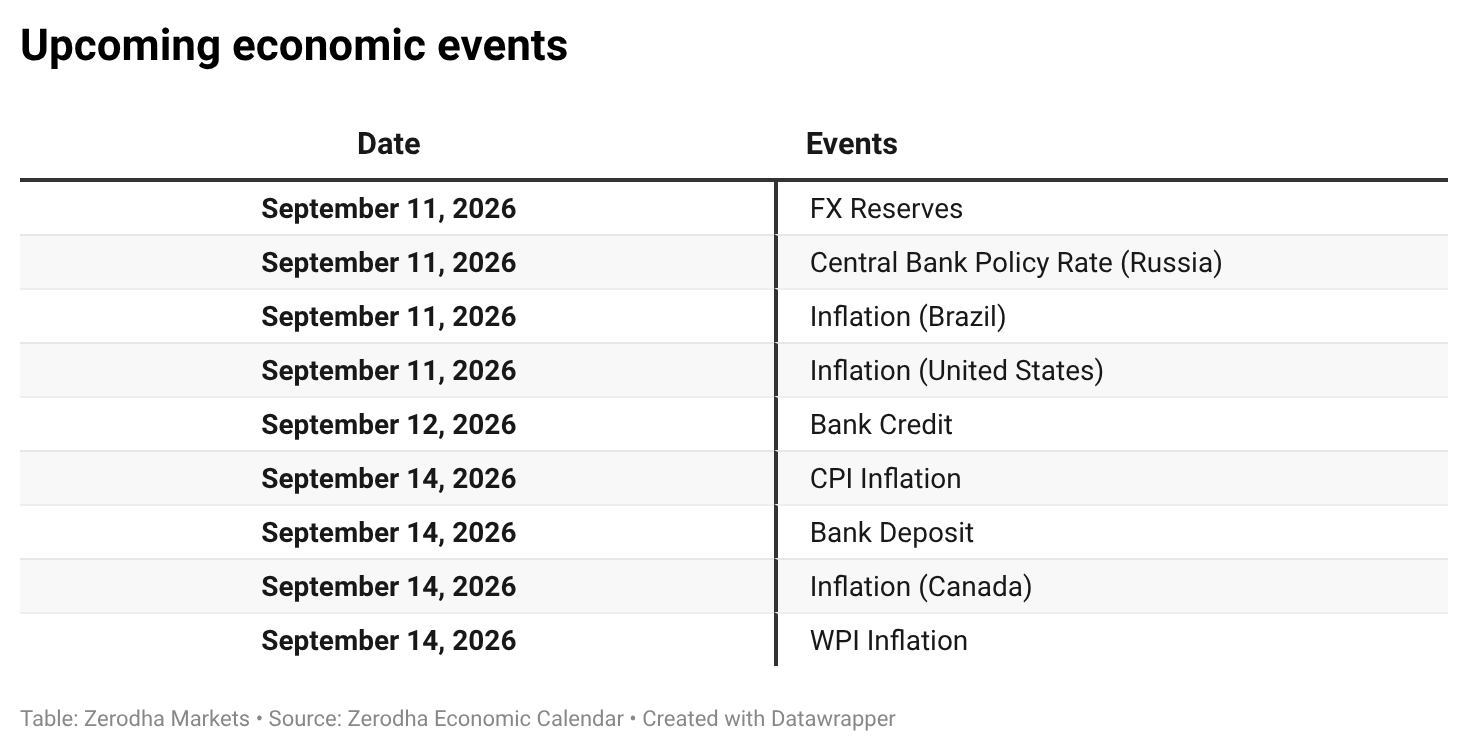
Corporate Actions
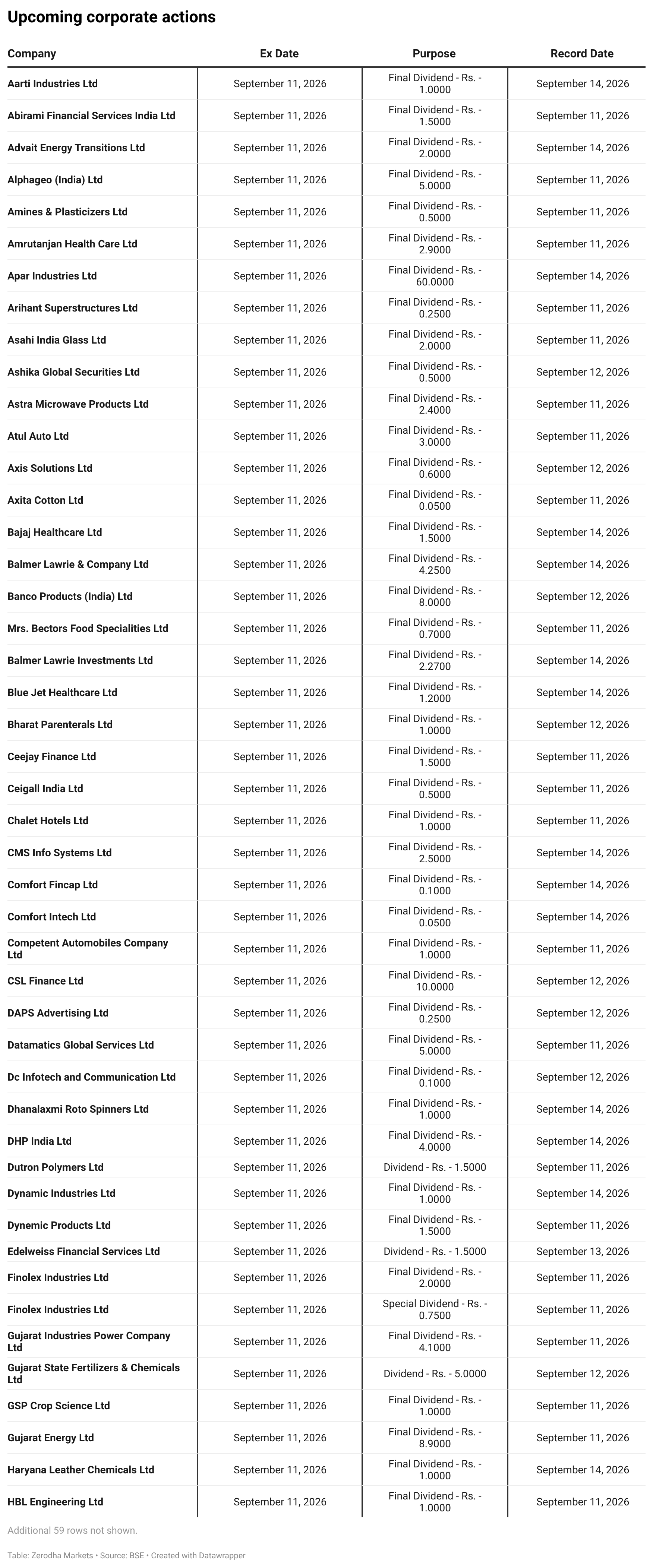
Published by Zerodha. Not investment advice. Data from NSE, BSE, and MCX.
In our latest episode of In The Money by Zerodha, we trace the story of Fibonacci levels, from their origins in ancient India to their use on modern stock charts. We look at how the Fibonacci sequence was connected to Sanskrit poetry, how Leonardo of Pisa brought the numbers to Europe, and how they eventually found their way into market analysis.
We also examine whether Fibonacci levels actually work in markets, and what psychology and anchoring have to do with why traders use them. Finally, we explore why our brains are so good at finding patterns, even when those patterns may not really exist.
That’s it from us for today. We’d love to hear your feedback in the comments, and feel free to share this with your friends to spread the word!