
Welcome to Aftermarket Report, a newsletter where we do a quick daily wrap-up of what happened in the markets, both in India and globally.
What data points and transformations do you want to see?
We’re trying out a new format for the Aftermarket Report, with much more comprehensive coverage of the data that shapes the trading day.
Beyond the headline indices, we’re now tracking market breadth, new highs and lows, sector and thematic performance, delivery data, F&O positioning, global markets, commodities, flows, and more. We’re also looking at ways to transform this raw data into insights that are actually useful for traders and investors.
The idea is simple: bring different datasets together in one place to give you a clearer picture of what’s happening beneath the surface of the market.
This is still a work in progress, and we’d love your feedback. What data points are we missing? What transformations, ratios, comparisons, or indicators would you find useful? Also tell us what worked, what didn’t, and what felt unnecessary.
Your feedback will help shape the Aftermarket Report from here.
Markets Today
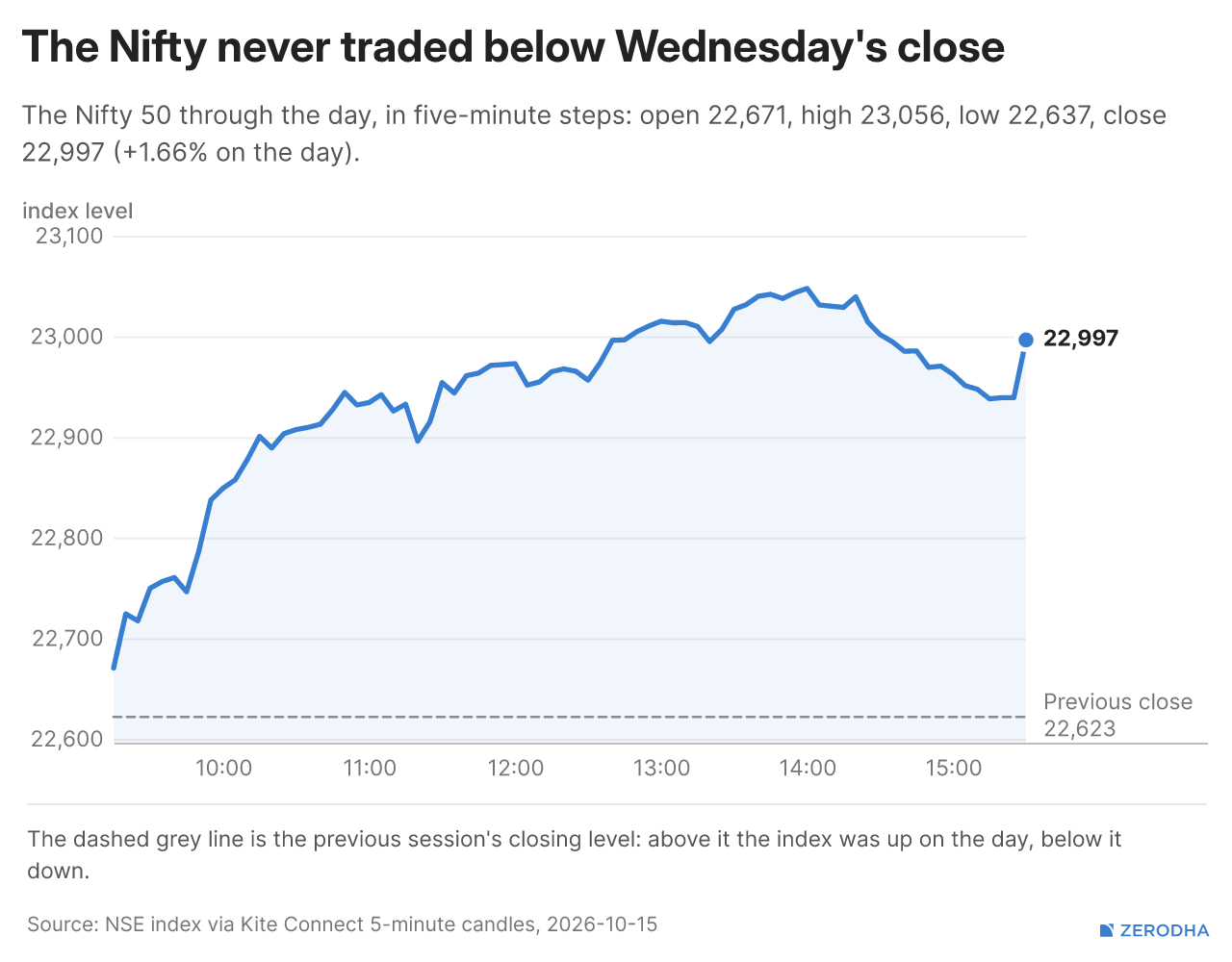
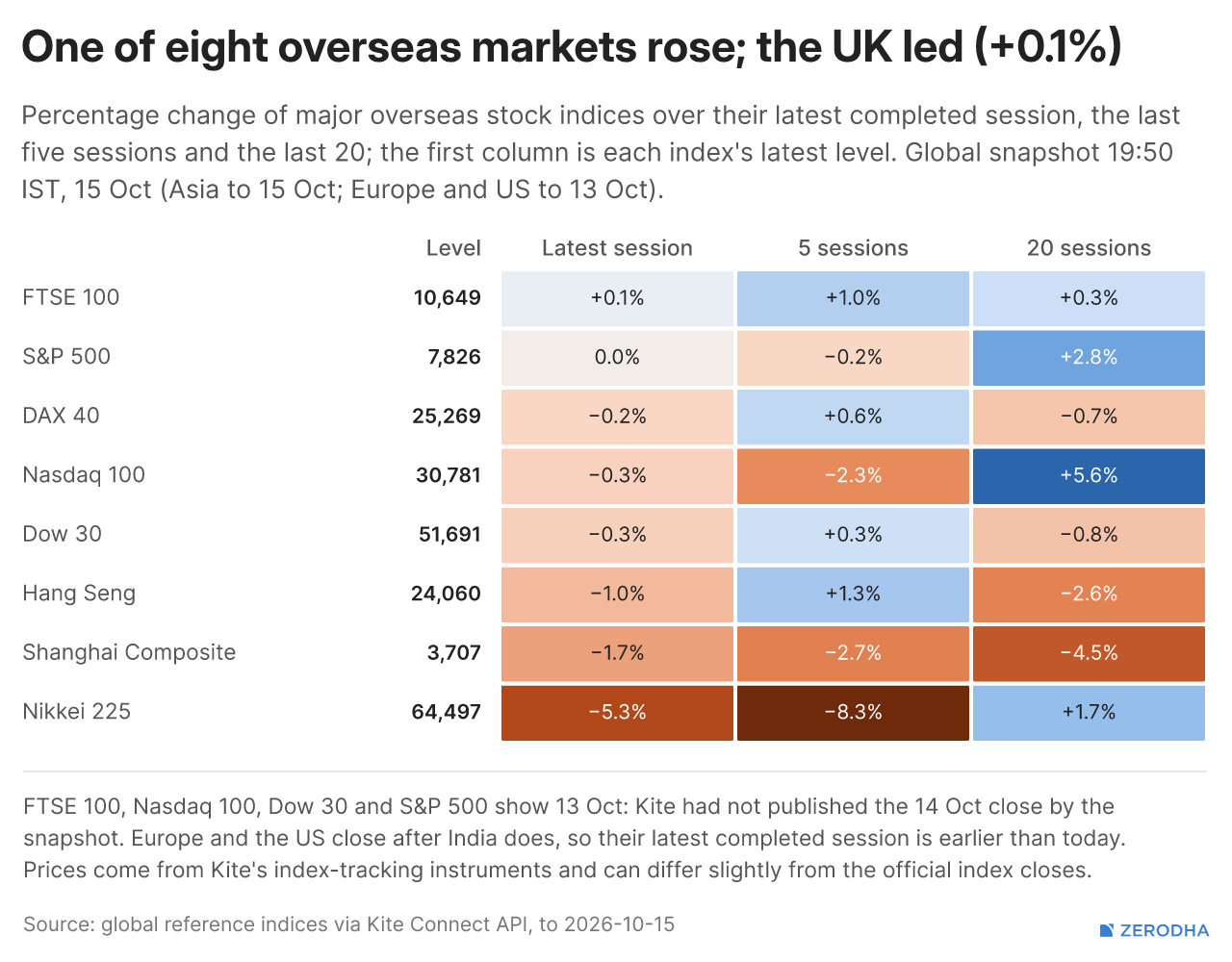
Nifty opened with a 48-point gap up at 22,671, bucking the weak global trend as South Korean and Japanese markets fell 8% and 5%, respectively, amid a sharp sell-off in Asian technology stocks driven by concerns over high interest rates and the sustainability of AI investments.
Despite the weak global backdrop, Nifty quickly gained momentum, climbing above 22,750 within the first 20 minutes and crossing 22,850 by 10 AM. Buying continued through the morning, pushing the index above 22,900 around 10:15 AM and towards 22,950 by 11 AM. A brief bout of profit booking dragged Nifty back towards 22,890, but buying resumed, helping the index reclaim 22,950 by 11:30 AM.
The second half began on a positive note, with Nifty gradually moving higher and crossing 23,000 around 12:40 PM. The index consolidated near 23,000 through the early afternoon before another round of buying pushed it towards an intraday high near 23,050 around 1:45 PM.
However, the rally lost momentum after 2 PM, with profit booking gradually dragging Nifty below 23,000 and towards 22,930 by 3 PM. A decent recovery in the CAS helped the index reclaim 23,000. Nifty eventually closed at 22,997.35, around 330 points above its opening level, marking a strong session as domestic markets significantly outperformed their Asian peers despite the weak global backdrop.
Fear & Greed Index
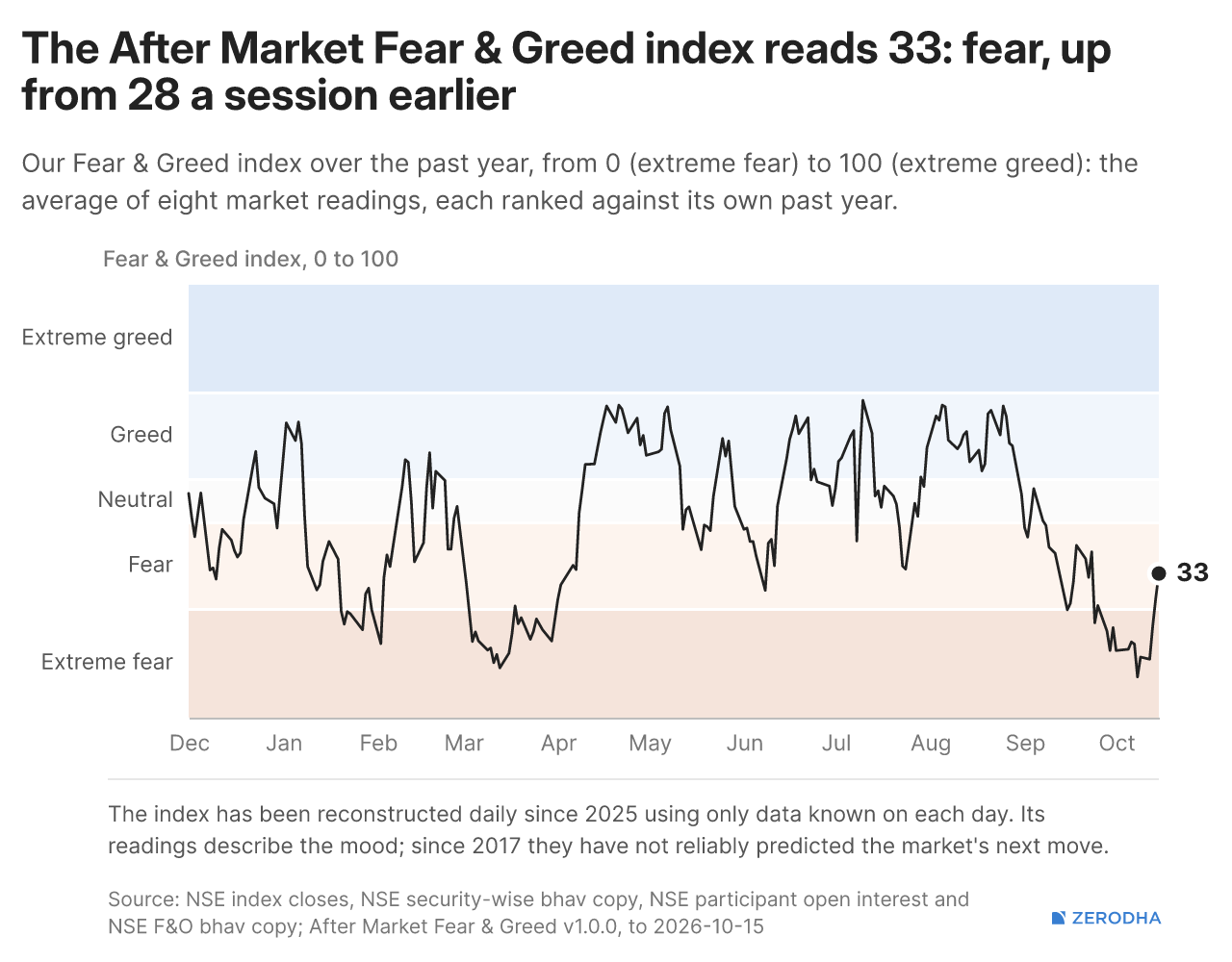
The Fear & Greed Index improved from 28 to 33, remaining in the fear zone. Sentiment has recovered significantly from last week’s reading of 9, although weak broader market trends and cautious foreign investor positioning continue to weigh on confidence.
Market Breadth
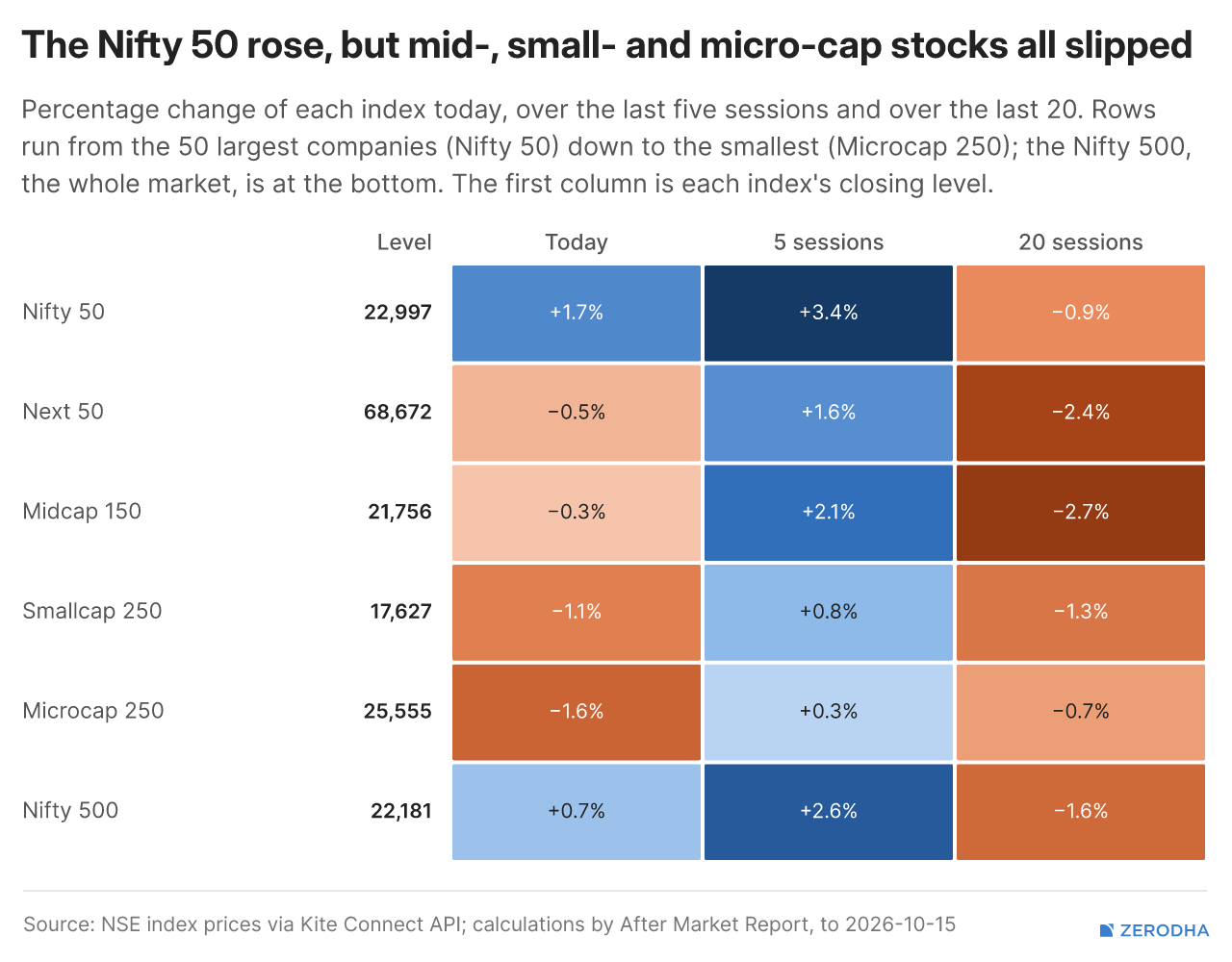
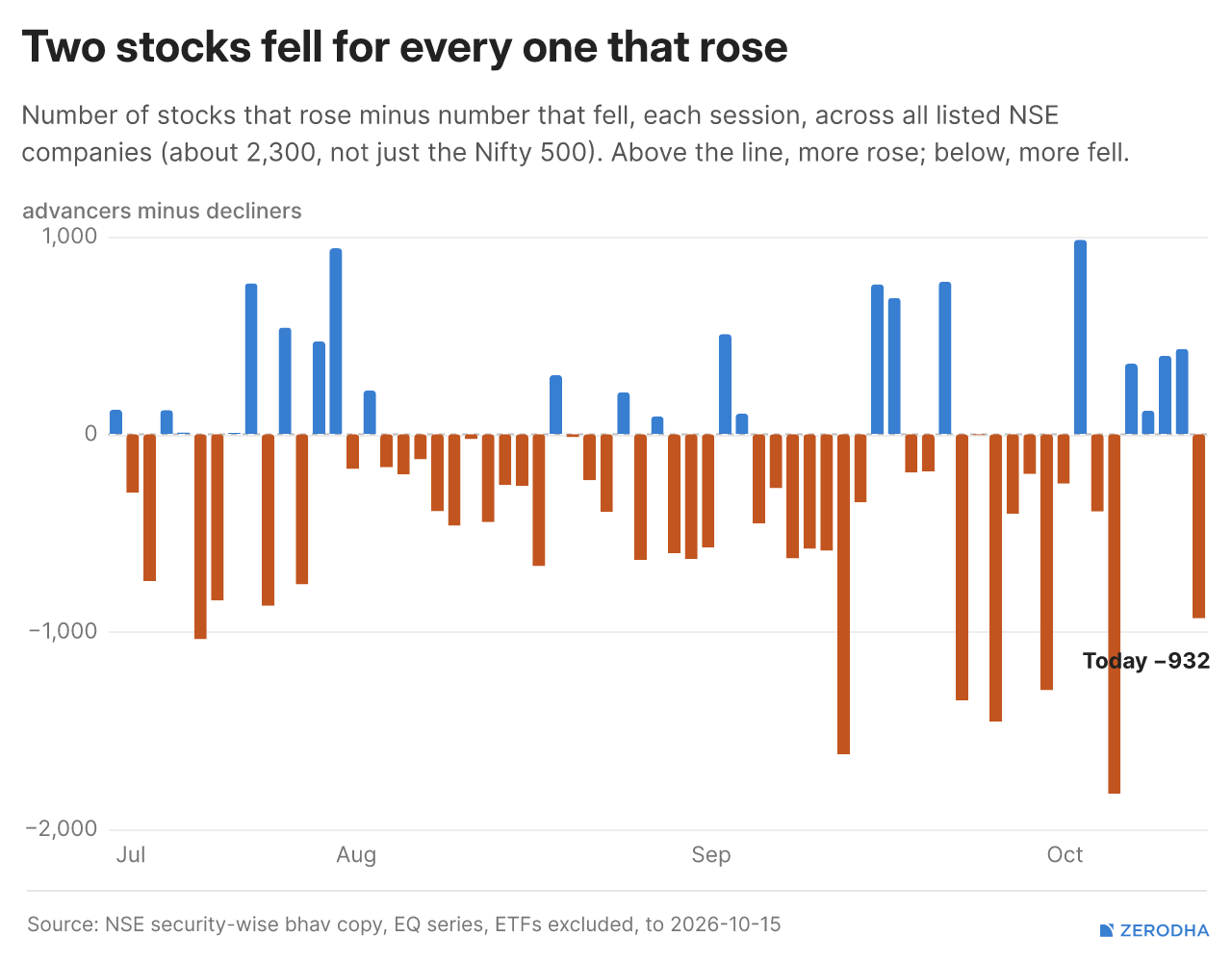
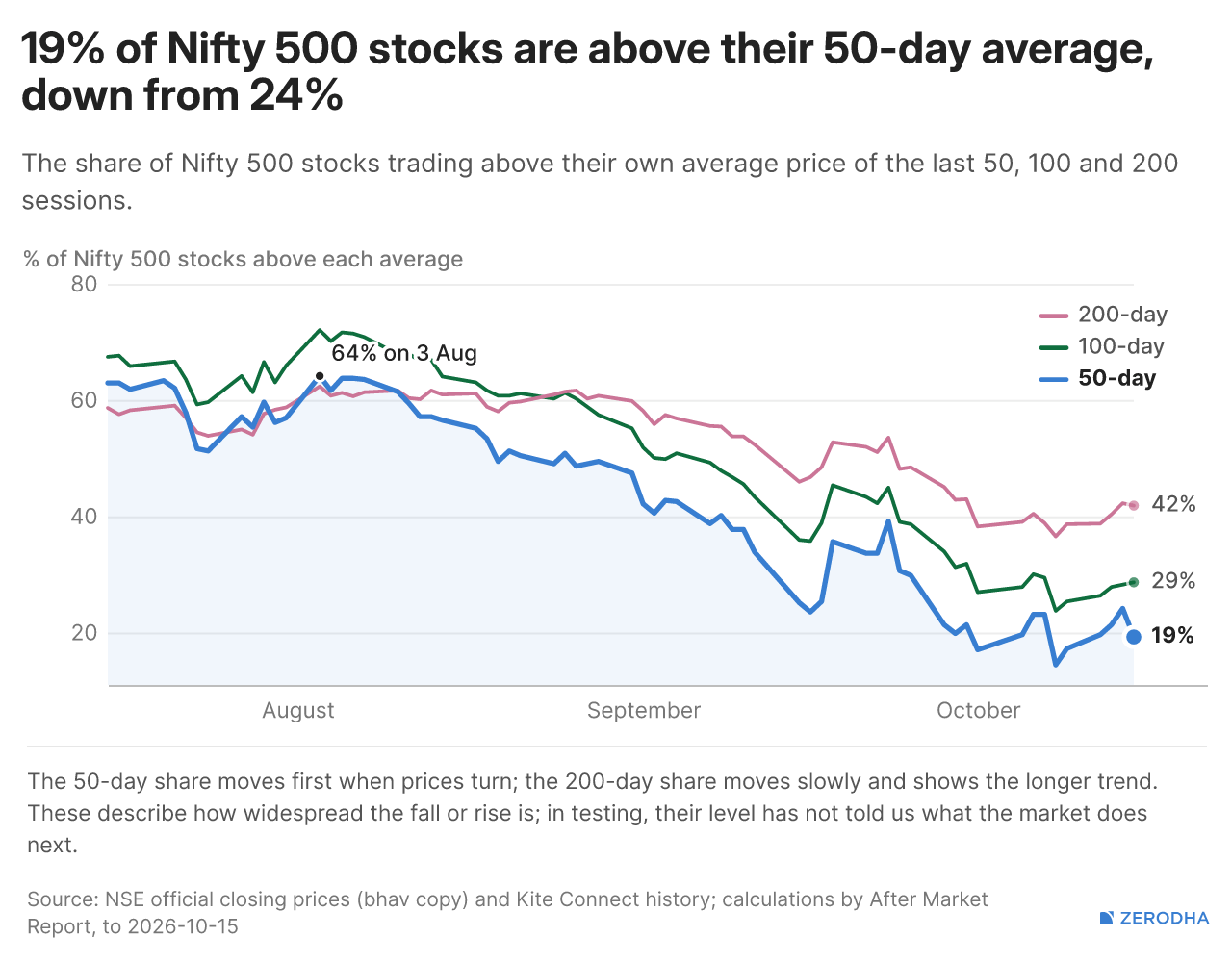
Despite Nifty’s strong rally, market breadth was sharply negative, with 1,623 declining stocks against just 691 advancing. The average Nifty 500 stock fell 0.53% even as the index gained 0.65%, highlighting a heavyweight-driven rally, while only 19.4% of stocks remain above their 50-day average.
52 Week Highs & Lows
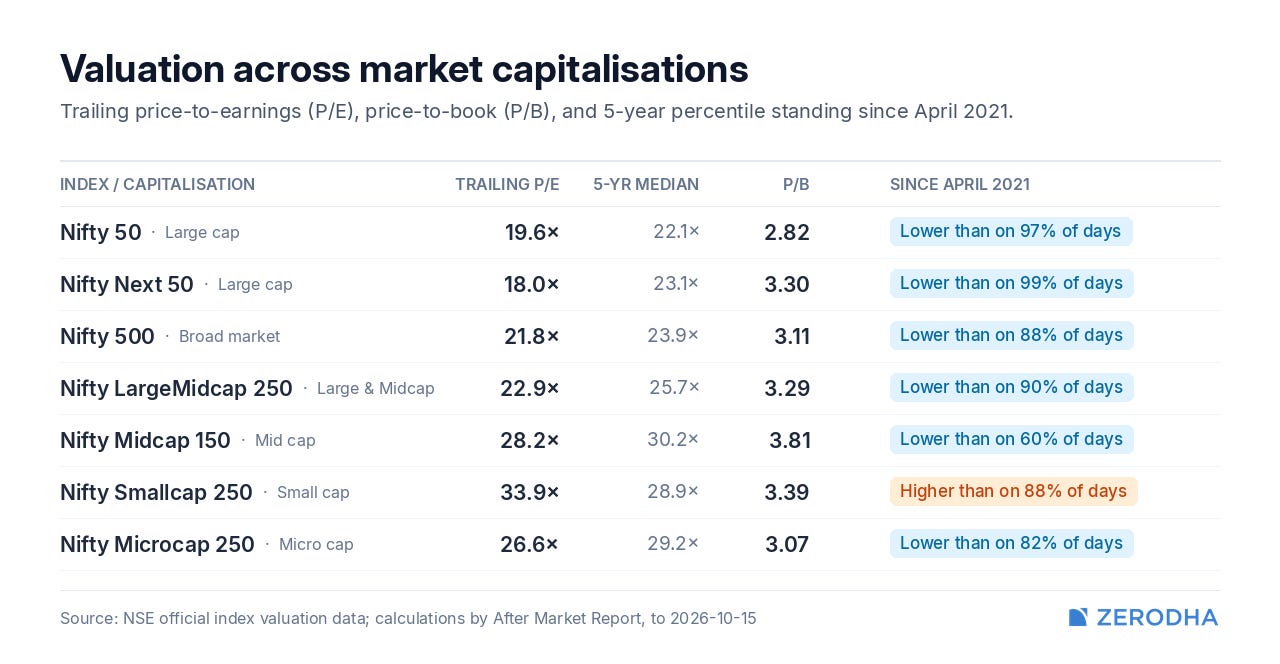
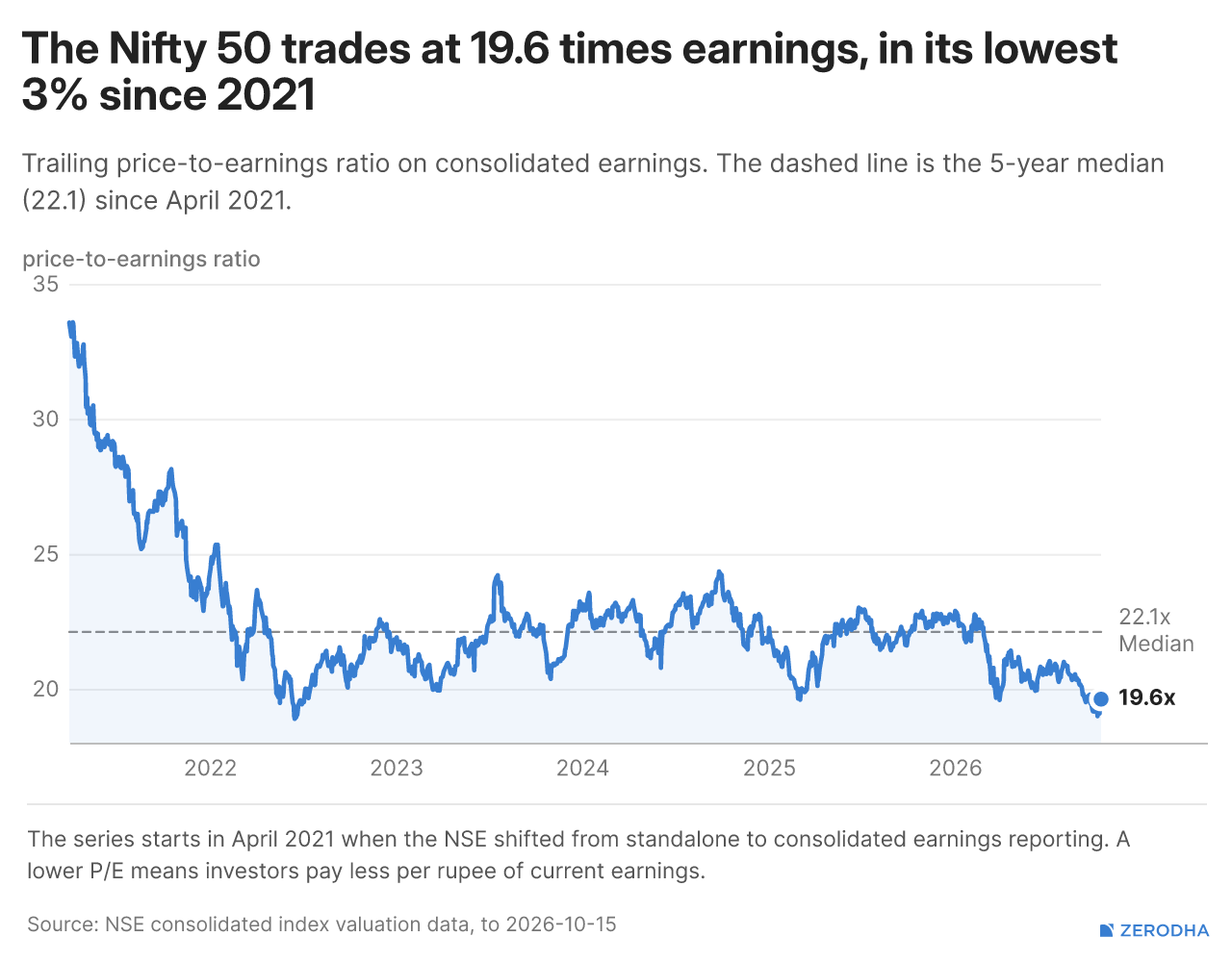
Valuation Check
Sectoral Indices Performance
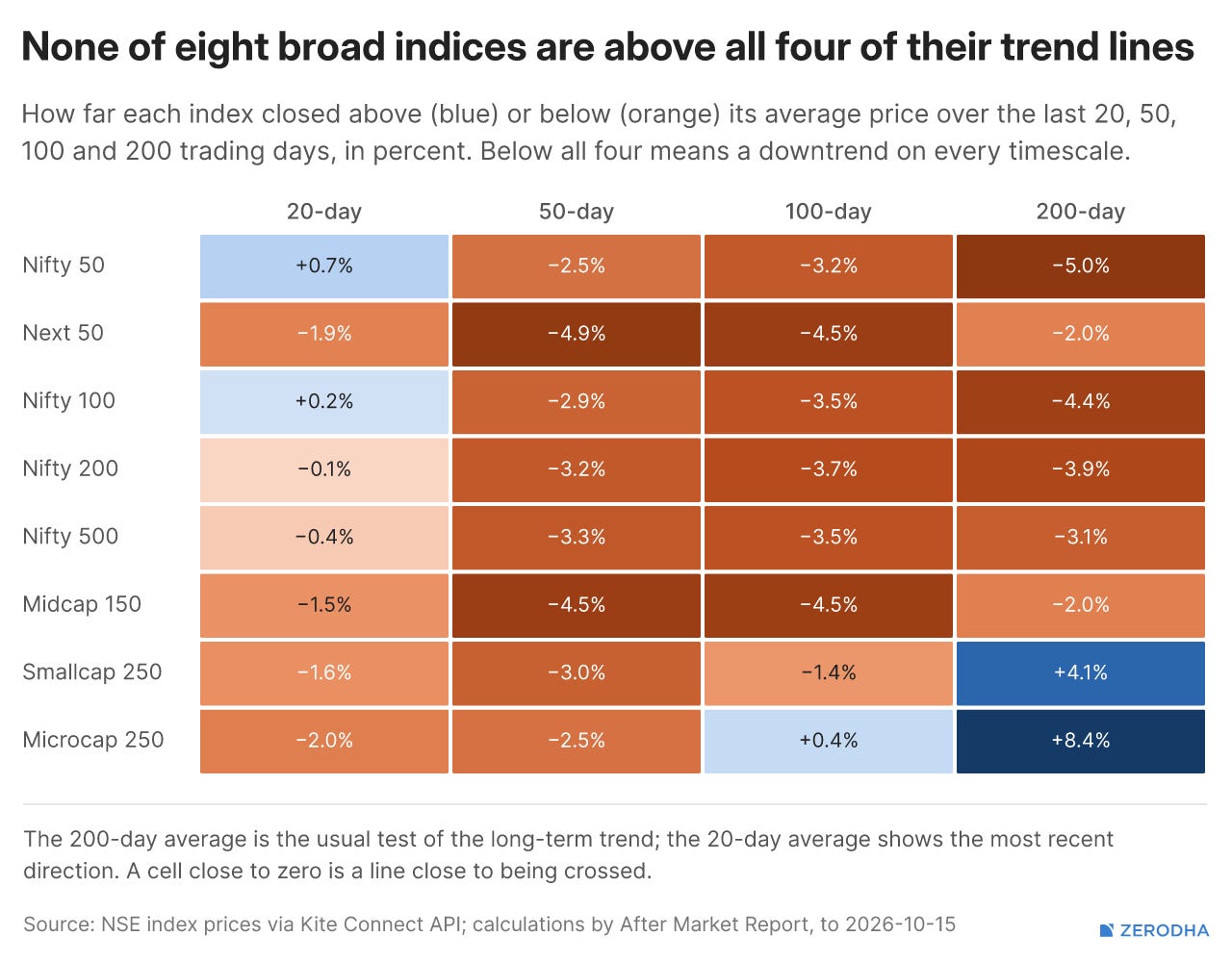
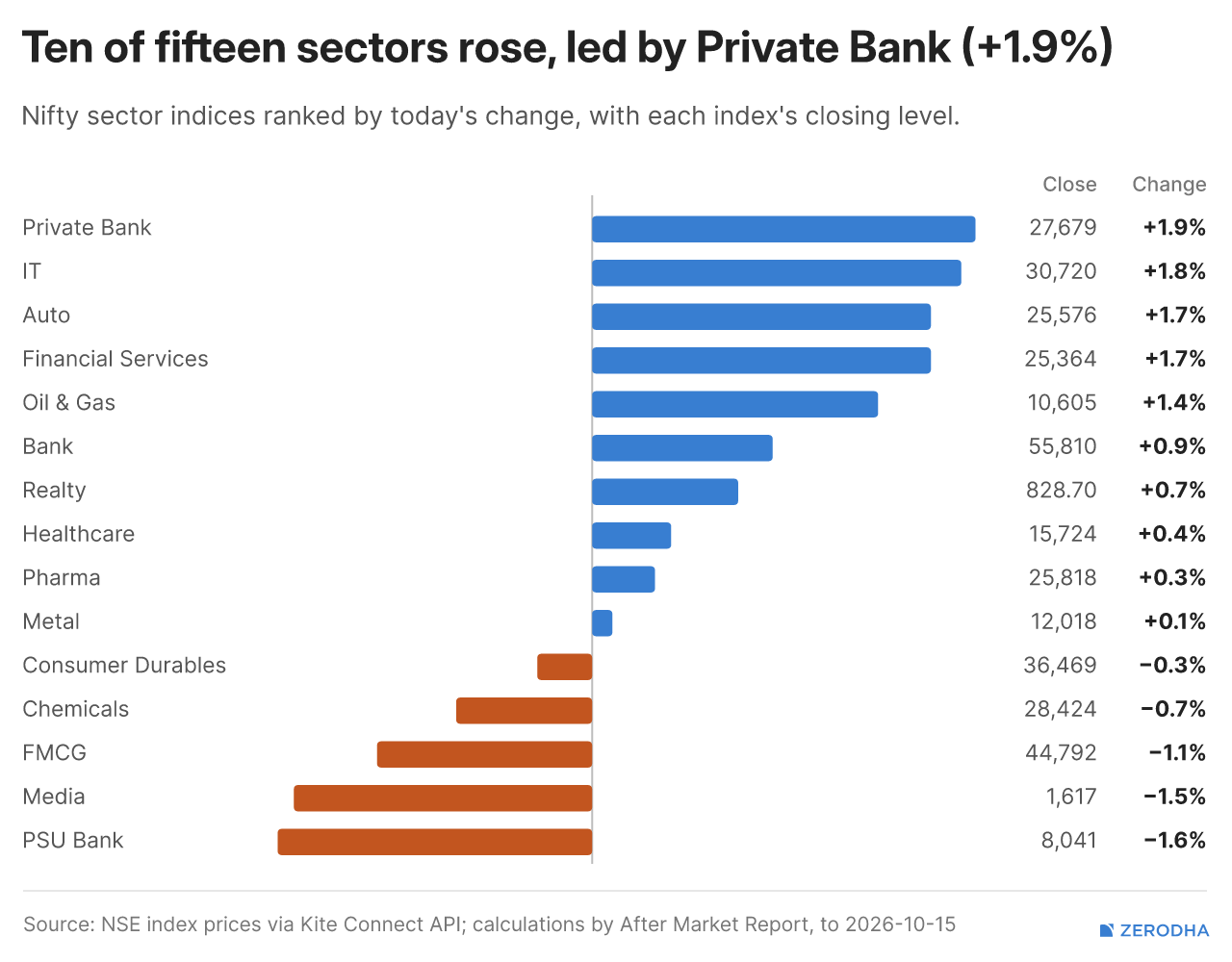
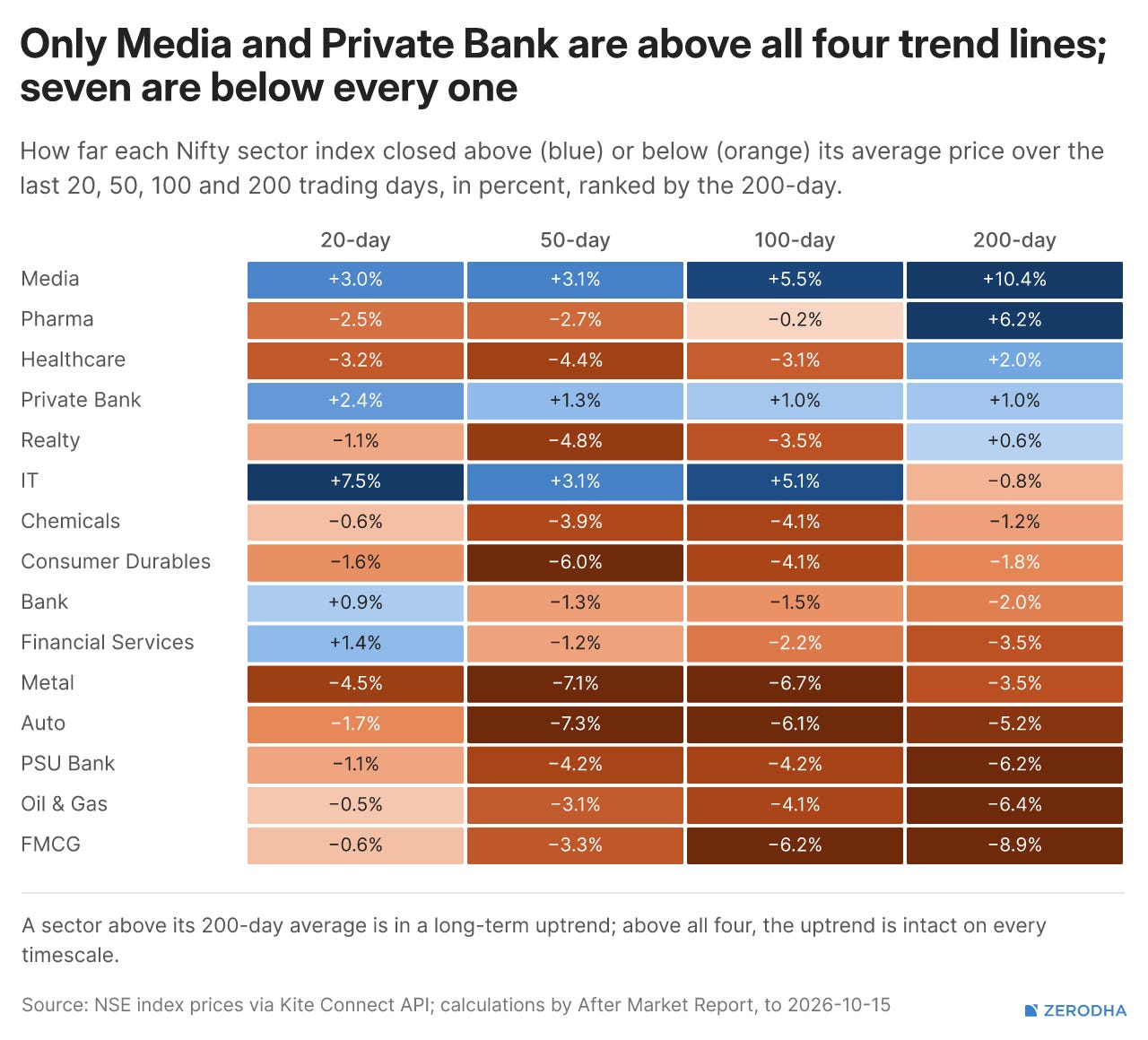
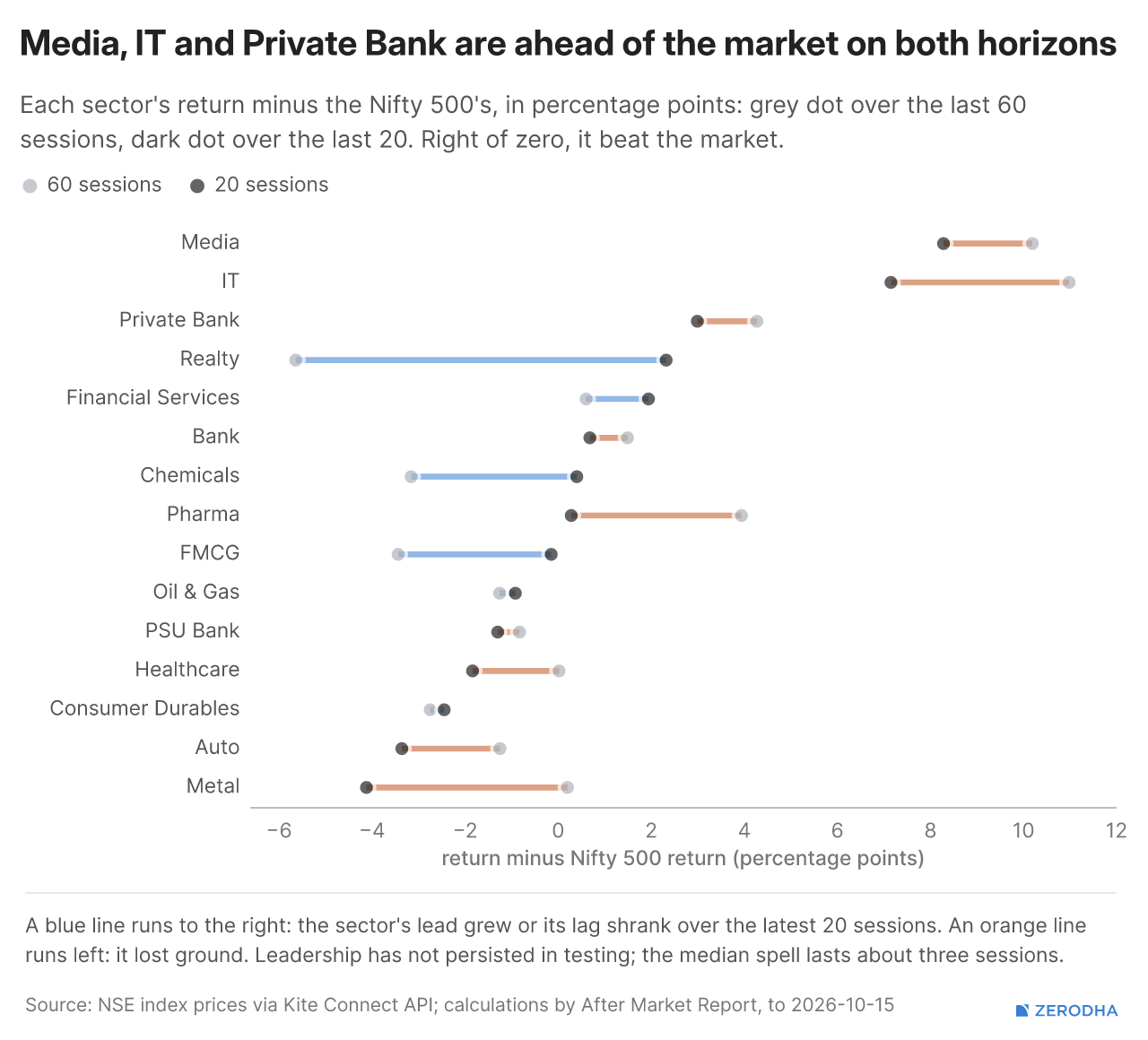
Private Banks led with a 1.89% gain, while PSU Banks fell 1.55%, with 10 of 15 sectors advancing. Media, IT and Private Banks remain the relative leaders over 20 and 60 sessions, with Media and Private Banks the only sectors trading above all four key moving averages.
Winners & Losers
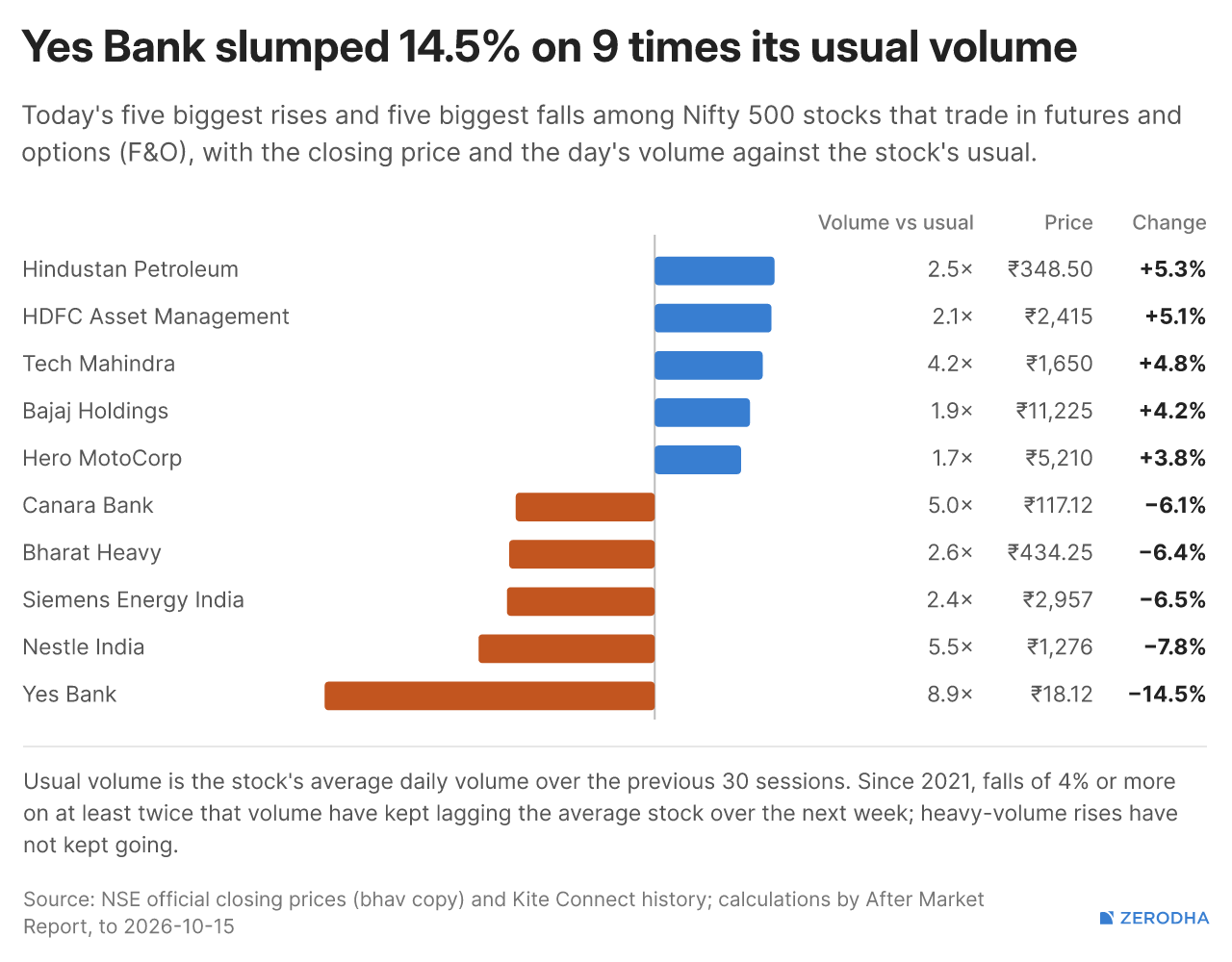
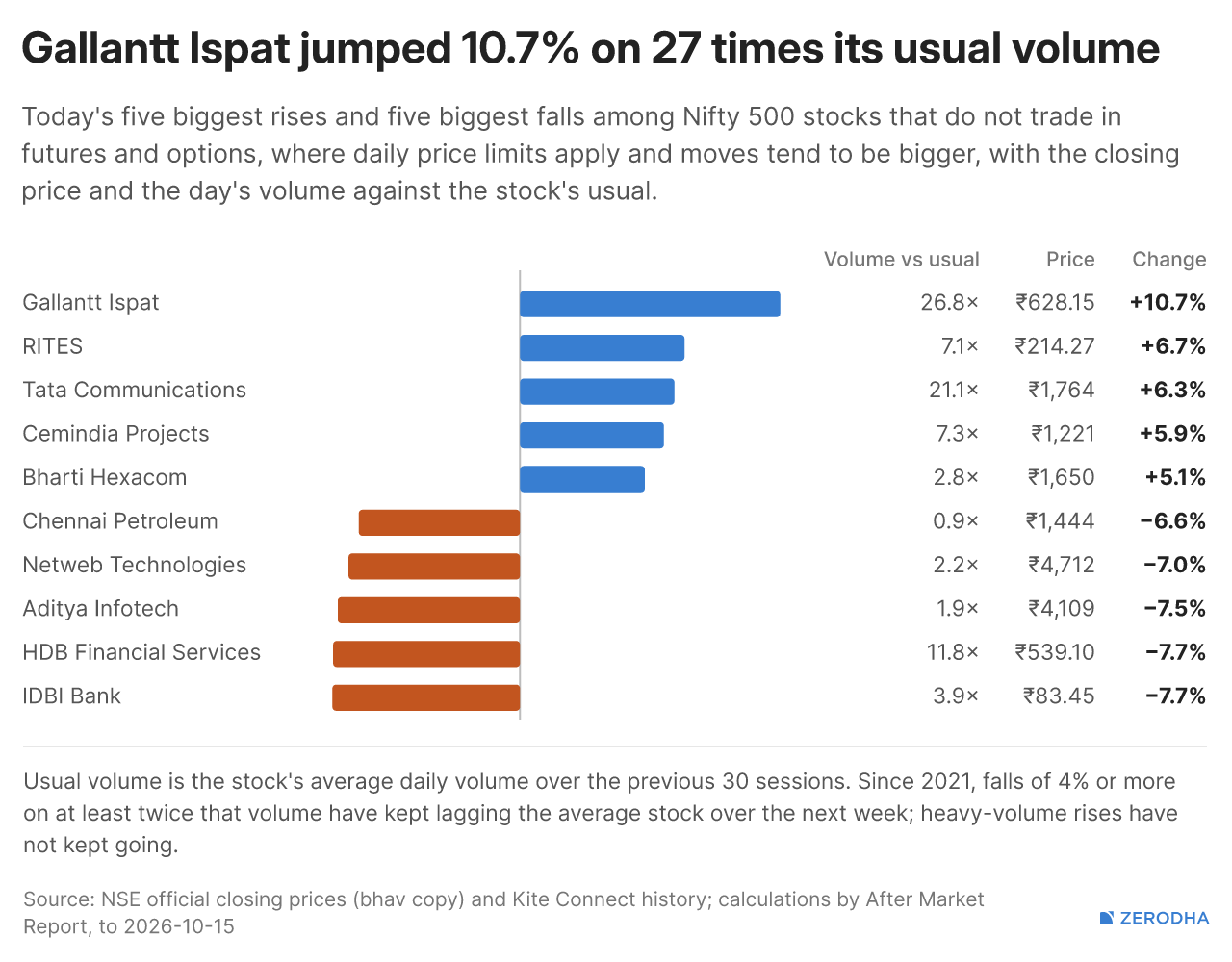
Gallantt Ispat jumped 10.65% on 27× usual volume, while Tata Communications gained 6.32% on 21× volume. Yes Bank plunged 14.53% on nearly 9× usual volume, while Nestlé India and BHEL declined 7.76% and 6.41%, respectively.
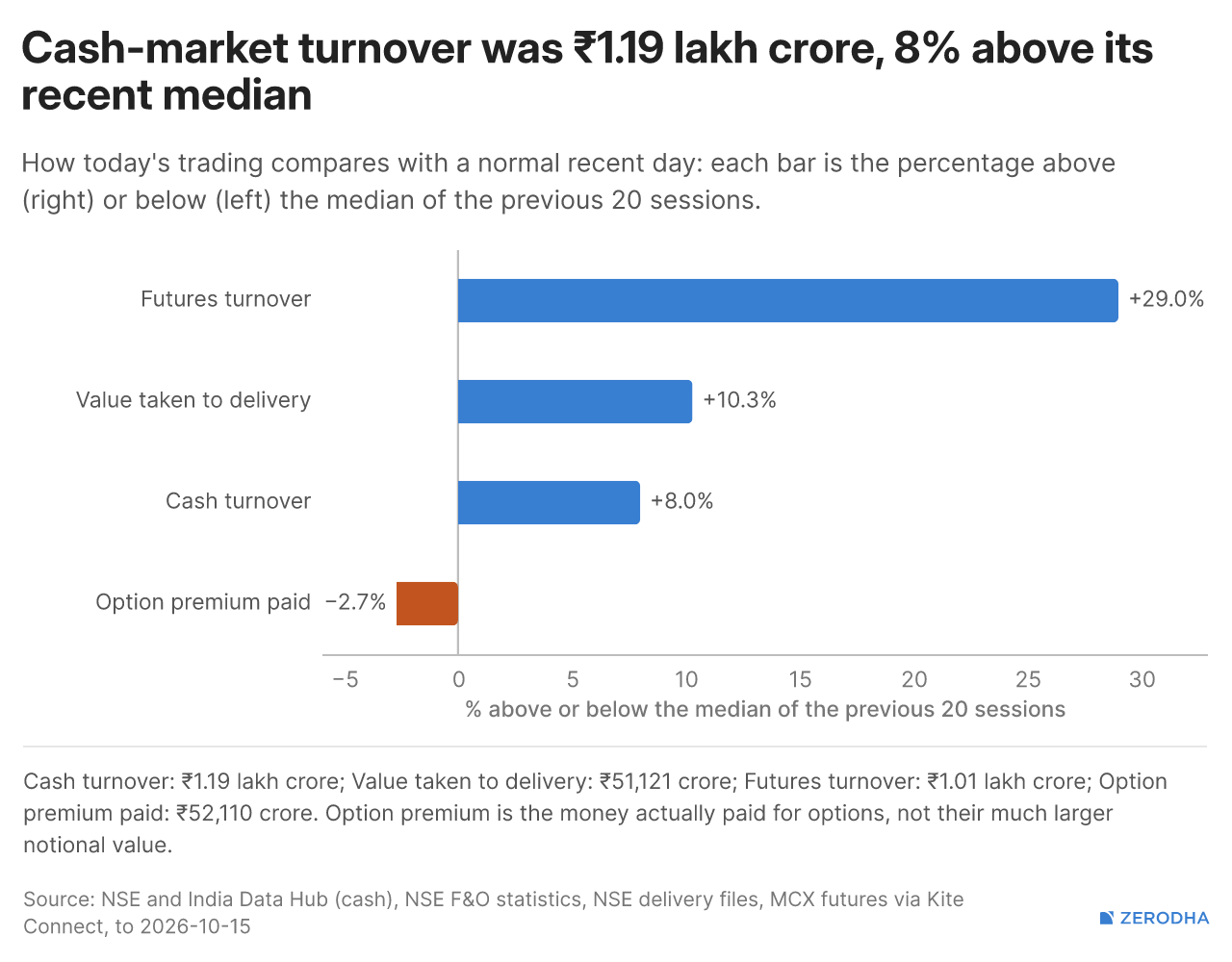
Delivery Data
Global Markets
Commodities
Institutional Flows & Participant Positioning
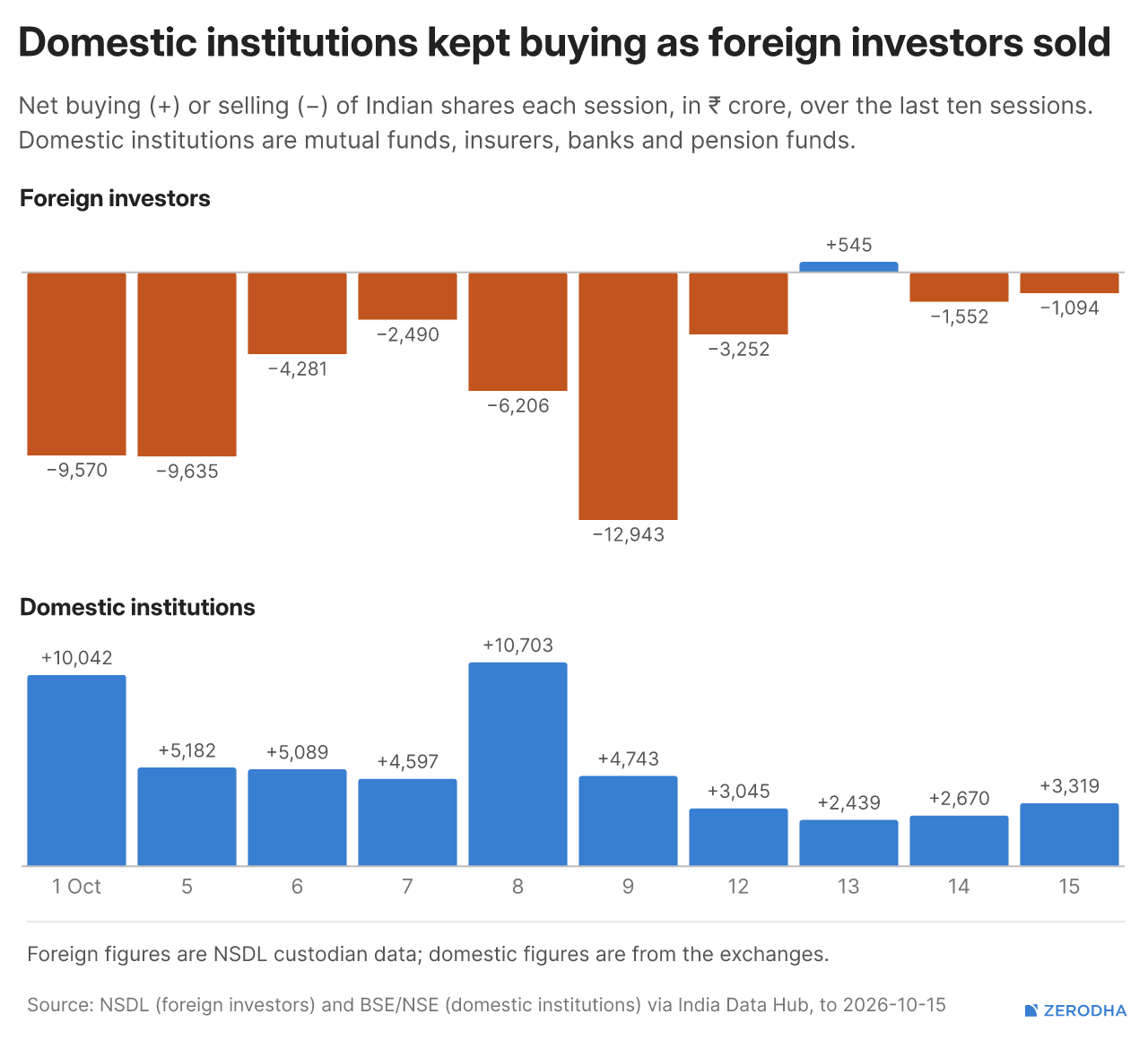
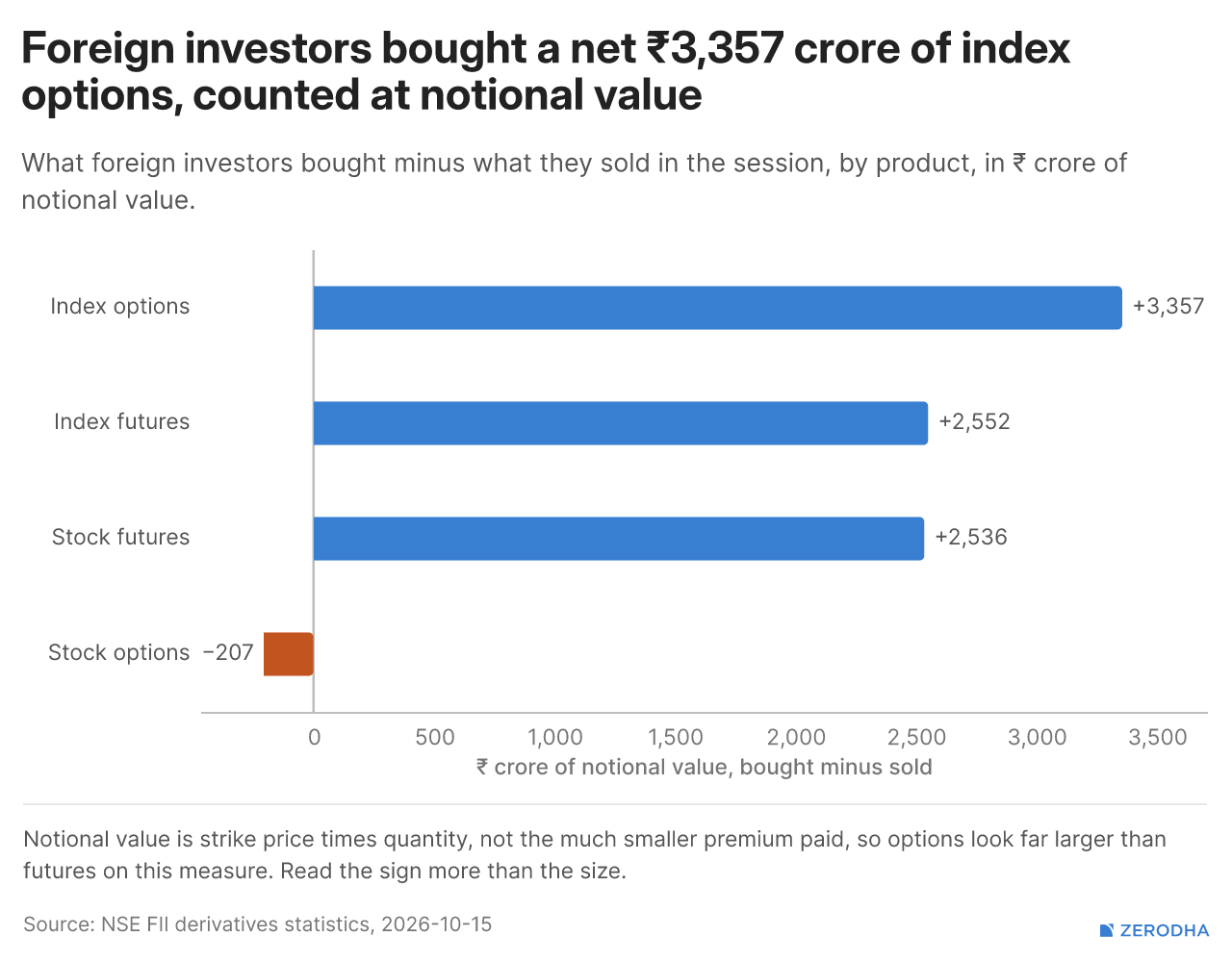
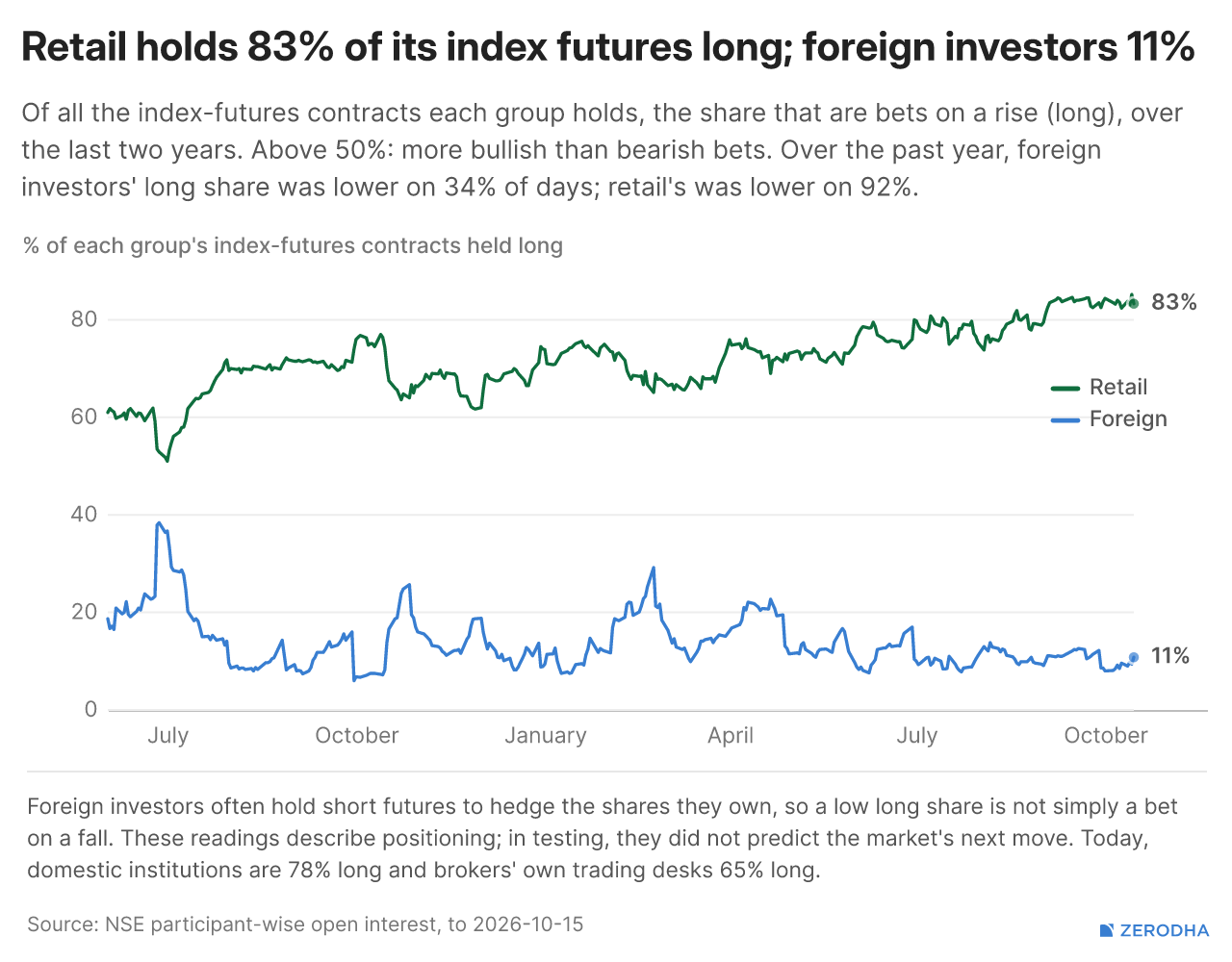
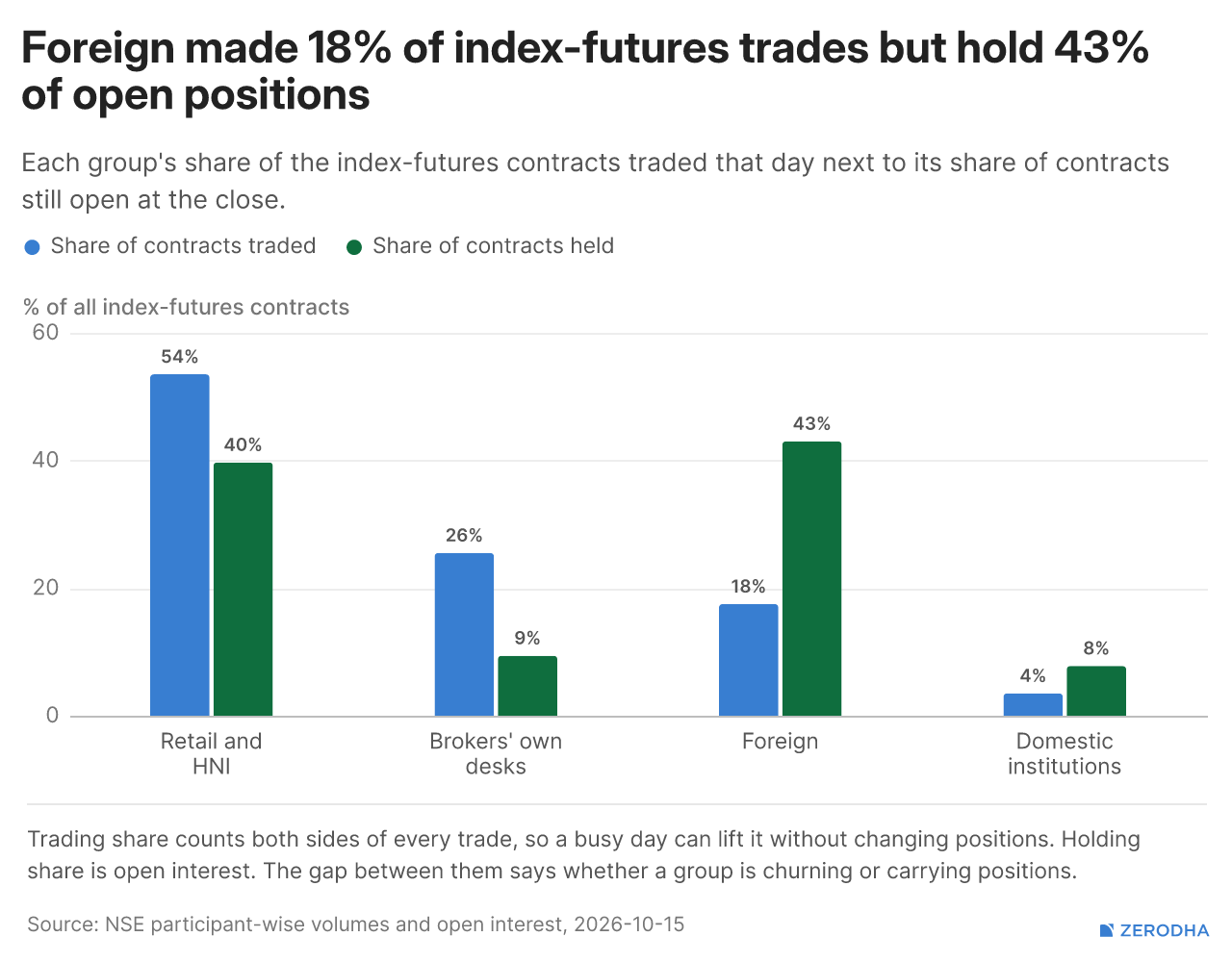
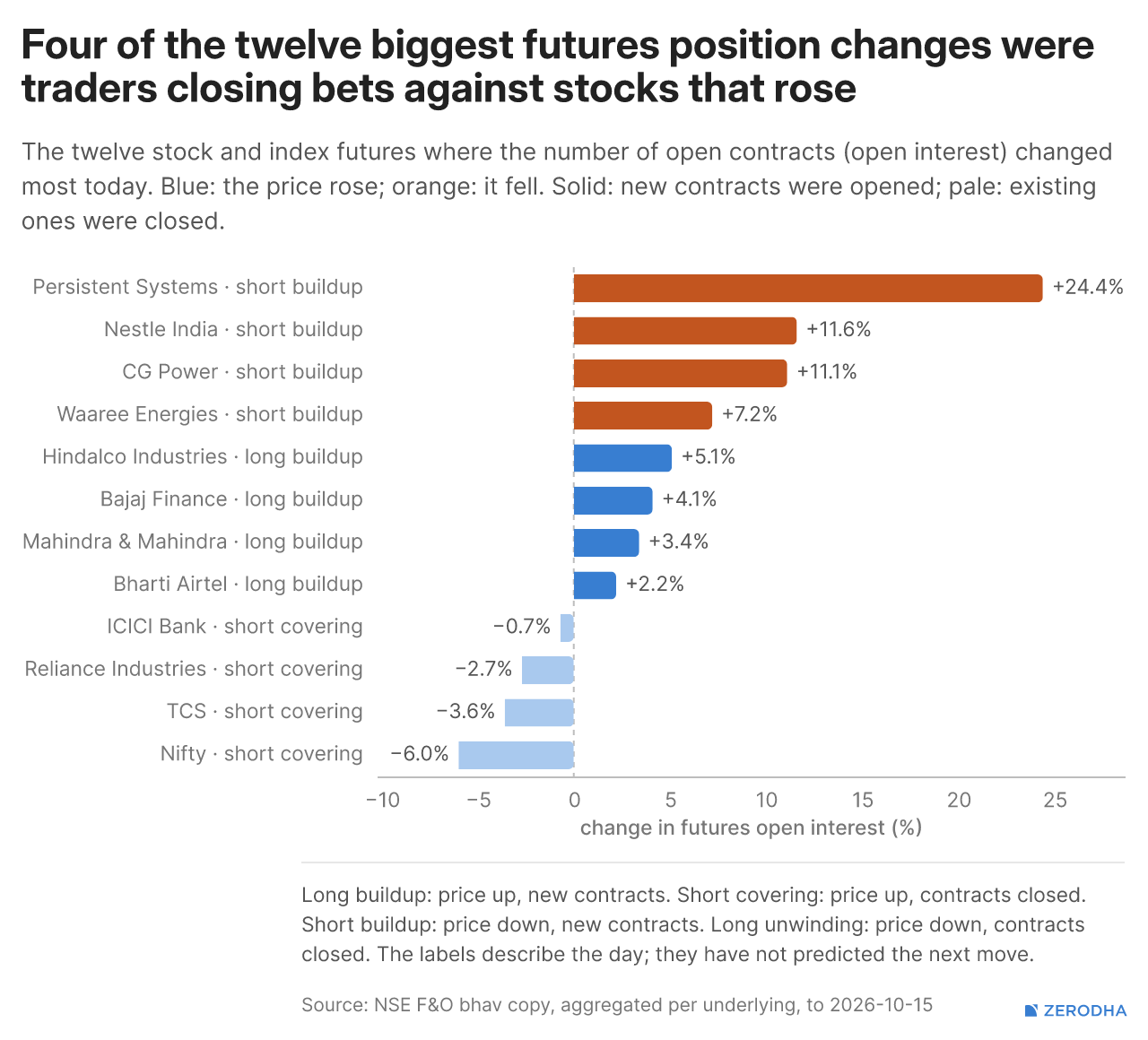
Put writing strengthened, lifting the PCR from 0.91 to 1.37, while implied volatility fell from 13.1% to 12%. FIIs increased their index-futures long ratio to 10.8% and bought a net 16,870 contracts, while retail and HNIs remained heavily long at 83%.
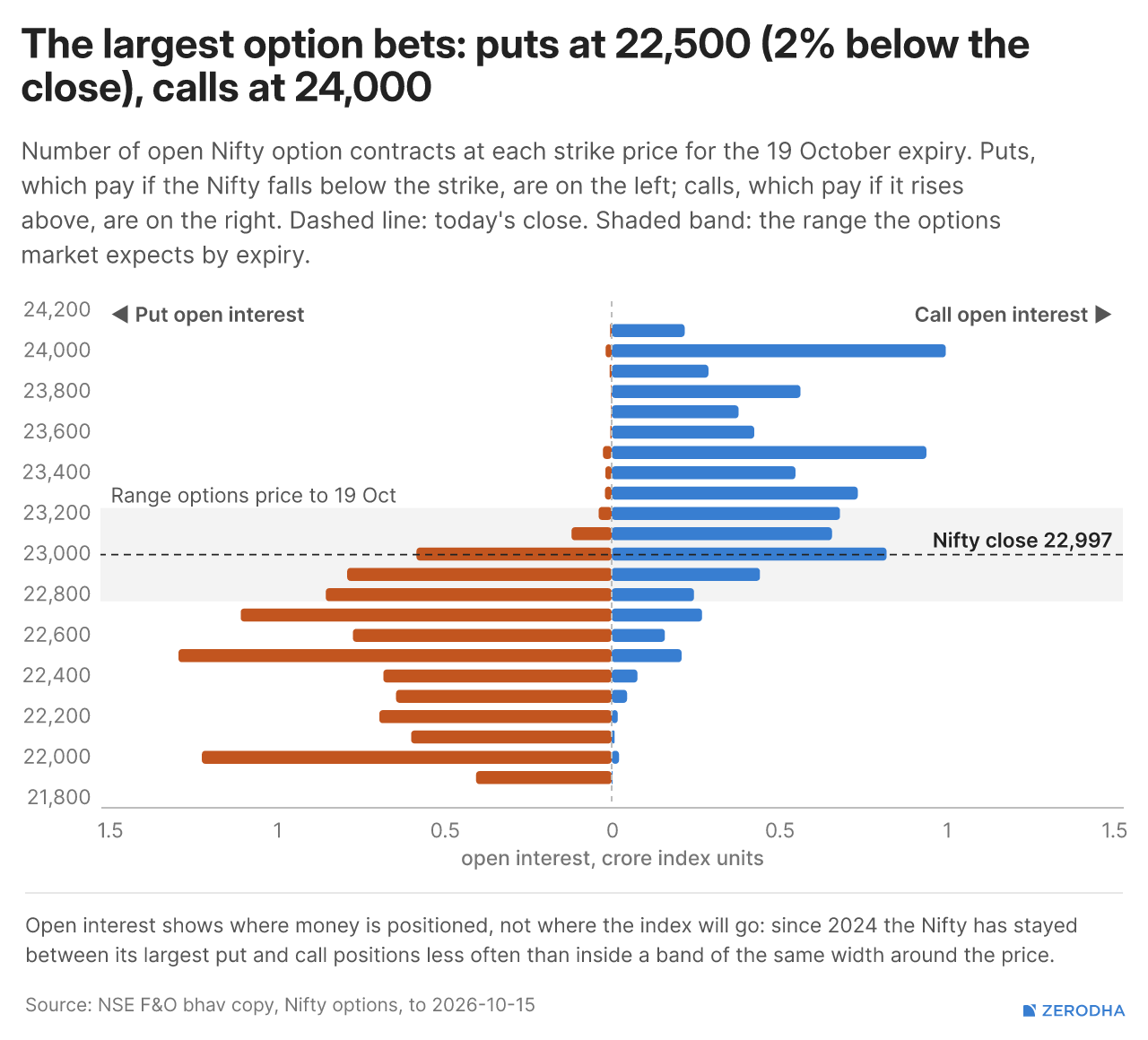
Options imply a 22,715–23,174 range into October 19 expiry, with the heaviest put OI at 22,500 and call OI at 24,000. The 50-day moving average at 23,580 remains the next major trend hurdle.
Thematic Indices
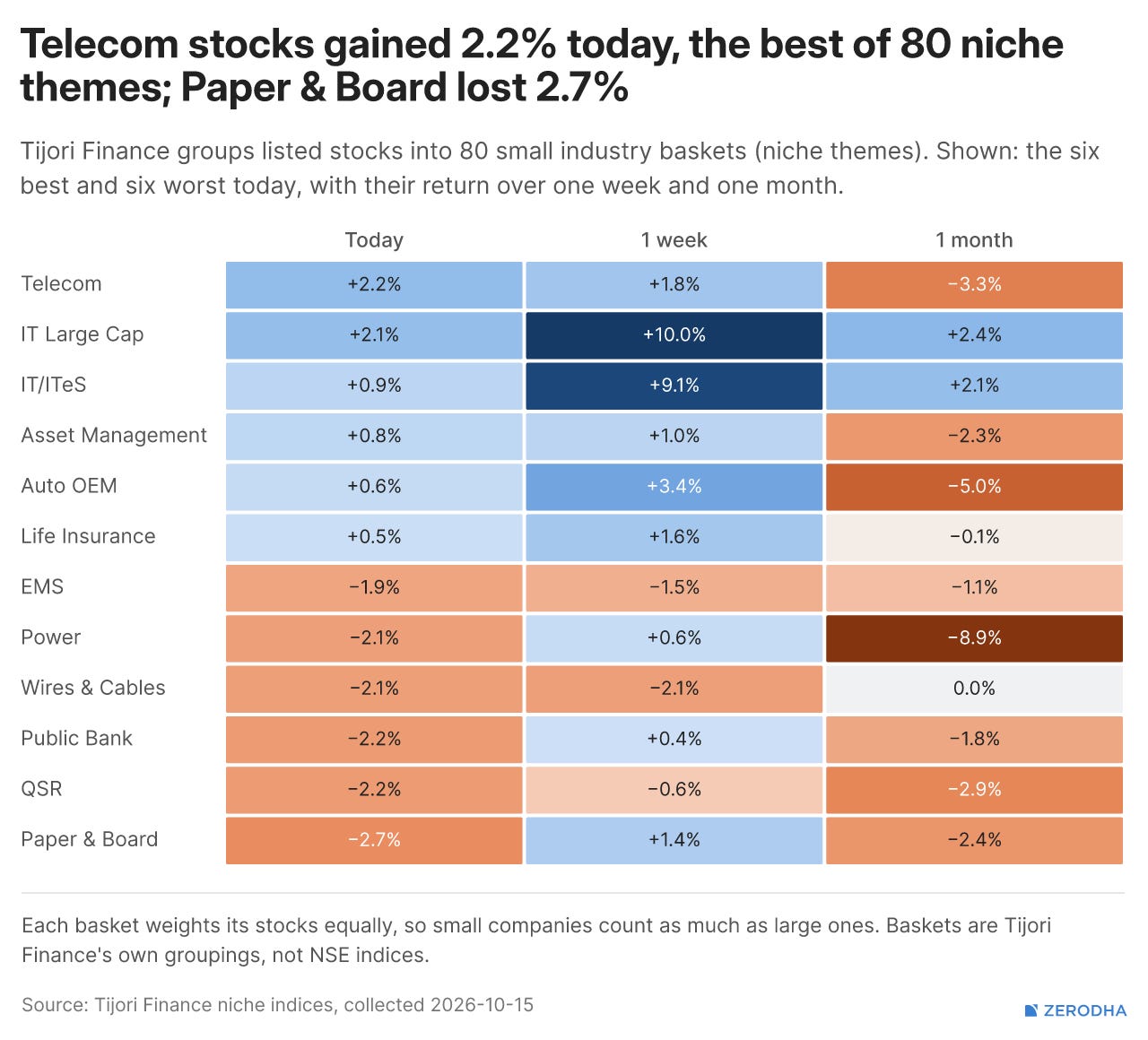
Tijori’s niche indices, where today’s move sorts pockets of the market beyond standard sector baskets. You can also track promoter buying and other interesting stuff, like Capex activity by the companies in the Tijori App’s idea dashboard
F&O Corner

Top Stories in India
India’s net direct tax collections rose 13.2% YoY to ₹13.38 lakh crore as of October 14, supported by strong corporate tax receipts and higher STT collections. Gross collections grew 14.9% to ₹16.03 lakh crore, while refunds increased 24.2% to ₹2.65 lakh crore. Dive deeper
The Supreme Court ruled that Yes Bank's ₹8,400 crore write-off of AT-1 bonds during its 2020 restructuring was illegal. The bank wrote off the bonds as part of its rescue plan, triggering a prolonged legal dispute with bondholders. Dive deeper
Nestlé India reported a 35.9% YoY rise in Q2 FY27 consolidated net profit to ₹1,009.6 crore, while total sales grew 20.5% to ₹6,782.2 crore. Domestic sales increased 20.4%. Dive deeper
Stellantis plans to invest ₹4,000 crore in India over the next three years and launch 12 models across its Jeep and Citroën brands. The automaker aims to triple domestic sales volumes by 2030. Dive deeper
STT collections surged nearly 52% YoY to ₹46,840 crore between April 1 and October 14, compared with around ₹31,000 crore last year, amid heightened stock market volatility. Dive deeper
Wipro reported a 1.4% YoY decline in Q2 FY27 consolidated net profit to ₹3,200.6 crore, while revenue rose 9.1% to ₹24,752.7 crore. Sequentially, profit fell 4.5%, while revenue increased 1%. Dive deeper
HDFC Life reported a 13.6% YoY rise in Q2 FY27 net profit to ₹508 crore, while net premium income grew 15.7% to ₹21,727 crore. Its value of new business increased 12.1% in H1 FY27, with new business margins improving to 24.7%. Dive deeper
Tech Mahindra reported a 32% YoY rise in Q2 FY27 net profit to ₹1,586 crore, while revenue grew 15.6% to ₹16,180 crore. EBIT margin improved 260 bps YoY to 14.8%, while new deal wins stood at $1.02 billion, marking the fourth consecutive quarter of over $1 billion in bookings. Dive deeper
Top Stories Globally
Credit default swap spreads for major AI-linked companies widened amid growing concerns over debt-funded AI infrastructure investments. CoreWeave’s CDS spreads crossed 1,000 bps, while Oracle’s stood at 288 bps and SoftBank’s reached 424 bps. Dive deeper
Asian technology stocks slumped amid concerns over high interest rates and the sustainability of AI investments. South Korea’s Kospi plunged nearly 8%, extending losses for a seventh session, while Japan’s Nikkei fell 5%. Dive deeper
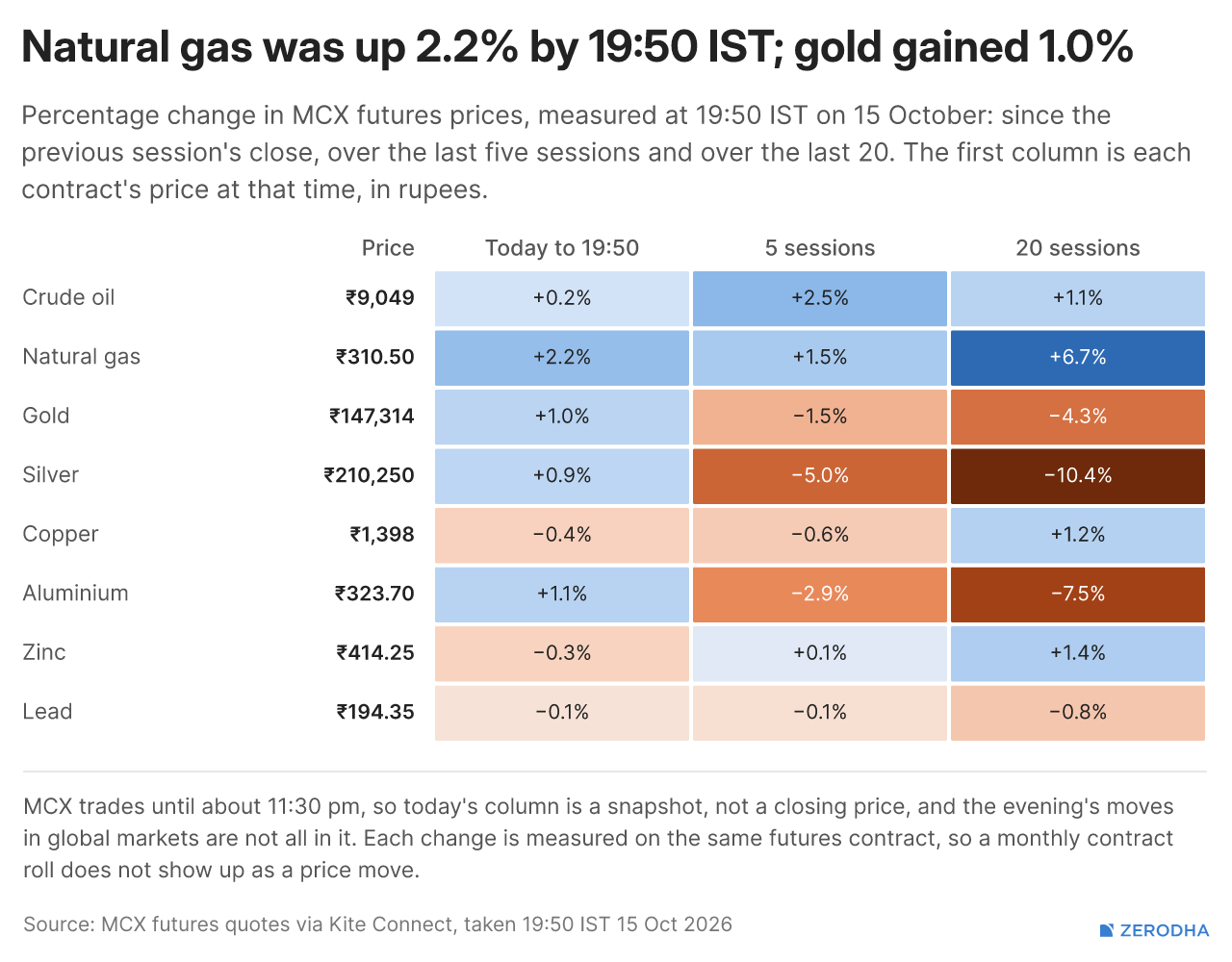
Crude oil traded around $95 per barrel as renewed shipping disruptions in the Strait of Hormuz raised supply concerns, while worries about weakening global demand limited further gains. Dive deeper
TSMC reported a 69% jump in Q3 net profit to T$763.1 billion, marking its sixth consecutive record quarter. The chipmaker raised its 2026 revenue growth forecast to around 44% but cautioned about macroeconomic uncertainty and rising component costs heading into 2027. Dive deeper
The US 10-year Treasury yield fell nearly 13 bps to 5.05% as investors moved toward safer assets amid a global equity sell-off and concerns over AI-related spending. Dive deeper
US producer prices jumped 1.3% MoM in September, significantly above expectations of 0.5% and the sharpest increase since March 2022. Energy costs surged 10.8%, driving higher transportation and trade costs. Dive deeper
Management Chatter
In this section, we highlight interesting comments from management at major companies and from policymakers in the Indian and Global Economies.
Polycab’s management on UltraTech's entry into the wires business:
“There is enough room, and given the kind of growth we are seeing in this segment, there is enough room for a few players to enter and take some share. However, we do not see any real competition in the near term, simply because the wires market is still a very small part of our overall business. The impact is primarily on players that are wires-heavy.
For us, we are already operating at very high margins. If you look at the overall industry, the market is also expected to grow over the next 2-3 years to around 40,000-50,000 crore. With that, considering the capex that UltraTech has put into this industry and the revenue guidance they have given, with potential of around 6-7x, it looks elusive at the moment. However, that is again a very small part of the overall market.” - Link
The week ahead & Corporate Actions
Corporate Actions
Published by Zerodha. Not investment advice. Data from NSE, BSE, and MCX.
In our latest episode of In The Money by Zerodha, we explore the story of Paul Tudor Jones, the legendary macro trader known for his approach to risk management and his role during the 1987 stock market crash.
From an early career setback in cotton trading to the lessons he took away from Silver Thursday, we look at the experiences that shaped his trading philosophy.
How did Jones approach risk? What did he learn from his early losses? And what can his career teach us about surviving the markets over the long run?
That’s it from us for today. We’d love to hear your feedback in the comments, and feel free to share this with your friends to spread the word!
On the data request, the breadth line is the most useful piece here, with the average Nifty 500 stock down 0.53% on a day the index gained 0.65%. A running spread between equal-weight and cap-weight returns would turn that single observation into a series. Pairing it with the share of stocks above their 50-day average, which sits at 19.4% today, would show how long heavyweights have been carrying the index alone.