

Welcome to Aftermarket Report, a newsletter where we do a quick daily wrap-up of what happened in the markets, both in India and globally.
What data points and transformations do you want to see?
We’re trying out a new format for the Aftermarket Report, with much more comprehensive coverage of the data that shapes the trading day.
Beyond the headline indices, we’re now tracking market breadth, new highs and lows, sector and thematic performance, delivery data, F&O positioning, global markets, commodities, flows, and more. We’re also looking at ways to transform this raw data into insights that are actually useful for traders and investors.
The idea is simple: bring different datasets together in one place to give you a clearer picture of what’s happening beneath the surface of the market.
This is still a work in progress, and we’d love your feedback. What data points are we missing? What transformations, ratios, comparisons, or indicators would you find useful? Also tell us what worked, what didn’t, and what felt unnecessary.
Your feedback will help shape the Aftermarket Report from here.
Markets Today
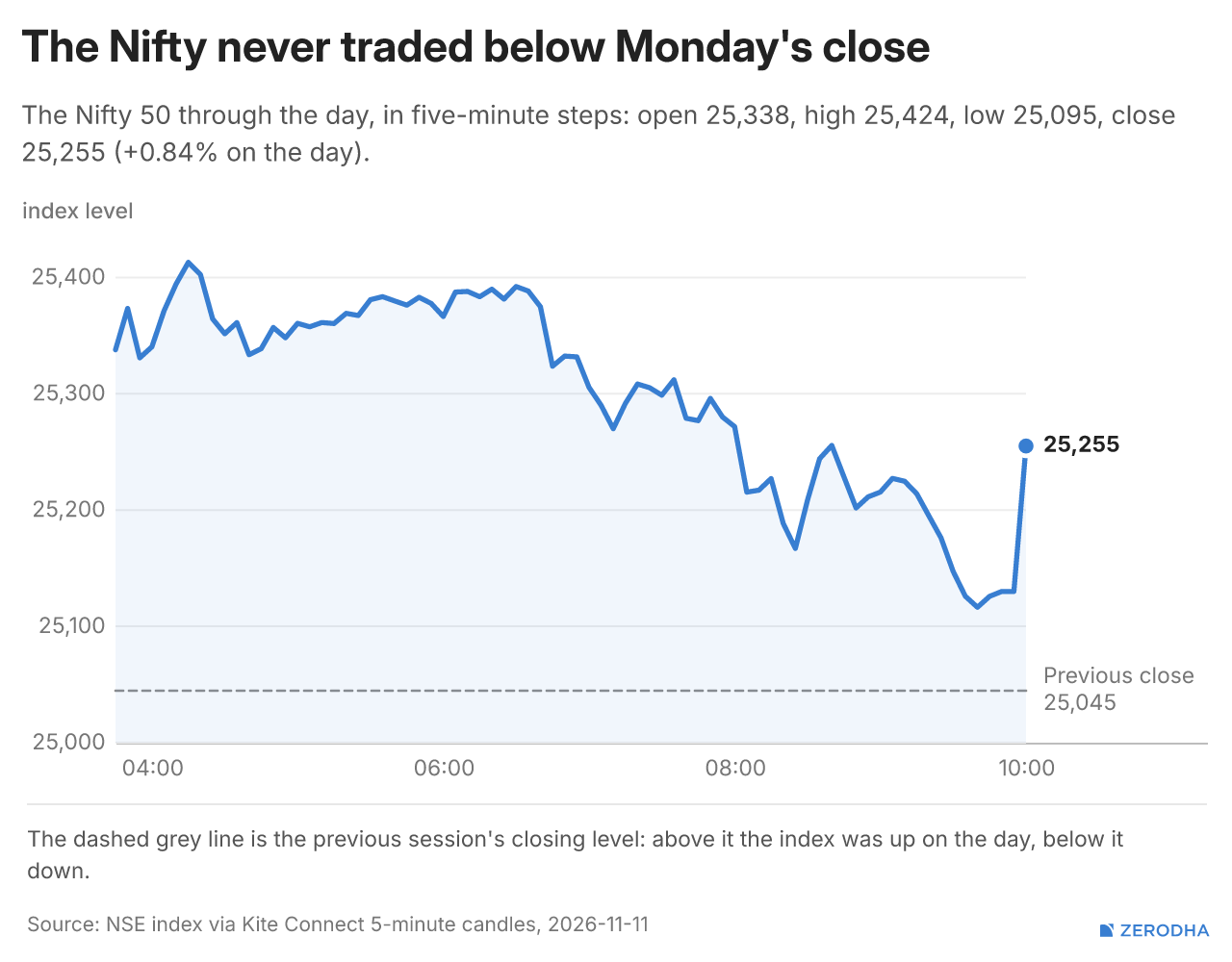
Nifty opened with a massive 293-point gap-up at 25,338, tracking a strong recovery in global markets and a substantial decline in crude oil prices towards $90 per barrel. The index initially witnessed some volatility, slipping towards 25,290 before recovering sharply to an intraday high near 25,420 around 9:40 AM. However, the recovery failed to sustain, with selling pressure dragging Nifty back towards 25,350 by 10 AM. The index remained largely range-bound between 25,350 and 25,400 through the rest of the morning, with multiple attempts to move higher failing to gather momentum.
The second half began on a weak note, with selling pressure intensifying shortly after noon and dragging Nifty below 25,300 by 12:30 PM. The index attempted a brief recovery towards 25,320 around 1 PM, but the rebound failed to sustain as fresh selling pushed it below 25,250 and then near 25,180 by 2 PM.
A recovery attempt after 2 PM helped Nifty briefly reclaim 25,250, but selling pressure returned at higher levels. Weakness intensified in the final hour, with the index slipping steadily towards an intraday low near 25,100 around 3:10 PM. Strong CAS helped Nifty eventually close at 25,255.05, around 83 points below its opening level, as persistent selling pressure through the second half erased a significant portion of the opening gains despite supportive global cues and cooling oil prices.
Fear & Greed Index
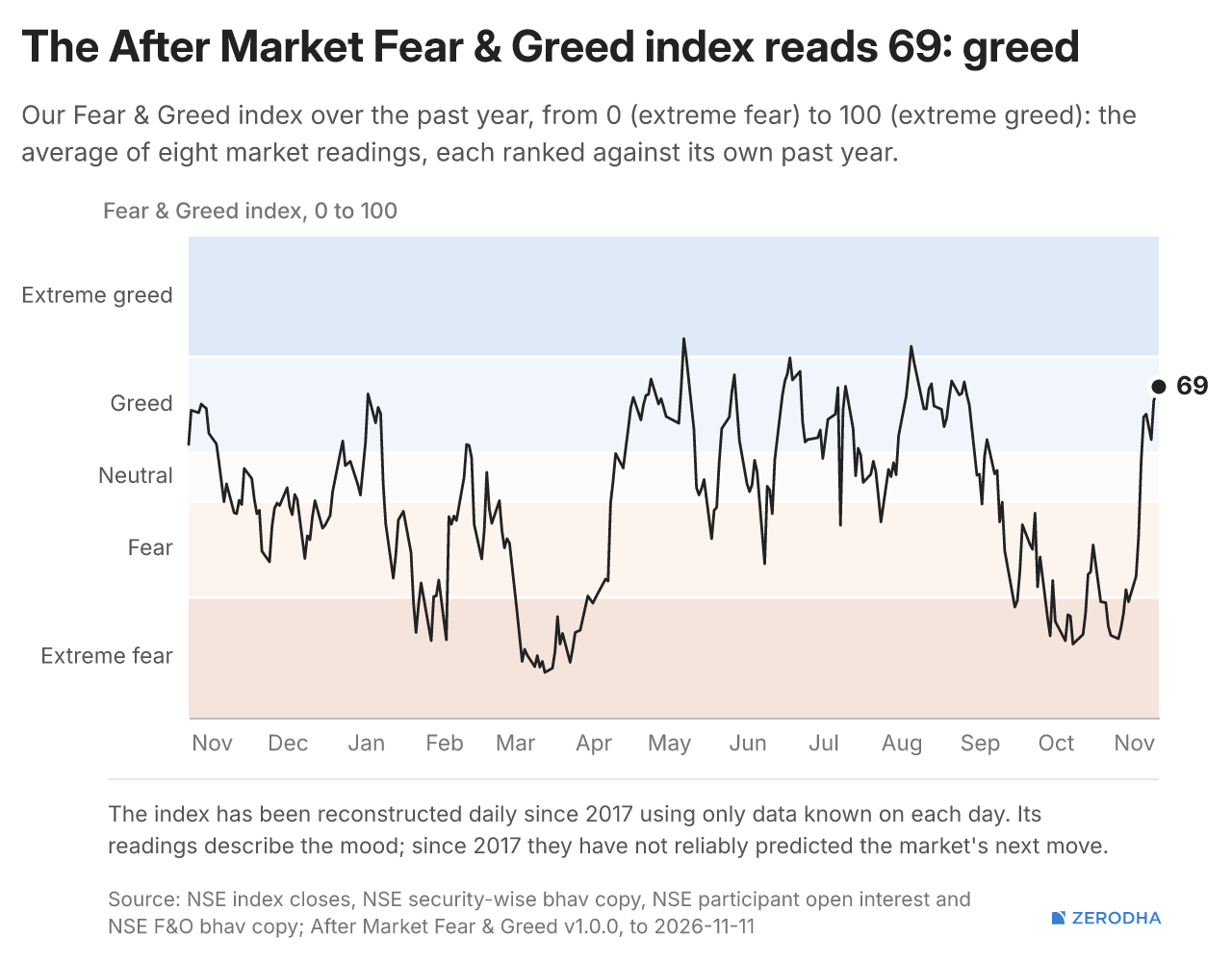
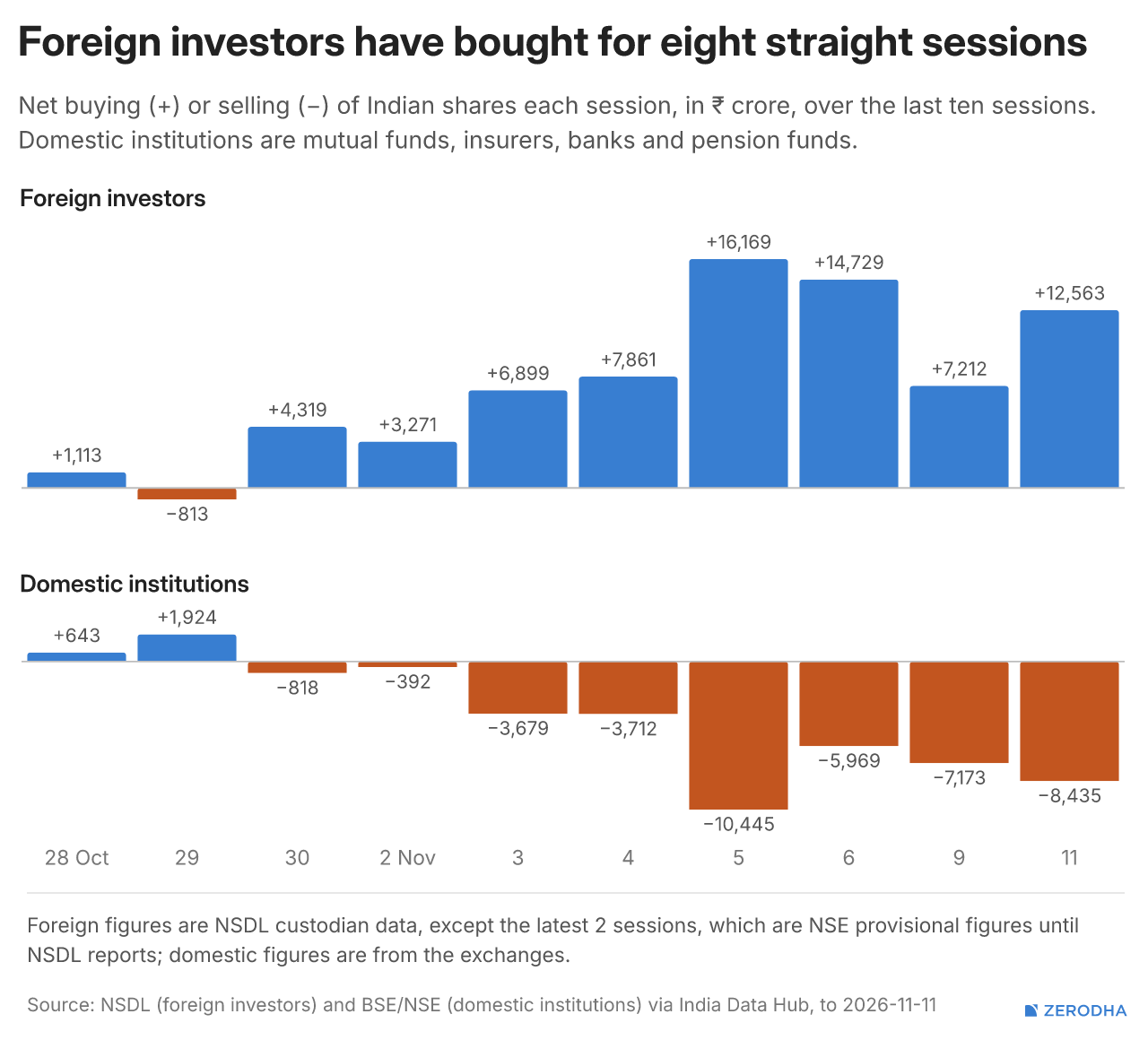
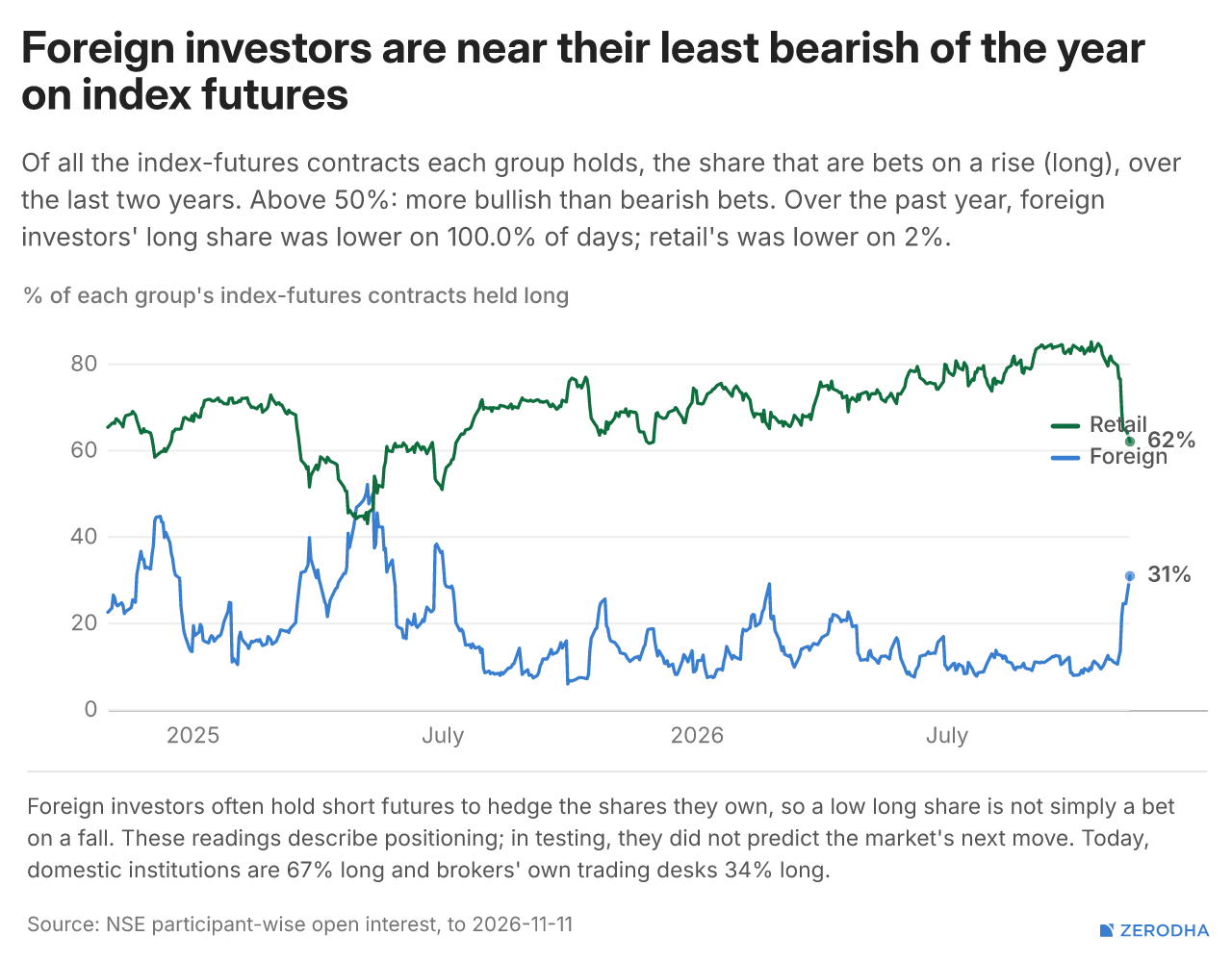
The Fear & Greed Index climbed from 66 to 69, moving further into the greed zone as foreign investors maintained stronger bullish positioning and demand for downside protection eased. However, elevated volatility and defensive stocks outperforming high-beta stocks suggest some underlying caution.
Market Breadth
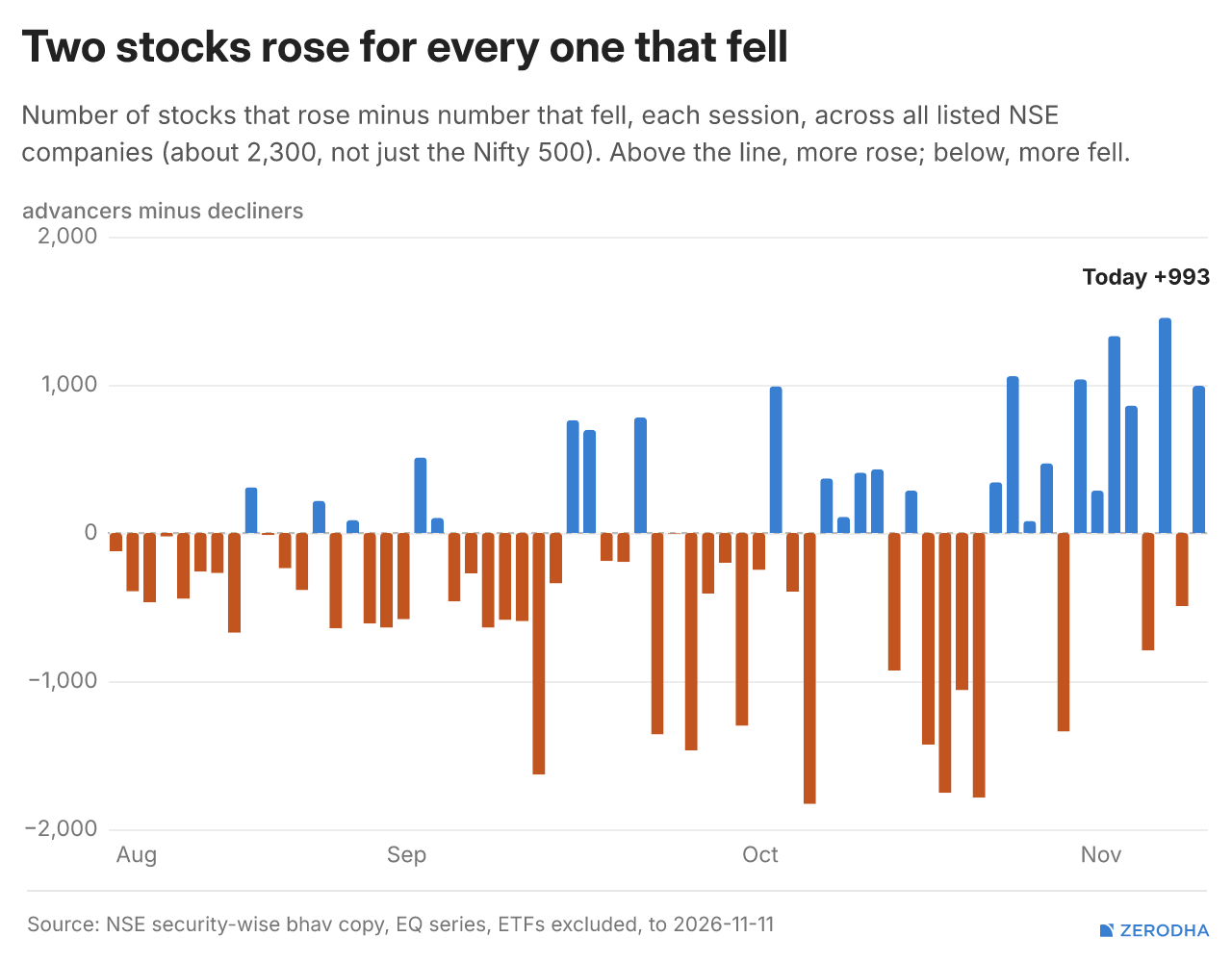
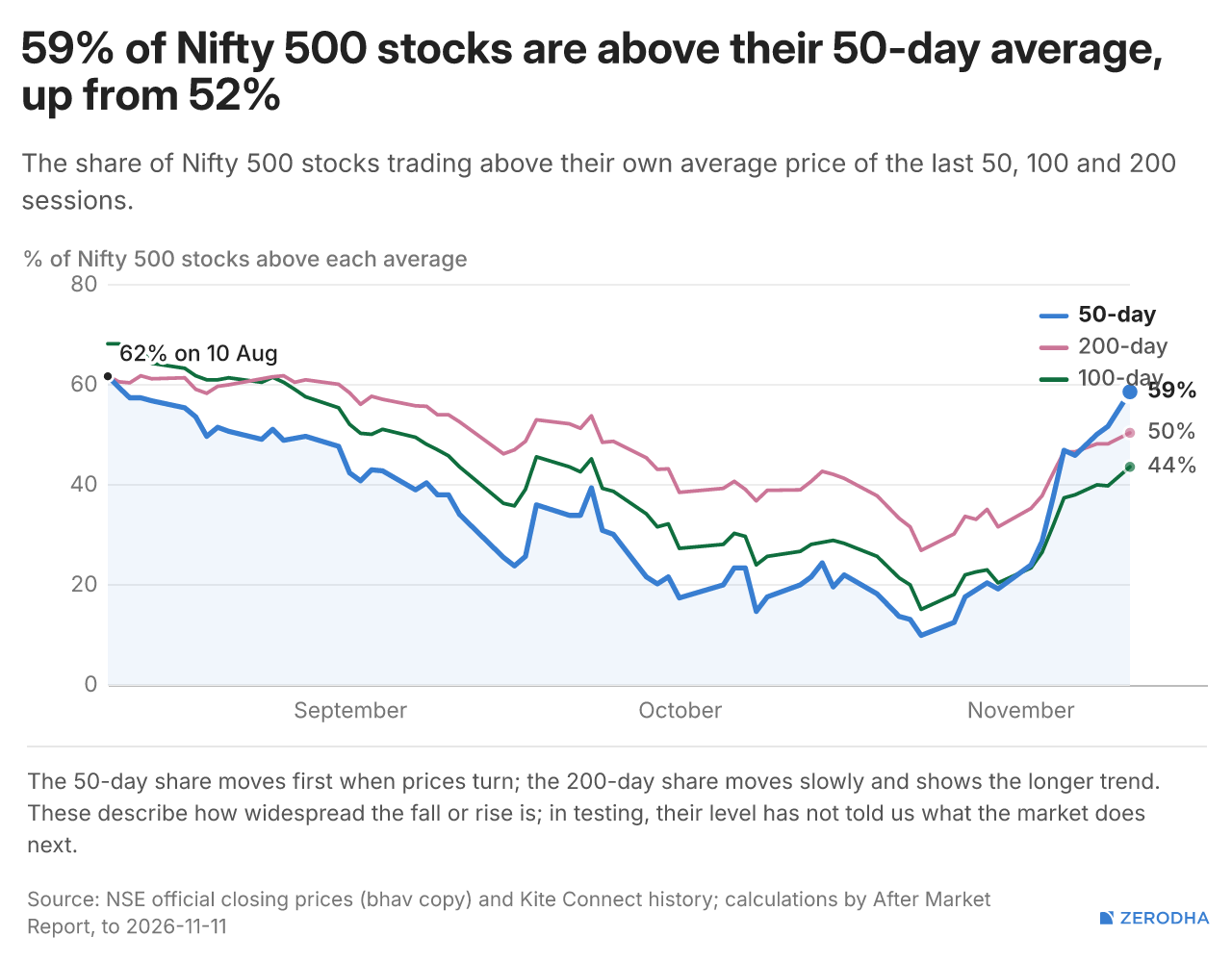
Market breadth improved significantly, with 1,683 advancing stocks against 690 declining, while cash-market turnover rose 31% above its recent median. The share of Nifty 500 stocks above their 50-day moving average jumped 6.9 percentage points to 58.6%, although longer-term participation remains relatively weak.
52 Week Highs & Lows
Valuation Check
Sectoral Indices Performance
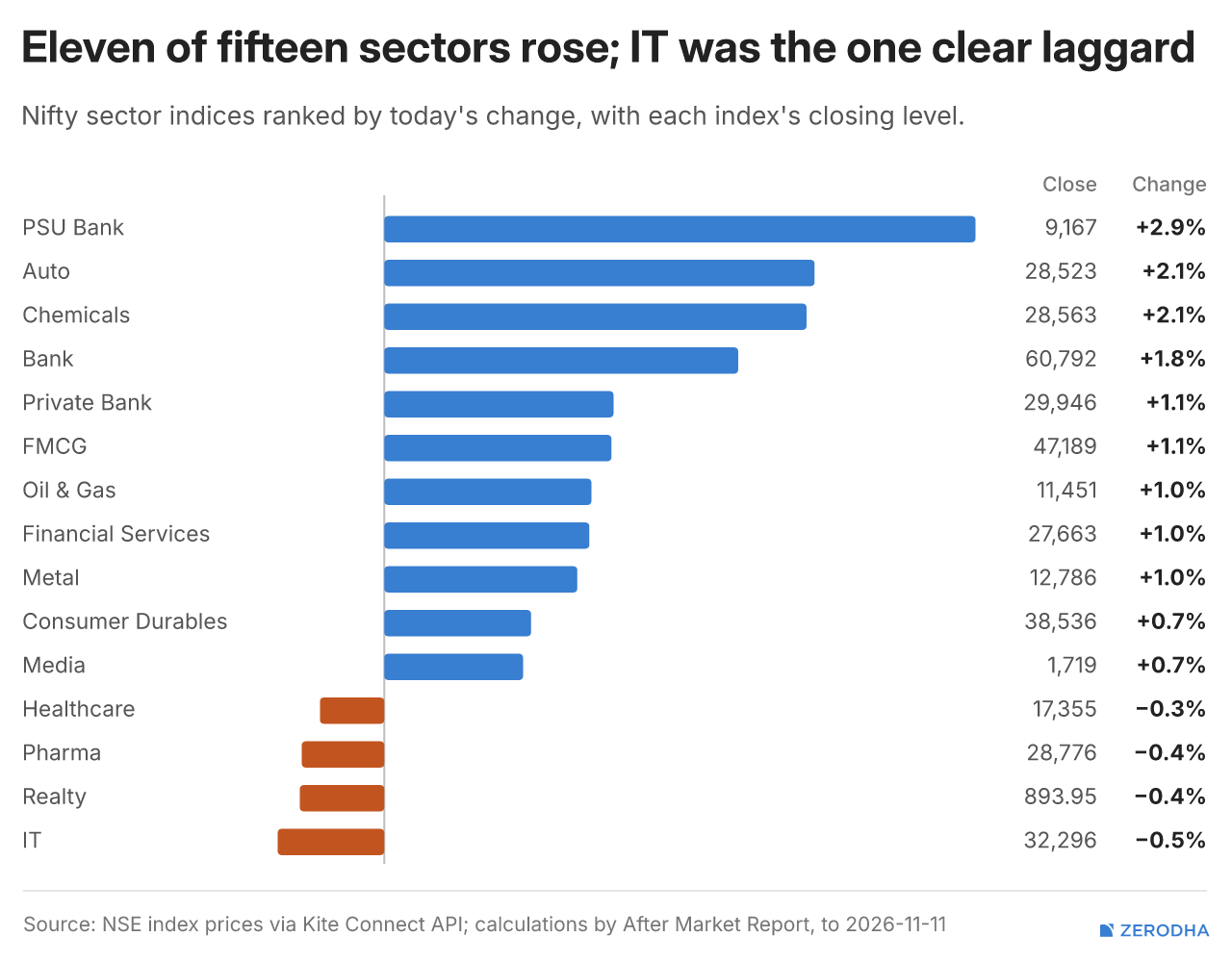
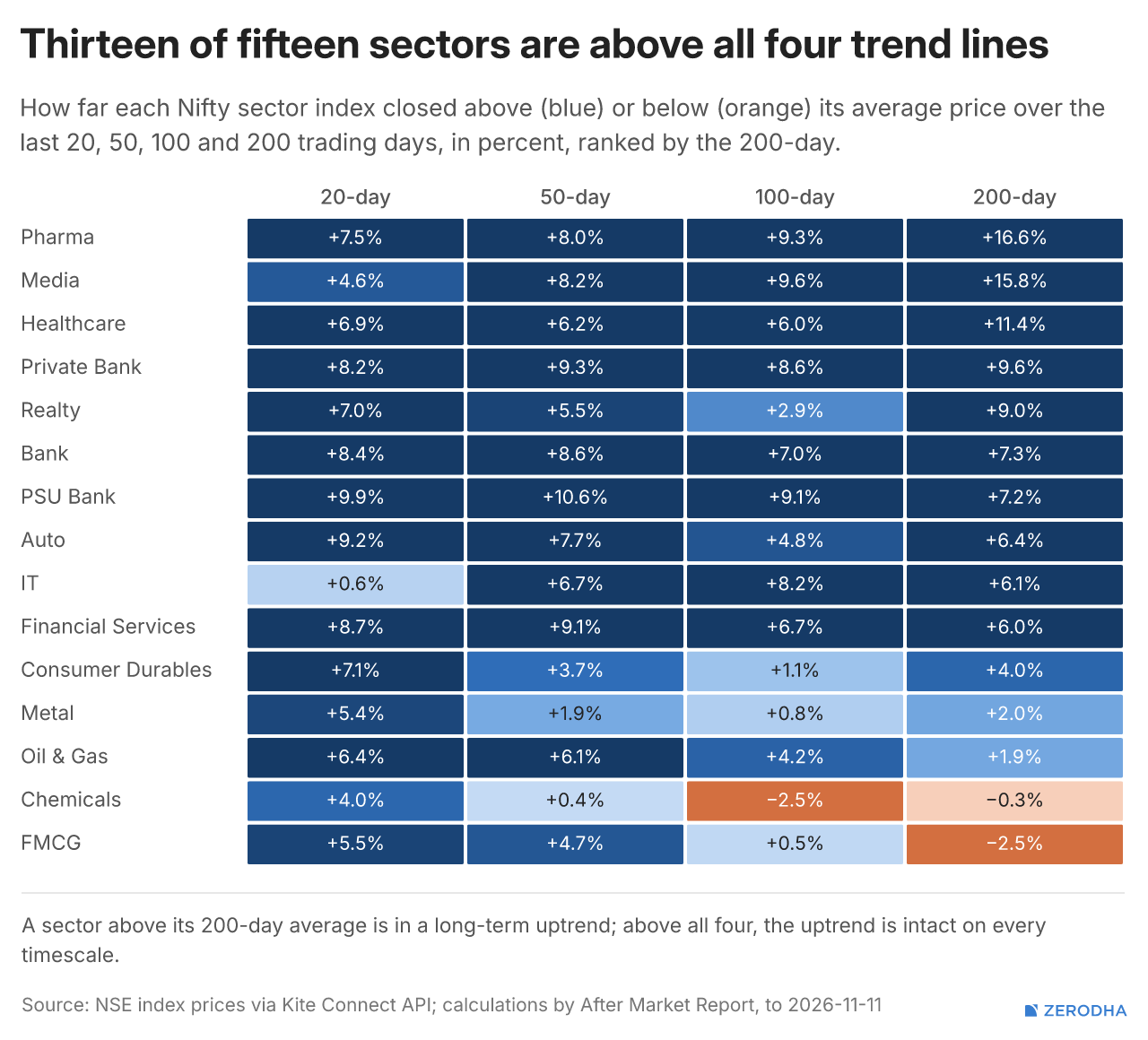
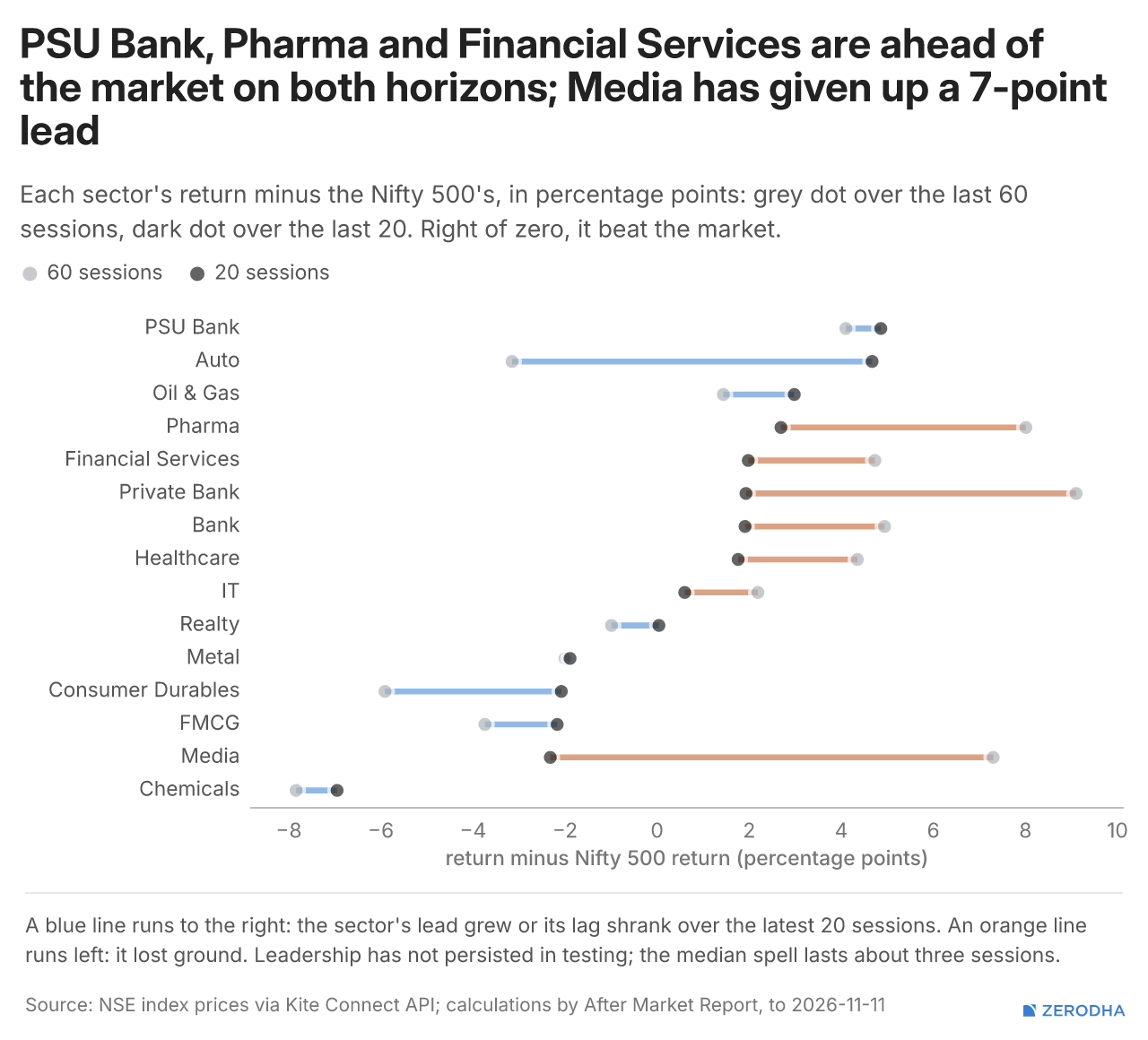
PSU Banks surged 2.94%, leading the 11 sectors that ended in the green, while IT declined 0.53%. PSU Banks, Pharma and Financial Services remain the strongest relative performers over 20 and 60 sessions, with 13 of 15 sectors trading above their 200-day moving averages.
Winners & Losers
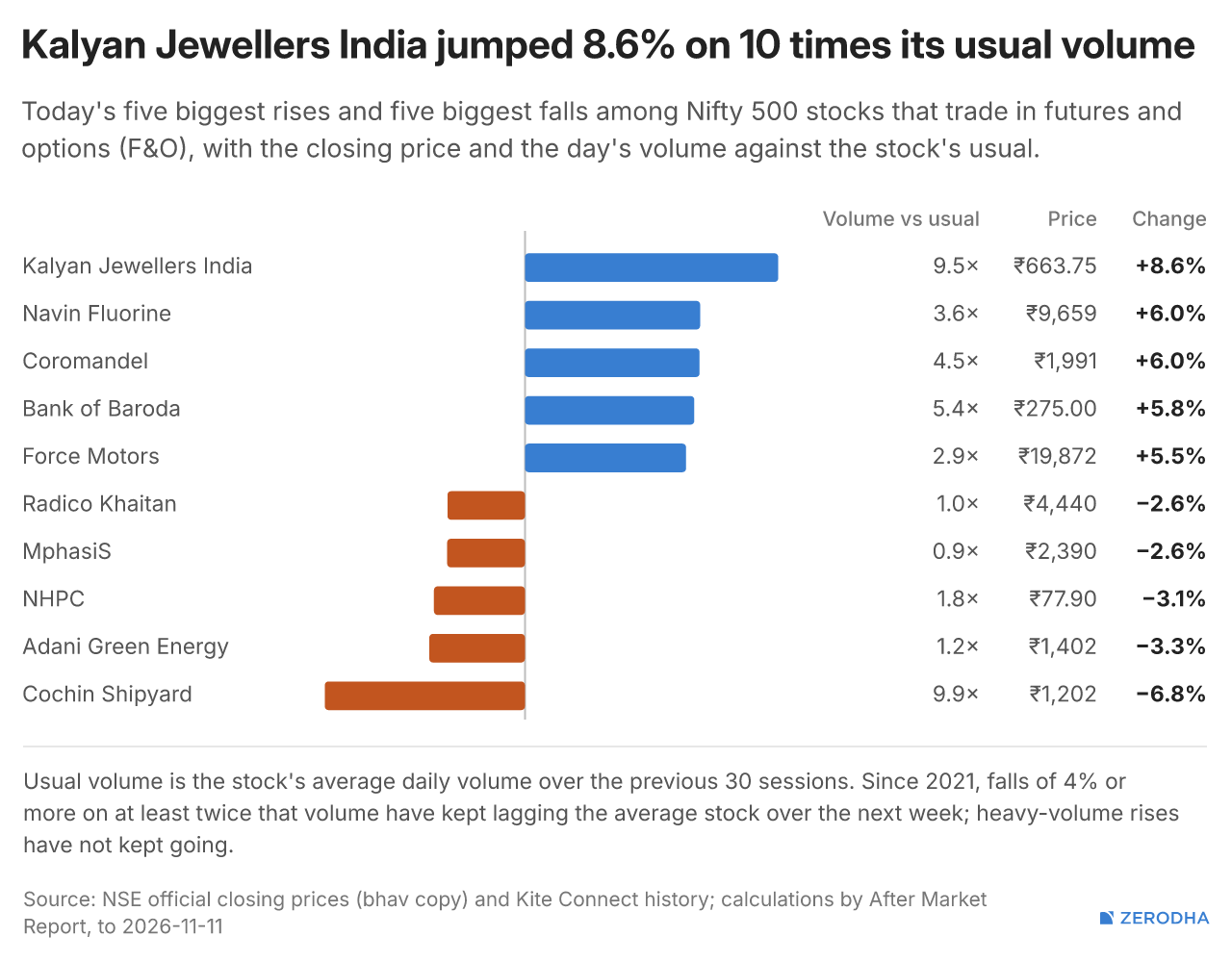
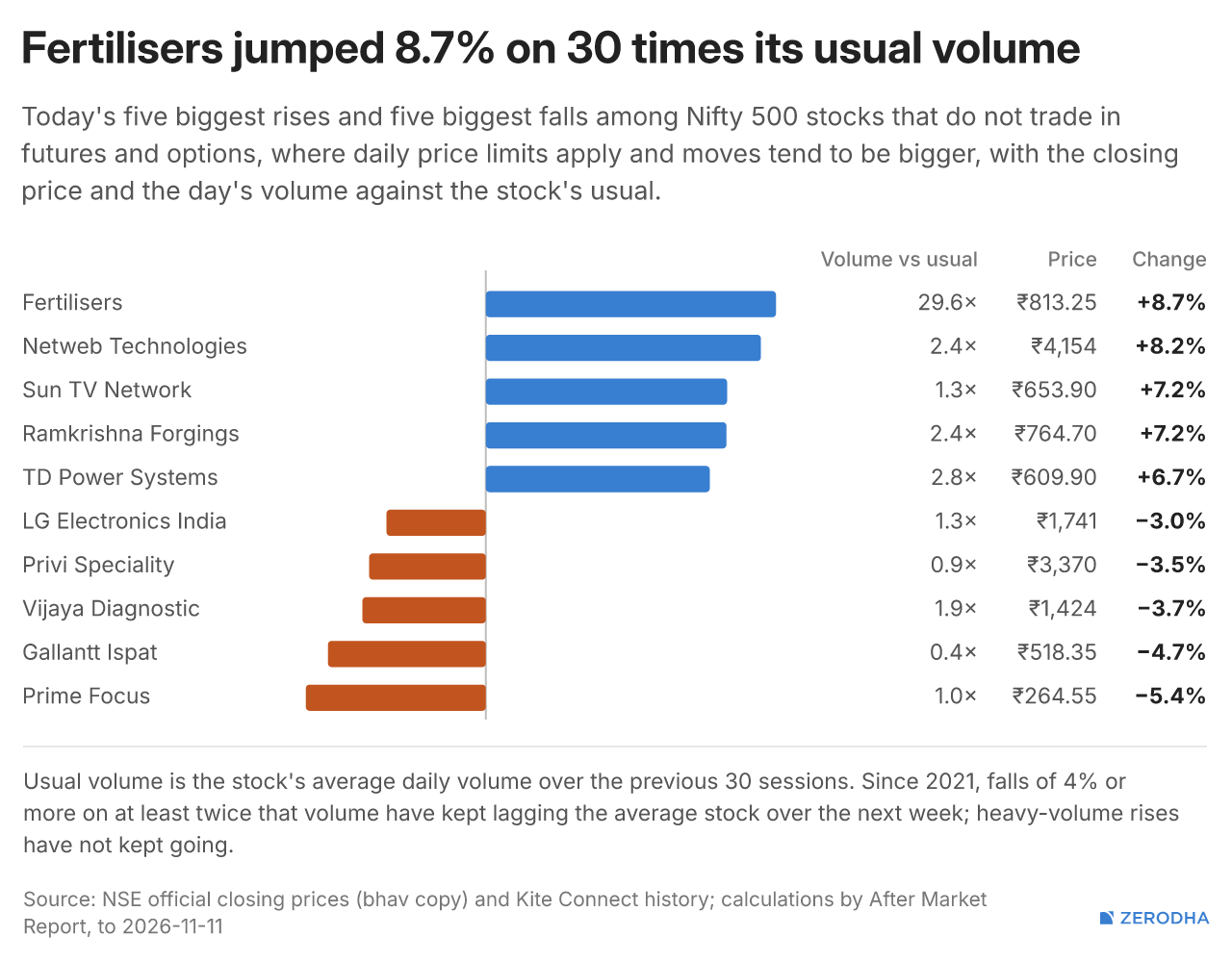
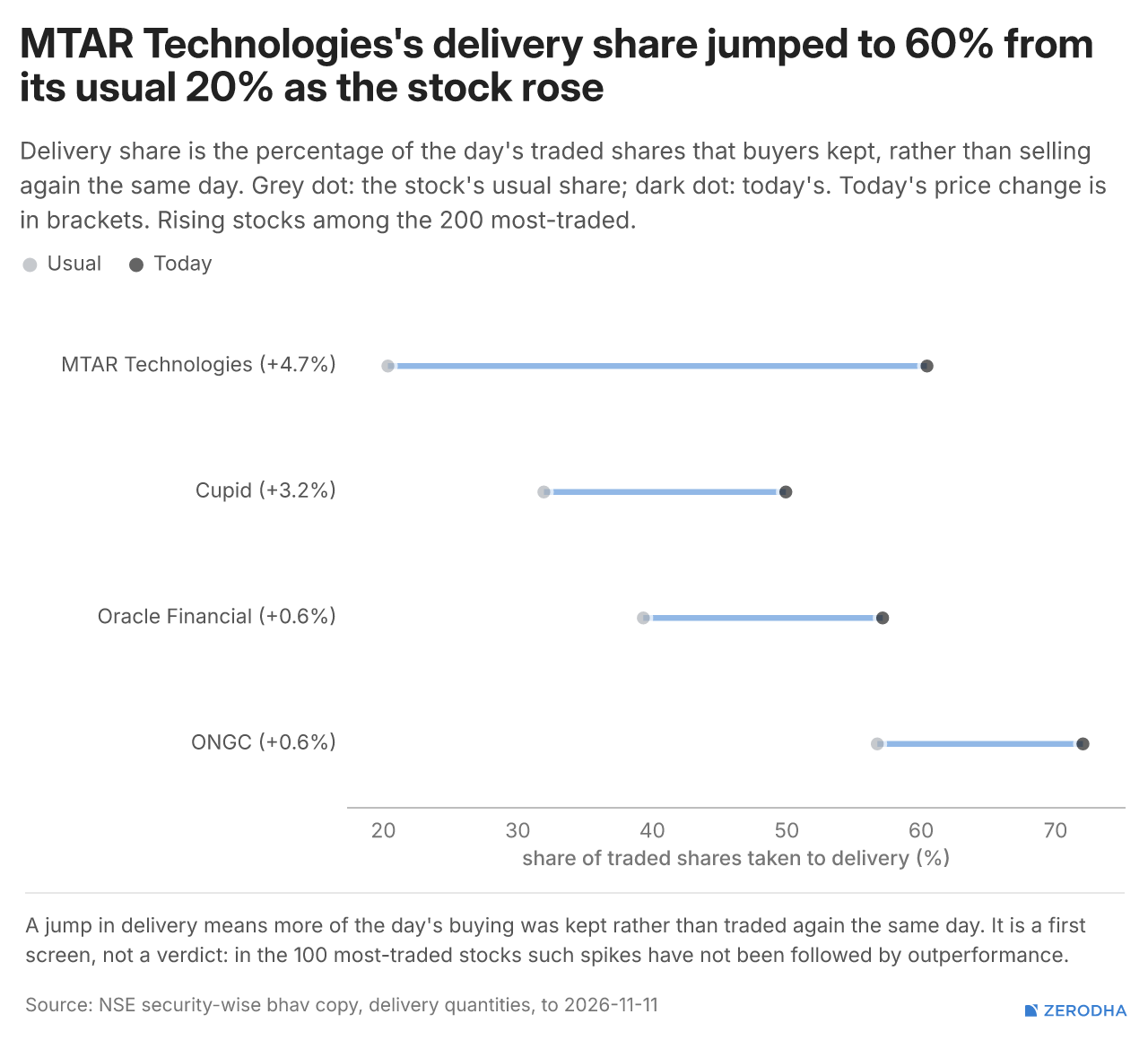
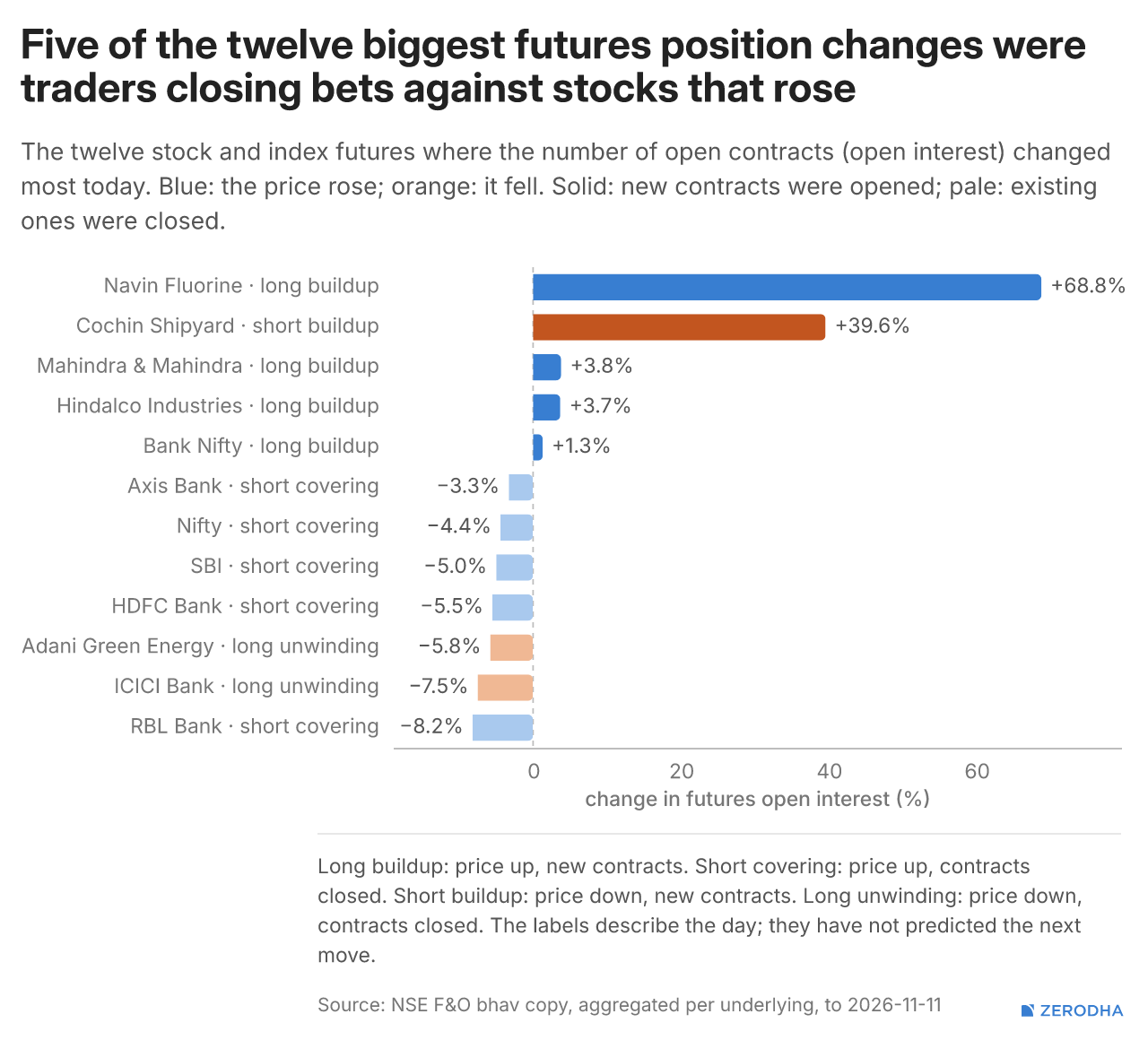
Kalyan Jewellers surged 8.63% on 9.5× usual volume, while Fertilisers and Chemicals gained 8.67% on nearly 30× usual volume. On the downside, Cochin Shipyard fell 6.82%, while MTAR Technologies saw a sharp delivery spike, with 60% of traded shares taken to delivery against its usual 20%.
Delivery Data
Global Markets
Commodities
Institutional Flows & Participant Positioning
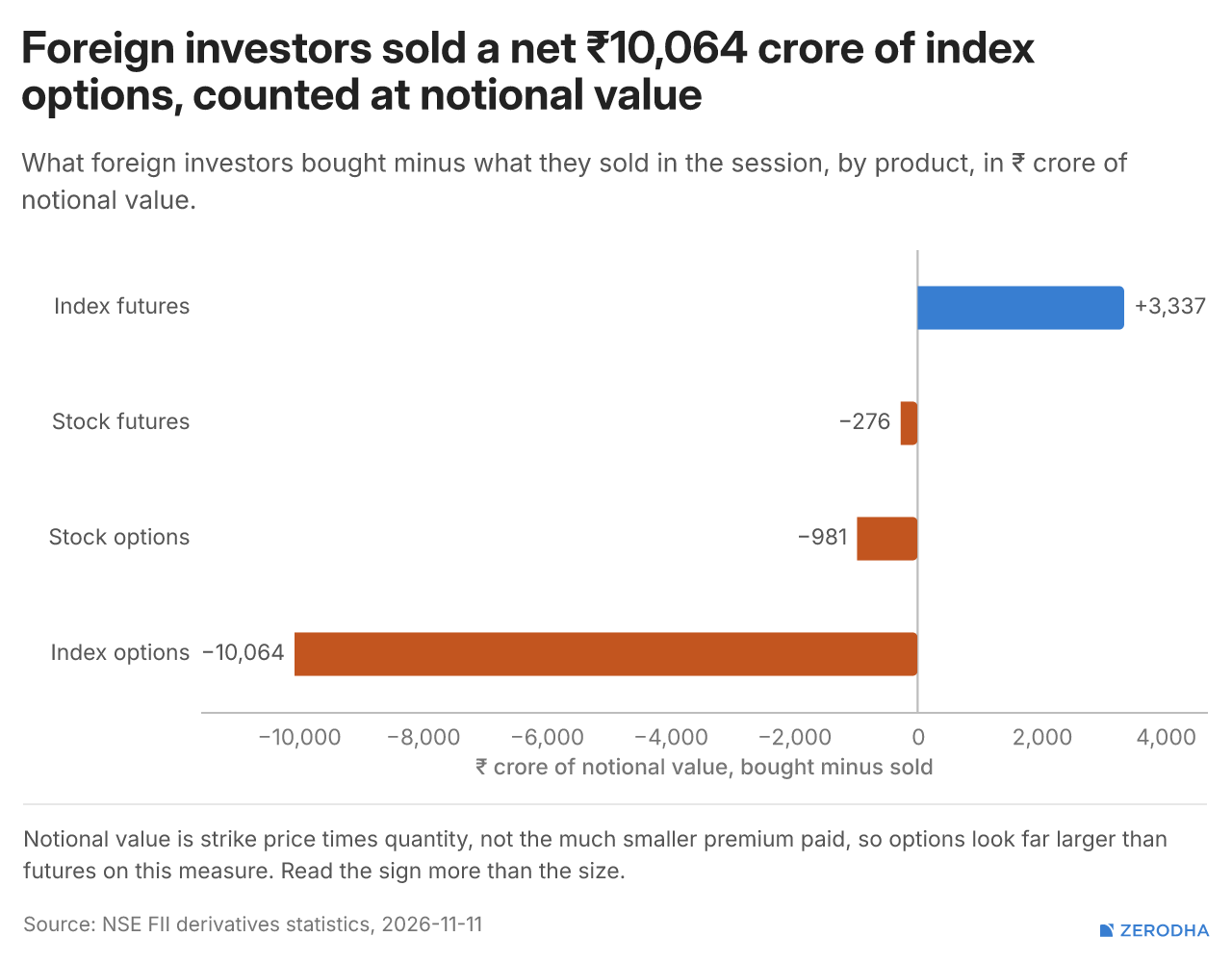
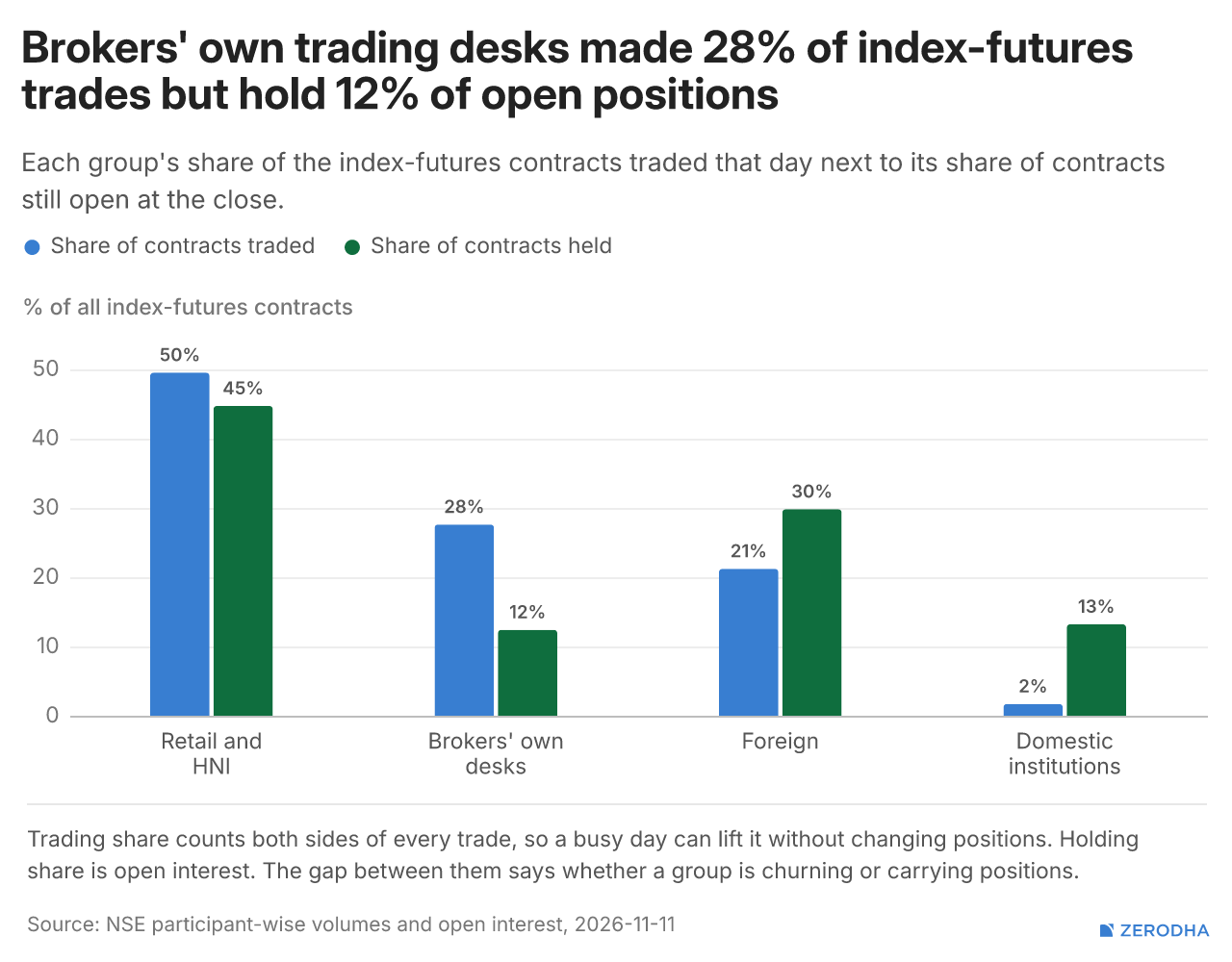
The put-call ratio declined from 1.15 to 0.98, as call open interest fell less sharply than put open interest, while implied volatility rose from 16.8% to 17.8%. FIIs bought 20,328 index-futures contracts worth ₹3,337 crore, lifting their long positioning to 31%, among their least bearish readings over the past year.
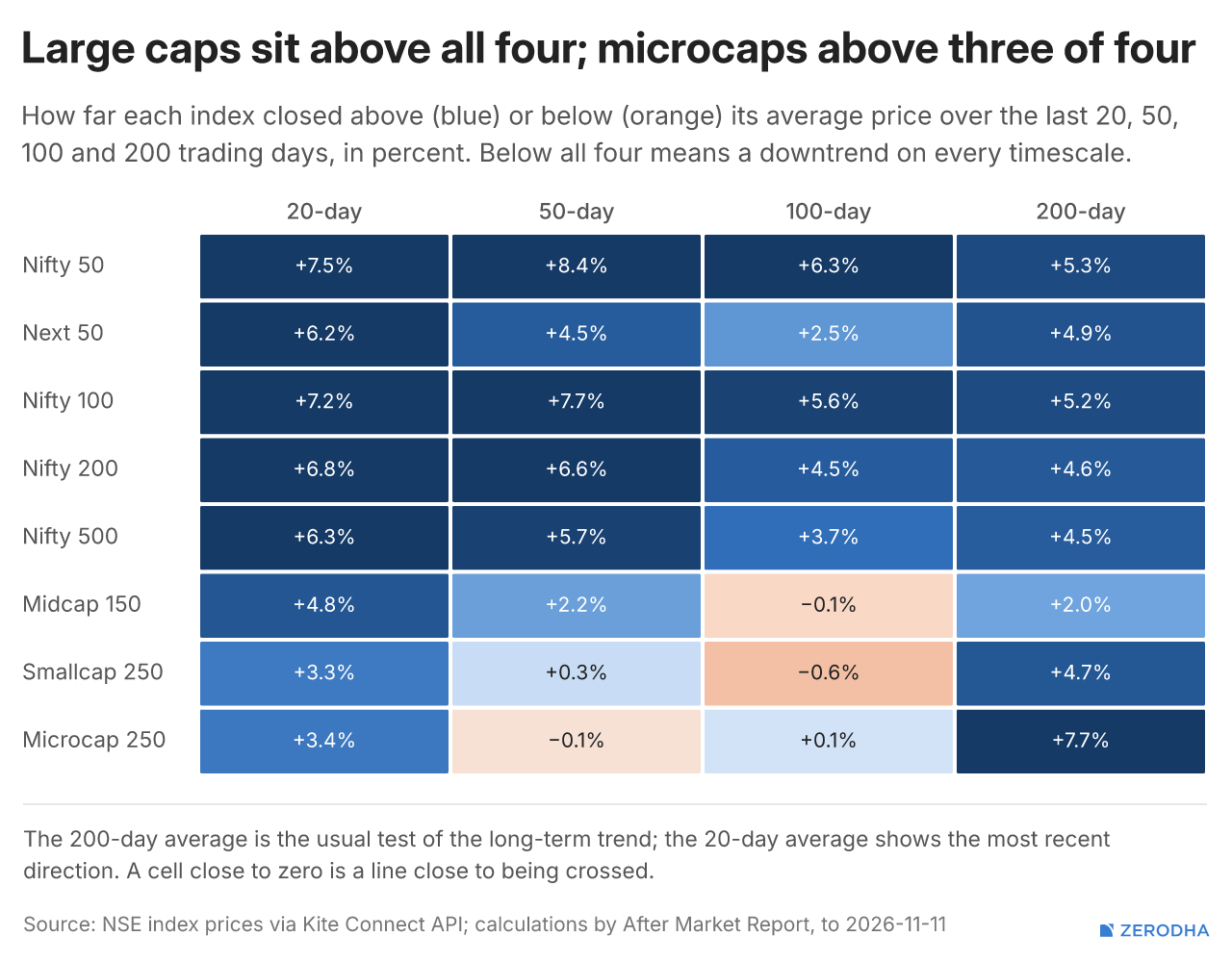
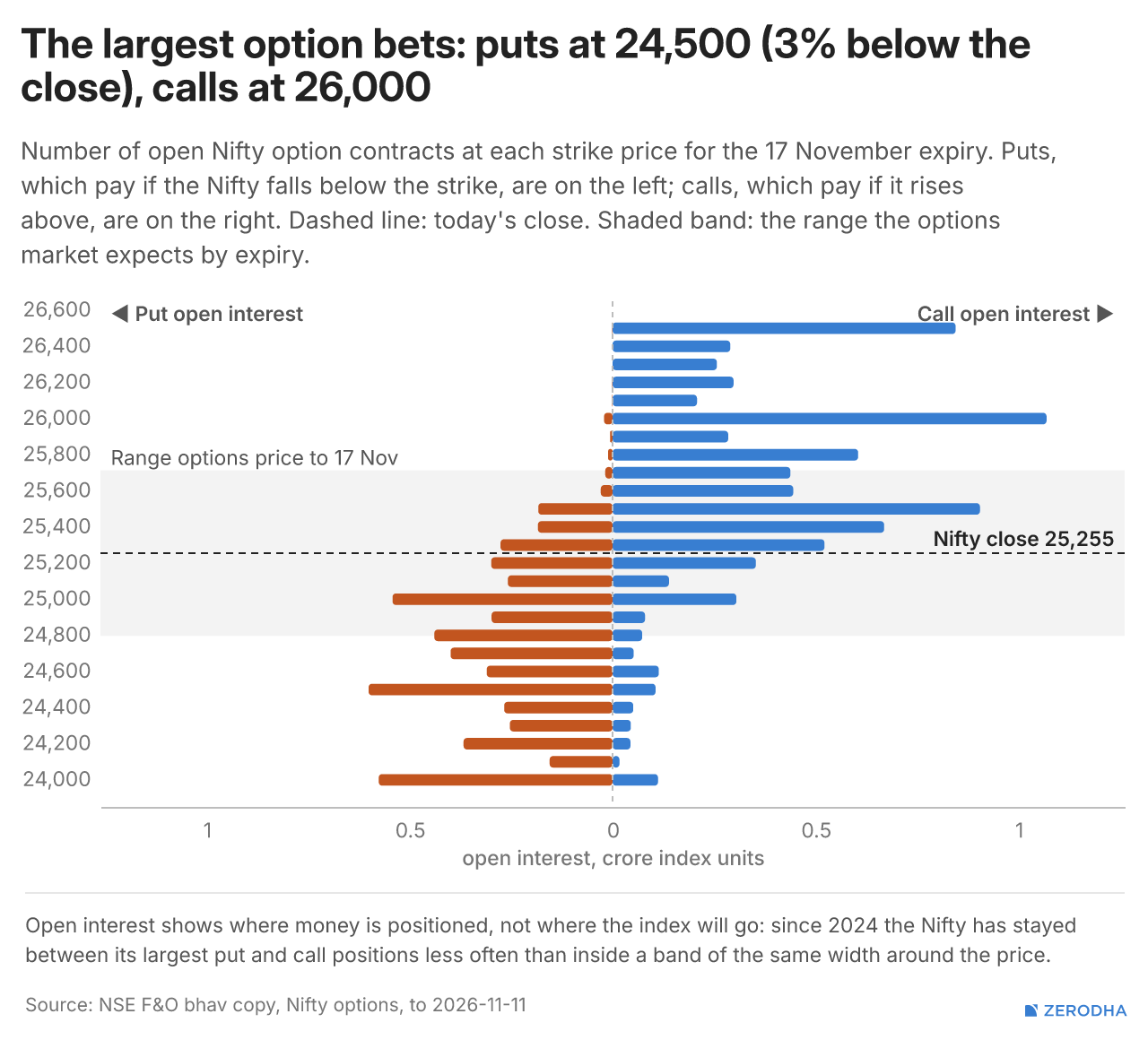
Options imply a 24,735–25,650 range into the November 17 expiry, with the heaviest put OI at 24,500 and call OI at 26,000. Nifty's 200-day moving average at 23,988 remains an important longer-term technical support level.
Thematic Indices
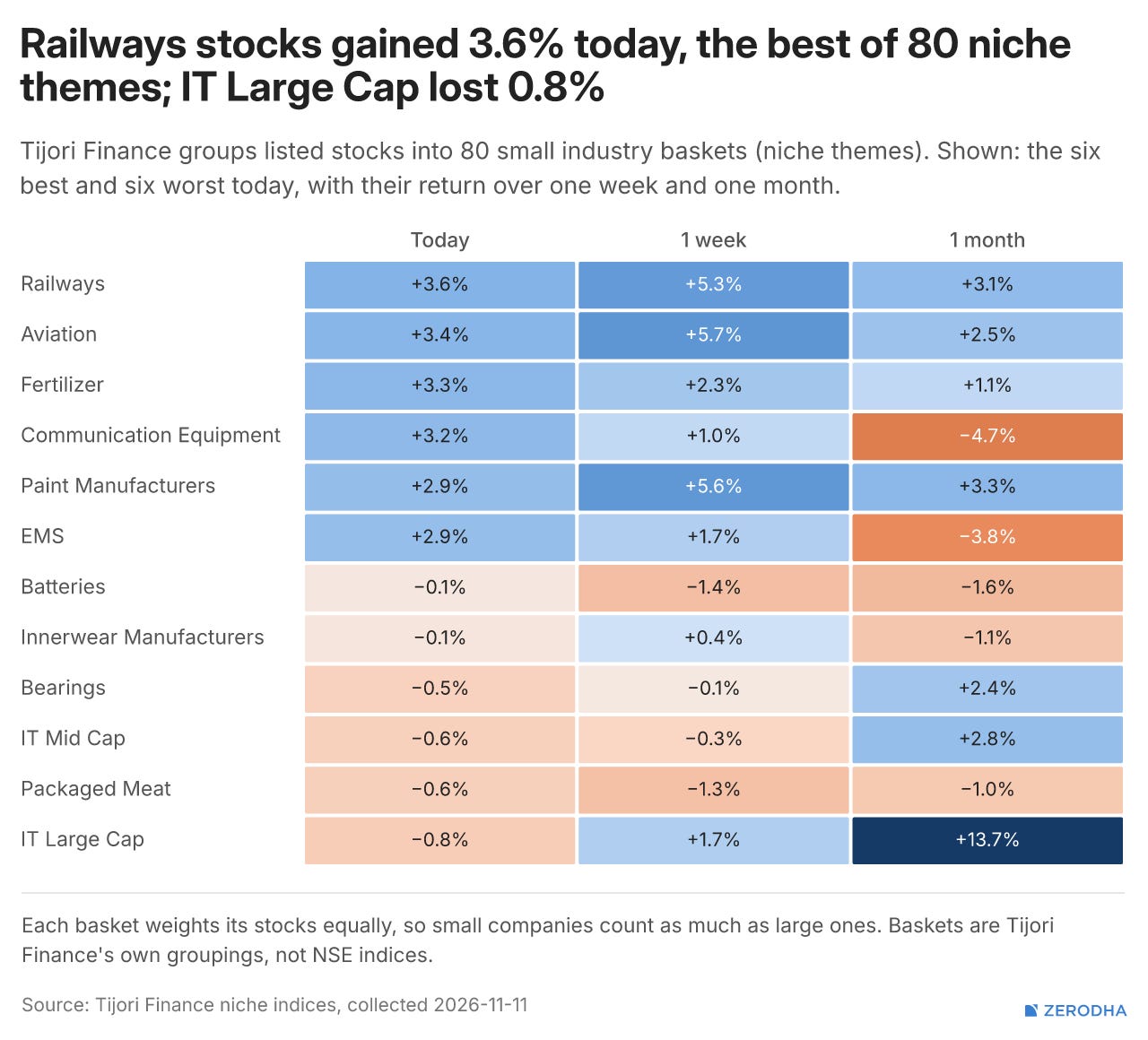
Tijori’s niche indices, where today’s move sorts pockets of the market beyond standard sector baskets. You can also track promoter buying and other interesting stuff, like Capex activity by the companies in the Tijori App’s idea dashboard
F&O Corner

Top Stories in India
Moody’s Ratings raised India’s FY27 GDP growth forecast to 7% from 6.5%, citing broad-based economic momentum and resilience to energy supply shocks. However, it warned that elevated inflation, a deficient monsoon and strengthening El Niño conditions could weigh on household consumption, agricultural output and rural demand. Dive deeper
The Union Cabinet approved a ₹62,370 crore fertiliser subsidy package for the Rabi 2026–27 season, a 64% increase over last year’s allocation. The package aims to keep DAP fertiliser prices fixed at ₹1,350 per bag and includes subsidies for phosphatic and potassic fertilisers, along with additional support for other fertiliser categories. Dive deeper
The Indian rupee gained 0.2% to close at 93.69 against the US dollar, its strongest closing level since April, supported by foreign equity inflows and declining crude oil prices. The currency has recovered sharply from its May record low of 96.96, although it remains down approximately 4% year-to-date. Dive deeper
US chipmaker Qualcomm is undertaking a global workforce reduction, potentially affecting more than 1,000 employees in India, although the company has not confirmed the country-specific numbers. CEO Cristiano Amon described the cuts as performance-focused, with notifications to affected employees expected to begin in November. Dive deeper
Tata Power reported a 32.7% YoY increase in consolidated net profit to ₹1,652 crore in Q2 FY27, supported by improved performance across its power generation and renewable energy businesses. Revenue grew 26.3% to ₹19,636 crore, while EBITDA increased 5.3% to ₹4,245 crore. Dive deeper
Top Stories Globally
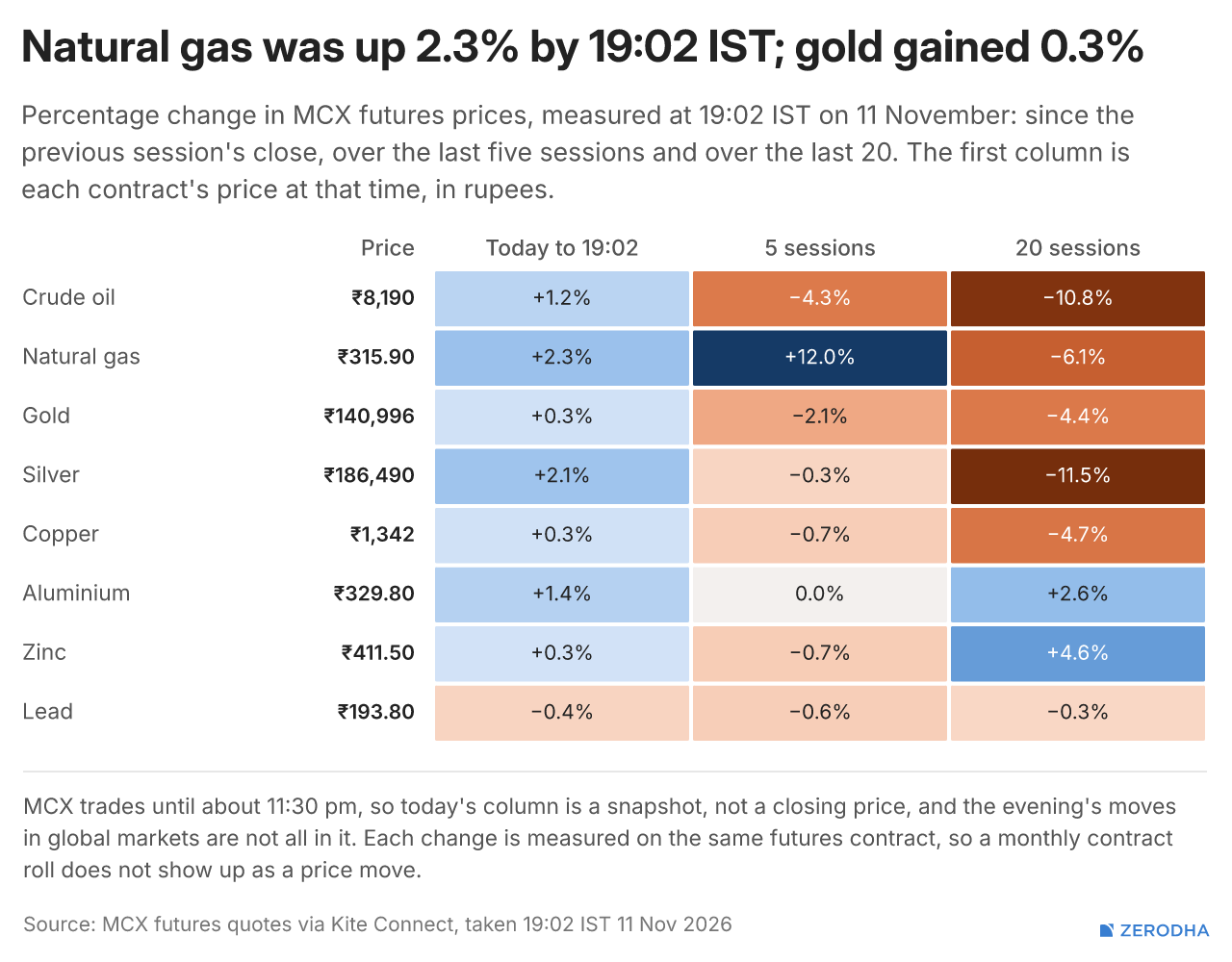
Crude oil prices rose around 1% to nearly $87 per barrel, recovering from a 10-week low as uncertainty surrounding US-Iran negotiations persisted. Prices gained after Iran reiterated its refusal to allow enriched nuclear material to leave the country, highlighting a major obstacle to diplomatic efforts to end the conflict. Dive deeper
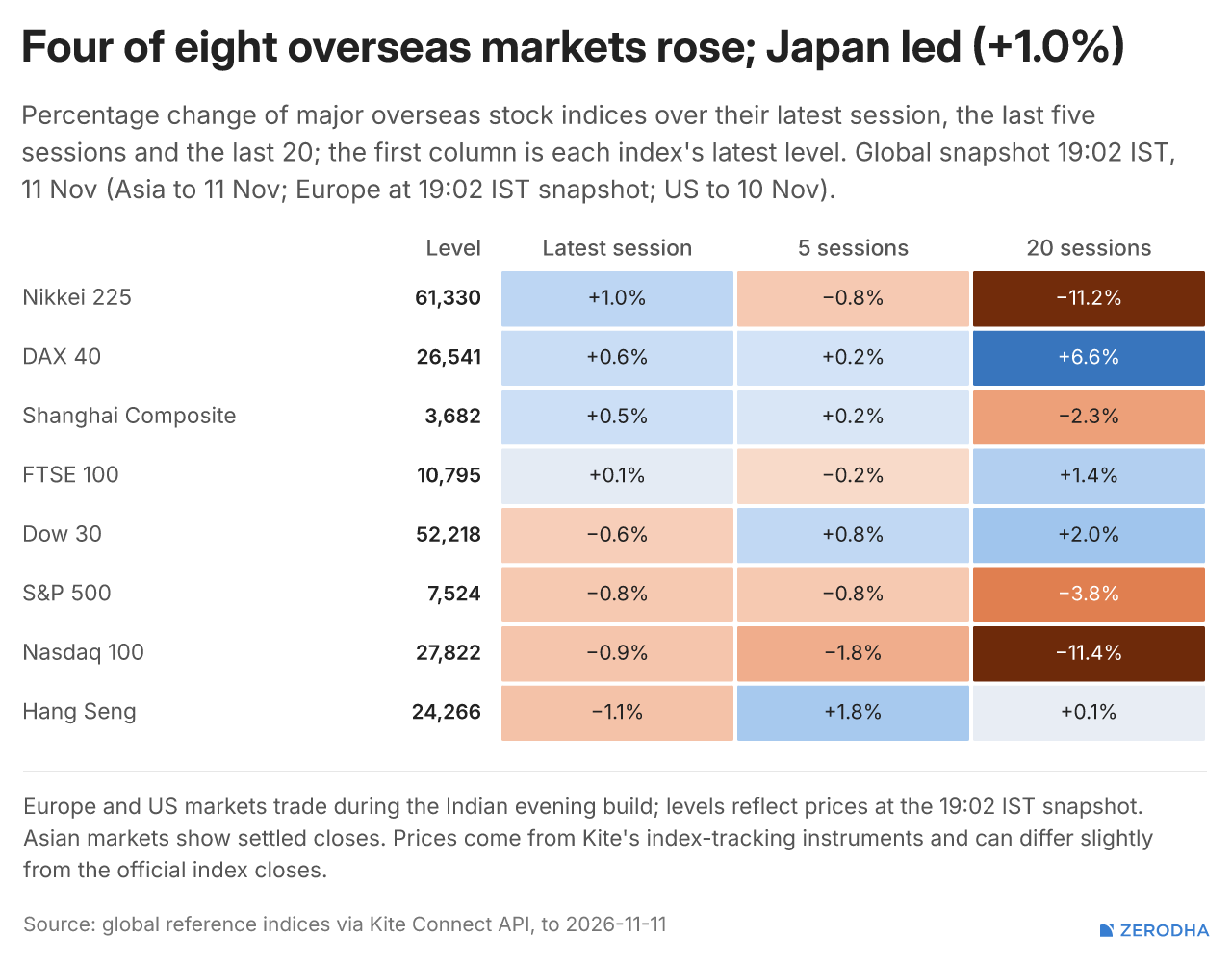
Global equities advanced as strong results from AI infrastructure company CoreWeave eased concerns over excessive AI spending. European stocks rose 0.4%, while US futures gained and CoreWeave shares jumped over 13% in premarket trading after the company projected adjusted profitability in the first half of 2028. Dive deeper
The US dollar gained against most major currencies, with the dollar index rising 0.2% to 102.4, approaching a two-week high. Strong inflation data and hawkish comments from Federal Reserve officials increased expectations of another interest rate hike in December. Dive deeper
Microsoft surpassed Nvidia to become the world’s second-most valuable company as Nvidia shares declined amid uncertainty surrounding AI industry prospects. Investor sentiment was also affected by an investigation into whether a foreign intelligence operation had targeted Nvidia CEO Jensen Huang. Dive deeper
Management Chatter
In this section, we highlight interesting comments from management at major companies and from policymakers in the Indian and Global Economies.
Samir Arora, founder of Helios Capital, on why the FIIs can come back to the Indian market:
The case for India rests on a sharp improvement in earnings growth. Indian companies delivered rupee earnings growth of just 9–10% over the past two years. With the rupee depreciating by 5–6% annually, that left dollar earnings growth at only around 3–5%, making Indian equities less attractive to global investors.
That equation could now change. Earnings growth in rupee terms could rise to 14–15%, while currency depreciation moderates to around 3% a year. The resulting dollar earnings growth of about 11% would make India stand out. - Link
Check out The Chatter by Zerodha
Hundreds of earnings calls this season. Nobody’s reading all of them.
We read a lot of them, though. Every week, [The Chatter] pulls out the lines from calls, management interviews and regulator speeches that tell you something the results table doesn’t, and links you to the source.
Go check out The Chatter here

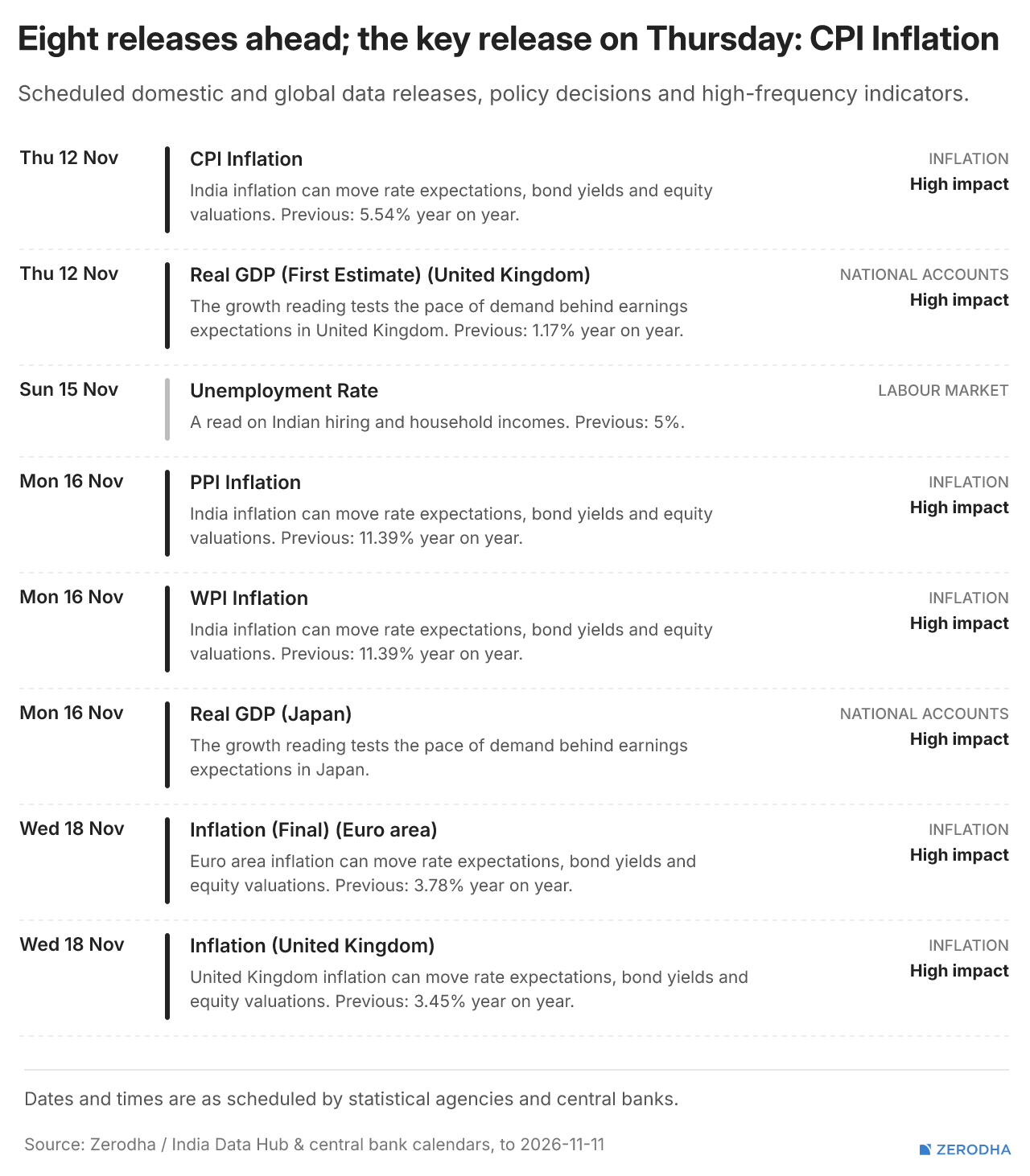
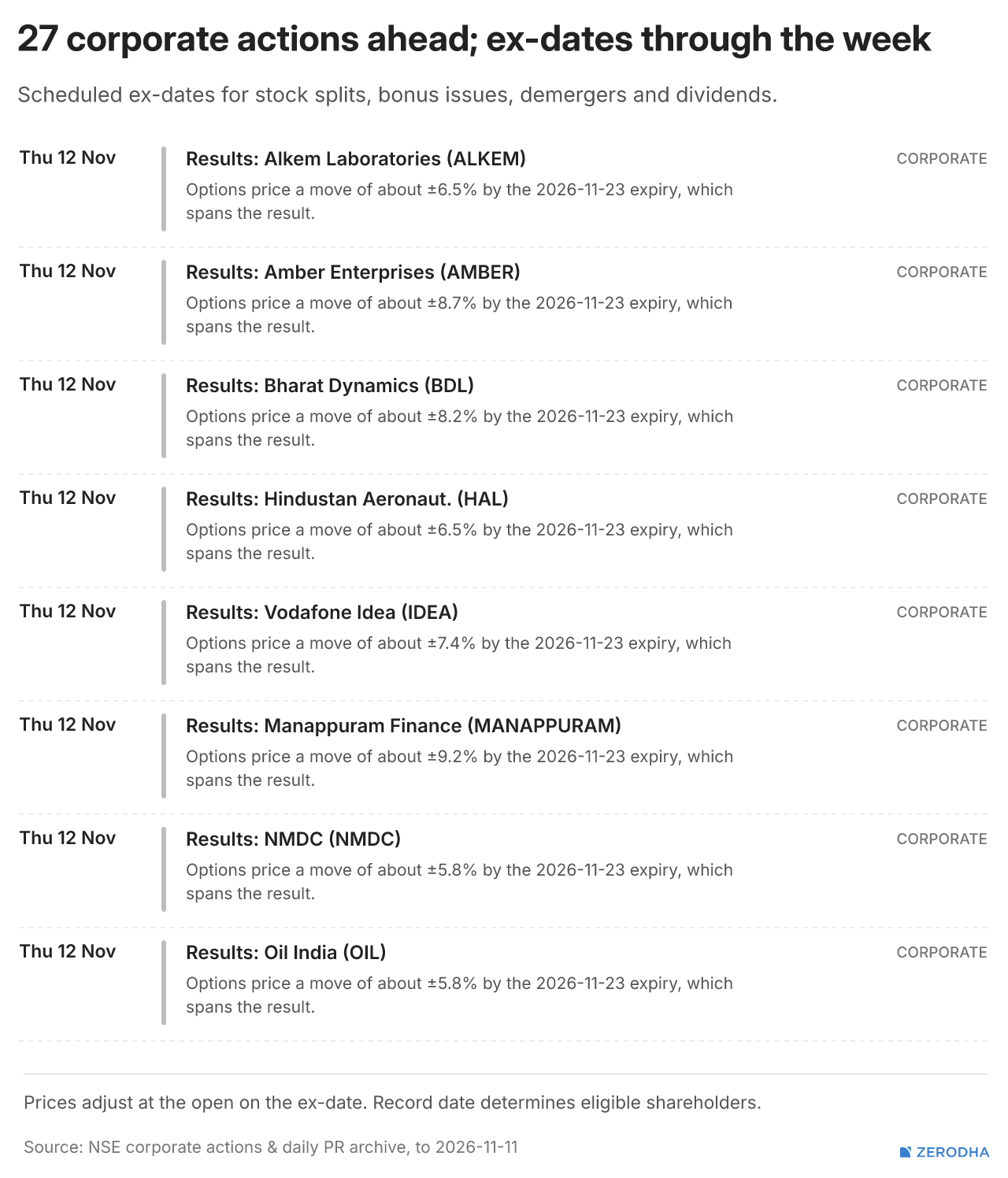
The week ahead & Corporate Actions
Corporate Actions
Published by Zerodha. Not investment advice. Data from NSE, BSE, and MCX.
In our latest special episode of In The Money by Zerodha, we test two strategies on Indian stocks: selling a naked straddle after results and selling an iron fly with defined risk.
Using data from 209 Indian F&O stocks between October 2021 and August 2026, we examine six exit timings, from the same day to five trading days later. We analyse average returns, win rates, median returns, and stock-by-stock performance to understand how holding periods affect results.
We then test an iron fly strategy, where protective options limit potential losses. We examine how protection costs affect returns and why positive median returns can coexist with negative average percentage returns.
That’s it from us for today. We’d love to hear your feedback in the comments, and feel free to share this with your friends to spread the word!
Breadth and delivery data together is the most useful addition here. One idea: split the 52-week highs into large vs small caps. That alone says a lot about where the money is actually going.
would love to have more about mutual funds
thankyou!