
Welcome to Aftermarket Report, a newsletter where we do a quick daily wrap-up of what happened in the markets, both in India and globally.
What data points and transformations do you want to see?
We’re trying out a new format for the Aftermarket Report, with much more comprehensive coverage of the data that shapes the trading day.
Beyond the headline indices, we’re now tracking market breadth, new highs and lows, sector and thematic performance, delivery data, F&O positioning, global markets, commodities, flows, and more. We’re also looking at ways to transform this raw data into insights that are actually useful for traders and investors.
The idea is simple: bring different datasets together in one place to give you a clearer picture of what’s happening beneath the surface of the market.
This is still a work in progress, and we’d love your feedback. What data points are we missing? What transformations, ratios, comparisons, or indicators would you find useful? Also tell us what worked, what didn’t, and what felt unnecessary.
Your feedback will help shape the Aftermarket Report from here.
Markets Today
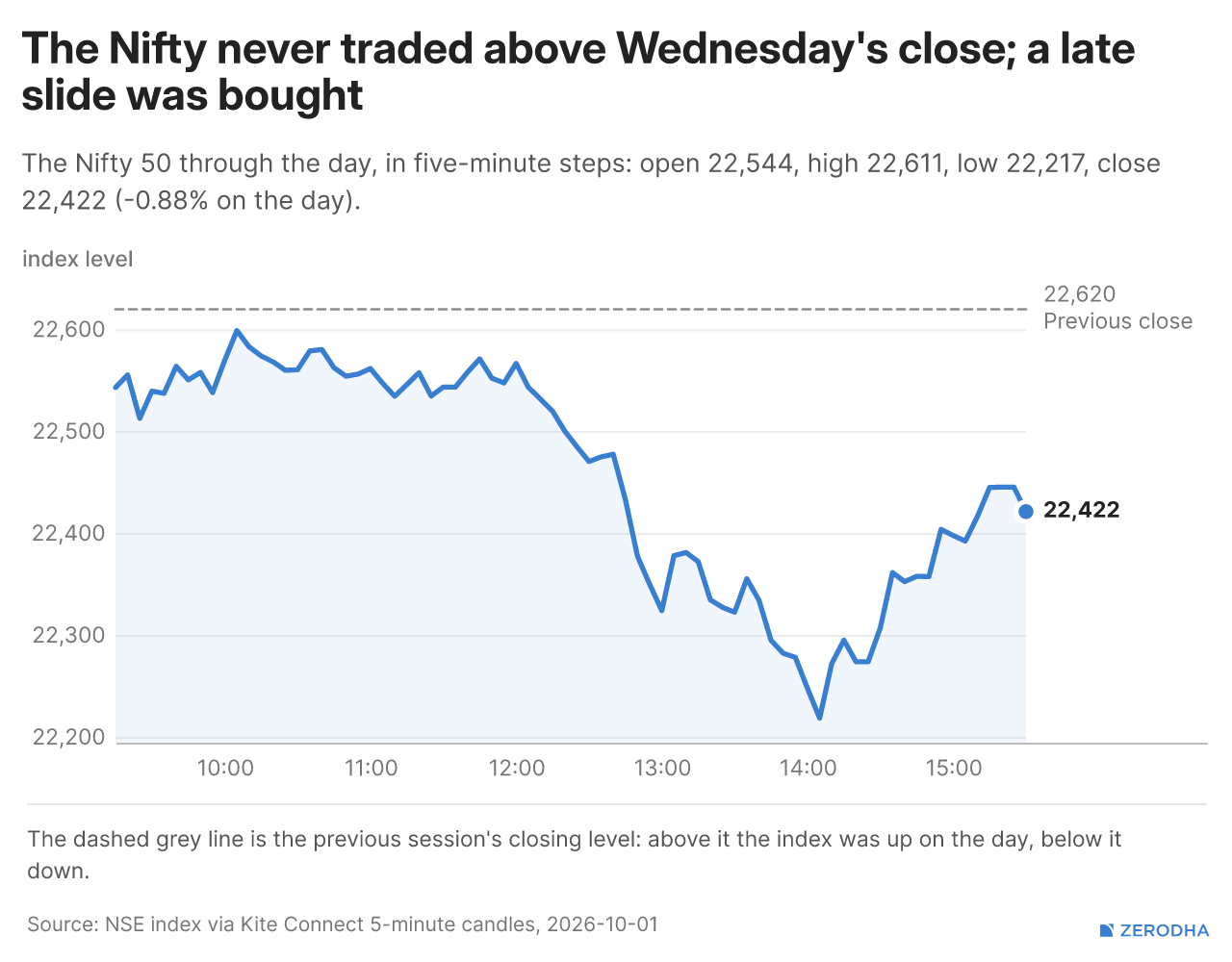
Nifty opened with a 76-point gap down at 22,544, tracking lacklustre global cues and firm oil prices above $90 per barrel, while extremely weak domestic sentiment continued to weigh on markets. The index remained volatile during the opening hour, initially slipping towards 22,510 before recovering to an intraday high near 22,600 around 10 AM. However, the recovery failed to sustain, with Nifty largely oscillating between 22,540 and 22,580 through the rest of the morning.
Selling pressure intensified after noon, with Nifty slipping below 22,500 before a sharper fall around 12:40 PM pushed it towards 22,300. A brief recovery towards 22,380 followed, but the index remained under heavy pressure and eventually touched an intraday low near 22,215 around 2 PM. Buying emerged from the lows in the final part of the session, helping Nifty recover more than 200 points and move back above 22,400. The index eventually closed at 22,421.95, around 122 points below its opening level, with the late recovery helping pare a significant portion of the day’s losses.
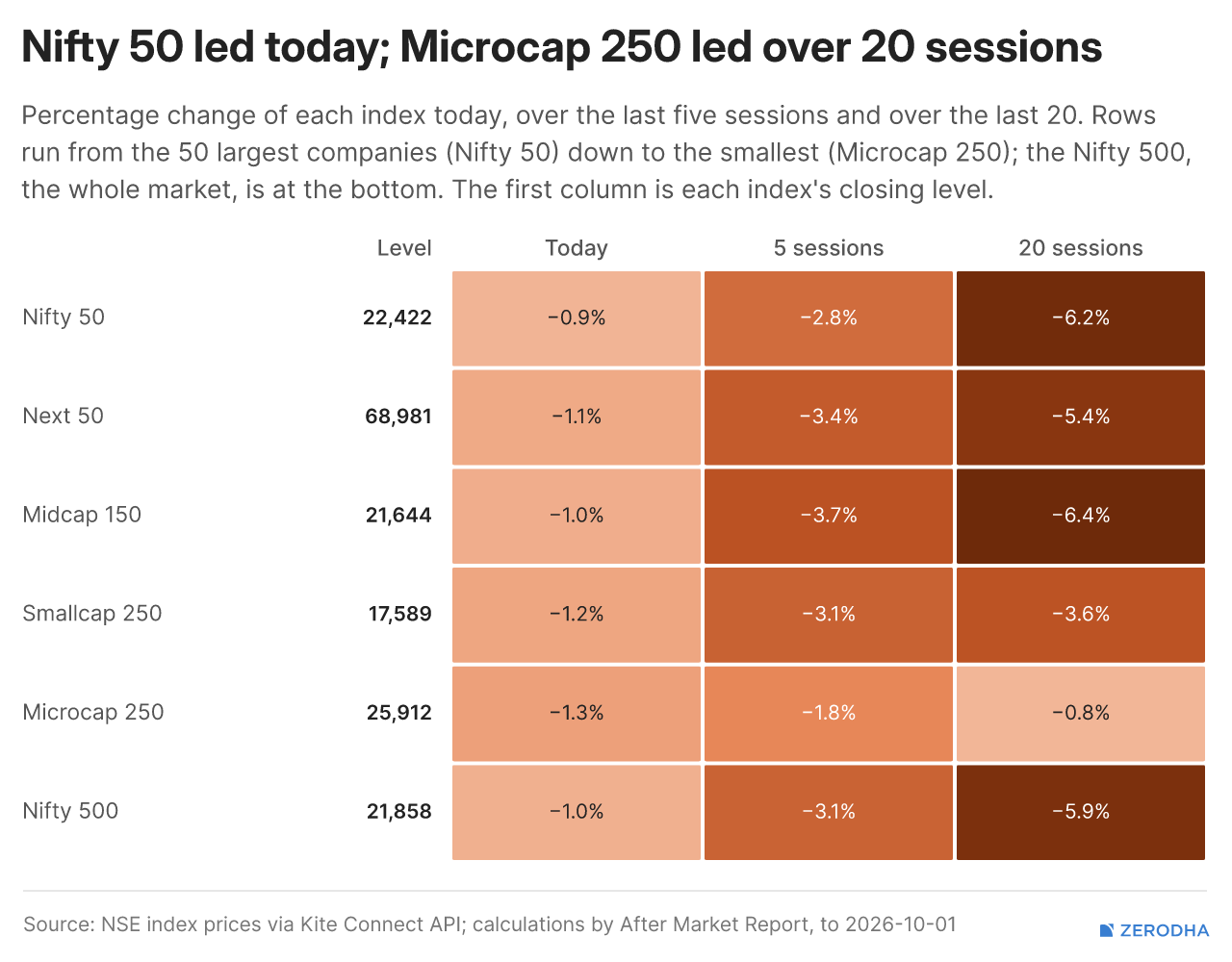
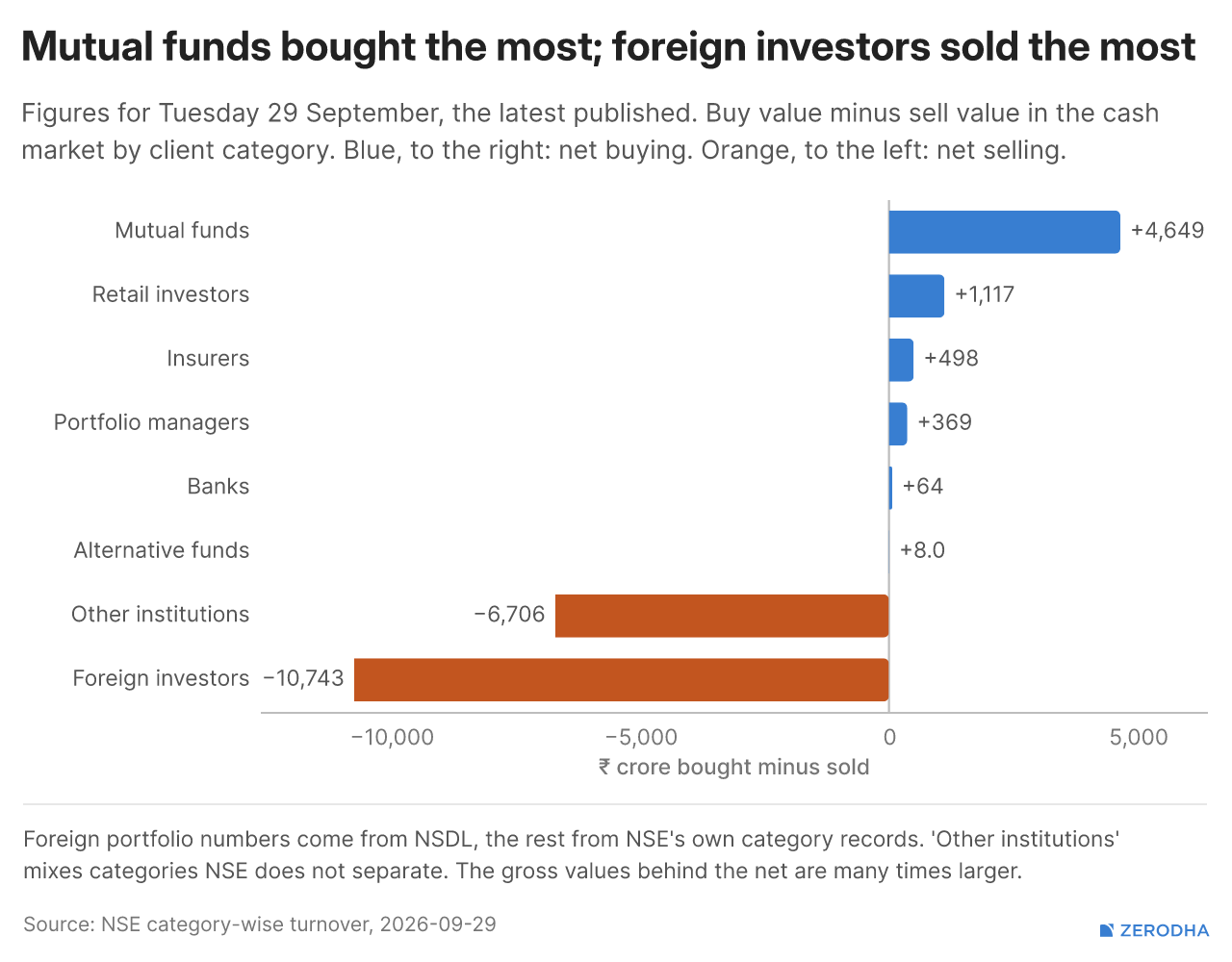
The broader weakness was driven by intensifying FII selling in recent sessions, weak auto sales weighing on index heavyweights, a softer rupee and surging bond yields.
Fear & Greed Index
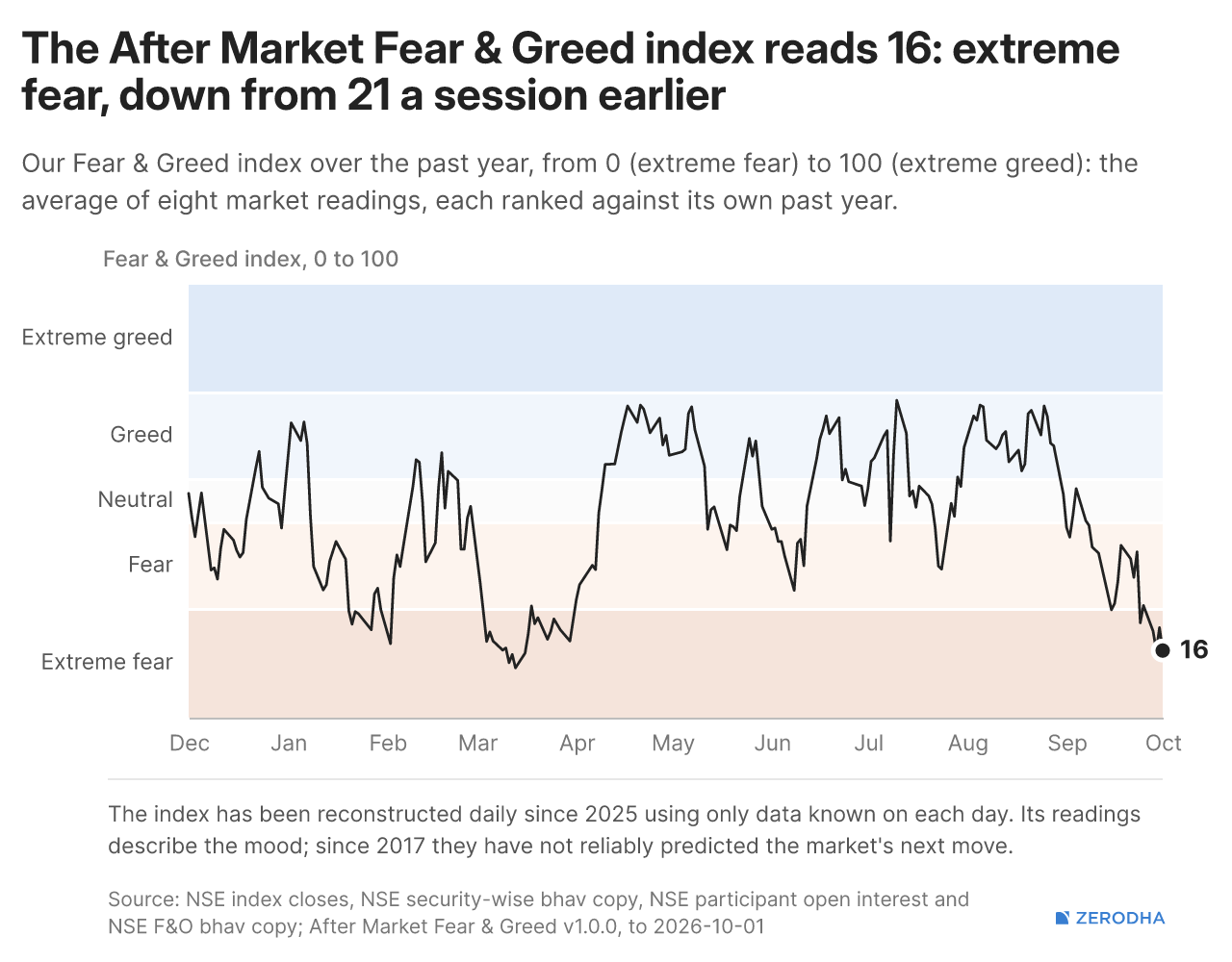
The Fear & Greed Index slipped from 21 to 16, remaining in extreme fear. Bearish foreign positioning, weak market trends, and bonds outperforming equities continued to weigh on sentiment.
Market Breadth
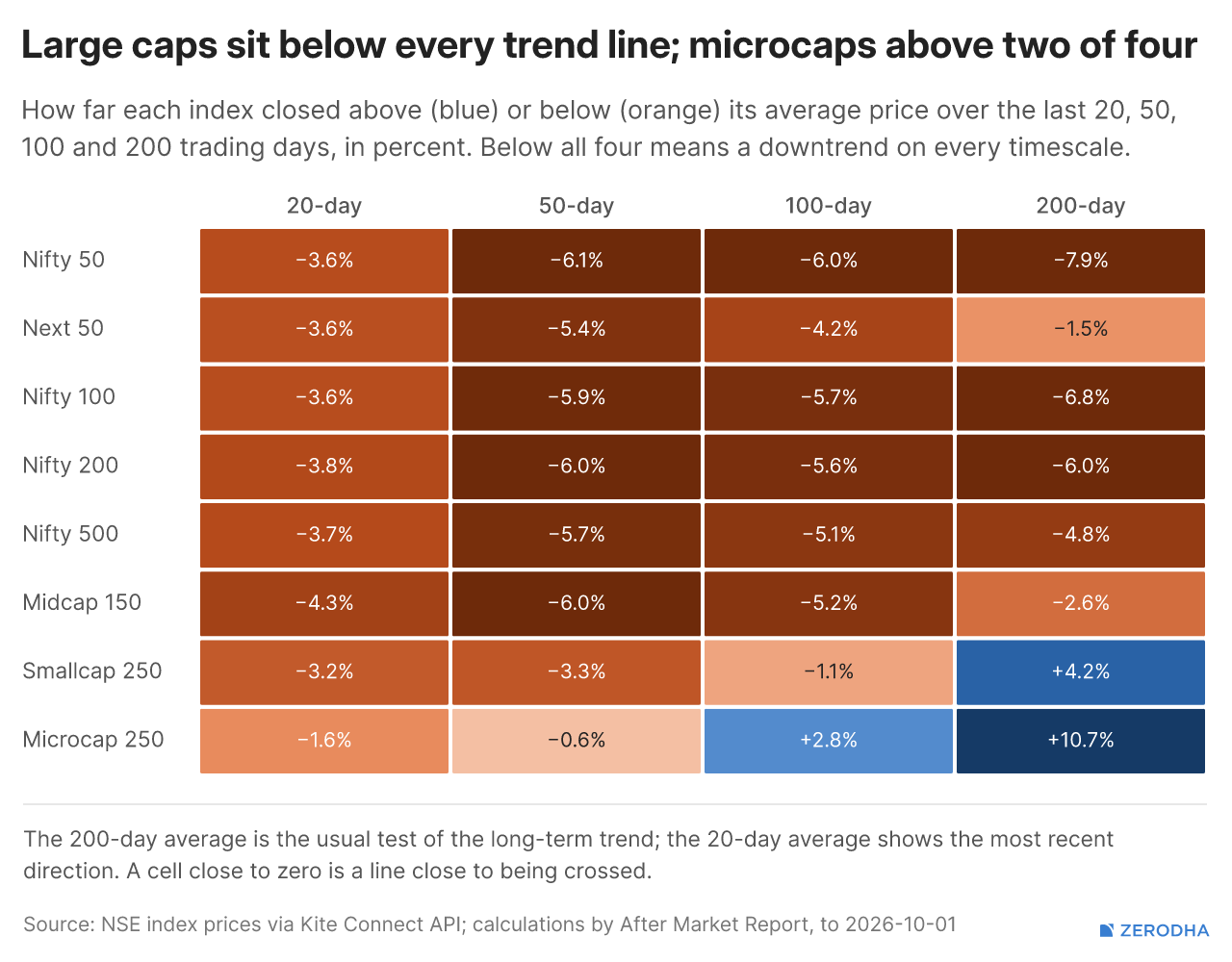
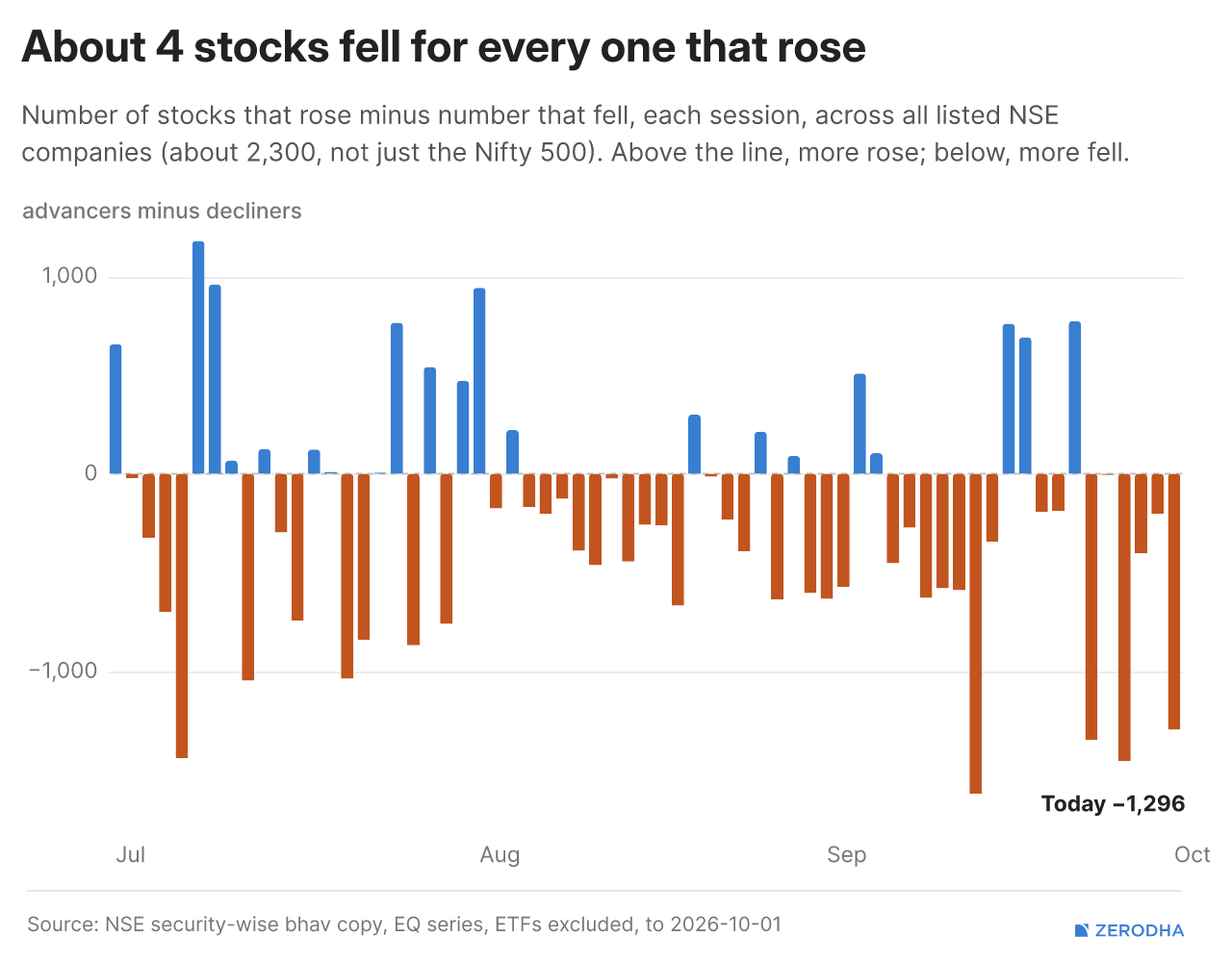
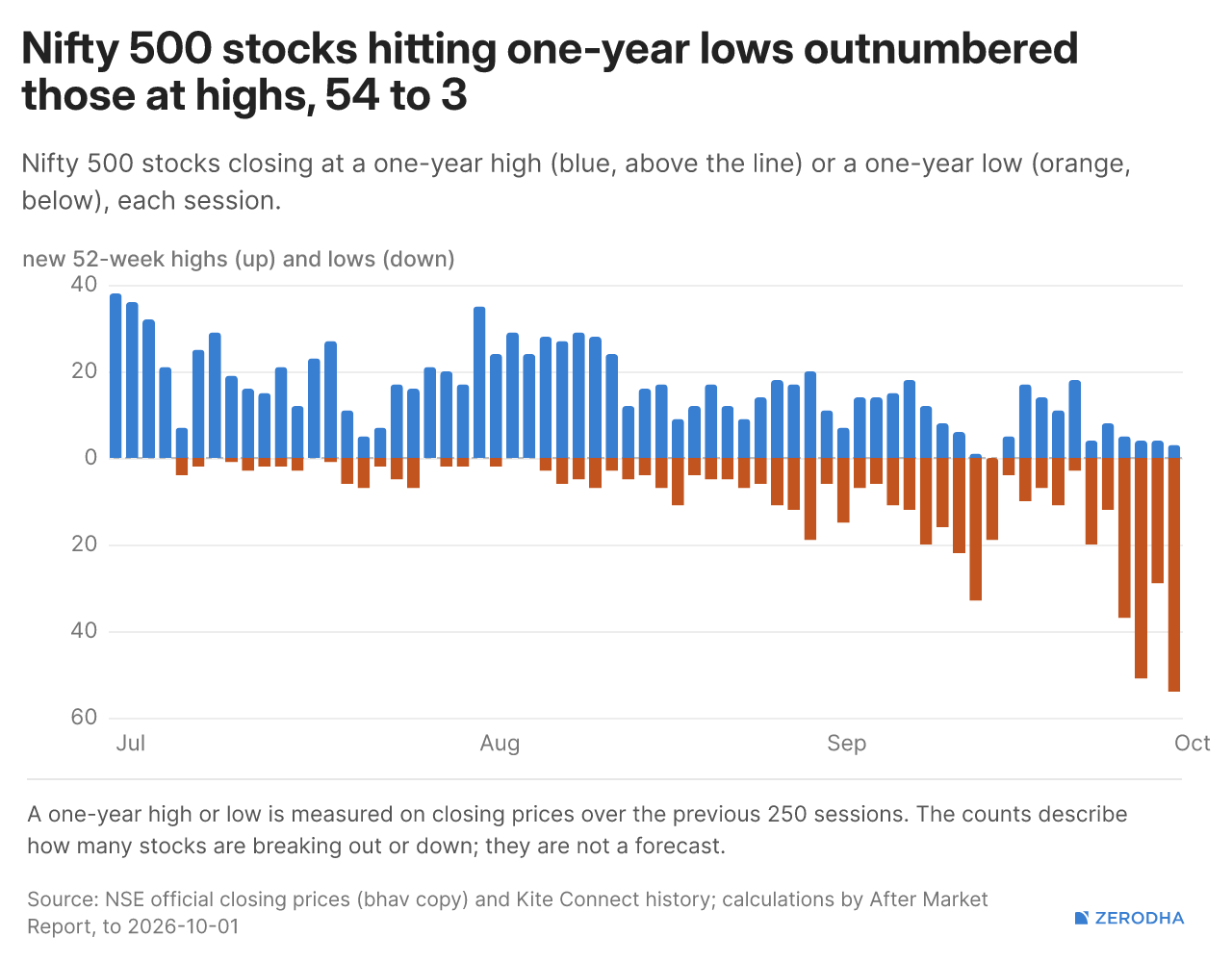
Selling was broad, with 1,795 decliners versus just 499 advancers. Only 17.2% of Nifty 500 stocks remain above their 50-day average, while 52-week lows outnumbered highs 54 to 3.
52 Week Highs & Lows
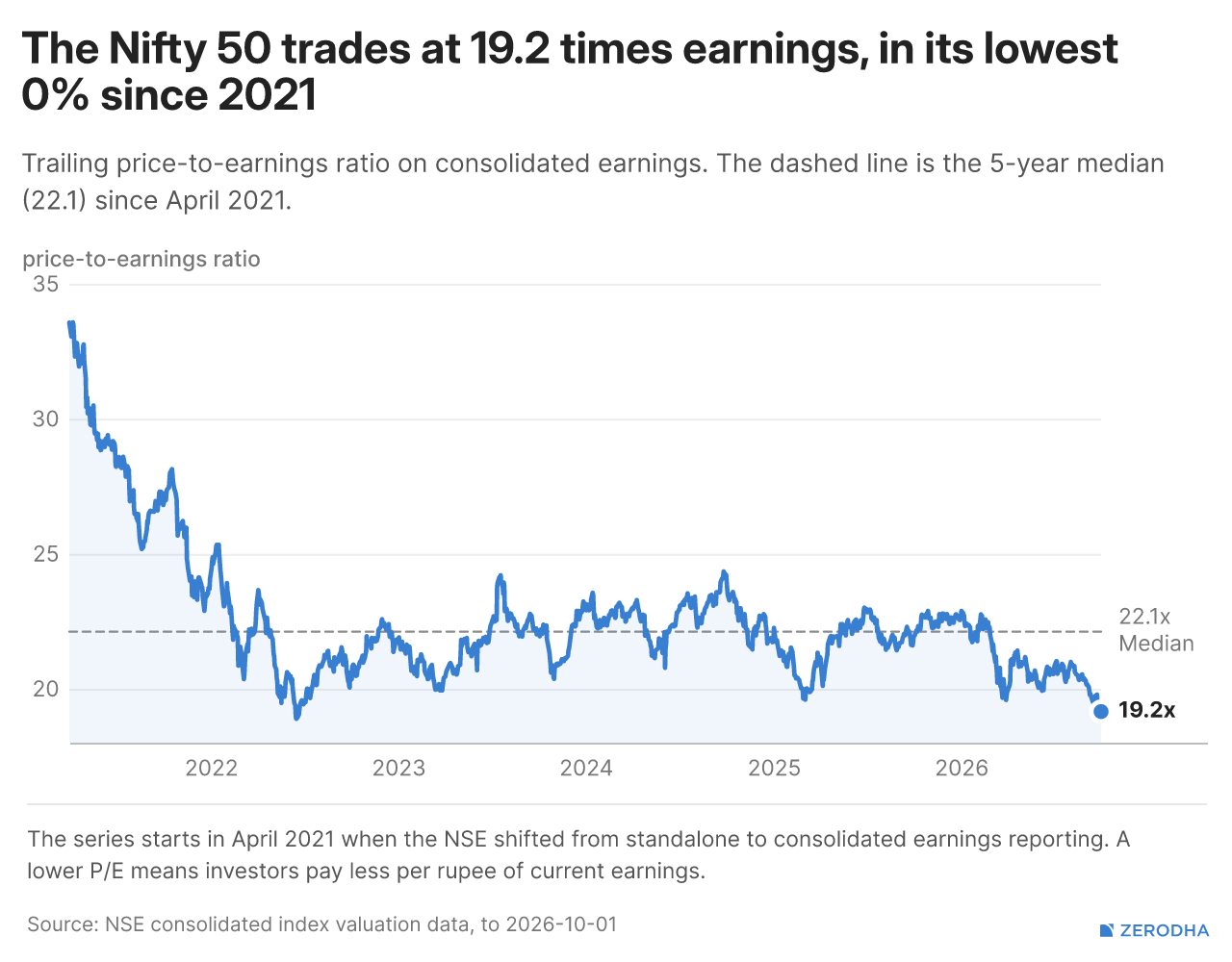
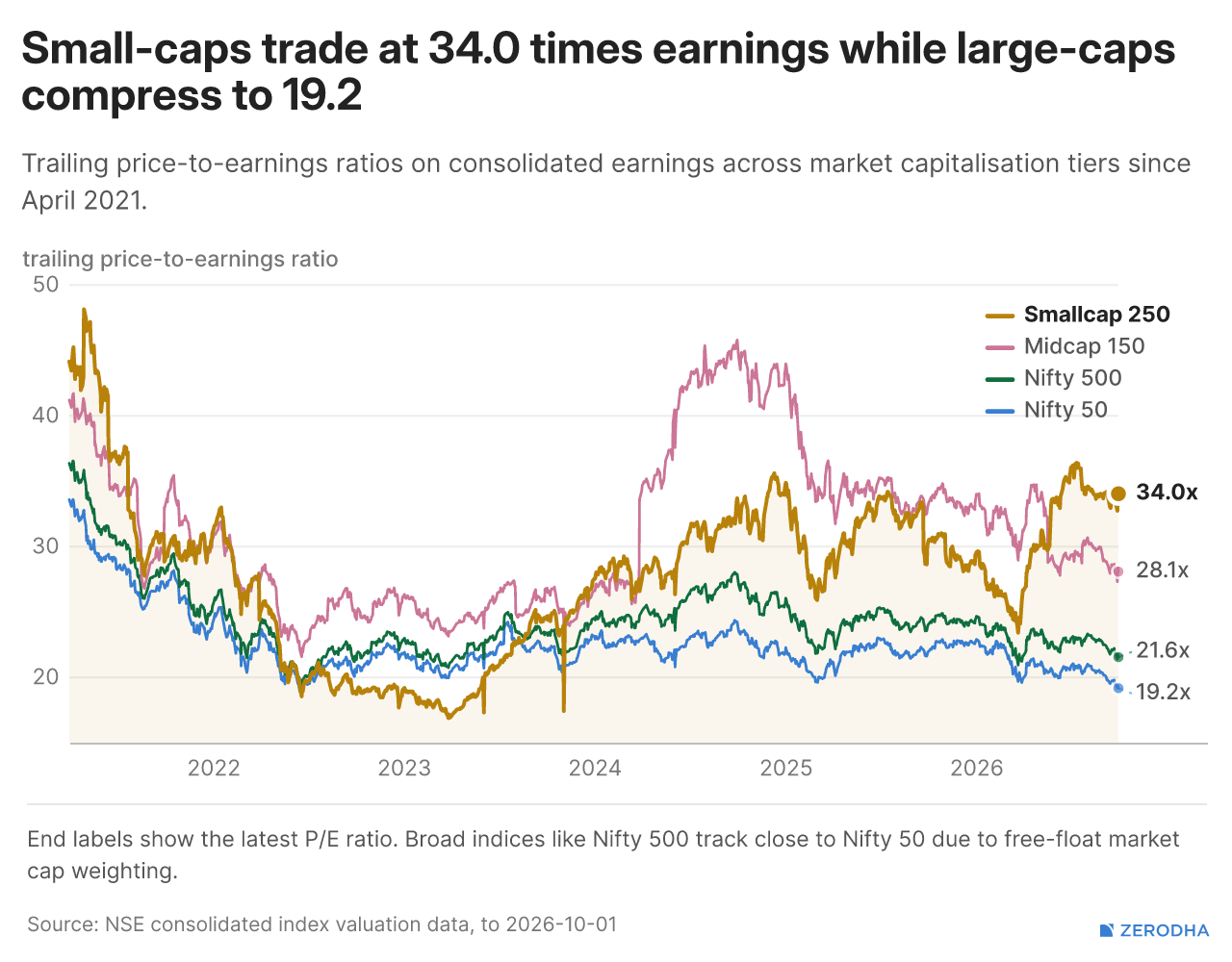
Valuation Check
Sectoral Indices Performance
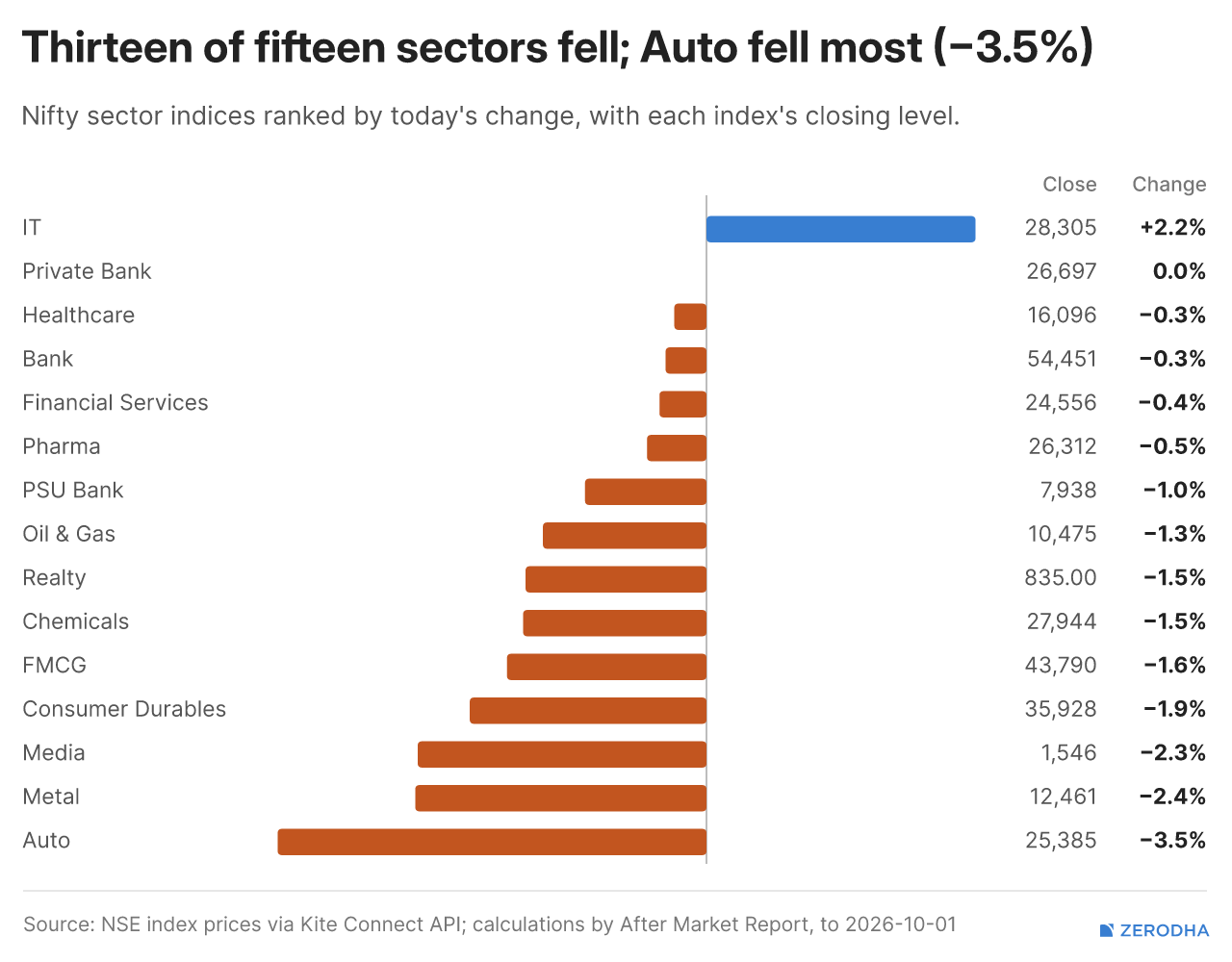
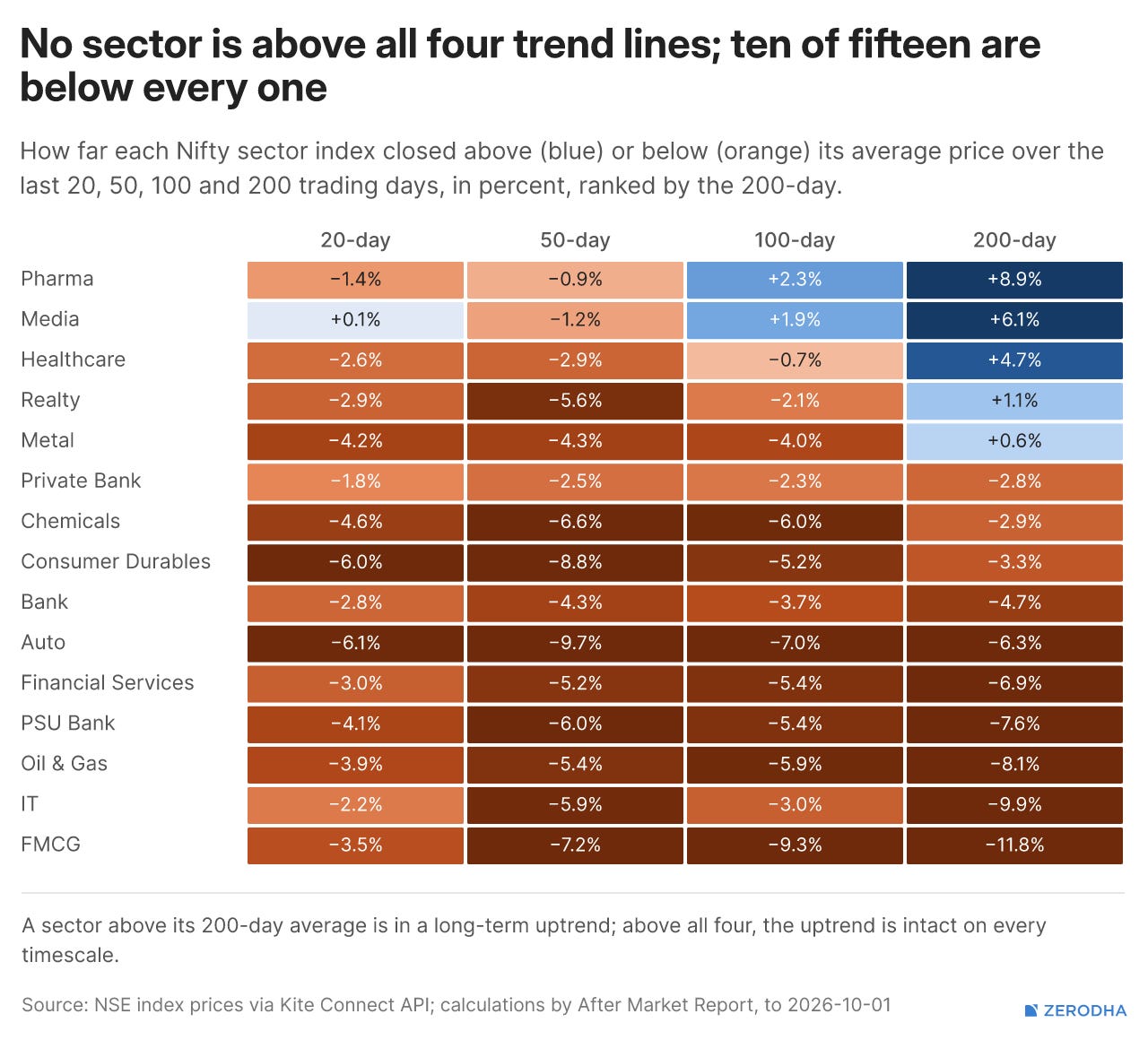
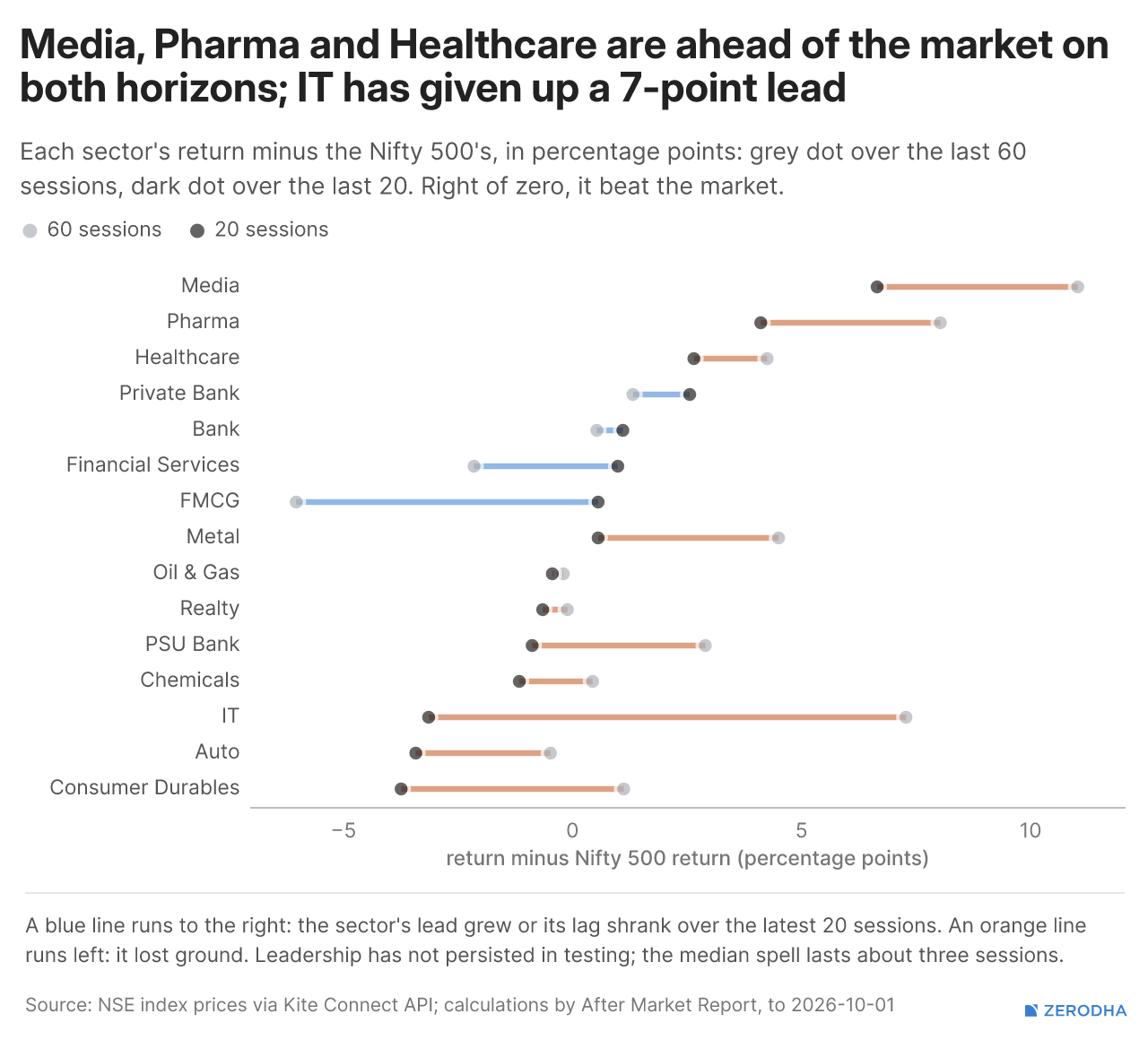
IT surged 2.17% to lead while Auto plunged 3.46%, with only two of 15 sectors gaining. Media, Pharma and Healthcare remain the relative leaders, but no sector is now above all four key moving averages.
Winners & Losers
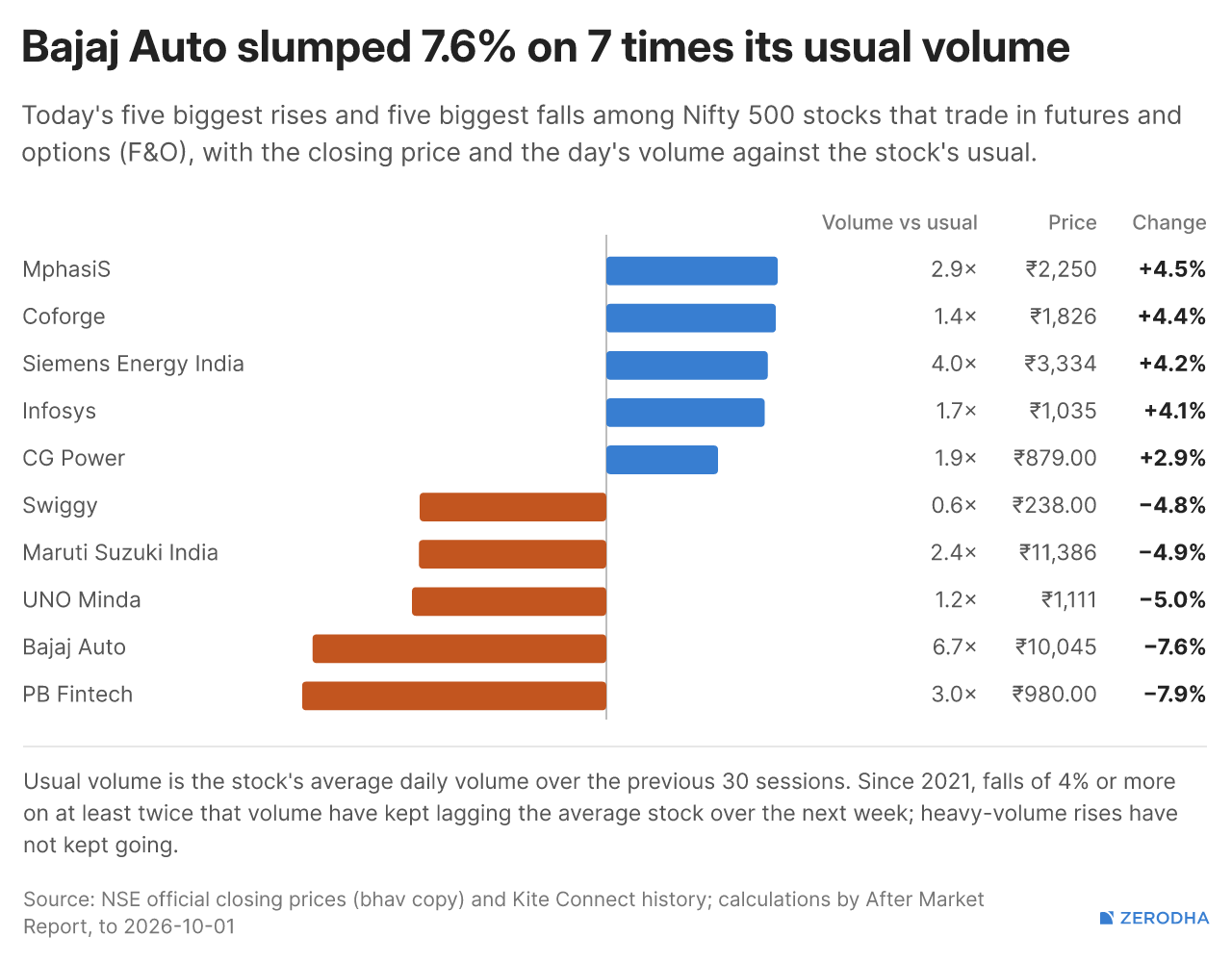
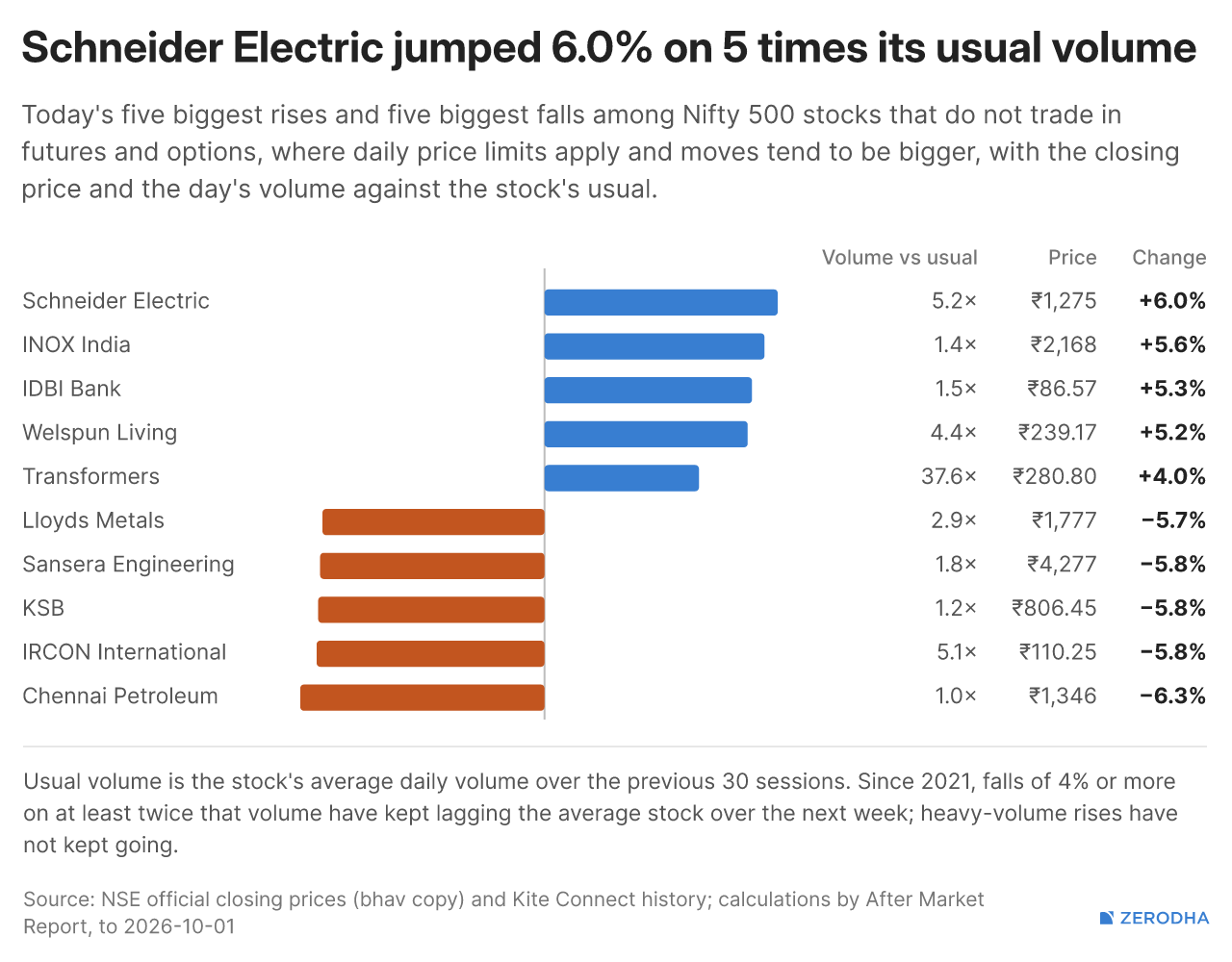
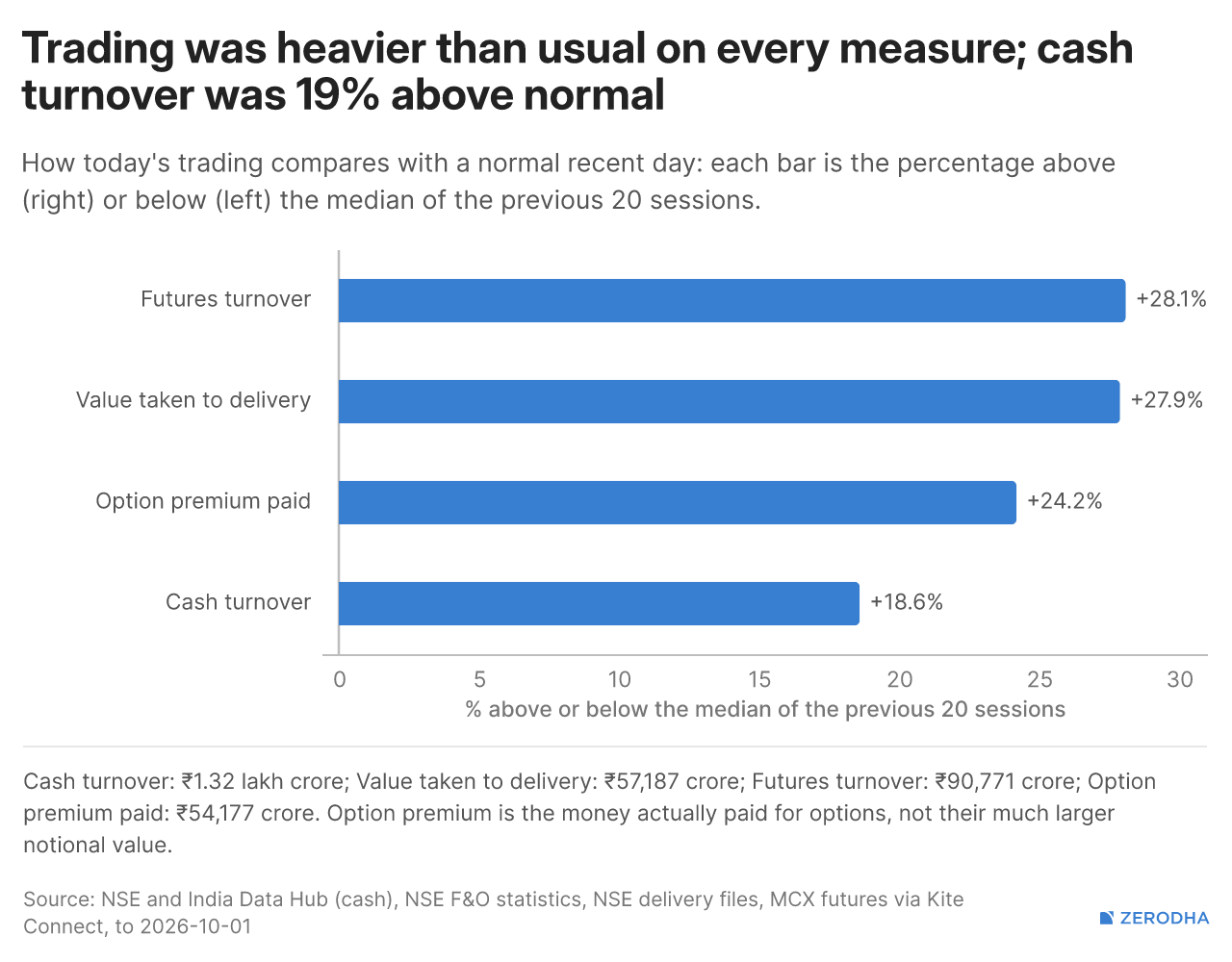
Bajaj Auto plunged 7.62% on 6.7× usual volume, while Schneider Electric gained 5.98% on heavy activity. Auto stocks occupied three of the five worst F&O slots, while Angel One saw the biggest jump in implied volatility.
Delivery Data
Global Markets
Commodities
Institutional Flows & Participant Positioning
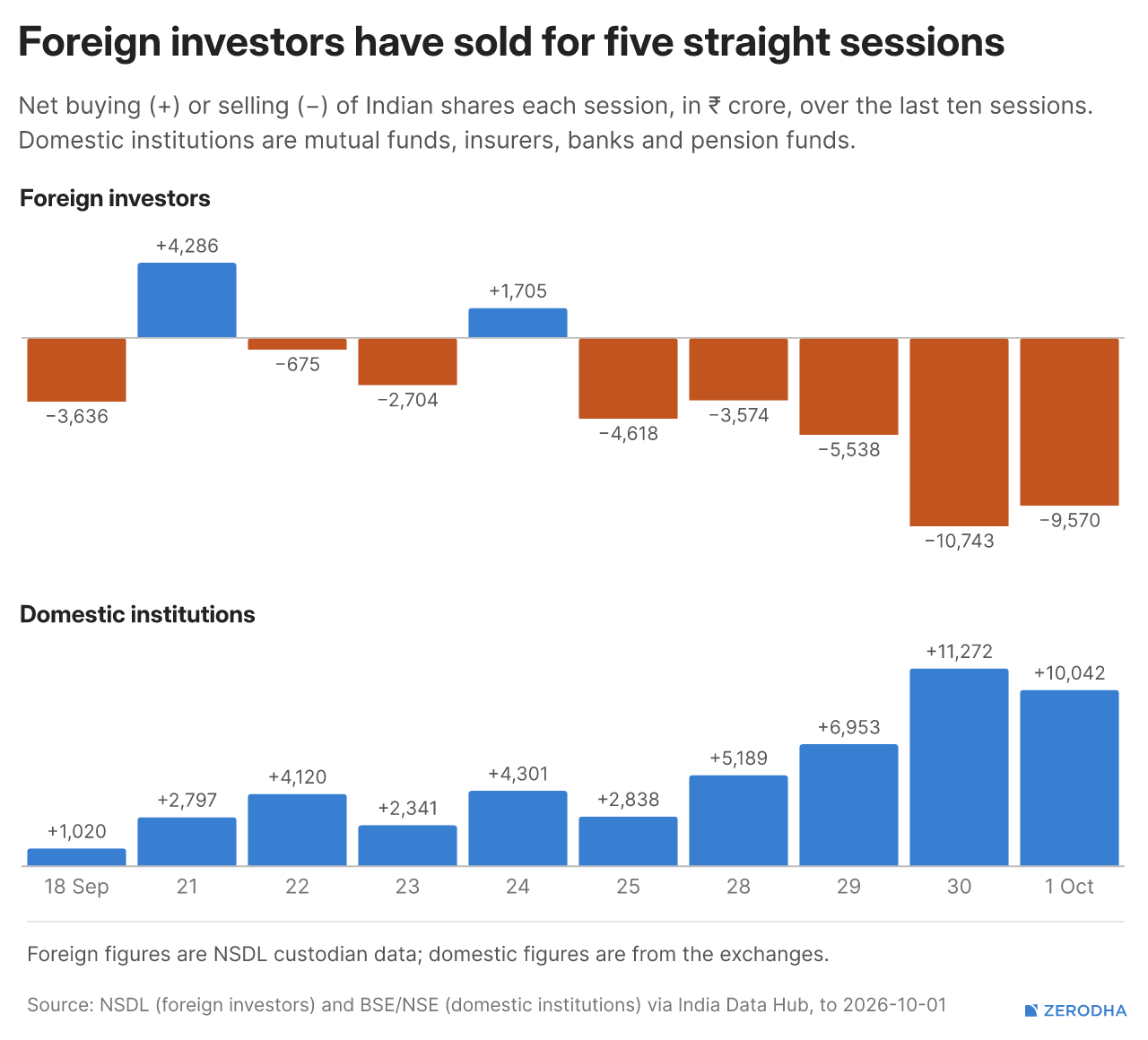
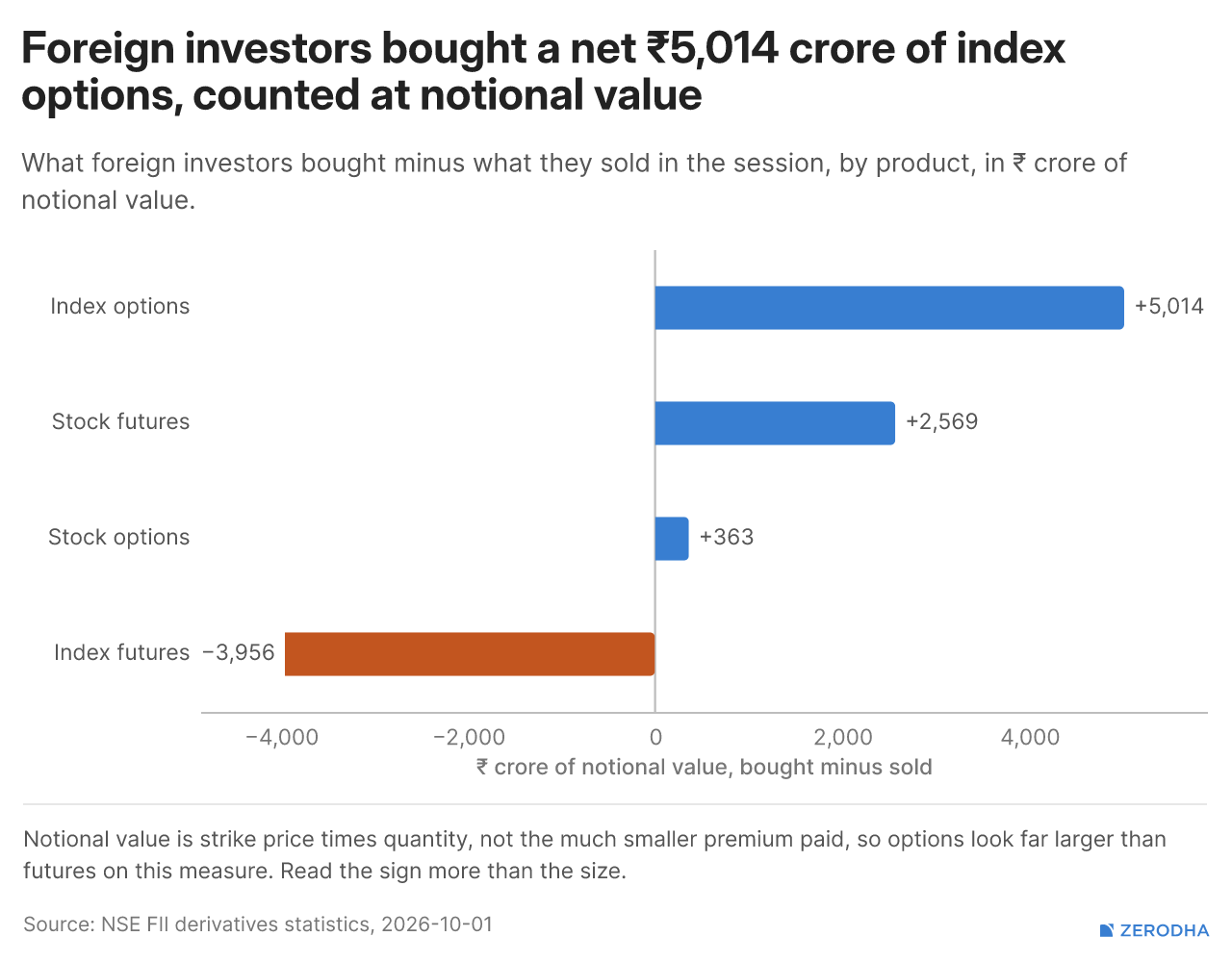
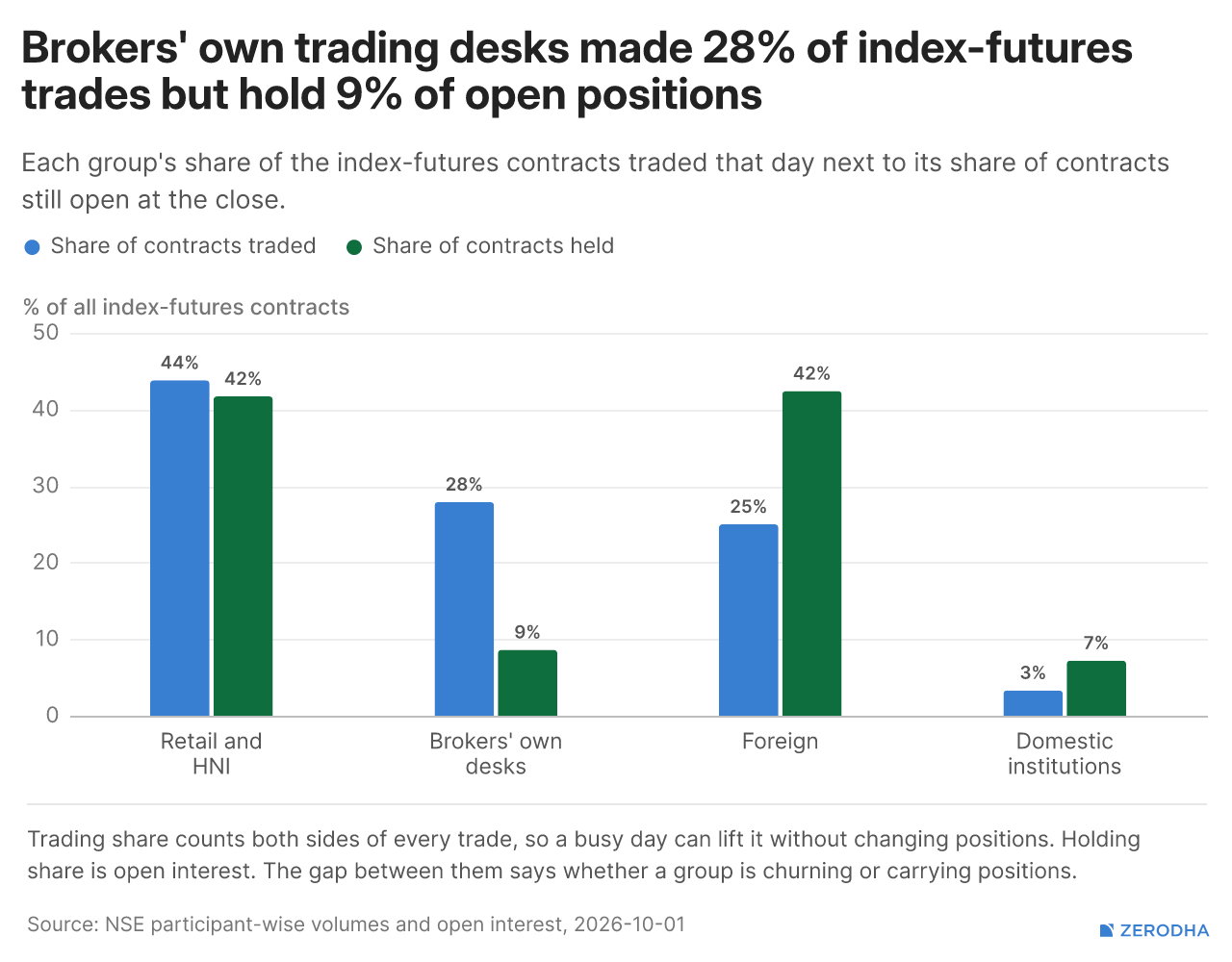
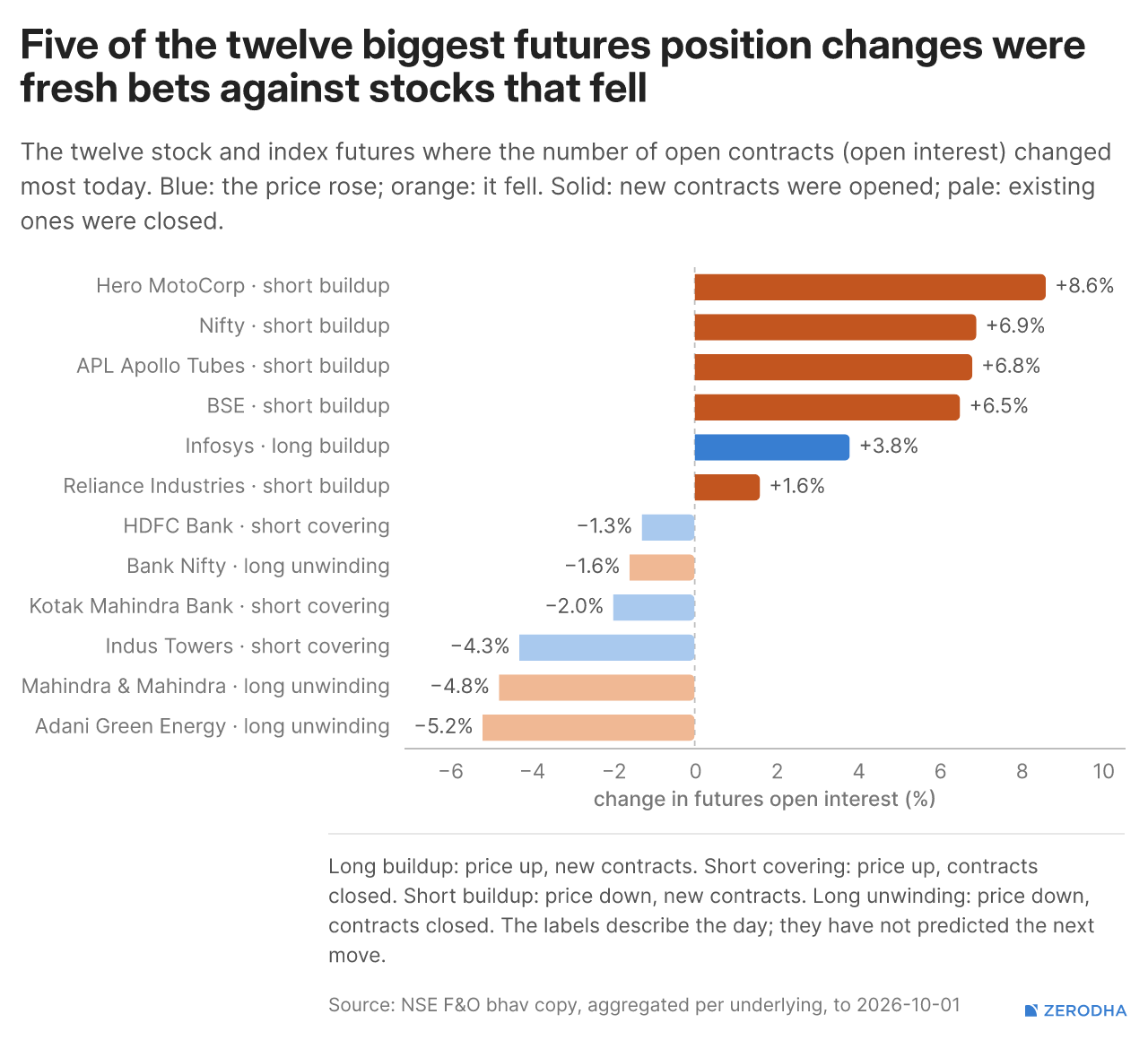
FIIs remain heavily bearish with just 8% of index-futures positions long, while retail and HNIs are 84% long, near their most bullish positioning of the past year.
Thematic Indices
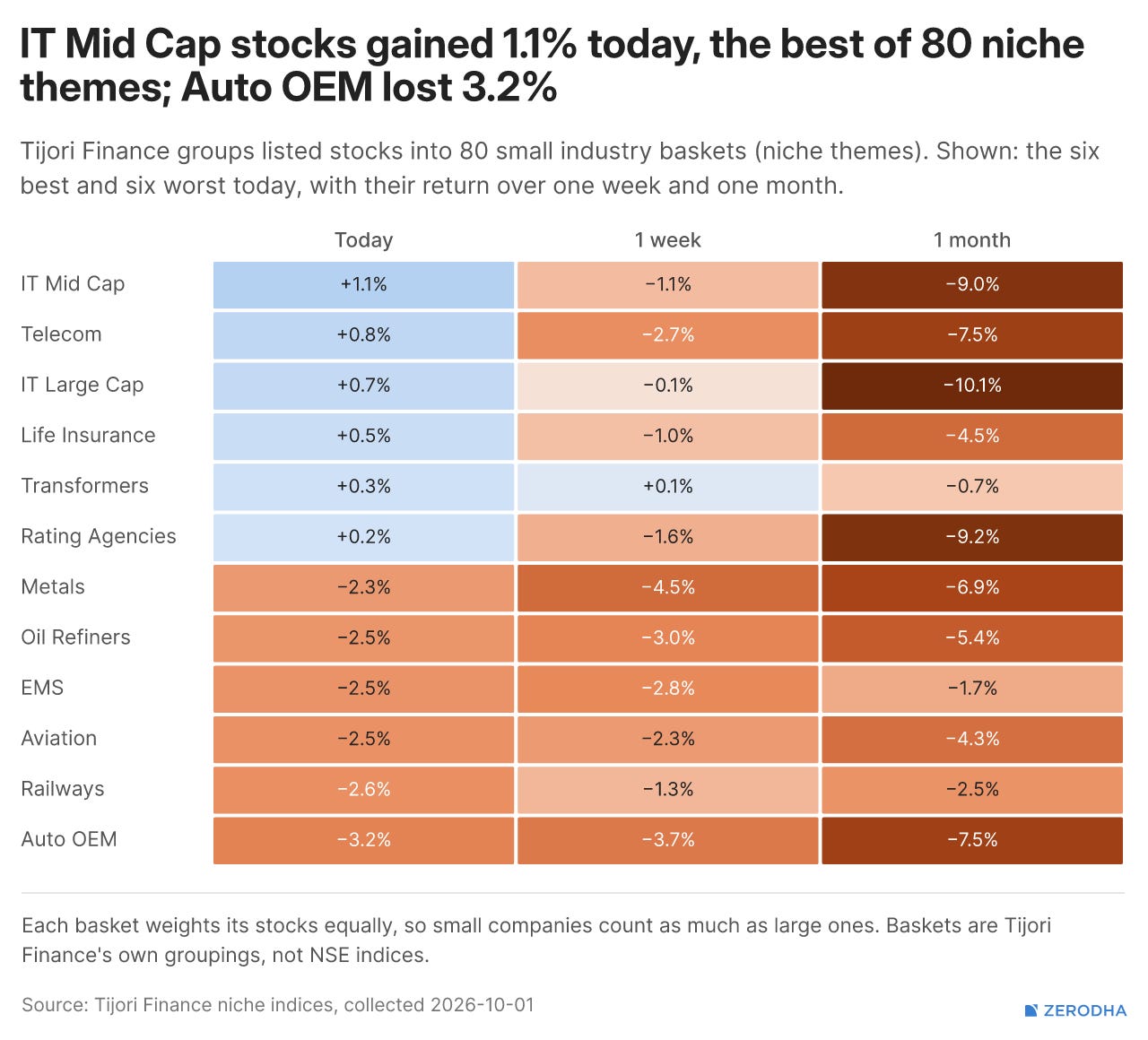
Tijori’s niche indices, where today’s move sorts pockets of the market beyond standard sector baskets. You can also track promoter buying and other interesting stuff, like Capex activity by the companies in the Tijori App’s idea dashboard
F&O Corner
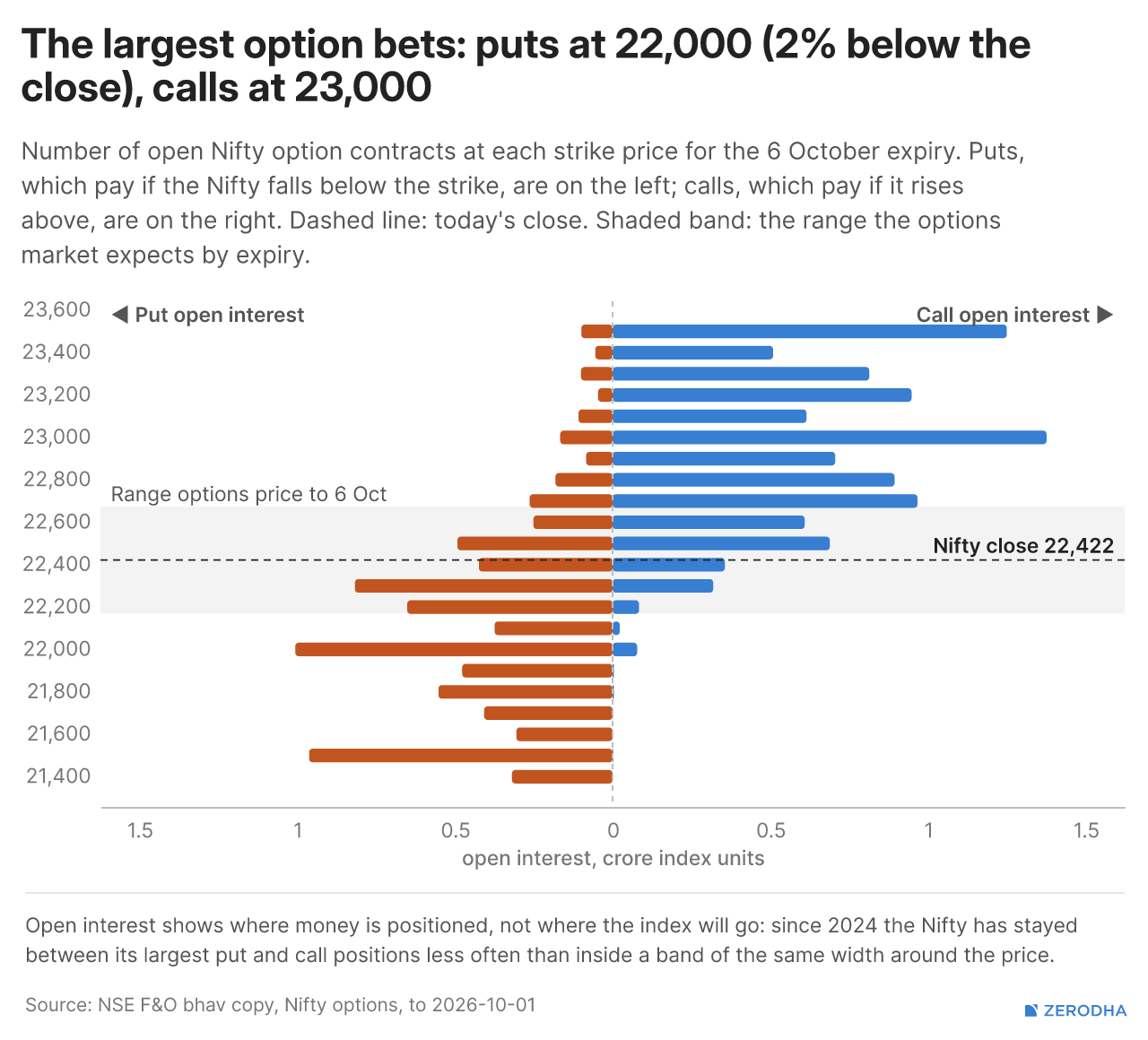
Options imply a 22,209–22,715 range, with the heaviest put OI at 22,000 and call OI at 23,000. The 20-day moving average at 23,269 remains the first major trend hurdle. Options price a roughly 253-point move either way into October 6 expiry.

Top Stories in India
India’s manufacturing PMI rose to a seven-month high of 55.1 in September from 52.8 in August, supported by stronger new orders, production and hiring. However, the Q2 FY27 average of 53.8 was the weakest since the corresponding quarter of 2021. Dive deeper
HDFC Bank has appointed Anup Bagchi as MD & CEO, following RBI approval. He will take charge on October 27, 2026, succeeding Sashidhar Jagdishan, whose term ends on October 26. Dive deeper
The rupee fell 0.5% to ₹96.315/$, its weakest level in two months, as surging global bond yields, higher oil prices and foreign portfolio outflows weighed on the currency. State-run bank dollar sales helped limit the decline. Dive deeper
Gross GST collections crossed ₹2 lakh crore for the third straight month in September, with domestic revenues up 10.1% and import revenues up 26%. After refunds, net collections rose 18.1% YoY to over ₹1.76 lakh crore. Dive deeper
SEBI has given NSE a no-objection certificate to launch futures linked to a corporate bond index, subject to RBI approval. The contracts would allow investors to hedge corporate bond exposure through an exchange-traded instrument. Dive deeper
HEG Advanced Materials’ subsidiary Replus Engitech secured ₹127.35 crore of lithium-ion battery bank orders from Indus Towers. Dive deeper
Infosys extended its strategic partnership with ABN AMRO, focusing on enterprise-wide AI adoption, platform simplification and building a scalable IT foundation. Infosys shares recovered after touching a 52-week low a day earlier. Dive deeper
Hyundai recorded its highest-ever monthly sales of 77,916 units in September, up 10.8% YoY. Domestic sales rose 10.9% to 57,166 units, while exports increased 10.4% to 20,750 units. Dive deeper
NTPC’s Q2 power generation rose 13% YoY to 117.9 billion units, while coal dispatch jumped 28.45% to 11.9 million tonnes. Power trading volumes also increased 22% to 15.06 BU. Dive deeper
Most of the auto stocks came under pressure after September sales showed a slowdown from August’s strong levels. Bajaj Auto fell over 8% after domestic sales declined 12% YoY, while M&M slipped over 3% despite passenger vehicle sales rising 14% YoY. Dive deeper
Top Stories Globally
Global bonds extended their sell-off, pushing the US 10-year Treasury yield to 5.34%, its highest since 2002. France’s 10-year yield approached 5%, while Britain’s 30-year yield crossed 6%, as rising borrowing costs spilled into broader markets.Dive deeper
Brent crude rose around 2.5% to above $100 per barrel after China suspended oil-product exports, adding to concerns over tight global fuel supplies. Markets also continued to track diplomatic efforts around the Middle East conflict. Dive deeper
BYD’s global vehicle sales rose 17% YoY to 463,561 units in September, marking a fifth consecutive monthly increase. Overseas shipments surged 154% to nearly 180,000 units, helping offset continued weakness in China. Dive deeper
The dollar index rose above 101.8, its highest since April 2025, extending gains for a fourth session after rising 2% in September. Expectations of further Fed tightening, elevated inflation pressures and resilient US economic activity supported the currency. Dive deeper
Accenture shares surged 22% after the company signalled faster revenue growth despite concerns that AI could hurt consulting demand. FY26 revenue rose 4% to $74.2 billion, while earnings increased 8%, with Accenture saying AI is helping lift revenue per employee. Dive deeper
Management Chatter
In this section, we highlight interesting comments from management at major companies and from policymakers in the Indian and Global Economies.
Amit Agarwal, Investor Relations of HFCL on OFC demand:
“Historically, we have seen that OFC has always been cyclical in nature. With every new application, such as 2G, 3G and 4G, we have seen a sharp increase in demand, and after 2–3 years, the industry has gone through a lean period. However, this time, we are witnessing structural changes in the industry, mainly driven by demand from hyperscalers and data centres. We believe that this time the demand is more structural, and we see a long runway ahead of us.” - Link
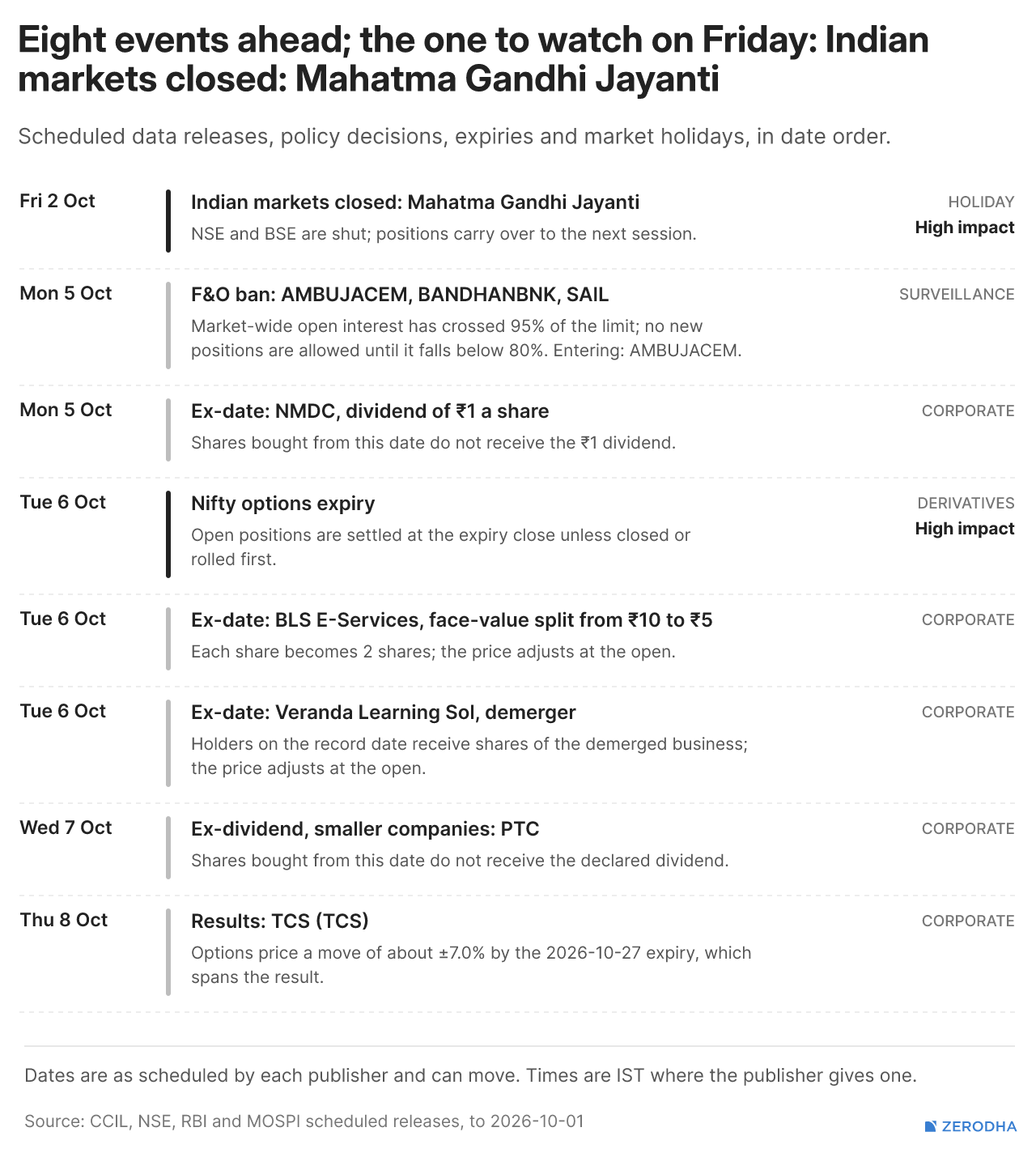
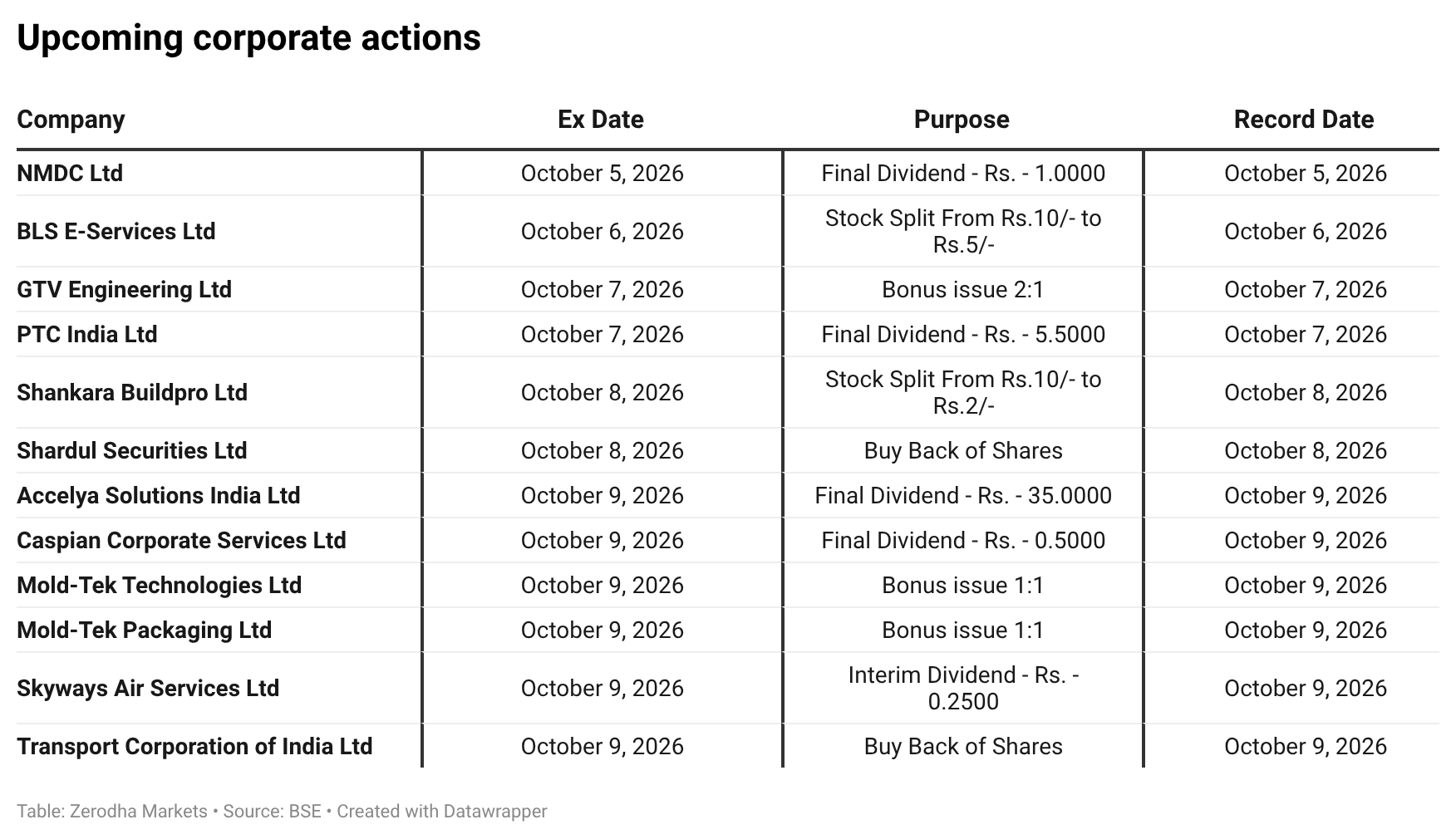
The week ahead & Corporate Actions
Corporate Actions
Published by Zerodha. Not investment advice. Data from NSE, BSE, and MCX.
In our latest episode of In The Money by Zerodha, we start with how covered calls are pitched to investors, as a way to earn "free money" on stocks you already own, and why even Fischer Black, co-creator of the Black-Scholes formula, was skeptical of the idea.
We then look at the history of the strategy, how it was sold by brokers over the decades, and what a behavioral study on Dutch investors revealed about why people find it attractive in theory but less so when they actually see the payoff.
The episode breaks down the mechanics of a covered call with real numbers, what happens when the stock falls, stays flat, or rallies, and why the strategy has a capped upside but nearly full downside.
Finally, we run a backtest on 10 of the most liquid large-cap Indian stocks from January 2022 onward, selling a 5% out-of-the-money call every month, and compare the results stock by stock to see whether covered calls actually add value to a buy-and-hold portfolio in India.
That’s it from us for today. We’d love to hear your feedback in the comments, and feel free to share this with your friends to spread the word!
On the new format: the positioning line is the most useful part. FIIs at 8% long in index futures against 84% for retail and HNIs is a lopsided book, and as a single day's number it is hard to read. A rolling series of that gap would show how often it preceded a washout versus a squeeze. A breadth-versus-index-return panel would also help, since IT rose 2.17% while only two of 15 sectors gained.