

Welcome to Aftermarket Report, a newsletter where we do a quick daily wrap-up of what happened in the markets, both in India and globally.
In our latest episode of In The Money by Zerodha, we’re discussing a formula that has influenced everyone from professional gamblers to hedge fund managers and some of the greatest investors of all time — the Kelly Criterion.
If you have a strategy with an edge, how much should you bet on it? Most traders spend years trying to improve their entries and exits but spend very little time thinking about position sizing. Yet, the amount you allocate to a trade can have a bigger impact on long-term outcomes than the trade itself.
In this episode, we explore what the Kelly Criterion is, how it works, and why it remains one of the most debated ideas in finance. We’ll look at its fascinating origins, understand where it helps, where it falls short, and discuss how traders and investors can apply its principles in the real world without taking unnecessary risks.
Markets Today
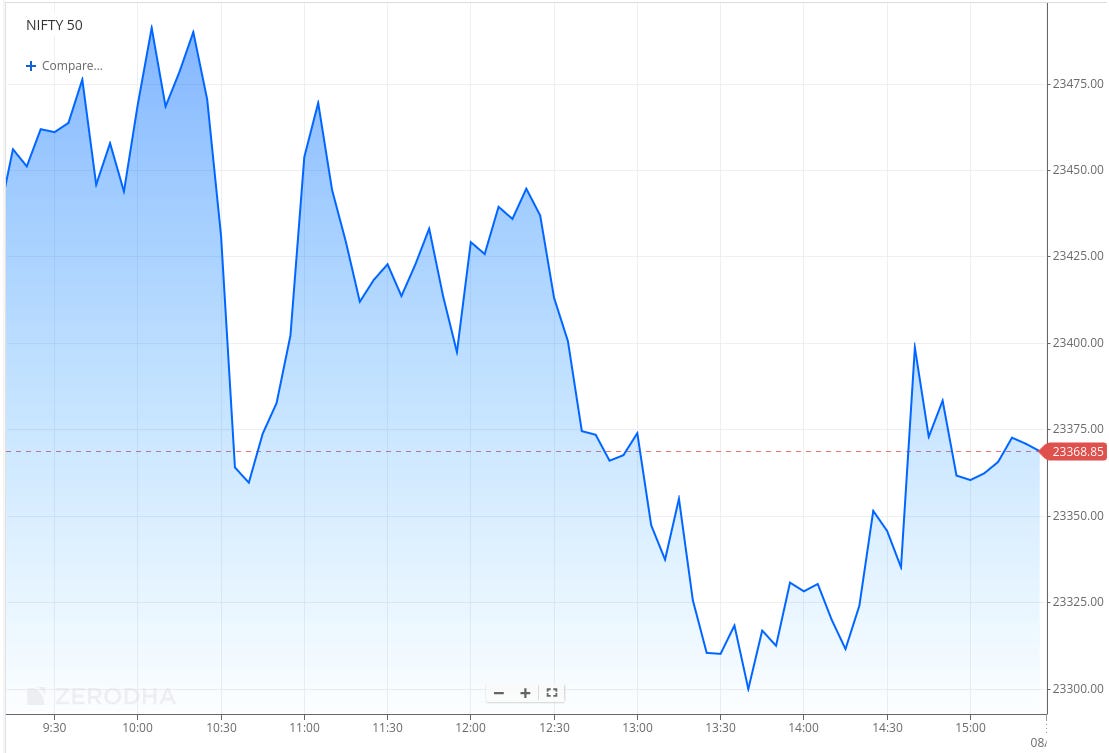
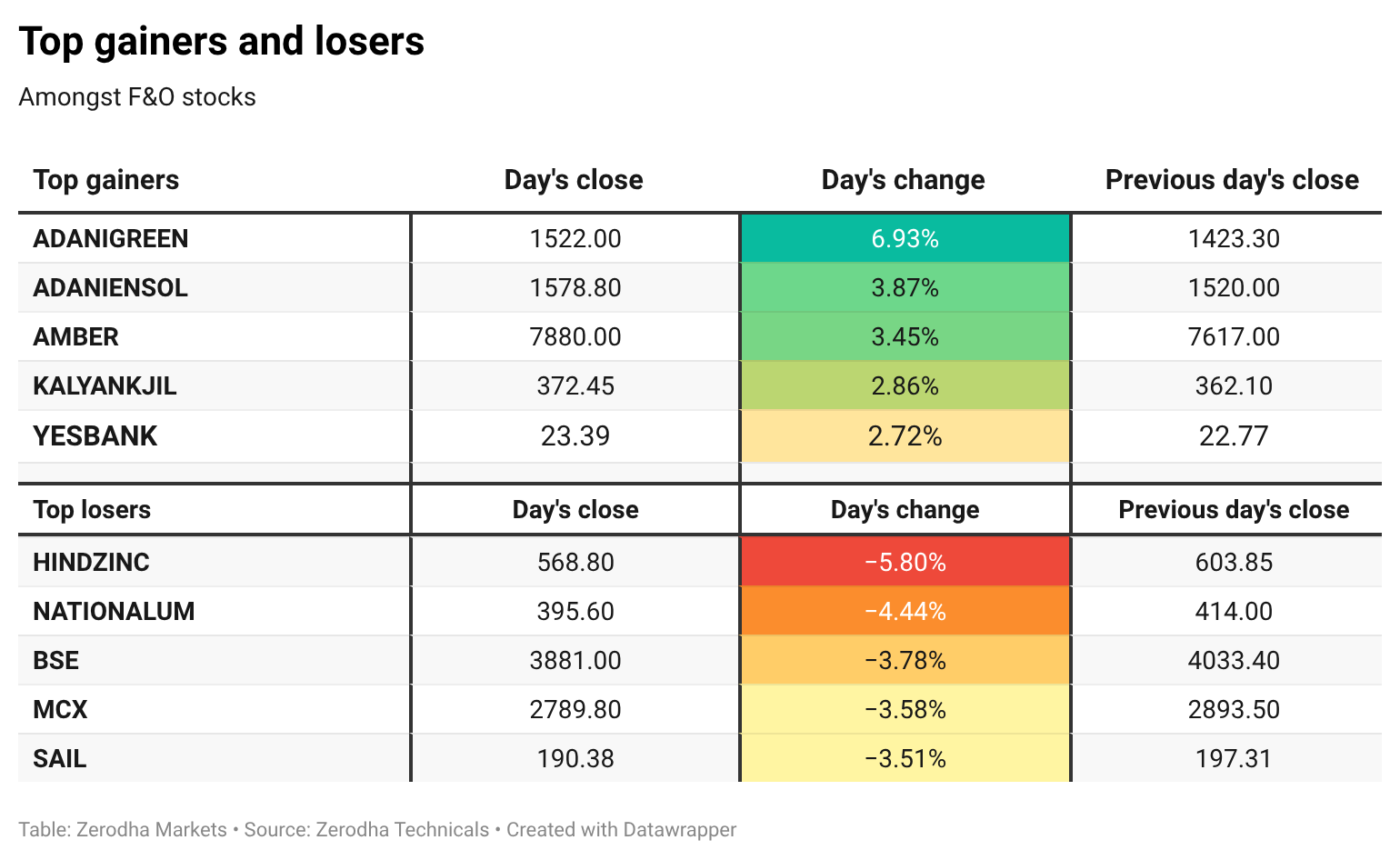
Nifty opened with a gap up of 63 points at 23,479 ahead of the RBI policy announcement. The index saw a choppy start, trading between the 23,450–23,470 range in the first hour as traders positioned ahead of the policy outcome.
However, the initial optimism faded quickly after the policy announcement as Nifty gave up most of its gains and turned volatile, slipping toward the 23,350–23,380 range through the late morning session. A brief recovery around 11 AM pushed the index back above 23,470, but the move failed to sustain.
In the second half, selling pressure intensified, dragging Nifty steadily lower. The index slipped below the 23,350 mark after 1 PM and continued to weaken, hitting the day’s low near the 23,280 zone around 1:45 PM.
A recovery attempt emerged later in the session, helping Nifty rebound toward the 23,380–23,400 range. However, the bounce lacked follow-through, and the index spent most of the final hour in a narrow range before eventually closing at 23,366.70.
The session was marked by sharp swings around the RBI policy, an opening rally that quickly faded, and persistent second-half weakness, leaving Nifty marginally lower despite the positive start.
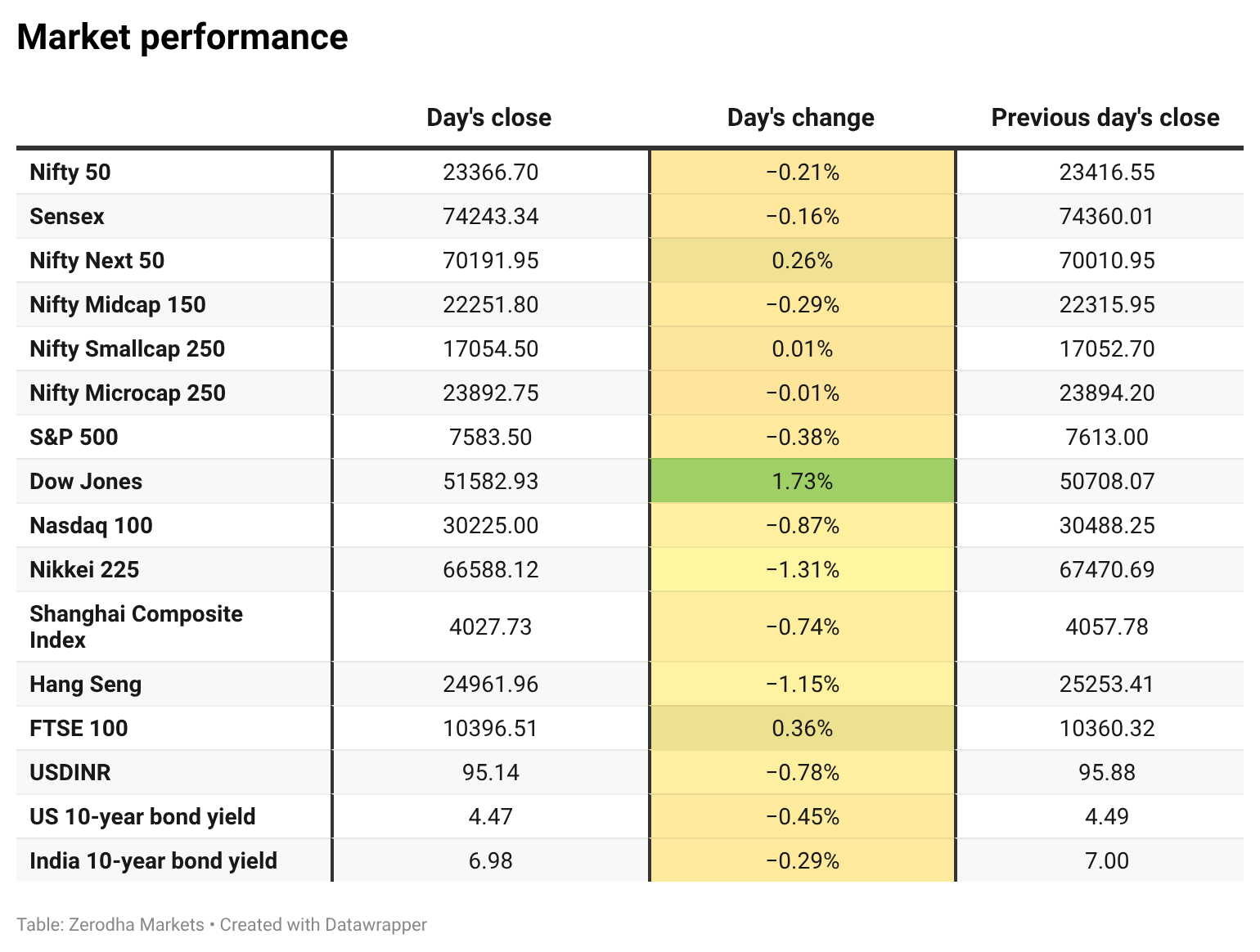
Sectoral Indices Performance
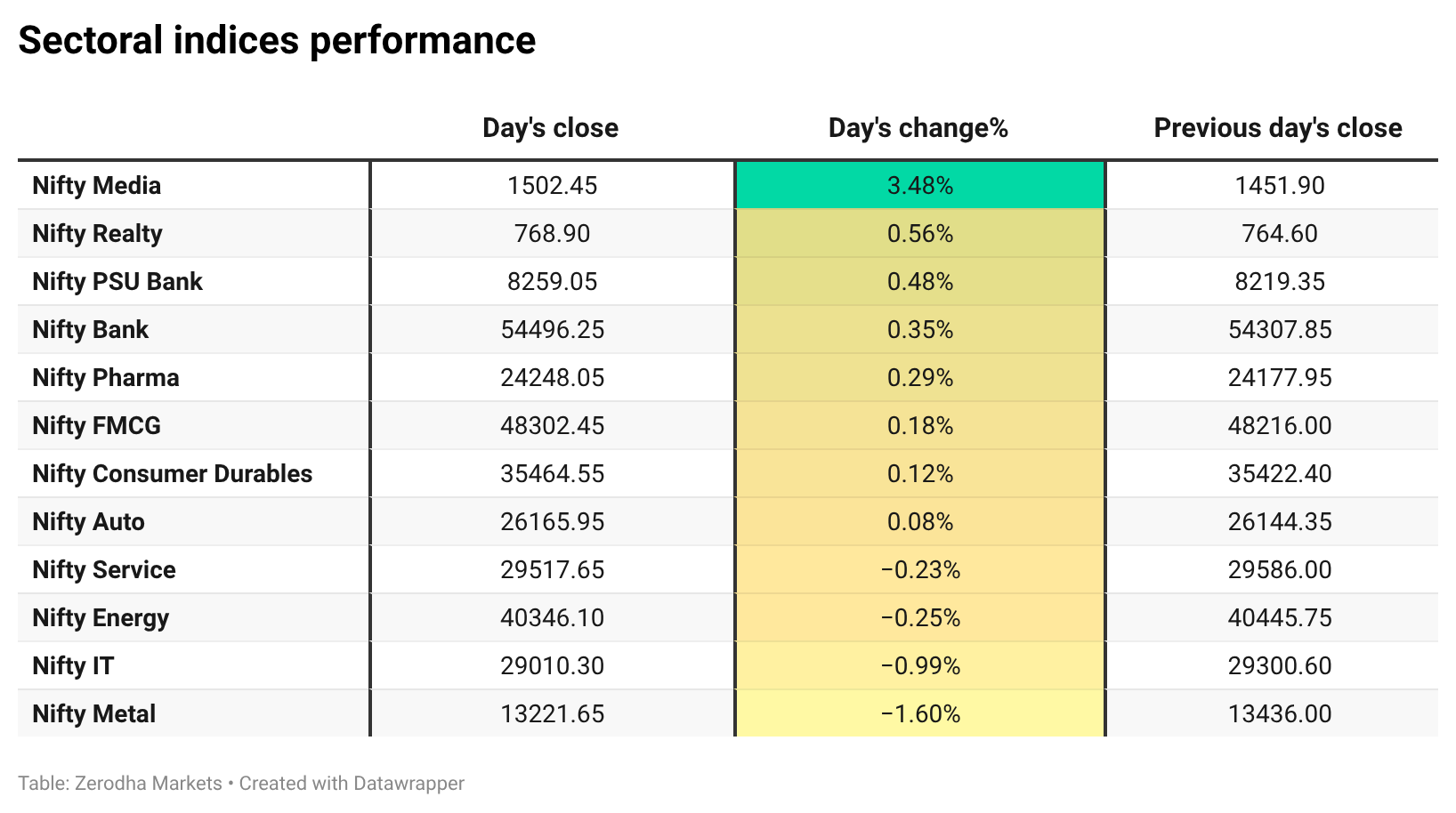
Winners & Losers
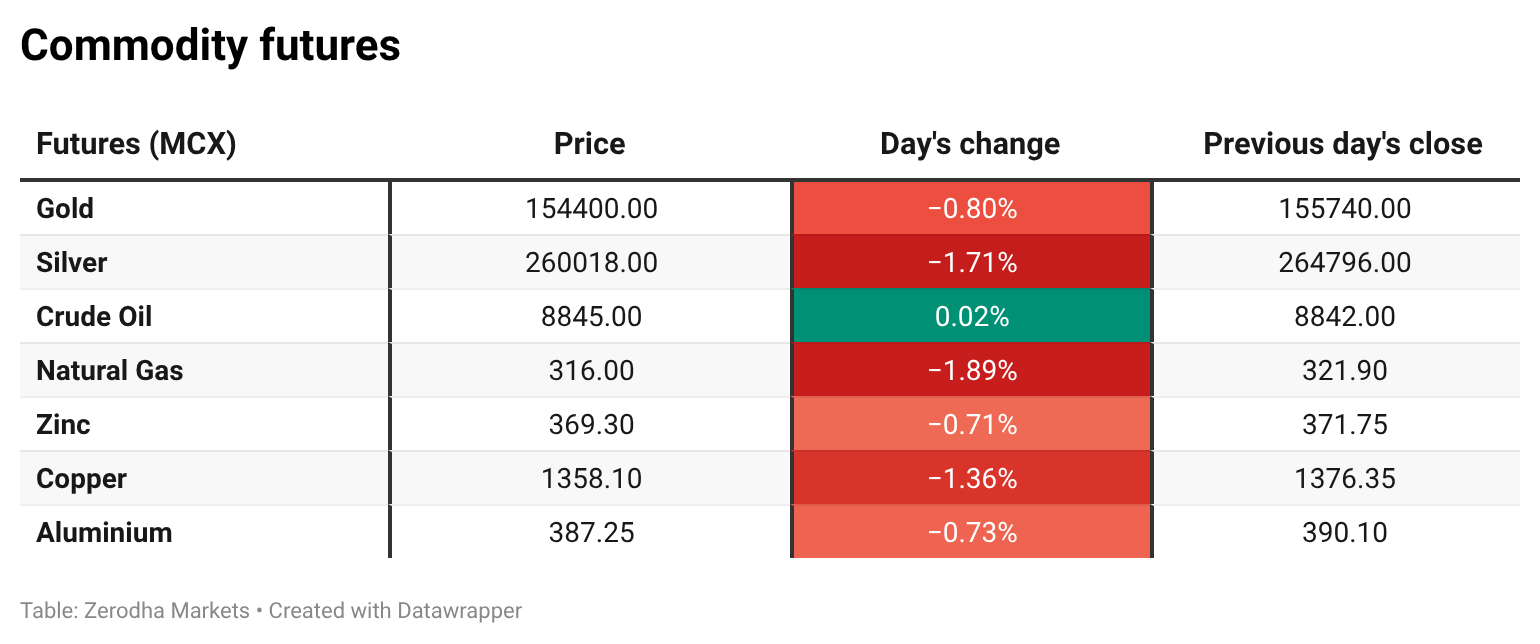
Commodities
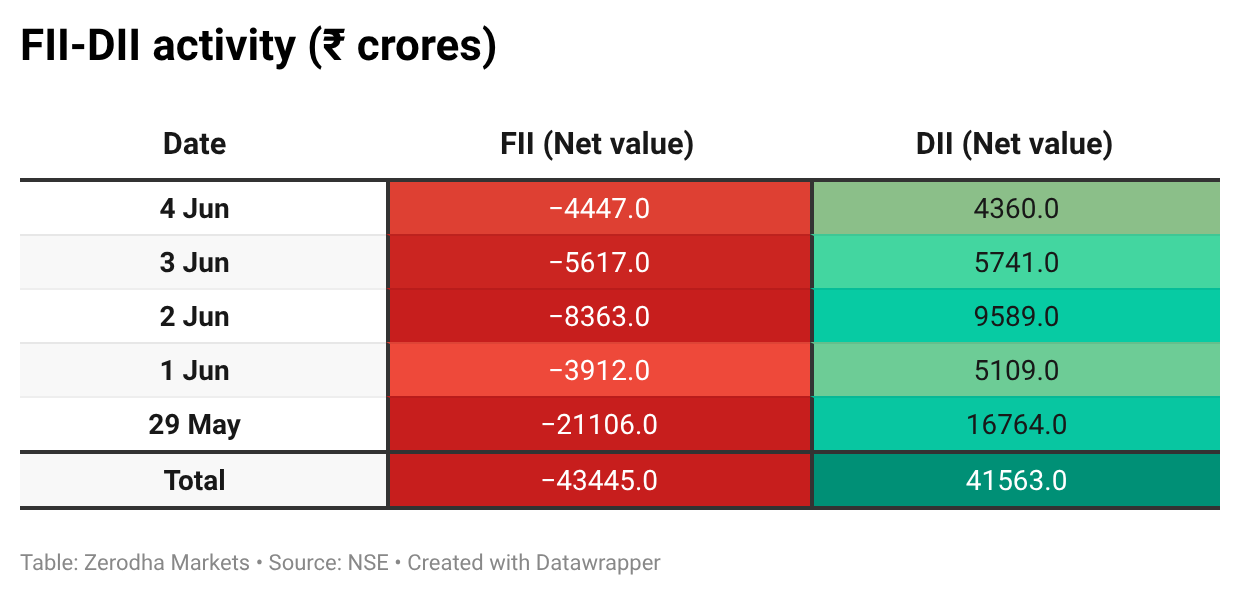
FII / DII Flows
Here’s the trend of FII-DII activity from the last 5 days:
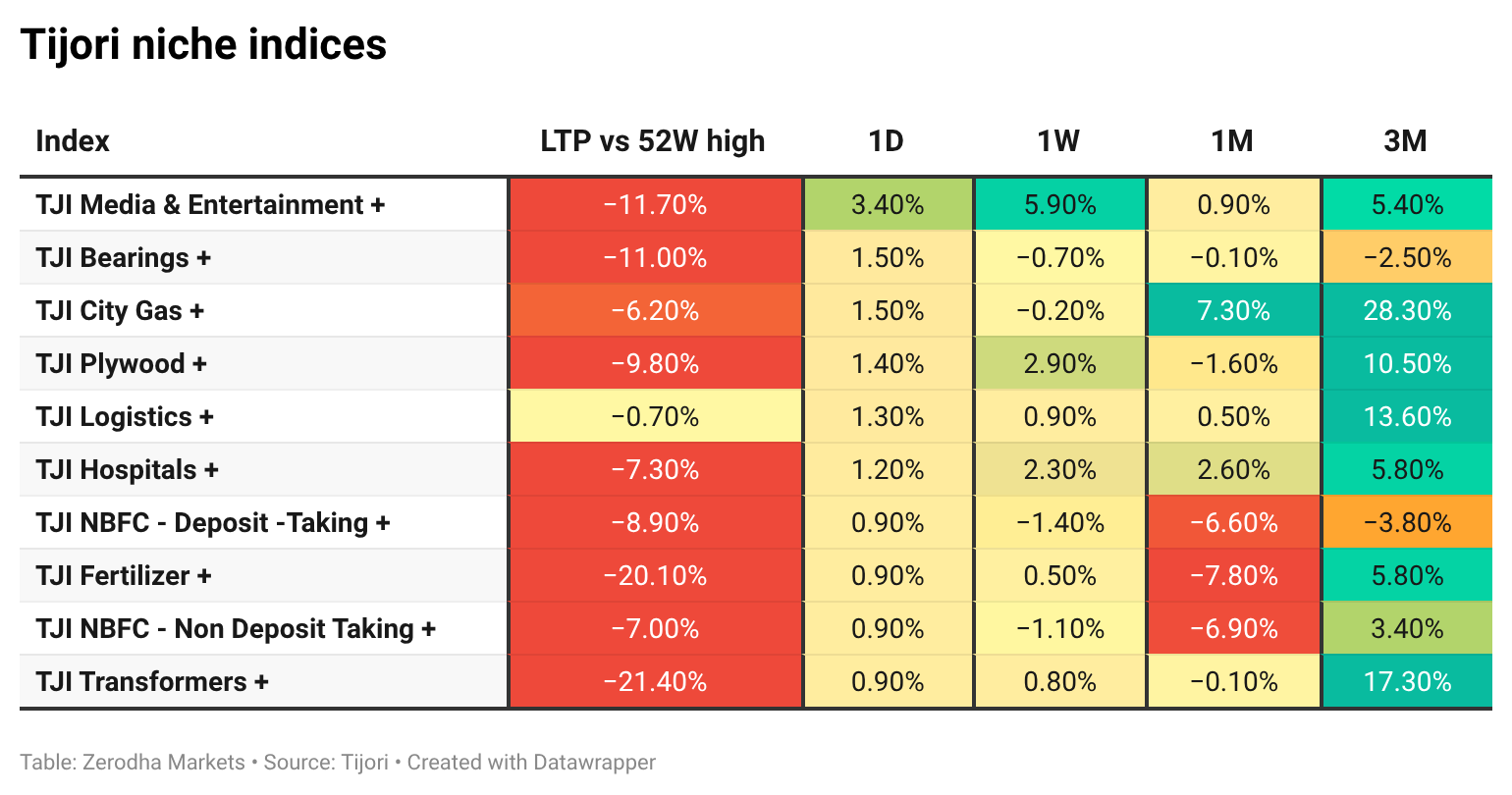
Thematic Indices
Tijori’s niche indices, where today’s move sorts pockets of the market beyond standard sector baskets. You can also track promoter buying and other interesting stuff, like Capex activity by the companies in the Tijori App’s idea dashboard
Change in OI for the day
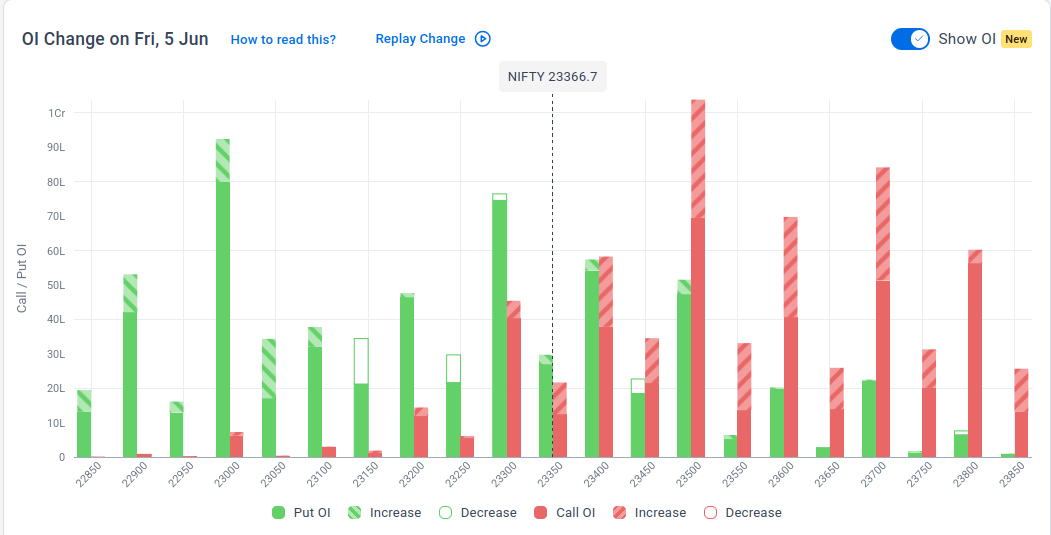
The following is the change in OI for Nifty contracts expiring on 9th June:
The maximum Call Open Interest (OI) is observed at 23,500, followed by 23,700, indicating potential resistance at the 23,600 -23,700 levels.
The maximum Put Open Interest (OI) is observed at 23,000, followed by 23,300, suggesting support at 23,200-23,100.
Note: OI is subject to multiple interpretations; however, generally, an increase in Call OI indicates resistance in a falling market, while an increase in Put OI indicates support in a rising market.
Source: Sensibull
Top Stories in India
The RBI kept the repo rate unchanged at 5.25%, citing rising inflation risks and potential downside risks to growth amid the West Asia conflict. RBI Governor Sanjay Malhotra said higher fuel and commodity prices, supply chain disruptions, financial market volatility, weather-related uncertainties, and a weaker rupee have increased risks to both inflation and economic growth, while the policy stance remains neutral. Dive deeper
The RBI unveiled a package of measures to attract foreign capital, including expanding unrestricted foreign access to long-term government bonds under the FAR route and easing investment norms for NRIs and overseas investors.
It also extended support for overseas fundraising through concessional forex swap facilities for PSU borrowings and continued hedging-cost support for FCNR(B) deposits until September 2026. Additionally, the central bank restored the export proceeds repatriation timeline to the normal 9 months from the temporary 15-month window. Dive deeper
The Indian rupee surged 81 paise to close at 94.93 against the US dollar, marking its strongest single-day gain in weeks. The rally was driven by the RBI’s measures to attract foreign capital, improve forex liquidity, and boost investor confidence in Indian financial markets. Dive deeper
The government has issued an ordinance exempting Foreign Institutional Investors (FIIs) from income tax on interest income and capital gains earned from government securities, effective April 1, 2026. The move removes the existing 12.5% long-term capital gains tax and 20% withholding tax on interest from G-Secs, aiming to attract greater foreign investment into India’s sovereign bond market. Dive deeper
India’s economy grew 7.7% in FY26, accelerating from 7.1% in FY25, according to data released by the Ministry of Statistics and Programme Implementation. GDP growth for the January–March quarter was estimated at 7.8%, while nominal GDP rose 8.9% to ₹346.36 lakh crore during the fiscal year. Dive deeper
AirTrunk plans to invest around ₹3 lakh crore ($30 billion) in India to build 5 GW of data centre capacity, one of the largest commitments in the country’s digital infrastructure sector. Narendra Modi said the investment will strengthen India’s position as a global hub for cloud computing and AI while creating jobs and supporting domestic supply chains. Dive deeper
Capital market-related stocks came under pressure after Sanjay Malhotra reiterated that the RBI will implement its proposed lending norms for proprietary trading from July 1, with no further extension. The rules require 100% collateral backing for loans linked to proprietary trading activities, raising concerns about funding availability and trading volumes in the capital markets ecosystem. Dive deeper
India’s gold ETFs recorded a net outflow of $61 million in May, the first monthly outflow in a year, according to the World Gold Council. The reversal was driven by profit-booking after higher import duties pushed domestic gold prices higher, compared with net inflows of $297.2 million in April. Dive deeper
Top Stories Globally
WTI crude futures held near $93 per barrel on Friday after a 3.1% decline in the previous session, as markets balanced optimism over progress in US-Iran negotiations against lingering uncertainty surrounding a ceasefire between Israel and Lebanon. Dive deeper
Global equity funds recorded net inflows of $21.44 billion in the week ended June 3, the highest level in three weeks, as strong technology-sector earnings and continued enthusiasm around the AI theme boosted investor appetite for equities. The inflows marked the largest weekly allocation to global equity funds since mid-May. Dive deeper
Asian markets declined as investors booked profits in technology and AI-related stocks, triggering a sell-off in semiconductor shares. Japan and Hong Kong fell over 1%, while South Korea’s KOSPI slumped more than 5.5%, also weighed down by expectations of a potential Bank of Japan rate hike. Dive deeper
The Eurozone economy contracted 0.2% in Q1 2026, marking its first decline since Q4 2022 and the sharpest drop since mid-2020, according to final data from Eurostat. The contraction was driven by a steep 12.1% decline in Ireland’s GDP and a slight contraction in France, while Spain, Germany, Italy, and the Netherlands continued to post modest growth. Dive deeper
Management Chatter
In this section, we highlight interesting comments from the management of major companies and policymakers in the Indian and Global Economies.
RBI Governor Sanjay Malhotra on the possible impact of deficiency in rainfall:
“Rural demand, yes; private consumption, yes. Some impact will be there,"
"Additionally, the projected deficiency in the south-west monsoon will have implications for agricultural production and rural demand. However, programmes and initiatives for crop diversification, water harvesting and conservation, climate-resilient practices and short-duration crops, among others, are expected to mitigate the impact," - Link
Chief Economic Advisor Anantha Nageswaran on Inflation & growth in FY27:
"Whether oil prices continue to stay below $100 will also determine the course of inflation."
If economic growth were to slip below the 7% mark due to external factors, government policies and reforms would help steer the economy back to a 7% growth trajectory in FY28 or once conditions normalize. - Link
Corporate Actions & Events
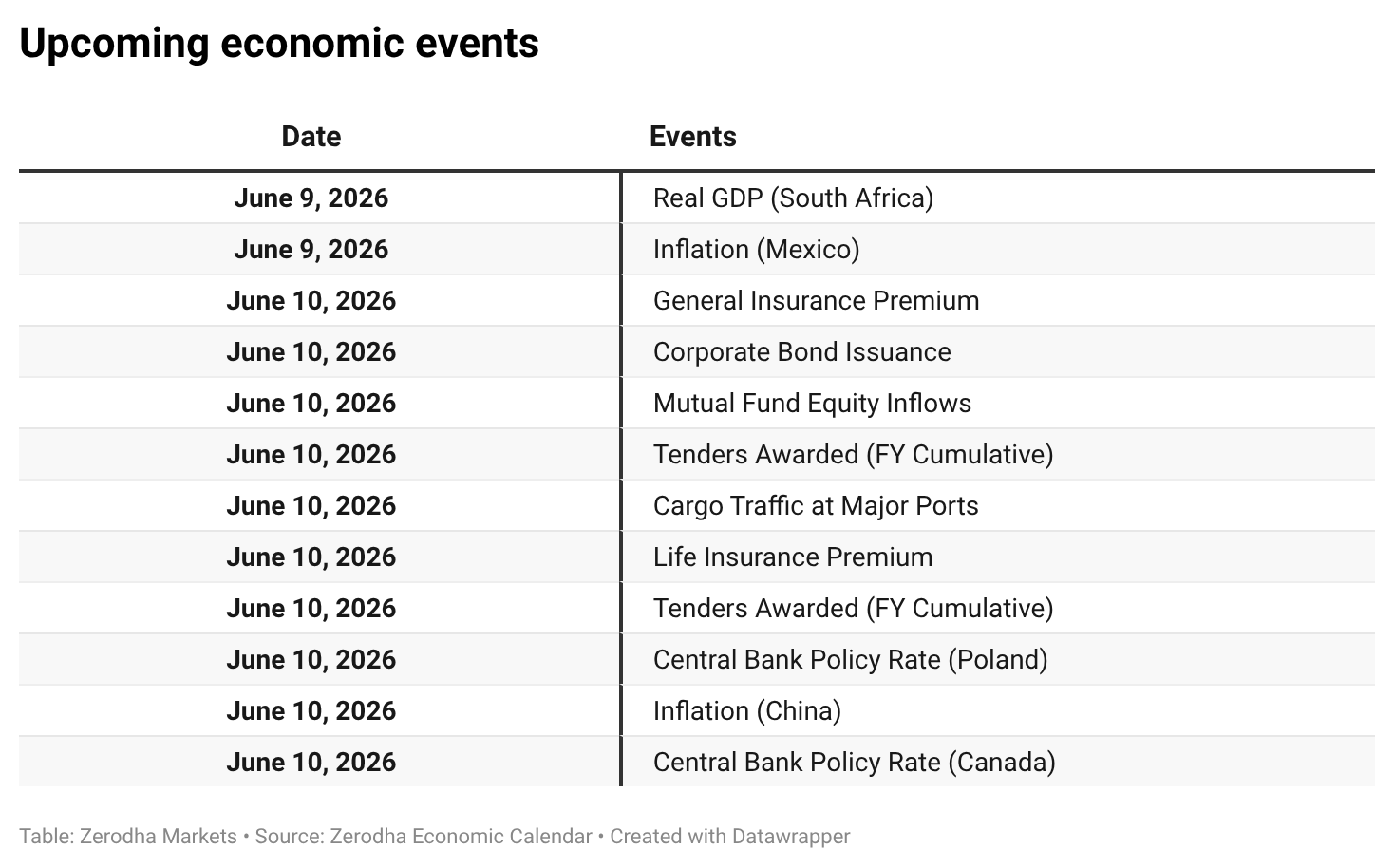
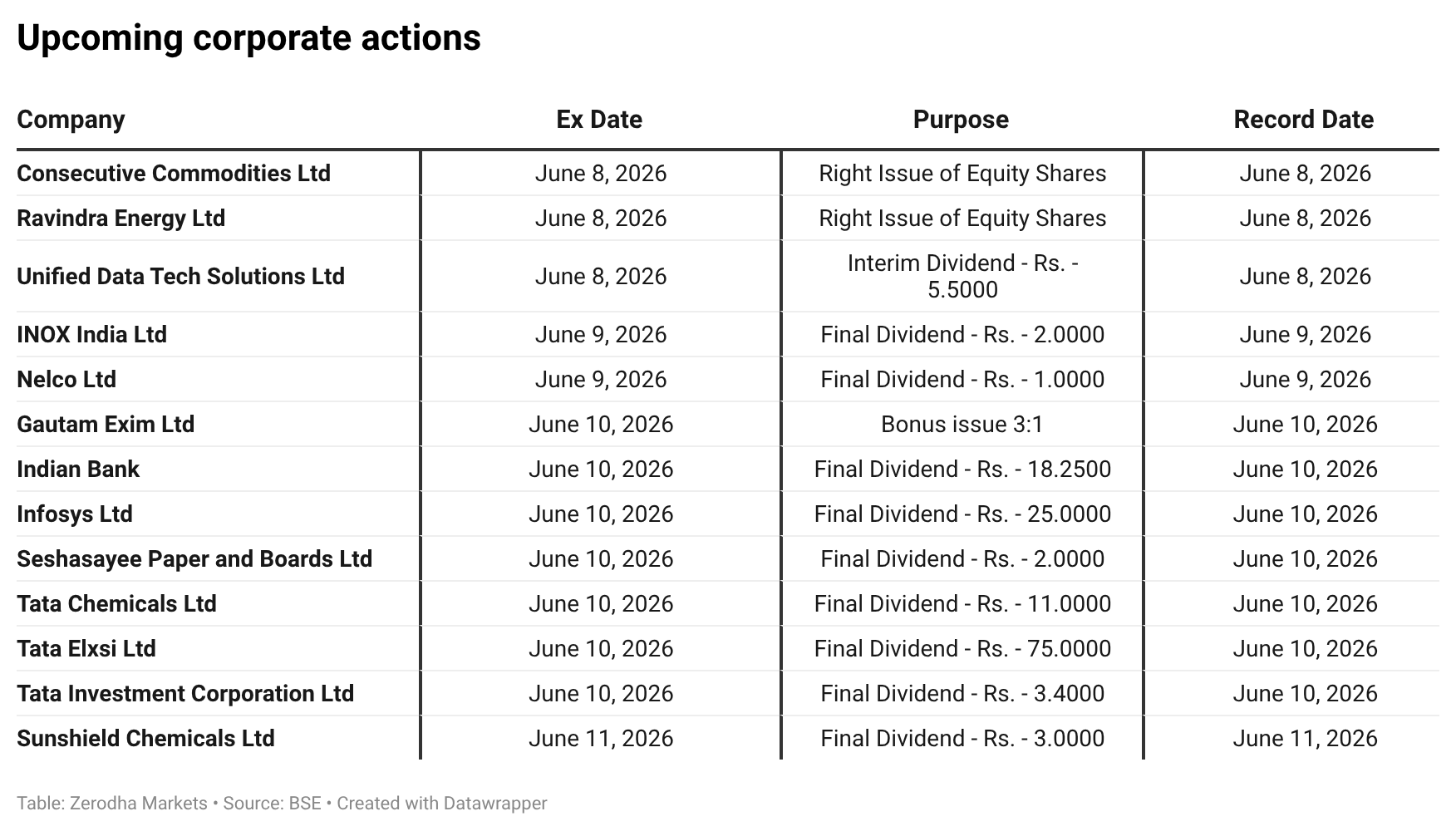
Corporate Actions
Published by Zerodha. Not investment advice. Data from NSE, BSE, and MCX.
That’s it from us for today. We’d love to hear your feedback in the comments, and feel free to share this with your friends to spread the word!